




No CrossRef data available.
Article contents
- Abstract
- Introduction
- Methodology
- Information currently available in Australia
- Reasons for the lack of data
- Why the need for Australian data?
- Changing the Australian approach to corporal punishment
- How can these data be gathered in Australia to create a meaningful understanding of corporal punishment prevalence, impact and social acceptance?
- Recommendations
- Conclusion
- Footnotes
- References
Corporal punishment of children in the home in Australia: a review of the research reveals the need for data and knowledge
Published online by Cambridge University Press: 17 June 2019
Article contents
- Abstract
- Introduction
- Methodology
- Information currently available in Australia
- Reasons for the lack of data
- Why the need for Australian data?
- Changing the Australian approach to corporal punishment
- How can these data be gathered in Australia to create a meaningful understanding of corporal punishment prevalence, impact and social acceptance?
- Recommendations
- Conclusion
- Footnotes
- References
Abstract
A growing body of literature indicates that corporal punishment (CP) has the potential to adversely affect the mental and physical wellbeing of children in childhood as well as into adulthood. Corporal punishment of children in the home is legal in all states and territories in Australia, but not much is known about this type of family violence in the Australian context. This article presents a review of the literature currently available on the prevalence of CP of children in the home in Australia, covering online surveys, academic research, government data and grey literature. The role of online surveys is examined, and the lack of data available from government studies concerned with the wellbeing of children is also explored. There is found to be an overall lack of consistent data available on CP of children in the home in Australia, and this article calls on researchers and policymakers to further research and act on this aspect of family violence.
Information
- Type
- Practice Commentaries
- Information
- Copyright
- © The Author(s) 2019
Footnotes
* Studies measure CP but do not provide empirical data in publication.
References
Afifi, T. O., Fortier, J., Sareen, J., & Taillieu, T. (2019). Associations of harsh physical punishment and child maltreatment in childhood with antisocial behaviours in adulthood. Retrieved from https://jamanetwork.com/journals/jamanetworkopen/fullarticle/2722572Google Scholar
Afifi, T. O., Ford, D., Gershoff, E. T., Merrick, M., Grogan-Kaylor, A., Ports, K. A., … Bennett, R. P. (2017). Spanking and adult mental health impairment: The case for the designation of spanking as an adverse childhood experience. Child Abuse and Neglect, 71, 24–31.CrossRefGoogle ScholarPubMed
Agrawal, A., Madden, P. A. F., Heath, A. C., Lynskey, M. T., Bucholz, K. K., & Martin, N. G. (2005). Correlates of regular cigarette smoking in a population-based sample of Australian twins. Addiction, 100, 1709–1719.CrossRefGoogle Scholar
Aharony, N. (2012). WikiLeaks comments: A study of responses to articles. Online Information Review, 36(6), 828–845. Retrieved from http://www.emeraldinsight.com/doi/abs/10.1108/14684521211287927?journalCode=oirCrossRefGoogle Scholar
AIFS (Australian Institute of Family Studies) (2016a). Child deaths from abuse and neglect. Retrieved from https://aifs.gov.au/cfca/publications/child-deaths-abuse-and-neglectGoogle Scholar
AIFS (Australian Institute of Family Studies) (2016b). Child protection and Aboriginal and Torres Strait Islander children. Retrieved from https://aifs.gov.au/cfca/publications/child-protection-and-aborigfinal-and-torres-strait-islander-childrenGoogle Scholar
AIFS (Australian Institute of Family Studies) (2017a) Corporal punishment: Key issues. Retrieved from https://aifs.gov.au/cfca/publications/corporal-punishment-key-issuesGoogle Scholar
AIFS (Australian Institute of Family Studies) (2017b). The Australian Temperament Project. Retrieved from http://www3.aifs.gov.au/atp/pubs/index.htmlGoogle Scholar
AIFS (Australian Institute of Family Studies) (2017 c). Growing up in Australia: The longitudinal study of Australian children. Retrieved from http://growingupinaustralia.gov.auGoogle Scholar
AIHW (Australian Institute of Health and Welfare) (2019). Child protection Australia 2017-18. Retrieved from https://www.aihw.gov.au/getmedia/e551a2bc-9149-4625-83c0-7bf1523c3793/aihw-cws-65.pdf.aspx?inline=trueGoogle Scholar
Alati, R., Maloney, E., Hutchinson, D. M., Najman, J. M., Mattick, R. P., Bor, W., & Williams, G. M. (2010). Do maternal parenting practices predict problematic behaviour of adolescent alcohol consumption? Addiction, 105, 872–880.CrossRefGoogle ScholarPubMed
Ateah, C. A., & Durrant, J. E. (2005). Maternal use of physical punishment in response to child misbehaviour: Implications for child abuse prevention, Child Abuse and Neglect, 29(2), 169–185.CrossRefGoogle Scholar
Australian Human Rights Commission (2016). Children’s rights report 2016, National Children’s Commissioner, 1st ed. Retrieved from https://www.humanrights.gov.au/sites/default/files/document/publication/AHRC_CRR_2016.pdfGoogle Scholar
Batty, R. (2018). Quit: A model for reducing family violence. The Guardian. Retrieved from https://theguardian.com/commenisfree/2018/aug/28/quit-a-model-for-reducing-family-violenceGoogle Scholar
Breen, A., Daniels, K., & Tomlinson, M. (2015). Children’s experiences of corporal punishment: A qualitative study in an urban township of South Africa. Child Abuse and Neglect, 48, 131–139.CrossRefGoogle Scholar
Briggs, F., & Watson, C. (2011). Parents give up on discipline as smacking declared unacceptable. Courier Mail. Retrieved from http://www.couriermail.com.au/news/national/parents-give-up-on-discipline/news-story/e9311e289f9322819e7d0b9f88d1da05Google Scholar
Broadley, K., Goddard, C., & Tucci, J. (2014). They count for nothing: Poor child protection statistics are a barrier to a child-centred national framework. Melbourne: Australian Childhood Foundation & Child Abuse Prevention Research Australia, Monash University.Google Scholar
Byrne, M., Badcock, P. B., Simmons, J. G., Whittle, S., Pettit, A., Olsson, C. A., … Allen, N. B. (2017). Self-reported parenting style is associated with children’s inflammation and immune activation. Journal of Family Psychology, 31(3), 374–380.CrossRefGoogle ScholarPubMed
Camerini, A.-L., & Schulz, P. J. (2017). Social desirability bias in child-report social well-being: Evaluation of the Children’s Social Desirability Short Scale using Item Response Theory and examination of its impact on self-report family and peer relationships. Child Indicators Research, 11(4), 1159–1174.CrossRefGoogle Scholar
Campo, M., Kaspiew, R., Moore, S., & Tayton, S. (2014). Children affected by domestic and family violence, 1st ed, NSW Family and Community Services. Melbourne: Australian Institute of Family Studies. Retrieved from http://www.women.nsw.gov.au/__data/assets/file/0014/300623/PDF-6_Final_Report_Children_affected.pdfGoogle Scholar
Cavanagh, K., Dobash, R. E., & Dobash, R.P. (2007). The murder of children by fathers in the context of child abuse. Child Abuse and Neglect, 31(7), 731–746.CrossRefGoogle ScholarPubMed
Chan, A., & Payne, J. (2013). Homicide in Australia: 2008–09 to 2009–10 National Homicide Monitoring Program annual report, monitoring report no. 21. 1st ed. Canberra: Australian Institute of Criminology. Retrieved from http://www.aic.gov.au/media_library/publications/mr/mr21/mr21.pdfGoogle Scholar
COAG (Coalition of Australian Governments) (2009). National framework for protecting Australia’s children 2009-2020. Retrieved from https://www.dss.gov.au/our-responsibilities/families-and-children/publications-articles/protecting-children-is-everyones-businessGoogle Scholar
Critchley, C. R., & Sanson, A. V. (2006). Is parent disciplinary behaviour enduring or situational? A multi-level investigation of individual and contextual influences on power assertive and inductive reasoning behaviours’. Journal of Applied Developmental Psychology, 27, 370–388.CrossRefGoogle Scholar
Cuskelly, M., Morris, M., Gilmore, L., & Besley, T. (2015). Parents’ reported use and views of strategies for managing the behaviour of their preschool child. Australian Journal of Early Childhood, 40(2), 99–106.CrossRefGoogle Scholar
Dearden, J., & Jones, W. (2008). Homicide in Australia: 2006-07. National Homicide Monitoring Program annual report, 1st ed. Canberra: Australian Institute of Criminology. Retrieved from http://www.aic.gov.au/media_library/publications/mr/mr01/mr01.pdfGoogle Scholar
Deater-Deckard, K., Lansford, J. E., Dodge, K. A., Pettit, G. S., & Bates, J. E. (2003). The development of attitudes about physical punishment: An 8-year longitudinal study. Journal of Family Psychology, 17, 351–360.CrossRefGoogle ScholarPubMed
Department of Social Services (2009). The cost of violence against women and their children, 1st ed. Retrieved from https://www.dss.gov.au/sites/default/files/documents/05_2012/vawc_economic_report.pdfGoogle Scholar
Dietz, T. (2000). Disciplining children: Characteristics associated with the use of corporal punishment. Child Abuse and Neglect, 24(12), 1529–1542.CrossRefGoogle ScholarPubMed
Dittman, C. K., Henriquez, A., & Roxburgh, N. (2016). When a non-resident worker is a non-resident parent: Investigating the family impact of fly-in, fly-out work practices in Australia. Journal of Child and Family Studies, 25, 2778–2796.CrossRefGoogle Scholar
Dittman, C., Keown, L. J., Rose, D., Farruggia, S. P., Sanders, M., & Sofronoff, K. (2011). An epidemiological examination of parenting and family correlates of emotional problems in young children. American Journal of Orthopsychiatry, 81(3), 360–371.CrossRefGoogle ScholarPubMed
Dodd, C. (2011). Ending CP of children: A handbook for working with and within religious communities, 1st ed, Nottingham: Russell Press Ltd. Retrieved from http://www.endcorporalpunishment.org/assets/pdfs/reports-thematic/FaithHandbook%202011.pdfGoogle Scholar
Douglas, E. M., & Straus, M. A. (2006). Assault and injury of dating partners by university students in 19 countries and its relation to corporal punishment experienced as a child. European Journal of Criminology, 3(3), 293–318.CrossRefGoogle Scholar
Durrant, J. (2000). Legal reform and attitudes toward physical punishment in Sweden. The International Journal of Children’s Rights, 11, 147–173.CrossRefGoogle Scholar
Durrant, J., & Ensom, R. (2017). Twenty-five years of physical punishment research: What have we learned? Journal of Korean Academic Child and Adolescent Psychiatry, 28(1), 20–24.CrossRefGoogle Scholar
Edwards, M. (2004). Social science research and public policy: Narrowing the divide. Policy paper 2. 1st ed. Canberra: Academy of social sciences in Australia. Retrieved from http://www.assa.edu.au/wp-content/uploads/2013/11/2004_No2_Social_science_research.pdfGoogle Scholar
Elgar, F. J., Waschbusch, D. A., Dadds, M. R., & Sigvaldason, N. (2007). Development and validation of a short form of the Alabama Parenting Questionnaire. Journal of Child and Family Studies, 16, 243–259.CrossRefGoogle Scholar
Family Court of Australia (2016). What is Family Violence? Retrieved from http://www.familycourt.gov.au/wps/wcm/connect/fcoaweb/family-law-matters/family-violence/what-is-family-violence/Google Scholar
Fewster, S. (2016). Smacking a child does not transform a parent into a criminal, SA Supreme Court rules. The Advertiser. Retrieved from http://www.adelaidenow.com.au/news/south-australia/smacking-a-child-does-not-transform-a-parent-into-a-criminal-sa-supreme-court-rules/news-story/4189d20bb1760f05bb9189a55bfd6b63Google Scholar
Fuller, G., & Tomison, A. (2015). Violence in Australia: Some policy directions and challenges. In Day, A. & Fernandez, E. (Eds.), Preventing violence in Australia: Policy, practice and solutions (1st ed, pp. 216–235). Annandale: The Federation Press.Google Scholar
Gershoff, E. T. (2016). Should parents’ physical punishment of children be considered a source of toxic stress that affects brain development? Family relations, 65, 151–162.CrossRefGoogle Scholar
Gershoff, E. T., & Grogan-Kaylor, A. (2016). Spanking and child outcomes: Old controversies and new meta-analyses. Journal of Family Psychology, 30(4), 453–469.CrossRefGoogle ScholarPubMed
Gibson, R., Wilson, S., Meagher, G., Denemark, D., & Western, M. (2005). Bringing together social research and public policy. In Wilson, S., Meagher, G., Gibson, R., Denemark, D. & Western, M. (Eds.), Australian social attitudes: The first report (1st ed., pp. 1–13). Sydney: UNSW Press.Google Scholar
Giles-Sims, J., Straus, M. A., & Sugarman, D. B. (1995). Child, maternal, and family characteristics associated with spanking. Family Relations, 44(2), 170–176.CrossRefGoogle Scholar
Global Initiative to End All Corporal Punishment of Children (2019). Retrieved from http://www.endcorporalpunishment.org/Google Scholar
Godfrey, A. (2011). Hands raised, we’re smack addicts: Australian parents open about smacking kids. The Daily Telegraph. Retrieved from http://www.news.com.au/national/australian-parents-do-smack-their-children/news-story/4c2560e2e4ae10f072a7ce0d1fa6db0cGoogle Scholar
Grogan-Kaylor, A. (2005). Corporal punishment and the growth trajectory of children’s antisocial behaviour. Child Maltreatment, 10(3), 283–292.CrossRefGoogle Scholar
Grogan-Kaylor, A., & Otis, M. (2007). The predictors of parental use of corporal punishment. Family Relations, 56(1), 80–91.CrossRefGoogle Scholar
Hemphill, S. A., Smith, R., Toumbourou, J. W., Herrenkohl, T. I., Catalano, R. F., McMorris, B. J., & Romaniuk, H. (2009). Modifiable determinants of youth violence in Australia and the United States: A longitudinal study. The Australian and New Zealand Journal of Criminology, 42(3), 289–309.CrossRefGoogle ScholarPubMed
Herrenkohl, T. I., Kosterman, R., Mason, W. A., & Hawkins, J. D. (2007). Youth violence trajectories and proximal characteristics of intimate partner violence. Violence and Victims 22(3), 259–274.CrossRefGoogle ScholarPubMed
Holden, G.W., Williamson, P. A., & Holland, G. W. O. (2014). Eavesdropping on the family: A pilot investigation of corporal punishment in the home. Journal of Family Psychology, 28(3), 401–406.CrossRefGoogle ScholarPubMed
Holden, G. W., Brown, A. S., Baldwin, A. S., & Caderao, K. C. (2014). Research findings can change attitudes about corporal punishment. Child Abuse and Neglect, 38(5), 902–908.CrossRefGoogle ScholarPubMed
Homel, R. (2005). A short history of crime prevention in Australia. Canadian Journal of Criminology and Criminal Justice, 47(2), 355–368.CrossRefGoogle Scholar
Indemaur, D., & Roberts, L. (2005). Perceptions of crime and justice. In Wilson, S., Meagher, G., Gibson, R., Denemark, D. & Western, M. (Eds.), Australian social attitudes: The first report (1st ed.). Sydney: UNSW Press.Google Scholar
Kish, A. M., & Newcombe, P. A. (2015). Smacking never hurt me! Identifying myths surrounding the use of corporal punishment. Personality and Individual Differences, 87, 121–129.CrossRefGoogle Scholar
Kolar, V., & Soriano, G. (2000). Parenting in Australian families: A comparative study of Anglo, Torres Strait Islander and Vietnamese communities, Research report no 5. Australian Institute of Family Studies. Retrieved from https://aifs.gov.au/publications/parenting-australian-familiesGoogle Scholar
Kremer, M., Smith, A. B., & Lawrence, J. A. (2010). Family discipline incidents: An analysis of parental diaries. Journal of Family Studies, 16, 251–263.CrossRefGoogle Scholar
Lansford, J. E. (2014). Parents’ aggression toward children and children’s own aggression. In Selin, H. (Ed.), Parenting across cultures: Childrearing, motherhood and fatherhood in non-Western cultures, science across cultures: The history of non-Western science (7th ed., pp. 445–458). Dordrecht: Springer Science+Business Media.Google Scholar
Lynch, S. K., Turkmeier, E., D’Onofrio, B. M., Mendle, J., Emery, R. E., Slutske, W. S., & Martin, N. G. (2006). A genetically informed study of the association between harsh punishment and offspring behavioural problems. Journal of Family Psychology, 20(2), 190–198.CrossRefGoogle Scholar
Meier, M., Slutske, W. S., Heath, A. C., & Martin, N. G. (2009). The role of harsh discipline in explaining sex differences in conduct disorder: A study of opposite-sex twin pairs. Journal of Abnormal Child Psychology, 37, 653–664.CrossRefGoogle ScholarPubMed
Moore, S. E., Scott, J. G., Ferrari, A. J., Mills, R., Dunne, M. P., Erskine, H. E., … Norman, R. R. (2015). Burden attributable to child maltreatment in Australia. Child Abuse and Neglect, 48, 208–220.CrossRefGoogle ScholarPubMed
Mouzos, J., & Rushforth, C. (2003). Family homicide in Australia. Trends and issues in crime and criminal justice (no 255). Canberra: Australian Institute of Criminology.Google Scholar
Nelson, E. C., Lynskey, M. T., Heath, A. C., Madden, P. A. F., & Martin, N. G. (2010). A family study of adult twins with and without a history of childhood abuse: Stability of retrospective reports of maltreatment and associated family measures. Twin Research and Human Genetics, 13(2), 121–130.CrossRefGoogle ScholarPubMed
Nielssen, O. B., Large, M. M., Westmore, B. D., & Lackersteen, S. M. (2009). Child homicide in New South Wales from 1991--2005. Medical Journal of Australia, 190(1), 7–11.CrossRefGoogle Scholar
Noble, F. (2016) Daily Mail. Retrieved from https://www.dailymail.co.uk/news/article-3503280/Adelaide-father-pilot-smacked-son-agrravated-assault-conviction-overturned.htmlGoogle Scholar
Perry, B. D. (2001). The neurodevelopmental impact of violence in childhood. In Schetky, D. & Benedek, E. (Eds.), Textbook of child and adolescent forensic psychiatry (pp. 221–238). Washington, DC: American Psychiatric Press Inc.Google Scholar
Pilcher, G. (2009). Readers’ poll supports the right of parents to smack after mother is accused of assault after disciplining child with a wooden spoon. Retrieved from https://www.heraldsun.com.au/news/mother-accused-of-assault-after-disciplining-child-with-a-wooden-spoon/news-story/ef69b0270d0f13abe55f766dae6d7cb3?sv=ab795ea3346971cfd3982f2393f1c75Google Scholar
Porzig-Drummond, R. (2015). Help, not punishment: Moving on from physical punishment of children. Children Australia, 40(1), 43–67.CrossRefGoogle Scholar
Poulsen, A. (2018). The role of corporal punishment of children in the perpetuation of intimate partner violence in Australia. Children Australia, 43, 32–41.CrossRefGoogle Scholar
Queensland Crime and Misconduct Commission (2013). Vulnerable victims: Child homicide by parents. Retrieved from http://www.ccc.qld.gov.au/research-and-publications/publications/research/vulnerable-victims-child-homicide-by-parentsGoogle Scholar
RACP (Royal Australasian College of Physicians) (2013). Position statement on the physical punishment of children. Retrieved from https://www.racp.edu.au/docs/default-source/default-document-library/physical-punishment-of-children.pdfGoogle Scholar
Ralston, N. (2015). 83 Children die from domestic violence in the last decade: NSW Ombudsman. Sydney Morning Herald. Retrieved from http://www.smh.com.au/nsw/83-children-die-from-domestic-violence-in-last-decade-nsw-ombudsman-20150629-gi0i9h.htmlGoogle Scholar
Redmond, G., Skattebol, J., Saunders, P., Lietz, P., Zizzo, G., O’Grady, E., … Roberts, K. (2016). Are the kids alright? Young Australians in their middle years: Final report of the Australian Child Wellbeing Project (1st ed.). Flinders University, University of New South Wales, Australian Council for Educational Research. Retrieved from http://australianchildwellbeing.com.au/sites/default/files/uploads/ACWP_Final_Report_2016_Full.pdfGoogle Scholar
Relationships Australia (2016). Online survey: Corporal punishment. Retrieved from https://www.relationships.org.au/what-we-do/research/online-survey/april-2016-corporal-punishment/resultsGoogle Scholar
Relationships Australia (2017). Online survey: Corporal punishment. Retrieved from https://www.relationships.org.au/what-we-do/research/online-survey/april-2017-corporal-punishmentGoogle Scholar
Rohner, R. P., & Lansford, J. E. (2017). Deep structure of the human affectional system: Introduction to interpersonal acceptance-rejection theory. Journal of Family Theory and Review, 9(4), 426–440.CrossRefGoogle Scholar
Rozenblat, V., Ryan, J., Wertheim, E. H., King, R., Olsson, C. A., & Krug, I. (2017). Investigating direct links between depression, emotional control and physical punishment with adolescent drive for thinness and bulimic behaviours, including possible moderation by the serotonin transporter 5-HTTLPR polymorphism. Frontiers in Psychology, 8, ID 1361.CrossRefGoogle ScholarPubMed
Ryan, R. M., Kalil, A., Ziol-Guest, K. M., & Padilla, C. (2016) Socioeconomic gaps in parents’ discipline strategies from 1988 to 2011. Pediatrics 138(6). Retrieved from https://pediatrics.aappublications.org/content/pediatrics/138/6/e20160720.full.pdfCrossRefGoogle ScholarPubMed
Saunders, B. J., & Goddard, C. (2010). Physical punishment in childhood: The rights of the child. Chichester: Wiley-Blackwell.CrossRefGoogle Scholar
Sanders, M. R., Bor, W., & Morawska, A. (2007). Maintenance of treatment gains: A comparison of enhanced, standard and self-directed Triple P Positive Parenting Program. Journal of Abnormal Child Psychology, 35, 983–998.CrossRefGoogle ScholarPubMed
Sanders, M. R., Markie-Dadds, C., Rinaldis, M., Firman, D., & Baig, N. (2006). Using household survey data to inform policy decisions regarding the delivery of evidence-based parenting interventions. Child: Care, Health and Development, 33, 768–783.Google Scholar
Simons, R. L., Whitbeck, L. B., Conger, R. D., & Chyi-In, W. (1991). Intergenerational transmission of harsh parenting. Developmental Psychology, 27(1), 159–171.CrossRefGoogle Scholar
Smart, D., Richardson, N., Sanson, A., Dussuyer, I., Marshall, B., Toumbourou, J., … Oberklaid, F. (2005). Patterns and precursors of adolescent antisocial behaviour: Outcomes and connections. Retrieved from https://aifs.gov.au/publications/patterns-and-precursors-adolescent-antisocial-behaviour-outcomes-and-connectGoogle Scholar
Standing Committee on Social Issues (2012). Domestic violence trends and issues in NSW, NSW: Parliament Legislative Council. Retrieved from http://rlc.org.au/sites/default/files/attachments/120827%20Final%20report.pdfGoogle Scholar
Straus, M. A., Gelles, R. J., & Steinmetz, S. K. (1980). Behind closed doors: Violence in the American family. Beverly Hills: Sage.Google Scholar
Straus, M. A., Hamby, S. L., Finkelhor, D., Moore, D. W., & Runyan, D. (1998). Identification of child maltreatment with the parent-child conflict tactics scales: Development and psychometric data for a national sample of American parents. Child Abuse and Neglect, 22(4), 249–270.CrossRefGoogle ScholarPubMed
Taylor, C. A., Hamvas, L., & Paris, R. (2011). Perceived instrumentality and normativeness or corporal punishment use among black mothers. Family Relations, 60(1), 60–72.CrossRefGoogle ScholarPubMed
Taylor, C. A., McKasson, S., Hoy, G., & DeJong, W. (2016). Parents’ primary professional source of parenting advice moderate predictors of parental attitudes toward corporal punishment. Journal of Childhood and Family Studies, 26(2), 652–663.CrossRefGoogle ScholarPubMed
Taylor, C. A., Al-Hiyari, R., Lee, S. J., Priebe, A., Guerrero, L. W., & Bales, A. (2016). Beliefs and ideologies linked with corporal punishment: A content analysis of online comments. Health Education Research, 31(3), 563–575.CrossRefGoogle ScholarPubMed
Thorpe, D., & Jackson, M. (1997). Child protection services and parental reactions to children’s behaviour. Child and Family Social Work, 2, 81–89.CrossRefGoogle Scholar
Toumbourou, J. W., Leung, R. K., Homel, R., Freiberg, K., Satyen, L., & Hemphill, S. A. (2015). Violence prevention and early intervention: What works? In Day, A. & Fernandez, E. (Eds.), Preventing violence in Australia: Policy, practice and solutions. Annandale: The Federation Press.Google Scholar
Trocme, N., & Durrant, J. (2003). Physical punishment and the response of the Canadian child welfare system: Implications for legislative reform. Journal of Social Welfare and Family Law, 25(1), 35–56.CrossRefGoogle Scholar
Trocme, N., Maclaurin, B., Fallon, B., Daciuk, J., Billingsley, D., Tourigny, M., … McKenzie, B. (2001). Canadian Incidence study of reported child abuse and neglect: Final report. Ottawa: Minister of Public Works and Government Services Canada.CrossRefGoogle Scholar
Tucci, J., Saunders, B. J., & Goddard, C. R. (2002). Please don’t hit me! Community attitudes toward the physical punishment of children. Melbourne: Australian Childhood Foundation.Google Scholar
Tucci, J., Mitchell, J., & Goddard, C. (2006). Crossing the line: Making the case for changing Australian laws about the physical punishment of children. Melbourne: Australian Childhood Foundation.Google Scholar
Twum-Danso, I. A. (2013). Children’s perceptions of physical punishment in Ghana and the implications for children’s rights. Childhood, 20(4), 472–486.CrossRefGoogle Scholar
UN (United Nations) (2019). Sustainable development goals knowledge platform. Retrieved from https://sustainabledevelopment.un.org/post2015/transformingourworldGoogle Scholar
UNCRC (United Nations Committee on the Rights of the Child) (2006). General Comment No. 8. The right of the child to protection from corporal punishment and other cruel and degrading forms of punishment. Retrieved from https://resourcecentre.savethechildren.net/library/general-comment-no-8-2006-right-child-protection-corporal-punishment-and-other-cruel-orGoogle Scholar
Victorian Department of Education and Training (2019). Respectful relationships. Retrieved from https://www.education.vic.gov.au/about/programs/Pages/respectfulrelationships.aspxGoogle Scholar
Victorian Royal Commission into Family Violence (2016). Retrieved from www.rcfv.com.auGoogle Scholar
Watson, C. (2012). Survey find the majority of parents think it’s OK to smack but most opt for other methods. Adelaide Advertiser. Retrieved from http://www.adelaidenow.com.au/news/south-australia/survey-finds-majority-of-parent-think-its-ok-to-smack-but-most-opt-for-other-methods/news-story/df4f09a59083cd8bfff864e37bddaba5Google Scholar
Wauchope, B., & Straus, M. A. (1990). Physical punishment and the physical abuse of American children: Incidence by age, gender and occupational class. In Straus, M. A. & Gelles, R. J. (Eds.), Physical violence in American families: Risk factors and adaptations in 8,145 families (pp. 133–145). New Brunswick, NJ: Transaction.Google Scholar
Wells, M., Mitra, D., & Flanagan, K. (2015). State of Australia’s fathers 2015, Save the Children Australia. Retrieved from https://resourcecentre.savethechildren.net/library/state-australias-fathers-2015Google Scholar
White Ribbon (2016). White Ribbon policy: The issue of corporal punishment of children and violence against women in Australia. Retrieved from http://www.whiteribbon.org.au/uploads/media/Research_series/WR_Policy_Corporal_Punishment.pdfGoogle Scholar
Willow, C., & Hyder, T. (1998). It hurts you inside: Children talking about smacking. London: Save the Children UK/National Children’s Bureau.Google Scholar
Wilson, H. W., Stover, C. S., & Berkowitz, S. J. (2009). Research review: The relationship between childhood violence exposure and juvenile antisocial behaviour: A meta-analytic review. Journal of Child Psychology and Psychiatry, 50(7), 769–779.CrossRefGoogle ScholarPubMed
Zolotor, A. J., Theodore, A. D., Chang, J. J., Berkoff, M. C., & Runyan, D. K. (2008). Speak softly – and forget the stick: Corporal punishment and child physical abuse. American Journal of Preventive Medicine, 35(4), 364–369.CrossRefGoogle ScholarPubMed
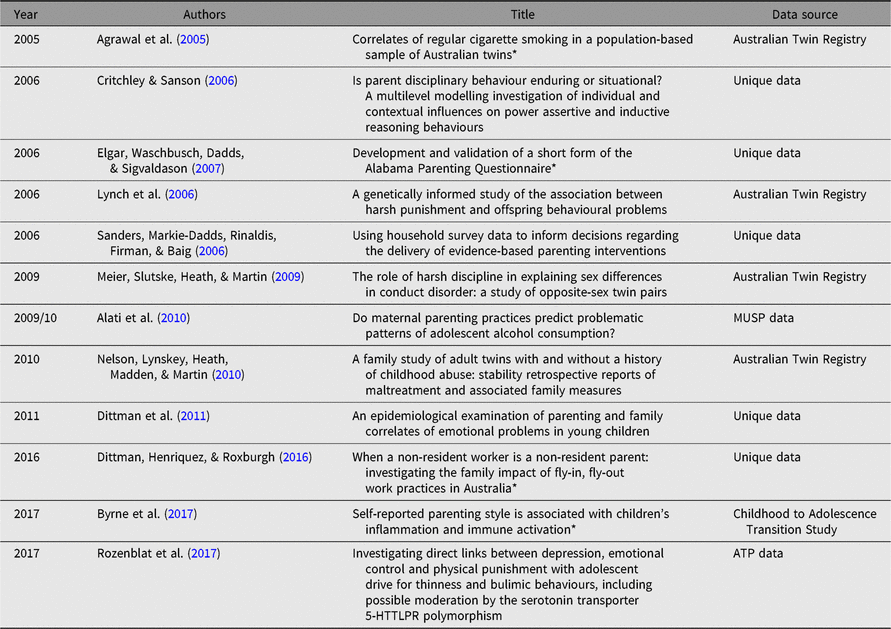
Appendix A: Australian research on corporal punishment of children.
 You have
Access
- 7
- Cited by
Introduction
Corporal punishment (CP) is a part of many children’s childhoods both in Australia and internationally. More than 25 years of CP research has revealed that the practice is, with very few exceptions, associated with adverse outcomes in childhood, adolescence and adulthood (Durrant & Ensom, Reference Durrant and Ensom2017). Some researchers have argued for the inclusion of CP as an adverse childhood experience, citing the similar outcomes associated with both child abuse and CP (Afifi et al., Reference Afifi, Ford, Gershoff, Merrick, Grogan-Kaylor, Ports and Bennett2017). A meta-analysis by Gershoff and Grogan-Kaylor (Reference Gershoff and Grogan-Kaylor2016) found that CP is associated with many adverse childhood and adulthood outcomes, including aggression, mental health problems and antisocial behaviour. This research also found that the more CP a child experiences, the more likely they are to be physically abused.
While CP is illegal in all settings in 54 countries (Global Initiative to End All Corporal Punishment of Children, 2019), Australian Common Law provides a legal defence for using CP as a discipline strategy, as it falls into the category of ‘reasonable chastisement’. This term is not defined in legislation and has led to confusion amongst judges (see, e.g., Noble, Reference Noble2016), and there may be considerable discrepancies between parents’ perceptions of what is reasonable and acceptable discipline, and what is not (e.g., Relationships Australia, 2017; Tucci, Mitchell, & Goddard, Reference Tucci, Mitchell and Goddard2006). Australia has ratified the Convention on the Rights of the Child (UNCRC, 2006) and has made a commitment to end all forms of violence towards children; however, violence in the form of CP towards children remains legally defensible.
Despite increasing international research on CP, a limited amount of research has been conducted on the prevalence, chronicity, severity and nature of CP in the Australian context. While international research has informed CP policy in countries around the world, Australia has yet to adopt this knowledge to improve outcomes for Australian children and families. Further research and a better understanding of CP practices in Australia may enable the development of an evidence-based preventative approach to family violence policy.
This article reviews the CP research conducted in Australia over the past 20 years and discusses the importance of such research for a number of reasons. While state and territories maintain data on child abuse and homicide, not enough is known about the role CP plays in these violent scenarios in Australia, despite international research suggesting that they are interlinked. Solutions that focus on education and legislation, and that have been successful in countries that have banned CP of children, are also discussed in this article. Finally, meaningful and context-specific recommendations conclude this article, and these place particular emphasis on further research, understanding and a greater focus on meeting responsibilities to children and families in Australia.
Methodology
This article examines the nature of contemporary research and literature on CP in Australia. A four-pronged approach was used to collect all relevant data. Firstly, the nature and outcomes of online quantitative attitudinal surveys undertaken by news sources within Australia during the period from January 2007 to January 2017 were collected. Surveys were obtained by searching the Factiva news database using the search terms, ‘smacking and poll’, ‘smacking and survey’, ‘corporal punishment and poll’ and ‘corporal punishment and survey’. The polls with the greatest response rates were selected and used to illustrate the challenge presented by relying on such sources for accurate information about CP attitudes and practices in Australia. Secondly, Informit, a database chosen for its speciality in information from Australia, was searched using the search terms ‘corporal punishment’ (349 results), ‘physical punishment’ (240 results) and ‘smacking’ (65 results) in articles published between January 1997 and October 2018 in Australia. Thirdly, the PsychInfo database was searched for the period between and including January 1997 and October 2018 using the terms ‘corporal punishment’ and ‘Australia’ (54 results); ‘physical punishment’ and ‘Australia’ (52 results); ‘smacking’ and ‘Australia’ (7 results). The resultant studies from this search that included empirical measurement of CP in Australia and are published in journals are listed in the Appendix (studies not included in the Appendix are: studies measuring attitudes towards CP or intention to use CP; studies from samples smaller than 100 that measured CP in samples of children with Attention Deficit Hyperactivity Disorder (ADHD), samples of high-risk, children’s services referred families; and studies that grouped CP with other types of harsh treatment such as yelling). The varied definitions of CP, as well as the sampling criteria and methodologies, made a data meta-analysis inappropriate.
Finally, to capture some of the grey literature on the topic, the websites of Australia’s two peak bodies whose primary focus is on research about the wellbeing of children and families – the Australian Institute of Family Studies (AIFS) and the Australian Institute of Health and Welfare (AIHW) – were searched. Research conducted by these organisations since 2006 was found using the search terms ‘corporal punishment’, ‘physical punishment’ and ‘smacking’. A longitudinal study of parents and children – the Mater-University Study of Pregnancy (MUSP) – was also scanned for the above search terms. To contextualise CP in the family violence scenario, the current national Government initiatives established to combat family violence in Australia are also included here.
The United Nations’ (UN) widely accepted definition of CP is used in this article: ‘any punishment in which physical force is used and intended to cause some degree of pain or discomfort, however light’ (UNCRC, 2006, para 11). This includes ‘smacking’, as it is mostly referred to in Australia, such as of the hand, face or bottom.
Information currently available in Australia
Popular media opinion polling
It would be remiss not to include the information gathered through attitudinal surveys from online opinion polling in any thorough discussion of CP in Australia. Incidents involving a parent administering CP to a child in public are regularly reported in the media. Online opinion polls conducted by news corporations in response to news incidents gauge the attitudes of their readers towards CP. In October 2009, an online poll was conducted by News Ltd across its news websites in response to a story about a mother whose nine-year-old daughter had reported to her teacher that she was hit with a wooden spoon by her parents. Mandatory reporting regulations in Australia require teachers to report potential cases of abuse and the incident was investigated by the police. An online opinion poll asked readers whether they thought that parents should be allowed to smack their children, with more than 90% of over 8000 respondents answering yes (Pilcher, Reference Pilcher2009). More recently, a South Australian man was charged with aggravated assault after smacking his 12-year-old son three times for ‘throwing a tantrum’ (Fewster, Reference Fewster2016). The father had been convicted of abuse in 2014, but the conviction was overturned when the judge ruled that the punishment was reasonable and legal under Australian laws (Noble, Reference Noble2016). Polls have also shown that respondents generally disagree with being told how children should be disciplined. For example, in one survey, nearly one-third of respondents stated that parents should be able to discipline their children as they see fit (McPhee, Reference McPhee2010); another found that 82.2% of respondents claimed to have been smacked with an open hand as part of discipline while they were growing up and 59.4% of respondents stated that they did not want Australian courts to have the power to dictate acceptable methods of discipline for children (Watson, Reference Watson2012).
A survey conducted by Relationships Australia also asked questions pertaining to parents’ rights to use CP. The second of two online monthly surveys conducted in April 2016 and April 2017 (Relationships Australia, 2016, 2017) on its website asked whether respondents would support a ban on CP if it meant that parents who occasionally smacked their child/ren would not be prosecuted. Of the almost 1450 respondents, the majority of whom identified as female (77%); it was found that 59% of women and 45% of men would support such a ban. This survey also found that 51% of parents had used CP on their child/ren and that over 80% had experienced CP in their own childhood. Only 8% of female respondents and 17% of male respondents felt it reasonable to use an instrument such as a wooden spoon to discipline children. The surveys consisted of six questions each, which restricts the extent of its investigation; however, they measured gender, age and parent status of the respondents and state that ‘the demographic profile of survey respondents remains consistent with our experience of the groups of people that would be accessing the Relationships Australia website’ (Relationships Australia, 2016, 2017, para 6).
There are many problems with using opinion polls to gauge attitudes towards, and prevalence of, CP. Online opinion polls conducted by media outlets are subject to limited method variance, and employ ambiguous colloquial terminology, such as ‘smacking’, without proper definition. When a contentious issue such as CP of children is brought to the fore in the context of an incident such as those mentioned earlier, it is likely that ‘individual views and audience-maximising media programming amplify each other through synergistic selection and reinforcement’ (Indemaur & Roberts, Reference Indemaur, Roberts, Wilson, Meagher, Gibson, Denemark and Western2005, p. 148), and the reader may be reacting impulsively and emotively when completing the subsequent survey (Aharony, Reference Aharony2012). Media outlets have their own readership and cater to certain demographics of political affiliation, age and socioeconomic status. Most surveys do not ask for any information on these variables, nor do they seek to collect a representative sample of respondents. This effect is unhelpful in uncovering comprehensive attitudinal and prevalence data on CP and is counter to the employment of valid research to inform and guide public policy. A survey conducted on the news.com.au website in September 2011, in which 85% of respondents admitted to using CP (Godfrey, Reference Godfrey2011), has been cited by academic researchers in Australia (e.g., Kish & Newcombe, Reference Kish and Newcombe2015; Porzig-Drummond, Reference Porzig-Drummond2015), despite the dubious validity of such data. Another problem with opinion polling is that it is ‘able to read the public pulse, but rarely tries to understand how social attitudes and social behaviour change over time, or tell us why different constituencies find themselves in conflict’ (Gibson, Wilson, Meagher, Denemark, & Western, Reference Gibson, Wilson, Meagher, Denemark, Western, Wilson, Meagher, Gibson, Denemark and Western2005, p. 2). They may provide a snapshot of attitudes or practices at a point in time, but do not place information contextually. Beliefs and ideologies are linked with approval of CP (Taylor et al., Reference Taylor, Al-Hiyari, Lee, Priebe, Guerrero and Bales2016), and a multidimensional, ecological approach that includes consideration of culture, religion, education and socio-economic background is therefore required, rather than a simplistic model such as that provided by online polls.
Empirical academic research
The Australian Childhood Foundation, in collaboration with the former National Research Centre for the Prevention of Child Abuse at Monash University, commissioned a market research company to collect attitudinal data from 301 parents on CP of children in 2002 (Tucci, Saunders, & Goddard, Reference Tucci, Saunders and Goddard2002) and from 720 adults in 2006 (Tucci et al., Reference Tucci, Mitchell and Goddard2006). The 2006 study found that 10% of parents agreed with using implements such as belts and canes to punish a naughty child, while 82% disagreed and 8% were uncertain; compared with the 2002 study in which 4% agreed, 95% disagreed and 1% were uncertain about using implements to punish children. While the possibility of using an instrument to corporally punish a child is not precluded from the law, the relatively high number of parents who feel that this is not a reasonable means of punishing a child suggests that current allowances in legislation for CP is at odds with some community expectations. In 2002, 55% agreed that it was reasonable to leave a mark on a child as a result of punishment, and 45% agreed with this in 2006. This figure also highlights a discrepancy between what is legally permissible and what is deemed reasonable by a large proportion of parents as parents in New South Wales (NSW), for example, who leave a mark after punishment would be in breach of the current legislation in that state (see AIFS, 2017a). State and territory legislation may vary and is underpinned by the Common Law defence of ‘reasonable chastisement’. However, in NSW, an amendment to state legislation was introduced in 2001 stipulating that children may be hit from the neck down only and that punishment must not harm the child for more than a ‘short period’, however this term is not clearly defined. It is indicated that approval of CP is declining (Tucci et al., Reference Tucci, Mitchell and Goddard2006) and that a proportion of parents are either not aware of legislation governing CP, confused about it, or their own opinions are at odds with it.
An international study (Douglas & Straus, Reference Douglas and Straus2006) found that, among 219 university students in Australia, 52.8% did not strongly disagree that they were spanked or hit a lot before age 12. The authors assumed that students who did not experience CP would most likely strongly disagree with the statement that they were ‘spanked or hit a lot’ (p. 297). Cuskelly, Morris, Gilmore, and Besley (Reference Cuskelly, Morris, Gilmore and Besley2015) conducted two studies: the first, comprising 149 parents with at least one child under six years of age, found that 28% of parents used CP to manage their child’s behaviour; and of the 127 parents in the second study, between 12.2% and 37.2% used CP, and this was associated with their education level. Moreover, in their assessment of a parenting program, Sanders, Bor, and Morawska (Reference Sanders, Bor and Morawska2007) found that, in a sample of 305 parents with a three-year-old child, over half of the parents had employed CP with their children. A study of 4010 caregivers of children younger than 12 in Queensland found that 43.4% used a single smack on the hand as a discipline strategy, while 7.7% used multiple smacks, or used an object to smack (Sanders, Markie-Dadds, Rinaldis, Firman, & Baig, Reference Sanders, Markie-Dadds, Rinaldis, Firman and Baig2006). The MUSP surveyed 4076 mothers and found that, when their children were aged five years, 71.6% used CP sometimes, 9.2% always used CP and 19% never used it to discipline their children (Alati et al., Reference Alati, Maloney, Hutchinson, Najman, Mattick, Bor and Williams2010). A study of 4,502 respondents from Brisbane, Sydney and Melbourne found that approximately 40% use a single smack, around 10% smack multiple times, and around 8% use an object to smack their children to discipline them (Dittman, et al., Reference Dittman, Keown, Rose, Farruggia, Sanders and Sofronoff2011).
A prominent Australian empirical CP study has focused on qualitative research. Saunders and Goddard’s (Reference Saunders and Goddard2010) report on the impact of CP on children documented children’s trauma, sadness, confusion and anger associated with being corporally punished by a parent. Their research is comparative to other such research published internationally (see, e.g., Breen, Daniels, & Tomlinson, Reference Breen, Daniels and Tomlinson2015; Trocme et al., Reference Trocme, Maclaurin, Fallon, Daciuk, Billingsley, Tourigny and McKenzie2001; Willow & Hyder, Reference Willow and Hyder1998). Qualitative data from parents’ perspectives may also be useful in understanding the motivations and propensity for the use of CP, and this type of research has also been previously conducted overseas (see, e.g., Taylor, Hamvas, & Paris, Reference Taylor, Hamvas and Paris2011), but not in Australia. This qualitative research forms a basis upon which our knowledge of children’s experiences with CP may be built and reinforced by comprehensive and robust quantitative research.
Empirical academic research conducted over the past 20 years in Australia has been primarily incidental and limited in scope and depth. Further investigation into prevalence of CP practices among parents and experiences among children, as well as data on chronicity, severity and the nature of the CP is needed to further build upon the current knowledge within the field. Academic research must provide an important foundation for evidence-based policy development in any progressive society.
Australian government studies
Several Australian government institutions collect data on the health and welfare of children and youth. The Australian Temperament Project (ATP) by AIFS, a longitudinal study that began in 1983, is one of two studies that has collected data on the practice of CP and have been published in incidental contexts (see AIFS, 2017b; Smart et al., Reference Smart, Richardson, Sanson, Dussuyer, Marshall, Toumbourou and Oberklaid2005, for examples of such reports). With a sub-sample of 467 respondents, one study showed that 38.5% had experienced CP as a child and 5.8% had experienced severe CP (Rozenblat et al., Reference Rozenblat, Ryan, Wertheim, King, Olsson and Krug2017). Another AIFS study, ‘Growing up in Australia: The Longitudinal Study of Australian Children’ (AIFS, 2017c) did not collect any data on CP specifically, but measured variables of ‘hostile and inconsistent parenting’, ‘lower parental warmth’ and ‘low use of reasoning’ and found them to be risk factors for social or emotional problems, peer problems and low prosocial skills, respectively. These factors may be linked with the use of CP in some scenarios (for a review of this theory, see Rohner & Lansford, Reference Rohner and Lansford2017). Notably, wave 7 of this study asked questions to the cohort pertaining to their experiences with CP in childhood, but only to determine whether respondents felt that their parents had used CP excessively, and these data have not yet been analysed at the time of writing this manuscript.
Research conducted between 1995 and 1998 as part of the Australian component of the Parenting-21 study on parenting in cultural contexts in Australia, collected qualitative data on the practice of CP and quantitative data on attitudes toward it (Kolar & Soriano, Reference Kolar and Soriano2000). The data were used to compare the approaches of Anglo, Torres Strait Islander and Vietnamese parents, and it was found most parents disagreed or strongly disagreed (60% of Anglo parents and 68% of Vietnamese parents) with the introduction of a law to ban CP. It should be noted that the data were limited only to attitudinal data and did not measure CP prevalence in its sample.
A third study by AIFS, entitled ‘Children Affected by Domestic and Family Violence’ (Campo, Kaspiew, Moore, & Tayton, Reference Campo, Kaspiew, Moore and Tayton2014), recognises the detrimental and far-reaching effects of family violence, but omits entirely the collection of data on the practice of CP in Australia. The majority of CP occurs between the ages of 3 and 5 years and gradually decreases as children get older (Wauchope & Straus, Reference Wauchope, Straus, Straus and Gelles1990). This study focuses on the role of primary prevention, specifically targeting 0–8-year-old children ‘before behaviours and attitudes become fixed’ (Campo et al., Reference Campo, Kaspiew, Moore and Tayton2014, p. 20), but it does not discuss the documented connection between CP in this age group and later aggression and maladjustment. The report by AIHW, entitled A Picture of Australia’s Children 2009: How Safe and Secure are Australia’s Children (AIHW, 2009), does not mention CP, although there is an analysis of the impact of violence on the lives of young children. The State of Australia’s Fathers 2015 report by Save the Children Australia (Wells, Mitra, & Flanagan, Reference Wells, Mitra and Flanagan2015), while not collecting data on violence committed by fathers against their children, noted that this may be a topic for later research. ‘The Child Wellbeing Project’ (see Redmond et al., Reference Redmond, Skattebol, Saunders, Lietz, Zizzo, O’Grady and Roberts2016) collected important information related to family, health and the marginalisation of young people between the ages of 8 and 14 years, but did not collect any data on CP, despite its documented link with many of the variables explored in this research. While it is not expressly the purpose of any of these reports to document the use of CP, its absence in the broader context of the health and wellbeing of children is notable.
Reasons for the lack of data
Several reasons for the lack of data on CP in Australia are notable. Firstly, Australia’s traditional understanding of child maltreatment encompasses four categories: sexual abuse, physical abuse, emotional abuse, and neglect (AIHW, 2019) and, historically, CP has not been classified into any of these categories.
Secondly, in addition to the practice being legal in all states and territories in Australia, it is also widely socially accepted (Tucci et al., Reference Tucci, Mitchell and Goddard2006). While this social acceptability may have been declining in recent times, it is still reasonable to deduce that a considerable portion of people believe that CP forms a legitimate component of raising children and, as Kolar and Soriano (Reference Kolar and Soriano2000) assert, ‘there is a general reluctance to support prohibition of physical punishment, since it is perceived to infringe on a parent’s rights’ (Physical Punishment, para 1). Since 1990, international research on the topic of CP has proliferated (Durrant & Ensom, Reference Durrant and Ensom2017); however, Australian beliefs and attitudes remain vested in the traditional definitions and structures, and the issue has not prompted significant political debate.
Thirdly, the nature of CP is such that its disclosure is not a given. CP primarily occurs behind closed doors and against very young children who are even less likely than older children to talk about discipline at home (Dodd, Reference Dodd2011). Children may be indoctrinated to form a normative perception of CP and lack knowledge of what is reasonable and what is not (Twum-Danso, Reference Twum-Danso2013), making it difficult for children whose parents are overstepping the line into abuse to seek help. Typical power roles in the adult–child relationship make disclosure of abuse further unlikely. Children are also sensitive to the social desirability of reporting on family relationships on surveys (Camerini & Schulz, Reference Camerini and Schulz2017) and harsh parenting (Simons, Whitbeck, Conger, & Chyi-In, Reference Simons, Whitbeck, Conger and Chyi-In1991) and may therefore not disclose CP to peers, teachers or others. Parents, too, may be confused about whether they are using discipline afforded to them by the law, or whether they are overstepping the ill-defined boundaries into abuse, as may anyone wishing to make a complaint to authorities about potential child abuse. This is further exacerbated by subjective terminology such as ‘reasonable chastisement’ and that pain must only be experienced for ‘a short period of time’ in some state and territory legislature. With these ambiguous and imprecise terms employed to determine whether an act of CP or abuse has occurred, both adults and children may be unsure about the need for disclosure.
Australia’s child abuse statistics show that the majority of notifications for child abuse in 2017-18 were unsubstantiated (AIHW, 2019). Information on the outcomes of unsubstantiated child notifications is not available; however, a study of 660 children in Western Australia who were referred to child protection services found that 90% of incidents comprised parents using CP to control children (Thorpe & Jackson, Reference Thorpe and Jackson1997). It is therefore conceivable that a classification of ‘unsubstantiated’ may arise as a result of violence such as CP that is not severe enough to be deemed abusive, as is evident in Canada (Trocme & Durrant, Reference Trocme and Durrant2003), where similar legislation to that in Australia is in place.
Why the need for Australian data?
Commitment under the UNCRC
The banning of CP in 54 countries around the world has largely been motivated by the United Nations Convention on the Rights of the Child (UNCRC, 2006; Lansford, Reference Lansford and Selin2014, p. 446), to which Australia is also a signatory. The UN has highlighted the link between CP and other types of violence and proposed that ending CP is a ‘key strategy for reducing and preventing all forms of violence in societies’ (UNCRC, 2006, para 3). As part of the UN’s overarching Sustainable Development Goals for 2030 (UN, 2019), child physical discipline was singled out as an indicator of child wellbeing, putting a sharper focus on this aspect of childhood. The National Children’s Commissioner, endowed with representing the interests and rights of children in Australia, has urged the Australian Government to accede to the ‘Optional Protocol to the Convention on the Rights of the Child on a Communications Procedure’ and ratify the ‘Optional Protocol to the Convention Against Torture and Other Cruel, Inhuman or Degrading Treatment or Punishment’ (Australian Human Rights Commission, 2016), in line with UN recommendations. If Australia is to meet its obligations under the CRC, it is important to lead with a national dialogue on CP, informed by a thorough understanding of the phenomenon and all its facets.
Completeness of data
Additionally, data on CP may help to consolidate the current set of data on child abuse and add to an understanding of other parts of child protection. Research has shown that CP has the potential to develop into child abuse (Gershoff & Grogan-Kaylor, Reference Gershoff and Grogan-Kaylor2016; Trocme & Durrant, Reference Trocme and Durrant2003; Zolotor, Theodore, Chang, Berkoff, & Runyan, Reference Zolotor, Theodore, Chang, Berkoff and Runyan2008). Children’s experiences of CP are linked to their sex and age (Dietz, Reference Dietz2000; Giles-Sims, Straus, & Sugarman, Reference Giles-Sims, Straus and Sugarman1995; Grogan-Kaylor & Otis, Reference Grogan-Kaylor and Otis2007), and whether their parent was corporally punished as a child (Deater-Deckard, Lansford, Dodge, Pettit, & Bates, Reference Deater-Deckard, Lansford, Dodge, Pettit and Bates2003). Additionally, the socioeconomic status (Ryan, Kalil, Ziol-Guest, & Padilla, Reference Ryan, Kalil, Ziol-Guest and Padilla2016) and education level of the parents (Ateah & Durrant, Reference Ateah and Durrant2005) are also linked with the use of CP. Australian Indigenous children are overrepresented in cases of abuse and neglect (AIFS, 2016c), and international research indicates that race and ethnicity may affect levels of CP (Dietz, Reference Dietz2000; Grogan-Kaylor & Otis, Reference Grogan-Kaylor and Otis2007). However, it is not currently known whether higher rates of CP in Indigenous families correlate with levels of abuse, or whether CP is linked to or has an impact on other types of violence among Indigenous children and within Indigenous families. With the lack of data on these variables in relation to CP in Australia, it is not known what role CP plays in potentially placing certain Australian children at higher risk of violence, maltreatment and death.
Prevention of child homicide
Extreme cases of child abuse may result in the fatality of the child. Between July 1997 and June 2010, 338 child homicides were committed in Australia (Queensland Crime and Misconduct Commission, 2013), accounting for approximately 9% of all homicides in that period (Chan & Payne, Reference Chan and Payne2013). An average of 25 children were killed each year by a parent between 1989 and 2002, and 46% were killed with assaultive force (Mouzos & Rushforth, Reference Mouzos and Rushforth2003). In 2015, the NSW Ombudsman found that 51 of the 83 children who had died from family violence in the preceding decade died as the result of inflicted injuries (Ralston, Reference Ralston2015). Currently, there is no information available to ascertain whether such injuries occurred as a result of CP. The AIFS (2016b) states that no national report exists on the causes of death of all Australian children under the age of 18, and it is possible that misclassification results in an underestimation of child maltreatment fatalities. A report analysing child protection statistics in Australia has highlighted the need for a national framework to properly and consistently record and assess child abuse (Broadley, Goddard, & Tucci, Reference Broadley, Goddard and Tucci2014), and this would also provide further information on the incidence of child homicide. The majority of child homicides are filicides – committed by a biological or step-parent (Dearden & Jones, Reference Dearden and Jones2008). Cavanagh, Dobash, and Dobash (Reference Cavanagh, Dobash and Dobash2007) found that the majority of fathers who commit filicide intend to hurt, but not to kill, the child, and see such actions as punishment for disobedience. Nielssen, Large, Westmore, and Lackersteen (Reference Nielssen, Large, Westmore and Lackersteen2009) found that cases where a parent had been accused of a child’s homicide drew on the defence of ‘reasonable chastisement’ that had gotten out of hand and asserted that banning CP and educating parents on how to use alternative disciplinary methods may have the potential to save the lives of children. Despite a lack of national data on child fatalities, Australia employs a legal model that affords parents a defence of violence that has the potential to cause real harm and even death. Proper understanding of the implications of such legislation can be gained by further research on the nature, prevalence, severity and chronicity of CP, and resultant action may lead to child homicide prevention.
Adverse effects of corporal punishment
The most recent and comprehensive meta-analysis on the topic (Gershoff & Grogan-Kaylor, Reference Gershoff and Grogan-Kaylor2016) cannot establish causality; however, it found that CP was associated with more aggression, more antisocial behaviour, internalising and externalising problems, more mental health problems, more negative relationships with parents, lower moral internalisation, lower cognitive ability and lower self-esteem in childhood. In adulthood, CP was associated with antisocial behaviour, mental health problems and support for CP. The analysis also found that the more CP a child experiences, the more likely they are to be physically abused. Research also indicates that youth violence trajectories may begin with CP (Grogan-Kaylor, Reference Grogan-Kaylor2005; Herrenkohl, Kosterman, Mason, & Hawkins, Reference Herrenkohl, Kosterman, Mason and Hawkins2007). CP may result in toxic stress for children that can affect their brain development (Gershoff, Reference Gershoff2016). Violence during childhood has been found to affect the neurological development of the child’s brain and in some cases, leads to aggression and impulsivity (Perry, Reference Perry, Schetky and Benedek2001). Experiences of CP in childhood may lay foundations for attitudes and behaviours in adulthood, and research showing the adverse short and long-term effects of CP should be considered during policy development.
Among the indicators for children’s wellbeing, according to COAG 2009-10 (Protecting Children is Everyone’s Business), are attendance rate of primary school children and achievement of national minimum literacy and numeracy standards, hospital admission at emergency departments, substantiated child protection cases, and mental health problems. Gershoff and Grogan-Kaylor’s (Reference Gershoff and Grogan-Kaylor2016) comprehensive meta-analysis of over 160,000 children has linked CP with mental health problems and lower cognitive ability, and the evidence suggests that the more CP the children receive, the more likely they are to be physically abused. By adapting policy informed by international research, Australia has the opportunity to forge pathways for better outcomes for families. If social norms pertaining to the use of CP are to change, the disconnect between the empirical evidence that demonstrates the harms of CP and the highly prevalent attitudes and ideologies that support its use must first be understood (Taylor et al., Reference Taylor, Al-Hiyari, Lee, Priebe, Guerrero and Bales2016).
Family violence context
In recent years, family violence has been a topical issue in Australia. High profile family violence cases such as Rosie Batty (see Batty, Reference Batty2018) and the release of economic estimates on the cost of family violence have prompted the federal and state governments to create a national response to combat family violence. Family violence encompasses partner, child, parent and sibling abuse, and includes the witnessing of intimate partner violence (IPV) by children (Family Court of Australia, 2016). The National Council to Reduce Violence Against Women and their Children has estimated that family violence costs the Australian economy more than $13 billion each year (Department of Social Services, 2009) and the Australian government has committed an unprecedented $100 million over five years to address family violence in Australia’s states and territories. A review of available literature found a consistent association between being corporally punished in childhood and becoming involved, both as perpetrator and victim, in IPV in adulthood (Poulsen, Reference Poulsen2018). Another recent study (Afifi, Fortier, Sareen, & Taillieu, Reference Afifi, Fortier, Sareen and Taillieu2019), found that harsh CP (defined as a push, grab, shove, slap or hit) has been linked with antisocial behaviours (including spousal abuse) in adulthood in a similar way to child maltreatment (distinctive from CP on the basis of causing physical injury). The burden of child maltreatment in Australia is high (Moore et al., Reference Moore, Scott, Ferrari, Mills, Dunne, Erskine and Norman2015) and presents similar long-term effects to CP, such as mental health problems (Gershoff & Grogan-Kaylor, Reference Gershoff and Grogan-Kaylor2016). CP of children is a form of family violence posing similar problems to child maltreatment (Gershoff, Reference Gershoff2016) and, internationally, it is widely acknowledged as a type of abuse, but Australian governments have hitherto been reluctant to interfere with these violent familial interactions. Research that considers the role played by CP in the establishment of a violence trajectory that may result in IPV, and that takes CP as seriously as child maltreatment is needed to advance knowledge in this field.
Evidence-based policy development
In the context of violence prevention, an evidence-based approach is integral to its effectiveness (Homel, Reference Homel2005). Evidence in the form of public feedback, social analysis, legal opinion, expert judgement and overseas experience play an increasingly important role in policy making (Edwards, Reference Edwards2004) and forms an evidence-based policy development approach. Homel (Reference Homel2005) asserts that, in the past, crime prevention has not been successful in Australia for myriad reasons and states that ‘the absence of a commitment to a research and evaluation process designed to build up an evidence base for determining policy and program priorities’ (p. 365) forms a part of the problem. Homel (Reference Homel2005) suggests the necessity for ‘a movement towards a more systematic and evidence-based set of crime prevention programs and policies’ (p. 365) to form a foundation on which to build coherency and determine outcomes in Australia’s strategic crime prevention overall. Fuller and Tomison (Reference Fuller, Tomison, Day and Fernandez2015) assert that ‘there is a need to collect and refine data to better capture the nature of violence … there will still be a need to supplement [crime] data with non-crime datasets on violent behaviour … as a sizeable proportion of violent behaviour is not reported or not captured in criminal justice records’ (p. 232), and CP, although legal in Australia, falls under this banner. It is particularly important that data sets are inclusive of all experiences with violence in childhood, including those that are considered benign, legal and occur in the home at the hands of parents, to allow a complete and holistic picture of all potential variables to emerge. Such a picture must consider all current knowledge about CP and its potential effects to underpin informed and effective policy development and implementation.
Changing the Australian approach to corporal punishment
Education
While Australians have a growing awareness of the social unacceptability of CP (Briggs & Watson, Reference Briggs and Watson2011), most still approve of this method to discipline children (Tucci, Saunders, & Goddard, Reference Tucci, Saunders and Goddard2002; Tucci et al., Reference Tucci, Mitchell and Goddard2006). Whether a parent deems CP as an appropriate punishment, and to what extent they deem it mild, moderate or severe, may be determined by their own experiences of being corporally punished as a child. Kish and Newcombe (Reference Kish and Newcombe2015) found that ‘lay theories’ or ‘myths’ about CP were prevalent in a sample of university students in Australia, and these findings are suggestive of their applicability to the wider Australian population. The perpetuation of these myths, and indeed mentalities, is likely intergenerational; however, research by Holden, Brown Baldwin, and Caderao (Reference Holden, Brown, Baldwin and Caderao2014) shows that it is possible to change the minds of parents who are proponents of CP by presenting them with data on the potential detrimental effects. Furthermore, in their research on attitudes toward spanking, Taylor, McKasson, Hoy, and DeJong (Reference Taylor, McKasson, Hoy and DeJong2016) found that perceived approval of CP by professionals, family and friends played a large role in whether parents chose to use this method of discipline. The abovementioned research has shown that parents are often confused about, and have varying perceptions of whether CP is acceptable, and to what extent. The potential power of professionals, such as doctors and health professionals, in educating parents about the use of CP is therefore an important factor in its prevention. Accordingly, many Australian organisations advocating for children’s wellbeing have position statements against the effects of CP, including the Royal Australian College of Physicians (RACP, 2013). Educating parents about the changing community expectations around the use of CP has been shown to be effective in countries where CP has been legislated against. However, legislation against CP must either precede or act simultaneously with such education.
Legislation
It can be difficult to lead with attitudinal change in the population rather than legislative change, and legislation must be underpinned by sound ethics and science. However, defining crime and what constitutes violence may be difficult and subjective, and ‘Notions of what is acceptable and unacceptable in terms of behaviour, and what constitutes harm, are culturally influenced and constantly under review as values and social norms evolve’ (Fuller & Tomison, Reference Fuller, Tomison, Day and Fernandez2015, p. 216), thus ‘Australians hold divergent views about what behaviour is acceptable, and defining behaviour as criminal is often fiercely contested’ (Indemaur & Roberts, Reference Indemaur, Roberts, Wilson, Meagher, Gibson, Denemark and Western2005, p. 149). This makes legislative intervention potentially necessary to reflect evolving ethics and science, and an attitudinal change may follow. Research has shown that approval for CP has diminished over time in countries that have led with legislative change (see, e.g., Durrant, Reference Durrant2000).
Legislative change has the potential to take a violence prevention approach. Australian policymakers have come some way in acknowledging the importance of prevention and early intervention to tackle violence, but policies and legislation have yet to fully reflect a preventative approach. For example, the Victorian Department of Education and Training employed the ‘Respectful Relationships’ program in 2017 (Victorian Department of Education and Training, 2019). This program focuses on educating students from the primary school level and up about violence, with the aim of creating generational change in attitudes toward family violence. However, by not acknowledging the presence of CP in many homes as a type of violence, it contradicts the message at its core. ‘The Victorian Royal Commission into Family Violence’ (2016) – the first of its kind in Australia – resulted in 140 recommendations designed to address the problem of family violence in Australia and provide tangible solutions to eliminate it; however CP was not addressed in the report. The National Framework for Protecting Australia’s Children 2009–2020: Protecting Children is Everyone’s Business (COAG, 2009) states that ‘Australia needs to move from seeing “protecting children” merely as a response to abuse and neglect to one of promoting the safety and wellbeing of children’. Australia’s commitment to addressing family violence is clear, but a lack of data and knowledge about CP may be preventing the ecological objectivity required to effectively achieve progress.
While responding to violence (and its consequences) after it occurs has typically been the primary focus for governments and many services, a strong focus on the prevention of harm needs to be exercised by governments and the relevant infrastructure (Fuller & Tomison, Reference Fuller, Tomison, Day and Fernandez2015). Employing an ecological approach to violence prevention in legislation may assist in the prevention of severe and widespread violence. Indeed, the vision to prevent violence is a prominent feature in each of the states and territories’ plans to eliminate family violence. According to the Standing Committee on Social Issues Legislative Council of NSW (2012), ‘addressing the causes of violence against women must form the basis for any prevention strategy’ (p. xxii). Toumbourou et al. (Reference Toumbourou, Leung, Homel, Freiberg, Satyen, Hemphill, Day and Fernandez2015) identified that ‘Early family risk factors are considered to be particularly important in early-onset violent pathways and in this way predict increased violent and non-violent offending’ (p. 51), and research has indicated that CP is one such risk factor. Hemphill et al. (Reference Hemphill, Smith, Toumbourou, Herrenkohl, Catalano, McMorris and Romaniuk2009), in their longitudinal study on youth violence in Australia and the United States, recommend that prioritising prevention and early intervention across different aspects of a young person’s life is needed to prevent youth violence from occurring. Indeed, legislative measures that seek to prevent violence of all types, including CP—in childhood, effectively aligns with other violence prevention legislation.
How can these data be gathered in Australia to create a meaningful understanding of corporal punishment prevalence, impact and social acceptance?
The above analysis of Australian data on CP has highlighted the need for more research and knowledge of the issue. In order to ascertain how much CP is being used by parents, a measurement of behaviour needs to be carried out for example, by asking parents to estimate how many times in the month prior they have corporally punished their child/ren. There are problems with relying on one source for information about how often CP is used in the home, and both mothers and fathers are involved in CP, making it important to seek out both sources for more accurate information on the prevalence of CP within a family (Straus, Gelles, & Steinmetz, Reference Straus, Gelles and Steinmetz1980). Parents may underestimate the amount of CP that they administer to their children due to the social undesirability of harsh parenting, and each family member provides their own personal biases and cannot be relied upon for absolute accuracy; therefore, ‘a measure that combines parent and child reports is likely to be a more valid indicator of disciplinary practices than a measure that relies on a single source of information’ (Simons et al., Reference Simons, Whitbeck, Conger and Chyi-In1991, p. 167).
Cross-sectional research that considers many factors, including social and environmental factors, is required to understand the links between CP and IPV. It is also important to consider the use of CP in the context of broad religious, social and cultural factors that lead to the choice to use CP (Grogan-Kaylor & Otis, Reference Grogan-Kaylor and Otis2007; Wilson, Stover, & Berkowitz, Reference Wilson, Stover and Berkowitz2009), as well as individual factors, which may not be the result of individual choice, but rather a default mechanism that results from stress and impulse (Kish & Newcombe, Reference Kish and Newcombe2015). A nationally representative sample of parents with children of a certain age, considering immigrants, Indigenous Australians and other minority groups, is the most comprehensive way to gather data on the prevalence and chronicity of the practice and accompanying attitudinal data.
A nationally representative sample of children, delivered as a part of a school program, would ascertain their experiences of CP. Ideally, each school student completing a survey on CP would be cross-referenced with their parent or carer’s survey responses. Such an approach might yield some problems as well however, as parents’ and children’s responses may differ and even contradict each other’s reports. More novel approaches, such as the one carried out by Holden, Williamson, and Holland (Reference Holden, Williamson and Holland2014) included an in-depth analysis of footage or audio from the homes of parents with children. Parenting diaries (Kremer, Smith, & Lawrence, Reference Kremer, Smith and Lawrence2010) might be equally useful in gathering real-time data. Another potentially effective and statistically sound method is the addition of explicit questions to do with CP to existing longitudinal surveys administered in Australia, such as those by the AIHW and AIFS mentioned above. This approach also presents potential problems, however, as their inclusion may cause incongruity, and the inclusion of such questions in more recently established longitudinal studies would likely yield more reliable results over a period of time. Questions may be based on the established and validated Parent-Child Conflict Tactics Scale (Straus, Hamby, Finkelhor, Moore, & Runyan, Reference Straus, Hamby, Finkelhor, Moore and Runyan1998) or other validated methods of enquiry. Indeed, much international research has been carried out that is both applicable and relevant to the Australian context – Canada is such an example – and approaches and methodologies may guide Australian research.
Recommendations
Based on the above analysis of information, the following recommendations are made:
An increased focus on gathering relevant, comprehensive and accurate data on CP in the home in Australia. This may include a representative sample of parents and children, surveying caregivers and cross-referencing responses.
More thorough and detailed recording of child abuse data, child homicide data and other forms of violence in the home (including CP) to facilitate an ecological approach to understanding family violence.
Communication and education strategies to inform parents, children and the general public of their rights and responsibilities around CP in the home. Making clear distinctions between CP and other types of family violence would help to facilitate this. Organisations such as White Ribbon (2016), whose position statement on CP cautions against its use, as well as the Royal Australasian College of Physicians, have campaigned for the banning of CP based on its documented adverse effects and their messages need to be made more prominent and accessible.
Economic modelling to estimate the cost of CP in Australian homes. The ability to complete such estimations is underpinned by the introduction of comprehensive data collection and understanding of CP in the home and its potential impact.
Investigations into the consistency of the current approach to defining ‘reasonable chastisement’ in the child welfare system and enforcing it in the judicial system.
Conclusion
A review of data available on CP in Australia has revealed a gap in the knowledge about this aspect of family violence. Preventing family violence such as IPV and child abuse is a priority for the Australian government; however, CP is a type of family violence that has not yet been adequately addressed. CP has been linked to adverse effects in childhood that are similar to those linked to child maltreatment, such as aggression, child abuse and involvement in IPV as an adult. Conducting research and gaining knowledge about CP in the Australian context may help to understand and mitigate the risk of these effects and should be a priority for Australian researchers and policymakers. Understanding the prevalence, nature, chronicity and severity of CP forms the first component in a thorough ecological understanding of family violence and forms part of a preventative policy approach to family violence.
Australian research on corporal punishment of children.