I. INTRODUCTION
Aluminum alloy has been widely used in various industries for its light weight and high specific strength properties. And numerous efforts have been devoted to improve the properties of aluminum product, especially for components applied in aerospace and defense industry, from composition and processing technology in the last several decades. Reference Zhang, Liu, Liu and Zhou1–Reference Wu, Wang, Hsu and Trong4 One of the most important objectives in aluminum processing is to remove contaminants, which may be in the form of gases or inclusions, from molten aluminum prior to casting. Inclusions in aluminum alloy can lead to poor machinability, a tendency to increase corrosion, sites of stress raiser, and cause premature failure of components. Reference El-Soudani and Pelloux5 Several methods have been proposed to remove inclusions from molten aluminum, such as flotation, sedimentation, centrifugal separation, filtration, and electromagnetic separation. Reference Mirgaux, Ablitzer, Waz and Bellot6–Reference Xu, Jian, Meek and Han8 Among which, some are being applied in industry.
The relationship between inclusions and aluminum melt plays a key role in the process of purification, Reference Shahverdi, Ghomashchi, Shabestari and Hejazi9 verification and the interaction between inclusions and the aluminum substrate is helpful to understanding purification technology and key to higher efficiencies with aforementioned processes as well as further improvement. Besides, the interface between remaining inclusions and aluminum substrate also plays an important role in determining the properties of a processed component. Therefore, there is a urgent need to examine the interface structure between aluminum and commonly reported inclusions.
In terms of interface structure, orientation relationship (OR) always plays a crucial role in many processes, such as the formation, growth, adsorption, and wettability of an interface. The interfacial energy between two components is another factor to determine an interface structure. For a low interfacial energy, the two components have to be coherent or partially coherent, which leads to certain OR from a crystallographic point view. Many models have been proposed to describe and explain some crystallographic features of an interface, such as near-coincidence site model, Reference Liang and Reynolds10 structural ledge model, Reference Forwood and Lawn11–Reference Rigsbee and Aaronson14 invariant line model, Reference Weatherly and Zhang15–Reference Dahmen21 and O-lattice theory, Reference Fonda and Shiflet22–Reference Zhang and Weatherly25 and many of them have been applied in many systems. However, regardless of the accuracy which model describes, none of them can predict the ORs without assumptions. Reference Zhang and Kelly26,Reference Kelly and Zhang27 Recently, the edge-to-edge matching model, proposed by Zhang and Kelly, Reference Zhang and Kelly26–Reference Fu, Qiu, Zhang, Wang, Kelly and Taylor34 has been developed, to predict ORs between two component based on the actual crystal structures and the corresponding atom positions. The predicted ORs by edge-to-edge matching model agrees well with observed ORs in other works as reported in Refs. Reference Zhang and Kelly26, Reference Zhang and Kelly28, Reference Zhang and Kelly29 and Reference Zhang, Kelly, Easton and Taylor35–Reference Zhang and Kelly37.
In the present paper, the edge-to-edge matching model was used to predict OR between Al matrix and several typical inclusions, Al2O3, MgO, AlN, TiB2, and AlB2, in Al alloy, Reference El-Soudani and Pelloux5,Reference Birol38 based on the derived ORs the removability of those inclusions from molten aluminum has been discussed.
II. PREDICTION OF THE ORIENTATION RELATIONSHIP
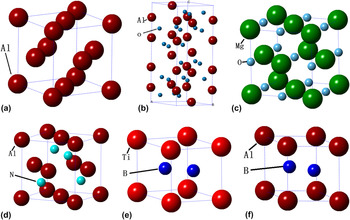
The edge-to-edge matching model is based on the matching of rows of atoms across the interface. Hence, the crystal structure, lattice parameters, and atomic positions of each phases were needed to predict ORs with edge-to-edge matching model for a given system. Al has a FCC structure and its lattice parameters vary with its chemical composition, however, owing to the concentration of solute element in the alloy is very low, the effect of the solute element on lattice parameters can be ignored. The pure Al metal is used in present work, and its lattice parameter is 0.40495 nm. Meanwhile, Table I summarized the space group, SG number, crystal system, lattice parameters and atom positions of Al2O3, MgO, AlN, TiB2, and AlB2, Reference Kondo, Tateishi and Ishizawa39–Reference Vinod Kumar, Murty and Chakraborty43 based on which the crystal structure of Al2O3, MgO, AlN, TiB2, AlB2, and Al were constructed, as present in Fig. 1.
The space group, SG number, crystal system, lattice parameters and atom positions of Al2O3, MgO, AlN, TiB2 and AlB2.

Crystal structure of (a) Al, (b) Al2O3, (c) MgO, (d) AlN, (e) TiB2, and (f) AlB2.

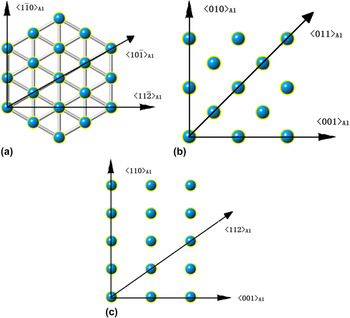
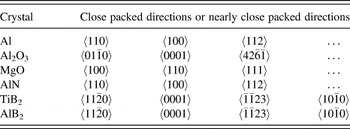
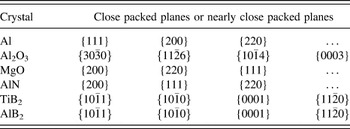
The next step of OR prediction by edge-to-edge matching model is to identify the close packed directions or nearly close packed directions. Generally, there exist two kinds of directions, straight atom rows and zigzag atom rows, and it is expected that the straight atom row in one phase will match with the straight atom row in another phase, the zigzag atom row in one phase will match with the zigzag atom row in another phase. Due to the three close packed directions or nearly close packed directions, 〈110〉Al, 〈100〉Al, 〈112〉Al, of Al are straight atom rows, the zigzag type close packed directions or nearly close packed directions of inclusions were ignored. The straight type close packed directions or nearly close packed directions of Al, Al2O3, MgO, AlN, TiB2, and AlB2 are summarized in Table II based on the crystal structure parameters and atomic positions of each atom. Thirdly, the method, proposed by Kelly, was used to identify the close packed planes or nearly close packed planes of Al and the inclusions, which was based on the structure factor and the interplanar spacing of a plane. Reference Kelly, Ren, Qiu and Zhang44 Accordingly, the derived close-packed planes or nearly close-packed planes are listed in Table III. As an example, Fig. 2 shows the close-packed planes or nearly close-packed planes of Al, together with the close packed directions or nearly close packed directions on each plane.
The close packed directions or nearly close packed directions of Al, Al2O3, MgO, AlN, TiB2 and AlB2.
The close packed directions or nearly close packed planes of Al, Al2O3, MgO, AlN, TiB2 and AlB2.
Close-packed planes or nearly close-packed planes of (a) {111}Al, (b) {200}Al, and (c) {220}Al, together with the close packed directions or nearly close packed directions on each plane.

Then the interatomic spacing misfit along matching directions and the interplanar spacing misfit of matching planes between Al and Al2O3, MgO, AlN, TiB2, AlB2 were calculated, and the results are listed in Tables IV and V, respectively. As reported in literature, Reference Zhang and Kelly26 for a probable OR the interatomic spacing misfit along matching directions and the interplanar spacing misfit of matching planes were examined to be less than 10 and 6%, respectively, so as to ensure a small deviation of the matching planes from each other, by Zhang and Kelly. Reference Zhang and Kelly26 Thus, in the present work, we also select 10% as the critical value for interatomic spacing misfit and 6% as the critical value for interplanar spacing misfit in the prediction of a possible OR.
Interatomic spacing misfit (%) along possible matching directions between Al and Al2O3, MgO, AlN, TiB2, AlB2.
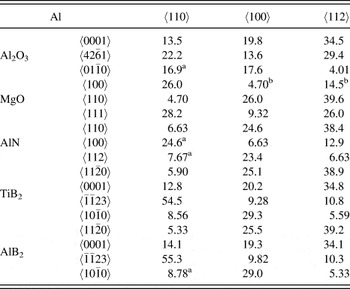
a Indicates that two or more interatomic spacings in Al match with one interatomic spacing in another.
b Indicates that one interatomic spacings in Al match with two or more interatomic spacing in another.
Interplanar spacing misfit (%) of possible matching planes between Al and Al2O3, MgO, AlN, TiB2, AlB2.
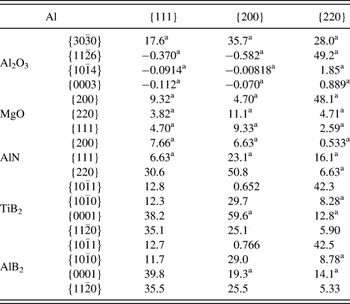
a Indicates that two or more interplanar spacings in Al match with one interplanar spacing in another.
It can be seen from Table IV that there is only one possible direction matching pair,
 ${\left\langle {112} \right\rangle _{{\rm{Al}}}}//{\left\langle {01\bar 10} \right\rangle _{{\rm{A}}{{\rm{l}}_2}{{\rm{O}}_3}}}$
, for Al/Al2O3 system, and its interatomic spacing misfit is 4.01%. In terms of Al/MgO system, the absolute interatomic spacing misfit of 〈100〉Al//〈100〉MgO, 〈110〉Al//〈110〉MgO, and 〈100〉Al//〈111〉MgO are less than 10%, which are 4.7, 4.7, and 9.32%, respectively. The Al/AlN system have four possible direction matching pairs, they are 〈110〉Al//〈110〉AlN, 〈110〉Al//〈112〉AlN, 〈112〉Al//〈112〉AlN, 〈100〉Al//〈100〉AlN, the interatomic spacing misfit are all close to 7%. Similarly, the Al/TiB2 system also have four possible direction matching pairs, they are
 ${\left\langle {110} \right\rangle _{{\rm{Al}}}}//{\left\langle {11\bar 20} \right\rangle _{{\rm{Ti}}{{\rm{B}}_2}}}$
,
 ${\left\langle {110} \right\rangle _{{\rm{Al}}}}//{\left\langle {10\bar 10} \right\rangle _{{\rm{Ti}}{{\rm{B}}_2}}}$
,
 ${\left\langle {100} \right\rangle _{{\rm{Al}}}}//{\left\langle {\bar 1\bar 123} \right\rangle _{{\rm{Ti}}{{\rm{B}}_2}}}$
,
 ${\left\langle {112} \right\rangle _{{\rm{Al}}}}//{\left\langle {10\bar 10} \right\rangle _{{\rm{Ti}}{{\rm{B}}_2}}}$
, and the matching direction pairs of Al/AlB2 are the same as Al/TiB2.
Obviously, it can be seen from Table V that the possible matching plane pairs for Al/Al2O3 system are
 ${\left\{ {111} \right\}_{{\rm{Al}}}}//{\left\{ {10\bar 14} \right\}_{{\rm{A}}{{\rm{l}}_2}{{\rm{O}}_3}}}$
,
 ${\left\{ {200} \right\}_{{\rm{Al}}}}//{\left\{ {10\bar 14} \right\}_{{\rm{A}}{{\rm{l}}_2}{{\rm{O}}_3}}}$
,
 ${\left\{ {220} \right\}_{{\rm{Al}}}}//{\left\{ {10\bar 14} \right\}_{{\rm{A}}{{\rm{l}}_2}{{\rm{O}}_3}}}$
,
 ${\left\{ {200} \right\}_{{\rm{Al}}}}//{\left\{ {0003} \right\}_{{\rm{A}}{{\rm{l}}_2}{{\rm{O}}_3}}}$
,
 ${\left\{ {220} \right\}_{{\rm{Al}}}}//{\left\{ {0003} \right\}_{{\rm{A}}{{\rm{l}}_2}{{\rm{O}}_3}}}$
. In terms of Al/MgO system, the absolute interplanar spacing misfit of {111}Al//{220}MgO, {111}Al//{111}MgO, {200}Al//{200}MgO, {220}Al//{220}MgO, {220}Al//{111}MgO are less than 6%, which were calculated to be 3.82%, 4.7%, 4.7%, 4.7%, and 2.59%, respectively. The Al/AlN system have two possible plane matching pairs, they are {111}Al//{111}AlN and {220}Al//{220}AlN, both of the interatomic spacing misfit are close to 6.6%. Similarly, the Al/TiB2 system also have two possible plane matching pairs, they are
 ${\left\{ {200} \right\}_{{\rm{Al}}}}//{\left\{ {10\bar 11} \right\}_{{\rm{Ti}}{{\rm{B}}_2}}}$
and
 ${\left\{ {220} \right\}_{{\rm{Al}}}}//{\left\{ {11\bar 20} \right\}_{{\rm{Ti}}{{\rm{B}}_2}}}$
, and the matching plane pairs of Al/AlB2 are the same as Al/TiB2.
Besides, one of the another important rule for predicting a probable OR by edge-to-edge matching model is the matching directions should belong to the matching planes accordingly. Hence, the ORs between the aforementioned inclusions and Al matrix have been predicted as follows. For Al/Al2O3 system, only one possible OR has been predicted,
 ${\left\{ {220} \right\}_{{\rm{Al}}}}//{\left\{ {0003} \right\}_{{\rm{A}}{{\rm{l}}_2}{{\rm{O}}_3}}}$
,
 ${\left\langle {112} \right\rangle _{{\rm{Al}}}}//{\left\langle {01\bar 10} \right\rangle _{{\rm{A}}{{\rm{l}}_2}{{\rm{O}}_3}}}$
, while seven ORs have been predicted in Al/MgO system, they are {200}Al//{200}MgO, 〈100〉Al//〈100〉MgO; {220}Al//{220}MgO, 〈100〉Al//〈100〉MgO; {200}Al//{200}MgO, 〈110〉Al//〈110〉MgO; {111}Al//{220}MgO, 〈110〉Al//〈110〉MgO; {220}Al//{220}MgO, 〈110〉Al//〈110〉MgO; {220}Al//{220}MgO, 〈100〉Al//〈111〉MgO; {220}Al//{111}MgO, 〈110〉Al//〈110〉MgO. For systems of Al/AlN, Al/TiB2, and Al/AlB2 all predicted to have two ORs, as follows, {220}Al//{200}AlN, 〈110〉Al//〈110〉AlN and {220}Al//{200}AlN, 〈100〉Al//〈100〉AlN for Al/AlN,
 ${\left\{ {200} \right\}_{{\rm{Al}}}}//{\left\{ {10\bar 11} \right\}_{{\rm{Ti}}{{\rm{B}}_2}}}$
,
 ${\left\langle {110} \right\rangle _{{\rm{Al}}}}//{\left\langle {11\bar 20} \right\rangle _{{\rm{Ti}}{{\rm{B}}_2}}}$
, and
 ${\left\{ {220} \right\}_{{\rm{Al}}}}//{\left\{ {11\bar 20} \right\}_{{\rm{Ti}}{{\rm{B}}_2}}}$
,
 ${\left\langle {112} \right\rangle _{{\rm{Al}}}}//{\left\langle {10\bar 10} \right\rangle _{{\rm{Ti}}{{\rm{B}}_2}}}$
for Al/TiB2,
 ${\left\{ {200} \right\}_{{\rm{Al}}}}//{\left\{ {10\bar 11} \right\}_{{\rm{Al}}{{\rm{B}}_2}}}$
,
 ${\left\langle {110} \right\rangle _{{\rm{Al}}}}//{\left\langle {11\bar 20} \right\rangle _{{\rm{Al}}{{\rm{B}}_2}}}$
, and
 ${\left\{ {220} \right\}_{{\rm{Al}}}}//{\left\{ {11\bar 20} \right\}_{{\rm{Al}}{{\rm{B}}_2}}}$
,
 ${\left\langle {112} \right\rangle _{{\rm{Al}}}}//{\left\langle {10\bar 10} \right\rangle _{{\rm{Al}}{{\rm{B}}_2}}}$
for Al/AlB2.
III. REFINEMENT OF THE ORIENTATION RELATIONSHIPS
According to the edge-to-edge matching model, the matching directions are parallel to each other, while the matching planes are allowed to have a few degree rotation around matching directions. Accordingly, the obtained ORs predicted above need to be further refined with the Δg theory. Reference Weatherly and Zhang15,Reference Zhang and Purdy23,Reference Zhang and Weatherly25 Determination of rotation angle between matching plane pairs can be computed using the method described in Ref. Reference Zhang, Chen, Ren and Kelly45 proposed by Zhang, which was based on the actual lattice parameters of each structures. The process can be easily being demonstrated using simulated electron spot diffraction patterns. The first step is to find another plane pair, which will generate a Δg 2. The selection of the second plane pair was based on the criteria specified in Ref. Reference Zhang, Chen, Ren and Kelly45. Then construct the spot diffraction patterns using the matching directions as zone axis for both phases, and overlapping the two patterns with the zone axis parallel. Thirdly, fix one pattern, and rotate the other one about the matching direction to make the Δg 1, generated from predicted matching planes, parallel to Δg 2, then the precise value of rotation angle can be identified.
The Al/Al2O3 system will be used as an example to demonstrate the determination of the rotation angle between matching plane pairs with Δg method, since it is impossible to cover all the predicted ORs in present work. According to the above, the second plane pair is selected to be
 ${\left\{ {\bar 1\bar 11} \right\}_{{\rm{Al}}}}//{\left\{ {\bar 3033} \right\}_{{\rm{A}}{{\rm{l}}_2}{{\rm{O}}_3}}}$
, Fig. 3(a) is the simulated spot diffraction pattern of Al and Al2O3 on the zone axes of
 ${\left\langle {112} \right\rangle _{{\rm{Al}}}}//{\left\langle {01\bar 10} \right\rangle _{{\rm{A}}{{\rm{l}}_2}{{\rm{O}}_3}}}$
, where the g of
 ${\left\{ {2\bar 20} \right\}_{{\rm{Al}}}}$
is set to be parallel to the g of
 ${\left\{ {0003} \right\}_{{\rm{A}}{{\rm{l}}_2}{{\rm{O}}_3}}}$
, clockwise rotation of the pattern of Al2O3 by 5.3947 deg leads to Δg
1, formed by
 ${\left\{ {2\bar 20} \right\}_{{\rm{Al}}}}//{\left\{ {0003} \right\}_{{\rm{A}}{{\rm{l}}_2}{{\rm{O}}_3}}}$
, being parallel to Δg
2, formed by
 ${\left\{ {\bar 1\bar 11} \right\}_{{\rm{Al}}}}//{\left\{ {\bar 3033} \right\}_{{\rm{A}}{{\rm{l}}_2}{{\rm{O}}_3}}}$
, as shown in Fig. 3(b). Therefore, the OR was defined with the combination of the parallel matching directions, matching planes, and the rotation angle between two crystals around matching directions. Then, the final OR for Al/Al2O3 system is refined to be {220}Al 5.39 deg from
 ${\left\{ {0003} \right\}_{{\rm{A}}{{\rm{l}}_2}{{\rm{O}}_3}}}$
,
 ${\left\langle {112} \right\rangle _{{\rm{Al}}}}//{\left\langle {01\bar 10} \right\rangle _{{\rm{A}}{{\rm{l}}_2}{{\rm{O}}_3}}}$
. Thus, all the predicted ORs above have been refined, and the results are listed in Table VI.
Simulated electron spot diffraction patterns of Al and Al2O3 on the zone axes of
 ${\left\langle {112} \right\rangle _{{\rm{Al}}}}//{\left\langle {01\bar 10} \right\rangle _{{\rm{A}}{{\rm{l}}_2}{{\rm{O}}_3}}}$
: (a) originally set the g of
 ${\left\{ {2\bar 20} \right\}_{{\rm{Al}}}}$
being parallel to the g of
 ${\left\{ {0003} \right\}_{{\rm{A}}{{\rm{l}}_2}{{\rm{O}}_3}}}$
; and (b) clockwise rotation of the pattern of Al2O3 by 5.39 deg leads to Δg
1 being parallel to Δg
2.

The predicted ORs between Al and Al2O3, MgO, AlN, TiB2, AlB2.

IV. DISCUSSION
As stated above, 1, 7, 2, 2, and 2 ORs between Al and Al2O3, MgO, AlN, TiB2, and AlB2, respectively, have been predicted and refined via edge-to-edge matching model. For Al2O3, only one possible OR has been predicted, the d-value mismatch,
Reference Zhang, Kelly, Easton and Taylor35
0.89%, occurs between the {0003} of Al2O3 and the third close packed plane, {220}, of Al, which is quite small among all the studied systems, and the interatomic spacing misfit along matching directions is slightly smaller than other predicted matching directions. In terms of the predicted ORs of Al/MgO system, the smallest d-value mismatch occurs between the close packed plane, {111}, of MgO and the third close packed plane, {220}, of Al, while the interatomic spacing misfit along matching direction pair of
 ${\left\langle {100} \right\rangle _{{\rm{Al}}}}//{\left\langle {110} \right\rangle _{{\rm{MgO}}}}$
is quite larger than other pairs. Two ORs have been predicted for Al/AlN, they occur in the same matching plane pair, {220}Al//{200}AlN, with a d-value mismatch of 0.53%, which is the smallest mismatch value among all the studied systems. And the interatomic spacing misfit along matching direction pairs are quite closed. For TiB2 and AlB2, the smallest d-value mismatch occurs between the close packed plane,
 $\left\{ {10\bar 11} \right\}$
, of the inclusions and the second close packed plane, {200}, of Al. Both of them have been predicted to have two ORs with Al, which is quite agreed well with the reported ORs determined by electron spot diffraction in and ORs predicted in Zhang’s work.
Reference Zhang, Kelly, Easton and Taylor35
As reported from Ouyang
Reference Ouyang and Luo46
that the OR of
 ${\left\{ {111} \right\}_{{\rm{Al}}}}//{\left\{ {1\bar 210} \right\}_{{\rm{A}}{{\rm{l}}_2}{{\rm{O}}_3}}}$
,
 ${\left\langle {11\bar 2} \right\rangle _{{\rm{Al}}}}//{\left\langle {11\bar 10} \right\rangle _{{\rm{A}}{{\rm{l}}_2}{{\rm{O}}_3}}}$
,
 ${\left\langle {10\bar 1} \right\rangle _{{\rm{Al}}}}//{\left\langle {20\bar 21} \right\rangle _{{\rm{A}}{{\rm{l}}_2}{{\rm{O}}_3}}}$
between Al and Al2O3 has been observed by TEM, which is different from the prediction in present work, so there is a lack of experimental data to prove the correctness of prediction OR of {220}Al 5.3947 deg from
 ${\left\{ {0003} \right\}_{{\rm{A}}{{\rm{l}}_2}{{\rm{O}}_3}}}$
,
 ${\left\langle {112} \right\rangle _{{\rm{Al}}}}//{\left\langle {01\bar 10} \right\rangle _{{\rm{A}}{{\rm{l}}_2}{{\rm{O}}_3}}}$
. But the predicted OR for Al/Al2O3 is similar to Pilania’s work, which was based on molecular dynamics simulations,
Reference Pilania, Thijsse, Hoagland, Lazić, Valone and Liu47
and the obtained results for Al/MgO is similar to Yang’s work.
Reference Yang, Xia, Babu and Li48
However, there is still no direct data to support the results of Al/AlN in present work. Though there are no available experimental data to support the predicted OR between Al and Al2O3, MgO, AlN, however, taking account of the application of edge-to-edge matching model in Refs. Reference Zhang and Kelly26, Reference Zhang and Kelly28–Reference Zhang and Kelly31, Reference Ye, Ning, Wang, Huang and Rong49, and Reference Yang, Wang, Wu, Wang and Zhang50, we believe our predicted ORs are credible. Furthermore, the ORs obtained in present work should serve as a good reference for further investigation.
Generally, the lattice strain energy between two phases always evolved to interfacial energy. From the interfacial energy point of view, a favored OR always corresponds to a low interfacial energy and a relatively stable mode in thermodynamics. In present work, the more ORs exist between Al matrix and inclusions means that the more patterns of inclusions may exist in molten aluminum. Therefore, it can be concluded that MgO is the most likely to be wetted and Al2O3 is the most difficult to be wetted by aluminum melt among all the studied inclusions, since seven and one ORs with Al have been predicted, respectively. As for AlN, TiB2, and AlB2, two possible ORs between Al have been predicted with edge-to-edge matching model for all of the above three. And the ORs between Al and AlB2 were found to be more favored, owing to the relatively lower interatomic misfit, followed by ORs between Al and TiB2. That is to say, the wettability of Al to the studied inclusions could rank as MgO, AlB2, TiB2, AlN, Al2O3 in the order of decreasing.
The purpose of purification of aluminum melt is to remove unwanted component from molten aluminum. When those inclusions are presented in the melt, a higher interfacial energy between Al and inclusion means a lower free energy was required to drive the separation progress. Hence, a lower interfacial energy between Al and inclusions means that it is more difficult to remove these inclusions from molten aluminum or it is preferred to remain in melt under the same purification process. Thus, from the perspective of crystallography features, the removability from aluminum melt of the studied inclusions could rank as MgO, AlB2, TiB2, AlN, Al2O3 in the order of increasing. That is to say MgO is the most stubborn particle for its removing from aluminum melt.
Moreover, in a solid material system a high-energy interface is more likely to become a stress concentration point, causing cracks and premature failure for a processed component. In this regard the adversely effect of Al2O3 is the biggest, MgO has the minimal impact, when the studied inclusions were residual in aluminum alloy. That is to say, Al2O3 have a higher sensitivity to the performance of a processed aluminum alloy component than other inclusions.
V. SUMMARY AND CONCLUSION
The OR between Al matrix and several typical inclusions, Al2O3, MgO, AlN, TiB2, and AlB2, in Al alloy have been studied by edge-to-edge matching model. Several remarks could be deduced as follows.
-
(1) The close packed or nearly close packed directions and planes have been derived based on the actual crystal structure and atom position of Al, Al2O3, MgO, AlN, TiB2, and AlB2, and interatomic spacing misfit along matching directions and the interplanar spacing misfit of matching planes were calculated.
-
(2) The ORs between Al and Al2O3, MgO, AlN, TiB2, AlB2 were predicted with criteria of the interatomic spacing misfit along matching directions and the interplanar spacing misfit of matching planes were less than 10 and 6%, which were predicted to have 1, 7, 2, 2, and 2 ORs with Al, respectively, and every predicted OR were refined according to Δg theory.
-
(3) The predictions indicate that the wettability of Al to the studied inclusions could rank as MgO, AlB2, TiB2, AlN, Al2O3 in the order of decreasing, while the removability of the studied inclusions from aluminum melt rank in a opposite way from the perspectives of crystallography features of interfacial energy.
-
(4) Al2O3 has a higher sensitivity to the performance of a processed aluminum alloy component than other inclusions, and MgO has the minimal impact, when the studied inclusions were residual in aluminum alloy.
ACKNOWLEDGMENTS
Valuable discussions with Dr Xian-Wei Ren is gratefully appreciated. The work were financially and technically supported by the Fundamental Research Funds for the Central Universities of Central South University (Grant No. 2015zzts042).