





Highlights
-
• Investigated cued versus voluntary switching in Arabic–French bilinguals
-
• Voluntary switching led to reduced switch and mixing costs
-
• Balanced bilinguals showed a mixing benefit in voluntary switching
-
• Highlights the necessity of assessing individual variability factors to better understand language control
-
• Supports the use of voluntary paradigms to reflect real-life language use in frequent code switchers
1. Introduction
The literature on language control in bilinguals, defined as “the cognitive mechanism that allows bilinguals to correctly speak in one language avoiding interference from the nontarget language” (Branzi et al., Reference Branzi, Della Rosa, Canini, Costa and Abutalebi2016, p. 2367), suggests that all bilingual speakers do not control languages in the same way. This has been attributed to both internal factors, i.e., language dominance, proficiency, age of acquisition (AoA) and external factors, i.e., the communication context and the type of interlocutors.
Bilingual language use also differs across populations: some bilinguals use languages in a compartmentalized manner, limiting the use of particular languages to certain communication contexts and avoiding to mix them; for instance, they may use one language at work, another at home. Other bilinguals, often those who are part of a larger bilingual community, make use of their languages in a more integrated manner, by mixing them within the same communication context (Gullifer & Titone, Reference Gullifer and Titone2020). Thus, different bilinguals may need to exert varying levels of language control depending on the interactional context and even on their broader language environment.
In the laboratory setting, one way these control processes have been studied was with cued bilingual picture-naming paradigms, in order to measure the cognitive cost of language switching (Costa & Santesteban, Reference Costa and Santesteban2004). When bilingual individuals switch between language A and language B during a naming task, it incurs cognitive costs: switch and mixing costs. Switch costs reflect temporary adjustments between tasks from trial to trial and indicate reactive control (Declerck et al., Reference Declerck, Philipp and Koch2013; Festman & Mosca, Reference Festman, Mosca and Schwieter2016; Mosca & Clahsen, Reference Mosca and Clahsen2016), while mixing costs reflect a sustained control process across all trials in mixed blocks and indicate proactive control (Festman & Schwieter, Reference Festman, Schwieter and Schwieter2015). These costs are similar to what is observed in broader task-switching paradigms (Rogers & Monsell, Reference Rogers and Monsell1995), where switching between tasks also incurs a processing delay. Although language-switching paradigms (LSP) have shown that switch and mixing costs do occur in most bilinguals, less attention has been given to those who frequently engage in dense code-switching, using two languages in an integrated, non-compartmentalized way in their daily lives. For these bilinguals who routinely mix languages, called “frequent code switchers” (FCS), language behaviors may differ, potentially offering new insights into switch and mixing costs (Gosselin & Sabourin, Reference Gosselin and Sabourin2023).
1.1. Language control in bilinguals
Language switching in bilinguals can be either internally motivated by the speaker, such as due to greater ease of lexical access or to better convey an idea, or externally triggered by contextual factors. These external factors may include the context (e.g., working in an international company may require using English in the work environment, while using another or other languages at home and for socializing) or the interlocutor (e.g., a German–French bilingual must necessarily speak German when interacting with a German monolingual person).
These differences have been modeled by Green and Abutalebi (Reference Green and Abutalebi2013), who introduced the adaptive control hypothesis (ACH), suggesting that bilinguals primarily navigate between 3 interactional contexts:
-
1. Single-language context: Each language is spoken in a specific environment. For instance, English may be spoken exclusively at work and French at home. This setup reflects a compartmentalized use of languages, where language switching rarely occurs. Through control processes such as interference control and goal maintenance, the bilingual speaker is able to use only one language in each distinct context.
-
2. Dual-language context: Both languages are spoken in the same environment but used with different interlocutors. For example, in a shop, a German–French bilingual may speak German with their spouse and French with the cashier. In this case, switching between languages occurs based on the interlocutor but not within the same utterance. The speaker relies on selective response inhibition and engages or disengages in a conversation by detecting salient cues from their interlocutor.
-
3. Dense code-switching context: The bilingual speaker uses both languages in the same utterance, switching frequently between the two languages. This pattern is characteristic of bilingual populations who grow up with multiple languages, such as the Lebanese community. In Lebanon, Lebanese Arabic,Footnote 1 French and/or English are often used in the same sentence, to the point where Lebanese people are known for the trilingual sentence: “[Hi]EN [kifak]AR [ça va]FR?” (translation: Hi how are you, are you okay?). In this situation, the speaker engages in opportunistic planning, using the language that is most readily available to express their idea.
Thus, control of languages used in each of these three contexts is variable. In fact, the bilingual speaker may be able to dissociate languages, using only one in a single-language context, separating the two (or more) languages in a dual-language context or mixing them within the same sentence in a dense code-switching context. However, the different situations require specific cognitive processes, such as interference control and selective response inhibition (Green & Abutalebi, Reference Green and Abutalebi2013). Despite these processes, “slips of the tongue” may still occur involuntarily, reflecting occasional lapses in control. The degree of language control required in each context is modeled in Green and Wei’s (Reference Green and Wei2014) Control Process Model of Code-Switching, which identifies three modes of code-switching: competitive, coupled/cooperative and open control. In single-language and dual-language contexts from the ACH, corresponding, respectively, to monolingual and cued language switching, languages are in a competitive mode, whereas in a dense code-switching context, FCS rely on cooperative or open control, drawing on the language that comes to mind first. Types of code-switching are also closely linked to control mode. In single- and dual-language settings, where languages are in competitive control, switching within an utterance is not intended. However, lapses in control may surface as brief alternations, corresponding to Muysken’s (Reference Muysken and Pütz1997) alternational code-switching, typically involving the use of short phrases from the nontarget language. In contrast, cooperative and open control, characteristic of dense code-switching contexts, are associated with insertional and congruent lexicalization patterns, respectively, reflecting more integrated language use. Furthermore, interindividual variability in language control has been attributed to factors such as language proficiency, language dominance and the AoA of the languages (Bonfieni et al., Reference Bonfieni, Branigan, Pickering and Sorace2019; Kheder & Kaan, Reference Kheder and Kaan2021).
To evaluate language control in the laboratory setting, bilingual LSP have emerged (Christoffels et al., Reference Christoffels, Firk and Schiller2007; Costa & Santesteban, Reference Costa and Santesteban2004). These paradigms primarily focus on measuring reaction times (RT) during bilingual picture naming, and they establish the cognitive cost associated with switching between languages. They rely on the ACH’s contexts, where monolingual blocks correspond to single-language context, cued blocks to dual-language context and voluntary blocks to dense code-switching.
1.2. Language-switching paradigms
LSP are a tool allowing to investigate the cognitive mechanisms behind language control. These paradigms differ in both their type and the linguistic materials used to assess language production in naming tasks. In a comprehensive literature review, Declerck and Philipp (Reference Declerck and Philipp2015) identify four types of LSP: (1) cued, (2) alternating, (3) sequence-based and (4) voluntary. The current study focuses on types (1) and (4), which are of particular interest when focusing on FCS. The material used in these paradigms typically consists of visual stimuli such as digits or images, which serve to elicit the concept to be named.
The cued LSP (1) is one of the earliest and most commonly used paradigms described in the literature, inspired by task-switching research (Rogers & Monsell, Reference Rogers and Monsell1995) and adapted to language behavior (Costa & Santesteban, Reference Costa and Santesteban2004; Meuter & Allport, Reference Meuter and Allport1999). A color cue or flag is presented alongside the target image, with each cue corresponding to one of the languages of the task (usually two languages). Two types of trials emerge in cued LSP: stay/non-switch/repetition Footnote 2 trials, where consecutive items are named in the same language (indicated by an identical cue), and switch trials, where consecutive items are named in different languages (indicated by a different cue). Numerous studies (Christoffels et al., Reference Christoffels, Firk and Schiller2007; Costa & Santesteban, Reference Costa and Santesteban2004; Jevtović et al., Reference Jevtović, Duñabeitia and de Bruin20 Reference De Bruin, Samuel and Duñabeitia20) have shown poorer performance in switch trials compared to stay trials, demonstrating that switching languages incurs a cognitive cost, known as the “switch cost.” Switch costs are calculated as the difference in RT between switch and stay trials. These costs reflect transient, trial-to-trial control processes, short-term adjustments made when switching languages. These adjustments involve reconfiguring the internal task set, updating goals and linking the relevant stimulus–response mappings for the new language. Since these processes are activated only during a language switch, switch costs typically manifest as temporary spikes in cognitive demand, leading to slower RTs in switch trials compared to stay trials (Braver et al., Reference Braver, Reynolds and Donaldson2003).
Moreover, each LSP includes monolingual Footnote 3 blocks that match the number of languages in the task (typically two). These monolingual blocks serve as baselines for the bilingual blocks, which represent the target LSP. Multiple studies (Christoffels et al., Reference Christoffels, Firk and Schiller2007; Declerck et al., Reference Declerck, Philipp and Koch2013; Festman & Schwieter, Reference Festman, Schwieter and Schwieter2015) have found that performance in bilingual blocks is generally poorer compared to monolingual blocks, a phenomenon known as “mixing costs.” Mixing costs are computed as the difference in RT between stay trials in bilingual conditions and blocked trials in monolingual conditions. They reflect sustained control processes and arise from the ongoing cognitive effort required to maintain multiple language systems over time, involving the continuous monitoring and activation of both languages while inhibiting the nontarget language. Because these processes are maintained across trials, mixing costs represent the cumulative cognitive load of managing dual-language conditions, resulting in slower RTs compared to single-language trials (Braver et al., 2003).
1.3. Cued versus voluntary language switching
Research on language switching has largely focused on switch costs in cued LSP representing controlled use of languages (Christoffels et al., Reference Christoffels, Firk and Schiller2007; Costa & Santesteban, Reference Costa and Santesteban2004). More recent research has focused on voluntary language switching, testing the dense code-switching context of the ACH, especially in populations of FCS and balanced bilinguals (Blanco-Elorrieta & Pylkkänen, Reference Blanco-Elorrieta and Pylkkänen2017; De Bruin et al., Reference De Bruin, Samuel and Duñabeitia2018; Jevtović et al., Reference Jevtović, Duñabeitia and de Bruin20 Reference De Bruin, Samuel and Duñabeitia20; Kennis et al., Reference Kennis, Zheng, de Bruin and Piai2024).
In contrast to cued LSP where language choice is externally dictated through external cues, voluntary LSP (4) is a paradigm where participants freely choose the language to use for naming each image. No external cue or language monitoring is required, allowing the participant to use the more accessible language. This paradigm closely mirrors everyday bilingual behavior in FCS, where they switch languages freely based on internal factors (e.g., personal needs and lexical access), rather than responding to laboratory-based cues. In this paradigm, switch costs are often reduced (Jevtović et al., Reference Jevtović, Duñabeitia and de Bruin2020; Kennis et al., Reference Kennis, Zheng, de Bruin and Piai2024; Zhu et al., Reference Zhu, Blanco-Elorrieta, Sun, Szakay and Sowman2022) or even absent (Adamou & Shen, Reference Adamou and Shen2019; Kleinman & Gollan, Reference Kleinman and Gollan2016; Liu et al., Reference Liu, Tong, de Bruin, Li, He and Li2020). Mixing costs may also be reduced (De Bruin & McGarrigle, Reference De Bruin and McGarrigle2024; Zhu et al., Reference Zhu, Blanco-Elorrieta, Sun, Szakay and Sowman2022) and even inverted, potentially leading to a mixing benefit in FCS (De Bruin et al., Reference De Bruin, Samuel and Duñabeitia2018; Mooijman et al., Reference Mooijman, Schoonen, Roelofs and Ruiter2024b). The mixing benefit, observed primarily in balanced bilinguals, has been interpreted as evidence that for these bilinguals, freely switching languages may even be easier than having to stay in one.
In cued LSP, switch costs were found to be large, as the external cue imposed by the task leads to additional cognitive demands. These external cues require the activation of both the target language and its corresponding control mechanisms, while simultaneously inhibiting the nontarget language (Green, Reference Green1998). As a result, when bilinguals switch between languages in a cued LSP, the need to inhibit the nontarget language results in slower responses and a notable increase in RT compared to stay trials (Costa & Santesteban, Reference Costa and Santesteban2004; Meuter & Allport, Reference Meuter and Allport1999). However, the switch cost is often significantly reduced in bilingual naming situations where no cue is involved. As we have seen above, in voluntary picture naming, bilinguals are free to switch between languages at will, and for FCS, this flexibility often results in significantly lower switch costs (De Bruin et al., Reference De Bruin, Samuel and Duñabeitia2018; Jevtović et al., Reference Jevtović, Duñabeitia and de Bruin20 Reference De Bruin, Samuel and Duñabeitia20; Mooijman et al., Reference Mooijman, Schoonen, Ruiter and Roelofs2024a). On the contrary, more attentional resources are required in cued switching compared to voluntary, as reflected by longer RTs and higher workload ratings (de Bruin & McGarrigle, Reference De Bruin and McGarrigle2024). These results, often based on behavioral data, were confirmed by magnetoencephalography (MEG) analyses (Blanco-Elorrieta & Pylkkänen, Reference Blanco-Elorrieta and Pylkkänen2017). Switch costs were also found in more ecological, sentence-based switching paradigms, but only in the L2 (Sánchez et al., Reference Sánchez, Struys and Declerck2022; Titus & Peeters, Reference Titus and Peeters2024), potentially indicating that daily language-switching costs are less pronounced than in laboratory single-word LSP.
With respect to mixing costs, some studies have found that voluntary switching can lead to lower cognitive costs compared to cued switching, with reduced mixing costs in voluntary conditions. For instance, in a study on 32 Spanish–Basque bilinguals, Jevtović et al. (Reference Jevtović, Duñabeitia and de Bruin20 Reference De Bruin, Samuel and Duñabeitia20) used two picture-naming tasks, one purely voluntary and one with intermixed cued and voluntary trials, and found lower mixing costs in the voluntary trials of the intermixed condition compared to the cued condition. Interestingly, some studies even report a mixing benefit rather than a cost, where bilinguals respond faster when they can switch languages freely than when restricted to a single language. In an extensive study on switching costs and benefits, Gollan and Ferreira (Reference Gollan and Ferreira2009) assessed 73 Spanish–English bilinguals using a voluntary LSP. They found, among other results, that unbalanced English-dominant bilinguals exhibited a mixing benefit, whereas balanced bilinguals showed a mixing cost even when switching voluntarily. Similarly, De Bruin et al. (Reference De Bruin, Samuel and Duñabeitia2018), in two studies involving 55 and 45 Spanish–Basque bilinguals, respectively, found a clear mixing benefit in the voluntary condition compared to the cued one. This mixing benefit can be particularly pronounced in bilinguals with lower proficiency in one language and may suggest that freely using both languages is less demanding than being restricted to just one, due to lower suppression of the nontarget language.
Voluntary switching is characteristic of FCS, individuals who frequently switch and mix languages in daily life. This phenomenon is not limited to specific individuals but can also be observed across entire populations, such as in Catalonia and Lebanon. Both societies are characterized by widespread multilingualism, where language switching is deeply ingrained in everyday communication. For FCS, voluntarily switching languages is the closest laboratory situation to their ecological use of languages, because it reflects the way they use languages in everyday communicative contexts. Additionally, FCS exhibit varying patterns of code-switching, which can be influenced by more personal factors. These individual differences highlight the diversity in how language control is managed and provide insight into the cognitive and sociocultural dynamics of voluntary switching.
1.4. Factors of variability in language switching for FCS
The various interindividual factors influencing language-switching behaviors of FCS include language dominance, L2 proficiency, length of residence in a host country, daily code-switching habits and language entropy. Previous literature has highlighted the importance of assessing these factors in bilingualism research, and especially in language-switching studies, in order to have comprehensive and comparable language experience information (De Bruin, Reference De Bruin2019; Nortier, Reference Nortier, Wei and Moyer2008; Olson, Reference Olson2024; Tomoschuk et al., Reference Tomoschuk, Ferreira and Gollan2019). While some of these factors, such as L2 proficiency and code-switching habits, were first considered only as control measures or simple demographic information (Hirsch et al., Reference Hirsch, Declerck and Koch2015; Kleinman & Gollan, Reference Kleinman and Gollan2016; Mosca & Clahsen, Reference Mosca and Clahsen2016), a growing body of research is now taking them into account in analyses of switch and mixing costs (Bonfieni et al., Reference Bonfieni, Branigan, Pickering and Sorace2019; Mooijman et al., Reference Mooijman, Schoonen, Ruiter and Roelofs2024a; Wagner et al., Reference Wagner, Bekas and Bialystok2023). For instance, language entropy (Gullifer & Titone, Reference Gullifer and Titone2020), language proficiency (Abutalebi et al., Reference Abutalebi, Della Rosa, Ding, Weekes, Costa and Green2013; Calabria et al., Reference Calabria, Costa, Green and Abutalebi2018) and language exposure (Bonfieni et al., Reference Bonfieni, Branigan, Pickering and Sorace2019; Hartanto & Yang, Reference Hartanto and Yang2016) have been shown to have an impact on bilingual language control.
1.4.1. Language dominance, L2 proficiency and length of residence
In FCS, languages are typically learned early and often used interchangeably in daily conversations. FCS generally exhibit high proficiency in all of their spoken languages, making it difficult to determine clear language dominance. Usage-based approaches to measuring language dominance, such as the bilingual language profile (BLP; Birdsong et al., Reference Birdsong, Gertken and Amengual2012), may result in FCS showing high usage percentages across multiple languages, which can lead to controversial and difficult-to-interpret findings. Thus, a more objective assessment of language proficiency is required (Luque et al., Reference Luque, Koronkiewicz, Issa, Faretta-Stutenberg and Bowden2025; Olson, Reference Olson2024), using tools such as the LexTale (Lemhöfer & Broersma, Reference Lemhöfer and Broersma2012) or DIALANG (Weber, Reference Weber2007), especially to identify balanced bilingualism. Furthermore, L2 proficiency has been found to modulate the ability to switch between languages (Bonfieni et al., Reference Bonfieni, Branigan, Pickering and Sorace2019).
Beyond language dominance and proficiency, the linguistic context in which bilinguals are embedded may influence language control (Green & Abutalebi, Reference Green and Abutalebi2013; Hartanto & Yang, Reference Hartanto and Yang2016, Reference Hartanto and Yang2020). Language exposure in a given environment can shape switching behavior. For example, an extended length of residence in a dense code-switching environment can promote greater comfort and fluency in using both languages, as observed in bilinguals with long-term exposure to such environments (Grosjean, Reference Grosjean2008). For these bilinguals, switching back to a single or dual-language environment may become challenging, as they are accustomed to fluidly integrating both languages in their communication.
1.4.2. Code-switching habits
Among the various factors influencing language-switching behavior in FCS, code-switching habits are shaped by both external factors, such as the social setting and interlocutors (Green & Abutalebi, Reference Green and Abutalebi2013), and internal factors, including language proficiency and preference. According to Grosjean’s language mode hypothesis (Reference Grosjean2008), bilinguals operate within different language modes, ranging from a monolingual mode (using only one language) to a bilingual mode (using both languages simultaneously), with the specific mode being influenced by situational and contextual factors. Social factors, such as the interlocutor’s identity (e.g., friends versus colleagues), further influence which language mode the bilingual adopts and how frequently they switch languages. The bilingual code -switching profile (BCSP; Olson, Reference Olson2022) also sheds light on how these internal and external factors contribute to an individual’s unique code-switching habits, by providing a unique subjective measure of code-switching practices, the code-switching profile (a score between 0 and 100), based on code-switching history, use, proficiency and attitudes.
1.4.3. Language entropy
In addition to more traditional variables that influence language-switching behavior, language entropy offers a novel perspective on how bilinguals use languages in their daily lives. Introduced by Gullifer and Titone (Reference Gullifer and Titone2020), this measure captures the social diversity of language use by assessing how languages are distributed across different communicative contexts. In complement with the distinctions between single-language, dual-language and dense code-switching contexts proposed in the ACH (Green & Abutalebi, Reference Green and Abutalebi2013), entropy indicates whether language use is compartmentalized across multiple communication contexts or more integrated within each of the contexts. It is computed based on responses from sociolinguistic questionnaires, typically covering home, social and work environments. Language entropy is expressed on a scale from 0 to log(n), where n represents the number of languages considered. High entropy reflects a dynamic situation where multiple languages are used interchangeably in the same social setting, leading to frequent language switching. In contrast, low entropy characterizes more rigid language separation, where each language is confined to specific domains such as home or work. The entropy score is a continuous measure of how integrated the use of multiple languages is in FCS.
2. Current study
The current study aimed to investigate behavioral switching and mixing effects in cued versus voluntary picture-naming paradigms in FCS. We collected data from 62 Lebanese adults residing in France, all of whom speak Arabic and French, two languages that are used frequently and interchangeably in daily life in Lebanon. The country is characterized by early bilingualism, with most Lebanese individuals acquiring French and/or English alongside Arabic in early childhood. Lebanese speakers generally become highly proficient in their L2 and often engage in spontaneous code-switching between Arabic and French in everyday interactions. This makes this population of FCS ideal for exploring language-switching behavior in a naturally occurring bilingual setting.
The main hypotheses of the study are as follows. We expect to find the usual switch cost observed when comparing RTs on switch trials with stay trials in bilingual task conditions (e.g., Declerck & Philipp, Reference Declerck and Philipp2015), reflecting the cognitive cost associated with switching between languages. Building upon this, our first hypothesis states that switch costs will be higher in the cued condition compared to the voluntary condition as the restriction on language choice in the cued condition requires more cognitive control. In contrast, the voluntary condition offers more flexibility, as participants can freely choose the language that is more accessible at the moment of naming, thus reducing cognitive load and minimizing switch costs (Jevtović et al., Reference Jevtović, Duñabeitia and de Bruin20 Reference De Bruin, Samuel and Duñabeitia20; Kennis et al., Reference Kennis, Zheng, de Bruin and Piai2024). Our second hypothesis concerns mixing costs (i.e., cognitive cost observed when comparing RTs of stay bilingual and blocked monolingual trials), expected to be lower in the voluntary condition compared to the cued condition or even show a mixing benefit in the voluntary condition. Indeed, allowing participants to choose the most accessible language during naming in the voluntary condition may reduce the cognitive load arising from language inhibition, as found by De Bruin et al. (Reference De Bruin, Samuel and Duñabeitia2018).
Concerning predictor variables, we investigate the impact of L2 proficiency, language entropy, code-switching profile and length of residence in France on switching performance in the cued and voluntary conditions.
2.1. Participants
Sixty-two (31 females) French-speaking Lebanese adults took part in this study and were compensated with vouchers. Participants were on average 26.5 years old (standard deviation [SD] = 4.7; range 18–35), and 71.0% had a master’s degree or a PhD degree. All participants were native speakers of Arabic, acquired around the age of 1 (M = 0.9, SD = 1.4), with French as their early L2 or even second L1 (M = 3.8, SD = 2.3). They all used English as their third language, acquired around the age of 8.4 (SD = 3.6), and were living in France at the time of the study. Sociolinguistic data were collected with a unified online questionnaire, based on the Language Experience and Proficiency Questionnaire (LEAP-Q; Marian et al., Reference Marian, Blumenfeld and Kaushanskaya2007), the BLP (Birdsong et al., Reference Birdsong, Gertken and Amengual2012) and the BCSP (Olson, Reference Olson2022), in a version adapted to Lebanese Arabic and French.Footnote 4 The characteristics of the participants are shown in Table 1.
Language background questionnaires and proficiency

Table 1. Long description
The table is structured with two main language columns, Arabic and French, each subdivided into Mean, S D, and Range.
a Self-ratings for language proficiency were provided on a scale from 0 (not well at all) to 6 (very well).
b The code-switching profile, ranging from 0 to 100, represents the degree of engagement with code-switching in the participants’ daily life: “lower scores indicate less engagement and experience with code-switching and higher scores indicate more engagement and experience with code-switching” (Olson, Reference Olson2022; p. 12).
As objective measure of language proficiency in French, we used the Oscar tool (Centre d’études de langues, 2024), granting a proficiency score between 0 and 100 and a Common European Framework of Reference for Languages (CEFR) level for each participant.
All participants had normal or corrected-to-normal vision, with no history of neurological, hearing or language impairment.
The study was approved by the ethical committee (ref. 2023_662) and the General Data Protection Regulation (ref. R-202310090959) of the University of Toulouse.
2.2. Procedure
2.2.1. Materials
Twenty-five black and white drawings were used, representing noncognate words in Arabic and French. The stimuli were taken from the database by Cycowicz, Friedman and Rothstein (Reference Cycowicz, Friedman, Rothstein and Snodgrass1997) initially developed for English and then adapted to French (Alario & Ferrand, Reference Alario and Ferrand1999) and Lebanese Arabic (Chedid et al., Reference Chedid, Sfeir, Mouzawak, Saroufim, Hayek, Wilson and Brambati2022). We controlled for name agreement, subjective frequency, familiarity and number of syllables (1–4) from these databases. We selected images present in the databases for both languages with the highest subjective frequency, corresponding to words with 90 to 100% name agreement, all the while controlling for number of syllables in both languages (median of 2 syllables per word). The final sample was distributed across five semantic categories, with five items each: animals, food, furniture, objects and others.
2.2.2. Experimental design
The experiment involved a cued and a voluntary language switch paradigm including four conditions (one block each), in which images were randomized. Each image was presented twice in every monolingual condition and four times in every bilingual condition:
-
1. Monolingual Arabic condition (50 trials): naming exclusively in Arabic in blocked trials.
-
2. Monolingual French condition (50 trials): naming exclusively in French in blocked trials.
-
3. Cued bilingual condition (100 trials): naming in Arabic or in French as indicated by a color cue presented along each item; a blue square was assigned to French and a red square to Arabic (colors were not counterbalanced). This condition included 49 switch trials and 50 stay trials; the first trial was not taken into account in the analysis. In this condition, trials were pseudo-randomized and distributed across languages and trial types (stay versus switch) in a balanced manner, resulting in comparable numbers of observations per trial type for Arabic and French.
-
4. Voluntary bilingual condition (100 trials): naming in either Arabic or French; the participant was free to use the language they wanted. It began with a neutral trial, and the number of switch and stay trials depended on each participant.
A total of 300 trials were used, distributed across these four conditions. With a total of 18,600 observations (3,100 per monolingual condition, 6,200 per bilingual condition), this design follows Brysbaert and Stevens’ (Reference Brysbaert and Stevens2018) recommendation of having at least 1,600 observations per condition to ensure sufficient statistical power. Language was treated as a within-condition factor, not as a separate experimental condition.
To determine the parameters of the experiment, a preliminary literature review on 36 articles reporting similar experiments focused on the extraction of stimulus-onset asynchrony (SOA), i.e., the delay between the beginning of one stimulus and the next, and the intertrial interval (ITI), that is, the interval between the display of the stimulus and the start of the new trial. The average SOA (2050 ms) and ITI (1101 ms) across these 36 articles were established to guide the design of our experiment. Accordingly, the following setup was used: each image remained on the screen for 2000 ms (SOA), while the microphone was active for recording. An ITI of 1000 ms preceded each stimulus involving the presentation of a blank screen and then a fixation cross during 500 ms each.
The experiment was run on a Dell® computer (15.6” screen, 1920 × 1080 pixel resolution) using PsychoPy® (Peirce et al., Reference Peirce, Gray, Simpson, MacAskill, Höchenberger, Sogo, Kastman and Lindeløv2019) v.2023.2.3 software. For each trial, responses were recorded through a Poly Blackwire 5220 USB-A Wired Headset with microphone noise cancellation.
2.2.3. Task sequence
Participants completed the online questionnaire (see Section 2.1) administered through the internal LimeSurvey® platform of University of Toulouse in their homes. The LSP was run during a session in the lab, which also involved the French proficiency test and several other experiments and executive function tests that will not be reported on here.
Prior to running the experiment, participants were familiarized with the target images to be named in both Arabic and French. This procedure ensured that the target words were activated in their mental lexicon and minimized errors stemming from unfamiliarity with the items. Before each condition, a practice segment was conducted to make sure the participant understood the instructions. To partially control for order effects, participants were assigned to one of two groups: half completed the monolingual block first, whereas the other half completed the bilingual block first. Importantly, within each block, condition order was not counterbalanced. In the monolingual block, the Arabic monolingual condition always preceded the French monolingual condition, and in the bilingual block, all participants completed the cued bilingual condition before the voluntary bilingual condition.
2.3. Data analysis
The dataset included a total of 16,838 observations after data cleaning. Data cleaning involved, for each participant and condition, the exclusion of inaccurate trials, neutral trials (corresponding to the first trial from the cued and voluntary conditions and to the trials preceded by an error), followed by the removal of RT values falling outside ±2.5 SD from the mean raw RT. This resulted in the exclusion of 9.5% of the data.
2.3.1. Accuracy and RT
For the analysis of accuracy, oral responses were recorded and later coded as correct or incorrect. Incorrect responses were (a) absent or delayed response, (b) incorrect word, (c) incorrect language for all conditions except voluntary and (d) recording failures (none noted).
RTs were provided by PsychoPy’s (Peirce et al., Reference Peirce, Gray, Simpson, MacAskill, Höchenberger, Sogo, Kastman and Lindeløv2019) internal voice key and manually checked using CheckVocal (Protopapas, Reference Protopapas2007). All responses were manually transcribed into an Excel file and annotated as correct or incorrect by an intern, with all annotations subsequently verified by the author. Responses preceded by hesitations (“uh…banane”) were manually marked as correct, and response onset was set using CheckVocal® at the beginning of the word (/b/ for the given example). All incorrect answers (0.089% of overall trials after data cleaning) were excluded from the analysis.
2.3.2. Switching
Responses from the monolingual conditions were set as blocked. In the bilingual conditions, stay trials were those preceded by a trial in the same language and switch trials were those preceded by a trial from a different language. In the cued condition, switching frequency was identical for all participants and set at 49%. In the voluntary condition, it was calculated as the number of switch trials divided by the total number of trials for each participant.
2.3.3. Switch and mixing models
All data were analyzed using the lme4 package in R (Bates et al., Reference Bates, Mächler, Bolker and Walker2015; R Core Team, 2024) for mixed-effects models (MEMs). Two models were computed, one for the switch costs hypothesis and another for the mixing costs hypothesis. RTs were log-transformed, and the categorical variables – trial type (blocked, stay, switch) and language (Arabic, French) – were contrast-coded. Arabic was coded as −0.5 and French as 0.5. English trials in the voluntary condition were coded as errors, as the instruction required the use of French or Arabic only. For the switch costs model, only stay and switch trials were included; stay trials were coded as −0.5 and switch trials as 0.5. For the mixing costs model, only stay and blocked trials were included; stay trials were coded as −0.5 and blocked trials as 0.5. Additionally, condition was treated as a four-level variable (Arabic monolingual, French monolingual, cued bilingual and voluntary bilingual).
Both models included log-transformed RTs as the dependent variable and random intercepts for participants and items. The switch costs model predicted log RT from the three-way interaction between condition, trial type and language, with L2 proficiency, code-switching profile, language entropy and length of residence in France as fixed effects, and included random slopes for condition, trial type and language by participant. All continuous predictors were z-scored prior to analysis. This model included stay and switch trials from the bilingual (cued and voluntary) conditions. The mixing costs model predicted log RT from the interaction between condition and trial type, with language and the same continuous predictors as fixed effects, and included random slopes for trial type by participant. This model included blocked trials from the monolingual conditions and stay trials from the bilingual conditions. Because language was confounded with condition in the monolingual blocks, it could not be included in the interaction structure without further dropping levels and was therefore entered only as a fixed effect.
Model selection followed an iterative procedure. Initial maximal models included random intercepts and random slopes for condition, trial type and language for both participants and items (Barr et al., Reference Barr, Levy, Scheepers and Tily2013). When models presented convergence issues or multicollinearity, as reflected by the variance inflation factor (VIF), the fixed-effects structure and random-effects structure were gradually simplified. This involved sequential removal of higher-order interactions and/or random slopes until a stable converging model was obtained. The final models represent the most complex structures supported by the data that successfully converged.
Formula for the switch costs model:
log_RT ~ condition * trial_type * language + L2_proficiency_score + code_switching_profile + overall.entropy + LOR_France + (1 + condition + trial_type + language | participant_ID) + (1 | image_name).
Formula for the mixing costs model:
log_RT ~ condition * trial_type + language + L2_proficiency_score + code_switching_profile + overall.entropy + LOR_France + (1 + trial_type | participant_ID) + (1 | image_name).
To further explore individual variability in mixing costs, exploratory analyses were conducted at the participant level. Voluntary mixing costs were computed for each participant as the difference in mean RT between blocked and stay trials and were then correlated with individual difference measures (L2 proficiency, code-switching profile, language entropy and length of residence in France) using Pearson’s correlations.
3. Results
3.1. Accuracy
The average accuracy was near ceiling across all conditions. For the monolingual blocked conditions, accuracy was perfect for both Arabic (M = 100%, SD = 0.0) and French (M = 99.8%, SD = 4.2). In the bilingual conditions, accuracy was similarly high, with participants achieving near-perfect accuracy in the voluntary bilingual condition (M = 99.8%, SD = 4.2 for switch trials; M = 99.9%, SD = 3.4 for stay trials). Likewise, in the cued bilingual condition, accuracy remained perfect in both switch (M = 100%, SD = 2.0) and stay trials (M = 100%, SD = 1.9). Given the high accuracy across conditions, this measure was not further analyzed.
3.2. Voluntary switching rate and language choice
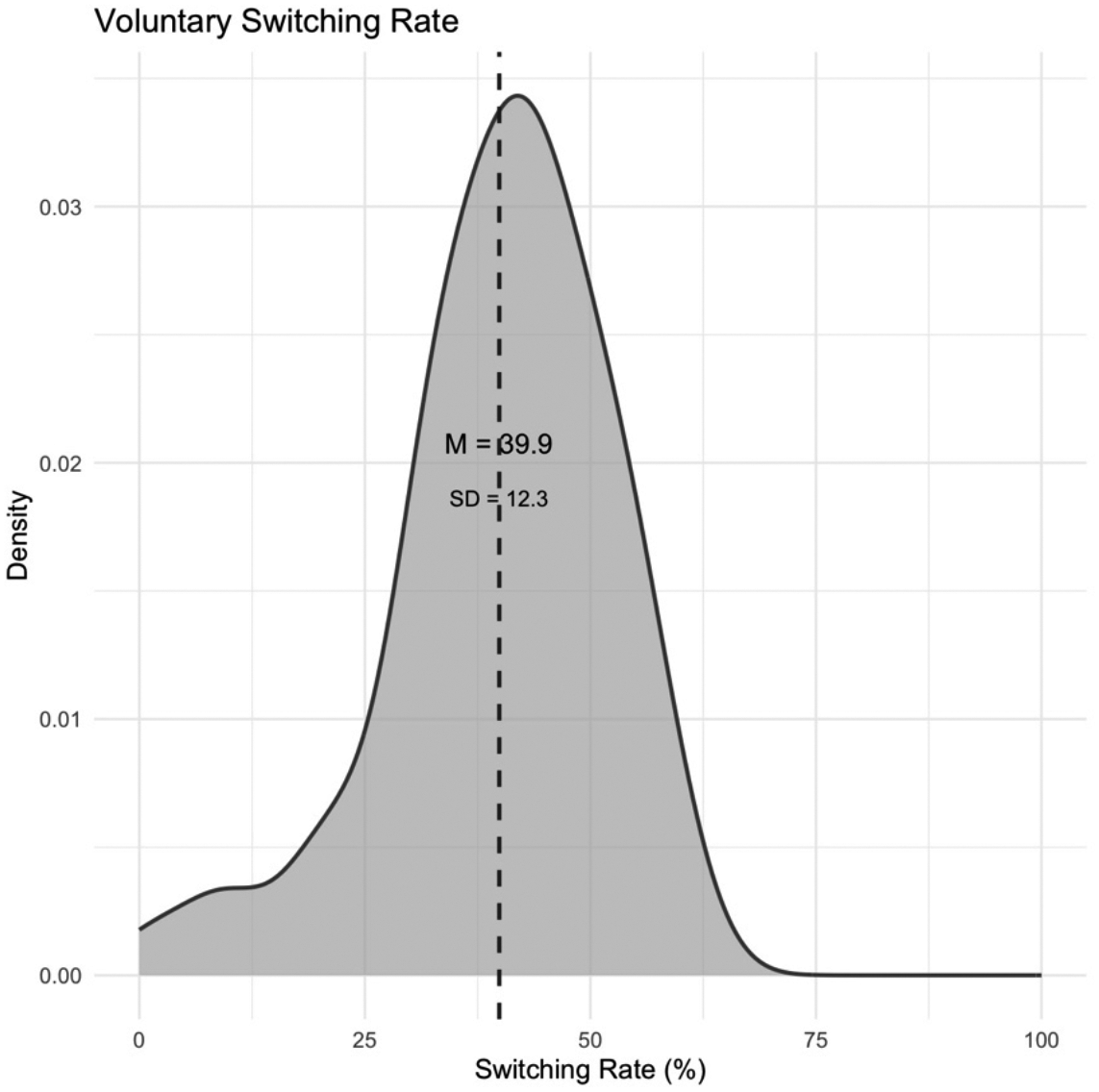
In the voluntary condition, participants switched on average 39.9% (SD = 12.3) of the trials, with switching proportion ranging from 1.1% to 61.2%. Further exploration showed that 69.3% of the participants switched between 25% and 50% of the time (see Figure 1). Across participants, 47.5% of the trials were named in Arabic, and 52.4% in French, and English was also used for 0.1% of the trials. Correlations between voluntary switching rate and individual predictors (L2 proficiency, code-switching profile, language entropy and length of residence in France) were nonsignificant (all |r| ≤ 0.26, ps > 0.05).
Switching rate in the voluntary condition.
Note: Density plot of the distribution of the switching percentage in the voluntary condition. The dotted line indicates the mean switching rate.

3.3. Switch costs model
The model on switch costs (summary in Table 2) showed that switch trials were significantly slower than stay trials (β = 0.05, t = 5.75, p < 0.001**), reflecting a switch cost (see Figure 2.). The interaction between condition and trial type was not significant (β = −0.020, t = −1.77, p = 0.0766). There was a main effect of condition, with voluntary trials showing significantly faster RT than cued (β = −0.19, t = −13.41, p < 0.001**). French responses were significantly faster than Arabic responses (β = −0.05, t = −7.33, p < 0.001**).
Results of the switch costs model

Table 2. Long description
The table consists of six columns: Predictor, Estimate, Std. error, d f, t value, and p value.
Note: The results of the switch costs model are presented in Table 2, showing the estimates, standard errors, t-values and p-values for each predictor. Significant effects are marked with asterisks. The cued condition served as the reference level for condition, stay trials as the reference level for trial type, and Arabic as the reference level for language.
Significance codes: <0.001***, 0.001**, 0.01**, 0.05*.
Violin plots for the distribution of RT across trial types, conditions and languages.
Note: Violin plots showing the distribution of RTs in Arabic (left panel) and French (right panel). For each language, the three trial types (blocked, stay and switch) are displayed for the cued (left) and the voluntary (right) condition. The median is indicated by the black horizontal line and the mean by the white dot.

Figure 2. Long description
A two-panel chart titled Reaction Times per Trial Type, Condition and Language. Both panels share a Y-axis labeled RT (m s) ranging from 500 to 2000 and an X-axis labeled Trial type with categories blocked, stay, and switch.
In all plots, the median is a black horizontal line, the mean is a white diamond dot, and the central box represents the interquartile range.
Significant interactions indicated that the RT reduction in the voluntary condition (relative to the cued) was smaller for French responses than for Arabic (condition × language: β = 0.03, t = 3.40, p < 0.001**), switch costs were larger in French than in Arabic (trial type × language: β = 0.06, t = 5.23, p < 0.001**), and the additional French switch cost was reduced under voluntary switching (three-way interaction: β = −0.06, t = −3.47, p < 0.001**). Pairwise comparisons confirmed that cued trials were significantly slower than voluntary for both stay and switch trials, with larger differences in French (all ps < 0.001**). Switch costs were substantially higher in the cued condition (M = 91.6 ms, SD = 64.4) compared to the voluntary condition (M = 29.5 ms, SD = 50.6). Among individual variability measures, higher language entropy was associated with faster responses across conditions and trial types (β = −0.14, t = −2.35, p = 0.0226*). Daily code-switching frequency, reflected by the code-switching profile, showed only a marginal effect (β = 0.002, t = 2.00, p = 0.0504). Neither French L2 proficiency nor length of residence in France significantly predicted RTs (ps > 0.05).
3.4. Mixing costs model
In the model examining mixing costs (summary in Table 3), effects were interpreted based on condition and planned estimated marginal means, given the partially nested structure of trial type across monolingual and bilingual blocks. A significant main effect of condition was observed, with overall faster responses in the stay trials from the voluntary condition compared to the cued condition (β = −0.15, standard error [SE] = 0.005, t = −27.54, p < 0.001**). Estimated marginal mean comparisons further showed that French and Arabic monolingual blocked trials were significantly faster than stay trials in the cued condition (all pairwise ps < 0.001**), indicating a robust mixing cost. In contrast, stay trials in the voluntary condition did not differ from blocked trials (e.g., French monolingual blocked fr–voluntary bilingual stay fr: estimate = −0.01, SE = 0.009, p = 1.000), suggesting little to no mixing cost under voluntary language control. Descriptively, mixing costs were substantially greater in the cued condition (M = 156 ms, SD = 79.8) than in the voluntary condition (M = 11 ms, SD = 87.0). Given the large variability observed in the voluntary condition, the distribution of mixing costs was further explored (Supplementary Appendix S1). The median mixing cost in the voluntary condition was −1.34 ms (corresponding to a log RT of 0.004), indicating that approximately half of the participants (48.4%) exhibited a mixing benefit (negative values), while the other half (51.6%) showed a mixing cost (positive values). Mixing costs did not significantly differ between languages, with participants showing an average of 0.028 ms in French and 0.009 ms in Arabic (t(59) = −1.20, p = 0.24). In addition, responses in French were significantly faster than in Arabic (β = −0.06, SE = 0.006, t = −10.35, p < 0.001**). Higher language entropy was associated with faster responses across conditions and trial types (β = −0.14, SE = 0.058, t = −2.40, p = 0.0196*).
Results of the mixing costs model

Table 3. Long description
The table consists of six columns: Predictor, Estimate, Std. error, d f, t value, and p value.
Significant effects are marked with asterisks. The cued condition served as the reference level for condition and Arabic for language.
Note: The results of the mixing costs model are presented in Table 3, showing the estimates, standard errors, t-values and p-values for each predictor. Significant effects are marked with asterisks. The cued condition served as the reference level for condition and Arabic for language.
Significance codes: <0.001***, 0.001**, 0.01**, 0.05*.
Exploratory correlations further revealed that higher French L2 proficiency was associated with smaller voluntary mixing costs (r = −0.21, p < 0.001**), whereas language entropy, code-switching habits and length of residence in France were not significantly related to mixing costs (all ps > 0.05).
3.5. Practice effect
Although the order between monolingual and bilingual conditions was counterbalanced, the cued condition always preceded the voluntary condition. Because the same images were used in all blocks, to check for potential practice effects across conditions, we compared the RT of the first two occurrences of each item with the last two within each bilingual condition (cued and voluntary). Two MEMs with random intercepts for participant and item were used, one for each condition, and estimated marginal means were computed to compare early and late occurrences within conditions (first 2 versus last 2). Results revealed significant speeding from early to late occurrences in both conditions (cued: first2 − last2 = 0.018, SE = 0.006, p = 0.0016*; voluntary: first2 − last2 = 0.017, SE = 0.005, p = 0.0012*), corresponding descriptively to an average reduction of approximately 44 ms in the cued condition and 21 ms in the voluntary condition, supporting the idea that the use of similar images and the blocked order of cued preceding voluntary facilitated lexical access.
However, to examine whether this general speeding effect extended to language control processes, complementary analyses were conducted within the cued condition by comparing the first and second halves of the task. For switch costs, a MEM with task half (first versus second) as a fixed effect and random intercepts for participants showed no significant effect of half (β = 0.015, SE = 0.010, p = 0.162). Descriptively, switch costs were comparable across halves (first half: M = 86.2, SD = 85.4; second half: M = 100.0, SD = 76.0). For mixing costs, a separate MEM also showed no significant effect of half (β = −8.693, SE = 8.766, p = 0.321), with similar mixing costs in the first (M = 159, SD = 242) and second halves (M = 150, SD = 240) of the cued condition. Thus, although overall RT decreased across repetitions, neither switching nor mixing costs were modulated by task progression, suggesting that item repetition effects did not translate into changes in language control demands.
4. Discussion
The primary objective of this study was to compare voluntary and cued language mixing and switching within the same task among Lebanese bilinguals who frequently engage in code-switching. It is the first research to examine these costs within this population, using the same material across both conditions. Overall, the voluntary condition appeared to be less cognitively demanding than the cued condition, as shown by faster overall RTs, reduced switch costs and smaller mixing costs. Previous research comparing voluntary and cued tasks had also reported faster RT in voluntary conditions (Blanco-Elorrieta & Pylkkänen, Reference Blanco-Elorrieta and Pylkkänen2017; de Bruin et al., Reference De Bruin, Samuel and Duñabeitia2018). By focusing on a population of FCS, this study provides valuable insights into bilingual language processing and contributes to the growing body of literature on bilingual language control. The present study demonstrates that Lebanese bilinguals produce faster responses when they voluntarily switch between languages compared to when language selection is externally cued, using one same set of stimuli across conditions.
4.1. Switch costs in cued versus voluntary switching
Results showed that there are switch costs in bilingual conditions, with responses being significantly slower on switch trials compared to stay trials in both the cued and voluntary conditions. These switch costs differ significantly between both bilingual conditions, with responses in the cued condition being significantly slower than in the voluntary condition, confirming our first hypothesis. These results align with previous research on other types of bilingualism and different languages (Blanco-Elorrieta & Pylkkänen, Reference Blanco-Elorrieta and Pylkkänen2017; Jevtović et al., Reference Jevtović, Duñabeitia and de Bruin20 Reference De Bruin, Samuel and Duñabeitia20; Kennis et al., Reference Kennis, Zheng, de Bruin and Piai2024) and extend those findings to Lebanese FCS.
In our results, language-specific effects also emerged: L2 (French) responses were generally faster than L1 (Arabic), indicating a reverse language dominance effect, as reported in previous studies (Christoffels et al., Reference Christoffels, Firk and Schiller2007; Costa & Santesteban, Reference Costa and Santesteban2004; Declerck & Koch, Reference Declerck and Koch2023). On the contrary, switch costs were larger in the L2 than in the L1, contradicting the usual asymmetrical switch cost with higher costs when switching into the dominant L1 (Gade et al., Reference Gade, Declerck, Philipp, Rey-Mermet and Koch2021; Meuter & Allport, Reference Meuter and Allport1999). These results suggest that French is more dominant in our participants, a pattern which is not unlikely as they live in a French-speaking environment. However, this is not what is indicated by their BLP dominance score, and so it raises the question of whether the relatively balanced bilingualism of the participants and the L2-dominant environment is accurately captured by the BLP. Interestingly, voluntary switching reduced this larger L2 switch cost, suggesting that allowing participants to freely choose the language to use attenuates the additional cognitive demand for less dominant languages.
Notably, language switching in a cued paradigm implies simultaneous activation of the target language and inhibition of the nontarget language (Green, Reference Green1998). Additional language control mechanisms are also involved in this process, such as goal maintenance, conflict monitoring, interference suppression and salient cue detection (Green & Abutalebi, Reference Green and Abutalebi2013), relying on a competitive control of the languages (Green & Wei, Reference Green and Wei2014). On the other hand, voluntary switching is supposed to rely more on opportunistic planning, where the first language available is the one used (Green & Abutalebi, Reference Green and Abutalebi2013), consequently involving lower demands and more open control (Green & Wei, Reference Green and Wei2014). For Lebanese FCS, our results suggest that it is behaviorally easier to switch languages at will than to switch in response to external cues.
Moreover, while previous studies had mainly found those results in unbalanced/late bilinguals (Christoffels et al., Reference Christoffels, Firk and Schiller2007; Kennis et al., Reference Kennis, Zheng, de Bruin and Piai2024), the current study extends them to balanced bilinguals who frequently use two to three languages in their daily lives. Even for these bilinguals, who are highly proficient and comfortable using multiple languages, a switch cost still exists. Although switch costs were very low in the voluntary condition compared to the cued condition, our results challenge research that reports no switch cost (Kleinman & Gollan, Reference Kleinman and Gollan2016). Such studies often use experimental designs where they control or fix which language each stimulus is presented in to guide language switching based on how easily the word can be accessed, in order to reduce the usual cognitive effort involved in switching languages. In the absence of such a design, speakers are more likely to select the language based on which word comes to mind more easily or quickly. This reflects opportunistic planning (Green & Abutalebi, Reference Green and Abutalebi2013), where language choice is guided by immediate lexical access rather than a predefined switching pattern. However, other factors might also influence language choice: Participants may default to a preferred language (Grosjean, Reference Grosjean1998), use the L2 for prestige (Smairat, Reference Smairat2019) or not prioritize switching efficiency (Kleinman & Gollan, Reference Kleinman and Gollan2016). Moreover, switching could depend on previously named items (Kennis et al., Reference Kennis, Zheng, de Bruin and Piai2024) or, in more ecological settings, on the interlocutor or context (Green & Abutalebi, Reference Green and Abutalebi2013).
4.2. Mixing cost versus mixing benefit
In the current study, mixing costs were significantly higher in the cued condition compared to the voluntary condition, confirming the first part of our second hypothesis and consistent with previous studies (De Bruin et al., Reference De Bruin, Samuel and Duñabeitia2018; Jevtović et al., Reference Jevtović, Duñabeitia and de Bruin20 Reference De Bruin, Samuel and Duñabeitia20). In the voluntary condition, the reduction in mixing costs led us to further investigate the direction of this effect. Modeling the mixing effect showed that approximately half of the participants exhibited a mixing cost, while the other half showed a mixing benefit, suggesting that additional factors may influence the presence of mixing effects in FCS. Contrary to the mixing cost, a mixing benefit implies that freely using two languages may be less effortful than having to stay in one, since the nontarget language does not need to be suppressed, reducing overall language control demands (De Bruin et al., Reference De Bruin, Samuel and Duñabeitia2018), a phenomenon informally reported by FCS. In our sample, the mixing benefit was particularly pronounced for participants with more balanced bilingualism, as reflected by a negative correlation between voluntary mixing costs and L2 proficiency.
Language-specific effects were also observed in the mixing model. Overall, responses in the L2 were faster than in the L1, reflecting the same reverse language dominance effect found in switch trials. While mixing costs were pronounced in the cued condition, they were minimal in the voluntary condition, suggesting that free choice of the language reduces proactive control demands. This pattern further supports the idea that FCS can maintain both languages active in voluntary contexts, minimizing costs for either language.
When switching languages freely, speakers operate in an open control mode (Green & Wei, Reference Green and Wei2014), typical of dense code-switching contexts (Green & Abutalebi, Reference Green and Abutalebi2013) and a bilingual language mode (Grosjean, Reference Grosjean2008), where both languages remain active and accessible. In contrast, monolingual settings demand more inhibitory control to suppress the nontarget language, which remains activated, requiring competitive control (Green & Wei, Reference Green and Wei2014) within a single-language setting (Green & Abutalebi, Reference Green and Abutalebi2013) and a monolingual mode (Grosjean, Reference Grosjean2008). This difference in control demands helps explain why approximately half the participants showed a mixing benefit in voluntary switching contexts. Nonetheless, the absence of a consistent mixing effect at the group level, with nearly equal proportions of participants exhibiting either a benefit or a cost, points to individual variability factors influencing FCS’s voluntary language control.
It has to be recalled, however, that although switch and mixing costs were significantly smaller in the voluntary condition, these effects remain to be interpreted with caution. The cued condition always preceded the voluntary condition, and an analysis of the first two occurrences of each item showed that responses were significantly slower in the cued condition than in the voluntary condition, suggesting a practice effect due to repeated stimuli.
4.3. Individual variability factors
In the present study, the effect of L2 proficiency on RT showed that more balanced bilinguals tended to name images faster, although this effect was not significant. Unlike in Bonfieni et al. (Reference Bonfieni, Branigan, Pickering and Sorace2019), L2 proficiency did not modulate switching performance, which may be explained by differences in proficiency assessment: In the present study, proficiency was measured objectively with the Oscar test, whereas Bonfieni et al. relied on subjective self-ratings. On the other hand, in the present study, more balanced bilinguals exhibited a greater mixing benefit.
In parallel, language exposure and length of residence in France showed a similar trend, with longer residence in France being associated with faster RTs, although this effect did not reach significance. Immersion in a French-speaking country likely promoted greater use of the L2 and better L2 performance, possibly more than in the dense code-switching environment in Lebanon. This pattern aligns with theories suggesting that language control is shaped by interactional context, with bilinguals adapting their language use to the environments in which they are embedded (Green & Abutalebi, Reference Green and Abutalebi2013; Grosjean, Reference Grosjean2008; Hartanto & Yang, Reference Hartanto and Yang2016, Reference Hartanto and Yang2020). Lebanese FCS residing in France may be more frequently engaged in dual-language contexts, whereas in Lebanon they are more likely to operate in dense code-switching environments, switching languages fluidly in daily interactions with most interlocutors. Ideally, future work directly comparing participants residing in Lebanon would help confirm this interpretation. Consistent with this, language entropy, reflecting how integrated or compartmentalized language use is (Gullifer & Titone, Reference Gullifer and Titone2020), and computed based on the sociolinguistic questionnaire, showed a significant effect on picture naming, with higher entropy associated with faster response times, indicating that more integrated language use facilitates language control.
In contrast, code-switching habits and use, as reflected by the code-switching profile, showed a nonsignificant trend toward slower RTs, suggesting that self-reported frequent daily code-switching may impose additional language control demands.
In sum, assessing these factors is essential for understanding language control in FCS, further highlighting the importance of examining individual variability and its impact on language-switching costs, as emphasized by De Bruin (Reference De Bruin2019) and Bonfieni et al. (Reference Bonfieni, Branigan, Pickering and Sorace2019).
4.4. Voluntary switching rate and language choice
The average switching rate in our study was 39.9%. This rate is comparable to De Bruin et al.’s (Reference De Bruin, Samuel and Duñabeitia2018) 41% on balanced Spanish–Basque bilinguals, is slightly above the 35% described in balanced Spanish–English bilinguals by Gollan and Ferreira (Reference Gollan and Ferreira2009) and remains below the 48.1% observed by Blanco-Elorrieta and Pylkkänen (Reference Blanco-Elorrieta and Pylkkänen2017) in Arabic–English bilinguals. These differences in switching rates may be explained by multiple factors. First, task design may differ. For example, our instruction required participants to use whichever language between Arabic and French to name the images as fast as possible, similarly to Blanco-Elorrieta and Pylkkänen’s (Reference Blanco-Elorrieta and Pylkkänen2017), who instructed participants to “respond as quickly and accurately as possible” and to De Bruin et al. (Reference De Bruin, Samuel and Duñabeitia2018), where participants were encouraged to avoid using the same language throughout the whole task. No requirement was imposed on how frequently to switch. On the contrary, Gollan and Ferreira (Reference Gollan and Ferreira2009), in Experiment 2, instructed participants to name approximately half the images in Spanish and the other half in English, which may have added cognitive load by requiring participants to maintain a half–half distribution throughout the task.
Second, voluntary switching may also be influenced by the studies’ target populations and their daily language use and code-switching habits. For instance, in the Arab Gulf where Blanco-Elorrieta and Pylkkänen’s (Reference Blanco-Elorrieta and Pylkkänen2017) study was conducted, daily code-switching between Arabic and English is common, as reflected in participants’ reported daily language exposure (Arabic: 41.72%; English: 58.27%). Participants were also highly proficient in their L2 (native speakers of Arabic with high proficiency in English), suggesting relatively balanced bilingualism. A similar bilingualism pattern is observed in our population, as reflected by a high average code-switching profile (M = 74.1/100), a high mean L2 objective proficiency score (M = 71.9/100) and early acquisition of both Arabic and French before the age of 4. In De Bruin et al. (Reference De Bruin, Samuel and Duñabeitia2018), participants also showed highly balanced bilingual profiles, with very early ages of acquisition for Spanish (0.5 years) and Basque (1.3 years), comparable objective proficiency scores (Spanish: 94.5/100; Basque: 92.1/100) and relatively balanced daily exposure (51.6% Spanish; 34.4% Basque). Despite these comparable characteristics across studies, voluntary switching rates still varied, suggesting that switching behavior cannot be attributed to bilingual balance alone but is likely influenced by daily language experience, highlighting the importance of carefully assessing daily code-switching habits (Olson, Reference Olson2022), language entropy (Gullifer & Titone, Reference Gullifer and Titone2020) and interactional contexts of language use (De Bruin, Reference De Bruin2019). Third, the role of these measures as markers of individual variability appears to vary across populations. Namely, Gollan and Ferreira (Reference Gollan and Ferreira2009) reported higher switching rates for more balanced bilinguals compared to unbalanced bilinguals, whereas in De Bruin et al. (Reference De Bruin, Samuel and Duñabeitia2018), switching frequency was not related to participants’ proficiency in the L2. In our sample, correlations with L2 proficiency, code-switching profile, language entropy and length of residence in France were nonsignificant, suggesting that voluntary switching behavior was largely independent of such factors within this population. However, this pattern may also be explained by the relative homogeneity of the group across these measures.
Voluntary switching naturally relates to the distribution of the language chosen on each trial. Language choice itself depends on lexical access at the moment of naming the trial (Gollan & Ferreira, Reference Gollan and Ferreira2009), as instructed by the task to name the images the fastest possible in whichever language comes to mind first. De Bruin et al. (Reference De Bruin, Samuel and Duñabeitia2018) even found that language choice was predicted by lexical access, further supporting the relation between the two. Although lexical access was not directly assessed in the present study, language choice can be characterized descriptively: across participants, 47.5% of trials were named in Arabic, 52.4% in French and 0.1% in English. English responses were coded as errors, as production in this language was neither required by the task nor included in the analyses for convenience of modeling. This raises the question of the actual use of opportunistic planning in the voluntary condition. Opportunistic planning is defined as “making use of whatever comes most readily to hand in order to achieve a goal” (Green & Abutalebi, Reference Green and Abutalebi2013; p 519). This contradicts the restriction to two languages, given that all our participants had English as their L3, as is common in the Lebanese population. Thus, participants had to suppress their L3 in the voluntary condition, adding an inhibitory cognitive load and limiting truly freely switching between their known languages. This observation suggests that the eight control processes described by Green and Abutalebi (Reference Green and Abutalebi2013) may not fully capture the complex demands of language control in trilingual populations and that the traditional categorization of interactional contexts into single-language, dual-language and dense code-switching may be rigid. For trilinguals, it may be more appropriate to conceptualize adaptive control as a continuum rather than as discrete categorical contexts.
5. Conclusion
This study contributes to the growing body of research on voluntary language switching, replicating previously observed reductions in language switch and mixing costs compared to classic cued picture-naming paradigms. Notably, it is the first study to examine Lebanese FCS. The findings highlight the impact of free language switching for FCS, with voluntary switching exhibiting switch and mixing benefits compared to cued, and emphasizing that more balanced bilingualism is associated with smaller voluntary mixing costs and even mixing benefits in Lebanese bilinguals. These results were discussed in relation to the Adaptive Control Hypothesis (Green & Abutalebi, Reference Green and Abutalebi2013) and to previous findings in bilinguals with resembling language-switching patterns. Further exploration of language switching in more ecological discourse settings is necessary to generalize these findings. Future research should examine how bilinguals manage language control in naturalistic conversational contexts, as daily code-switching dynamics may differ from experimental conditions.
Supplementary material
The supplementary material for this article can be found at http://doi.org/10.1017/S136672892610162X.
Data availability statement
Data supporting the findings of this study are available upon request from the authors.
Acknowledgements
This research was supported by a PhD grant from École Doctorale CLESCO. The authors also wish to thank the reviewers for their constructive comments and valuable feedback, which contributed to improving the manuscript. Special thanks are extended to Dr. Angela de Bruin for her insightful comments on earlier versions of this work, which helped shape the present publication.
Competing interests
The authors declare no competing interests.



 Open access

