Introduction
Education has been frequently claimed to shape demographic outcomes. Mortality, fertility, and nuptiality have all been attested to be affected to some extent by education attainment. In particular, the link between fertility and education has been long investigated, and some authors have postulated theories in which education represents one of the most decisive factors, if not the most important one, in the decline of fertility (Caldwell Reference Caldwell1982; Cleland Reference Cleland2002). The idea of education as one of the most powerful tools for the decline of fertility—even more than socioeconomic factors (Cochrane Reference Cochrane1979)—became so widespread and accepted in the scientific world that many international organizations—such as the World Bank and the United Nations Population Fund—launched programs to increase the schooling years of females in large areas of the developing world to prompt a drop in fertility. However, empirical findings have proved that the relationship between education and reduced fertility was not so strong nor it was universal or applicable to every local context as some of the most accepted theories had seemed to imply. The main reason is that the very large part of the theoretical frameworks of fertility are theories on the fertility decline, thereby suffering from the fact that they were postulated on evidence relative to the demographic transition period. They have paid little attention to ancient regime populations. The second point of weakness of such theoretical frameworks is that they often rely, just like the previously mentioned study, on aggregate data. Such an approach does not allow a detailed analysis of the mechanisms of the relationship between education and fertility, especially as far as confounders, such as age at marriage and, most of all, socioeconomic status (SES), are present.
These are the two main reasons why we have embarked on a study on the effects of education on fertility over time from a microanalytical perspective, taking a step further from a previous analysis (Breschi et al. Reference Breschi, Fornasin and Manfredini2013, Reference Breschi, Esposito, Fornasin and Manfredini2016). Individual-level data are here used to evaluate whether and to what extent education affected the fertility pattern of the same population either in a pretransitional or in a transitional period. We have focused our study on the sharecropping community of Casalguidi, in Tuscany, which has been analyzed for the pretransitional period (1819–59) using longitudinal data reconstructed from parish registers, and for the posttransitional one using the women’s reproductive histories included in the Italian census of 1961, covering approximately the period 1890–1960. The case study is particularly intriguing not only because it concerns the same population over time but also because it deals with a sharecropping society. This was a household-based form of land tenure, in which the stability on the same farm depended on the family workforce. Thus, sharecropping family groups were much concerned about fertility (Manfredini and Breschi Reference Manfredini and Breschi2008), mostly to ensure male offspring to maintain the family on the same plot of land (Barbagli Reference Barbagli1990; Biagioli Reference Biagioli1986; Doveri Reference Doveri2000). This peculiar population could be viewed as a further and interesting challenge for some of the theories on fertility.
A Brief Review of the Conceptual Links between Education and Fertility
As mentioned previously, the theoretical models that have described the role of education on the proximate determinants of fertility were primarily conceived to explain the strong fertility decline that occurred during the demographic transition, thereby paying little attention to what was the situation in the pretransitional period (Axinn and Barber Reference Axinn and Barber2001; Becker Reference Becker1992; Becker et al. Reference Becker, Cinnirella and Woessmann2010; Léridon Reference Léridon2015).
Education is always seen as a sort of precondition through which the couple, and women in particular, could be able to put in place a series of behaviors aimed at controlling fertility during the demographic transition. The theoretical frameworks address two possible mechanisms through which education may affect fertility. The first link sees parents’ schooling as a cause of fertility decline. In these theories (Becker Reference Becker1991; Easterlin and Crimmins Reference Easterlin and Crimmins1985; Notestein Reference Notestein1953), educated women have stronger opportunities to improve their family and social position, especially through larger participation in the labor market and a consequent income growth. According to Becker’s New Home Economics theory, however, this new female condition causes rising opportunity costs of childbearing and rearing of children, inducing postponement of marriages and fertility decline.
The preceding pathway gets more efficient thanks to the indirect effect of education on fertility through female autonomy (Jejeebhoy Reference Jejeebhoy1995). In fact, more educated women are usually more autonomous and acquire more decisional power within the family, especially in terms of reproductive choices and the use of birth control methods (Caldwell and Caldwell Reference Caldwell and Caldwell1987). Moreover, this condition could also determine a lower demand for children on the ground of choices of self-affirmation in the profession and, more in general, in the society.
The second link connecting education to fertility operates through children’s schooling. Caldwell claims that at the beginning of mass education couples were loaded by the direct and indirect costs of children’s education (Caldwell Reference Caldwell1976). The direct costs included school fees, uniforms, books, and other things that were necessary to attend school, whilst the indirect costs were represented by the impossibility for scholars to participate in household activities and work, also outside the family circle. These costs began to be extremely considered in high- fertility societies, leading many couples to implement strategies of birth control.
Another theoretical framework that postulates children’s schooling as the key issue linking education with fertility is the quantity–quality trade-off theory put forward by Becker (Becker Reference Becker1960; Becker and Lewis Reference Becker and Lewis1973). In this framework, education is intended as one of the most important features of children’s quality. According to this theory, which assumes that parents invest evenly in all their children, parents derive utility from both offspring quantity and quality, choosing which to invest in according to various elements, especially income. As incomes rise, families demand higher-quality children, investing in their offspring human capital. This determines an increase in the marginal cost of children, which in turn produces a shift from quantity to quality. From a different perspective, the same line of reasoning was followed by Philippe Ariés (Reference Ariés1973), when he introduced his vision on the passage from a rural economy based on “useful” children to a modern economy in which they are vice versa considered as “precious” rather than useful. More recently, the Quantity-Quality model has been claimed to have a key role also within the framework of the unified growth theory that explains the economic transition from Malthusian stagnation to modern sustained growth (Galor Reference Galor2005; Galor and Moav Reference Galor and Moav2002). According to this theory, the new technologies that appeared during the Industrial Revolution led to an increase in the demand for education, which in turn triggered the parents’ decision to turn from quantity to quality in the hope of future returns on their offspring’s human capital. Becker and colleagues (Reference Becker, Cinnirella and Woessmann2010) have provided first evidence of this model also for the pretransitional phase, which was one of the very few studies on the link between education and fertility for that period. Health is another element parents may want to invest in to increase the quality of their offspring in times of rising incomes. However, despite its strict association with family income and wealth, a woman’s and child’s health are also important mechanisms through which education may affect fertility. Even when depurated by the effects of SES, education may influence a woman’s health and her biological capacity to conceive and give birth through healthier eating habits, a better lifestyle, and a better managing of pregnancy, childbirth, and the postpartum period. This peculiar situation might have the immediate effect of increasing fertility, especially in the first stages of mortality decline. However, as the decline of infant mortality proceeded, educated couples adopted behaviors to limit family size and reduced the demand for children (McCrary and Royer Reference McCrary and Royer2011). As for noneducated women, the decline of infant mortality may have intervened later, and so the increase in fertility, but once started it may have lasted longer, given their delay in using effective birth control methods with respect to educated women. Eventually, the net effect of education on fertility through health is usually the balance between the two previously mentioned mechanisms (Appleton Reference Appleton1996). Education plays then a key role also in the effectiveness of such fertility control. With respect to noneducated women, educated ones have not only the sufficient independence from religious principles and doctrine (Derosas and Van Poppel Reference Derosas and Van Poppel2006), but they are also “ready, willing, and able” (Coale Reference Coale1973) to use appropriate birth control methods to limit family size (Rosenzweig and Schultz Reference Rosenzweig and Schultz1989; Stanfors and Larsson Reference Stanfors and Larsson2014). Other behavioral effects associated with education may involve the postponement of marriage and first birth, and different postpartum behaviors, such as the length of the breastfeeding and sexual abstinence, which may all negatively affect the final offspring size (Cleland Reference Cleland2002).
In conclusion, education may affect the proximate determinants of fertility through income and wealth, as well as through behavioral and ideational changes, woman empowerment, cultural preparation, and technical ability. Often those factors intertwine with one another, as it is evident in the relationship between education, health, and fertility.
The Study Area
Casalguidi is a Tuscan community that until 1861 belonged to the Grand Duchy of Tuscany. After that date, it became part first of the Italian Kingdom, and then of the Italian Republic. In this study, we analyze the period 1819–59 using reconstructed reproductive histories based on parish registers (Manfredini Reference Manfredini1996; Manfredini and Breschi Reference Manfredini and Breschi2008). This reconstruction does not involve only the standard vital registers of baptism, marriage, and burial but it also concerns a census-like source called Status Animarum, recorded on an annual basis, which allows assessing the year-by-year presence in the village and pattern of coresidence.Footnote 1 The second period investigated spans roughly from 1890 to 1960. It is based on the reproductive history of married women recorded in a special section of the 1961 Italian census (Breschi et al. Reference Breschi, Fornasin and Manfredini2013, Reference Breschi, Esposito, Fornasin and Manfredini2016).
The resident population increased from about 2,400 inhabitants in the period 1819–59 to 4,711 at the census of 1961. Given that the period analyzed covers both the pretransitional and the transitional phase, the demographic pattern was characterized by a consistent drop in total fertility from 5.2 children per woman in 1819–59 to around 1.9 in the mid-twentieth century as well as an even more precipitous decline in infant mortality from a level of 200 per thousand in the mid-nineteenth century to about 40 per thousand in 1950.
The economic structure was largely dominated by agricultural activities until World War II, although the relative importance of this occupational sector declined over time. In the mid- nineteenth century, Casalguidi had, in fact, about 82 percent of household heads employed in agriculture against a share of 40 percent at the census of 1961. Despite this decline, women show only a very limited improvement in the access to the labor market (only about 5 percent of women were recorded as having a job in the 1961 census),Footnote 2 which excludes increased participation in the labor market and increased female autonomy, especially on the economic side, as possible causal mechanisms of the relationship between higher literacy and fertility decline in Casalguidi.
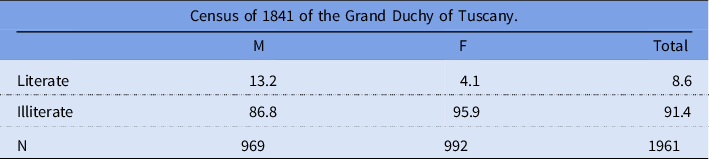
As for education, in Casalguidi the schooling process began only in 1887 when compulsory schooling was firstly introduced in Italy and five-year-old children were obliged to attend primary school for three years. This obligation was then extended to twelve years of age in 1911 and to fourteen years in 1923. Notwithstanding that the law provided penalties for parents who failed to observe this obligation toward their children, the majority of children, especially from the lower strata of the population, left school after a few years. The obvious consequence is that before that date, for the whole pretransitional period here studied, very few were educated or able to read and write, especially in a rural setting such as Casalguidi. Thus, for that period, the population can be only divided into two main groups, literate and illiterate individuals. Such a piece of information was retrieved from the census of the Grand Duchy of Tuscany of 1841, which allowed us to compute the literacy rate for the population 10+ years (table 1). The results prove that illiteracy was by far predominant in such a rural population of the mid-nineteenth century (91.4 percent of the total population 10+ years) and that the few that were able to read and write were prevalently males. Among men, the literacy rate was 13.2 percent, which dropped to 4.1 percent among women.
Literacy rate by sex in Casalguidi (people aged 10+)

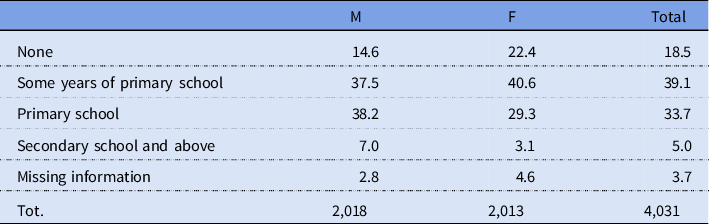
By linking this census piece of information to people living in Casalguidi before and after 1841, it has been possible to assess the literacy status of 809 married women, which amounts to 48.6 percent of all the married women analyzed between 1819 and 1859. As for the transitional phase (first half of the twentieth century), the census family form of 1961 reports the educational attainment of each individual. Notwithstanding compulsory schooling had been introduced in 1887, 80 years earlier, a consistent part of the population was still illiterate (10.5 percent for people 10+ years), again with a strong differential by gender, respectively 7.6 percent among males and 13.5 percent among females. A gender differential was present also in the level of educational attainment, as shown in table 2. In fact, 22.4 percent of females aged 10+ had never attended school and only 32.4 percent had at least the elementary school certificate against values among males that are, respectively, of 14.6 percent and 45.2 percent.
Educational attainment by sex in Casalguidi (people aged 10+), Italian Census of 1961

A Brief Outline of the Evolution of Fertility in Casalguidi
In a recent work, Caltabiano and Dalla Zuanna (Reference Caltabiano and Zuanna2015) have investigated the relationship between education and fertility for the Italian female cohorts born between 1861 and 1961, using aggregate data. The results confirm their inverse relationship and a gap in fertility between educated and not educated women that appears narrowing over time and cohorts. However, the pattern is complicated by regional differences, which are sometimes marked, especially for the earlier cohorts.
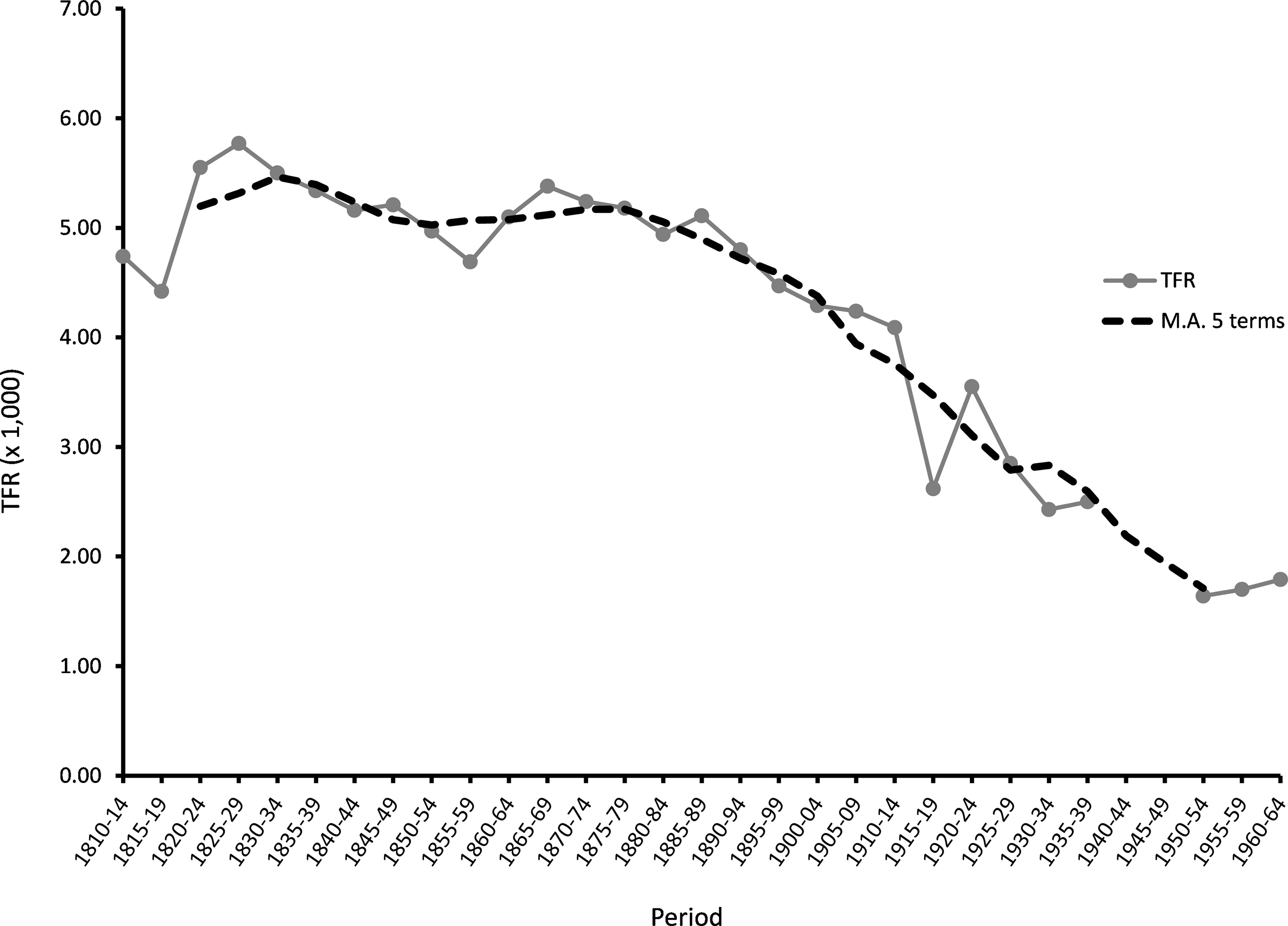
Thus, the evolution of fertility in Casalguidi must be framed within the context of the more general trend of Tuscany, whom it follows very closely. Figure 1, which uses data collected and elaborated by Breschi (Reference Breschi1990), shows that the Total Fertility rate (TFR) of mid-nineteenth-century Tuscany remained more than five children per woman until 1880–84 before starting to decrease very slowly.
TFR (× 1,000) in Tuscany, 1810–1960.

It was around 4.3 at the beginning of the twentieth century and it fell to three children per woman during the interwar period (1925–29). Eventually, it reached below-replacement levels in the fifties of the twentieth century (1.72 in 1952). The trend depicts a situation that is not only characterized by high levels of fertility but also by a slow pace of reduction over time in comparison with other countries (Breschi Reference Breschi1990). Apart from France, whose fertility decline started already in the second half of the eighteenth century and progressed continuously over the nineteenth century (3.95 children in 1810–15 and 3 in 1890–95), Sweden was characterized by lower TFR levels than Italy since the early nineteenth century and began its fast decline in 1870. In the same years, England shows as well a rapid and sustained decline of fertility, which had started, however, from levels similar to Italy at the beginning of the nineteenth century (Vallin Reference Vallin, Caselli, Vallin and Wunsch2006).
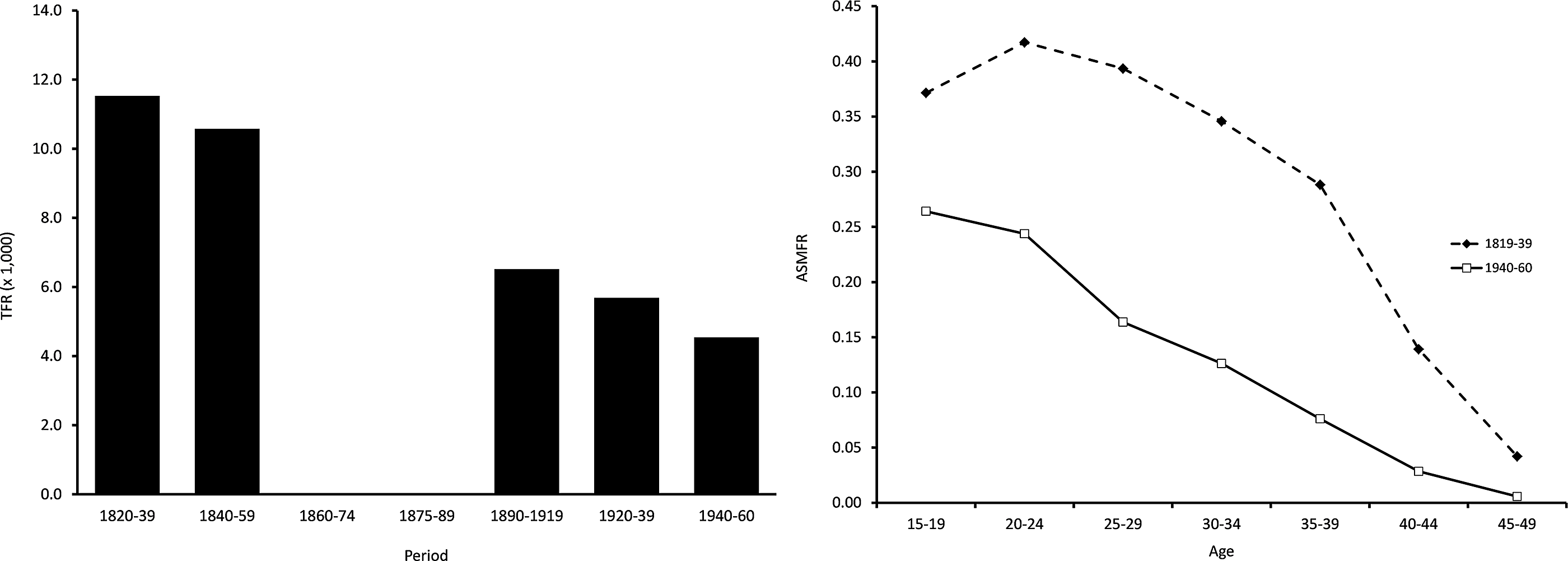
As for marital fertility, which is the focus of this article, figure 2 (left) shows the decline of the Total Marital Fertility Rate (TMFR) in Casalguidi from very high levels of the first half of the nineteenth century to the lower ones at the turn of the twentieth century. In 70 years, the TMFR almost halved, passing from values more than 10.5–11.5 children per married woman to about 6.5 in 1890–1919. It then fell to 4.5 in 1940–60. The strong decline in marital fertility is accompanied by a marked change in the age-specific marital fertility rates (ASMFR). The fertility pattern by age of the two periods 1819–39 and 1940–60 presents, in fact, a very different profile (figure 2, right). In particular, the earlier curve is concave to the origin, as is typical of populations with natural fertility, whereas the later one is closer to being convex.
TMFR (left) and ASMFR (right) in Casalguidi, 1820–1960.

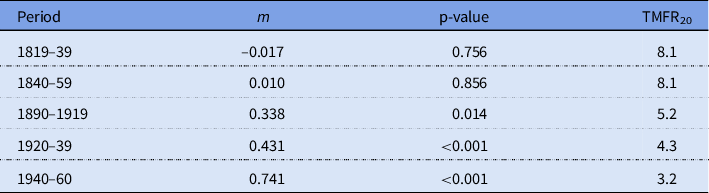
Such profiles depict the different nature of the fertility patterns in the two periods, without any form of deliberate fertility control the period 1819–59, characterized by the widespread use of fertility-control techniques the later one (1890–1960). This is proved in table 3, which reports the Coale and Trussell (Reference Coale and Trussell1978) indices of birth control for the five periods studied. If the first half of the nineteenth century is characterized by a nonstatistically significant m parameter, the situation changes starting from 1890–1919, when m becomes significant and it increases progressively, an indication of fertility control that spreads over time.
Coale and Trussell indices of birth control: Casalguidi, 1819–1960

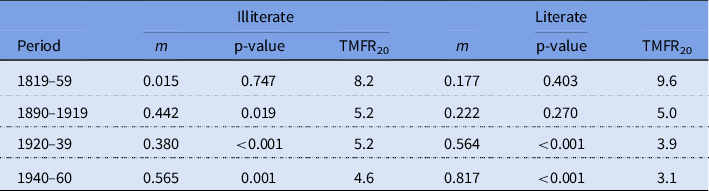
The same approach has been used to analyze fertility by literacy status (table 4). We found evidence of a stronger and more rapid decline in fertility among literate women than among illiterate ones. For the former, the TMFR20 drops by 67.7 percent between 1819–59 and 1940–60, by 43.9 percent for the latter. Both groups do not appear to adopt birth control behaviors in the first half of the nineteenth century, which conversely occur in the twentieth century, with a degree of control that is increasingly greater among literate women.Footnote 3
Coale and Trussell indices of birth control by literacy: Casalguidi, 1819–1960

The Model
As reminded in the preceding text, many of the causal links connecting literacy to fertility does not work for the pretransitional period, and some of them do not even apply to the Tuscan rural context of the twentieth century here analyzed, such as the increased autonomy, from both a social and economic point of view, of the mothers living in Casalguidi. Thus, to allow a homogeneous comparison between the two periods, the analysis will address the simple issue of the role of literacy in shaping the fertility of married women in the pretransitional and transitional period, once controlled for husband’s occupation, a proxy of the SES of the family group. The statistical model is an event history analysis in discrete time on account of the discrete nature of the parish sources. Therefore, the models make use of a logistic regression technique and were estimated separately for the two periods 1819–59 and 1890–1960. The former model includes 3,225 births and 11,969 woman-years, while the latter one is based on 3,347 births and 24,437 woman-years.
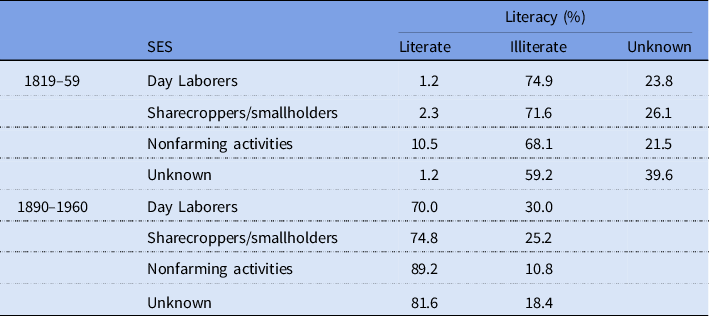
A woman’s literacy status has been used as a proxy for woman’s education. Its role on the risk of having a child was estimated after controlling for some potential confounders, such as time, age, age at first marriage, and SES. SES, in particular, has a deep and strong link with literacy, especially for the earliest period here analyzed, as table 5 illustrates. Woman’s SES has been proxied by her husband’s occupation.Footnote 4 The introduction of a SES variable is further justified by the obvious uneven distribution of literate women by social group. Table 5 shows how in the earlier period literate women represented an important share among families whose husband was employed in a nonfarming activity (10.5 percent), whilst they were a negligible part among farmers (2.3 percent) and especially among day laborers (1.2 percent).Footnote 5
Woman’s literacy by SES: Casalguidi, 1819–59 and 1890–1960

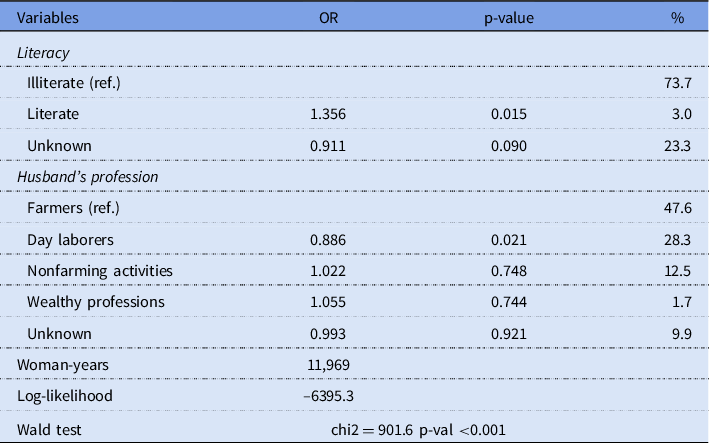
In the period 1890–1960, literacy characterizes already the very large part of the female population regardless of SES, with percentages between 70–75 percent among women married with husbands involved in agriculture and nearly 90 percent among the rest of the population. The model 1819–59 (table 6) shows that literacy, once controlled for other potentially confounding factors, SES in particular, had a positive effect on fertility, significantly increasing the odds of having a child by 36 percent compared with illiterate women.Footnote 6 This result is substantially consistent with the descriptive analysis (table 4), in which literate women showed higher marital fertility than illiterate ones (respectively, 9.6 and 8.2 children per married woman). To explain such a fertility advantage for literate women, the classic theoretical frameworks linking fertility decline and education are of little help here. Conversely, we cannot exclude a possible differential impact of mother’s health.Footnote 7 In fact, primary sterility, which can be indirectly defined as the proportion of married women not giving birth in the first five years of marriage, was around 8 percent among illiterate women and completely absent among the literates, fact that could produce a fertility gain for the latter group. More interesting, however, is the possible role played by wet-nursing. Wet-nursing was a quite common practice in the Tuscan countryside of that time, whose effects on fertility are well-known. Putting a baby out to nurse drastically reduces the mother’s postpartum amenorrhea period, thereby shortening the birth interval and, in turn, increasing fertility. On the wet-nurse’s side, conversely, her prolonged lactation could induce a delay in the ovulation, thereby reducing her fertility (Léridon Reference Léridon, Bongaarts and Keyfitz1984; Oris et al. Reference Oris, Derosas, Breschi, Bengtsson, Campbell and Lee2004). The parish burial acts of Casalguidi report, in the case of infant death, the name and surname of the eventual wet-nurse. This is obviously only a partial and selected list of all the wet-nurses existing in the village,Footnote 8 but it is quite revealing that all the 115 wet-nurses recorded in the burial registers (and representing about 9 percent of total married women) belonged to poor rural families, and none of them was literate. It is therefore likely that well-off and literate women sent their babies out to nurse to low-status and illiterate women.Footnote 9
Logistic regression Odds-ratios of having a child, Casalguidi, 1819–1959

Note: The model controls also for Period, Age, and Age at Marriage.
As for the SES, once depurated from the effects of literacy, it shows a significant reduction of the odds associated with women married to day laborers, –11 percent with respect to women married to a sharecropper or a smallholder.
This is in line with theoretical expectations and empirical findings that show a lower demand for children among day laborers than among sharecroppers and smallholders, whose marital fertility was higher basically on account of the necessity to ensure the future household working force to either farm the land effectively or guarantee the renewal of the sharecropping contract and the permanence on the same plot of land. Moreover, the lower fertility of day laborers could be also an effect of the seasonal absence from home associated with the sustained work mobility of husbands, always in search of work opportunities as well as a consequence of their bad health conditions associated with periodic shortage of foods.Footnote 10
A model with an interaction between SES and literacy was also estimated, but it did not provide any statistically significant improvement in model fit (LR chi2(6) = 3.96; p-value = 0.683).
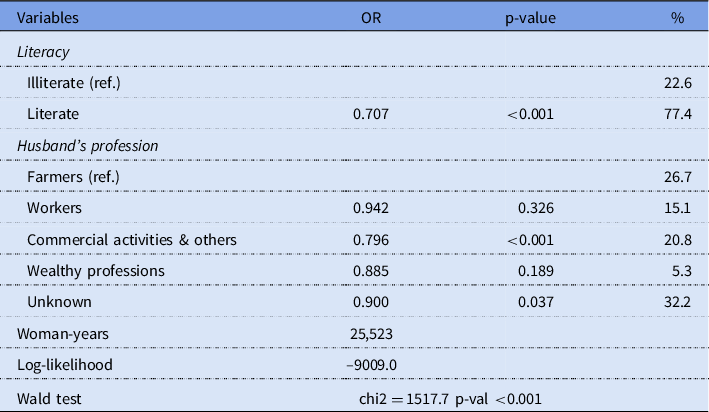
As for the period 1890–1960 (table 7), the association between literacy and fertility switches direction, becoming negative. Literate women show a significant reduction in the odds of having a child. More specifically, literate women show a 29 percent lower risk of having a child compared to illiterate women. Moreover, this differential risk occurs regardless of the educational attainment of literate women (model not shown). Women without any educational attainment but able to read and write display a 25 percent significant decrease in the odds compared with illiterate women,Footnote 11 whilst literate women with educational attainment show a higher significant reduction in fertility, namely –43 percent. This is further evidence that fertility decline started and spread within the literate and more educated categories, likely spurred by new reproductive behaviors associated with birth control.
Logistic regression: Odds-ratios of having a child, Casalguidi, 1890–1960

Note: The model controls also for Period, Age, and Age at Marriage.
As for SES, a premise is necessary. This model is based on a retrospective reconstruction of life-histories, with the drawback that we used occupations reported in the census of 1961 for the entire female reproductive period. This could be a quite strong assumption given the profound changes in the economic structure of Casalguidi occurred during the industrialization period. In 1961, the category of farm day laborers was almost disappeared (only 10 household heads were reported as such in 1961), while sharecropping would have been abolished by the law in 1964.Footnote 12 The agricultural sector was losing jobs to the growing industrial sector, and many peasants found employment in firms and industries as factory workers, bricklayers, handymen, and so forth. This is the reason why a different occupational classification was used in this model, which includes just one category of farmers and the new category of workers from the industrial and construction sector. The model highlights just a significant drop in fertility among commercial activities and other occupations not belonging to the industrial and construction sector (–20 percent) with respect to the category of farmers. This is a sign that the fertility decline could also rely on more strict economic reasons besides literacy. Just like the model 1819–59, the interaction between the SES proxy and literacy has provided a nonstatistically significant improvement in model fit (LR chi2(4) = 6.62; p-value = 0.157).
Conclusions
In this article, the role of literacy in shaping reproductive behaviours has been explored over time for a rural Italian population, Casalguidi. The novelty here is that it is one of the few studies that analyzes such a relationship from an individual-level perspective, not limited to the transitional period, but also extended to the pretransitional one. The period investigated includes 20 years in the mid-nineteenth century (1819–59) and about 70 years embracing the first half of the twentieth century (1890–1960), allowing us to highlight the different roles that literacy played in shaping fertility. In 1986, Massimo Livi Bacci had already demonstrated that the Jews, nobles, and wealthy socioeconomic groups were forerunners of fertility control in the urban settings across Europe. He emphasized the role of some demographic mechanisms, such as delayed marriages or permanent celibacy, but left the door open for other more indirect causes. In 2006, Renzo Derosas substantially confirmed the lower fertility levels of the Venetian Jewish population, pointing out the decisive role of cultural factors, among which the literacy level. However, no study had addressed so far the role of literacy in rural populations, where the socioeconomic structure was less varied and poorer than it was in towns and cities. Our results prove that in pretransitional Tuscany, when no effective method of birth control was applied in any social group, literate women had significantly higher fertility than illiterate ones, once controlled for SES factors. This reinforcing effect of literacy on the fertility of the mid-nineteenth-century-educated women occurred likely through an increased ability to conceive on account of lower rates of primary sterility, but, more significantly, through a frequent recourse to wet-nurses, which could contribute reducing the postpartum amenorrhea period of literate women, on the one hand, and prolonging the anovulatory period of illiterate wet-nurses, on the other hand (Manfredini and Breschi Reference Manfredini and Breschi2008).
The relationship between literacy and fertility appears then reversing during the transitional period. The ability to read and write is, in fact, associated with a reduction in fertility, whilst illiteracy is conversely linked to higher levels of fertility and a limited recourse to birth control techniques. Thus, given the minor role of socioeconomic conditions, in Casalguidi the emergence of new demographic behaviors aimed at limiting family size and controlling fertility passed in the first place through literacy and education. Educated couples were forerunners in that process because they were in the position to be the most pressed to control reproduction due to their previous higher level of fertility. The success of the revolution of the most educated group was likely ensured by the awareness of reproductive mechanisms and the knowledge of effective birth-control methods, the economic possibility to have them, and the necessary capacity to use them, once again the Coale’s model of “ready, willing, able.” However, more analyses at the individual level will have to clarify whether such a pattern was common in other Italian rural areas, and what were the connections with the urban forerunners groups of fertility control.