Introduction
With our aging society, more older people need care. Most are looked after by family members with dedication and often little support, but a small minority are abused (Cooper et al., Reference Cooper, Selwood, Blanchard, Walker, Blizard and Livingston2009). Elder abuse is a violation of a vulnerable older person's human and civil rights by another person or persons (Department of Health, 2000).The consequences of abuse for the older person include distress, poor physical and mental health, reduced survival (Lachs et al., Reference Lachs, Williams, O'Brien, Pillemer and Charlson1998), institutionalization and financial loss. Most perpetrators of abuse are family members (Nelson, Reference Nelson2002).
Abuse is a spectrum of behaviors and degrees of behaviors, which we often artificially dichotomize. In research, “cases” of abuse have been identified by setting thresholds for the severity or frequency of an abusive behavior that constitute “significant” abuse. The CARD (Carers and Relatives with Memory Disorders) study is a representative cross-sectional study of family carers of people with dementia seen by U.K. psychiatric services. We recently reported that a third of these carers reported abusive behavior towards the person they cared for which met criteria for an “abuse case” on the Modified Conflict Tactics Scale (MCTS) (Cooper et al., Reference Cooper, Selwood and Livingston2008b). The “case” threshold for this instrument requires that at least one of the psychologically or physically abusive behaviors asked about had happened “at least sometimes” in the last three months (Beach et al., Reference Beach, Schulz, Williamson, Miller, Weiner and Lance2005). Using similar thresholds, other research studies have found that around 6% of the older general population are abused, with higher rates in vulnerable groups, such as those with dementia. About 5% of family members caring for people with dementia report carrying out physically abusive behavior, and a third report any abuse over a period of a year (Cooper et al., Reference Cooper, Selwood and Livingston2008b).
These rates are at odds with the relatively few cases of elder abuse knowingly encountered by most clinicians. Around 60% of U.S. physicians working with older people reported that they had not identified any cases of elder abuse in the last year (Oswald et al., Reference Oswald, Jogerst, Daly and Bentler2004; Kennedy, Reference Kennedy2005). Health professionals in the U.S.A. and most European countries are legally responsible for identifying and actively managing situations in which significant harm may be occurring, or where there is a high risk of significant harm.
While it is widely agreed that current detection and reporting rates for elder abuse are low, it is also likely that not all the cases of elder abuse defined as such in research studies require clinical intervention to prevent harm. All abuse is worthy of clinical attention, but there is a need for a screening tool to detect efficiently those cases of abuse where harm has occurred or where there is a high risk of harm, so that these can be managed urgently. We hypothesize, based on our research and clinical experience, that current abuse screening tools have low specificity for such cases and are therefore of limited use to health professionals.
Previous studies have reported on the prevalence of people who screen positive for psychological and physical elder abuse, but these studies have not evaluated the proportion of these involving clinically concerning abuse. One exception to this, the study by Fulmer et al. (Reference Fulmer2005), asked an expert team to diagnose neglect using information from the Elder Abuse Assessment Instrument. We used a similar approach in the current study which is part of a larger study considering the prevalence, determinants and management of abuse (Cooper et al., Reference Cooper, Selwood and Livingston2008b; Selwood et al., Reference Selwood, Cooper, Owens, Blanchard and Livingston2009). Our objectives were (1) to compare research-defined criteria for elder abuse to the gold standard of a clinician's diagnosis based on carers’ responses on detection instruments; and (2) to explore how the MCTS could best be used to detect clinically concerning cases of abuse in clinical practice, using data from the CARD study.
Methods
Setting and participants
We recruited consecutive family carers of people with a clinical diagnosis of dementia; living at home and referred to one of five different Community Mental Health Teams covering London and Essex (U.K.). They included inner city, suburban and rural areas. We defined a family carer as someone providing care for ≥4 hours per week. Interviews took place at a time and place convenient to the carer, usually their home.
Consent and data collection
The study received Research Ethics Committee approval. Participants gave written informed consent. The information sheet specified that “we respect confidentiality but cannot keep it a secret if anyone is being seriously harmed.” Care recipients (CRs) were asked for consent to access their medical notes, but were not interviewed. Where the CR lacked capacity to consent (judged from their psychiatrist's and carer's reports), we asked carers whether they thought that the CR would have agreed when they had capacity. Three experienced psychiatrists carried out interviews between January 2007 and April 2008, with each interview lasting about an hour.
Measures
We collected sociodemographic data on: carer and CR age, sex, ethnicity, relationship of carer to the CR (spouse, child, other) and whether they lived together. We also reported the Mini-mental State Examination (MMSE) score of the CR (obtained from medical notes). More details about this cohort are reported elsewhere (Cooper et al., Reference Cooper, Selwood and Livingston2008b; Selwood et al., Reference Selwood, Cooper, Owens, Blanchard and Livingston2009).
Abuse
Carers completed the Modified version of the Conflict Tactics Scale (MCTS) (Beach et al., Reference Beach, Schulz, Williamson, Miller, Weiner and Lance2005). The measures were self-completed where possible, but if the carer was unable to complete it the interviewer administered it. They were asked how often in the last three months they had acted in each of five psychologically and five physically abusive ways towards the CR, which were scored on a Likert scale from 0 (never) to 4 (all the time). The psychological abuse items asked were whether they had: (1) screamed or shouted at the CR, (2) used a harsh tone of voice, insulted, sworn at, or called them names, (3) threatened to send them to a care home, (4) to stop taking care of or abandon them, and (5) threatened to use physical force on them. The physical abuse items were: (1) whether the carers had been afraid they might hit or hurt them, (2) whether they had withheld food, (3) whether they had hit or slapped them, (4) whether they had shaken, or (5) handled them roughly in other ways. Adequate psychometric properties have been reported (Cooper et al., Reference Cooper, Manela, Katona and Livingston2008a). A score of ≥2 (sometimes) for any question is recommended as a threshold to indicate significant abuse (Beach et al., Reference Beach, Schulz, Williamson, Miller, Weiner and Lance2005).
After completing this instrument, carers were asked questions to determine whether their acts fulfilled the Pillemer criteria for significant abuse (Pillemer and Finkelhor, Reference Pillemer and Finkelhor1988): whether the psychologically abusive behaviors had happened at least ten times over the last year; and whether any of the five physical abuse items had happened on any occasion over the last year.
Clinical diagnosis of abuse
The information was made anonymous and presented to two experienced consultant old age psychiatrists (K.M. and G.L.) for independent diagnostic review. Any disagreement in ratings was settled by discussion with a third old age psychiatrist (CC). The experts were asked the question “do the carer's responses indicate abuse in which significant harm might be occurring, or that there is a future risk of significant harm to the care recipient?” In reaching a judgment they considered whether they would judge that an intervention was required if this information were reported to them in their clinical practice. They reached a judgment regardless of whether any intervention had happened or not.
Data analysis
We analyzed data using SPSS 14.0. We compared participants and non-participants using χ2 tests, and described the main characteristics of the sample using appropriate summary statistics. We reported the proportion of carers meeting abuse “caseness” criteria using the MCTS conventional cut point (reporting at least one item as happening at least “sometimes”, a score of ≥2 from a possible 0–4), and the Pillemer criteria for abuse. We also reported the proportion of carers who described abuse that our experts considered of potential clinical concern. We reported Cronbach's α for inter-rater reliability. Using this expert consensus as our gold standard, we calculated the sensitivity, specificity, positive and negative predictive value of the different screening criteria for abuse: (1) the MCTS cut point; (2) the Pillemer criteria. Secondly, we considered the total MCTS score, and determined the sensitivity and specificity of different cut points. Because physical abuse is more likely to require intervention than verbal abuse, we repeated this, weighting the physical abuse items. All carers completed the MCTS. Three carers did not complete questions about whether abuse met the Pillemer criteria for abuse, so could not be included in these analyses.
Results
Of 318 eligible carers recruited, 220 (69%) participated; 98 refused or were uncontactable. There were no differences between participants and non-participants in care recipient or carer gender (χ2 = 1.3, p = 0.26; χ2 = 0.0, p = 1.00); whether they lived together (χ2 = 2.2, p = 0.14), or the relationship between them (partner, child or other) (χ2 = 2.7, p = 0.26).
The mean age of care recipients was 81.6 (range 58–99); 159 (72.3%) were female, 174 (79.1%) were of White U.K. ethnicity and 118 (53.6%) were living with the family carer. Their average MMSE score was 18.4 (range 0–29). The mean age of the family carers was 61.7 (range 24–92); 144 (65.5%) were female, 182 (82.7%) of White U.K. ethnicity; 72 (32.7%) were the spouse, 120 (54.5%) were the child of the care recipient and 28 (12.7%) were other relatives or friends. All participants completed the MCTS.
Prevalence of abuse
Clinical criteria of abuse where intervention was required
The independent clinical judgment about whether abuse was clinically concerning was the same in 216/220 (98.2%) of cases (Cronbach α = 1). After discussing the cases, our professionals agreed on all cases and agreed that 15 (6.8%) carers reported abusive behavior that was potentially clinically concerning.
MCTS abuse criteria
Using the MCTS cut point for abuse, 74 (33.6%) participants reported significant abuse; 72 (32.7%) psychological and 8 (3.6%) physical abuse (reported previously: (Cooper et al., Reference Cooper, Selwood and Livingston2008b)). The sensitivity of these criteria for abuse compared to the gold standard of expert consensus was 87%, the specificity was 70%, the positive predictive value was 18%, and the negative predictive value was 99%.
Pillemer criteria
Using the Pillemer criteria, 47 (21.4%) of carers reported abusive actions; 44 (20.0%) verbal abuse and 11 (5.0%) physical abuse. The sensitivity for these criteria for abuse compared with expert consensus was 93%, the specificity was 84%, the positive predictive value was 30%, and the negative predictive value was 99%.
MCT score
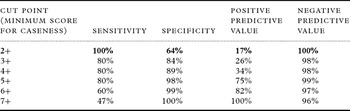
We investigated using a cut point on the total score on the MCTS to screen for abuse (Table 1). The area under the Receiver Operator Curve (ROC) was 0.95. The best cut point for sensitivity was ≥2. This gave 100% sensitivity but only 64% specificity and a positive predictive value of 17%.
Sensitivity and specificity for cut points of the MCTS, compared with expert consensus

Bold denotes cut point with psychometric properties we judged most advantageous.
Weighted MCT score
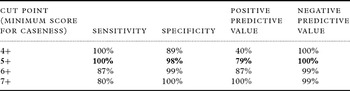
We weighted the physical abuse items. In deciding the weighting, we took into account the content validity of any scoring system. We considered that any of the physical items occurring “at least sometimes” in three months was very likely to be of clinical concern. We also compared the ROCs for weightings of ×2, ×3 and ×4. Multiplying these scores by four produced the most effective screening attributes (area under the ROC = 0.998), so for simplicity we have only reported this system. A cut point of 4/5 had a sensitivity of 100%, specificity of 98%, positive predictive value of 79% and negative predictive value of 100% (Table 2).
Sensitivity and specificity for cut points of the MCTS weighted, compared with expert consensus
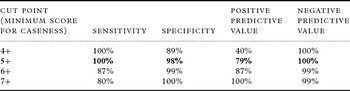
Bold denotes cut point with psychometric properties we judged most advantageous.
Discussion
Elder abuse is often discussed in policy and in literature as a phenomenon with a concrete existence, but the prevalence of abuse reported by family carers ranged from a fifth to a third depending on the research criteria used to define it. By comparison, one in fifteen carers reported abusive behavior that our expert panel viewed as requiring clinical intervention. This suggests that thresholds for defining abuse in research studies, while in line with definition of abuse, are significantly lower than those conventionally used in clinical practice. We found that 7% of carers of people with dementia reported clinically concerning abuse. This prevalence is low compared with previously reported figures, but still suggests that the cases of abuse currently actively managed by health and social services are the tip of an iceberg. In the U.S.A., where reporting of suspected elder abuse is mandatory, less than 1% of the general population aged 60 and over are known to Adult Protective Services (National Center on Elder Abuse, 1998).
The positive predictive value for the Pillemer and conventional MCTS criteria for defining abuse cases was low when these instruments were used to screen for clinically significant abuse. This does not indicate that they are invalid when used in a research setting, or indeed in any setting where the goal is to identify situations in which any abuse is occurring. Early detection and interventions for less severe abuse may help prevent more serious abuse. Nonetheless, our findings indicate that these criteria are unlike those in clinical practice and of limited use to clinicians if the aim is to identify cases where immediate action is needed.
Limitations
Our expert panel judged whether or not they would be clinically concerned about a case based on a carer's responses to questions about abuse. Their gold standard relates to their clinical practice within teams and their awareness of the legislation and research but does not correspond to diagnostic criteria as they do not exist. They did not personally interview the carer nor have access to previous clinical assessments. While many carers were willing to report abusive actions, some may not have been so willing and our numbers may be an underestimate. Similarly, despite our high response rate and the similarity in socio-demographic terms, non-participants may have had more issues about abuse.
Conclusions
The MCTS is a brief instrument that is acceptable to carers (Cooper et al., Reference Cooper, Manela, Katona and Livingston2008a). We additionally found that it had good sensitivity and specificity when used as a screening instrument for clinically concerning abuse, if caseness was defined as a score of five or more, and the physical abuse item scores were multiplied by four. This suggests it could be used routinely in clinical practice with carers of people with dementia to detect clinically concerning cases of abuse, many of which are currently being missed.
Conflict of Interest
None.
Description of authors' roles
CC, GL, AS and MB designed the study; CC and AS interviewed participants; KM and GL were on our expert panel; CC, GL and KM wrote the first draft of the paper and all authors revised it critically for important intellectual content and approved the final version.
Acknowledgments
We thank the family carers who took part, the clinical teams who assisted in recruitment and Colm Owens for conducting some of the interviews.