Introduction
By 2022, approximately 87% of all cropland acres in the United States were reported to be implementing some form of a conservation tillage production system, defined as tillage being reduced for at least one crop in a given field (Creech Reference Creech2022). Of this conservation tillage system percentage, continuous no-till accounted for one-third of the hectares. Utilization of conservation tillage in crop production can lead to a potential 2,888 million-L reduction in diesel equivalents per year as well as a 7.7 billion kg yearly reduction in associated emissions (Creech Reference Creech2022). Realized benefits of conservation tillage systems can include improved soil health, decreased erosion, maximized water infiltration, improvement in nutrient cycling, and a buildup in organic matter (Creech Reference Creech2022; Farmaha et al. Reference Farmaha, Sekaran and Franzluebbers2021; Lal Reference Lal2015).
Conservation tillage systems rely greatly on herbicides for effective preplant weed management. Numerous herbicides or combinations of herbicides are currently labeled and recommended for preplant or “burndown’” control of many common and troublesome winter weed species encountered in corn (Zea mays L.), cotton (Gossypium hirsutum L.), and soybean [Glycine max (L.) Merr.] production fields (Anonymous 2023a, 2024a, 2024b, 2024c). Weed resistance issues and difficult to control species have necessitated identification of novel strategies and herbicides for continued successful preplant weed management in these production systems (Flessner and Pittman Reference Flessner and Pittman2019; Johanning et al. Reference Johanning, Young and Young2016; Vollmer et al. Reference Vollmer, Van Gessel, Johnson and Scott2019; Westerveld et al. Reference Westerveld, Soltari, Hooker, Robinson and Sikkema2021a, Reference Westerveld, Soltari, Hooker, Robinson and Sikkema2021b; Zimmer et al. Reference Zimmer, Young and Johnson2018).
Tiafenacil, a new protoporphyrinogen IX oxidase (PPO)-inhibiting herbicide developed by FarmHannong Co., Ltd., Korea, exhibits nonselective contact activity on both weed and crop species (Anonymous 2023b; Park et al. Reference Park, Ahn, Nam, Hang, Song, Kim and Sung2018). PPO-inhibiting herbicides halt the production of protoporphyrin IX (PPIX) from protoporphyrinogen IX, eventually preventing chlorophyll and heme biosynthesis. The increase in PPIX in the cytoplasm results in increases singlet oxygen, which leads to lipid peroxidation, cell membrane destruction, and ultimately plant death (Shaner Reference Shaner2014). Tiafenacil is registered in the United States for preplant application to corn, cotton, soybean, and wheat (Triticum aestivum L.) as well as for defoliation of cotton (Adams et al. Reference Adams, Barber, Doherty, Raper, Miller and Peralisi2022; Anonymous 2023b). Limited published research with tiafenacil has focused on weed management. Tiafenacil at 74 g ai ha−1 applied with varying urea ammonium nitrate carrier volumes provided 85%, 81%, 92%, and 90% control of barnyardgrass [Echinochloa crus-galli (L.) P. Beauv.], common lambsquarters (Chenopodium album L.), kochia [Bassia scoparia (L.) A.J. Scott], and redroot pigweed (Amaranthus retroflexus L.), respectively, at 1 wk after application (Mookodi et al. Reference Mookodi, Spackman and Adjesiwor2023). Tiafenacil applied at 50 g ha−1 alone resulted in 82% control of glyphosate-resistant (GR) downy brome (Bromus tectorum L.) (Geddes and Pittman Reference Geddes and Pittman2023) at 7 d after treatment (DAT), while the same rate coapplied with metribuzin at 400 g ha−1 resulted in 88% control of GR horseweed [Conyza canadensis (L.) Cronquist; syn.: Erigeron canadensis L.] (Westerveld et al. Reference Westerveld, Soltari, Hooker, Robinson and Sikkema2021b).
Soybean was planted on more than 35 million ha in the United States in 2023 (USDA-NASS 2023). Soybean emergence and early-season growth often coincide with preplant herbicide applications made in preparation for later-planted soybean or cotton and often occurs in adjacent fields, thereby increasing opportunity for off-target herbicide movement. Drift or off-target movement was previously identified by survey respondents from two separate states as the biggest herbicide application challenge they face (Butts et al. Reference Butts, Barber, Norsworthy and Davis2021; Virk and Prostko Reference Virk and Prostko2022). Additionally, severe crop injury from off-target herbicide movement is possible upward of 60 m downwind from both ground and aerial applications, which can negatively impact yield, environmental stewardship, and other beneficial species (Butts et al. Reference Butts, Fritz, Kouame, Norsworthy, Barber, Ross, Lorenz, Thrash, Bateman and Adamczyk2022). As a result, it is imperative to understand the implications on crop growth and development if the crop were to be exposed to a herbicide drift event.
Serious deleterious effects of simulated off-target movement of nonselective herbicides to soybean have been demonstrated (Ellis and Griffin Reference Ellis and Griffin2002; Johnson et al. Reference Johnson, Fisher, Jordan, Edmisten, Stewar and York2012). Ellis and Griffin (Reference Ellis and Griffin2002) reported that glufosinate, a nonselective contact herbicide like tiafenacil, injured 2- to 3-leaf (lf) non–glufosinate tolerant soybean 19% and 6% at 7 DAT when applied at 12.5% and 6.3% of the labeled use rate, respectively. In addition, soybean height was reduced 11% and 9% at these respective rates averaged across a 2- to 3-lf and first-flower application. Although most PPO-inhibiting herbicides applied postemergence are well tolerated by soybean, initial injury can be observed. Hager et al. (Reference Hager, Wax, Bollero and Stoller2003) reported 5% to 11%, 3% to 7%, and 13% to 20% injury at 7 DAT with the PPO-inhibiting herbicides acifluorfen, fomesafen, and lactofen, respectively, applied to 2-lf soybean. Similarly, Harris et al. (Reference Harris, Gossett, Murphy and Toler1991) reported 10% to 22%, 5% to 9%, and 16% to 29% injury with these same respective herbicides applied to V4 to V5 soybean; however, yield reduction was not observed.
To our knowledge there exists no published information on the impact of tiafenacil on soybean growth and yield following foliar application at sublethal rates that may be encountered in off-target movement events. Therefore, the objective of this research was to determine any negative impacts of foliar application of tiafenacil to soybean.
Materials and Methods
Field Trial Establishment
Field experiments were conducted in 2022 at the LSU AgCenter Northeast Research Station near St Joseph, LA (31.9184°N, 91.2335°W), the LSU AgCenter Dean Lee Research and Extension Center near Alexandria, LA (31.3113°N, 92.4451°W), the University of Arkansas System Division of Agriculture Lonoke Extension Center in Lonoke, AR (34.7843°N, 91.9001°W), and the University of Tennessee AgResearch and Education Center in Milan, TN (35.9198°N, 88.7589°W) to determine the impact of reduced rates of tiafenacil (Reviton®, HELM Agro, Tampa, FL) on soybean growth and yield. Experiments were conducted in a randomized complete block design with treatments replicated three or four times. Treatments were applied via compressed-air or CO2-pressurized backpack sprayer at 140 L ha−1. Treatments included reduced rates of tiafenacil at 0×, 1/8×, 1/16×, 1/32×, 1/64×, 1/128×, and 1/256× applied to 1- to 2-lf soybean. The 1× rate basis for reduced rate calculation was 24.64 g ha−1. The tiafenacil label (Anonymous 2023b) allows single application rates from 24.64 to 75.04 g ha−1; however, previous unpublished research has indicated that the lower rate in combination with glyphosate provides adequate cost-effective control of most common winter weed species before planting (DKM, personal observation). Methylated seed oil (MSO) was added at 1% v/v to all treatments per label recommendations to maximize weed control (Anonymous 2023b). A comparison 1% MSO-alone treatment was included but resulted in no impacts on parameters measured in comparison to the 0× rate and therefore was excluded from statistical analysis. Tiafenacil at designated rates was applied to 1- to 2-lf soybean variety ‘AG48xF2’ near St Joseph on May 23, variety ‘AG47xF2’ near Alexandria on June 1, variety ‘AG46xF2’ in Lonoke on June 20, and variety ‘AG48xFO’’ in Milan on June 16. This timing was selected as being the most likely to exist when burndown of later-planted cotton and soybean ground normally occurs in the U.S. Midsouth (authors’ personal observations). Plots were maintained weed-free at St Joseph and Alexandria with as-needed application of glyphosate (Roundup PowerMax® 3, Monsanto, St Louis, MO) at 1,120 g ha−1 plus glufosinate (Liberty® 280 SL, BASF, Research Triangle Park, NC) at 420 g ha−1. Plots were maintained weed-free at Lonoke with S-metolachlor plus metribuzin (Boundary® 6.5 EC, Syngenta, Greensboro, NC) preemergence at 1,820 g ha−1 and glufosinate (Liberty® 280 SL) at 655 g ha−1 applied at V4 and R1. Plots were maintained weed-free at Milan by hand weeding. Parameter measurements included visual injury on a scale of 0 = no injury and 100 = plant death at 1, 2, and 4 WAT; plant height at 2 and 4 WAT; and yield.
Statistical Analysis
The four-parameter log-logistic model was fit to all parameters measured averaged across locations.
 $$Y = c + {{{d - c}}\over{{1 + {\rm{exp}}\left[ {b\left( {{\rm{ln}}\left( x \right) - {\rm{ln}}(e} \right)} \right)]}}}$$
where Y is injury (%), b is the slope at the inflection point, c is the lower limit, d is the upper limit, e is the dose of herbicide corresponding to the midpoint of plant injury response observed between the upper and lower limits, and x is tiafenacil rate (g ha−1) (Tables 1–3). The goodness of fit of the four-parameter log-logistic model was evaluated using the root mean-square error (RMSE) (Tables 1–3).
 $${\rm{RMSE}} = \sqrt {{{1}\over{N}}\mathop \sum \limits_{i=1}^N {{\left( {{Y_i} - {{\hat Y}_i}} \right)}^2}} $$
Nonlinear regression parameters for soybean visual injury at 1, 2, and 4 wk after treatment (WAT) following application of tiafenacil at 0×, 1/8×, 1/16×, 1/32×, 1/64×, 1/128×, and 1/256× of a 24.64 g ai ha−1 use rate applied to 1- to 2-lf soybean for data collected at St Joseph, LA, Alexandria, LA, Lonoke, AR, and Milan, TN, in 2022

a RMSE, root mean-square error.
Nonlinear regression parameters for soybean height at 2 and 4 wk after treatment (WAT) following application of tiafenacil at 0×, 1/8×, 1/16×, 1/32×, 1/64×, 1/128×, and 1/256× of a 24.64 g ai ha−1 use rate applied to 1- to 2-lf soybean for data collected at St Joseph, LA, Alexandria, LA, Lonoke, AR, and Milan, TN, in 2022

a RMSE, root mean-square error.
b Value expressed as the absolute value of −2.82.
Nonlinear regression parameters for soybean yield following application of tiafenacil at 0×, 1/8×, 1/16×, 1/32×, 1/64×, 1/128×, and 1/256× of a 24.64 g ai ha−1 use rate applied to 1- to 2-lf soybean for data collected at St Joseph, LA, Alexandria, LA, Lonoke, AR, and Milan, TN, in 2022

where Y
i
is the evaluated injury (%) and
 $${\hat Y_i}$$
is the corresponding value predicted by the model. N is the total number of observations. Smaller RMSE values are an indication of a better model fit to the data, with values of 0 representing a perfect fit. The lm() function of the stats package was used to fit all curve models in R v. 4.3.3 (R Core Team 2024). Data were analyzed by location and model parameters (slopes and intercepts) compared (Ritz et al. Reference Ritz, Kniss and Streibig2015), with no statistical differences detected between parameters of locations for herbicide rates applied (data not shown). Therefore, data were pooled across locations for curve fitting. Model assumptions of linearity, homoscedasticity, independence, and normality were checked in each case.
Results and Discussion
Soybean Injury
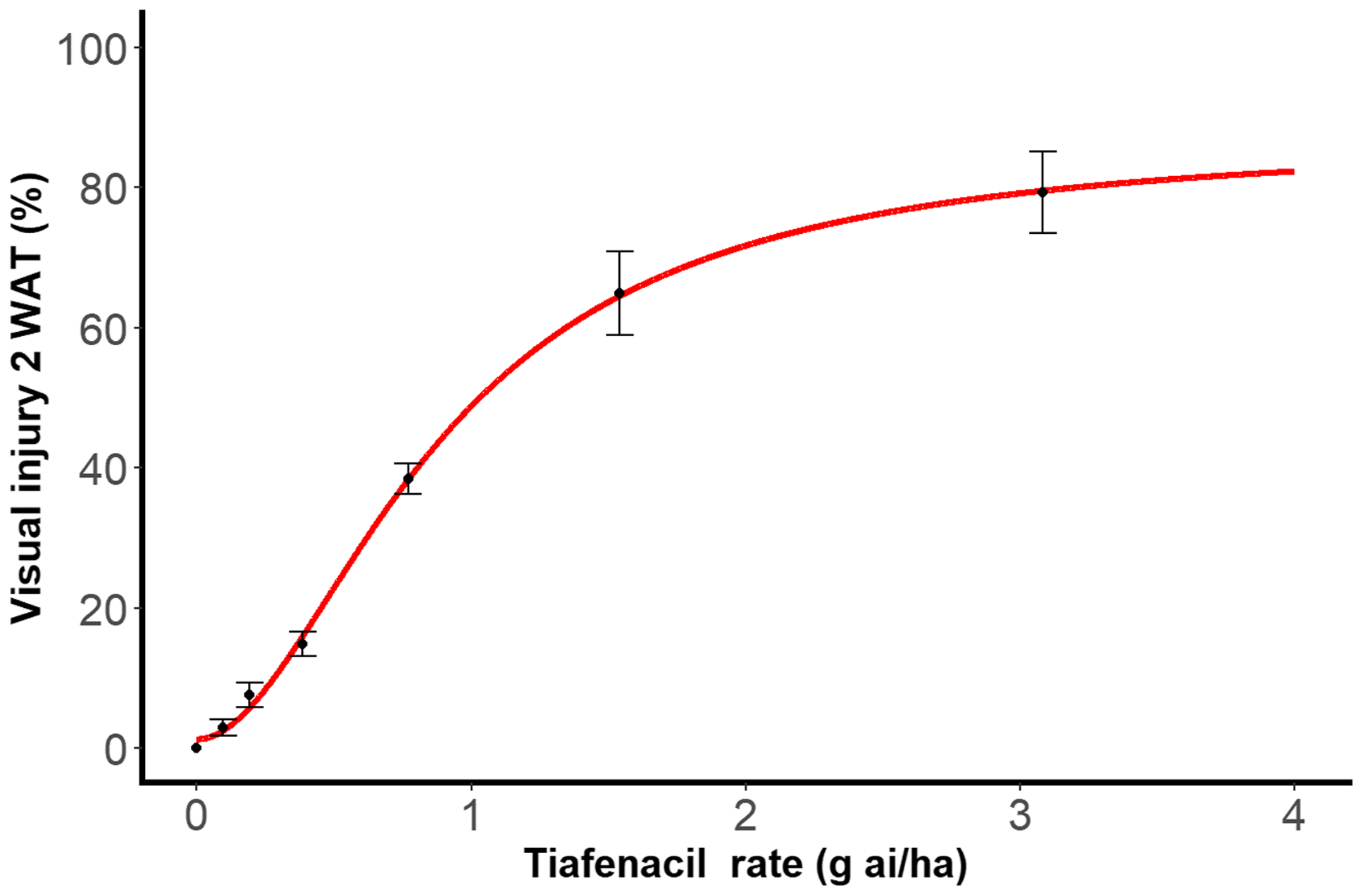
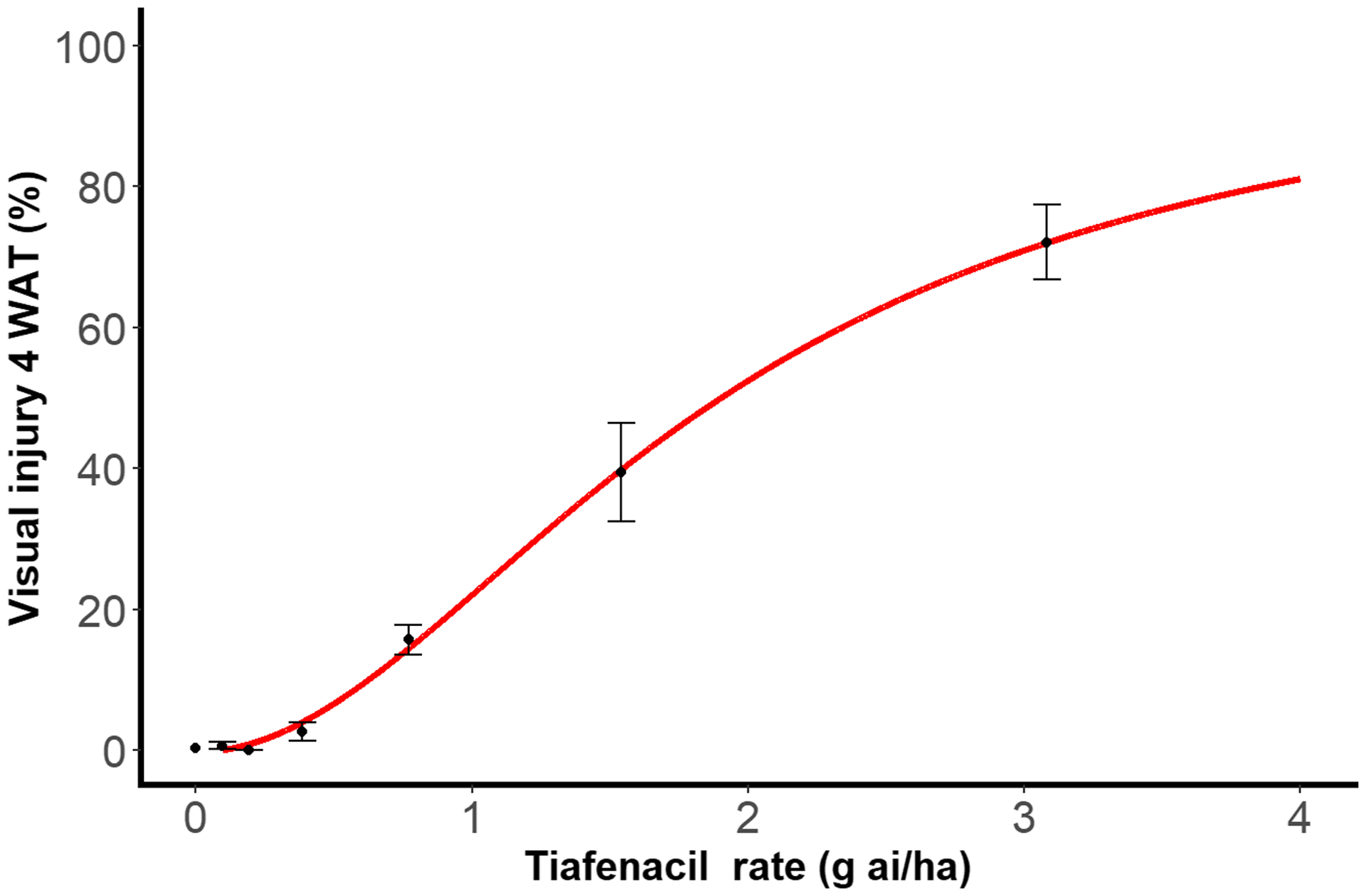
Soybean visual injury was characterized by necrotic speckling of leaves contacted at time of application and population reduction due to plant death at higher rates. Soybean was injured 80% at the highest tiafenacil rate applied (1/8×), with each successive rate reduction resulting in 61%, 39%, 21%, 12%, and 7% visual injury at 1 WAT (Figure 1). At 2 WAT, visual injury was 80%, 65%, 38%, 16%, 6%, and 3% at these same rates (Figure 2). By 4 WAT, visual injury for each successive reduced rate was still 67%, 33%, 14%, 4%, 1%, and 0% (Figure 3). Hager et al. (Reference Hager, Wax, Bollero and Stoller2003) reported 5% to 11%, 3% to 7%, and 13% to 20% injury at 7 DAT with the labeled PPO-inhibiting herbicides acifluorfen, fomesafen, and lactofen, respectively, applied to 2-lf soybean. However, unlike the current research, by 3 WAT, soybean injury was no greater than 5%. Similarly, Ellis and Griffin (Reference Ellis and Griffin2002) reported that the glufosinate, a nonselective contact herbicide like tiafenacil, injured 2- to 3-lf non–glufosinate tolerant soybean 19% and 6% at 7 DAT when applied at 12.5% and 6.3% of the labeled use rate, respectively. By 4 WAT, however, injury was no greater than 1%. Previous research has also indicated that tiafenacil can injure soybean foliage and provide very effective defoliation of soybean before harvest (Miller et al. Reference Miller, Stephenson, Barber, Doherty and Mize2021).
Soybean visual injury at 1 wk after treatment (WAT) as impacted by reduced tiafenacil rate at 0×, 1/8×, 1/16×, 1/32×, 1/64×, 1/128×, and 1/256× of a 24.64 g ai ha−1 use rate applied to 1- to 2-lf soybean for data collected at St Joseph, LA, Alexandria, LA, Lonoke, AR, and Milan, TN, in 2022.

Soybean visual injury at 2 wk after treatment (WAT) as impacted by reduced tiafenacil rate at 0×, 1/8×, 1/16×, 1/32×, 1/64×, 1/128×, and 1/256× of a 24.64 g ai ha−1 use rate applied to 1- to 2-lf soybean for data collected at St Joseph, LA, Alexandria, LA, Lonoke, AR, and Milan, TN, in 2022.

Soybean visual injury at 4 wk after treatment (WAT) as impacted by reduced tiafenacil rate at 0×, 1/8×, 1/16×, 1/32×, 1/64×, 1/128×, and 1/256× of a 24.64 g ai ha−1 use rate applied to 1- to 2-lf soybean for data collected at St Joseph, LA, Alexandria, LA, Lonoke, AR, and Milan, TN, in 2022.

Soybean Height
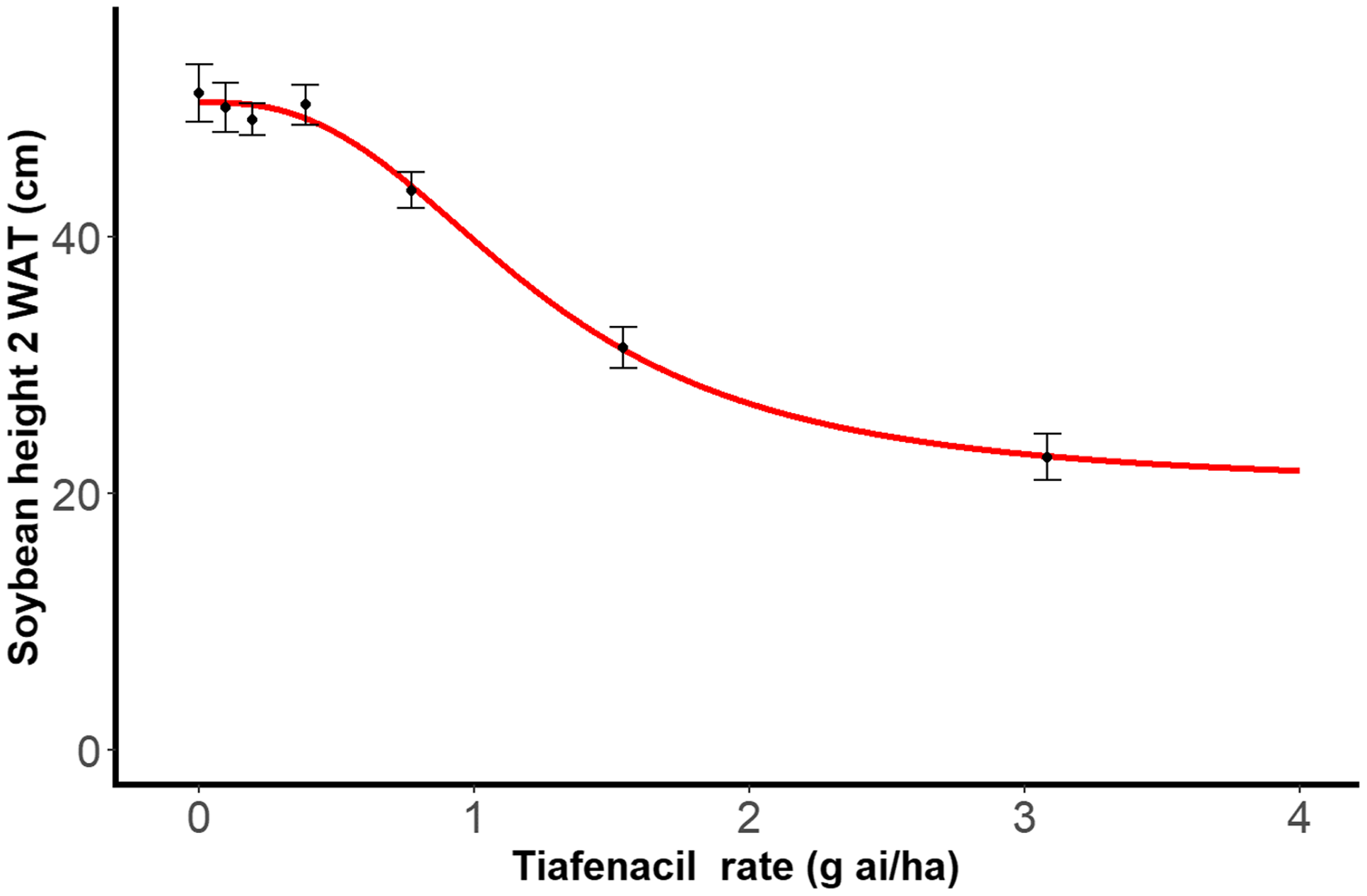
At 1 WAT, the three highest rates of tiafenacil applied reduced soybean height 5%5 to 13%, while lower rates resulted in no greater than a 2% reduction (Figure 4). At 4 WAT, height was reduced 53% to 13% by the three highest tiafenacil rates and 5% by the 1/64× rate (Figure 5). The lowest rates applied reduced height no greater than 2%. The nonselective contact herbicide glufosinate at 12.5% and 6.3% of the labeled use rate reduced soybean height 11% and 9% at these respective rates averaged across a 2- to 3-lf and first-flower application (Ellis and Griffin Reference Ellis and Griffin2002). These results and results from the current research indicate greater sensitivity of early-season soybean growth to off-target movement of tiafenacil compared with glufosinate.
Soybean height at 2 wk after treatment (WAT) as impacted by reduced tiafenacil rate at 0×, 1/8×, 1/16×, 1/32×, 1/64×, 1/128×, and 1/256× of a 24.64 g ai ha−1 use rate applied to 1- to 2-lf soybean for data collected at St Joseph, LA, Alexandria, LA, Lonoke, AR, and Milan, TN, in 2022.

Soybean height at 4 wk after treatment (WAT) as impacted by reduced tiafenacil rate at 0×, 1/8×, 1/16×, 1/32×, 1/64×, 1/128×, and 1/256× of a 24.64 g ai ha−1 use rate applied to 1- to 2-lf soybean for data collected at St Joseph, LA, Alexandria, LA, Lonoke, AR, and Milan, TN, in 2022.

Soybean Yield
Soybean yield following exposure to tiafenacil at the 1/8× rate was reduced 53% (Figure 6). Tiafenacil applied at 1/16× and 1/32× rates resulted in reduced yield of 24% and 5%, while the lowest rates reduced yield no greater than 1%. Conversely, previous research with the PPO-inhibiting herbicides acifluorfen, fomesafen, and lactofen (Harris et al. Reference Harris, Gossett, Murphy and Toler1991) and the nonselective contact herbicide glufosinate (Ellis and Griffin Reference Ellis and Griffin2002) indicated that although each can result in soybean injury, significant at times, early season after application soybean was able to fully recover, and negative yield impacts were not observed. These results and results from the current research indicate greater sensitivity of soybean to tiafenacil compared with other PPO-inhibiting herbicides and glufosinate, with impacts lingering throughout the growing season.
Soybean yield as impacted by reduced tiafenacil rate at 0×, 1/8×, 1/16×, 1/32×, 1/64×, 1/128×, and 1/256× of a 24.64 g ai ha−1 use rate applied to 1- to 2-lf soybean for data collected at St Joseph, LA, Alexandria, LA, Lonoke, AR, and Milan, TN, in 2022.

In summary, severe soybean visual injury including plant death was observed early season in response to tiafenacil rates ranging from 12.5% to 1.6% of the lower end of the labeled rate range (26.64 g ai ha−1) and did not lessen over time. This visual injury was also manifested in significant height and yield reduction. In comparison to previous research conducted on PPO-inhibiting herbicides (Harris et al. Reference Harris, Gossett, Murphy and Toler1991), soybean season-long response to off-target application of tiafenacil applied at rates evaluated would be much greater. Application of tiafenacil directly adjacent to soybean in early vegetative stages of growth should be avoided. In cases where off-target tiafenacil movement does occur before the 2-lf stage, injured soybean should not be expected to fully recover, and negative impact on growth and yield will be observed.
Funding statement
The authors wish to thank the Louisiana Soybean and Feedgrain Research and Promotion Board for providing partial funding of this project.
Competing interests
The authors declare no competing interests.