In 1588, São Jorge da Mina governor and sexual predator João Pessanha was tried by the Portuguese Inquisition for ‘sins of the flesh, with both Christian and Heathen women’. Though his predation was a staple in Portuguese male-African female relations, his case was remarkable for its details and a rarity for the highest-ranking Portuguese official on the Mina (Gold) Coast. Twenty-three witnesses testified against him, including men who worked with him and under his command. In Pessanha's quarters, several specified ‘he kept black women, with whom he sinned’. More telling is that ‘he had his black men bring him by force the daughters or nieces of black women, to sleep with them’. Rape was routine for women and girls, for he ‘opened the girls with his hands, when he could not do it otherwise’. One witness explained, ‘He had his black men take the black women because they did not want to live with him as mistresses, and so he slept with them forcibly; and I say this because his black men told me so, shocked as they were by seeing him behaving thus’. Who were these men? Pessanha ‘had his slaves take daughters by force from their parents, and under threat and menace the said parents gave them to the slaves’, clarified another witness. The assistance his captives provided was specific: ‘His slaves held them by their legs and arms when they did not comply in any other way’.Footnote 2
Several testifiers indicated the girls and women so violated came from the neighboring polity of Fetu and the village of Adena, adjacent to the São Jorge da Mina fortress. Pessanha supported and even gifted some of the girls and women, calling them around midday to his abode. Pessanha was no anomaly nor rare sexual predator, preying on the enslaved as he and others did to girls and women in nearby settlements. Indeed, his ritual acts of repetitive violence was, in the mouth of a witness, ‘customary among men in this fortress’. One witness, a 40-year soldier, knew some of these African women but did not utter their names for the record. Other women among the nameless included hostages from Winneba and the Eguafoɔ, ‘who were taken to his house, and he locked himself with them’. When face-to-face with inquisitors, Pessanha offered a plea, characterizing himself as a ‘sensual sinner, endeavoring to satisfy my savage appetite and nothing more’. He admitted, ‘I have defiled those black women’, but then pivoted, saying, ‘if there is any excuse in this, it lies in my being misled by their all bearing Christian names, and this is so widespread in those parts that it is not condemned by confessors any more than other sensual sin with a Christian woman outside matrimony’. The elderly Pessanha pleaded for mercy and absolution. He was sentenced to four months in a monastery, requiring him to pay the case fee and to confess each month. Nothing about African girls and women or sexual violence found their way into the Holy Inquisition's decision.Footnote 3
Said violence cannot be written off with Pessanha’s mea culpa, ‘to satisfy my savage appetite’. His admission, his pithy phrasing, and the title of this article encapulate the serial plunder in the course of Portuguese claims to bodies of martime water and bodies on land in their desire for global empire. The abundant testimonies about Pessanha’s sexual predations, far greater than any adherence to Catholic dogma, inform any speculation about the context of sexual violence that would have saturated the daily lives of Graça and Mónica Fernandes at São Jorge da Mina. Interrogating the evidence from their cases, read through the optics supplied by Pessanha’s case, show how they lived in defiance of enforced Catholicism and enslavement, and sought to maintain a spiritual, cultural, and therapeutic practice of their own and thus using what Nwando Achebe has described as their ‘female power’ while facing varied forms of physical and epistemic violence.Footnote 4
Scholars who focus on gender and power within religious or colonial (slavery) contexts have for some time drawn our attention to sexual violence against African girls and women.Footnote 5 Despite what historians of slavery and imperial violence have noted about their vulnerability and survival strategies in ‘colonial’ and ‘postcolonial’ contexts, questions remain about sexual predation and slavery in earlier periods, particularly in sixteenth century Africa-Europe relations when Portugal held a monopoly on European trade and knowledge production in Western Africa.Footnote 6 In the Mina (Gold) Coast, except for traveller accounts and archival records from the mid-seventeenth century onward, there is little known about the lived experiences of enslaved and ‘freed’ girls and women, and this is especially true for females held captive or in proximity to Portuguese slaving and gold trading bases of operation.Footnote 7 However, although only three inquisitional trials exist for the Mina (Gold) Coast, sources which provide rare African female voices in the Portuguese colonial and evangelical world, narratives of women and particularly those under Portuguese slaving and religious hegemony can tell us much about sexual violence, slavery, and religious orthodoxy in early modern Atlantic Africa.
This article focuses on the two extant inquisitional dossiers, other than Pessanha's case, supplemented by archival and published sources. These cases involved two African women — the elderly and enslaved Graça, and the younger and manumitted Mónica Fernandes — transacted in 1540 and 1566, respectively. Their lives played out in the principal Portuguese base at São Jorge da Mina, nearby villages and polities on the Mina (Gold) Coast, and in Lisbon.Footnote 8 While the Mina (Gold) Coast played host to all major European slaving nations, beginning with Portugal in 1471, only two general histories exist for the one and a half centuries during which Portuguese documentation predominated, and thus most historians of the region have neglected these sources.Footnote 9 Graça's and Mónica's testimonies, imbricated with the lives of dozens of women and girls, reduces this lacuna while also contributing to the study of Portugal's slaving enterprise on West African soil, Catholic evangelization, and the global reach of its Inquisition.Footnote 10 Indeed, as religious and secular authorities exerted power over these women, their human actions contested the logic of empire and expectations of Catholic practice. Though Graça and Mónica were ‘slaves’ of the king of Portugal, and King João III was the ultimate slaver because all captives not in private hands belonged to him, they were noncompliant ‘subject-slaves’ and their ritual practice rejected Catholic dogma. And it was this intransience that brought both women before the Inquisition and into the Portuguese-supplied records.
João III was also a fanatical Catholic believer. The Inquisition became the foremost institution in the empire, helmed by the king in 1540. Nascent and still in flux, the newborn Inquisition extended religious authority throughout Portugal and its global patchwork of fortified trading posts and colonial enclaves, sponsored by close cooperation between crown and clergy. Unlike the medieval and papal versions, Portugal's Inquisition came under the monarchy's direct control and metastasized throughout the empire, with fear percolating every layer. Portugal's ruling elite thus applied its jurisdictional authority abroad as it did in the homeland, though there were no tribunals in Africa. Consequently, Graça and Mónica were sent to stand trial in Lisbon, as African healer Domingos Álvares did in the eighteenth century.Footnote 11 From what is recoverable in documents originally created for their repression, Graça and Mónica's life stories bore witness to the terror of empire not in abstraction but in the regimes of slaving, belief, and sexual violence.Footnote 12
On the late fifteenth and sixteenth century Mina (Gold) Coast, young and old, enslaved and manumitted, unconvinced as well as baptized African women stood in defiance of Portugal's global empire, in different ways. By ‘defiance’ I mean strategic noncompliance, dissent, subversion, boldness, and contempt, which is to say more women were likely in defiance but whose actions did not rise to the level of inquisitional inquiry. The difference in outcome for Graça and then Mónica shows the growing power of dissent and personal advocacy against a massive empire. Rather than yield to Catholicization and predation of their labor and bodies, Graça, Mónica, and others chose African medicines and therapies in the face of ridicule from other ‘black women’ and sexual violence from Portuguese men. To leading men of the Inquisition and empire, Graça and Mónica were disposable women facing justice for defiant nonconformity to Catholic and imperial dogma. But these women had other ideas.
Graça: ‘the matter is between black people’
Graça was born between 1470 and 1480, a decade in which the first Portuguese mariners reached her homeland in 1471 but certainly before São Jorge da Mina was built in 1482–3. Erected on a rocky peninsula near the village of Adena, now called Elmina, this military and trading base — the most vital fortress in Atlantic Africa — was built under the direction of inaugural captain Diogo de Azambuja, but not without conflict with Adena villagers. The uneasy truce between Adena and São Jorge da Mina — often collapsed under the rubric of ‘Mina’ — formed the setting for Graça's everyday life, saturated with violence. Graça was one of the earliest enslaved females at the fortress, serving its sixty male residents and working in the infirmary and the oven house. She spent most of her time with the villagers of Adena, spoke an Akan-based language instead of Portuguese, and relished temporary amnesty from the physical, sexual, and spiritual violence endured in the fortress. As her trial records concede, ‘Graça lived in Mina… and spent most of her time with black people, with whom she talked’.Footnote 13 How Graça became a ‘slave’ of João III and what her everyday life prior to that might have been is unknowable, but her captivity, new name, and daily life in the fortress began between the ages of 19 and 29. Capture or purchase brought her into the world of captivity, laboring and serving her captors, and baptism sealed her fate as a chattel which belonged to João III and his god.
Most white females living in São Jorge da Mina were exiled from Portugal to serve their judical punishment in the empire's outposts for a fixed period, and were a mix of married and unmarried women. Some of the white females were wives of officials. Though we lack exact numbers, there were few — less than a handful for each term served — compared to the large roster of enslaved African girls and women. The latter hailed from the triangular region formed by the Mina (Gold) Coast, kingdoms of Benin and Kôngo, and the island of São Tomé. Others were African or African-descended women from Portugal. In a formative era of global empires, driven by mercantilistic commerce and religious dogma, we know the least about the number of enslaved women and even less about their lived experiences, especially where miscegenation was rare, and where they were neither mistresses nor liaisons to Portuguese men.Footnote 14
Graça was baptized in the church of Nossa Senhora da Conceicão.Footnote 15 From the perspective of the enslaved, baptism was a placeholder for conquest, claiming Graça for Portugal and Christendom, for Portugal styled itself as the defender of the Catholic faith. Baptism also worked as a placeholder for slavery as a state of war, by registering peoples of her homeland ‘black heathen’ objects of Christen conquest.Footnote 16 Baptism was not a singular event, for it involved changing the captive's name, excoriating any return to pre-baptismal cultural forms and ideas, and requiring public professions of faith. For most enslaved Africans, baptism was a meaningless ritual in a mysterious language or, worse, a form of European witchcraft and a sign of their cannibalism.Footnote 17
Catholicism was an alien set of rituals which Iberian slavers had little interest in diffusing among their chattel.Footnote 18 Though conversion was discursively the primary reason for enslavement — to save the souls of ‘slaves’ — primal greed for precious metals and goods took precedence.Footnote 19 Thus, those targeted as the worst offenders against the Catholic Church were those who kept something of their indigenous beliefs and cultural forms after baptism.Footnote 20 At the height of trading gold and captives on the Mina (Gold) Coast, the king of Portugal incentivized conversion: two juntos of gold coins worth 380 réis went to each Catholic priest for every boy from Adena, ‘up to a total of fifteen a year, whom they trained as choirboys’.Footnote 21 The captain would also receive two juntos for each boy, and one junto for each adult convert. The empire's dependence on gold, goods, and commodified humans triggered this conversion strategy, but it failed. Most villagers, even those with frequent Portuguese contact, preferred their ‘heathen names’, and consulted ritual specialists and healers in the village. Graça's constant exchanges with these same villagers and healers illustrate how anemic a spell Catholicism cast over their lives.
At first glance, Graça was in a liminal space, laboring in the Portuguese Catholic fortress while communing routinely with Adena villagers. She neither belonged fully to the fortress community of her captors nor to the village of her friends and extended family, but her preference was clear. Though free to make choices, they were not made in freedom. And yet, electing to spend much of her time in Adena, engrossed in the language and cultural forms there, says something about Graça's loyalties and her personal and broader history. Though enslaved, she gives the impression of having been liberated with each trip to Adena, each conversation with indigenes, each taste of indigenous food. Her ongoing bonds with Adena villagers poked holes in Portuguese notions of conversion and control while she remained a captive working in the fortress. But these very same connections also made her vulnerable to accusations and later anonymous denouncement to the Inquisition.
Graça was the first African and perhaps first woman to come before the Inquisition, beginning with an interrogation of her baptism. Though baptized, Graça knew little about the rudiments of Catholic orthodoxy, and this would remain so. Neither the priest who baptized her nor her godparents taught her how to cross herself (signum crucis) or how to recite Our Father (pater noster) and Hail Mary (ave maria). At best, Graça was only able to mumble the first words of these prayers in Latin. Most Africans subjected to inquisitional terror came before the tribunal because of their alleged ignorance of the faith.Footnote 22 Even as Graça offered food to her direct ancestors and communed with them at night, in her shared quarters near the oven house, folk superstition and medicine — including talismans and spells — were practiced throughout Portugal into the nineteenth century. These folk beliefs proliferated in part because illiteracy was so high in mid-sixteenth century Europe. It was over 80 per cent but more pronounced for women, thus unduly targeting them as purveyors of erroneous belief.Footnote 23 Graça could not utter a single word of the Creed, though she said Priest Pedro Lopes was teaching it to her.Footnote 24
The tenure of Graça's godparent João Machado places her baptism between D. Manuel's ascension, who ruled Portugal from 1495 to 1521, and Machado's return to Portugal in 1499.Footnote 25 It is strange that a nineteen- or twenty-something-year-old would be baptized if she were born, as her records stipulate, in the São Jorge da Mina fortress. Graça was, by her captors’ reckoning, between sixty and seventy years old when imprisoned in Lisbon, making her older than the fortress. The fortress signified a world peripheral to the surrounding settlements. Its closest settlement was Adena, but it was under the political overlordship of the Eguafoↄ, sometimes contested by the polity of Fetu. The Eguafoↄ and citizens of Fetu and Adena formed the spatial arc of Graça's community, and speculatively her homeland, while her strongest bonds emanated from visiting and being visited by Adena villagers.
When Graça became the king's slave, her servile status was confirmed by the denial of a surname, certifying kinlessness and becoming the property of another. Graça was her baptismal name but tucked away in the African language she spoke was a non-slave name, used when in the company of ‘black people’ from Adena. Portuguese officials at São Jorge da Mina hoped the ritual of mass and roll call would help baptized or captive Africans ‘hear their Christian names repeated, because … all the other [converts] after leaving the company of Christians and returning to their village, call themselves by heathen names’.Footnote 26 Out of the four women working in the oven house, two, namely Graça and Beatriz, did not have second or family names. Unsurprisingly, both belonged to the king of Portugal.
Living near the fortress’ oven house, Graça ‘was a kneader in said oven house, baking bread for the people’. Bread was the staple of the Portuguese diet. The oven house supervisor received a monthly supply of flour, then employed women of the fortress to make bread. Regulations dictated that four salaried and four unpaid women, aided by some enslaved females, kneaded and baked the bread. Room and board replaced salaries for unpaid workers. Graça's salaried female coworkers received the lowest annual wage (12,000 reis) compared to the 56–63 male workers stationed at the fortress in the sixteenth century. Graça and the women of the oven house also toiled as nurses in the infirmary and were routinely subjected to the everyday sexual violence coded in the records as ‘other duties pertaining to them’. Enslaved girls and women, who were not counted as members of the fortress, were at the disposal of residents.Footnote 27 By 1519, there were 18 enslaved women serving in houses of high-ranking officials and residents, and Graça, now between the age of 39 and 49, was the mother of four sons while still working in the oven house. The production of ‘mulattos’ was a signature of Portuguese male presence across the globe, and the 18 enslaved women working in the fortress gave birth to at least 14 children — 6 daughters and 8 sons. Graça had the most children of any one woman and her sons, like the children of all enslaved women, inherited their mother's chattel status. We cannot prove rape resulted in these children, but neither can we evince consent.Footnote 28
Graça and other women working in the oven house provided each resident with four loaves of coarse baked bread daily. Women, too, received rations of bread, along with oil and vinegar. Breads were made from imported wheat or locally procured millet or maize.Footnote 29 Breads produced in Graça's oven fed crew and captives aboard Portuguese slave ships to São Tomé, the Bight of Benin, Kingdom of Kongo, and onto Portugal, satiating a global appetite for enslaved bodies baptized in mass.Footnote 30 Overabundance of bread, however, exposed the Portuguese and their captives to excessive starch and too little (meat) protein in their diet. Restricted from obtaining chicken and other protein sources from Adena, the foreigners waited on livestock imported periodically from São Tomé. Graça's frequent contacts with Adena villagers and her fluency in their language and landscape removed her from this nutritional obstacle. Adena was nestled in a forest-coastal ecological zone with ready access to fresh fruits, vegetables, nuts, and seeds. Portuguese residents had a high mortality rate, in contrast to Graça's old age and longevity. Observers in Graça's homeland paid attention to what foods ‘the blacks eat’: yams, seeds and nuts, cowpeas, guinea fowl, fish, domestic goats, sheep, giant snails, oranges, lemons, citrons, peppers, coconuts, sugar cane, honey, plantains, eggplant, white and red pumpkins, sweet potato, amaranths, maize, palm oil, and palm wine.Footnote 31 Over time, local diet was affected by Portuguese-supplied starches, creating a transatlantic slave diet because the new crops arrived along slaving routes and often provisioned slave ships.Footnote 32 Graça was condemned not for her foodways nor baking bread but for ritually feeding her deceased parents, and thus defying the empire's core ideology.
Graça's crime
It was a Sunday, early morning, 7 April 1540. João Vaz de Paiva appeared before the vicar of São Jorge da Mina, Pedro Lopes, to testify against Graça. Paiva was an unmarried officer who worked as the fortress pharmacist. Paiva told the vicar:
I was going to the oven house of the fortress for some vermicelli-like pasta, and I met some black women who worked in the oven house [and] who were shouting. These were Margarida Rodrigues and Bárbara Lopes, women who worked at the kneading-house. I asked them why they were shouting, and they told me that Graça, slave of Our Lord the King, had done some things related to sorcery and idolatry, of the heathen kind, and that they told me about it to unburden their conscience, for they were Christians.Footnote 33
Meeting at the customs house, the vicar informed captain Manuel de Albuquerque of what the pharmacist told him. With only months left in his term before returning to Portugal, Manuel de Albuquerque ordered Graça be brought before him at once, along with the alleged objects of witchcraft. Captain Albuquerque then ordered ‘that Graça be put in the pillory and prison of the fortress’.Footnote 34
That same day, vicar Lopes went up to the pillory where Graça was held. He asked her, ‘Are you a Christian’? She answered, ‘Yes’. Graça said she became a Christian ‘in the church of this fortress’. The captain of the fortress at that time, Graça answered, was Diogo Lopes de Sequeira. Sequeira had been captain from December 1503 to January 1505. If ‘made a Christian’ meant baptism, then Graça's baptism sometime during 1495–9 is contradicted. Graça may have also confused the details of her early life, especially events that happened more than 35 years earlier and were not particularly important to her sense of self. Hoping to pin Graça down to a specific time, the vicar asked her, ‘What was the name of the priest who baptized you’? She could not remember, only saying, ‘He was a large man, who shortly after left for Portugal. He had lodged with the factor [merchant], who was called Barros’.Footnote 35 Unable to name the priest using ‘proper’ Portuguese, Graça probably meant factor Estêvão Barradas, who served in that capacity from 1504 to 1507.
Margarida Rodrigues and pharmacist João Vaz de Paiva then testified against Graça, separately corroborating the same narrative. Paiva explained that he and João da Mata ‘told the cooper, who was present, to move a chest aside, and they found a small bowl with a base, the size of an eating vessel, with four round sticks in it, around four fingers long each. The bowl and sticks were floured with flour or lime’. The witnesses asked Graça about the significance of these items. Her response? ‘Leaning against the chest where the objects had been taken from, she said with a serious face that it was her God’. Asked, ‘Your god’? Graça reiterated ‘Yes’! Paiva admitted rebuking her. He told the vicar, ‘The black woman who served the meirinho [bailiff or officer of justice] … said that Graça's spells could kill no one and that she had taken the said sticks and rubbed her breasts with them’. Graça also said that these objects were ‘for her father and mother, who were already dead, to come there and eat and that this was a custom of black people’.Footnote 36
Graça knew some of what was expected of her, and yet her poor grasp of Portuguese and Catholic liturgy on one hand, and her communion with her ancestors and ritually feeding them on the other, opened a set of knotted perspectives. How could someone whose captivity, monitoring, and surveillance had been underway for three to four decades not grasp the language and theology of her captors? Most evocative in the dissonance between Graça's lived experiences and Christian hegemony was her act of spending ‘most of her time with black people’ in Adena and paying lip service to religious orthodoxy. Yet, she was not so unlike her captors, because Portuguese captains, residents, and clergy also paid more attention to liquor and so-called mulatto women (such as Margarida) than their faith. These bureaucrats laboring at the behest of the empire were essential workers riddled with contradictions because empires breed hypocrisy, corruption, and cutthroat politics. Graça lived through the many hypocrisies of empire, probably knowing somewhere in her soul that the officials of empire lied when they argued that her case was about truth, justice, and the rule of law.Footnote 37
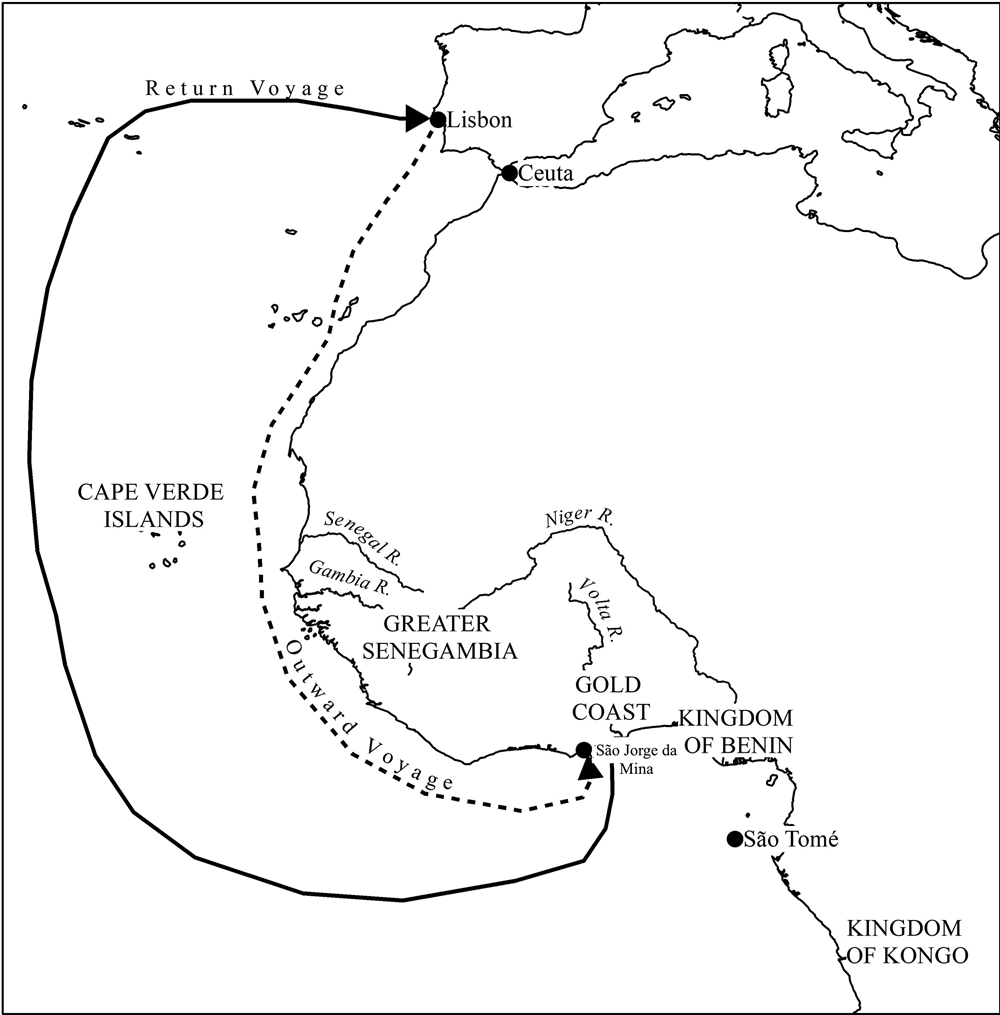
Disembarking in Lisbon after a two-month journey from the Mina (Gold) Coast (see Fig. 1), Graça appeared in chains, removed like an object from the Galga's dark hold, under the watchful eye of captain Rui Dias Freitas. Now an inmate for the second time, Graça cleared customs. She traversed Lisbon's hectic streets, with people of African ancestry making up 15 to 20 per cent of the city's residents, before landing in yet another dark hold: an ecclesiastical prison. A tense despondency filled the prison, opposite the Sé cathedral, the oldest and most iconic church in Lisbon. There in the Aljube, Graça awaited yet another trial in the nerve center of the global empire.Footnote 38 With her parents deceased and counted among the ancestors, her children and grandchild in West Africa, Graça had no more than memories to keep her company as the prison's darkness fell upon her. Graça was also burdened with how gender shaped criminality and empire: monarchs advised court judges to spare male prisoners because their labor was needed for imperial expansion. Men were more useful alive. If, as one clergy member described it, Lisbon's Aljube prison was ‘a tomb for the dead’, then Graça was not only kinless.Footnote 39 She was destined for a fate far worse than that of her deceased parents: to die alone in her slavers’ land without the possibility of returning home for a proper burial. Graça faced, then, the real possibility of an irreconcilable alienation that would become a paradigm, a fixture in the lives of millions evicted not only from their homelands but almost from humanity itself.Footnote 40
The oceanic route between the Mina (Gold) Coast and Portugal.
Source: Created by author.

Graça was among the earliest of the inquisitional prisoners from Africa, and Africa lived within her, as she had maintained a strong connection with Adena villagers rather than immersing herself among the fortress Portuguese. ‘The reason for this’, the king's attorney explained, ‘is that Graça lived in Mina, without ever coming to Portugal, and spent most of her time with black people, with whom she talked. Therefore, it is only to be expected that she should not have enough [religious] instruction to know and do what is required by justice’.Footnote 41
The inquisitors were ready for a decision. The argument offered by the king's attorney on Graça's behalf was convincing: an enslaved and illiterate African woman who had never been to Portugal nor truly learned Catholic orthodoxy or Portuguese language should be granted leniency and acquitted of all charges. Senior inquisitor D. João de Melo, however, pronounced: ‘We sentence the defendant to life imprisonment, where she will be instructed in the Faith. We assign her as her prison the Monastery of Santa Clara of this city of Lisbon, and we charge in conscience the Mother Abbess and nuns of the monastery with taking very great care in her instruction and salvation’.Footnote 42 Immediately after the ruling, Graça was removed from one prison and delivered to another, where she would serve her life sentence: the Santa Clara Monastery.
More than eight months of denouncement, detention, and interrogation came to a legal — but not an existential — end with the pronouncement of Graça's sentence. The daughter who matured into the woman that became the ‘king's slave’ was now a perpetual prisoner to the Catholic god and his doctrine. Most inmates of the Portuguese empire who were given a sentence of life imprisonment only served three- to five-year sentences. But unlike Portuguese nationals convicted and not sentenced to death by the Inquisition, Graça could never return home. She would never see her family and grandson again. She would never interact with her Adena friends and family. Physically unsettled, she was bounced around from one ecclesiastical prison to another: Mina's jail, the Aljube, the monastery. She probably died in the monastery, without a suitable burial. A Christian burial is also doubtful considering her condemned and spiritually enslaved status. Graça's life sentence was a death penalty of kinlessness and enslavement to a theology she cared little about — and which cared even less about her.Footnote 43
Mónica Fernandes: ‘she was manifestly denying the truth’
Sometime during the mid-sixteenth century, a loud quarrel erupted in the Mina fortress. A heated disagreement between two women had spilled over into the fortress-city ecosphere, drawing in multiple ‘black women’ observers. Born in the fortress, enslaved, and later manumitted, Mónica Fernandes squabbled with Ana Fernandes, described as a ‘black woman’ from Portugal. Mónica and Ana possessed the same surname, yet they were unrelated, sharing only the condition of serving the male Portuguese residents that outnumbered women in an 8:1 ratio. The name Mónica Fernandes was a baptismal name that nullified an unknown name anchored in ancestry. It was a slave name signaling the chattel's trademark like a tattoo. Graça alerted us to this fact: the possession of a singular, first (baptismal) name represented a loss of kin and dispossession because the said person did not own him/herself. Yet even if (former) captives had both a first and a second name, dispossession was still implied because the surname belonged to the (former) owner. Having known each other as bonded then manumitted persons, an animus developed among the two Fernandes women.
The source of their argument is unknown and seemingly unrecorded. Whatever the content, it must have been egregious because Ana told Mónica, ‘If we were in Portugal, I would have someone stab you in the face’. Maria Domingues and a manumitted woman named Clara were corroborating witnesses.Footnote 44 Then Mónica swore, with a hand on Ana's face, ‘I would not go to Portugal, but I would make you cease to be a woman’. Days later, Ana fell gravely ill, complaining that Mónica had killed her. Ana's skin peeled and cracked. She went back to Portugal, where local physicians told her, just before she died, that her condition was ‘completely incurable because it was poison’.Footnote 45
Authorities immediately turned to Mónica as the obvious perpetrator, but Mónica's case turned out to be anything but straightforward.Footnote 46 During her trial, Mónica remained unwavering in her innocence while revealing the squabble with Ana paled in comparison to the tumultuous times and everyday violence through which she lived. Her trial revealed the tensions between empire, trade and religious orthodoxy, and the rituals and healing tightly bound to the lived experiences of ‘all the black men and women in Mina’.Footnote 47
The world of Graça persisted. Though Graça was older, she and Mónica knew each other, having shared common spaces within and outside the fortress-city. Graça and Mónica also had overlapping experiences as captives attending to Portuguese men in São Jorge da Mina. Though their births were both registered in São Jorge da Mina, the fortress was under construction when Graça was born, but Mónica claimed, ‘I had always resided in the castle of Mina’. Her engagement with a spirituality, with a set of cultural technologies analogous to Graça's, also led to her eventual trials and exile. Armed with a poor grasp of the Portuguese language and partial knowledge of Catholic dogma, Mónica would travel a path paved by Graça, yet their outcomes were so different.Footnote 48
Unlike Graça, Mónica had received her manumission. Yet she still served the captain and officials of São Jorge da Mina, washing their clothes and serving in their abodes. It was not by choice; manumission fell short of freedom, and baptism yoked her to the Christian god and Portugal's king. Ever-present reminders of this twin bondage were her baptismal name and her Portuguese enslaver's tattoo: Fernandes. Mónica tells us, ‘I was a baptized Christian and was baptized in Mina by a clergyman who resided in the fortress and whose name I do not know’. Having been baptized for 15 to 20 years at the time of her Lisbon trial places Mónica's entry into the Catholic world around 1540, the year Graça's troubles began.Footnote 49 Like Graça, Mónica spent most of her ‘free’ time frequenting the villages adjacent to São Jorge da Mina.
On 13 September 1552, newly assigned captain Rui de Melo ordered an inquiry by Filipe Eanes, described as the ‘vicar of this cathedral of the town of São Jorge da Mina’. The interrogation, convened in the dwellings of Filipe Eanes, examined five women: Maria Domingues, Clara, Marta Fernandes, Margarida de Albuquerque, and Catarina (also known as Madu). Excluding the accused was standard procedure. The Inquisition in Lisbon questioned witnesses, spies, and those who had the benefit of hearsay, while its officials interrogated the accused. The witnesses in Mónica's case file were all ‘asked about the matters mentioned in this record’. They were not merely called in to tell what they knew, without hints or prompts, but to respond to what was already in the record, having had said record first read to them.
Although Mónica was baptized, she was not confirmed — another important sacrament on the path to becoming a proper Catholic. Mónica admitted she had not been confirmed, making her baptism as incomplete as the records of her early life. However slender those details, they point to a birth in the 1520s, between the captaincies of Afonso de Albuquerque (1522–4) and Estêvão da Gama (1529–32), and a baptism at the end of Manuel de Albuquerque's captaincy. As fate would have it, Pedro Lopes, the vicar who initiated charges of witchcraft against Graça, was also the priest who would have baptized Mónica around 1540. Mónica declared, ‘I confessed every year, except last year [c. 1555] because the vicar of Mina [Diogo Pacheco] did not want me to confess and did not allow me to take the Sacrament’, and that ‘she attended mass every Sunday’. But how do we sync that information with the fact that ‘she does not know the Christian doctrine because it had only been taught to her [over] a few days’ in September 1556?Footnote 50 Did her incomplete baptism have any value, or was it merely a shallow ritual undergone as part of captivity? Or something else?
A marginal note in Mónica's trial records seems to condemn her: ‘Não sabe nada da doutrina cristã’, or ‘She knows nothing of Christian doctrine’. Under interrogation, ‘she crossed herself imperfectly and was unable to say the Pater Noster or the Ave Maria, except for some words from the Pater Noster and others from the Ave Maria, and she did not know any other thing at all about doctrine or the Creed’. Mónica, however, was quick-witted. She converted those few days of Catholic catechism into a compelling counterargument against doctrinal ignorance. When Inquisitor Friar Jerónimo de Azambuja asked ‘whether she knew who Jesus Christ was, and whose son he was’, Mónica ably replied, ‘Jesus Christ was Our Lord’. She stumbled a bit when asked why certain festive days were celebrated, suggesting she may not have celebrated them actively herself, but she knew the purpose of Lent. Asked if she knew anything about witchcraft or consulted with witches or demons, Mónica explained, ‘I have never been a witch, and I only at times made some powders, by grinding a broad bean from my land with a stick of redwood, and with water and oil, and I anointed myself with it when I was ill’.Footnote 51
Mónica told her inquisitor, Friar Azambuja, about medicines from her land used for healing, which he glossed as ‘feitiços’.Footnote 52 Feitiços means ‘magic’ and ‘sorcery’ in Portuguese, implying diverse African objects and practices were enemies of Christian doctrine and were dismissed as sorcery.Footnote 53 Mónica's spiritual culture was on trial, filtered through the Inquisition's demonological preoccupations, whose procedures were less investigations of the truth than enforcers of orthodoxy authorized to determine the degree of punishment for religious or spiritual difference. Rather than seek out the vicar or medicines from the Portuguese apothecary, Mónica insisted ‘that she had been to the local healer of the village, which is next to the castle, not to make feitiços but to cure herself of a foot which had been bitten by a cat’. That village was Adena. Asked what this healer did to cure her, Mónica replied, ‘He had put something on my foot, I do not know what, and he wet it repeatedly and had tied it with a cloth, and this healer was an old black man and was not a Christian’. From the head of the Portuguese empire down to its imperial foot soldiers, this testimony — with Mónica affirming that therapeutic ritual and healing, or the power to heal, lied with indigenous spiritualists and ‘not a Christian’ — was a tremendous slap in the face, challenging the empire's core beliefs and institutions. The friar was infuriated. He lashed out and told Mónica that ‘she was manifestly denying the truth’!Footnote 54 But was she? Or was his truth and the global empire's truth a lie?
As if a metaphor for the empire that Mónica and Ana lived under, Ana's return to Portugal and the peeling away of her face mirrored Portugal's shedding burdensome fortresses in North Africa and a recommitment to the Asian spice trade as far as China. At the same time, the empire was plagued with the increased costs of expansion, indebtedness, and declining state revenue. By the time women like Maria and Clara witnessed or consumed the hearsay of Mónica's deeds, the leading Portuguese gold trading site at São Jorge da Mina and its satellite trading fort at Akyem were mired in challenges.Footnote 55 They were taking in less and less gold, the prime currency of international trade and a buoy to Portugal's domestic economy. João III managed these pressures by focusing tremendous attention on the Inquisition. He ceded to the Jesuits and religious advisors at court a dominant role in guiding the future of the empire as a commercial and missionary force. The tensions between trade and Christian orthodoxy were palpable.Footnote 56
A stream of accusations flooded in against Mónica once she was on trial. That she was shunned by both male residents and women of the fortress-city suggest that Mónica was alone. A crusade against her developed, a drama spiced with spies and friends-cum-enemies. One of these was Catarina, whose pre-baptismal name was Madu. She worked stealthily on behalf of the empire to take out competing beliefs and practices. Turning Madu into Catarina, trademarking her ‘a slave of Our Lord the King’, turned her into a weapon against herself and her people. When Catarina testified against Mónica, she did so ‘without being given the oath since she was a captive’, not realizing she was a pawn and viewed as a non-member in the community of believers.Footnote 57
Nothing happened immediately with these testimonies. They were kept on file for three years until their contents became interesting to someone. On 16 July 1555, Francisco Pires, chief alcaide, or high-ranking commander, of São Jorge da Mina, ordered the records in Mónica's case file brought to him. Friar Filipe Eanes had departed the fortress-city. Pires was informed Eanes had the records in his possession pending action. He had them delivered to vicar Diogo Pacheco, then vicar of São Jorge da Mina's church, ‘to do with them as he thought appropriate’. It is unknown why Rui de Melo ordered the inquiry and then sat on it. Perhaps he realized there was not much there to justify the expense of exiling Mónica to stand trial in Lisbon. Perhaps his captaincy was tenuous, fighting off other Europeans who competed for gold and space on the Mina (Gold) Coast. Perhaps the rising and unresolved tensions between professions of faith in Christian orthodoxy and the commerce in captives, gold, and spices had made Mónica's transgression seem minor in the larger scheme of things.Footnote 58
Another year passed. Days away from his return to Portugal, Rui de Melo allowed the alcaide and the new vicar to proceed in Mónica's case, reversing an earlier decision not to pursue charges made by Eanes. De Melo's flippant acquiescence on his way out upended Mónica's life. Vicar Diogo Pacheco sent the records to be reviewed by the inquisitors. In short order, Mónica was exiled, confined to a ship bound for Lisbon, following an ocean path crossed less than two decades earlier by Graça. Accompanied by her case file and an unnamed niece, Mónica landed on European soil after two months of sea travel, then disembarked at the globalized, Atlantic port city of Lisbon.Footnote 59
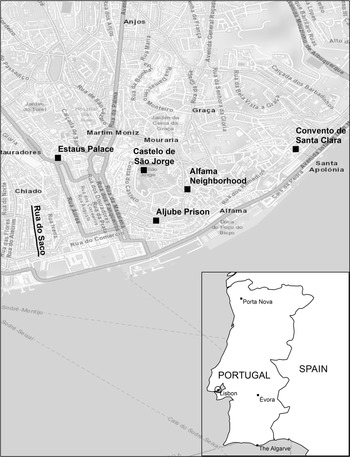
Mónica had been exiled before, at the local Portuguese trading post near Akyem, but this was different. Condemned and imprisoned, she awaited trial. Perhaps she was haunted by the thought that Ana had threatened to do her bodily harm if she was ever in Lisbon. In the Palace of Estaus (see the map of Lisbon in Fig. 2, below), the official site of the Portuguese Inquisition, appeared Friar Jerónimo de Azambuja. On the first day of September, Azambuja received the records together with the accused woman.Footnote 60
Map of Lisbon, showing the places where Graça and Mónica were held as captives, interrogated, and forcibly indoctrinated.
Source: Created by author.

Three days later, in the Holy Inquisition council chamber, Mónica appeared on trial. There is no way to know if she sat or stood or laid strapped to some medieval torture device. Likewise, we have no hints about her state of mind. With Mónica's case file in hand, the barrage of questioning began.Footnote 61 Azambuja asked if the accused had used witchcraft to get officials of Mina to love her. Mónica denied the accusation but said that a male healer used a pan from which he drew a ‘mézinha’ (concoction) to treat her cat bite. Azambuja pushed further, seeming not to accept the cat bite justification. Perhaps frustrated, Mónica responded, ‘I anointed myself with the powders made with the broad bean and the stick of redwood to cure myself when I was ill, but that I have never anointed myself with any feitiços’. Indeed, ‘this ointment was not made only by her’, Mónica explained, ‘but also by all the black men and women in Mina’. Widespread use of indigenous medicines and ritual technologies were inherently suspicious regardless of the purpose; Mónica and Graça had indeed anointed their faces, limbs, and breasts with said medicines.Footnote 62 Now on the offensive, Mónica emphasized that ‘she, the confessant, does not know any other spells, and that the said black woman, who … quarreled with her in Mina, and who died in this city, bore this [false testimony] against her because she bore ill will against her’.Footnote 63 Mónica, unlike Graça, had no children at the time of her trials.Footnote 64 It is possible that the reason she did not have any children noted on the same lists as Graca was due to the use of rituals and birth control from the indigenous healers she frequented. Although infertility cannot be ruled out, it did not spare Mónica from the predatory violence women faced in the fortress.
Incensed and doubtful, Inquisitor Azambuja told Mónica that ‘she was manifestly denying the truth…which was known and was told by the witnesses’. He admonished her to just confess her crimes already ‘in the name of Our Lord Jesus Christ’, suggesting that ‘she would be treated mercifully’ if she confessed her guilt — a common tactic to get the innocent to confess. Mónica did not respond. Instead, she was escorted to her prison cell.Footnote 65
Over a week later, on 14 September, Mónica was called to appear in the Holy Inquisition's council chamber. The inquisitors restated the claims against her.Footnote 66 To these absurdities, Mónica responded, ‘The truth is that I anointed myself with mud and with powders made of redwood, and with oil and crushed broad bean, which I was taught to make by a black man who was a healer, who lived in a village [of Adena] next to the fortress of Mina’.Footnote 67 Mónica admitted to Africa-based practices but disconnected them from Catholic notions of witchcraft.
The inquisitors gave a stunning verdict. They were of the ‘opinion that these were matters of minor importance and unworthy of being remitted to the Ordinary [Justice], [and] ordered that the said Mónica should be taken to the College of the Doctrine of the Faith so that she might be instructed there in matters of Faith’. In other words, Mónica needed more indoctrination. She was then sentenced as a prisoner in the College of the Doctrine of the Faith, to be propagandized in Christian orthodoxy.Footnote 68
Mónica's fate was quite different from Graça's. Apparently out of nowhere, less than two months after her religious incarceration, Mónica was set to be released. Most condemned heretics sentenced to the College of the Doctrine of the Faith spent one to three years there. The reasoning was: ‘Now she has no more [money] to spend or anyone to give it to her because she is in prison and a foreigner and has no one to help her meet her needs. She requests that she be released, and she will always pray to God for Your Graces’ life and prosperity’.Footnote 69 Indeed, Mónica had requested her own release by showing Francisco de São Miguel, head of the College of the Doctrine of the Faith, ‘what she knew about the said Doctrine…how to cross herself, and the Pater Noster, and the Ave Maria, and the Creed’. Mónica thus advocated for herself. On this basis, São Miguel implored Azambuja and his colleagues ‘to have mercy on her, given that she has spent some of the little money she brought on herself and on a niece she brought with her to serve her’.Footnote 70 The inquisitors took São Miguel's petition seriously and told Mónica she was being released because she already knew enough doctrine. Such an inquisitional reversal was rare and even more so because of Azambuja's reputation for brutality.
Mónica was not totally off the hook, however. The inquisitor told her before she left ‘henceforward to go to the College of the Doctrine of the Faith on Sundays and holy days until she fully learned the Christian doctrine’. He instructed her to confess on the ‘three Easters of the year and take the Holy Sacrament whenever her confessor should find fit’. Mónica was warned to never return to the Mina (Gold) Coast again; it was too easy outside of the empire's panoptic view to return to non-Christian ways.Footnote 71 Exiled without the possibility of parole, without the possibility of seeing kin, her victory over the inquisitional empire was measured, not emphatic. Still, Mónica earned at least a partial victory against the empire and the Inquisition. The certificate of release issued by São Miguel and her departure from prison the very same day authenticated her truth.
Conclusion
Two days after sentencing, João Pessanha received a pardoned in the name of King Filipe I. The 74-year-old Pessanha probably died not long after his pardon, for it was rare for European men stationed in tropical West Africa to live through their tenure overseas much less to that old age and through a trial and (tempered) conviction. As for the African women and girls, whom he and other men had ‘slept with them forcibly’, there was and could be no pardon, or redemption, that returned to virgin girls their innocence and to adult women their consent. We might debate whether an enslaved person has the capacity of consent, which is to say the owner of a tool need not ask that tool if or how it wants to be used. But likes of Pessanha remind us that sexual violence is not predicated on nor mitigated by slavery and thus being a ‘slave’ or having membership as a believer. The likes of Pessanha considered raping ‘Christian’ girls and women as inconsequential as raping non-Christian girls and women. And that this serial rape and predation on bodies for pleasure, reproduction, and productivity was standard practice, or ‘customary among men in this fortress’, implies a new set of perspectives on slavery, belief, and sexual violence during the Portuguese documentary period on the Mina (Gold) Coast. Indeed, scholars who cling to Atlantic world notions of ‘fluidity’ and ‘creolization’, and then claim, ‘beginning in 1482, Atlantic creole culture was given birth in the Gold Coast’, will find no support in the Portuguese sources (which they have not consulted) nor in the cases detailed in article.Footnote 72
In different ways, tempered by age and status, Graça and Mónica stood in defiance of Portugal's global empire in a local place. Their perspectives, coded in lived experiences and culled from inquisitional testimonies, show a growing power of resistance and personal advocacy, even against a global maritime empire and even when the odds were against them. The empire and its Inquisition had the power to rebrand, violate, and uproot people from their homelands and exile them to foreign lands. And yet, as the stories of Graça and Mónica Fernandes illustrate, even the Inquisition could not steal the cultural practices deemed at odds with and outside of Christendom. These two women learned to maneuver around the Catholic dogma that overwhelmed their everyday lives while maintaining their cultural forms and resisting (with measured success) the surrounding violence of sexualized and racialized slavery. Especially in Mónica's case, her endurance and personal advocacy effectively overturned her original sentence. The intention here is not to trivialize the all-encompassing power of the Inquisition but rather to show its complexity and limitations. By doing so, this article has shown how ordinary women in times of extraordinary global change lived, worked, and believed within the web of empire, set against the backdrop of imperial trade, religious dogma, and slaving and sexual predation. To be sure, Graça and Mónica relied far less on their connection with the ‘Atlantic world’ for their status and power, and instead activated their own forms of ‘female power’.
Competing Interests
The author declares none.