There has been a world of activity marking the centennial of the outbreak of the First World War. Much of it has been in the sphere of public commemoration. I want to call attention to a particular kind of commemoration called reenactment, since its substantial growth over recent years presents an important challenge to what we historians do.
Reenactment is less reviewing the past, than reliving it. All over the world, men and women put on uniforms, either of the war period or tailored as closely as possible to its materials, and bear arms, authentic if possible, in imitation training and in combat conditions. Verdun, the Somme, Gallipoli, Caporetto have attracted reenactors, either at the site of the original battle, or in places made to resemble them, whenever possible. Reenactment societies exist all over the world, and come together through the internet. Online merchants service them, and on-site auxiliaries enable them to go through their paces. This is internet history par excellence, a kind of computer game come alive. And it is very lucrative for those who make it possible.
In this essay I want to align reenactment with other kinds of commemorative and historical representations of war, and to try to express my view that it is a dangerous and offensive form of both historical and commemorative activity. It is dangerous because it adds elements of excitement and adventure to contemporary notions of war. It is offensive because it lacks respect for the hardship, the suffering and the anguish of men in battle. It betrays the men who fought by sanitising war and turning combat into what we now call infotainment.
This matters on ethical grounds, but it also matters on professional grounds. Much of the public history of the Great War during the centennial in general, and reenactment in particular, takes virtually no notice of what we do or say. To the public, we are hermetically sealed in our profession, and only talk to each other. To outsiders we are minor swimmers in a stream that others propel forward. We do not control the direction of the stream or even the way it is navigated by the millions of people fascinated by the Great War.
How do we answer this challenge? One way is to say we are trained to turn legends into archivally documented narratives. What we offer, as best we can, is the truth, and nothing but the truth, scrupulously based on the sources we cite in our publications. Truth is not a particularly valuable commodity in today's marketplace. All the more's the need for us to insist on standards of evidence and proof when examining historical narratives of all kinds, both within and beyond the academy.
It is important, though, to recognise the force of the challenge presented by reenactors and reenactment. The centennial of the outbreak of the Great War has been marked by a shift in the balance between collective memory and collective history. Collective memory is the memory of collectives, and most of these collectives are relatively small. Collective memory is almost never the memory of the state. We call state-based narratives about the past ‘official memory’. Below that level there are groups of people who form an idea of the past through family records or through participating in relatively small-scale commemorative events. The French Presidential Commission on the Commemoration of the Great War found that the overwhelming majority of projects submitted to it for approval and money were of this kind – the history of our town, or our school or our factory in the Great War. Small is beautiful is their watchword, and as a result, the scale of much of Great War commemoration has been reduced to the life-size, the quotidian, the personal.
This is where we historians – we who create collective history – have to pause and take note. In much of this commemorative activity, as well as in television, film and theatre, the complexity of the war has been reduced to the personal level. Commemoration is public history, the performance in different places of narratives about the war using different media. Many of these narratives are framed by stories people tell around the dinner table about their past, their family and their local past. Jan and Aleida Assmann call these stories ‘communicative memory’. When they are repeated in public, and last for generations, they enter into enduring stories they term ‘cultural memory’.Footnote 1 Commemoration of the Great War at its centenary is cultural memory expressed through rituals, objects and images.
Television and museums present stories about the Great War all over the world. They use visual technology to tell stories about the war. Without photographs or other images, televisual history is impossible. So is the history presented in museums, though in those institutions artefacts, and the narratives embedded in them, have pride of place. But in many forms of public history, the kind of history we get is first-person history.Footnote 2 When no authentic voice can be found in memoirs, then visual history searches for its story elsewhere. One point to which we shall return below is that this requirement tends to turn television and museums into places where it is difficult to present some kinds of academic history: structural history, the history of the environment, history on the comparative and transnational level, in particular. There are exceptions, but much of public history tells a story visitors already know. The faces on the screen or in the display are like theirs – mostly white and European, or of European settlers. Africans, Asians, Latin Americans, Caribbean people are extras on this extended film set.
This is hardly surprising, since cultural memory comes out of family stories, and the families who have been telling stories about the Great War are by and large European. What matters more is what is left out of even this restricted story. Most of the time, the war that is presented on television or in museums aims at historical accuracy.
Others who tell stories about the war in public are also interested in accuracy – the precision of detail of uniforms, trenches, weapons. They study their subject, war, and come together to reenact combat. This paper focuses in part on this large group of commemorators. The reason I do so is that what they do profoundly distorts our understanding of war. What they offer is not war, but a caricature of war – simplified, sanitised, banalised. We historians need to respond in public to the blurring of the truth about war or its blatant elimination in the public domain. Reducing war to entertainment is simply wrong.
Reenactment societies are not the only culprit. Any historical reconstruction which uses smoke to simulate gas and light bulbs to simulate an artillery barrage betrays the truth. Visitors to such exhibitions are not getting the truth, but a travesty of the truth. That, alas, mars the new Australian Sir John Monash Information Centre at Villers-Bretonneux, which offers its visitors a son et lumière of combat in 1918. Ambient sound in museums suggests that visitors are in a liminal space – on the way to the past. Most of the time, these special effects are used to make people believe that they themselves are really on or near the battlefield, and that they can take a time machine, just for a moment, into the past. This is complete nonsense.
To support my argument, I will present various instances of reenactment and other forms of historical fantasy. Thereafter, I want to add a second charge to my bill of indictment: it is that the reduction of war to the level of personal experience almost always cuts the politics out of it. And there is politics aplenty in this domain. Their omission of the politics of remembrance raises the great danger that in seeking popular ways to honour and glorify those who fought in war, historical reenactors wind up glorifying war itself.
I Reenactment as ‘living history’
A search for what we may term ‘authentic history’ has led a large number of people to support and engage in false history. The primary impulse behind this shift is a surge of interest in and search for the corporeal experience of war. What history offers are representations and interpretations of the corporal experience of war. For a very large population, that is not enough. What they want is the thing itself.
And they want both more and less than the truth. They want the emotional charge of reenactment, understood ‘as a body-based discourse in which the past is reanimated through physical and psychological experience’. ‘Once inhabiting this psychological and physiological space … reenactors describe a condition referred to as “period rush” – a state of complete absorption in the reenacted event – followed by difficulty transitioning out of the past and into the present.’
This conversion experience ‘take[s] the form of testimonials: reenactors attest to profound experiences that are markers on the hard road to knowledge. They begin as novices (referred to in the reenactment community as “farbs”), undergo trials, acquire skills and experience, and are finally inducted into a community of dedicated reenactors’. In case we miss the religious flavour of the phenomenon, one acute observer of reenactment tells us:
The epistemological implications of this conversion-testimonial structure are twofold. First, knowledge is the result of individual experience, and, second, it is perceived to be true. Trauma, privation, emotional disturbance, and transformation leave their marks on the body and psyche, and it is to these wounds and scars that reenactors testify.Footnote 3
Wounds, scars, transformations: we clearly have entered into the language of the Eucharist. For many, though not all, Roman Catholics, the wine and the wafer actually become the blood and the body of Christ. Something similar seems to occur for reenactors: they seek to break through the barrier between past and present, and live in the event itself.
I will come in a moment to the price such people pay for converting the profane material of history into the sacred material of quasi-sacred performance. It is relatively easy to see to what extent those who think they are actually at Verdun during the battle are deluded. They miss the otherness, the strangeness of the past in general, and the radical strangeness of that corner of the past in particular. Yet, many of them insist that their reality is more real than any historical account.
Reenactors do what they do for many reasons. For some, their motivation is clear. They are in search of the sacred, and they find it in the horror and suffering of war. Yes, they find other things, too – evidence of courage, fortitude and endurance – but by and large what they seek are limit experiences, extreme experiences to add a new dimension to their lives. One US Civil War reenactor put it clearly when he said that his quest in uniform was similar to the search for the Holy Grail. He found it not in a cup or other artefact but in the scraps of material which made up his uniform.Footnote 4
Reenactors travel. They can be found on all continents. There are dozens of societies of German reenactors of the American Civil War; not surprisingly, most opt for the losing side. On 11 November 2011, there were French reenactors at the inauguration of the Museum of the Great War at Meaux on the river Marne not far from Paris. Other dedicated French amateurs have restaged the battle of Verdun at Verdun, and at the ceremony marking the centennial of the battle there was a march past of French and German units in period uniforms and gear.Footnote 5
Reenactment has long been a lively enterprise in the United States. At Rockport, Illinois, there was recently a ‘living history’ reenactment of the battle of Verdun.Footnote 6 This town was the site of other reenactments of different episodes in the war, including a gas attack and (not surprisingly) American combat in 1918.Footnote 7 Similar reenactments were conducted at Parkville, Pennsylvania,Footnote 8 and at the Edward Waldo House in Scotland, Connecticut. Thousands of members of the Great War Association ‘experience a living history of the Great War’, says the presenter of the cable television programme History's Guns, presented by the website ‘Shooting USA’, an affiliate of the National Rifle Association.Footnote 9 These and other similar events may simply be an echo of the much larger phenomenon of the US Civil War reenactment movement. But they are by no means restricted to the United States.
In 2018 the 10th Essex, the Royal Warwicks and the Rifle Corps were on display in full First World War kit and attire at a reenactment by living history groups participating in the Great War weekend at Batemans, a seventeenth-century mansion and its grounds at Burwash, in Sussex.Footnote 10 The same group shows those who want to know what British drill instructions were like in the First World War.Footnote 11 Near Chelmsford, the ‘Queen's Own’ Royal West Kent Regiment Living History Group (50th & 97th) manned trenches to mark the centennial.Footnote 12 Former history teacher and Great War specialist Andrew Robertshaw dug a trench system in his back garden in Oxfordshire and dressed up archaeologists and reenactors to help them understand ‘the individual experience’ of soldiers in the line in the Great War.Footnote 13 You can also find on YouTube a reenactor displaying his cooking skills at the front.Footnote 14 British First World War gear for the Royal Naval Division can be seen (and purchased), from an American source.Footnote 15 North of the border, reenactors presented the trench life of the Canadian Black Watch Regiment in 1918.Footnote 16
More surprising was the Great War reenactment ‘family day’ in the War Memorial Gardens in Islandbridge, in Dublin, in May 2016.Footnote 17 Such an event, sponsored by the Irish Great War Society, would have been inconceivable twenty years ago. Two decades later the onset of peace in Northern Ireland created the social space for a commemoration of Irishmen who died in the British army during the Great War. I can recall visiting this site thirty-odd years ago – it was covered by waist-high grass and served well as a field for grazing horses. Now it is spick and span and suitable for reenactment. Other parts of Dublin served as living sets for reenactments of the Easter Monday Rising in Ireland in the same year.Footnote 18
There is a secondary market for younger people, too. Legoland offers a display of soldiers in the battle of the Somme, presumably for younger reenactors.Footnote 19 There are six other moments in the war similarly displayed, and video games are on sale as well. Evidently reenactment is a profitable enterprise for those who provide the paraphernalia, both for reenactors and for their families. There is no better example of the phenomenon George Mosse described thirty years ago as the trivialisation of war.Footnote 20
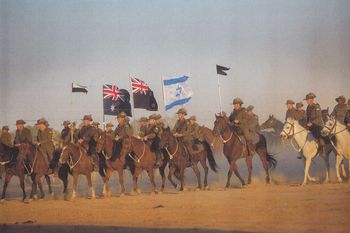
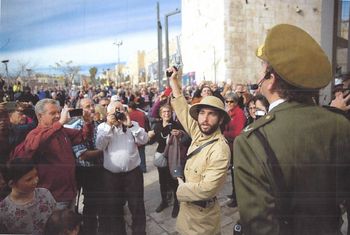
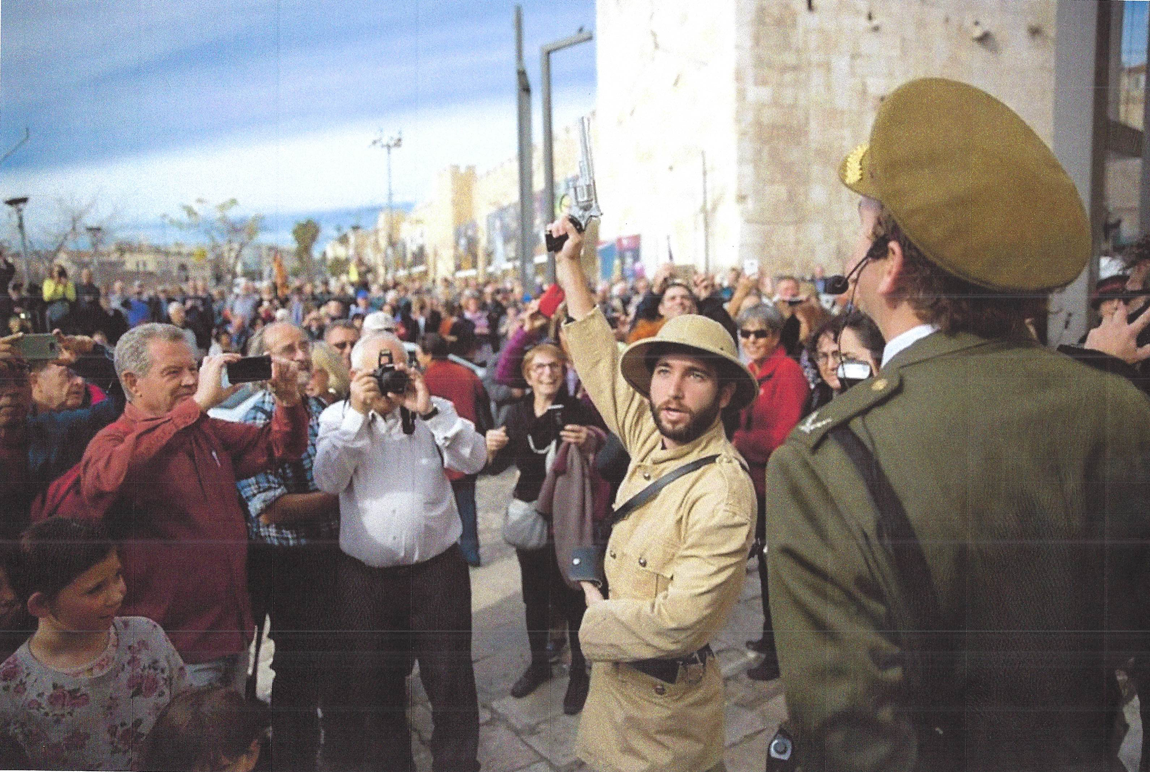
Reenactment straddles the globe. In 2017, Slovenian reenactors ‘relived’ the battle of Caporetto. Despite a major hailstorm, more than 200 soldiers entertained 4,000 visitors at the scene of the battle.Footnote 21 At Beersheva in Israel, Australian reenactors staged their cavalry charge of 1917,Footnote 22 and they made sure that their hosts were part of the story – note the Israeli flag flying proudly, thirty years before the State of Israel was founded (Figure 1). In November 2017, British troops recaptured Jerusalem again, just as they had done a century beforeFootnote 23 (Figure 2). In 2018, there was a Kiwi reenactment of the liberation of Le Quesnoy, replete with armoured cars and air power.Footnote 24 It was repeated on 4 November 2018, precisely 100 years after the battle. Not surprisingly, Gallipoli was reenacted at Lake Kalapiro, in Cambridge, New Zealand, in 2014.Footnote 25 So, too, was the use of tanks on the Somme two years later, at the same site.Footnote 26
Battle of Beersheva, reenactment, 2017 (note the Israeli flag in the centre). (Source: The PMO, 31 October 2017.)

Entry of Allenby to Jerusalem, reenactment, 2017. (Source: i24news, 8 November 2017.)
This range of effort and expense is a global phenomenon, aided by the internet. Arming and clothing a troop of reenactors is easier than it ever was: all you need is access to the web, and then the door is open to anyone who believes that everyone can know, through acting, what it felt like to fight in the Great War.
One aspect of the phenomenon of reenactment that does deserve our respect is its emphasis on emotion. Those who write about war without emotion are suffering from a delusion. The questions that matter are how to express emotion, how does politics frame the expression of emotion, and what part of the emotional universe of the past lies within our reach?
II Emotion and the framing of the past: reenactment, the performing arts, museums
To answer these questions, we can divide the spectrum of approaches to representing the Great War into four domains. On one end of the spectrum is reenactment, sought by those who value what they take to be ‘living history’ and transformational experience. At the other end is academic history. In between are the performing arts and museums, which I shall discuss below. My claim is that academic history, like the performing arts and museums, engages with representations of war. Reenactment occupies a different domain, that of reliving war. Therein lies the rub.
The temptations of reenactment
I start with the question as to why people reenact battle. What do they get out of it? There are two frameworks which seem to fit these people and their search for a palpable past. The first is that of ‘postmemory’, a term coined by Marianne Hirsch in her adept description of the indelible imprint made by parents’ stories about their lives, stories which give their children an eerie sense of having been there with them.Footnote 27 Thus one generation's memories seem to inhabit their children's imaginative reconstruction of their own past. Postmemory can work in a didactic sense too. Thus men whose fathers or grandfathers served in war transmit stories about war which their sons and grandsons want to adopt as their own. Reenactment enables them to do so.
The second framework to account for such phenomena is Alison Landsberg's notion of prosthetic memory.Footnote 28 This refers to a more general phenomenon than Hirsch's notion of ‘postmemory’, since in Landsberg's interpretation, many individuals can attach to their lives a series of stories that may have no family or other direct connection, but that make them feel richer, fuller or more accomplished people. At the extreme, this can arise from psychosis, such as the well-known case of Benjamin Wilkomerski, who truly believed he was a child of Holocaust victims, because he was deeply moved by having seen a photograph of one such child, which, he believed, was his own portrait; subject and object merged. He was not a fraud, just a victim of a prosthetic memory that had seamlessly merged with his own sense of himself. This genre of remembering entails a splicing into an individual's autobiographical knowledge of specific elements from other people's lives. The messages adopted come from film, television and the internet, a process facilitated by the way they present stories about the past as free-floating signifiers that viewers and visitors can adopt as their own.
This can lead to activism in social movements, such as participating in marches today to join in some way the great Civil Rights marches of the past. Rabbi Abraham Heschel wrote that when he marched in Alabama in the 1960s, his feet were praying. Why can't ours do the same? Reenactors treat this question not as our engagement with a metaphor, but as our entry into a moment in history; we really join the stream of history at a point of our own choosing.
Reenactment, after all, is both a social phenomenon and a very profitable part of the tourist and leisure industries. My tentative reading of reenactment is the following. War unfolds stories which are based on myths, or eternal themes, like love, brotherhood, sacrifice, suffering, redemption. Those stories have been framed for centuries in the traditional churches. I sense that many of the people who have become reenactors are some of those who have left their churches by the millions in the last two generations and are seeking the sacred in a new environment. Reenactment, which is both intensely individualistic and a collective activity, provides this environment. Total immersion, obviously a reference, intended or not, to baptism, leads to living history, or the visceral ingestion of the past, as part of both body and mind. It is a conversion experience, intensely emotional and personally transformative. It is also sold by some very able marketers who know what they are doing, though reducing it entirely to hucksterism would be a mistake.
It is important to qualify this argument by admitting that reenactment has its attraction for those for whom organised religion is still an essential part of their lives. Most sociologists argue that in the developed world the proportion of the population still devoted to their churches is in decline, but that is not the case everywhere. Churchgoing is still common in the American South, and fundamentalist sects and evangelical churches flourish in many parts of the world, particularly in migrant communities. An annual meeting of the Christian Open Door Church in Mulhouse, France, was the unintended trigger for the spread of coronavirus in 2020.Footnote 29 In Lebanon, the blood of Imam Hussein is still shed by the Shia faithful, in the ceremony of the Ashura, marking the martyrdom of the House of Ali. Secularisation and religious fervour are both evident in many parts of the world, requiring us to qualify any correlation between trends in organised religion and reenactment.
There is another reason why reenactment is popular today. It is a celebration of martial masculinity at a time when, for a host of reasons, both war and masculine violence have got a bad name. It is wonderful propaganda for the National Rifle Association in the United States. What better way for those who are troubled by feminism to flee the conflicts around #MeToo and the like than by joining other middle-aged men in a search for the thrill of combat and the scent of danger? Of course, reenactment has nothing to do with the brutal face of war and violence, since if anyone bleeds or shits in his trousers, it is purely accidental. Reenactment is a retreat to a vanished world, one in which men of a certain age can feel safe enough together to celebrate their fascination, their fixation even, with guns and organised violence. Reenactment is even a better fix than drugs or alcohol, since there is no hangover the following day.
The performing arts
The second domain of the representation of war which flourished during the centenary is that of performative artists, institutions and events. Museums, films, concerts, ‘dark tourism’, art installations and other performances are the central media in which history and memory come together in forms which resist the two extremes – total immersion in emotion in reenactments and total refusal to express emotion in some scholarly quarters.
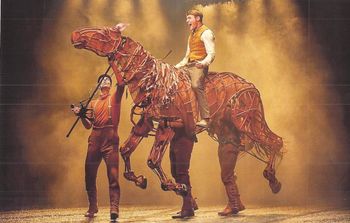
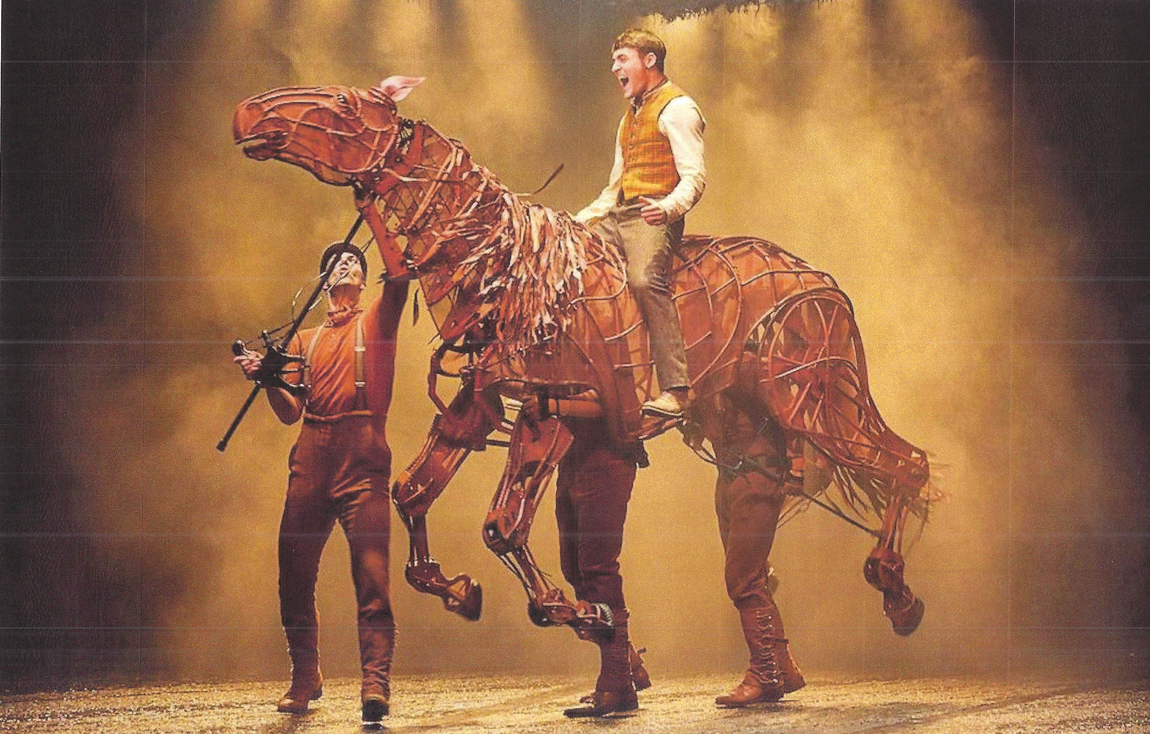
Did the directors of the very successful play based on Michael Morpurgo's book for children, War Horse, engage in reenactment? No, because the social convention which binds theatre companies to their audiences is that they are watching a representation of reality, and not reality itself. The South African puppeteers Adrian Kohler and Basil Jones, and their Handspring Puppet Company, created a maquette of a horse whose body was transparent. The two puppeteers creating his uneven cadence and his equine movements stand under, and work in, the maquette. It is so evidently not a horse that, when their artistry brought the horse to life on stage, the result was utterly stunning (Figure 3). When Steven Spielberg put the book to film, his realism was less true to life than was the artifice of the Handspring Puppet company. In their stage production we saw a living, breathing horse on stage precisely because artists of immense talent used suggestion rather than false special effects designed to ‘recreate’ reality.
Michael Morpurgo's War Horse, National Theatre, London. (Source: Theatre Times, 16 November 2018.)
The same contrast can be seen in two versions of R. C. Sherriff's 1929 play Journey's End. With Laurence Olivier in the lead, the original presentation was set in one dugout on the Western front just before the launching of the March 1918 German offensive. The claustrophobia of the underground war was captured on the stage, and when everything was blown to pieces at the end of the play, we knew that the offensive had begun. The part stood for the whole. A film version released in 2018 reproduced most of the dramatic action in Sherriff's original play, but it ends oddly with German soldiers poking around the ruins of the British trench they have just captured. Cinematic realism failed to convey the tension and destructive force of war as well as did the indirection of Sherriff's theatrical treatment of the theme.
In Britain many of the most striking imaginative works on war that have been produced during the centennial were not realistic in character or form.Footnote 30 One way to understand reenactment is as a form of amateur theatrical work trying to touch war, or to present it as a living reality, while disseminating a hidden agenda that war is honourable and so too is the possession and use of guns and ammunition.
It is possible to argue that reenactment is just a form of open-air theatre, or an open-air version of war films, in which the actors are people like you and me. The difficulty with this argument is that both theatre and film present an imagined alternative reality, one that we know did not happen in the way shown on stage or screen, whereas reenactment presents an experienced alternative reality, one which enables participants to leap over the proscenium arch directly into the past. When staged performances become in the eyes of those staging them a pathway into the heart and soul of the past, then they go beyond the art of performance and enter the domain of enhanced reality.
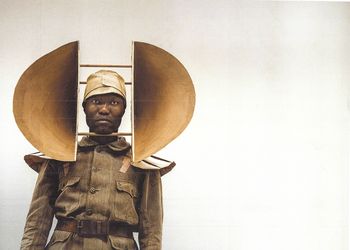
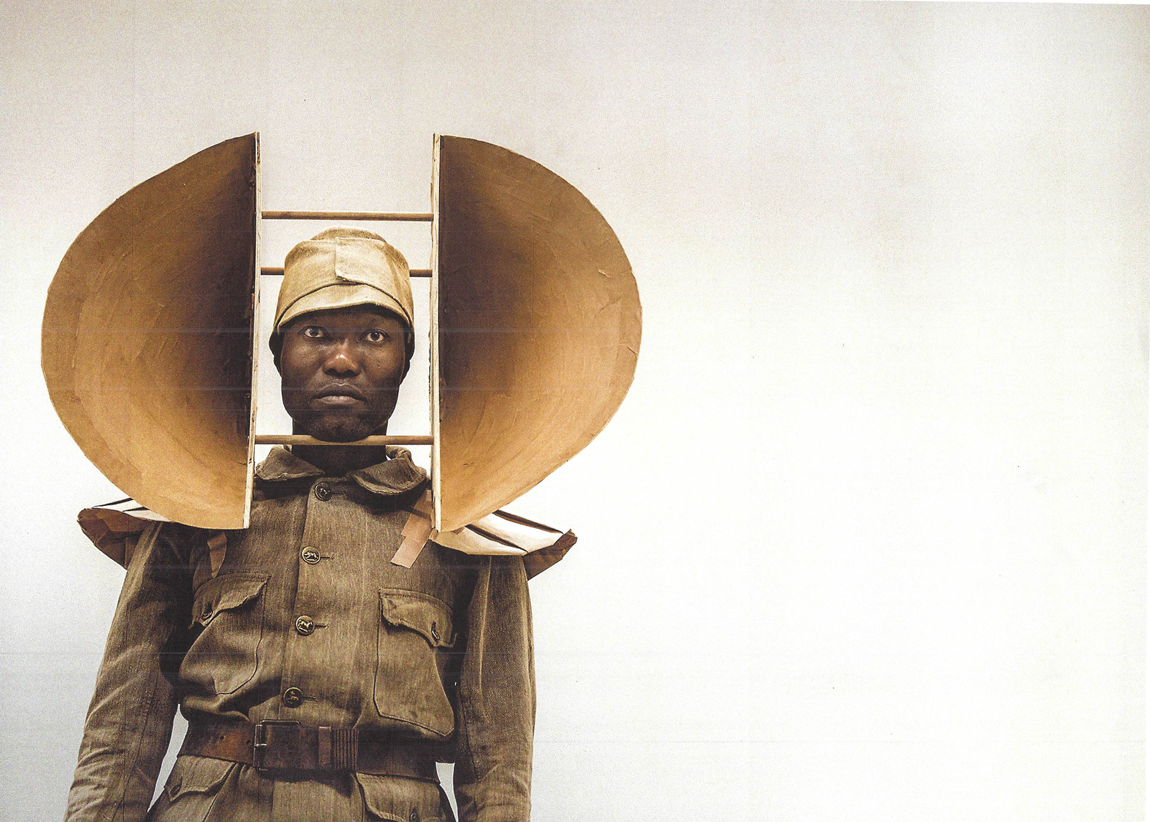
One of the most successful ventures in drawing on all the arts in the commemorative period was a British project called 14–18 Now. It was a publicly financed organisation which presented and funded over 100 works of art about the war. Among these works are William Kentridge's play about African porters and soldiers in the First World War, The Head and the Load, which premiered at the Tate Modern in London, moved to Germany and then to New York. It is a brilliant representation of Africans at war, using techniques from Brecht's Berliner Ensemble, as well as puppets and latèrna magica effects, to bring out the price Africans paid during the war (Figure 4). Another such imaginative project sponsored by 14–18 Now was the pilgrimage to many destinations of one part of Paul Cummins's Blood Swept Lands and Seas of Red, the installation of poppies around the Tower of London in 2014. A third was the performance of the music of John Taverner on 4 August 2014.
William Kentridge's The Head and the Load. (Source: 14–18 Now.)
All three of these projects touch on the sacred themes of suffering, death and sacrifice. But they do so from within a theatrical framework which announces clearly that these are representations of sacred themes, set in different languages of representation. They are clearly within the category of staged performances. Reenactment goes beyond representation, and therefore beyond history.
That is why it is dangerous. Of course we need to reach out to the vast public concerned with, indeed obsessed by, the Great War. But we must never pretend that we offer them ‘the war experience’ as did the Imperial War Museum (IWM) from 1990 to 2014 in their permanent and vastly popular exhibit ‘The Trench Experience’. The IWM has sobered up and moved on, but a great many people have gone the other way.
Reenactment does present real challenges to historians. We operate within the realm of representations and use documents to create narratives about war. We all know that war is a limit experience. It entails observing the pain of others, as Susan Sontag put it.Footnote 31 It is not possible, therefore, to treat writing the history of war the way you would treat the history of prices or population movements. Images and objects carry emotion, and thus have a particular role in both the academic and public history of war. Since emotion is an essential element in the waging of war, it must be so in the history of the waging of war. But writing about such emotions does not mean going down Alice in Wonderland's rabbit-hole. We are outside the story, and those who claim they are inside it are either deluded or dangerous.
An analogy may be useful here. Many, perhaps one-third of, American Roman Catholics believe in the miracle of the Eucharist, when the wine and the wafer become the blood and the body of Christ.Footnote 32 Two-thirds of those who regularly go to Mass believe in the miracle. But aside from these weekly churchgoers, many Catholics are sceptical or take the ritual as a metaphor. Reenactment takes place in the realm of belief; artistic representation, history in museums, and academic history remain in the realm of metaphor.
Museums
Museums occupy a space between reenactment and metaphor. They share with reenactors the privileging of artefacts which were used in war. They borrow from the metaphors of the imaginative arts the organisation of objects and captions in such a way as to convey a story, which is set out in space like a story. It is not battle itself but an account of battle, and therefore approaches what academic historians do.
Of course, we need to adapt the organisation of museal space to the culture of the internet and the cell phone. Interactive design can facilitate learning in a host of ways. The technology is not the problem. What is more troubling is how time horizons have shrunken. What is driving forward many of these attempts at creating virtual reality is the overpowering tendency of the internet to make communication (and perception) instantaneous and (whenever possible) spectacularly visual. Museums are inevitably part of the world of entertainment, and therefore compete for attention with many other attractions including reenactment. But they are also part of the world of learning and, implicitly or explicitly, present to the visitor a social contract, a kind of Hippocratic oath, that their exhibition designers will do the truth no harm.
Most of the time, museums of the First World War keep the faith. But we should note the elements of museal representation which move towards reenactment and thereby implicitly make the false claim that what they provide is the experience of war.
There are at least three areas in which we can see how museum designers try to attract a population bombarded by, indeed inundated with, electronic reality. The first is sound; the second is landscape; the third is experiential, specifically the effort to identify the visitor with the warrior or with the victim of the warrior, to make him or her – if only for a moment – part of the experience of war. All three aim at bringing visitors inside historical experience, rather than leaving them outside the past. They suggest that visitors can try on a certain element of past reality and see if it fits. They ask us to enter the mood of war, and if we close our eyes, we can begin a voyage into the past.
Regarding all three museum strategies of bringing visitors into an intimate relation with the past – sound, landscape and a vague notion of ‘experience’ – I admit to being a purist. The reason is simply that compromising on these points leads almost inevitably to the falsification of history and its refashioning as sanitised entertainment. Consider sound, for instance. Before you enter the Musée de la Grande Guerre in Meaux, near Paris, you hear the sound of artillery projected from below ground. Then, to introduce you to the period, you enter an orientation space, where time moves backward and you hear the sights and sounds of yesteryear. Until the war breaks out. Then you are ushered into the narrative structure of the museum, which does indeed have much of interest in it. Sound here is transitional, a way of telling you what is coming, and preparing you for the voyage you are about to take into the past. The sound is false, and so is the sense that we can really hear the artillery of the Great War. No one can.
The designers of the In Flanders Fields Museum in Ypres initially used sound as a kind of audio soundtrack to accompany visitors. But after consultation with visitors, with their own staff and with others in the profession, they turned the sound off. They recognised that there was no need to add a tonal boost to help visitors understand the tragedy of the war.
There is sound in many of the displays in the Ypres museum, heard privately through earphones, or in enclosed spaces. Some of the most effective representations are films of actors reading historical texts, such as the words of Harvey Cushing, the American neurosurgeon. He is one of what the museum terms its ‘iconic people’. Here we are right on the boundary between history and entertainment, since there is a false touch to the surgical gown worn by the actor reading his lines. I am prepared to accept that the text is more important than the props or the staging, but I still feel that the story is being fashioned to suit audiences used to BBC costume dramas. Perhaps this is a necessary compromise, since the words of Cushing (visually and dramatically presented) subvert any notion of the war or human suffering as redemptive.
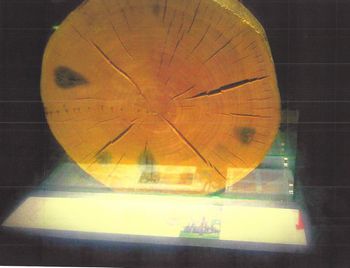
The second arena of negotiation between entertainment and history is in the presentation of landscape. I have noted that some years ago the IWM finally scrapped its old, and highly popular, displays of ‘The Trench Experience’. But the new Great War Museum at Meaux gives us a plastic trench painted to look like the real thing. Whenever present-day products are used to imitate historical artefacts, then the game is up. We glide between the false and the true like politicians, and immediately lose any idea that what we see in a museum is real. I admire the presentation in the In Flanders Fields Museum of a tree ring, showing damage to the tree during Great War bombardment (Figure 5). This is not a representation of a tree, but the tree itself, a document on which the war is written in black, indicating when the tree was almost killed at the time. It is like a man who has a shrapnel wound in his back and goes on living with the embodied traces of war. Showing it is history pur et dure, and nothing but the truth.
Tree trunk and tree rings displayed in In Flanders Fields Museum, Ypres. (Photo: author.)

Representations of landscapes in museums are very similar to sets in theatre or opera. They provide ambience, mood and (literally) a setting, not a kind of frozen reality. One comic example from television history made this point in an unforgettable way. In the 1989 BBC series Blackadder Goes Forth, there is an exchange where General Melchett surveys a map of the land ‘recaptured since yesterday’. He asks his adjutant what is the scale of the map. The answer is 1:1; what the General was looking at is the land taken from the Germans: 17½ feet.Footnote 33 So much for any artificial landscape providing a point of entry into the lived experience of the battle of the Somme or any battle like it.
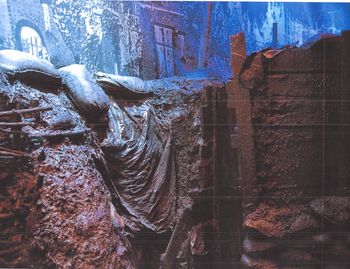
The third area of compromise concerns the representation of what is usually termed the landscape of battle. By that I mean a certain ambience of desolation, shown for example in a large display in the US National World War I Museum in Kansas City. Its purpose is to bring the visitor into an alternative world of massive destruction and danger (Figure 6). The problem is that such artificial installations, being inherently false, cannot convey ‘what it was really like’ to be at war. No one who visits a war museum can enter into the landscape of war, and any attempt that pretends to make that possible is doomed to fail.
Trench design, National World War I Museum and Memorial, Kansas City. (Photo: author.)

A similar problem confronts visitors to the US Holocaust Museum and Memorial in Washington, DC. Entrants are given a card on which is written the name of someone who was trapped in the Nazi state or in countries they occupied, and who became a victim of its racial policies, leading to genocide. Identification with the victims is understandable; moving into their experience is not. It constitutes precisely the kind of ‘prosthetic memory’ that reenactors conjure up from their day on the beaches of Normandy or in the forests of Poland.
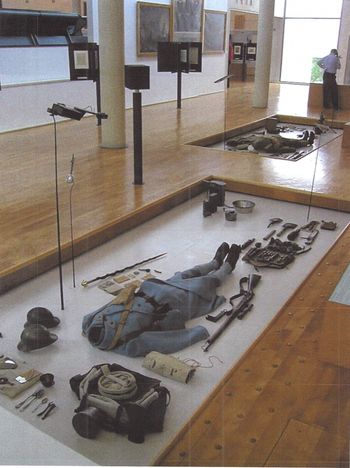
Museums can represent the experience of war but they cannot bring visitors into it. And that is the key choice that they, and all of us, have to make. In the Historial de la Grande Guerre, the designers of the museum (of whom I was one) decided to stylise the arrangement of objects in the fosses, or dugouts, to suggest that we are not in the business of creating a false sense that visitors can enter the domain of warfare by looking at a dozen objects soldiers used in the trenches (Figure 7). False realism is the danger lurking in this field, and the more designers gesture towards realism, the more they come up against the hard truth that much (if not all) of the experience of war lies at or beyond the limits of representation.
Fosse, French soldier's uniform and kit, Historial de la Grande Guerre, Péronne. (Photo: author.)

III Conclusion
Reenactment of battlefield history falsifies the truth on a host of levels, no matter how authentic the uniforms or weaponry may be. It is not only naive; it is also dangerous, because sanitising war – by separating it from terror, pain and bloodshed – makes it thinkable, and therefore, doable in the future.
The second major flaw of reenactment is the exclusion of politics from the domain of war experience. Reenactors are in search of a reified experience, almost always masculine. Some New Zealand nurses on a pilgrimage I led to Gallipoli, though, could not resist the temptation to put on the uniforms of their sisters who served in the war, as though the cloth could convey or offer a privileged point of entry to an earlier reality. Once more the absence of the idea that war is a political act is palpable. The reality of war, and in particular the reality of the Great War, was bound up in national sentiment supporting state power arrayed with tenacity against other state powers just as determined to see the struggle through to victory. Reenactors bypass this essential meaning of war, and thereby present a reified image of battle, as an engagement in violence outside of politics.
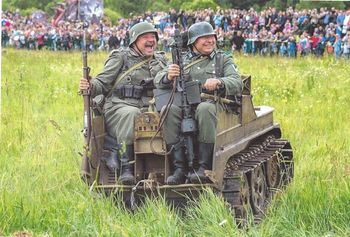
If the exclusion of the political distorts the Great War, you can imagine what it does when German reenactors put on Wehrmacht uniforms of the Second World War, and recreate the 1941 invasion of the USSR (Figure 8). Here is infotainment at its worst: a mixture of the obscene and the idiotic. Even if reenactors were to try (for an hour or two) to show solidarity with the victims of the German invasion of Poland, the Baltic states, Ukraine, Byelorussia and Russia, by pretending to walk alongside them, they would betray them, since we (and they) cannot know what they went through. Marking such events is important; staging them borders on absurdity. Turning suffering into entertainment is the worst kind of kitsch, and no historian worthy of the name wants to promote that.
Military history enthusiasts dressed as Nazi troops take part in a stage battle ‘Summer 1941’ near the village of Ivanovskoye, some 60 km outside Moscow, on 22 June 2014. (Source: Dmitry Serebryakov/AFP/Getty Images.)

It is important, though, to recognise the attraction of reenactment, and the money it generates, in order to understand the difficulties museum directors have in resisting it. Yes, museums have had bumper years of attendance during the centennial, but now (2020) that season is over. Now what? Will declining revenues require a more user-friendly approach to conveying the experience of war? If so, then I urge the museum world to turn to presenting theatre like War Horse or installations like Philippe Prost's Ring of Memory near Arras, France, or music like Benjamin Britten's War Requiem. The imaginative arts do not attempt reenactment. They do much better than that. They provide what Viet Thanh Nguyen terms ‘Just Memory’.Footnote 34 They tell the truths no reenactment can convey.
In much recent commemorative activity, the complexity of the war has been reduced to the personal level. This in part is a reflection of the increased significance of the visual in our internet-driven culture. Photographs, as Barthes has shown us, are powerful reminders of mortality, including our own, and they serve as indexical documents, perhaps as much as, or at times even more vividly than, do written documents. The personal can be conveyed by letters and objects, to be sure, but when these letters or objects or faces are captured in photography, they take on an additional aura of authenticity.Footnote 35
Museums show artefacts to bring that feeling of authenticity to the visitor, but even better is when they can juxtapose real objects with film or still photographs of the objects in use. This accounts in part for the success of the Historial de la Grande Guerre at Péronne, Somme, where small video screens perched on poles show the objects around them in action. The same use of objects, and of images of objects used by people, dominates television history. Without photographs or other images, televisual history is impossible. Much internet-driven history, like genealogical research, is first-person history, and when no authentic voice can be found in memoirs, then visual history searches for its story elsewhere. To be sure, what we now call the history of material culture has brought the richness of ancient and medieval societies to large populations both in museums and on television. As Ken Burns's path-breaking 1989 American television series on the history of the American Civil War showed, hearing actors reading aloud the letters contemporaries wrote to their loved ones is a powerful way of conveying history to millions. In the age of the witness,Footnote 36 the voice of the individual living through war understandably has become an essential part of televisualised history. When the voice matches the face of the man or woman who went through war, then we viewers can be both moved and informed at the same time.
The problem remains, though, that there is much important historical writing which focuses on issues beyond the biographical and the personal. That is why much of the best new historiography we have is not represented to any significant degree in the public domain. While the internet has put online an astonishing array of documents, it still privileges the history of individual men and women, moments of whose lives are captured vividly in particular in photographs and in letters. And most of these men and women are white. The work of artists in initiatives like 14–18 Now has helped to change the colour of the archive, but it is still true that the voices and faces of white participants in the war are prioritised in public history whereas people of other skin colours are marginalised.
The online archiving of mountains of war records both enriches visual history and virtually closes off other avenues of historical thinking and representations. While the internet has democratised the archive, by adding millions of voices and records to it, it has also pointed scholars in the direction of questions that can be answered by reference to online sources alone.Footnote 37 What of the vast majority of archives that cannot afford digitisation, which is the case in much of Africa, Asia and Latin America? Are their holdings so far off the beaten path – the online path – as to be consigned to oblivion?
The better path for us to take is to accept the conditions and limits of public history, while expanding the range and nature of the sources it uses and the questions it poses. Furthermore, we must keep on trying to insert in the discourse of public history the fruits of our archival research in all kinds of archives, both on- and offline. We must continue to insist on the complexity and messiness of history and on the stubborn fact that there are some facets of war that simply cannot be reenacted.
A little bit of humility is no bad thing in the work both we and they do. It can make some people stand back from turning war into the subject of a theme park and history into a light consumer durable good. We all have a moral obligation to do better than that.