Introduction
Cognitive disturbance is frequent in the elderly population (Rait et al. Reference Rait, Fletcher, Smeeth, Brayne, Stirling, Nunes, Breeze, Ng, Bulpitt, Jones and Tulloch2005; Zhang et al. Reference Zhang, Shi, Liu, Liu, Yue, Liu, Xiang, Lu, Liu, Wisniewski, Wang and Ji2014) and is a source of increasing concern. Although cognitive disturbance is considered to be nuclear in the concept of dementia, including conditions such as Alzheimer's disease (APA, 2013), it is now also regarded as an index of ill-health (Regal-Ramos et al. Reference Regal-Ramos, Salinero-Fort and Cruz-Jentoft2005; Wiesli et al. Reference Wiesli, Schwegler, Schmid, Spinas and Schmid2005) and of frailty (Kelaiditi et al. Reference Kelaiditi, Cesari, Canevelli, van Kan, Ousset, Gillette-Guyonnet, Ritz, Duveau, Soto, Provencher, Nourhashemi, Salvà, Robert, Andrieu, Rolland, Touchon, Fitten and Vellas2013). In relation to this, it has been shown that cognitive impairment increases the mortality-risk (Nguyen et al. Reference Nguyen, Black, Ray, Espino and Markides2003; Schultz-Larsen et al. Reference Schultz-Larsen, Rahmanfard, Kreiner, Avlund and Holst2008; Park et al. Reference Park, Kwon, Jung, Han, Jo and Jo2013). We have confirmed these previous findings, but have also reported a gradient of increased mortality-risk in parallel with the severity of cognitive disturbance (Santabárbara et al. Reference Santabárbara, Lopez-Anton, Marcos, De-la-Cámara, Lobo, Saz, Gracia-García, Ventura, Campayo, Rodríguez-Mañas, Olaya, Haro, Salvador-Carulla, Sartorius and Lobo2014) suggesting the possibility of using the staging paradigm in this area. Implicit in the philosophy of staging is the gradual progression and deterioration of the clinical syndrome and of the underlying biological processes (Rikkert et al. Reference Rikkert, Tona, Janssen, Burns, Lobo, Robert, Sartorius, Stoppe and Waldemar2011). This model seeks to define the extent of progression of a disorder at a particular point in time and to differentiate early, milder clinical phenomena from those accompanying illness progression and chronicity. The model has been widely considered to be useful in clinical medicine (Edge & Compton, Reference Edge and Compton2010), having considerable potential in psychiatry (McGorry, Reference McGorry2007).
The staging model has been applied in the field of dementia and different methods have been proposed (Hughes et al. Reference Hughes, Berg, Danziger, Coben and Martin1982; Reisberg et al. Reference Reisberg, Ferris, de Leon and Crook1988), although none of them has been generally accepted (Rikkert et al. Reference Rikkert, Tona, Janssen, Burns, Lobo, Robert, Sartorius, Stoppe and Waldemar2011). These models in dementia emphasise the assessment of cognitive impairment, but we consider clinical dementia to be much broader (Semrau et al. Reference Semrau, Burns, Djukic-Dejanovic, Eraslan, Han, Lecic-Tosevski, Lobo, Mihai, Morris, Palumbo, Robert, Stiens, Stoppe, Volpe, Rikkert and Sartorius2015). Still, although there is no consensus about its significance, the construct global cognitive impairment has interest by itself, as shown by international groups pondering the so-called ‘cognitive frailty’ (Kelaiditi et al. Reference Kelaiditi, Cesari, Canevelli, van Kan, Ousset, Gillette-Guyonnet, Ritz, Duveau, Soto, Provencher, Nourhashemi, Salvà, Robert, Andrieu, Rolland, Touchon, Fitten and Vellas2013). The construct cognitive impairment is considered by some as a syndrome (Breitner, Reference Breitner2015), that may be observed in different diseases, and we have recently documented that is associated with an increased mortality-risk even after controlling for dementia (Santabárbara et al. Reference Santabárbara, Lopez-Anton, Marcos, De-la-Cámara, Lobo, Saz, Gracia-García, Ventura, Campayo, Rodríguez-Mañas, Olaya, Haro, Salvador-Carulla, Sartorius and Lobo2014). Therefore, we still feel the construct may be a candidate for staging models.
Timesaving methods of staging cognitive impairment would be particularly useful both in clinical settings and in community studies, since scales in widespread use were developed for staging dementia (Hughes et al. Reference Hughes, Berg, Danziger, Coben and Martin1982; Reisberg et al. Reference Reisberg, Ferris, de Leon and Crook1988), and may be time-consuming. Methods based on simple instruments such as the Mini-Mental State Examination (MMSE) (Folstein et al. Reference Folstein, Folstein and McHugh1975) would be convenient in this respect. Perneczky et al. (Reference Perneczky, Wagenpfeil, Komossa, Grimmer, Diehl and Kurz2006), mapping MMSE scores onto CDR categories, reported that the MMSE may perform as a surrogate of the CDR for the staging of dementia in AD. Using the same MMSE staging scores reported by Perneczky et al. (Reference Perneczky, Wagenpfeil, Komossa, Grimmer, Diehl and Kurz2006) we were able to document the gradient of increased mortality-risk in parallel with the severity of the cognitive impairment (Santabárbara et al. Reference Santabárbara, Lopez-Anton, Marcos, De-la-Cámara, Lobo, Saz, Gracia-García, Ventura, Campayo, Rodríguez-Mañas, Olaya, Haro, Salvador-Carulla, Sartorius and Lobo2014). However, the power of this categorisation of the MMSE to predict cognitive deterioration and dementia has not been tested previously.
A considerable number of studies, including studies conducted in the community have reported the association of cognitive impairment and dementia, including Alzheimer's disease (Ward et al. Reference Ward, Tardiff, Dye and Arrighi2013), particularly in the field of the so called ‘mild cognitive impairment’ (Mitchell & Shiri-Feshki, Reference Mitchell and Shiri-Feshki2009). Some of these studies used the MMSE to document cognitive disturbance (Aevarsson & Skoog, Reference Aevarsson and Skoog2000; Hensel et al. Reference Hensel, Luck, Luppa, Glaesmer, Angermeyer and Riedel-Heller2009; Wong et al. Reference Wong, Leung, Fungible, Chan and Lam2013). However, none of such studies tested the staging system of the MMSE. Moreover, to our knowledge, none of the previous studies associating cognitive disturbance and dementia controlled for mortality (Mauri et al. Reference Mauri, Sinforiani, Zucchella, Cuzzoni and Bono2012; Wong et al. Reference Wong, Leung, Fungible, Chan and Lam2013). Since death may prevent the occurrence of illness, particularly in the aged population, it is recommended that the effect of mortality should be taken into account in incidence studies (Berry et al. Reference Berry, Ngo, Samelson and Kiel2010).
In this context, we now aim at documenting that a simple method based on the MMSE is useful for staging cognitive disturbance at a population level. Our hypothesis is that individuals with cognitive difficulties identified by the MMSE, but not being classified as cases or subcases of dementia in the baseline study, will have an increased risk of incident dementia, the risk increasing according to the severity level of impairment.
Material and methods
Study design and sample
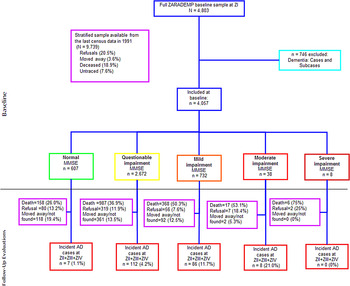
The ZARAgoza DEMentia DEPression Project (ZARADEMP Project) was designed as a longitudinal, community-based study to examine the incidence of dementia and the risk factors in incident cases of dementia. It was carried out in Zaragoza, a large city in Spain, with an important proportion of inhabitants coming from rural areas (Lobo et al. Reference Lobo, Saz, Marcos, Día, De la Cámara, Ventura, Montañés, Lobo-Escolar and Aznar2005). A stratified random sample of individuals 55 years of age and older, with proportional allocation by age and sex, drawn from the eligible individuals (n = 157 787) in the Spanish official census lists of 1991, was invited to participate in the baseline examination. In the baseline study, 4803 individuals were interviewed. For the follow-up, because we were interested in cognitively intact individuals, we excluded subjects considered to be cases or subcases of dementia at baseline (see definitions below; n = 746), for a starting sample of 4057 participants. The ZARADEMP Study participants underwent a baseline assessment (Wave I, starting in 1994) and three follow-up visits, starting in 1997 (Wave II), in 1999 (Wave III) and in 2006 (Wave IV) (Fig. 1). Further details of the objectives and methods of the project have been described elsewhere (Lobo et al. Reference Lobo, Saz, Marcos, Día, De la Cámara, Ventura, Montañés, Lobo-Escolar and Aznar2005, Reference Lobo, Lopez-Anton, Santabárbara, de-la-Cámara, Ventura, Quintanilla, Roy, Campayo, Lobo, Palomo, Rodriguez-Jimenez, Saz and Marcos2011). The Ethics Committee of the University of Zaragoza and the Fondo de Investigación Sanitaria approved this study, according to Spanish Law, and all individuals provided written informed consent.
Study flow chart.

Data collection
Several standard tools, previously validated in Spain, were incorporated in the ZARADEMP interview, including the Spanish version of the MMSE (Folstein et al. Reference Folstein, Folstein and McHugh1975; Lobo et al. Reference Lobo, Saz, Marcos, Día, de la Cámara, Ventura, Morales Asín, Fernando Pascual, Montañés and Aznar1999) for the screening of cognitive function. Both validity coefficients and population norms in this official version of the MMSE are very similar to those reported in the USA (Crum et al. Reference Crum, Anthony, Bassett and Folstein1993). The mental state of the study participants was assessed using the Geriatric Mental State B (GMS-B)-AGECAT (Copeland et al. Reference Copeland, Dewey, Wood, Searle, Davidson and McWilliam1987; Lobo et al. Reference Lobo, Saz, Marcos, Día and De-la-Cámara1995), a semi-structured standardised clinical interview that may be used by lay interviewers. The GMS-B includes neuropsychological items and provides a ‘threshold global score’ that discriminates between ‘non-cases’, ‘subcases ’ and ‘cases’ of dementia. Psychiatric history was taken using the History and Aetiology Schedule (Dewey & Copeland, Reference Dewey and Copeland2001), a standardised method accompanying the GMS. Instrumental and basic activities of daily living were assessed using the Lawton and Brody scale (Lawton & Brody, Reference Lawton and Brody1969; Tárraga, Reference Tárraga, Boada and Tárraga1995); and Katz's Index (Katz et al. Reference Katz, Ford, Moskowitz, Jackson and Jaffe1963; Álvarez et al. Reference Alvarez Solar, de Alaiz Rojo, Brun Gurpegui, Cabañeros Vicente, Calzón Frechoso, Cosío Rodríguez, García López, García-Cañedo Fernández, Pardo González and Suárez-González1992), respectively. Information on medical conditions considered to be risk factors of dementia was collected using the EURODEM Questionnaire (Launer et al. Reference Launer, Brayne and Breteler1992). This Questionnaire was developed to assess risk factors of dementia by EURODEM, a research consortium for European Studies of dementia. The authors performed a pooled analysis of European population-based prospective studies of individuals 65 years and older, with 528 incident dementia patients and 28 768 person-years of follow-up (Launer et al. Reference Launer, Andersen, Dewey, Letenneur, Ott, Amaducci, Brayne, Copeland, Dartigues, Kragh-Sorensen, Lobo, Martinez-Lage, Stijnen and Hofman1999). Each item in the ZARADEMP interview has been operationally defined, according to previously agreed EURODEM criteria. Detailed information on medical conditions in this study has been reported elsewhere (Lobo-Escolar et al. Reference Lobo-Escolar, Saz, Marcos, Quintanilla, Campayo and Lobo2008). Systematic checks on the reliability of the assessments were implemented to prevent the ‘reliability-drift’.
Dementia case finding
A two-phase epidemiological case-finding process for dementia was implemented in the baseline study (Wave I) and a similar method in the follow-up waves (Waves II, III and IV). In phase I in each wave, well-trained and regularly supervised lay interviewers (senior medical students) conducted the ZARADEMP interview at the subject's homes or place of residence. Interviewers in the follow-up waves were unaware of the results of the baseline interview. Outside caregivers were interviewed when the participant was considered to be unreliable (in cases of dementia and approximately 10% of subcases of dementia). Participants were nominated as ‘probable cases’ on the basis of GMS threshold ‘global’ score (1/2) and/or Mini-Mental (23/24) standard cut-off points.
In phase II, the ‘probable cases’ of dementia were reassessed at the subjects’ homes or place of residence by research psychiatrists. The same assessment instruments and methods were used, and a neurological examination was performed to help in the diagnostic process. The validity of this diagnostic process has been previously documented (Lobo et al. Reference Lobo, Saz, Marcos, Día and De-la-Cámara1995). Identified cases of dementia were presented to a panel of four research psychiatrists. Variables in the ZARADEMP interview were operationalised to conform to the DSM-IV criteria used to diagnose the cases. For the diagnosis of ‘incident case’ of dementia, agreement by at least three of the psychiatrists was required. To document the accuracy of the panel diagnosis of dementia, a proportion of cases were invited for a hospital diagnostic work-up, which included neuroimage studies and a complete neuropsychological diagnostic battery.
Assessment of stages of cognitive impairment
Information coming from the MMSE was used to classify subjects according to their scores into corresponding degrees of cognitive impairment. Standardised degrees of cognitive impairment in the MMSE validated by Perneczky et al. (Reference Perneczky, Wagenpfeil, Komossa, Grimmer, Diehl and Kurz2006) have been used in this study: ‘normal’ (scores 30); ‘questionable’ (scores 26–29); ‘mild’ (scores 21–25); ‘moderate’ (scores 11–20) and ‘severe’ (scores 0–10).
Ascertainment of mortality
All-cause mortality of the ZARADEMP-Project respondents was ascertained through a reliable source, the official population registry in the city. Information in the registry was completed and verified via death certificate, which provides accurate information, including day, month and year of death. Days from birth to the date of death were calculated for each subject, and those individuals remaining alive in 1st January 2007 or missing (refusal, emigrated, not localisable) were included in the analysis as censured.
Covariates
Potentially confounding factors assessed at baseline included socio-demographic characteristics (sex and education), medical risk factors (vascular disease, hypertension and diabetes), functional status and affective diagnosis (anxiety and depression). Education was categorised into three levels: illiterate (unable to read and write, and <2 years of formal education), primary (complete or incomplete) and secondary school or higher. Functional status was based on the Katz Index (Katz et al. Reference Katz, Ford, Moskowitz, Jackson and Jaffe1963), and the Instrumental Activities of Daily Living Scale (Lawton & Brody, Reference Lawton and Brody1969). For this study, scores on each scale were dichotomised into disability and no disability. The diagnosis of depression and anxiety were based on the AGECAT computer system. Blood pressure (BP) was measured during the interview using a standard manual tensiometer, using the average of 2 BP readings; hypertension was considered when BP >140/99 mmHg or if the participant reported being treated for hypertension. The presence of vascular risk factors and diabetes was based on the medical history obtained using the EURODEM Risk Factors Questionnaire (Launer et al. Reference Launer, Brayne and Breteler1992). Vascular diseases were dichotomised, distinguishing between vascular disease (angina and/or myocardial infarct and/or stroke) and no history of vascular disease. Diabetes was dichotomised into persons with a previous medical diagnosis or receiving treatment for diabetes and the absence of diabetes.
Statistical procedures
The two-tailed Cochran–Armitage (Armitage, Reference Armitage1955) test for trend was used to seek a linear trend in proportions across MMSE stages, and two-tailed analysis of variance test was used to seek linear trend in means of continuous measures.
We used a multivariate survival analysis with age as timescale (Thiébaut & Bénichou, Reference Thiébaut and Bénichou2004) to study the specific hypothesis that standardised stages of cognitive impairment (Perneczky et al. Reference Perneczky, Wagenpfeil, Komossa, Grimmer, Diehl and Kurz2006) are associated with an increased risk of dementia. The cumulative incidence function (CIF) approach (Fine & Gray, Reference Fine and Gray1999) was used to display the risk of patients experiencing the event of interest (i.e., dementia), taking into account the competing event (death) as time progressed (Pintilie, Reference Pintilie2006; Putter et al. Reference Putter, Fiocco and Geskus2007). In order to support using competing risks regression model, we assessed the difference between the CIF of dementia and death by means of the Kochar–Lam–Yip's test (Kochar et al. Reference Kochar, Lam and Yip2002).
In a first step of the survival analysis, we built CIF (Scrucca et al. Reference Scrucca, Santucci and Aversa2007) for the MMSE degrees of cognitive impairment to estimate the probability of incident dementia. Then, we test for equality of CIF across groups (Gray, Reference Gray1988). The different degrees of cognitive impairment were compared with the ‘normal’ performance group in the MMSE.
In a second step of the survival analysis, in order to explore mechanisms explaining the association between MMSE stages and risk of dementia, we used a multivariate model in which we controlled for potential modifiers: sociodemographic factors (sex and education), functional status, affective diagnosis (anxiety and depression) and medical risk factors (vascular disease, hypertension and diabetes).
To examine the assumption of proportional distribution hazards, we tested the time-varying effect of each covariate using the Scheike and Zhang test (Scheike & Zhang, Reference Scheike and Zhang2008).
For all analyses, we used R software (http://www.r-project.org), with its cmprsk and timereg packages for survival analyses and coin package for Cochran–Armitage test for trend.
Results
Out of the 4057 participants in baseline, 607 (14.9%) were classified as ‘normal’ (no cognitive impairment), 2672 (65.8%) as ‘questionable’ cognitive impairment, 732 (18.0%) had ‘mild’ cognitive impairment, 38 (0.9%) had ‘moderate’ cognitive impairment and 8 (0.2%) had ‘severe’ impairment (Fig. 1). The median follow-up time was 8.4 years (Interquartile range: 3.1–11.4). During the follow-up period, 1516 (37.3%) individuals died and 213 (5.2%) were considered to have incident dementia.
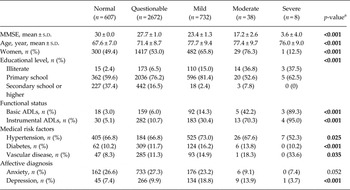
Table 1 shows the sociodemographic characteristics of the participants by level of cognitive impairment. The participants in the higher level of cognitive impairment (MMSE) were significantly older and, as the severity of the impairment increased, participants were more likely to be women and illiterate. Moreover, between the subgroups classified by level of impairment, significant differences were observed in most clinical variables (Table 1).
Characteristics of participants at baseline, by level of cognitive impairment

a Cochran–Armitage trend test or analysis of variance linear trends.
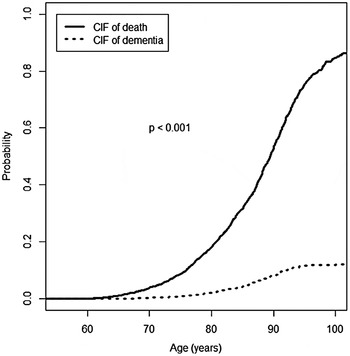
As Fig. 2 shows, a significantly higher probability of death compared to the probability of dementia was observed, according to the Kochar–Lam–Yip test (p < 0.001). Furthermore, the CIF for death is was above the CIF for dementia.
Probability of incident dementia and probability of death in the community sample. CIF: cumulative incidence function.

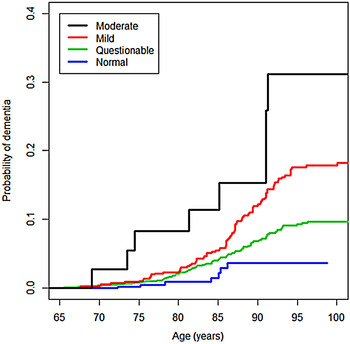
The crude comparison of the CIF by the MMSE level of impairment shows that the probability of dementia is higher in individuals with cognitive impairment when compared with the ‘normals’, the probability increasing with the severity of the impairment (p < 0.001) (Fig. 3). For example, for individuals of 85 years old, the probability (in percentage) of dementia in the ‘normal’ group was 1.5% (95% confidence intervals (CI): 0.5–3.9%), significantly lower than 4.3% (95% CI: 3.3–5.4%) for subjects in the ‘questionable’ degree, 5.9% (95% CI: 4.1–8.1) for subjects in the ‘mild’ degree and 11.7% (95% CI: 3.6–25.1%) for subjects in the ‘moderate’ degree.
Probability of incident dementia by degree of cognitive impairment in the community sample.

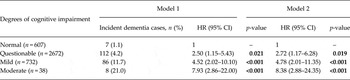
Table 2 shows the risk of dementia in relation to the level of cognitive impairment. The proportion of incident cases of dementia increases gradually as the MMSE scores decrease (p < 0.001). Table 2 also shows the results of the competing-risk regression analysis of the dementia risk associated with the different levels of cognitive impairment. The association with dementia risk increases by level of cognitive impairment. In the final multivariate model, model 2, with the inclusion of all potential confounding factors, the association between MMSE levels of cognitive impairment and dementia risk was: hazard ratio (HR) = 2.78 in the ‘questionable’; HR = 4.78 in the ‘mild’; and HR = 8.38 in the ‘moderate’ degree of cognitive impairment. The eight individuals with ‘severe’ cognitive impairment were not included in the analysis, since six of them had died at follow-up, and the remaining two were lost.
Risk of dementia associated with level of cognitive impairment

Fine and Grey regression model, HR, CIs, and p-values based on ‘normal approximation’ of Wald χ2 test with 1 df are shown for all variables analysed. Model 1: included terms for sex and education; Model 2: included the terms in model 1 plus terms for functional status, affective syndromes (anxiety and depression) and medical risk factors (vascular disease, hypertension and diabetes).
Discussion
The results support the hypothesis that individuals with cognitive difficulties identified by the MMSE, but not being classified as cases or subcases of dementia have an increased risk of incident dementia, the risk increasing according to the severity level of impairment: in the final multivariate statistical model, after adjusting by all the potential confounding factors, the association between the ‘questionable’ MMSE degree of cognitive impairment and dementia risk was increased (HR = 2.78) when compared with the ‘cognitively normal’ but the risk was higher in the ‘mild’ degree of cognitive impairment (HR = 4.18) and particularly in the ‘moderate’ degree of impairment (HR = 8.38). The short number of individuals in the ‘severe’ level of impairment impeded statistical calculations, but the outcome was quite negative, since the great majority of them (75%) had died at follow-up and the remaining were lost. Therefore, despite the fact that the risk of dementia for different severity levels in the MMSE overlaps, the results in this study support for the first time a staging model in the prediction of incident dementia, since there is a progression of risk in parallel with the severity level of impairment, a clear gradient, a ‘dose–response’ relationship.
Some previous studies reporting the association of cognitive impairment and incident dementia used the MMSE, but none of them controlled by mortality, and none tested a staging system of the MMSE (Aevarsson & Skoog, Reference Aevarsson and Skoog2000; Hensel et al. Reference Hensel, Luck, Luppa, Glaesmer, Angermeyer and Riedel-Heller2009; Wong et al. Reference Wong, Leung, Fungible, Chan and Lam2013). In a previous article, we also documented a gradient of increased mortality-risk in individuals with the same cognitive impairment model (Santabárbara et al. Reference Santabárbara, Lopez-Anton, Marcos, De-la-Cámara, Lobo, Saz, Gracia-García, Ventura, Campayo, Rodríguez-Mañas, Olaya, Haro, Salvador-Carulla, Sartorius and Lobo2014). Therefore, we argue in favor of maintaining the usefulness of this staging model, since predictions of both mortality and incident dementia may be helped by knowing the level of cognitive performance of the elderly.
The usefulness of staging models in the management of medical diseases has considerable support both in the literature and in clinical practice (Edge & Compton, Reference Edge and Compton2010), and McGorry (Reference McGorry2007) has extensively advocated its use in the field of psychiatry. Staging models have certainly been promoted in the area of dementia (Reisberg et al. Reference Reisberg, Ferris, de Leon and Crook1988), but cognitive impairment cannot be confounded with dementia, since dementing diseases are quite complex and need to be approached from several dimensions different from the nuclear cognitive disturbance (Rikkert et al. Reference Rikkert, Tona, Janssen, Burns, Lobo, Robert, Sartorius, Stoppe and Waldemar2011). In fact, we are now involved in the development of a multi-dimensional scale for staging clinical needs in individuals with dementia (Semrau et al. Reference Semrau, Burns, Djukic-Dejanovic, Eraslan, Han, Lecic-Tosevski, Lobo, Mihai, Morris, Palumbo, Robert, Stiens, Stoppe, Volpe, Rikkert and Sartorius2015).
On the other hand, there is some controversy about the meaning of the construct cognitive impairment (Dartigues & Amieva, Reference Dartigues and Amieva2014), and new research is needed to ascertain its nature. Cognitive impairment is nuclear in the present concept of dementia (WHO, 1992), but both constructs are not equivalent, as shown by the fact that even controlling by dementia, cognitive impairment is associated with increased mortality (Santabárbara et al. Reference Santabárbara, Lopez-Anton, Marcos, De-la-Cámara, Lobo, Saz, Gracia-García, Ventura, Campayo, Rodríguez-Mañas, Olaya, Haro, Salvador-Carulla, Sartorius and Lobo2014). This last construct is also considered to be an index of general ill health (Regal-Ramos et al. Reference Regal-Ramos, Salinero-Fort and Cruz-Jentoft2005) or of frailty (Kelaiditi et al. Reference Kelaiditi, Cesari, Canevelli, van Kan, Ousset, Gillette-Guyonnet, Ritz, Duveau, Soto, Provencher, Nourhashemi, Salvà, Robert, Andrieu, Rolland, Touchon, Fitten and Vellas2013). The staging model of cognitive impairment we propose here may stimulate both clinical and basic research. The model implies clinical progression, but also the progression of underlying biological pathological processes (Rikkert et al. Reference Rikkert, Tona, Janssen, Burns, Lobo, Robert, Sartorius, Stoppe and Waldemar2011) that may therefore be investigated in parallel.
In relation to the clinical applicability of the method, particularly for the high risk groups, it is remarkable that, after the exclusion at baseline not only the cases of dementia, but also the subcases, it was possible to identify individuals with minimal cognitive difficulties, ‘questionable’ according to Perneczky et al's criteria (Perneczky et al. Reference Perneczky, Wagenpfeil, Komossa, Grimmer, Diehl and Kurz2006), and individuals with ‘mild’ difficulties with a risk of dementia almost three times higher and almost five times higher respectively than the individuals with intact performance in the MMSE. Moreover, we have observed that these individuals with cognitive difficulties are different from the cases of mild cognitive impairment, MCI according to either classical, Petersen et al.’ criteria (Petersen et al. Reference Petersen, Smith, Waring, Ivnik, Tangalos and Kokmen1999) or DSM-5 criteria (Lopez-Anton et al. Reference Lopez-Anton, Santabárbara, De-la-Cámara, Gracia-García, Lobo, Marcos, Pirez, Saz, Haro, Rodríguez-Mañas, Modrego, Dewey and Lobo2015). MCI cases are characterised by most authors as cases with subjective memory difficulties and objective measures of cognitive impairment. On the contrary, the individuals in the ‘questionable’ or in the ‘mild’ stage of disturbance in this study rarely had subjective complaints. Since more severe stages of cognitive disturbance have also been identified with this simple method, it may be recommended not only for the early identification of individuals at risk, but also for monitoring the cognitive performance in follow-up, longitudinal studies, as well as in clinical practice.
We believe this study with a long follow-up period of 12 years, which is part of the ZARADEP Project, has some additional advantages. In support of the generalisability of the findings, it was conducted in a large and representative community sample. By excluding at baseline subcases of dementia, the possibility of overestimating the dementia risk is minimised, and the robustness of the results is supported by the fact that the individuals with normal cognitive performance were used as the reference in the statistical, regression models. Moreover, the MMSE severity degrees of cognitive impairment used here have been validated against well-known scales such as the Clinical Dementia Rating (Hughes et al. Reference Hughes, Berg, Danziger, Coben and Martin1982), which have also been used to assess cognitive impairment (Modrego & Ferrández, Reference Modrego and Ferrández2004; Sartorius et al. Reference Sartorius, Semrau, Burns, Lobo, Rikkert, Robert and Stoppe2013).
An important advantage in this report, and contrary to previous similar studies, relates to the use of the competing risk model in analysing cognitive impairment as a risk factor for dementia. Traditional models (e.g., Kaplan–Meier and Cox regression) may overestimate the risk of the disease (dementia) in the presence of high rates of mortality, since they do not take into account the competing mortality risk. The competing risk approach is particularly appropriate when the expected mortality is high (Berry et al. Reference Berry, Ngo, Samelson and Kiel2010) such as in the elderly individuals. Moreover, cognitive impairment in this age group has been associated with increased mortality (Kryscio et al. Reference Kryscio, Abner, Lin, Cooper, Fardo, Jicha, Nelson, Smith, Van Eldik, Wan and Schmitt2013) as previously reported in this same population (Santabárbara et al. Reference Santabárbara, Lopez-Anton, Marcos, De-la-Cámara, Lobo, Saz, Gracia-García, Ventura, Campayo, Rodríguez-Mañas, Olaya, Haro, Salvador-Carulla, Sartorius and Lobo2014). In addition, and contrary to previous studies using time-on-study (i.e., time since inclusion date), which apply age as a covariate in the survival models (Mauri et al. Reference Mauri, Sinforiani, Zucchella, Cuzzoni and Bono2012; Wong et al. Reference Wong, Leung, Fungible, Chan and Lam2013), we used exact age as timescale. In samples of older adults age is strongly associated with some covariates (for example, chronic diseases) and therefore this method should be preferred, since the bias on effect estimates can be avoided (Thiébaut & Bénichou, Reference Thiébaut and Bénichou2004).
On the other hand, this study was more stringent than previous ones in controlling for potentially confounding factors. We controlled by demographic factors and specifically low education, known to be associated with an increased risk of dementia (de Pedro-Cuesta et al. Reference de Pedro-Cuesta, Virues-Ortega, Vega, Seijo-Martinez, Saz, Rodriguez, Rodriguez-Laso, Reñe, de las Heras, Mateos, Martinez-Martin, Manubens, Mahillo-Fernandez, Lopez-Pousa, Reglà, Gascón, García, Fernández-Martínez, Boix, Bermejo-Pareja, Bergareche, Benito-León, de Arce and del Barrio2009), and the results were maintained when controlling by affective syndromes, namely depression and anxiety. While some previous reports are controversial (Schmand et al. Reference Schmand, Lindeboom, Hooijer and Jonker1995), a number of studies have shown the association of both depression (Chen et al. Reference Chen, Hu, Wei, Qin, McCracken and Copeland2008; Goveas et al. Reference Goveas, Espeland, Woods, Wassertheil-Smoller and Kotchen2011; Wong et al. Reference Wong, Leung, Fungible, Chan and Lam2013) and anxiety (Gallacher et al. Reference Gallacher, Bayer, Fish, Pickering, Pedro, Dunstan, Ebrahim and Ben-Shlomo2009) with dementia. Nonetheless, these studies used instruments describing symptoms and/or syndromes of anxiety and/or depression, but we used Stage II AGECAT diagnostic categories. We also controlled for potential medical risk factors, including vascular disease, hypertension and diabetes. We did not incorporate specifically obesity or head trauma for which there is less support in the literature (Lobo et al. Reference Lobo, Saz, Quintanilla and Levenson2010), but believe their inclusion would not modify the results in a substantial way. It might be argued that new covariate alterations could occur in the long follow-up period in this particular study. Nonetheless, in such case the group with cognitive disturbance would probably be more exposed to the covariate alterations and, consequently, the main results and conclusions of this study would be reinforced.
Limitations
The validity of instruments used and diagnostic processes implemented here have been supported in previous studies, but putative misclassification of cognitive disturbance cannot be totally eliminated, since the sensitivity and specificity of the MMSE is not optimal (Folstein et al. Reference Folstein, Folstein and McHugh1975; Lobo et al. Reference Lobo, Saz, Marcos, Día, de la Cámara, Ventura, Morales Asín, Fernando Pascual, Montañés and Aznar1999). Likewise, while the validity of the diagnosis of incident dementia in the participants’ homes has been supported in our previous studies (Lobo et al. Reference Lobo, Saz, Marcos, Día, De la Cámara, Ventura, Montañés, Lobo-Escolar and Aznar2005) a full hospital protocol including neuroimaging assessments could not be completed in all cases. Furthermore, potential risk factors of dementia such as the APO-e-4 (Tai et al. Reference Tai, Ghura, Koster, Liakaite, Maienschein-Cline, Kanabar, Collins, Ben-Aissa, Lei, Bahroos, Green, Hendrickson, Van Eldik and LaDu2015), co-morbidity (Cunningham & Hennessy, Reference Cunningham and Hennessy2015) or the diet (Morris, Reference Morris2012), were not controlled in this study.
Conclusion
In conclusion, this study has found support for the hypothesis that the staging model of cognitive impairment proposed is valid, since a clear gradient of dementia risk is shown, the risk increasing in parallel with the severity of impairment. It is remarkable that the proposed staging model based on the assessment with the MMSE, a simple, 10-min, bed-side or office cognitive test, that may be given by non-specialised researchers and health professionals, shows that, compared with an individual with good cognitive performance, an individual of the same age, sex, physical and mental conditions, has a risk of developing dementia close to three times higher in cases of ‘questionable’ cognitive disturbance, the risk progressing to more than four times and eight times higher in cases of ‘mild’ or ‘moderate’ degree of impairment, respectively. This is of major significance for clinical work in psychiatry or in settings such as primary care or geriatric facilities, and has also relevance for public health work and may be important in selecting areas for future research.
Acknowledgements
The following members of the ZARADEMP Workgroup participated in this manuscript: Pedro Saz, M.D., Ph.D.; Tirso Ventura, M.D., Ph.D.; Miguel Angel Quintanilla, M.D., Ph.D.; Juan Francisco Roy, Ph.D.; Antonio Campayo, M.D., Ph.D.; José Luis Día, M.D., Ph.D. The authors acknowledge the contribution of the lay interviewers, senior medical students who participated in the field work for this study.
Financial Support
Supported by Grants from the Fondo de Investigación Sanitaria, Instituto de Salud Carlos III, Spanish Ministry of Economy and Competitiveness, Madrid, Spain (grants 94/1562, 97/1321E, 98/0103, 01/0255, 03/0815, 06/0617, G03/128) and Gobierno de Aragón/ Programa Operativo Fondo Social Europeo 2007–2013.
Conflict of Interest
We declare that C. De-la-Cámara has received financial support to attend scientific meetings from Janssen-Cilag, Almirall, Eli Lilly, Lundbeck, Rovi, Esteve, Novartis, and Astrazeneca. P. Gracia-García has received Grant support from Janssen, AstraZeneca, and the Ilustre Colegio de Médicos de Zaragoza; she has received Honorarium from AstraZeneca, Lilly, Janssen and Servier; she has received travel support from Lilly, Almirall, Lundbeck, Rovi, Pfizer, and Janssen. A. Lobo had a consultancy with Janssen, and he has received honorarium or travel support from Eli Lilly and Bial. None of these activities is related to the current project. For the remaining authors, none was declared.
Ethical Standards
The authors assert that all procedures contributing to this work comply with the ethical standards of the relevant national and institutional committees on human experimentation and with the Helsinki Declaration of 1975, as revised in 2008.