Atrioventricular reentrant tachycardia is one of the most common forms of recurrent paroxysmal tachycardia in children,Reference Ko, Deal, Strasburger and Benson 1 accounting for 63–70%. Radiofrequency catheter ablation is an effective and safe means of eliminating atrioventricular reentrant tachycardia in patients of almost all ages. The acute success rates of this approach range from 97% to 100%, and the complication and recurrence rates are low.Reference Nielsen, Kottkamp, Piorkowski, Gerds-Li, Tanner and Hindricks 2
Although radiofrequency catheter ablation is now the first-line therapy for atrioventricular reentrant tachycardia, the risk of producing inadvertent atrioventricular block in children, thus necessitating lifelong pacemaker placement, has caused radiofrequency ablation to be limited in this population, mainly to drug-refractory cases.Reference Friedman, Walsh and Silka 3 However, most studies of risk factors for post-ablation complications have been performed either in adults or in groups that include children of all ages. No studies comparing younger children with adolescents have been reported. However, the risk of complications in children may vary with age, because pre-adolescents have smaller hearts and blood vessels than adolescents, and therefore theoretically present increased technical difficulty in catheter ablation. In addition, changes in the geometrical relationship of the ablation site to the conduction pathway during the younger child's subsequent growth and maturation may possibly cause a return of the arrhythmia.
Owing to the fact that limited data are available comparing potential risk factors for complications and recurrence following radiofrequency catheter ablation of atrioventricular reentrant tachycardia in younger and older children, we retrospectively examined and compared accessory pathway location, success rate, recurrence rate, and complications for children and adolescents with symptomatic atrioventricular reentrant tachycardia who underwent radiofrequency catheter ablation at our institution.
Methods
Patients
We conducted a single-centre, multiple operators, and retrospective review of 213 consecutive patients with symptomatic atrioventricular reentrant tachycardia admitted to our institution from January, 1991 to December, 2008, who underwent both electrophysiological study and radiofrequency catheter ablation. Eligibility requirements were: 18 years of age or younger and atrioventricular reentrant tachycardia with electrophysiologic demonstration of the presence of an accessory pathway. Demographic and procedural data and clinical outcomes were included for analysis. Congenital heart disease, presence of intermittent ventricular pre-excitation, and presence of Wolff–Parkinson–White syndrome were recorded, as well as position and number of accessory pathways. Intermittent ventricular pre-excitation was defined as sudden loss and recovery of atrioventricular nodal conduction. Procedure-related data included electrophysiological and radiofrequency catheter ablation parameters.
Electrophysiological examination
The procedure was scheduled after agreement and written informed consent by parents or guardians. Patients were in a fasting state at the time of the procedure, and no antiarrhythmic therapy was administered for at least five half-lives previous to the procedure. An electrocardiographic study was obtained from four electrodes in the coronary sinus, His bundle, right atrium, and right ventricle. One coronary sinus electrode is via the internal jugular vein, and the other three electrodes were in the right atrium, right ventricle, and His bundle, which was via right femoral vein, respectively. Standard electrophysiological study including anterograde and retrograde incremental pacing and extra-stimulus testing was conducted to determine the mechanism of supraventricular tachycardia in all patients. Measurement of PP interval, AH interval, HV interval in resting state, sinus nodal recovery time, dual atrioventricular nodal physiology including the effective refractory period of the fast pathway, effective refractory period of the slow pathway, effective refractory period of the antegrade accessory pathway, effective refractory period of the atrium by atrial programme pacing, effective refractory period of the retrograde accessory pathway by ventricular stimulation, and effective refractory period of the ventricle. The location and numbers of the accessory pathway – or presence of multiple accessory pathways – were also determined.
Ablation procedure
The location of the accessory pathway and mapping of the atrioventricular annulus was analysed by a 7 or 6 F steerable ablation catheter to detect ventriculoatrial fusion during right ventricular pacing in patients with a concealed accessory pathway, or atrioventricular fusion during sinus rhythm with a visible accessory pathway in 30° right and left anterior oblique fluoroscopic projection. If failure occurred, the alternative targets were tried, changing to the sites exhibiting the earliest local atrial activation during ventricular pacing or shortest local ventriculoatrial activation during sinus rhythm. Left-sided accessory pathway mapping and ablation was performed via a transfemoral approach – retrograde approach without transseptal approach – and heparin, 3000 U, was administered by intravenous bolus before delivery of the radiofrequency current to the target. Power-control strategy was used from 1991 to 2002, and temperature-control strategy was used from 2001 to 2008. The radiofrequency pulse was programmed at 20–30 W and delivered for 15–30 s during the period in which power control was used. During the period in which temperature control was used, the setting was 50–60 W at 50–55°C for each 15–60 s. If, after radiofrequency catheter ablation, the supraventricular tachyarrhythmia failed to be induced, and normal conduction was revealed from atrial and ventricular stimulation, the procedure was considered to have resulted in acute success. An electrophysiological study was repeated after successful ablation and after isoproterenol infusion with the dosage adjusted from 1 to 4 μg/min in order to achieve a 20% increase in the resting sinus rate.
Follow-up
A 24-hour Holter electrocardiographic recording was obtained immediately after radiofrequency catheter ablation in all patients. A 12-lead electrocardiographic recording was obtained 1 day after radiofrequency catheter ablation and 2 weeks later. All patients visited the outpatient clinic at least 3 months after radiofrequency catheter ablation. The definition of recurrence included recurrent ventricular pre-excitation in the 12-lead electrocardiography or the 24-hour Holter electrocardiography, or recurrent supraventricular tachycardia. A recurrence of conduction over any accessory pathway during electrophysiological study was also defined as recurrence.
Statistical analysis
Data were expressed as mean and standard deviation for age and body mass index and as number (%) for categorical variables; for all other clinical characteristics, data were expressed as median with inter-quartiles (IQR: Q1–Q3). Patients were stratified into two groups: children (age <12 years) and adolescents (12≤ age <18 years). Pearson chi-square test or Fisher's exact test (categorical variables), and two-sample t-test or Wilcoxon rank-sum test (continuous variables) were used to make comparisons wherever appropriate. The Kruskal–Wallis test and Fisher's exact test were used to assess the associations between echocardiography parameters and location of accessory pathways. We performed univariate logistic regression analysis and multiple logistic regression analysis with stepwise selection to predict the risk of recurrence. Statistical significance was defined as p < 0.05. All data were analysed using SAS 9.0 (SAS Institute Incorporation, Cary, North Carolina, United States of America).
Results
Demographic characteristics
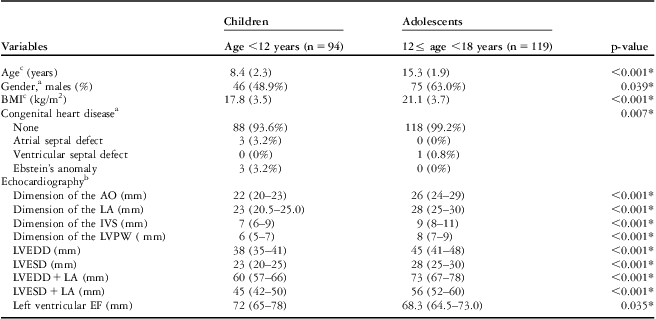
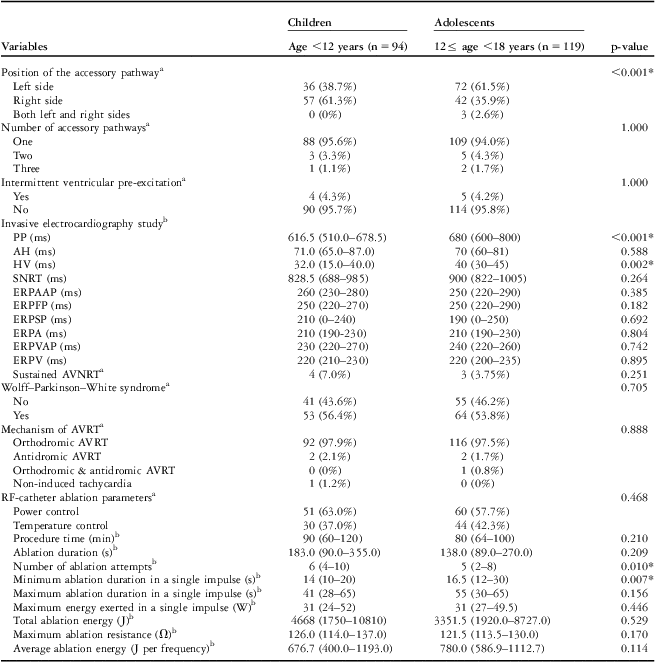
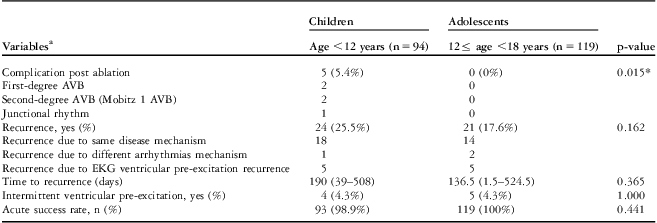
Of the 213 patients in the study, 94 were children (mean age: 8.4 ± 2.3) and 119 were adolescents (15.3 ± 1.9; Table 1). End points studied included presence of congenital heart disease, intermittent pre-excitation and Wolff–Parkinson–White syndrome (Table 1), location of the accessory pathway (Table 2), and success rate, recurrence rate, and complications (Table 3). In all, 212 ablations were successful. The single failure was in the <12 age group in a child with a repaired tetralogy of Fallot.
Demographic and echocardiography parameters of 213 consecutive children and adolescents with symptomatic AVRT who underwent electrophysiological examination and radiofrequency catheter ablation.

AO = aortic root; AVRT = atrioventricular reentry tachycardia; BMI = body mass index; EF = ejection fraction; IVS = interventricular septum wall; LA = left atrium; LVEDD = left ventricular end-diastolic diameter; LVESD = left ventricular end-systolic diameter; LVPW = left ventricular posterior wall
p-Values were calculated from Chi-square test or Fisher's exact test for acategorical variables, and by the bWilcoxon rank-sum test, and the ctwo-sample t-test for continuous variables
aCategorical data are shown as n (%)
bContinuous data are shown as median (Q1–Q3) except for age
cBMI, which are shown as mean (SD) by group
*p < 0.05
Electrophysiologic study parameters, accessory pathway characteristics, and radiofrequency catheter ablation variables.

AVNRT = atrioventricular nodal reentrant tachycardia; AVRT = atrioventricular reentry tachycardia; ERP = effective refractory period; ERPA = ERP of the atrium; ERPAAP = ERP of the antegrade accessory pathway; ERPFP = ERP of the fast pathway; ERPSP = ERP of the slow pathway; ERPV = ERP of the ventricle; ERPVAP = ERP of the retrograde accessory pathway; RF = radiofrequency; SNRT = sinus node recovery time
p-Values were calculated from Chi-square test or Fisher's exact test for acategorical variables and by the bWilcoxon rank-sum test for continuous variables
aCategorical data are shown as n (%)
bContinuous data are shown as median (Q1–Q3) by group
*p < 0.05
Post-ablation outcomes: complications, recurrences, and success rate.

AVB = atrioventricular block; EKG = electrocardiogram
aData are shown as n (%), except for recurrence duration, which is shown as median (IQR: Q1–Q3) by group, and compared using Fisher's exact test and the Wilcoxon rank-sum test.
*p < 0.05
Children had significantly more congenital heart disease than adolescents (6.4% versus 0.8%, p = 0.007). However, only seven of the 213 patients had this abnormality: three children with atrial septal defects and three with Ebstein's anomaly, and one adolescent with a ventricular septal defect. Intermittent ventricular pre-excitation in the patients was seen in four children (4.3%) and in five adolescents (4.2%). More than half in each group had Wolff–Parkinson–White syndrome (children, 56.4%; adolescents, 53.8%).
On echocardiography, children showed significantly smaller heart structure dimensions (p < 0.001), as expected, but a longer left ventricular ejection fraction (p = 0.035). In the electrophysiological study, children had shorter PP and HV intervals than adolescents, but showed no significant differences from adolescents in their other electrophysiological parameters (Table 2).
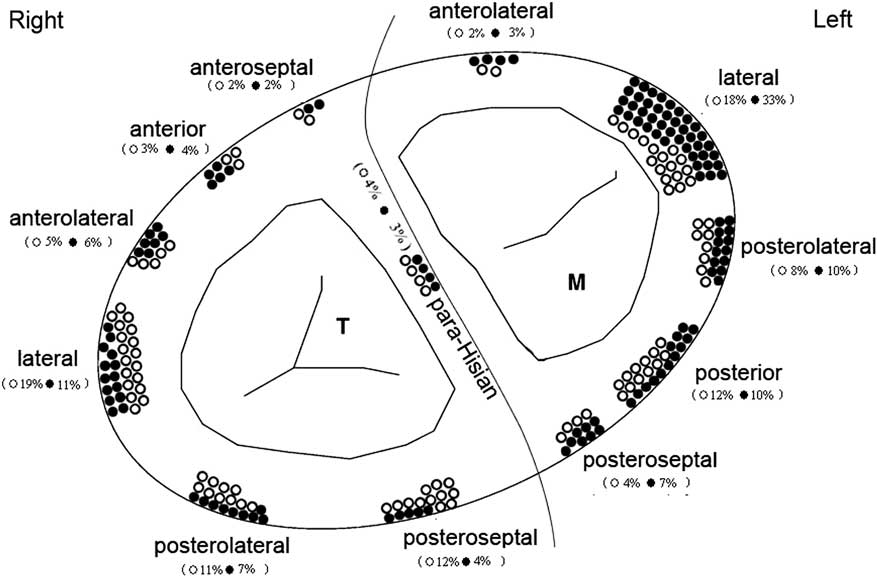
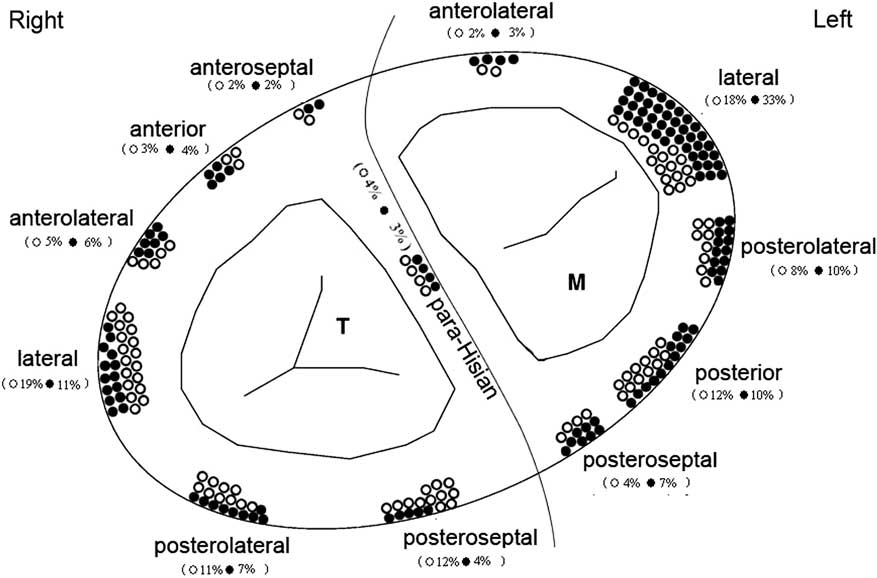
The position of the accessory pathways was significantly different in the two groups, being mostly right sided in children (61.3%) and left sided (61.5%) in adolescents. Over 94% in each group had only one accessory pathway and no intermittent ventricular pre-excitation. A total of 230 accessory pathways were found in the 213 patients, and the number of patients with multiple accessory pathways included four (4.4%) children and seven (6%) adolescents. Figure 1 shows the distribution of accessory pathways in both groups. Except for sinus heart rate and HV interval, all parameters including AH interval, sinus nodal recovery time, effective refractory period of the antegrade accessory pathway, effective refractory period of the fast pathway, effective refractory period of the slow pathway, effective refractory period of the atrium, effective refractory period of the retrograde accessory pathway by ventricular stimulation, effective refractory period of ventricle were similar in the two groups. The ratio of orthodromic and antidromic atrioventricular reentrant tachycardia was 25:1 in each group (children, 2.5%; adolescents, 2.1%). There was one patient who had a combination of the orthodromic and antidromic type. Multiple arrhythmias of atrioventricular reentrant tachycardia and atrioventricular nodal reentrant tachycardia occurred in four children (7%) and three adolescents (3.75%). Children underwent a higher number of ablation attempts (p = 0.010) and had a shorter minimum ablation duration in one ablation attempt (p = 0.007) than adolescents, but other parameters of ablation were not different in the two groups.
Schematic diagram of the locations of accessory pathways. T = tricuspid valve; M = mitral valve (children: ○, adolescent: •).
Outcomes of radiofrequency catheter ablation
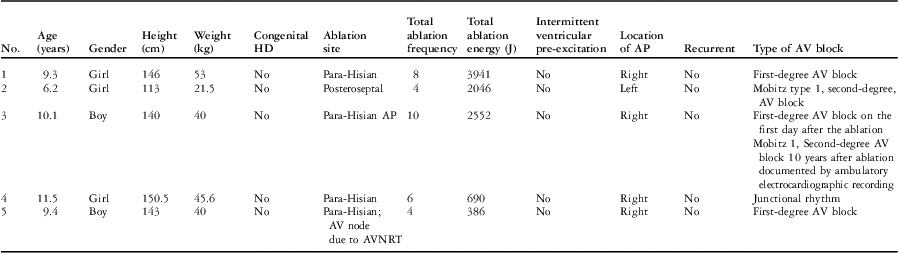
The acute success rate was very high and was similar in children and adolescents (98.9% versus 100%, p = 0.441; Table 3). All five complications occurred in children, who therefore showed a significantly higher frequency of post-ablation complications than adolescents (5.4% versus 0%, p = 0.015). The complications seen were: first-degree atrioventricular block (n = 2), second-degree atrioventricular block (n = 2), and junctional rhythm (n = 1). A summary of the five cases is given in Table 4. None had congenital heart disease. In all, three underwent a higher ablation frequency than the mean ablation frequency reported in children (>6), the fourth underwent ablation of a para-Hisian accessory pathway, and the fifth had ablation of a left-sided posteroseptal accessory pathway. None of the five children with complications had intermittent ventricular pre-excitation or post-ablation recurrence.
Summary of the five children diagnosed with complication during and following RF-catheter ablation.

AP = accessory pathway (bundle of Kent); AV = atrioventricular; AVNRT = atrioventricular nodal reentrant tachycardia; Congenital HD = congenital heart disease; RF = radiofrequency
The recurrence rate for atrioventricular reentrant tachycardia was 25.5% in children and 17.6% in adolescents. The median time to recurrence (days) was 190 in children and 136.5 in adolescents (Table 3).
Correlations between electrocardiography parameters and location of accessory pathways
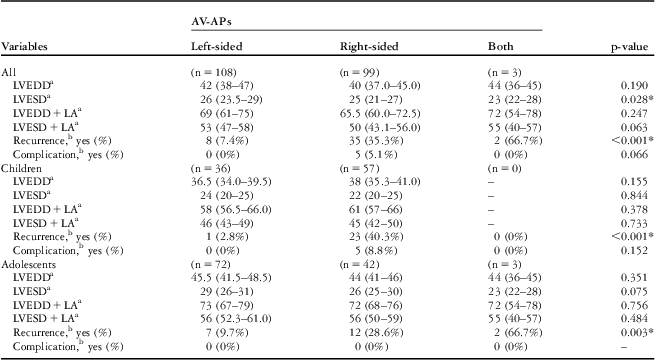
Left-sided accessory pathways were associated with a higher left ventricular end-systolic diameter (p = 0.028) and left ventricular end-systolic diameter + left atrial diameter (0.063), but a lower recurrence rate (p < 0.001) and complication rate (p = 0.066; Table 5). The higher recurrence and complication rates associated with right-sided accessory pathways and accessory pathways on both sides of the septum occurred in both children (p < 0.001) and adolescents (p = 0.003).
Correlations between electrocardiography parameters and location of AV-APs.

AV-APs = atrioventricular accessory pathways; LA = left atrium; LVEDD = left ventricular end-diastolic diameter; LVESD = left ventricular end-systolic diameter
Data are shown as amedian (IQR: Q1-Q3), and bn (%) with aKruskal–Wallis test and bFisher's exact test
*p < 0.05 indicates significant difference among the three types of AP location
Univariate and multivariate analysis of potential risk factors of recurrence
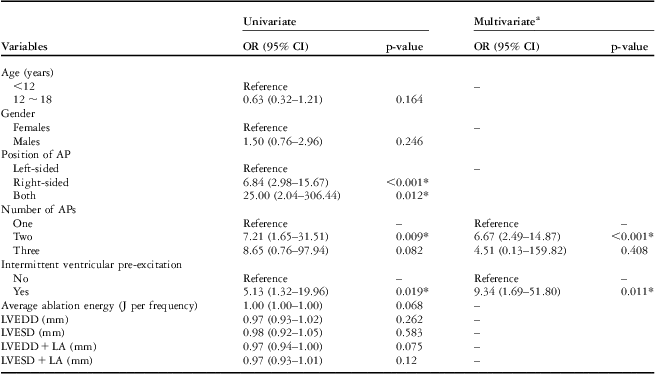
Univariate analysis of potential risk factors for recurrence (Table 6) indicated that children or adolescents with a right-sided accessory pathway were 6.84 times (95% confidence interval: 2.98–15.67, p < 0.001), and those with accessory pathways on both sides of the septum were 25 times (95% confidence interval: 2.04–306.44, p = 0.012) more likely to relapse than those with left-sided accessory pathways. Patients with multiple accessory pathways were also seven or eight times more likely to relapse than those with one accessory pathway; patients with intermittent ventricular pre-excitation were five times more likely to relapse (95% confidence interval: 1.32–19.96, p = 0.019) than those without this phenomenon.
Univariate and multivariate logistic regression analysis of potential risk factors of recurrence.

AP = accessory pathway; CI = confidence interval; LA = left atrium; LVEDD = left ventricular end-diastolic diameter; LVESD = left ventricular end-systolic diameter; OR = odds ratio
aMultivariate logistic regression analysis was observed through stepwise selection with considering multiple risk factors, Kent AP, Multiple Kent AP, and Intermittent Kent
*p < 0.05
Multivariate analysis showed children or adolescents with two accessory pathways to have a sixfold higher risk for relapse (95% confidence interval than those with one accessory pathway: 2.49–14.87, p < 0.001), and those with intermittent ventricular pre-excitation to have a ninefold higher risk of relapse following radiofrequency ablation (95% confidence interval: 1.69–51.80, p = 0.011) than those with no pre-excitation. The location of the accessory pathway did not appear as a risk factor in the multivariate model.
Discussion
The current study shows the relationship of successful ablation, complications, arrhythmia recurrence to patient characteristics such as age, presence of intermittent ventricular tachycardia, Wolff–Parkinson–White syndrome, congenital heart disease, and location of accessory pathways. Children and adolescents had a similar high acute success rate. Children had more complications than adolescents, and accessory pathways located on the right side or on both sides of the septum had a higher risk of complications, especially para-Hisian accessory pathways. Recurrence rates were not significantly different in children and adolescents, and multiple accessory pathways and intermittent ventricular pre-excitation were risk factors for recurrence.
Accessory pathway location, age, and congenital heart disease
Heart size – echocardiographic parameters – differed in the two groups in accordance with their age difference. Accessory pathway location shifted from right-sided dominance in children to left-sided dominance in adolescents (Fig 1), a finding not reported in previous studies.Reference Friedman, Walsh and Silka 3 In previous paediatric arrhythmia studies,Reference Van Hare, Javitz and Carmelli 4 , Reference Lee, Hwang and Chen 5 no significant difference was found between age and accessory pathway location. Our study also showed that congenital heart disease, like atrial septal defect and Ebstein's anomaly, occurred mainly in the <12 age group and were all in those with right-sided accessory pathways. This observation about age and congenital disease could give clues about accessory pathway location before invasive electrocardiography is begun.
Outcome of radiofrequency ablation: success, recurrence, and complication rate
The results of this study provide additional evidence of the efficacy and safety of radiofrequency catheter ablation of atrioventricular reentrant tachycardia in children and adolescents. Our acute success rate of radiofrequency ablations performed in 213 patients is consistent with that reported in literature,Reference Nielsen, Kottkamp, Piorkowski, Gerds-Li, Tanner and Hindricks 2 , Reference Van Hare, Javitz and Carmelli 4 – Reference Van Hare, Javitz and Carmelli 7 and was 99% and 100% in children and adolescents, respectively. The only failure was in the <12 age group. Age or cardiac size did not affect acute success.
We found a relatively higher complication rate in children (5.54%) than adolescents (0%). Our rates were within the range reported in children by others (0.7–9%)Reference Nielsen, Kottkamp, Piorkowski, Gerds-Li, Tanner and Hindricks 2 , Reference Van Hare, Javitz and Carmelli 4 , Reference Lee, Hwang and Chen 5 , Reference Van Hare, Javitz and Carmelli 7 and there were no deaths. The shorter minimum radioablation duration of a single impulse and the higher number of ablation attempts in the <12 age group suggest that surgeons used a more conservative technique when treating this group.
Our complications were two patients suffering with first-degree atrioventricular block following intervention, two with second-degree atrioventricular block, and one with junctional rhythm. Their accessory pathway locations were four right para-Hisian accessory pathways and one left posteroseptal accessory pathway. In one patient, a para-Hisian bundle of Kent was combined with atrioventricular nodal reentrant tachycardia. No patient required the permanent placement of a pacemaker.
Differences in complication rates in previous studies in adults have been attributed to differences in patient load, experience of centre, etc. No difference was seen between children and adults on success and complications in the study by Calkins et al.Reference Calkins, Yong and Miller 8 Saul et alReference Saul, Hulse, Papagiannis, Van Praagh and Walsh 9 expressed concern among children because of the possible effects from enlargement of the radiofrequency lesion as the child's heart matures. Current opinion suggests that radiofrequency ablation should be delayed until the child reaches a weight >15 kg.Reference Case, Gillette, Oslizlok, Knick and Blair 10 , Reference Kugler, Danford and Deal 11 Our study showed that children, compared with adolescents, were not only right-sided dominant in their accessory pathway location, but also had smaller heart dimensions, and these differences may be the reason that the complication rate was significantly higher in the younger age group.
Atrioventricular block after radiofrequency catheter ablation is a common complication that has been reported to occur in 0.7% to 16% of children in previous studies; however, the study of the risk factors for atrioventricular block was neglected or discussed incompletely in these studies except for risk factors pertaining to hospital size or staff experience.Reference Nielsen, Kottkamp, Piorkowski, Gerds-Li, Tanner and Hindricks 2 , Reference Van Hare, Javitz and Carmelli 4 – Reference Calkins, Yong and Miller 8 , Reference Kugler, Danford and Deal 11 – Reference Haissaguerre, Marcus, Poquet, Gencel, Le Metayer and Clementy 14 Kugler JD et al and Pruszkowska-Skrzep et alReference Pruszkowska-Skrzep, Pluta and Lenarczyk 15 found no difference between adults and children in the incidence of complications, including atrioventricular block,Reference Kugler, Danford and Deal 11 but did not look at differences in heart size with age. According to our study, children have a high incidence of atrioventricular block after ablation, and complications would be minimal if ablation was postponed until an older age. This means that “a bigger heart size may be safer for ablation procedures”.
Another major risk factor is accessory pathway location. In previous reports, right-sided accessory pathways showed a higher risk for atrioventricular block, particularly right-sided septal accessory pathways.Reference Van Hare, Javitz and Carmelli 7 , Reference Saul, Hulse and De 16 – Reference Jackman, Wang and Friday 18 Patients with atrioventricular block after ablation in our study included four with para-Hisian accessory pathway and one with right anteroseptal accessory pathway. The para-Hisian accessory pathway is the bundle of Kent insertion between the atrium and ventricle presenting with large His bundle potential of >0.1 mV.Reference Haissaguerre, Marcus, Poquet, Gencel, Le Metayer and Clementy 14 In contrast to other locations, the incidence of para-Hisian ablation complications varies in the general population in different studies from 0% to 71% because of different approaches.Reference Haissaguerre, Marcus, Poquet, Gencel, Le Metayer and Clementy 14 , Reference Yeh, Wang and Wen 19 , Reference Fuenmayor and Fuenmayor 20 Ablating para-Hisian accessory pathways is more risky in children because of a smaller Koch's triangle, different arrangements of atrionodal inputs, and individual electrophysiological characteristics. An extremely low incidence of atrioventricular block can be reached when avoiding ablating accessory pathways in special locations, especially para-Hisian locations, or in younger patients.
Our 25.3% recurrence rate is above the range (4.7–10.7%) reported in children by others.Reference Friedman, Walsh and Silka 3 , Reference Lee, Hwang and Chen 5 – Reference Van Hare, Javitz and Carmelli 7 However, some reports also showed similar results.Reference Langberg, Calkins and Kim 21 This discrepant finding may be related to differences in the diagnostic method used, the type and volume of the facility, and operator/institutional experience, but also because of the younger age, right-sided accessory pathway dominance, and multiple accessory pathways in our patients. Multiple accessory pathways are not only predictors for life-threatening tachyarrhythmia in asymptomatic ventricular pre-excitation,Reference Santinelli, Radinovic and Manguso 22 but are also a risk factor for recurrence in atrioventricular reentrant tachycardia ablation.Reference Langberg, Calkins and Kim 21 In Langberg et al'sReference Langberg, Calkins and Kim 21 research, the recurrences of accessory pathway in the multiple accessory pathway group reached 25%. Using multivariate analysis, we also found that children and adolescents with two accessory pathways and with intermittent ventricular pre-excitation were more at risk for recurrence following radiofrequency ablation. That having three accessory pathways did not reach statistical significance as a risk factor for recurrence was perhaps because of the small number of these patients. Multiple accessory pathways occur in 5–20% of patients with Wolff–Parkinson–White syndrome,Reference Chen, Hsia and Chiang 23 a syndrome present in more than 50% of our patients. In most cases of atrioventricular reentrant tachycardia, only single accessory pathways are reported. Previous studies have reported that the acute success and recurrence rates were similar in patients with single accessory pathways and multiple accessory pathways.Reference Chen, Hsia and Chiang 23 However, there are difficulties involved in managing multiple accessory pathways. Some of these include: longer fluoroscopy and longer ablation durations; the possibility that the second pathway may not be readily apparent until the dominant pathway is ablated,Reference Iwa, Magara, Watanabe, Kawasuji and Misaki 24 especially when two accessory pathways are adjacent to each other and are on the same side; and risk of a temporary loss of pathway conduction due to catheter trauma.Reference Chen, Hsia and Chiang 23 Previous studies have shown that left ventricular pacing can be used to help identify the existence of multiple accessory pathways before ablation using electrocardiography.
Another significant risk factor is intermittent ventricular pre-excitation. Intermittent ventricular pre-excitation is rarely discussed and explored in previous studies and is considered a low risk marker for sudden cardiac death.Reference Klein and Gulamhusein 25 A possible reason is that major tools such as 24-hour electrocardiography to document intermittent ventricular pre-excitation may not be necessary before ablation. In our study, there were four (4.3%) in the children group and five (4.2%) in the adolescent group with intermittent ventricular pre-excitation. All of them had recurrence. In multivariate analysis, intermittent ventricular pre-excitation was also a significant risk factor to predict recurrence. “Intermittent” is a sudden loss of antegrade conduction and recovery of ventricular pre-excitation in uncertain time, which is possible in seconds, minutes, or even hours. An electrophysiologist could mistake intermittent loss of antegrade accessory pathway conduction for a successful procedure. Regular 24-hour electrocardiography after ablation would discover recurrence earlier. We recommend observation windows of 30 min to detect recurrence and routine 24-hour electrocardiography Holter monitoring after ablation, especially in patients with intermittent ventricular pre-excitation.
Limitations
Our study was limited by a retrospective study design, and variations in number, interval, and duration of follow-ups. Owing to the high success rate, there were not many cases with complications: hence, the case number for this event was very limited. This was a single-centre experience, and thus there was also the possibility of a learning curve effect, a possibility that has been reported elsewhere.Reference Danford, Kugler and Deal 26 This effect was not accounted for in the multivariate analysis and may have influenced procedural data.
In conclusion, apart from providing additional support of the efficacy and safety of radiofrequency catheter ablation in children and adolescents, we have found that children were more likely than adolescents to experience complications, and that the position of the accessory pathways, number of accessory pathways, and presence of intermittent ventricular pre-excitation were related to risks of recurrence.