Introduction
Breast cancer is the most common cancer in the United Kingdom. Reference Sibbering and Courtney1 It is a cancer that mainly affects females accounting for over 30% of all cancers diagnosed in woman in Northern Ireland between 2013 and 2017. 2 The reported incidence throughout Europe increased following the introduction of effective mammography screening for designated age groups and is continuing to increase as a result of an ever-ageing population. Reference Senkus, Kyriakides and Penault-Llorca3 The risk factors of the disease are attributed to a number of different influences including genetic predisposition (BRCA1 and BRCA2 genes), exposure to oestrogens such as the combined oral pill, exposure to supradiaphragmatic ionising radiation in young woman, a history of atypical hyperplasia and the ‘western-style diet’ of increasing alcohol consumption as well as a rise in obesity levels. Reference Sibbering and Courtney1,Reference Senkus, Kyriakides and Penault-Llorca3 Advances in early detection and adjuvant therapies have seen the mortality rate of breast cancer steadily decline in most western countries although it remains the leading cause of cancer-related deaths for European women. Reference Cardoso, Harbeck, Fallowfield, Kyriakides and Senkus4
Breast Cancer Pathway
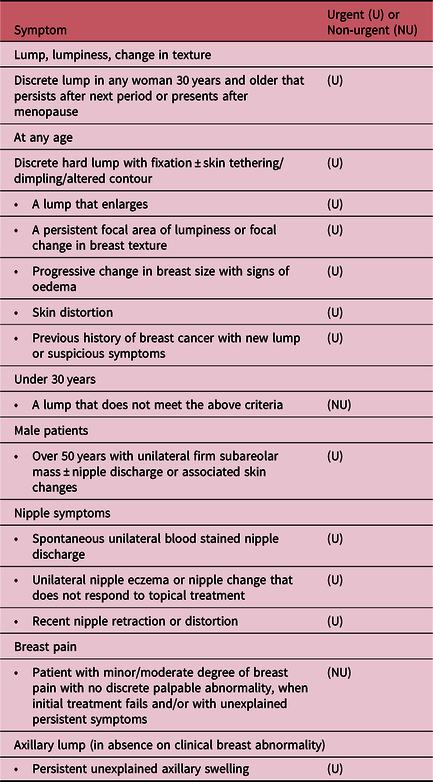
Around one-third of breast cancers are detected through breast-screening initiatives in the United Kingdom. Reference Sibbering and Courtney1 According to an audit carried out by the NHS breast-screening programme, it was responsible for detecting over 21,000 breast cancers per year, 2013–14. 5 That said, the major detection method remains that of referral by the General Practitioner (GP) where patients attend for consultation and physically describe the symptoms that they are experiencing. Best practice diagnostic guidelines for patients presenting with breast cancer symptoms were published in 2010. Reference Willett, Michell and Lee6 Table 1 outlines the guidelines for GPs when considering referral options for patients presenting with suspected breast cancer symptoms. Reference Sibbering and Courtney1
Best practice diagnostic guidelines 2010: referral of patient with breast cancer symptoms (Sibbering et al. p. 1 Reference Sibbering and Courtney1 )

Once referred, ‘triple assessment’ in the form of clinical, radiological and pathological assessments is carried out. Clinical involved meeting with the patient and obtaining a full medical history as well as physically examining the breast. This is generally carried out by a surgeon or a breast cancer nurse specialist. Radiological assessment is carried out using diagnostic imaging tools such as mammography and ultrasound which can lead to a pathological assessment for those patients that are found to have an abnormality present. Reference Sibbering and Courtney1 A fine needle aspiration (FNA) or punch biopsy is taken which provides primary information about the tumour, including pathological staging such as tumour type, grade and invasive status as well as measuring oestrogen receptor (ER) status, progesterone receptor (PgR) status and human epidermal growth factor (HER2) status. Reference Sibbering and Courtney1,Reference Newman7 All the biopsy information plays a vital role in determining the treatment strategy of choice for the individual patient.
Treatment strategies are decided using a multi-disciplinary team (MDT) approach, where all aspects of the disease and the patient’s status (including social and physiological status) are taken into account by a wide range of professionals. Factors considered at this point include the extent and location of the tumour, whether there is lymph node involvement, the biology of the tumour including biomarkers and gene expression, the age and general health of the patient as well as the personal preferences of the patient. Reference Senkus, Kyriakides and Penault-Llorca3 Depending on the results and data obtained, multimodal treatment options in the form of surgery, systemic therapy, hormonal therapies and radiotherapy are used in a variety of combinations and strengths to treat the disease. This mix of both local and systemic therapies is used to maximise the therapeutic benefit and minimise the risk for each individual patient. Reference Vaidya and Joseph8
Surgery
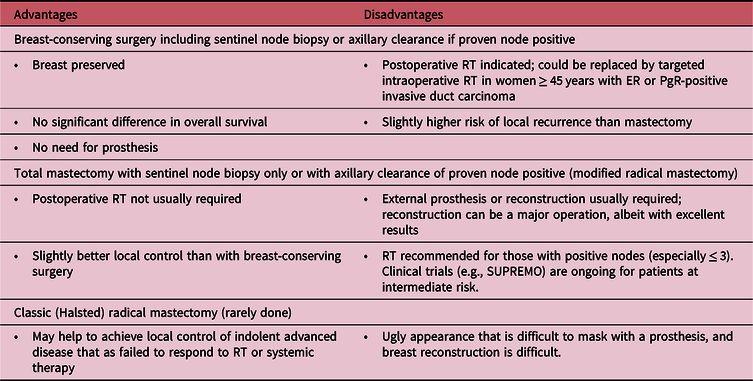
The term ‘local treatment’ in breast cancer refers mainly to surgery and radiotherapy, where the main aim of each is to (a) remove the cancer; (b) stop the cancer spreading and (c) reduce the likelihood of the cancer recurring locally within the breast, chest wall or axillary nodes. Reference Vaidya and Joseph8 Surgery is generally used as the primary treatment for breast cancer as it is the main starting point in achieving the goal of long-term disease-free survival. Reference Vaidya and Joseph8 Instances where this would not apply would be if local control of the disease was thought to be highly unlikely, for example, in patients presenting with distant metastases or a diagnosis of inflammatory carcinoma. Reference Jacobs and Finlayson9 Several surgical options are available for the different types of breast cancer, but all are dependent on the type of breast cancer diagnosed. Most cases of ductal carcinoma in situ (DCIS) are treated using surgery due to the difficulty in predicting the cases that could potentially progress to invasive disease and when this might occur. Reference Sibbering and Courtney1 For this type of potentially unpredictable breast cancer, mastectomy remains the most effective in achieving local control, although studies have shown that conservative breast surgery followed by radiotherapy can provide exceptional rates of local control. Reference Sibbering and Courtney1,Reference Viani, Stefano and Afonso10 Many patients diagnosed with DCIS are offered a choice between mastectomy and breast-conserving surgery. For patients diagnosed with invasive breast cancer, surgery to the breast and related lymph nodes is a requirement and will determine post-operative treatment options by establishing final histology reports. Reference Jacobs and Finlayson9 Identification of axillary node metastases is a very important factor in determining prognosis for the patient. If identified prior to surgery, an axillary lymph node dissection (ALND) is carried out at the time of surgery otherwise a node staging procedure is carried out by sentinel lymph node biopsy (SLNB) using radioisotope localisation techniques. Reference Sibbering and Courtney1 A summary of the advantages and disadvantages of surgical techniques is shown in Table 2.
Surgical options in breast cancer (Vaidya et al. Reference Vaidya and Joseph8 p. 71)

Abbreviations: ER, oestrogen receptor; PgR, progesterone receptor; RT, radiotherapy.
Chemotherapy
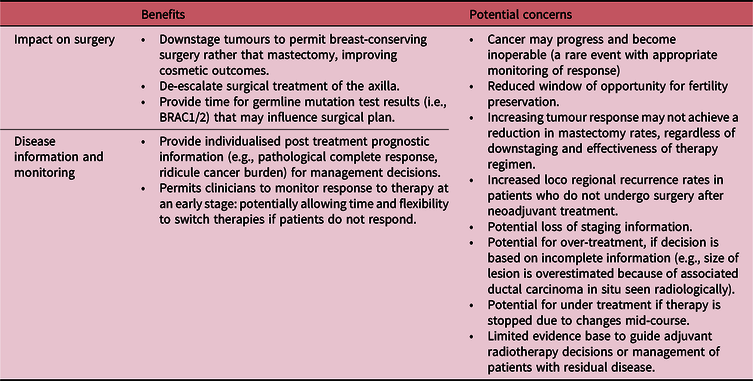
Chemotherapy can be administered as adjuvant or neoadjuvant therapy. Neoadjuvant chemotherapy is given in instances where tumour control or shrinkage is necessary before more localised treatments are employed. Reference Vaidya and Joseph8 Some studies have shown that there are little or minimal differences in disease-free or overall survival between the same regimes of systemic therapy given pre or post-surgery. Reference Wolmark, Wang, Mamounas, Bryant and Fisher11–Reference Mauri, Pavlidis and Ioannidis13 The clinical benefits and obvious concerns associated with neoadjuvant-chemotherapy treatment are summarised in Table 3.
Clinical benefits and potential concerns associated with neoadjuvant treatment for early breast cancer (Vaidya et al. Reference Vaidya and Joseph8 p. 148)

The National Institute for Health and Care Excellence (NICE) has issued evidence-based recommendations on tumour profiling tests to guide adjuvant chemotherapy decisions for patients with early breast cancer. The tests include EndoPredict (EPclin score), Oncotype DX Breast Recurrence Score and Prosigna. Gene expression profiling has been shown to be effective in predicting the course of disease in patients with ER-positive, HER2-negative and lymph node-negative early breast cancer who have been assessed as being at intermediate risk of distant recurrence.
The purpose of adjuvant chemotherapy is to reduce the risk of metastatic spread and recurrence and to improve the overall survival of the patient. Reference Jacobs and Finlayson9 Breast cancer is seen as a systemic disease at diagnosis with a high rate of undetectable dormant micro metastases that have the potential to develop into clinically significant metastatic disease sometime after primary diagnosis, Reference Vaidya and Joseph8 hence the need for systemic treatments in combination with local control. Features of the tumour that have been defined at surgery can help predict the risk of the development of metastatic disease in specific patient cases, including the grade and size of the tumour. Reference Jacobs and Finlayson9 A wide variety of drugs and combinations maybe used to treat breast cancer and are selected based on a number of factors including tumour histology, stage and grade of disease and patient-specific conditions such as cardiac function. Overall, Early Breast Cancer Trialists Collaborative Group (EBCTCG) meta-analyses cited by Jacobs et al. Reference Jacobs and Finlayson9 conclude that
-
1. ‘Combination therapy is more effective than single-agent therapy;
-
2. Anthracycline-based chemotherapy appears superior to non-anthracycline regimens;
-
3. Taxanes appear to add to anthracycline-based therapies;
-
4. Maintenance chemotherapy beyond six or eight cycles does not increase survival and
-
5. The targeted therapies (antioestrogen and anti-HER2) add significantly to chemotherapy when the targets are present in the tumour.’—(Jacobs et al. Reference Jacobs and Finlayson9 p. 21)
Endocrine Therapies
Endocrine therapy or as it is also known, hormonal therapy, is indicated in patients with ER+ status irrespective of chemotherapy and/or targeted therapy. Reference Senkus, Kyriakides and Penault-Llorca3 Patients with HER2+ status are treated using anti-HER2-targeted therapy, more commonly referred to as Herceptin. Reference Henderson14 The type and length of endocrine therapy offered to patients are primarily dependant on the patient’s menopausal status, with factors such as side-effect profile and patients’ general health playing a role. Reference Senkus, Kyriakides and Penault-Llorca3 Drugs most commonly used in adjuvant endocrine treatments include tamoxifen and aromatase inhibitors (AIs): Anastrozole, Letrozole and Exemestane. Reference Senkus, Kyriakides and Penault-Llorca3 These can be prescribed to patients in various sequences. Henderson Reference Henderson14 states that for postmenopausal women, one of the following options should be employed as an adjuvant treatment:
-
1. ‘5 years of an AI alone
-
2. 10 years of tamoxifen
-
3. Sequential therapy with 2–5 years of tamoxifen, followed by 5 years of AI leading to a total treatment duration of 7–10 years’—(Henderson Reference Henderson14 , p. 151)
Direct comparisons of each of these regimes have yet to be fully investigated and so the choice of which to use will mainly be dependent on the patient’s tolerance to the drugs themselves. Reference Senkus, Kyriakides and Penault-Llorca3,Reference Henderson14 For premenopausal women, Henderson suggests that one of the following options be used as an adjuvant treatment:
-
1. ‘10 years of tamoxifen
-
2. Sequential therapy with 5 years of tamoxifen followed by 5 years of AI, leading to total treatment duration of 10 years. (Menopausal status should be confirmed by biochemical measurement before starting the AI since AIs may be harmful to premenopausal patients.)’—(Henderson Reference Henderson14 , p. 152)
Henderson Reference Henderson14 also goes on to state that the addition of ovarian suppression with the use of gonadotrophin-releasing hormone (GNRH) agonists or direct ovarian ablation maybe advantageous for disease-free survival. However, studies regarding ovarian suppression and its use in premenopausal patients have yet to provide sufficient consistent data, and many clinical professionals do not recommend its use as part of adjuvant therapy until more evidence has been published. Reference Senkus, Kyriakides and Penault-Llorca3,Reference Henderson14
Radiotherapy
Meta-analysis data published show that radiotherapy provides effective local control leading to the prevention of local recurrence in 50–75% of cases, as well as significantly improving survival after 10–15 -year follow-up. Reference Vaidya and Joseph8,15 Radiotherapy may be given in various doses and fractionation patterns ranging from periods of 3 to 6 weeks, with a variety of treatment techniques being available, for example, intensity-modulated radiotherapy (IMRT), brachytherapy, conformal radiotherapy, breath hold radiotherapy and interstitial radiotherapy. The use of these techniques varies between departments and depends on the technology available at each centre. Whole-breast irradiation (WBI) is routinely delivered after surgery for patients with stage I–II breast cancer but is sometimes omitted due to factors such as patient age, low risk of disease recurrence or patient comorbidities. Reference Henderson14 NICE guidelines for the treatment of early and locally advanced breast cancer suggest that radiotherapy be offered in 40 Gy over 15 treatments as a standard practice. 16 This is supported by the Standardisation of Radiotherapy (START) trials which have shown that at 5 -year follow-up patients who received the 40 Gy in 15 fractions experienced equivalent local regional tumour relapse and late adverse effects as those who received 50 Gy in 25 fractions. 17 Accelerated partial breast irradiation (APBI) is aimed to reduce radiation treatment to less than 1 week and improve local control by increasing the dose to the tumour bed only. Reference Henderson14 Studies using APBI have employed both brachytherapy and external beam therapy techniques, and results have been challenging to interpret due to the inconsistency of techniques and short length of follow-up, averaging around 2·5 years (TARGIT trial). Reference Vaidya and Joseph8,Reference Henderson14 None-the-less, advantages in the use of APBI as a standard treatment due to minimal side effects and reduced treatment time have the potential to have a significant impact on future radiation treatment strategies. Reference Henderson14
Radiotherapy Toxicity Management
Many side effects may ensue from most if not all the treatment modalities outlined. Each of the effects is managed by a range of health care professionals over a wide range of services to ensure a holistic care approach is adopted throughout the patient’s care pathway. The focus of this section is however solely to consider the toxicity management of the side effects experienced during the radiotherapy treatment aspect of the patient’s journey.
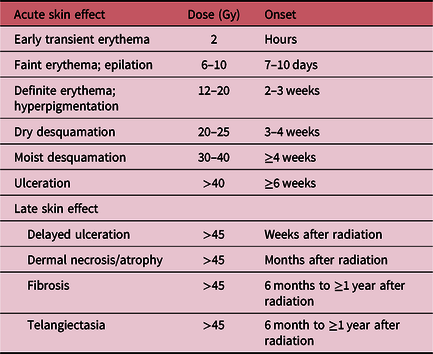
Patients undergoing breast radiotherapy are likely to develop many toxicities throughout their course of treatment with the most common being a radiation skin reaction. Reference McAlinden, Mullan and Shepherd18,Reference Sharp, Johansson, Landin, Moegelin and Bergenmar19 These skin reactions can cause the patient to feel pain, discomfort, irritation, itching and burning in the treatment area throughout the course of treatment. Reference McQuestion20 Radiation skin reactions maybe categorised as acute (hours or days) or late (months or years) and can occur at various rates and times during a course of radiotherapy. Table 4 shows a summary of acute and late skin reaction or changes in relation to the radiation dose during external beam radiotherapy. It demonstrates how skin reactions increase in severity as the dose of radiotherapy increases and how changes in the skin continue to occur even after the radiotherapy treatment has finished. Skin reactions generally peak during the last week of a patient’s treatment or around 1–2 weeks post treatment, with most acute reactions being fully resolved 4–5 weeks after that time. Reference O’Donovan, Colemen, Harris and Herst21
Acute skin changes with localised radiation dose (Ryan Reference Ryan22 p. 986)

Risk factors
Both treatment and patient-related risk factors can often increase the rate and time at which certain reactions appear during radiotherapy. Patient-related risk factors include body mass index (BMI), smoking, larger size breast size and previous skin damage. Reference Sharp, Johansson, Landin, Moegelin and Bergenmar19,Reference O’Donovan, Colemen, Harris and Herst21 Treatment-related factors include higher dose per fraction and increased size of irradiated volume. Reference Newman7,Reference Ryan22 Recording baseline measurement of some of these factors at the beginning of the radiotherapy journey can prove useful for the therapeutic radiographer in determining potential outcomes and management strategies for individual patients. Reference Bostock23 The development of advancing radiotherapy techniques for breast cancer, such as the introduction of intensity-modulated radiotherapy (IMRT), has witnessed a reduction in the grade of skin reaction that was more commonly seen with conventional radiotherapy techniques. Reference Feight, Baney, Bruce and Mcquestion24–Reference Hymes, Strom and Fife27 Studies have shown that IMRT not only reduces the incidence of skin reactions but also reduces the number of weeks patients are experiencing higher grade skin reactions, Reference Freedman, Li, Nicolaou, Chen, Ma and Anderson25 thus making the care of the reactions more manageable for both patients and health care professionals. Despite the introduction of advancing techniques in radiotherapy, the concurrent use of chemotherapy in the treatment of breast cancer means that common side effects such as radiation dermatitis still remain a clinically significant issue. Reference Fisher, Scott and Stevens28–Reference Paterson, Poonam and Bennett30
Grading systems
Grading of toxicities caused by cancer treatments have been around since the 1980s, with National Cancer Institute (NCI) creating the Common Toxicity Criteria (CTC) for chemotherapy toxicities and Radiation Therapy Oncology Group (RTOG) creating the Acute Radiation Morbidity Scoring Criteria for radiation effects. Reference Trotti, Byhardt and Stetz31 Much debate regarding these grading systems had arisen over the following years due to the creation and modification of older criteria for newer toxicities observed. This led to confusion and inconsistencies in grading and called for newer systems to be developed. Reference Trotti, Byhardt and Stetz31 In 1997, the NCI called for both the CTC and RTOG to merge into one system, named ‘Common Toxicity Criteria Version 2’ (CTC v 2). Reference Trotti, Byhardt and Stetz31 However, ongoing debate has continued to take place over a number of years which suggests that there is no clear agreement on which grading scale is more appropriate for clinical use. Reference Feight, Baney, Bruce and Mcquestion24,Reference Schnur, Love, Scheckner, Green, Wernicke and Montgomery32–Reference Momm, Bartelt, Haigis, Grobe-Sender and Witucki34 The RTOG Acute Radiation Morbidity Scoring Criteria (Table 5) assesses the severity of the skin reaction on a scale from 0 to 4. This scale is one of the most popular scales used in departments across Europe and is the most commonly used scale in clinical trials. Reference Feight, Baney, Bruce and Mcquestion24 The content only addresses the observation of physical changes and does not address symptoms or patient perspectives in any way. Reference Feight, Baney, Bruce and Mcquestion24,Reference Huang, Hou and Luo35 CTC v 4.03 (updated version of CTC v2) (Table 6) is similar in that it also assesses the severity of skin reactions using a scale, but grades them from 0 to 5. It goes into more detail regarding the scale of desquamation and dermatitis associated with the radiation, but as with the RTOG system, it only observes the physical changes and does not take into account additional symptoms or the patient’s perspective. Reference Feight, Baney, Bruce and Mcquestion24,Reference Huang, Hou and Luo35,Reference Schnur, Ouellette, DiLorenzo, Green and Montgomery36 Studies completed over the last number of years have shown that patient-reported outcomes have become valuable instruments in order to help document a more accurate assessment of toxicities. Reference Neben-Wittich, Atherton and Schwartz37,Reference Ryan, Bole and Hickok38 The studies have shown that more locally devised skin assessment tools are not corresponding to the CTC or RTOG grading systems and that small but critical skin changes and patient-reported information are being missed. Reference Ryan22 Using the grading systems alone in order to assess the toxicities experienced by patients having radiotherapy is not sufficient and a call for the development for of a more specialised system for breast cancer is required so that therapeutic radiographers can provide more superior symptom management. Reference Sharp, Johansson, Landin, Moegelin and Bergenmar19,Reference Ryan22,Reference Huang, Hou and Luo35
RTOG criteria (modified version) (Huang et al. Reference Huang, Hou and Luo35 p. 231)

CTCAE criteria version 4.0 (Huang et al. Reference Huang, Hou and Luo35 p 231)

Acute Effects
Skin toxicities
As skin toxicities are a common side effect experienced during breast cancer radiotherapy, prophylaxis management has been widely employed by many radiotherapy departments throughout the United Kingdom. Before a patient starts their course of radiotherapy, information communicated in leaflets and during face-to-face advice sessions is given. Historically, this information would include some of the following do’s and don’ts Reference Feight, Baney, Bruce and Mcquestion24,Reference Maddocks-Jennings, Wilkinson and Shillington39 :
-
Keep treatment area clean and dry
-
Use a mild soap when washing
-
Pat dry and use a soft towel, no rubbing of the skin
-
Avoid wet shaving the treatment area and use an electric razor only if necessary
-
Use deodorant only on intact skin
-
Moisturise area daily using plain, non-scented creams and discontinue use if skin breakdown
-
Avoid swimming in lakes or pools and the use of hot tubes or saunas
-
Avoid any tapes or adhesive dressings in treatment area
-
Avoid applying any extreme temperatures directly onto treatment area
-
Avoid direct sun exposure (cover completely or use a sunscreen with factor higher than 30 SPF)
Radiotherapy departments manage skin toxicities in breast cancer patients based on a mixture of both historical professional attitudes and clinical recommendations. Attitudes and opinions can vary depending on a range of factors and discrepancies in guidance, and published literature and clinical opinion all influence the variability and effectiveness of the advice given. In 2011, the Society and College of Radiographers (SCoR) carried out a survey to look at how skin toxicities were being managed in departments. The results showed that despite a wide range of information being distributed to patients, a lack of consistency across departments in the advice given was evident. Reference Harris, Probst and Beardmore40 The survey also showed that despite the SCoR publishing guidelines outlining that aqueous cream should not be used as a moisturiser, it was continuing to be used as such in many departments across the United Kingdom. Comparable studies carried out across Europe, Australia and America have shown very similar evidence that despite clear guidelines and recommendations, skin care advice and choice of skin care products are mainly based on historical anecdotal evidence and less importance is placed on evidence-based clinical practice. Reference Harris, Probst and Beardmore40–Reference Swamy, Ashamalla and Guirguis42 The results obtained from the SCoR survey prompted a national audit of practice, and new more relevant guidelines were published in 2015 in an attempt to standardise patient care. Reference Harris, Probst and Beardmore40 The audit also showed that there was a lack of evidence regarding the use of specific products in order to prevent or minimise skin reaction during radiotherapy. The recommendations did advise the use of a moisturising cream for patient comfort and to maintain skin hydration; however, no named product was directly recommended for use by the SCoR. 43 As a result, patients are still advised to use a cream during their radiotherapy treatment both prophylactically and up to a grade 1 erythema reaction in order to try and maintain skin hydration and subtleness. Only when the patient shows signs of skin breakdown and moist desquamation would they be asked to stop. At this point, alternative treatments may be necessary as the skin is now broken and the chance of infection becomes greater. In a study carried out by O’Donovan et al., Reference O’Donovan, Colemen, Harris and Herst21 it was at this grade of reaction where the greatest variation in practice was detected in departments. The study showed that soft silicone dressings were used in 58% of departments across Europe and the United States, followed by hydrogels in 45% and finally gentian violet in 18%. Reference O’Donovan, Colemen, Harris and Herst21 In the United Kingdom, the SCoR study concluded that 73% of departments used hydrogels to manage moist desquamation during a patient’s radiotherapy. 43 Evidence has shown that hydrogels are effective in the treatment of both dry and moist desquamation as they help to maintain fluid exchange on the wound surface and promote a moist healing environment. Reference Fowble, Yom, Yuen and Arron44 They also have a high water content which is proven to be cooling and soothing on wounds, helping to decrease discomfort for patients. Reference Fowble, Yom, Yuen and Arron44 However, some studies have shown that the use of hydrogels as treatment for moist desquamation can actually increase the severity of the skin reaction experienced. Reference Macmillan, Wells, Macbride, Rabb, Munro and Macdougall45 No definitive guidance on the use of such dressings has yet to be released with most stating that much evidence for their use in treating moist desquamation is unconvincing. Reference Fowble, Yom, Yuen and Arron44 Soft silicone dressings such as mepilex® and mepilex® lite remain the most used treatment for grade 2 and above reactions. They are absorbent soft dressings that adhere only to healthy skin and not to open wounds. Reference Fowble, Yom, Yuen and Arron44 Trials carried out by Diggleman et al. Reference Diggleman, Zytkovicz, Tuaine, Bennett, Kelly and Herst46 and Herst et al. Reference Herst, Bennett, Sutherland, Peszynski, Paterson and Jasperse47 showed that using soft silicone dressings in breast cancer skin reactions decreased radiation dermatitis significantly. However, disadvantages of their use remain an issue due to the need for daily removal of the dressing as a result of potential bolus effect during treatment, adding increased discomfort to the patient as well as increasing cost to the health service and the inability to adhere to highly moisturised skin, which is recommended during treatment. Reference O’Donovan, Colemen, Harris and Herst21,Reference Fowble, Yom, Yuen and Arron44
Fatigue
Radiation-induced fatigue effects around 75–77% of patients with breast cancer receiving radiotherapy. Reference Manir, Bhadra, Kumar, Manna, Patra and Sarkar48 Some studies have shown that fatigue tends to peak at around week 4 of treatment and then reduces back to baseline level by approximately 6 weeks post treatment. Reference Greenberg, Sawicka, Eisenthal and Ross49,Reference Wratten, Kilmurray and Nash50 However, other reports have shown that fatigue can last for up to 7 months after radiotherapy has been completed. Reference Lee, Kilbreath and Refshauge51 Although reports have shown that the levels of fatigue experienced tend to be mild to moderate, it does seem to affect patients’ daily activities and overall quality of life. Reference White and Joiner52 During radiotherapy treatment, patients should be generally advised on the management of fatigue, to rest or exercise appropriately and to prioritise tasks and activities as required. Reference White and Joiner52 Studies have shown that the introduction of gentle exercise can be very effective in the management of fatigue during radiotherapy. Reference Mock, Hassey-Dow, Meares, Grimm, Dienemann and Haisfield-Wolfe53–Reference McNally, Shepherd and Flood55
Non-radiotherapy-related side effects
As discussed previously, radiotherapy may not be the patient’s first definitive treatment with multimodal treatments such as surgery, chemotherapy and hormonal therapy all being accessed at some point during the management pathway. Reference Sibbering and Courtney1,Reference Senkus, Kyriakides and Penault-Llorca3,Reference Cardoso, Harbeck, Fallowfield, Kyriakides and Senkus4 Secondary toxicities to any of the treatments may arise during the patient’s radiotherapy, hence it is important that the therapeutic radiographer is aware and able to effectively and efficiently manage patient toxicities holistically and understand who to signpost patients for management during radiotherapy. Examples include:
Endocrine therapy—Side effects associated with endocrine therapy for breast cancer are dependent on the type of drug being taken. AIs can cause women to suffer from hot flushes, joint and muscle pain, fatigue and increased bone thinning. Tamoxifen can cause hot flushes and sweats, weight gain, tiredness, increased risk of thromboembolic complications and endometrial bleeding or even cancer. Reference McQuestion20,Reference Bostock23,56,Reference Amir, Seruga, Niraula, Carlsson and Ocana57 These are often feared by some women due to the treatment duration associated with endocrine therapy, and a lack of education on the side effect management can sometimes lead to treatment discontinuation or poor adherence. Reference Heisig, Shedden-Mora and Von Blanckenburg58 Some studies have shown that nocebo-related side effects can manifest in clinical practice linked with endocrine therapies for breast cancer. Reference Heisig, Shedden-Mora and Von Blanckenburg58 The effects experienced by the patient are induced by common expectations and sometimes occur independently of the pharmacological action of the drug itself. Reference Barsky, Saintford, Rogers and Borus59 Many of the commonly occurring side effects will be explained to the patient prior to starting endocrine therapy by either the clinician or specialist nurse. Patients will routinely be given written information on the type of hormonal therapy they are due to start and will be given opportunity for questions. Some studies have suggested that it could be beneficial for a more personal and individualised approach, where common misconceptions regarding treatment can be discussed as well as a more in-depth rationale for the use of the treatment. Reference Heisig, Shedden-Mora and Von Blanckenburg58
Post chemotherapy—Side effects from chemotherapy can be vast and affect each individual very differently. Most of the side effects are acute and will be managed by the clinician and nursing staff directly involved in the prescription and delivery of the chemotherapy treatment. However, some side effects can be longer lasting and continue to affect patients during radiotherapy. Examples would be peripheral neuropathy, hair loss, infertility, cognitive function, cardiac function and tiredness. Reference McQuestion20,56 Long-term management by the clinical oncologist, specialist nursing teams, General Practitioners (GPs) and specialist services are generally required for these conditions and knowing how to signpost to these services is essential.
Psychological issues—Cancer can cause patients to be psychologically vulnerable for a variety of reasons including stress of the diagnosis itself, chronic pain, lack of social or economic support and side effects experienced during treatment. Reference Van Oers and Schlebusch60 These may cause the patient to suffer from anxiety or manifest symptoms of depression at any time during their diagnosis and treatment and could lead to a lack of compliance and adherence with treatment schedules. Reference Van Oers and Schlebusch60 It is postulated that oncologists and therapeutic radiographers may be less focused on the prevalence of psychological distress in patients with their attention understandably more drawn to the management of the physical needs of the patient. Reference Halkett, Kristjanson and Lobb61 Noting symptoms of anxiety or depression at any time and signposting patients to support services provided by the information and support radiographers, social work, psycho-oncology or even local charities is paramount in providing efficient and effective care to patients.
Late Effects
Late effects of breast cancer treatment can arise from around 3 months post treatment and some instances are permanent. They range in severity and are mainly dependent on the individual patient treatment previously delivered. Examples of effects include:
Telangiectasia—dilated superficial blood vessels that remain prominent on the irradiated skin area post treatment. Some studies have shown a correlation in the extend and severity of appearance and with the extend and severity of acute skin reaction experienced by the patient during treatment. Reference Henderson14,Reference Fowble, Yom, Yuen and Arron44,Reference White and Joiner52 Other factors known to affect increased incidence include the total radiation dose and higher fraction size. Reference White and Joiner52 Telangiectasia is permanent but tends to reduce in severity overtime. Reference Fowble, Yom, Yuen and Arron44 A small study carried out by Lanigan et al. Reference Lanigan and Joannides62 showed the effective use of pulsed dye laser (PDL) treatment in significantly reducing and even removing the appearance of telangiectasia in a number of patients who had received breast radiotherapy, thus demonstrating potential treatment for this in the future.
Fibrosis—is a skin thickening of breast or chest wall after radiotherapy. It can cause pain and discomfort for patients who experience it. Both treatment and patient-related risk factors are shown to increase the incidence of fibrosis post treatment. Studies have shown that patients with collagen vascular diseases such as scleroderma are at a higher risk of developing fibrosis after breast radiotherapy. Reference Fowble, Yom, Yuen and Arron44 Treatment-related factors such as additional treatment fields (i.e., axilla), addition of boost treatments, total dose and fractionation and hypofractionation have also shown to increase the risk of development of fibrosis post treatment. Reference Fehlauer, Tribius and Holler63
Breast appearance—can change rapidly following breast cancer treatment. Changes in the size, shape and appearance of the breast can have a psychological effect on patients. Surgery, chemotherapy and radiotherapy have the potential to change the appearance of the breast, and an unsatisfactory cosmetic outcome can be seen as a late toxicity of breast cancer treatment. Reference White and Joiner52 Studies have shown that there are several radiotherapy treatment factors that are associated with poor cosmetic outcome for patients including, radiotherapy dose, inclusion of boost treatment both interstitial and electron and addition of treatment fields (i.e., supraclavicular and axilla). Reference White and Joiner52 Taylor et al. Reference Taylor, Perez and Halverson64 looked at breast retraction and compared the size and shape of the treated and non-treated breast and found that patient factors such as age, weight, surgical technique and site of primary tumour (upper quadrant) were also contributing factors in breast retraction post treatment. Although some of these factors cannot be altered due to the stage and grade of disease being treated, it is important to note the potential late effects.
Cardiac toxicities—may be a consequence of left-sided radiotherapy. Damage may occur to the heart most commonly seen in the pericardium; however, with new advances in radiotherapy planning and delivery and the introduction of image-guided radiotherapy, incidences remain uncommon. Reference Henderson14,Reference Mock, Hassey-Dow, Meares, Grimm, Dienemann and Haisfield-Wolfe53 Careful consideration should be employed when the use of cardiotoxic drugs is used concomitantly alongside radiotherapy treatment. Reference Henderson14
Radiation pneumonitis—is an uncommon clinical syndrome affecting the lung post treatment. Reference Henderson14 It presents as a cough, fever, shortness of breath and will show radiographic changes in the previous radiotherapy field only. Reference Mock, Hassey-Dow, Meares, Grimm, Dienemann and Haisfield-Wolfe53 Although uncommon risk factors for development include nodal irradiation and concomitant chemotherapy treatment. Reference Mock, Hassey-Dow, Meares, Grimm, Dienemann and Haisfield-Wolfe53
Conclusion
The treatment pathway for breast cancer patients varies greatly depending on a wide range of factors and is very much personalised for each individual patient. All decisions taken during the management process are decided by a large multidisciplinary team (MDT) who work together and put the best interests of the patient first to ensure effective and efficient care is provided. Reference Sibbering and Courtney1 Each treatment modality has its own advantages and disadvantages, and all present with side effects that can have detrimental effects on a patient’s daily living. They can arise at both the time of treatment or months after treatment has ended and therefore education on the management of these is essential for effective patient care. The management of radiotherapy side effects is inconsistent throughout centres across the United Kingdom, Europe and Australia. Reference O’Donovan, Colemen, Harris and Herst21,Reference Bostock23,Reference Harris, Probst and Beardmore40 Despite attempts to standardise clinical guidelines on the use of topical agents and dressings, historical opinions and ideas are still evident in clinical practice today. Currently used grading systems in radiotherapy only record the physical symptoms seen and none make a record of the patient’s perspective or emotional needs. Reference Feight, Baney, Bruce and Mcquestion24,Reference Huang, Hou and Luo35,Reference Schnur, Ouellette, DiLorenzo, Green and Montgomery36 Systems might be adapted in the future to address this in order to ensure that the holistic care approach is maintained throughout the patient journey and effective signposting to correct health care professionals and services when warranted. Many advances in radiotherapy treatment have the potential to decrease radiation-induced side effects. APBI and TARGIT trials are assessing the ability to introduce radiation treatment directly to the tumour bed using both external and interstitial therapies while minimising dose to the surrounding tissues over shorter treatment time periods. The results from these trials look promising, and with continued research and development, radiation-induced effects may be diminished further. Reference Vaidya and Joseph8,Reference Henderson14 Therapeutic radiographers maintain professional competency but should also strive for betterment and evidence to enhance the patient care experience. They must ensure that they remain equipped with the skills and knowledge to correctly manage and/or signpost services effectively. This overall outline of the management of patients with breast cancer is designed to help therapeutic radiographers reflect on the current practices and to inspire them, where evidence dictates, to seize opportunities, to explore improvement and to enhance best practice.
Acknowledgements
The authors thank the staff of the radiotherapy department, Western Health and Social Care Trust for their support.
Financial Support
This review received no specific grant from any funding agency, commercial or not-for-profit sectors.
Conflicts of interest
None.