Introduction
Bipolar disorder (BD) occurs in multiple forms and degrees of severity. Whereas the Diagnostic and Statistical Manual of Mental Disorders (DSM-IV) includes the BD II subtype, the International Classification of Diseases, 10th Revision (ICD-10) does not recognize it as a specified nosological category (Vieta & Suppes, Reference Vieta and Suppes2008).
The clinical course of BD II is characterized by the presence or history of one or more major depressive episodes and at least one hypomanic episode lasting at least 4 days (APA, 2000). It is often initially misdiagnosed as unipolar depression, adjustment disorder or personality disorder (Berk & Dodd, Reference Berk and Dodd2005). Many clinicians still consider BD II as a mild form of classical BD, although the data indicate that it may be associated with high morbidity and mortality, including higher episode frequency, co-morbidity, suicidal behaviour and rapid cycling as compared with BD I (Vieta et al. Reference Vieta, Gasto, Otero, Nieto and Vallejo1997, Reference Vieta, Colom, Martínez-Arán, Benabarre and Gasto1999). Misdiagnosing BD II may also affect therapeutic decisions and therefore the course and prognosis of bipolar patients (Vieta & Suppes, Reference Vieta and Suppes2008). An early age at onset of BD II has been associated with a higher degree of severity, a poorer treatment response and a worse prognosis (Engstrom et al. Reference Engstrom, Brandstrom, Sigvardsson, Cloninger and Nylander2003).
The estimated prevalence of BD II is from 0.5% to 6% depending on the flexibility of the application of diagnostic criteria (Akiskal, Reference Akiskal1996; Angst, Reference Angst1998; Benazzi, Reference Benazzi1999).
In the past, several reviews have been published supporting recognition of BD II as a distinct category within mood disorders (Vieta & Suppes, Reference Vieta and Suppes2008).
Emerging evidence suggests considering cognitive impairment as a trait marker in BD, this impairment being present even during euthymic periods. Recently published meta-analyses have shown that executive functions and verbal memory are the most impaired cognitive domains in euthymic patients (Robinson et al. Reference Robinson, Thompson, Gallagher, Goswami, Young, Ferrier and Moore2006; Torres et al. Reference Torres, Boudreau and Yatham2007) as well as attention/processing speed (Torres et al. Reference Torres, Boudreau and Yatham2007). These neurocognitive deficits have been postulated to constitute trait markers or endophenotypes of BD (Glahn et al. Reference Glahn, Bearden, Niendam and Escamilla2004; Savitz et al. Reference Savitz, Solms and Ramesar2005), but the specific neurocognitive and therefore endophenotypic status of BD II and other bipolar spectrum disorders remains unclear (Savitz et al. Reference Savitz, van der Merwe, Stein, Solms and Ramesar2008). Moreover, the concept of allostatic load is interesting in order to explain cognitive impairment in BD. The increased allostatic load in bipolar patients may be related to the cognitive decline seen among such patients as well as other pathophysiological mechanisms involved in illness progression. The main mediators of allostatic load are the dysregulation of the hypothalamic–pituitary–adrenal axis, and altered immunity, pro-inflammatory and oxidative stress states (Kapczinski et al. Reference Kapczinski, Vieta, Andreazza, Frey, Gomes, Tramontina, Kauer-Sant'anna, Grassi-Oliveira and Post2008).
Only a few studies have focused on cognitive impairment in BD II, probably due to the fact that BD II is an underdiagnosed entity. Most data regarding neurocognition in BD come from studies focusing on BD I patients or mixed samples of BD I and BD II subjects.
In one of the first studies comparing BD I and BD II, euthymic BD II patients had significantly less insight and higher level of subjective cognitive complaints than BD I patients (Pallanti et al. Reference Pallanti, Quercioli, Pazzagli, Rossi, Dell'Osso, Pini and Cassano1999). It is noteworthy that cognitive impairment, particularly memory deficits, may have negative implications in the functional outcome of bipolar patients (Martínez-Arán et al. Reference Martínez-Arán, Vieta, Colom, Torrent, Sánchez-Moreno, Reinares, Benabarre, Goikolea, Brugue, Daban and Salamero2004a, b). Between 30% and 50% of patients with BD experience significant social disability that may be related to persistent cognitive impairment (Zarate et al. Reference Zarate, Tohen, Land and Cavanagh2000) and there is a paucity of studies focusing on this topic in BD II.
The main aim of this critical review is to examine the existing literature on cognitive impairment in BD II in order to identify specific cognitive deficits that distinguish BD II from BD I patients, as well as from healthy subjects, therefore having implications for the patho-aetiology and nosology of this disorder.
Methodology
A comprehensive PubMed/Medline search was carried out in order to conduct an objective review of the available literature on the neuropsychology of BD II. The search was supplemented by manually reviewing reference lists from the identified publications. Only English-language articles published from 1980 to July 2009 were included in the present paper, using the search term ‘bipolar II’ cross-referenced with ‘cognition’, ‘cognitive function’, ‘cognitive impairment’, ‘neuropsychological’, ‘neuropsychological function’, ‘neurocognitive’, ‘attention’, ‘memory’, ‘executive function’ and ‘intellectual function’. Eligibility criteria were: (a) studies that included a comparison group [psychiatric or healthy control (HC) group] or normative data for standardized tests; (b) groups formed of more than 10 BD II subjects; (c) published between 1980 and July 2009; (d) adult patients (aged 18–65 years); (e) the use of standardized diagnostic criteria, such as DSM; (f) selection of standardized or well-established cognitive tasks; and (g) provided clear descriptive and comparative statistics of cognitive function measures.
Results
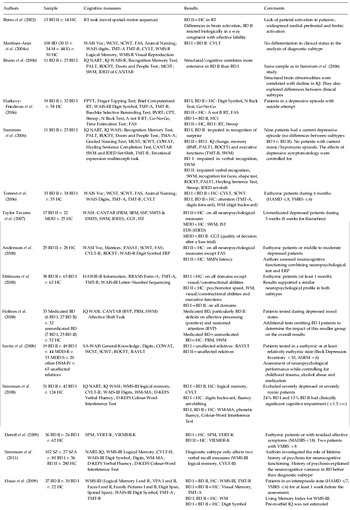
The systematic search yielded 55 articles, out of which 15 fulfilled the inclusion criteria. Table 1 summarizes the findings of the studies included in this review. Results will be shown according to different neurocognitive domains.
Studies on neurocognition including patients with BD II

ASRM, Altman Self-Rating Mania Scale; BD, bipolar disorder; BD I, bipolar disorder type I; BD II, bipolar disorder type II; BVRT, Benton Visual Retention Test; CANTAB, Cambridge Neuropsychological Test Automated Battery; CGT, Cambridge Gamble Test; COWAT, Controlled Oral Word Association Test; CPT, Continuous Performance Test; CVLT, California Verbal Learning Test; D, depressed patients; D-KEFS, Delis Kaplan Executive Functioning Scale; DSM, Diagnostic and Statistical Manual of Mental Disorders; E, euthymic patients; EDS, Extra-Dimensional Shift; ERP, event-related potentials; FAS, letter fluency test; HAWIE-R, German version of WAIS-R Information; HC, healthy controls; HAMD, Hamilton Depression Rating Scale; IDED, Intra-Dimensional Extra-Dimensional Set Shifting; IQ, intelligence quotient; IST, Information Sampling Test; M, manic or hypomanic patients; MADRS, Montgomery Asberg Depression Rating Scale; MCST, Modified Wisconsin Card Sorting Test; MDD, major depressive disorder; MDD-R, major depressive disorder – recurrent; MDD-S, major depressive disorder – single; MMN, mismatch negativity; NART, National Adult Reading Test; PALT, Paired Associates Learning Test (Warrington, Reference Warrington1996); PASAT, Paced Auditory Serial Addition Test; PPVT, Peabody Picture Vocabulary Scores; PRM, Pattern Recognition Memory; RAVLT, Rey Auditory Verbal Learning Test; RBANS, Repeatable Battery for the Assessment of Neuropsychological Status; RMF, Recognition Memory Faces; ROCFT, Rey-Osterreich Complex Figure Test; RT, reaction time; RVP, Rapid Visual Information Processing; SA-WAIS, South African-Wechsler Adult Intelligence Scale; SCWT, Stroop Colour-Word Test; s.d., standard deviation; SMTS & DMTS, Simultaneous and Delayed Matching to Sample; SPM, Ravens's Standard Progressive Matrices; SRM, spatial recognition memory; SSP, spatial span; SWM, spatial working memory; SZ, schizophrenia; SZA, schizo-affective; TMT-A, Trail Making Test A; TMT-B, Trail Making Test B; VERT-K, Vienna Emotion Recognition Tasks; VIEMER-K, Vienna Memory of Emotion Recognition; VPA, Verbal Paired Associates; WAIS-R, Wechsler Adult Intelligence Scale – Revised; WASI, Wechsler Abbreviated Scale of Intelligence; WCST, Wisconsin Card Sorting Test; WM, working memory; WM-MA, Working Memory-Mental Arithmetic Test; WMS, Wechsler Memory Scale; YMRS, Young Mania Rating Scale.
General intellectual function
One of the selected studies did not assess pre-morbid intelligence quotient (IQ) or current IQ (Hsiao et al. Reference Hsiao, Wu, Wu, Hsu, Chen, Lee, Lee, Yeh, Yang, Ko and Lu2009). Most of the other studies did not find significant differences between BD I, BD II and the HC group in the estimated current IQ, using different subtests of the Wechsler Adult Intelligence Scale or the Wechsler Abbreviated Scale of Intelligence (WASI), or the pre-morbid IQ using the National Adult Reading Test (NART) (Torrent et al. Reference Torrent, Martínez-Arán, Daban, Sánchez-Moreno, Comes, Goikolea, Salamero and Vieta2006; Taylor Tavares et al. Reference Taylor Tavares, Clark, Cannon, Erickson, Drevets and Sahakian2007; Andersson et al. Reference Andersson, Barder, Hellvin, Lovdahl and Malt2008; Holmes et al. Reference Holmes, Erickson, Luckenbaugh, Drevets, Bain, Cannon, Snow, Sahakian, Manji and Zarate2008; Savitz et al. Reference Savitz, van der Merwe, Stein, Solms and Ramesar2008). Harkavy-Friedman et al. (Reference Harkavy-Friedman, Keilp, Grunebaum, Sher, Printz, Burke, Mann and Oquendo2006) did not find significant differences in estimated current IQ assessed by the Peabody Picture Vocabulary either. It is noteworthy that Simonsen et al. (Reference Simonsen, Sundet, Vaskinn, Birkenaes, Engh, Hansen, Jónsdóttir, Ringen, Opjordsmoen, Friis and Andreassen2008) did not find any difference between the three groups (BD I, BD II and HC) in pre-morbid IQ assessed by the NART; however, current IQ assessed by the WASI revealed that the mean score of BD I patients was lower than that of the HC group, whilst BD II patients did not differ significantly from either group. However, although these differences were statistically significant, they were not significant from a clinical point of view.
Only one study found that both BD I and BD II patient groups differed significantly from the HC group as to pre-morbid IQ, but they did not differ significantly one from another (Dittmann et al. Reference Dittmann, Hennig-Fast, Gerber, Seemuller, Riedel, Emanuel, Langosch, Engel, Moller and Grunze2008). The baseline differences in pre-morbid IQ among groups might have affected the results on neuropsychological performance.
Furthermore, only one study considered an index of IQ change in order to assess intellectual decline and found that BD II patients scored significantly lower than BD I on full-scale IQ change (Summers et al. Reference Summers, Papadopoulou, Bruno, Cipolotti and Ron2006). Bruno et al. (Reference Bruno, Papadopoulou, Cercignani, Cipolotti and Ron2006), using the same sample of BD patients, aimed to correlate cognitive performance (IQ change) with structural brain abnormalities using neuroimaging techniques. An association between fronto-temporal abnormalities and decline in IQ in BD was detected as well as that the structural/cognitive correlates were more extensive in BD II than in BD I patients. The authors hypothesized that persistent depression, rather than mania, may represent a key pathophysiological factor or, alternatively, that BD II represents a clinical phenotype at risk for developing cognitive abnormalities. Although it is not possible to know whether the neuroanatomical substrate of cognitive function in patients deviates from that of normal subjects since the study did not include HCs, this does not invalidate the detection of differences between the two subgroups of BD patients. Moreover, the BD II sample was small (n=11).
In conclusion, most studies failed to detect significant differences in the IQ of BD II patients compared with BD I patients or healthy subjects.
Attention and psychomotor speed
In the selected studies attention and psychomotor speed have been assessed by different tests [Trail Making Test (TMT), Digits Span, Digit Symbol, Stroop Test, simple reaction time, Continuous Performance Test (CPT), Coding Task in RBANS (Repeatable Battery for the Assessment of Neuropsychological Status), Rapid Visual Information Processing from the Cambridge Neuropsychological Test Automated Battery (CANTAB)]. In three studies euthymic BD II patients were found to have poorer performance compared with HCs (Torrent et al. Reference Torrent, Martínez-Arán, Daban, Sánchez-Moreno, Comes, Goikolea, Salamero and Vieta2006; Andersson et al. Reference Andersson, Barder, Hellvin, Lovdahl and Malt2008; Dittmann et al. Reference Dittmann, Hennig-Fast, Gerber, Seemuller, Riedel, Emanuel, Langosch, Engel, Moller and Grunze2008), as well as BD I patients; there were no differences between these two groups (Torrent et al. Reference Torrent, Martínez-Arán, Daban, Sánchez-Moreno, Comes, Goikolea, Salamero and Vieta2006; Dittmann et al. Reference Dittmann, Hennig-Fast, Gerber, Seemuller, Riedel, Emanuel, Langosch, Engel, Moller and Grunze2008). In another more recent study BD II patients in an interepisodic phase had an intermediate performance between BD I and healthy subjects (Hsiao et al. Reference Hsiao, Wu, Wu, Hsu, Chen, Lee, Lee, Yeh, Yang, Ko and Lu2009). In a study (Harkavy-Friedman et al. Reference Harkavy-Friedman, Keilp, Grunebaum, Sher, Printz, Burke, Mann and Oquendo2006) assessing BD patients with a depressive episode, BD II patients had a worse performance in the Digit Symbol subtest, and performed worse than BD I patients in the Stroop Test. However, no significant differences were found in the TMT Test A (TMT-A) and CPT; this is the only study that assessed sustained attention by means of the CPT. Holmes et al. (Reference Holmes, Erickson, Luckenbaugh, Drevets, Bain, Cannon, Snow, Sahakian, Manji and Zarate2008) detected deficits in sustained attention in depressed medicated BD patients, particularly those with BD II, but not unmedicated BD patients, and suggested that such attention impairment may be specifically related to treatment with mood-stabilizing agents, therefore representing a medication side-effect or being the combination of the two.
On the other hand, two studies did not find impaired attention using the Digits Forward (Savitz et al. Reference Savitz, van der Merwe, Stein, Solms and Ramesar2008; Simonsen et al. Reference Simonsen, Sundet, Vaskinn, Birkenaes, Engh, Hansen, Jónsdóttir, Ringen, Opjordsmoen, Friis and Andreassen2008) and three of them did not find impairment in psychomotor speed using the TMT-A with respect to HC subjects (Harkavy-Friedman et al. Reference Harkavy-Friedman, Keilp, Grunebaum, Sher, Printz, Burke, Mann and Oquendo2006; Hsiao et al. Reference Hsiao, Wu, Wu, Hsu, Chen, Lee, Lee, Yeh, Yang, Ko and Lu2009) or with respect to normative data (Summers et al. Reference Summers, Papadopoulou, Bruno, Cipolotti and Ron2006).
Hence, concerning this domain the results are contradictory, probably due in part to the attentional measures used. Most measures implicate other components such as working memory and psychomotor speed, which may be less sensitive. In this regard, only one of the studies used the CPT, a widespread measure of sustained attention.
Learning and memory
Verbal memory
Verbal memory is usually evaluated with tests including word lists and story recall.
In four out of nine studies, BD II patients scored significantly worse than control subjects or normative data in this domain (Martínez-Arán et al. Reference Martínez-Arán, Vieta, Reinares, Colom, Torrent, Sánchez-Moreno, Benabarre, Goikolea, Comes and Salamero2004b; Summers et al. Reference Summers, Papadopoulou, Bruno, Cipolotti and Ron2006; Torrent et al. Reference Torrent, Martínez-Arán, Daban, Sánchez-Moreno, Comes, Goikolea, Salamero and Vieta2006; Andersson et al. Reference Andersson, Barder, Hellvin, Lovdahl and Malt2008) and two of them showed that the BD I group performed worse on some measures of verbal memory than the BD II group (Martínez-Arán et al. Reference Martínez-Arán, Vieta, Colom, Torrent, Sánchez-Moreno, Reinares, Benabarre, Goikolea, Brugue, Daban and Salamero2004a; Torrent et al. Reference Torrent, Martínez-Arán, Daban, Sánchez-Moreno, Comes, Goikolea, Salamero and Vieta2006). Of these reports, only the study conducted by Torrent et al. (Reference Torrent, Martínez-Arán, Daban, Sánchez-Moreno, Comes, Goikolea, Salamero and Vieta2006) assessed exclusively euthymic patients. In the study by Summers et al. (Reference Summers, Papadopoulou, Bruno, Cipolotti and Ron2006) BD I patients were only impaired in verbal recognition memory, whereas BD II patients presented more impairment in verbal memory measures. The small sample size of the BD II group (n=11) should, however, be taken into account.
In contrast, deficits in verbal memory in BD II patients were not found in five studies (Harkavy-Friedman et al. Reference Harkavy-Friedman, Keilp, Grunebaum, Sher, Printz, Burke, Mann and Oquendo2006; Dittmann et al. Reference Dittmann, Hennig-Fast, Gerber, Seemuller, Riedel, Emanuel, Langosch, Engel, Moller and Grunze2008; Savitz et al. Reference Savitz, van der Merwe, Stein, Solms and Ramesar2008; Simonsen et al. Reference Simonsen, Sundet, Vaskinn, Birkenaes, Engh, Hansen, Jónsdóttir, Ringen, Opjordsmoen, Friis and Andreassen2008; Hsiao et al. Reference Hsiao, Wu, Wu, Hsu, Chen, Lee, Lee, Yeh, Yang, Ko and Lu2009), whereas in four of them a significantly worse performance in BD I patients was observed (Dittmann et al. Reference Dittmann, Hennig-Fast, Gerber, Seemuller, Riedel, Emanuel, Langosch, Engel, Moller and Grunze2008; Savitz et al. Reference Savitz, van der Merwe, Stein, Solms and Ramesar2008; Simonsen et al. Reference Simonsen, Sundet, Vaskinn, Birkenaes, Engh, Hansen, Jónsdóttir, Ringen, Opjordsmoen, Friis and Andreassen2008; Hsiao et al. Reference Hsiao, Wu, Wu, Hsu, Chen, Lee, Lee, Yeh, Yang, Ko and Lu2009). However, Harkavy-Friedman et al. (Reference Harkavy-Friedman, Keilp, Grunebaum, Sher, Printz, Burke, Mann and Oquendo2006) did not find significant differences between BD I and BD II patients with a depressive episode and suicide attempts and HCs.
Simonsen et al. (Reference Simonsen, Sundet, Vaskinn, Birkenaes, Engh, Færden, Jónsdóttir, Ringen, Opjordsmoen, Melle, Friis and Andreassen2011) investigated whether neurocognitive dysfunction depends more on the history of psychosis or the diagnostic subtype and found that the latter only had significant main effect on two verbal recall measures, whereas history of psychosis influenced all subscores.
Discrepancies between studies do not allow us to draw conclusive results; nonetheless, four out of nine studies detected poorer performance in verbal memory in BD II patients. These discrepancies might be due to the different memory tasks used. Nevertheless, other factors could explain these discrepant findings such as the above-mentioned, history of psychoses or the presence of subclinical symptoms, among other factors that require further research.
Visual memory
Visual memory has been assessed in eight studies. In three of them BD II patients had a worse performance than healthy subjects (Andersson et al. Reference Andersson, Barder, Hellvin, Lovdahl and Malt2008; Dittmann et al. Reference Dittmann, Hennig-Fast, Gerber, Seemuller, Riedel, Emanuel, Langosch, Engel, Moller and Grunze2008) or with respect to normative data (Summers et al. Reference Summers, Papadopoulou, Bruno, Cipolotti and Ron2006). In the study by Dittmann et al. (Reference Dittmann, Hennig-Fast, Gerber, Seemuller, Riedel, Emanuel, Langosch, Engel, Moller and Grunze2008), both BD I and BD II groups significantly differed from the HC group but the two patient groups did not differ from each other. However, the findings reported by Andersson et al. (Reference Andersson, Barder, Hellvin, Lovdahl and Malt2008) did not reflect important functional impairment since the difference did not exceed 0.5 s.d. below the normative mean.
In contrast, five studies did not detect impaired visual memory in BD II patients (Harkavy-Friedman et al. Reference Harkavy-Friedman, Keilp, Grunebaum, Sher, Printz, Burke, Mann and Oquendo2006; Taylor Tavares et al. Reference Taylor Tavares, Clark, Cannon, Erickson, Drevets and Sahakian2007; Holmes et al. Reference Holmes, Erickson, Luckenbaugh, Drevets, Bain, Cannon, Snow, Sahakian, Manji and Zarate2008; Savitz et al. Reference Savitz, van der Merwe, Stein, Solms and Ramesar2008; Hsiao et al. Reference Hsiao, Wu, Wu, Hsu, Chen, Lee, Lee, Yeh, Yang, Ko and Lu2009). Savitz et al. (Reference Savitz, van der Merwe, Stein, Solms and Ramesar2008) suggested that verbal and, perhaps, visual recall deficits distinguish BD I patients from individuals with bipolar spectrum disorders. However, in two of them, BD I patients also did not differ from the HC group in visual memory (Harkavy-Friedman et al. Reference Harkavy-Friedman, Keilp, Grunebaum, Sher, Printz, Burke, Mann and Oquendo2006; Hsiao et al. Reference Hsiao, Wu, Wu, Hsu, Chen, Lee, Lee, Yeh, Yang, Ko and Lu2009).
Only three out of eight studies detected visual memory deficits in BD II patients. Therefore, the visual memory impairment, if confirmed, would be relatively small, and may depend on factors such as mild depressive symptoms or prior history of psychotic symptoms.
Executive functions and working memory
Working memory
Most of the studies reported that the working memory and executive function domain is impaired in BD II patients. In studies with samples formed of euthymic patients or patients with mild or residual symptomatology, deficits in some working memory measures were detected (Summers et al. Reference Summers, Papadopoulou, Bruno, Cipolotti and Ron2006; Torrent et al. Reference Torrent, Martínez-Arán, Daban, Sánchez-Moreno, Comes, Goikolea, Salamero and Vieta2006; Andersson et al. Reference Andersson, Barder, Hellvin, Lovdahl and Malt2008; Dittmann et al. Reference Dittmann, Hennig-Fast, Gerber, Seemuller, Riedel, Emanuel, Langosch, Engel, Moller and Grunze2008; Simonsen et al. Reference Simonsen, Sundet, Vaskinn, Birkenaes, Engh, Hansen, Jónsdóttir, Ringen, Opjordsmoen, Friis and Andreassen2008; Hsiao et al. Reference Hsiao, Wu, Wu, Hsu, Chen, Lee, Lee, Yeh, Yang, Ko and Lu2009). In this regard, Summers et al. (Reference Summers, Papadopoulou, Bruno, Cipolotti and Ron2006) found that BD II patients were significantly more impaired than BD I patients. Moreover, in a sample of depressed BD I and BD II suicide attempters, a poorer working memory performance was observed in BD II in two measures while BD I patients presented poorer performance only in one measure when compared with HCs (Harkavy-Friedman et al. Reference Harkavy-Friedman, Keilp, Grunebaum, Sher, Printz, Burke, Mann and Oquendo2006).
On the other hand, two studies failed to find impaired working memory in depressed BD II patients (Taylor Tavares et al. Reference Taylor Tavares, Clark, Cannon, Erickson, Drevets and Sahakian2007; Holmes et al. Reference Holmes, Erickson, Luckenbaugh, Drevets, Bain, Cannon, Snow, Sahakian, Manji and Zarate2008) as well as a study assessing euthymic patients (Savitz et al. Reference Savitz, van der Merwe, Stein, Solms and Ramesar2008).
In summary, six studies found impaired working memory while three of them failed to detect it; therefore, we can hypothesize that a working memory deficit may be one of the features of cognitive dysfunction associated with BD II.
Verbal fluency
Regarding phonemic verbal fluency, five out of six studies did not find a deficit in BD II patients (Summers et al. Reference Summers, Papadopoulou, Bruno, Cipolotti and Ron2006; Torrent et al. Reference Torrent, Martínez-Arán, Daban, Sánchez-Moreno, Comes, Goikolea, Salamero and Vieta2006; Andersson et al. Reference Andersson, Barder, Hellvin, Lovdahl and Malt2008; Savitz et al. Reference Savitz, van der Merwe, Stein, Solms and Ramesar2008; Simonsen et al. Reference Simonsen, Sundet, Vaskinn, Birkenaes, Engh, Hansen, Jónsdóttir, Ringen, Opjordsmoen, Friis and Andreassen2008), while Harkavy-Friedman et al. (Reference Harkavy-Friedman, Keilp, Grunebaum, Sher, Printz, Burke, Mann and Oquendo2006) pointed out that BD II patients had a worse performance than HC subjects in this task. It is also important to underline that BD II subjects in the latter study were depressed, so this finding may be related to findings reported by Martínez-Arán et al. (Reference Martínez-Arán, Penades, Vieta, Colom, Reinares, Benabarre, Salamero and Gasto2002, Reference Martínez-Arán, Vieta, Reinares, Colom, Torrent, Sánchez-Moreno, Benabarre, Goikolea, Comes and Salamero2004b) where the only significant difference between euthymic patients and depressed patients was observed in verbal fluency, suggesting that performance in the phonemic fluency task may be state-dependent.
Three studies examined semantic verbal fluency and two of them found that both BD I and BD II participants performed worse than HCs (Torrent et al. Reference Torrent, Martínez-Arán, Daban, Sánchez-Moreno, Comes, Goikolea, Salamero and Vieta2006; Simonsen et al. Reference Simonsen, Sundet, Vaskinn, Birkenaes, Engh, Hansen, Jónsdóttir, Ringen, Opjordsmoen, Friis and Andreassen2008). On the other hand, one study showed that only BD I patients performed worse than controls and BD II patients did not significantly differ from both BD I and HC groups (Dittmann et al. Reference Dittmann, Hennig-Fast, Gerber, Seemuller, Riedel, Emanuel, Langosch, Engel, Moller and Grunze2008).
Cognitive flexibility
The Wisconsin Card Sorting Test measures executive function, especially concept formation and cognitive flexibility. Three studies using this test did not find impaired BD II patients (Summers et al. Reference Summers, Papadopoulou, Bruno, Cipolotti and Ron2006; Torrent et al. Reference Torrent, Martínez-Arán, Daban, Sánchez-Moreno, Comes, Goikolea, Salamero and Vieta2006; Savitz et al. Reference Savitz, van der Merwe, Stein, Solms and Ramesar2008). However, Torrent et al. (Reference Torrent, Martínez-Arán, Daban, Sánchez-Moreno, Comes, Goikolea, Salamero and Vieta2006) found that BD II patients, as well as BD I patients, showed a trend towards a higher number of perseverative errors compared with HCs, which may also be related to greater impulsivity. In two studies, cognitive flexibility was evaluated with another measure, the Intra-Dimensional/Extra-Dimensional Set-Shift subtest from CANTAB, with contradictory results; one of them found that unmedicated BD II depressed subjects demonstrated intact performance (Taylor Tavares et al. Reference Taylor Tavares, Clark, Cannon, Erickson, Drevets and Sahakian2007) and the other found that BD II patients scored significantly lower than BD I patients (Summers et al. Reference Summers, Papadopoulou, Bruno, Cipolotti and Ron2006).
The TMT Test B (TMT-B) is used as a cognitive flexibility measure as well as a working memory measure. Three studies out of five did not find differences between the BD II and HC groups (Harkavy-Friedman et al. Reference Harkavy-Friedman, Keilp, Grunebaum, Sher, Printz, Burke, Mann and Oquendo2006; Torrent et al. Reference Torrent, Martínez-Arán, Daban, Sánchez-Moreno, Comes, Goikolea, Salamero and Vieta2006; Hsiao et al. Reference Hsiao, Wu, Wu, Hsu, Chen, Lee, Lee, Yeh, Yang, Ko and Lu2009). In the study by Summers et al. (Reference Summers, Papadopoulou, Bruno, Cipolotti and Ron2006) BD II patients were not impaired with respect to the normative data on the TMT-B, although they scored significantly lower than BD I participants on this measure. On the other hand, in the sample of Dittmann et al. (Reference Dittmann, Hennig-Fast, Gerber, Seemuller, Riedel, Emanuel, Langosch, Engel, Moller and Grunze2008) BD II patients performed significantly poorer than the HC group in this measure, although BD I patients did not differ from both groups. However, in the study by Torrent et al. (Reference Torrent, Martínez-Arán, Daban, Sánchez-Moreno, Comes, Goikolea, Salamero and Vieta2006), although no significant differences were found, a trend towards a poorer performance was detected in both BD subtypes when compared with HCs.
Overall, probably there is a decrease of cognitive flexibility in BD II.
Inhibitory control
The Stroop Colour and Word Test (SCWT) is a measure of selective attention, but the interference measure on the SCWT is usually considered a cognitive flexibility and, therefore, executive function measure. Three out of four studies found that BD II participants had a significantly poorer performance than the HC group (Torrent et al. Reference Torrent, Martínez-Arán, Daban, Sánchez-Moreno, Comes, Goikolea, Salamero and Vieta2006; Andersson et al. Reference Andersson, Barder, Hellvin, Lovdahl and Malt2008; Simonsen et al. Reference Simonsen, Sundet, Vaskinn, Birkenaes, Engh, Hansen, Jónsdóttir, Ringen, Opjordsmoen, Friis and Andreassen2008). In one of them, both BD I and BD II groups did not differ significantly among each other (Simonsen et al. Reference Simonsen, Sundet, Vaskinn, Birkenaes, Engh, Hansen, Jónsdóttir, Ringen, Opjordsmoen, Friis and Andreassen2008) and in another the BD II patients showed an intermediate level of performance between the BD I and control group (Torrent et al. Reference Torrent, Martínez-Arán, Daban, Sánchez-Moreno, Comes, Goikolea, Salamero and Vieta2006). Another study, detected as well that the BD II group was impaired with respect to normative data regarding this measure and scored significantly lower than the BD I group as well (Summers et al. Reference Summers, Papadopoulou, Bruno, Cipolotti and Ron2006).
In summary, all studies reported impaired inhibitory control as measured by the SCWT in BD II.
Other neuropsychological domains
Motor functioning
One study assessed motor functioning by the performance of two tasks (Harkavy-Friedman et al. Reference Harkavy-Friedman, Keilp, Grunebaum, Sher, Printz, Burke, Mann and Oquendo2006). In the Finger Tapping Test, no differences were detected between the BD I, BD II and HC groups, but depressed BD II patients performed significantly worse than BD I patients and HC subjects on a simple motor task.
Another study (Berns et al. Reference Berns, Martin and Proper2002) failed to find differences in a reaction time task between euthymic BD II and HC subjects, but different brain responses when performing novel motor–spatial sequences were shown. The authors suggested that the adaptation to a novel sequence occurs by different mechanisms in patients, with a widespread medial prefrontal and limbic activation. However, the lack of a BD I group made it impossible to know whether both subtypes had a similar activation of brain areas.
Motor functioning is a neglected domain, so future studies should focus on it, also given the task simplicity and compatibility with concomitant brain imaging analysis.
Visual/constructional abilities
Only one study (Dittmann et al. Reference Dittmann, Hennig-Fast, Gerber, Seemuller, Riedel, Emanuel, Langosch, Engel, Moller and Grunze2008) evaluated this domain and found that BD II patients showed significant deficits in this cognitive function compared with HC subjects, while BD I patients did not differ from any of the groups.
Affective processing
In a study by Holmes et al. (Reference Holmes, Erickson, Luckenbaugh, Drevets, Bain, Cannon, Snow, Sahakian, Manji and Zarate2008), the medicated BD group exhibited greater response latency than unmedicated BD and healthy subjects and made more omission errors during the happy condition than in the sad condition in an affective processing task, indicating a potential attentional bias in subjects with bipolar depression on mood-stabilizing medications. The sample included both depressed BD I and BD II participants; however, additional tests were run after omitting BD I subjects to determine the impact of this smaller group without altering the results. The authors consider that affective blunting may occur as a result of treatment with mood-stabilizing medications. In another study (Summers et al. Reference Summers, Papadopoulou, Bruno, Cipolotti and Ron2006), BD patients underperformed with respect to normative data in accuracy on the expression of surprise and there were no significant differences between the BD I and BD II groups. Patients with residual depression were less sensitive to expressions of happiness and anger than euthymic patients. They suggested that a poor emotion processing in these patients is due to depression-related cognitive deficits. On the other hand, Derntl et al. (Reference Derntl, Seidel, Kryspin-Exner, Hasmann and Dobmeier2009) observed a reduced emotion recognition performance in BD I but not BD II patients. BD I participants tended to misinterpret especially sadness as fear. These results were not correlated with either residual symptoms or other various clinical characteristics.
Although these studies reported differences in the emotion to which the BD patients are biased in affective processing, they support the notion that BD patients are impaired in recognizing emotions, regardless of diagnostic subtype.
Discussion
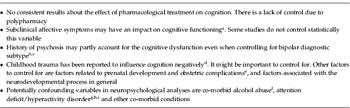
There is a paucity of studies addressing cognitive deficits in BD II, even more so regarding patients in euthymia. The latter are more suitable in order to evaluate the magnitude and the permanence of cognitive disturbance. Furthermore, methodological differences exist regarding comparative groups, such as heterogeneity of samples or inclusion of different mood states of the illness, for instance, making it difficult to draw conclusions. Some of the studies evaluated differences in neuropsychological performance between BD I and BD II; other studies compared depressed BD II patients with major depressive disorder; further studies focused on the comparison with other bipolar spectrum patients. Small sample-sized studies, especially regarding BD II patients, might have determined type I or type II errors, so larger samples should be analysed in order to reach firmer conclusions. Some studies were conducted in unmedicated patients, since treatments may play an important role in cognitive deficits, although available data regarding the effects of mood-stabilizers on cognition are inconsistent, possibly due to methodological issues (Goldberg & Chengappa, Reference Goldberg and Chengappa2009; Vieta, Reference Vieta2009; Balanzá-Martínez et al. Reference Balanzá-Martínez, Selva, Martínez-Arán, Prickaerts, Salazar, González-Pinto, Vieta and Tabarés-Seisdedos2010). The cognitive deficits observed in BD are not simply the effect of medication since these same cognitive deficits have been observed in unaffected relatives (Arts et al. Reference Arts, Jabben, Krabbendam and van Os2008; Bora et al. Reference Bora, Yucel and Pantelis2009). There is also a lack of consensus on neuropsychological tasks that assess different cognitive functions and the classification of tasks included under each cognitive domain; the same cognitive task may be used as a measure of different cognitive domains in different studies, because the performance in most tests involves more than one cognitive process. Depending on the classification of the neuropsychological measures on the different neurocognitive domains, the results of meta-analyses or systematic reviews may vary. The literature has suggested an association between cognitive impairment and several clinical factors, such as residual affective symptoms, number and subtype of episodes, age at illness onset and number of admissions (Martínez-Arán et al. Reference Martínez-Arán, Vieta, Colom, Torrent, Sánchez-Moreno, Reinares, Benabarre, Goikolea, Brugue, Daban and Salamero2004a, b). Nevertheless, there are other important clinical factors related to worse cognitive functioning that have not been systematically investigated. Table 2 summarizes the methodological issues of comparative studies regarding the role of factors involved in cognition.
Methodological issues of comparative studies on cognition: role of factors involved in cognition

a Martínez-Arán et al. (Reference Martínez-Arán, Vieta, Colom, Reinares, Benabarre, Gastó and Salamero2000). bMartínez-Arán et al. (Reference Martínez-Arán, Torrent, Tabarés-Seisdedos, Salamero, Daban, Balanzá-Martínez, Sánchez-Moreno, Manuel, Benabarre, Colom and Vieta2008). cSimonsen et al. (Reference Simonsen, Sundet, Vaskinn, Birkenaes, Engh, Færden, Jónsdóttir, Ringen, Opjordsmoen, Melle, Friis and Andreassen2011). dSavitz et al. (Reference Savitz, van der Merwe, Stein, Solms and Ramesar2008). eMartino et al. (Reference Martino, Marengo, Igoa, Scapola, Ais, Perinot and Strejilevich2009). f Sánchez-Moreno et al. (Reference Sanchez-Moreno, Martinez-Aran, Colom, Scott, Tabares-Seisdedos, Sugranyes, Torrent, Daban, Benabarre, Goikolea, Franco, González-Pinto, Ayuso-Mateos and Vieta2009). g Pavuluri et al. (Reference Pavuluri, Schenkel, Aryal, Harral, Hill, Herbener and Sweeney2006). h Henin et al. (Reference Henin, Mick, Biederman, Fried, Wozniak, Faraone, Harrington, Davis and Doyle2007). i Rucklidge (Reference Rucklidge2006).
Regarding the selected studies, some of them conclude that there are no essential differences in neuropsychological profiles between BD I and BD II patients (Dittmann et al. Reference Dittmann, Hennig-Fast, Gerber, Seemuller, Riedel, Emanuel, Langosch, Engel, Moller and Grunze2008). In the above-mentioned study, BD I patients showed significantly lower scores in psychomotor speed, working memory, verbal learning, delayed memory and executive functions than HCs, while BD II patients showed significant deficits in psychomotor speed, working memory, visual/constructional abilities and executive functions, but not on verbal learning and delayed memory. No significant differences among clinical groups were detected on any tested domain, supporting a similar pattern of cognitive deficits.
Other studies found that BD II patients had an intermediate level of performance between BD I and HC groups in verbal memory (Martínez-Arán et al. Reference Martínez-Arán, Vieta, Reinares, Colom, Torrent, Sánchez-Moreno, Benabarre, Goikolea, Comes and Salamero2004b; Torrent et al. Reference Torrent, Martínez-Arán, Daban, Sánchez-Moreno, Comes, Goikolea, Salamero and Vieta2006) and executive functions (Torrent et al. Reference Torrent, Martínez-Arán, Daban, Sánchez-Moreno, Comes, Goikolea, Salamero and Vieta2006). Similarly, some authors suggest that BD I patients have more widespread cognitive dysfunction than BD II patients (Simonsen et al. Reference Simonsen, Sundet, Vaskinn, Birkenaes, Engh, Hansen, Jónsdóttir, Ringen, Opjordsmoen, Friis and Andreassen2008; Hsiao et al. Reference Hsiao, Wu, Wu, Hsu, Chen, Lee, Lee, Yeh, Yang, Ko and Lu2009). In the study by Simonsen et al. (Reference Simonsen, Sundet, Vaskinn, Birkenaes, Engh, Hansen, Jónsdóttir, Ringen, Opjordsmoen, Friis and Andreassen2008) BD II patients showed reduced performance on certain measures of attention and executive function (working memory, verbal fluency and interference control), while the BD I group showed reduced performance on all verbal memory measures and on most measures of attention and executive function (working memory, fluency, interference control and set-shifting). Moreover, a higher proportion of BD I patients had clinically significant cognitive impairment compared with BD II patients, and they concluded that both groups have different neurocognitive profiles. In the study by Hsiao et al. (Reference Hsiao, Wu, Wu, Hsu, Chen, Lee, Lee, Yeh, Yang, Ko and Lu2009), while BD II patients showed a reduction only in working memory and psychomotor speed, BD I patients also showed a reduction in verbal memory and executive function.
Nevertheless, two studies suggest that cognitive deficits are more severe and pervasive in BD II than BD I patients (Harkavy-Friedman et al. Reference Harkavy-Friedman, Keilp, Grunebaum, Sher, Printz, Burke, Mann and Oquendo2006; Summers et al. Reference Summers, Papadopoulou, Bruno, Cipolotti and Ron2006). In the study by Summers et al. (Reference Summers, Papadopoulou, Bruno, Cipolotti and Ron2006), whereas the BD I group was only impaired in verbal recognition and spatial working memory, the BD II group was also impaired in these measures and additionally in other memory and executive measures. These authors point out that recurrent depressive episodes, rather than mania, may have a more detrimental and lasting effect on cognition. Regarding the study conducted by Harkavy-Friedman et al. (Reference Harkavy-Friedman, Keilp, Grunebaum, Sher, Printz, Burke, Mann and Oquendo2006), their sample of BD II patients may represent a greater severity of illness than those with BD II who have never committed a suicide attempt; however, they suggested that BD II is a serious disorder with a distinguishing pattern of neuropsychological functioning.
Finally, two studies failed to find deficits in the BD II group. The first study found that unmedicated depressed BD II subjects displayed relatively intact cognitive function (Taylor Tavares et al. Reference Taylor Tavares, Clark, Cannon, Erickson, Drevets and Sahakian2007). The latter found that BD II patients did not differ significantly from their unaffected relatives, whereas BD I patients showed impaired verbal memory (Savitz et al. Reference Savitz, van der Merwe, Stein, Solms and Ramesar2008). However, the sample size of BD II patients in these two studies was relatively small.
Noteworthy, also, is the study by Andersson et al. (Reference Andersson, Barder, Hellvin, Lovdahl and Malt2008), where performance of BD II patients was significantly worse than that of HCs on all measures, except for phonemic verbal fluency. These authors discussed the functional significance of neuropsychological impairment and suggested that differences regarding some aspects of executive function may be related to psychomotor speed, and not primarily to dysexecutive functioning, taking into consideration their findings in electrophysiological index.
Therefore, the results of these studies are inconsistent, possibly due to different methodologies used. For example, a factor that may predispose to a greater cognitive dysfunction in BD II than BD I is the increased prevalence of subclinical depressive symptoms in BD II (Benazzi, Reference Benazzi2001). Despite the scarcity of studies, the neuropsychological profiles of both diagnostic subtypes are different and, except for two studies, all of them detected cognitive deficits in BD II. The main findings include impaired working memory and some measures of executive functions (inhibitory control) and approximately half of the studies also detect verbal memory impairment.
Underlying mechanisms for differences in cognitive functioning between the two diagnostic subtypes could be due to either variations in frequency and severity of symptoms, as well as residual depressive symptoms, or to different genetic liability (Dittmann et al. Reference Dittmann, Hennig-Fast, Gerber, Seemuller, Riedel, Emanuel, Langosch, Engel, Moller and Grunze2008), or these may indicate neurobiological differences (Simonsen et al. Reference Simonsen, Sundet, Vaskinn, Birkenaes, Engh, Hansen, Jónsdóttir, Ringen, Opjordsmoen, Friis and Andreassen2008). These findings showing distinct cognitive profiles in both subtypes could lead to better identification of cognitive endophenotypes in BD. BD I would be nearer schizophrenia and BD II would show a lesser degree of cognitive impairment, reflecting the idea of a continuum in the psychoses (Torrent et al. Reference Torrent, Martínez-Arán, Daban, Sánchez-Moreno, Comes, Goikolea, Salamero and Vieta2006; Martínez-Arán et al. Reference Martínez-Arán, Torrent, Tabarés-Seisdedos, Salamero, Daban, Balanzá-Martínez, Sánchez-Moreno, Manuel, Benabarre, Colom and Vieta2008).
Future directions
Future studies should routinely assess cognitive functioning in euthymic patients with both subtypes of BD. Furthermore, large samples are to be highly recommended. One implication arising from this review is that future neurocognitive research needs to focus on individuals with BD and concomitant history of psychosis separately from those without a history of psychosis in order to study the impact of this variable on neuropsychological performance. Similarly to the above-mentioned study by Simonsen et al. (Reference Simonsen, Sundet, Vaskinn, Birkenaes, Engh, Færden, Jónsdóttir, Ringen, Opjordsmoen, Melle, Friis and Andreassen2011), Martínez-Arán et al. (Reference Martínez-Arán, Torrent, Tabarés-Seisdedos, Salamero, Daban, Balanzá-Martínez, Sánchez-Moreno, Manuel, Benabarre, Colom and Vieta2008) also suggested that the history of psychosis may partly account for the cognitive dysfunction seen in euthymic patients, especially with regard to persistent verbal memory dysfunction as well as some executive dysfunctions. Future studies should take into account residual symptoms, which are not frequently measured, since these might possibly explain some persistent cognitive deficits (Martino et al. Reference Martino, Marengo, Igoa, Scapola, Ais, Perinot and Strejilevich2009); furthermore a consensual definition of subclinical symptoms is necessary (Daban et al. Reference Daban, Martínez-Arán, Torrent, Tabarés-Seisdedos, Balanzá-Martínez, Salazar-Fraile, Selva-Vera and Vieta2006). Other variables to consider should be the polarity of the last episode, predominant polarity and the period of time from the last recurrence. Sustained attention should be routinely assessed, since attention is a function that influences other cognitive domains. Motor functioning is another aspect to evaluate (Balanzá-Martínez et al. Reference Balanzá-Martínez, Rubio, Selva-Vera, Martinez-Arán, Sánchez-Moreno, Salazar-Fraile, Vieta and Tabarés-Seisdedos2008). In a recent study it was suggested that motor speed may be a potential endophenocognitype for both schizophrenia and BD I patients (Salazar-Fraile et al. Reference Salazar-Fraile, Balanzá-Martínez, Selva-Vera, Martínez-Arán, Sánchez-Moreno, Vieta, Gómez-Beneyto and Tabarés-Seisdedos2009). It is necessary to reach a consensus on the most appropriate cognitive tests for the assessment of cognitive impairment in BD, in order to obtain comparable studies and replicate findings.
Differentiation between BD I and BD II patients will be helpful in order to determine cognitive endophenotypes in BD. Findings on neurocognitive differences between the two subtypes can be used as markers in research for underlying neurobiological distinguishers using neuroimaging techniques. Neuroimaging and genetics might be useful in validating BD II diagnostic subtype (Vieta & Suppes, Reference Vieta and Suppes2008). Some genetic studies have suggested that BD II and BD I ‘breed true’ in families; therefore, in further studies it would be interesting to correlate clinical and neuropsychological data with genetic data in BD II patients. Although this specific issue has not been extensively examined in this paper, focused basically on cognition, it could be important to do so in a future report.
Differences in cognitive dysfunction between both subtypes may have an effect on psychosocial functioning, treatment adherence as well as the possibility to benefit from psychoeducational programmes. Neurocognitive rehabilitation should consider differences in cognitive profiles in order to design specific programmes aiming to treat prevailing cognitive dysfunctions for each subtype.
According to the conclusions of this systematic review, though still not clearly established, it appears that there are subtle differences between BD I and BD II regarding cognition; deficits in BD II subjects were identified mainly in the areas of working memory, inhibitory control and verbal memory as well. Nowadays, BD II is classified as a distinct category within mood disorders, but the definition and boundaries deserve further clarification (Vieta & Suppes, Reference Vieta and Suppes2008).
Acknowledgements
This review was supported by the Instituto de Salud Carlos III, Centro de Investigación en Red de Salud Mental, CIBERSAM and the Generalitat de Catalunya to the Bipolar Disorders Group (2009 SGR 1022) and the following grant support by the Spanish Ministry of Science and Innovation (CP07/00144, PI080180 and PI08/90094). C.M.B. is funded by the Spanish Ministry of Education through an FPU (Formación de Profesorado Universitario) scholarship.
Declaration of Interest
A.M.-A. has received research funding from the Spanish Ministry of Innovation. E.V. has received research grants and served as consultant, advisor or speaker for the following companies: Almirall, AstraZeneca, Bristol–Myers Squibb, Eli Lilly, Forest Research Institute, Geodon Richter, GlaxoSmithKline, Janssen-Cilag, Jazz, Lundbeck, Merck, Novartis, Organon, Otsuka, Pfizer Inc., Sanofi-Aventis, Servier, Solvay, Schering-Plough, Takeda, United Biosource Corporation, and Wyeth. E.V. also received research funding from the Spanish Ministry of Science and Innovation, the Stanley Medical Research Institute and the 7th Framework Program of the European Union.