Staphylococcus aureus remains the leading cause of pediatric nosocomial infections and a significant threat to hospitalized neonates in the United States.Reference Lake, Weiner, Milstone, Saiman, Magill and See 1 Staphylococcus species, which constitute early components of the neonatal skin, nares and gastrointestinal microbiomes, continue to be responsible for the majority of neonatal late-onset sepsis (LOS).Reference Blanchard, Quach and Autmizguine 2 – Reference Shaw, Sim and Randell 5 Staphylococcus aureus colonization often precedes invasive infections (eg, central-line–associated bloodstream infections (CLABSIs), bacteremia, pneumonia, and on rare occasions meningitis) putting premature infants at risk for long-term neurological sequelae.Reference Stoll, Hansen and Adams-Chapman 4 , Reference Huang, Chou, Su, Lien and Lin 6 – Reference Graham, Morel and Zhou 8
Historically, measures to decrease or eradicate S. aureus colonization, such as treatment with intranasal mupirocin, have focused on methicillin-resistant S. aureus (MRSA). However, rates of methicillin-susceptible S. aureus (MSSA) infections in the neonatal intensive care unit (NICU) outnumber MRSA, and infection-related mortality can be as high as 25% in very low birth weight infants (VLBW, weight <1,500 g).Reference Blanchard, Quach and Autmizguine 2 , Reference Shane, Hansen and Stoll 9 Active surveillance cultures and decolonization of colonized neonates have led to reduced rates of S. aureus transmission and infections,Reference Popoola and Milstone 10 – Reference Pierce, Lessler, Popoola and Milstone 13 an approach that benefits the vulnerable neonate and concurrently, the general NICU population.Reference Popoola, Colantuoni and Suwantarat 11 , Reference Wisgrill, Zizka and Unterasinger 14
Despite the success of decolonization as a strategy to reduce nosocomial infections, hospitalized neonates may develop recurrent S. aureus colonization, which increases the risk for ongoing transmission and infection within the NICU.Reference Delaney, Wang and Melish 12 , Reference Septimus and Schweizer 15 , Reference Abad, Pulia and Safdar 16 A previous study noted that up to half of the decolonized neonates who remain in the NICU for ≥ 21 days may develop recurrent MRSA nasal colonization.Reference Popoola, Budd and Wittig 17 Recurrent S. aureus colonization could be secondary to persistent endogenous reservoirs, environmental reservoirs (eg, healthcare workers, contaminated surfaces, or parents), or may be as a result of antimicrobial resistance.Reference Wisgrill, Zizka and Unterasinger 14 , Reference Lepainteur, Royer and Bourrel 18 , Reference Günther, Blessing, Tacconelli and Mutters 19 No data are available describing factors that may impact the risk of recurrent S. aureus colonization in neonates. In this study, our objectives were to identify neonatal risk factors associated with recurrent S. aureus colonization after decolonization and to examine the genetic relatedness of S. aureus strains before and after decolonization.
Methods
Study design and population
We performed a retrospective cohort study of infants admitted to The Johns Hopkins Hospital’s (JHH) 45-bed NICU from April 2013 to December 2015, a period of active surveillance and decolonization for both MSSA- and MRSA-colonized infants. The NICU has individual patient rooms and 2 separate medical teams with shared nursing staff providing quaternary care to more than 700 infants per year. The Johns Hopkins Institutional Review Board approved the study with a waiver of informed consent.
Case identification and definitions
Using administrative data, all neonates admitted to the NICU during the study period were identified and served as the source population. Microbiology data were collected from a computerized surveillance system (TheraDoc, Premier, Charlotte, NC) and merged with hospital billing data. The study cohort consisted of infants with S. aureus colonization, defined as an infant with 1 or more weekly nasal surveillance culture(s) that grew S. aureus during the initial NICU admission and who received intranasal mupirocin treatment after colonization. A retrospective chart review was conducted to identify clinical characteristics and demographic data at the time of S. aureus colonization. These data were collected and stored on a secure, online database hosted by REDCap.Reference Harris, Taylor, Thielke, Payne, Gonzalez and Conde 20
Neonates with S. aureus nasal colonization underwent decolonization, per hospital protocol, which included a 5-day intranasal mupirocin treatment and topical chlorhexidine (CHG) antisepsis treatment, when age appropriate.Reference Popoola and Milstone 10 During the study period, CHG antisepsis was also part of other concurrent infection prevention bundles in the NICU. Therefore, an infant that received intranasal mupirocin treatment and had at least 1 negative nares surveillance culture after mupirocin treatment was classified as decolonized. The primary study outcome was recurrent colonization after decolonization with mupirocin.
Recurrent colonization was defined as growth of S. aureus from a surveillance culture after decolonization. Microbiological data for S. aureus infections, defined as clinical culture growth from a sterile site, were also collected. Stored bacterial isolates from a subset of infants with recurrent colonization after prolonged nasal clearance (ie, ≥2 negative surveillance cultures prior to recurrence of S. aureus colonization) were used for strain typing.
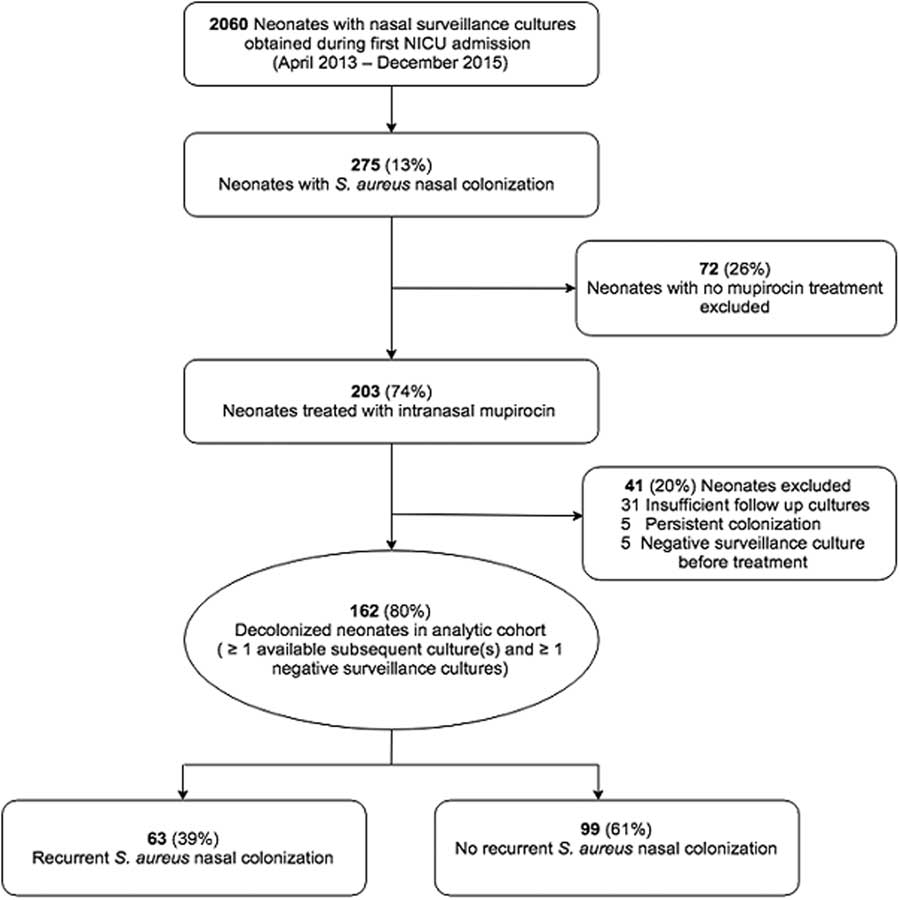
The following groups of infants were not eligible for the analytic cohort: (1) infants with no subsequent nares cultures after mupirocin treatment, (2) infants whose mupirocin treatments occurred before their first reported positive nares culture, (3) infants who had a subsequent negative surveillance culture prior to mupirocin treatment, and (4) infants with no negative surveillance cultures after decolonization (Fig. 1).
Flow chart used to identify neonates admitted to the neonatal intensive care unit (NICU) during the study period with Staphylococcus aureus colonization.

Microbiology laboratory methods and bacterial isolate strain typing
All nasal surveillance S. aureus isolates were cultured and distinguished using selective chromogenic agar plates (SaSelect, BioRad, Hercules, CA).Reference Popoola and Milstone 10 , Reference Popoola, Colantuoni and Suwantarat 11 , Reference Totten, Ross, Voskertchian, Colantuoni, Milstone and Carroll 21 Isolates were archived in tryptic soy broth with 20% glycerol at −80°C. As previously described, isolates were characterized by pulsed-field gel electrophoresis (PFGE) using SmaI-digested bacterial DNAReference Tenover, Arbeit and Goering 22 , Reference Tenover, McAllister and Fosheim 23 and were analyzed with a molecular analyst fingerprinting plus software (Fingerprinting II version 3.0, BioRad). They were deemed genetically similar if they had ≤3 band differences (≥85% comparison score).Reference Tenover, Arbeit and Goering 22 Mean comparison scores were measured for bacterial isolates. Gel images were maintained in a password-protected file so that within- and between-run comparisons could be performed for each group of isolates.
Statistical analysis
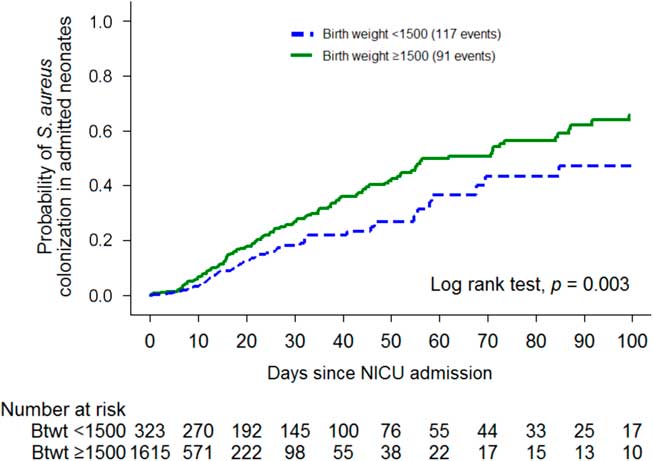
Continuous variables were summarized by both their means and standard deviations as well as their medians and interquartile ranges (IQRs). Categorical variables were reported as absolute counts and percentages. Kaplan-Meier estimates were calculated from (1) NICU admission to acquisition of S. aureus colonization and (2) S. aureus nasal decolonization to recurrent S. aureus colonization for infants who remained at risk (Fig. 2). Discrete-time Cox proportional hazards were used to explore relationships between clinical factors (methicillin resistance, systemic or topical use of anti-Staphylococci antibiotics (except mupirocin), presence of a peripherally inserted central catheter (PICC), nasoenteric catheter, endotracheal tube, nasal respiratory cannula (or mask), and time (in weeks) from decolonization to recurrent colonization. Discrete-time logistic survival models were also estimated using least-angle shrinkage and selection operator (LASSO) with κ-fold cross validation (κ = 10) to perform shrinkage and variable selection due to the large number of coefficients relative to the sample size and number of events observed.Reference Friedman, Hastie and Tibshirani 24 Analyses were performed using Stata version 14 software (StataCorp, College Station, TX) and R version 3.4.3 software (R Foundation for Statistical Computing, Vienna, Austria).
Probability of Staphylococcus aureus nasal colonization by birth weight using Kaplan-Meier survival estimates and time from admission to the neonatal intensive care unit (NICU). Note: NICU, neonatal intensive care unit; Btwt, birth weight. Administrative censoring occurred at 14 weeks and 122 neonates did not have birth weights documented.

Results
Acquisition of S. aureus nasal colonization within the NICU
Of the 2,060 infants admitted to the NICU and screened for S. aureus during the study period, 271 (13%) were colonized with S. aureus (Fig. 1). As shown in the Kaplan-Meier analysis (Fig. 2), VLBW infants were significantly more likely to become colonized with S. aureus during NICU admission (log rank test, P = .003). Of the neonates with nasal S. aureus colonization, 203 received mupirocin intranasal treatment, and 167 of the treated infants had subsequent follow-up surveillance cultures. Of the 167 infants, 5 infants with MRSA never cleared S. aureus from surveillance cultures, while 162 infants had at least 1 negative surveillance culture after mupirocin treatment and were included in the analytic cohort. Fewer than 33% of the infants were colonized with MRSA (Table 1).
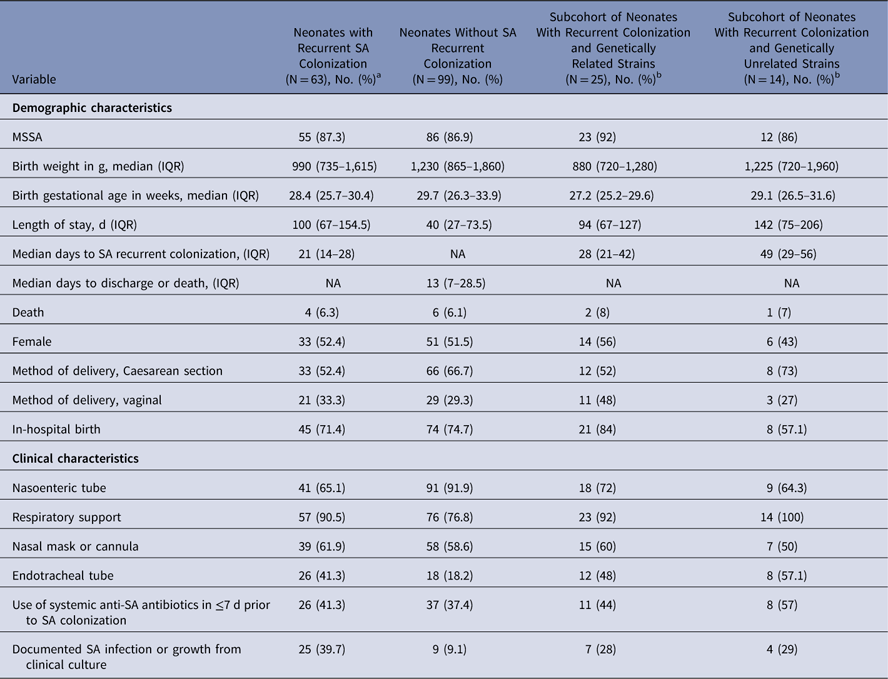
Demographics and Clinical Factors of Mupirocin Treated Neonates With Follow-Up Nasal Staphylococcus aureus Surveillance Cultures

NOTE: SA, Staphylococcus aureus; MSSA, methicillin-susceptible Staphylococcus aureus; WGA, weeks of gestational age; IQR, interquartile range.
a Infants had growth of SA from a nasal surveillance culture and at least 1 negative surveillance culture after mupirocin treatment.
b Infants had at least 1 SA isolate frozen and available for typing before and after nasal mupirocin treatment.
At the time of S. aureus colonization, infants in the cohort were often premature and had been admitted to the NICU for nearly 3 weeks (Table 1). Overall, 133 infants (81.5%) required respiratory support, and 132 (82%) had a nasally placed enteric tube. Nearly half of the infants (48.1%) had a central venous catheter inserted, and 63 infants (38.9%) had received an antibiotic with S. aureus activity (eg, cefazolin, clindamycin, cefepime, or vancomycin) in the week prior to documented growth of S. aureus from surveillance cultures. Clinical characteristics and demographics are summarized in Table 1.
Association between clinical characteristics and time to recurrent colonization
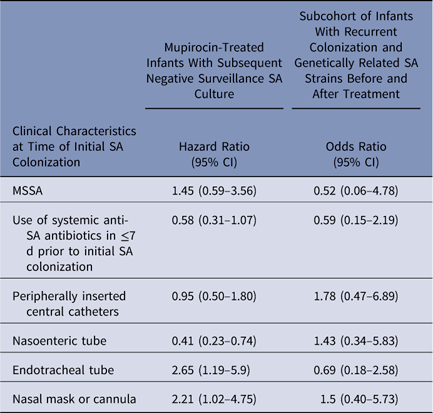
Among the 162 decolonized infants, 63 (39%) had recurrent S. aureus colonization after treatment with intranasal mupirocin (Supplemental Fig. 3). The characteristics of infants with recurrent colonization were similar to the study cohort such that they were mostly premature infants, required respiratory support and/or a nasoenteric tube, and most were colonized with MSSA (Table 1). Using discrete-time Cox proportional hazards models to explore the relationship between clinical risk factors and time to recurrent colonization, we found that the risk of recurrent colonization after mupirocin treatment was higher for neonates with an endotracheal tube or nasal cannula/mask (hazard ratio [HR], 2.65; 95% confidence interval [CI], 1.19–5.90; and HR, 2.21; 95% CI, 1.02–4.75, respectively) (Table 2 and Supplemental Fig. 4). Notably, methicillin resistance (HR, 1.4; 95% CI, 0.59–3.56), recent exposure to anti-S. aureus antibiotics (HR, 0.5; 95% CI, 0.31–1.07), and presence of a central venous catheter (HR, 0.9; 95% CI, 0.5–1.8) at the time of S. aureus colonization were not significantly associated with recurrent colonization after decolonization (Table 2).
Discrete-Time Proportional Hazards and Univariate Logistic Regression of Clinical Risk Factors Associated With Staphylococcus aureus Recurrent Colonization After Treatment

Note. SA, Staphylococcus aureus; MSSA, methicillin-susceptible Staphylococcus aureus; CI, confidence interval.
Relatedness between S. aureus strains before and after decolonization
Of the 63 infants with recurrent colonization, 39 (62%) had stored isolates available for strain typing. Of these 39 neonates, 25 (64%) had S. aureus strains that were genetically similar before and after decolonization (mean comparison score, 97.8%; standard deviation [SD], 3.96). Also, 14 neonates (36%) acquired a S. aureus strain that was genetically different from their pre-decolonization strain (mean comparison score, 58.3%; SD, 9.17).
Association between clinical characteristics and recurrent colonization with genetically similar strains
Among the 39 infants with isolates available for strain typing, there was an insignificant increase in the odds of recurrent colonization with concordant strains for those with nasoenteric tubes (odd ratio [OR], 1.43; 95% CI, 0.34–5.83), with nasal cannulas (OR, 1.5; 95% CI, 0.4–5.73) or with exposure to antibiotics in the week prior to S. aureus colonization (OR, 1.78; 95% CI, 0.47– 6.89) (Table 2).
Discussion
Hospitalized neonates are at high risk for invasive S. aureus infections.Reference Lake, Weiner, Milstone, Saiman, Magill and See 1 Decreasing neonatal nasal S. aureus burden, through decolonization, reduces risk of nosocomial infections.Reference Popoola, Colantuoni and Suwantarat 11 In this retrospective study, we demonstrated that >33% of hospitalized neonates developed recurrent S. aureus nasal colonization after a mupirocin-based decolonization treatment. These infants were mostly colonized with genetically similar strains before and after decolonization. Prematurity and respiratory support devices, known risk factors for nosocomial infections,Reference Zingg, Hopkins and Gayet-Ageron 25 were more common in infants with recurrent colonization. To our knowledge, this is the first study reporting NICU-patient level risk factors for S. aureus recurrent colonization and strain similarities before and after decolonization.
Prior studies have associated prolonged inpatient stays, prematurity, and vascular catheterization with S. aureus colonization.Reference Graham, Morel and Zhou 8 , Reference Achermann, Seidl and Kuster 26 – Reference Maraqa, Aigbivbalu and Masnita-Iusan 28 Because premature infants are frequently exposed to endogenous and exogenous reservoirs of S. aureus during extended NICU stays,Reference Milstone, Koontz and Voskertchian 29 we postulated that factors associated with initial colonization may likely affect recurrent colonization. Our study suggests that infants with recurrent colonization were mostly premature, and the risk of recurrence was increased by presence of an endotracheal tube or nasal cannula/mask at the time of S. aureus colonization (Supplemental Fig. 4). These data support the hypothesis that the frequent manipulation of respiratory equipment around the anterior nares or the creation of biofilms may increase the neonatal exposure to S. aureus reservoirs.Reference Zur, Mandell, Gordon, Holzman and Rothschild 30 However, the presence of a vascular catheter and recent systemic exposure to anti-staphylococcal antibiotics, at the time of S. aureus colonization, did not affect time to recurrent colonization.
Although many studies have documented the risk of recurrent colonization after treatment, our study compared the relatedness of strains identified from neonates before and after mupirocin-based decolonization. Our findings suggest that recurrent colonization was largely due to genetically similar strains, which supports prior suggestions that decolonization regimens may attenuate nasal bioburden rather eradicate S. aureus.Reference Wisgrill, Zizka and Unterasinger 14 , Reference Popoola, Budd and Wittig 17 , Reference Gregory, Eichenwald and Puopolo 31 Additionally, extranasal sites of endogenous colonization may contribute to recurrent colonization. However, many hospitals perform nasal surveillance without testing other anatomic sites because the nares remain the principal reservoirs for S. aureus and the elimination of nasal carriage has been associated with decreased incidence of infections.Reference Popoola, Colantuoni and Suwantarat 11 , Reference von Eiff, Becker, Machka, Stammer and Peters 32 Other factors may explain strain similarities before and after decolonization, such as ongoing exposure to a circulating strain within the NICU environment (ie, from HCWs, or re-exposure to a colonized parent).Reference Milstone, Koontz and Voskertchian 29 We did not find clonal S. aureus strains among infants included in the study, suggesting that neonates were not exposed to a common reservoir.
We demonstrated that nasally placed respiratory equipment was associated with a greater risk of recurrent colonization after decolonization. If these findings are replicated, clinicians could consider alternate decolonization strategies or attempt newer methods to eliminate S. aureus reservoirs, such as the use of antibiotic coated respiratory equipment to reduce transmission. Universal decolonization, contact isolation, and systemic antibiotics have been evaluated as alternative decolonization strategies with varying results.Reference Nelson, Bizzarro, Dembry, Baltimore and Gallagher 33 – Reference Jernigan, Titus, Gröschel, Getchell-White and Farr 35 Targeted decolonization for both MSSA and MRSA have not been extensively evaluated in neonates, but in adult patients with high risk of S. aureus infections, targeted decolonization and, at times, mupirocin prophylaxis have proven to be effective strategies.Reference Popoola and Milstone 10 , Reference Delaney, Wang and Melish 12 , Reference Septimus and Schweizer 15 , Reference Schweizer, Chiang and Septimus 36 Future research could identify which of these strategies has the most benefit for neonates. After identifying infants at high risk for recurrent colonization, a systematic approach to rescreening and retreatment with mupirocin may also be beneficial. Questions regarding safety or antimicrobial resistance of mupirocin and CHG are beyond the scope of this study and could be included in future research. Moreover, numerous studies have reported minimal adverse effects or mupirocin resistance after implementation of active surveillance culture and decolonization.Reference Popoola, Colantuoni and Suwantarat 11 , Reference Delaney, Wang and Melish 12 , Reference Wisgrill, Zizka and Unterasinger 14
This study has several limitations. Retrospective data collection and hospital-wide changes in electronic medical record software limited available clinical data. Small sample sizes, weekly S. aureus surveillance, and the single-center study design may have limited the ability to detect differences between groups, the precision of findings, and/or their generalizability. Prospective assessment of risk factors, daily S. aureus surveillance, or multicenter study design may provide findings that are more precise; however, feasibility and costs may be prohibitive. Staphylococcus aureus isolates from infants with recurrent colonization were stored at random and were available at our convenience. Nevertheless, a good proportion (62%) of recolonized infants had available isolates for strain typing. Data regarding CHG use in colonized infants could not be reliably obtained from the medical records. Exposure to CHG may have influenced rates of recurrent colonization, and this could be assessed in future studies. Finally, although PFGE remains the current gold standard for bacteria strain typing, PFGE can have some limitations in assessing genetic relatedness.Reference Tenover, McAllister and Fosheim 23 To further discriminate between isolates, other techniques, such as whole genome sequencing, could be used in future studies.Reference Achermann, Seidl and Kuster 26 , Reference Moore, Cookson and Gordon 37
Staphylococcus aureus colonization is common in the NICU. Neonates with recurrent colonization after mupirocin-based decolonization often have genetically similar strains of S. aureus before and after decolonization. To target neonates at greatest risk for recurrent colonization, clinicians may consider alternate decolonization strategies for premature infants requiring respiratory support equipment.
Supplementary material
To view supplementary material for this article, please visit https://doi.org/10.1017/ice.2018.223
Acknowledgments
We would like to acknowledge Danielle Koontz, Marissa Totten, and Dina Khammash for their assistance with data collection and/or bacteria strain typing. We thank the diligent staff of The Johns Hopkins Hospital NICU and The Johns Hopkins Medical Microbiology Laboratory.
Financial support
G.G. was supported by a Howard University Faculty Summer Research Fellowship. Additional funding was provided by Agency for Healthcare Research and Quality (AHRQ grant no. 1R01HS022872), by the National Institutes of Health (NIH training grant no. T32AI052071), and by the Baurenschmidt Foundation.
Conflicts of interest
A.M.M., A.V., and K.C.C. received grant support from The Agency for Healthcare Research and Quality (AHRQ). A.M.M. received prior grant support from Sage Products outside the submitted work. K.C.C. reports other support from GenePOC, GenMark, and Curetis outside the submitted work. All other authors report no conflicts of interest.