Introduction
There is evidence that subgroups of bipolar disorder exist based on age at onset (AAO) that may have important implications for the individual in terms of treatment and clinical outcome Reference Cate Carter, Mundo, Parikh and Kennedy(1,Reference Ernst and Goldberg2). Much of the research has focussed on familial morbidity and differences in clinical presentation between AAO groups.
Early-onset individuals may experience a more severe form of bipolar disorder. Patel et al. Reference Patel, Delbello, Keck and Strakowski(3) found that mixed episodes were more common in the early-onset (< 18 years) group and psychotic features and current substance use were more common in the typical (age 20–30 years) group. Other studies have found that people with early AAO have more frequent substance use, higher rates of Axis 1 comorbidity and more severe psychotic symptoms Reference Cate Carter, Mundo, Parikh and Kennedy(1,Reference Schurhoff, Bellivier and Jouvent4). There is also evidence that early-onset bipolar disorder is associated with a greater lag to appropriate diagnosis and treatment than later onset of the disorder Reference Berk, Dodd and Callaly(5,Reference Suominen, Mantere and Valtonen6). Studies comparing morbidity risk based on AAO indicate that relatives of early-onset bipolar disorder individuals, most often defined as having onset before age 19, have a greater risk for affective disorders than the relatives of late-onset individuals (Reference Schurhoff, Bellivier and Jouvent4,Reference Lin, McInnis and Potash7–Reference Strober, Morrell, Burroughs, Lampert, Danforth and Freeman9).
Despite the research supporting the existence of AAO groups, an issue remains as to how the groups should be defined. Most studies have used an a priori threshold of between 18–21 years to separate the samples into earlier and later AAO groups (Reference Cate Carter, Mundo, Parikh and Kennedy1,Reference Patel, Delbello, Keck and Strakowski3,Reference Lin, McInnis and Potash7). However, Bellivier et al. Reference Bellivier, Golmard and Rietsche(10) identified three distinct normal distributions within their observed sample of 211 subjects, with means of 16.9 years (41.4%), 26.9 years (41.9%) and 46.2 years (16.6%). Further analysis showed that these three groups differed significantly in clinical presentation and family history of affective disorders, and these differences were replicated in a second study by the same researchers Reference Bellivier, Golmard and Rietschel(11).
More recently, Manchia et al. (2008) provided further support for the existence of three separate AAO groups of bipolar disorder in their genetically homogeneous population of Sardinians with bipolar 1 disorder Reference Manchia, Lampus and Chillotti(12).
The primary aim of the current study was to assess the presence of subgroups based on differences in AAO of bipolar disorder, and to examine any clinical and functional differences between them. Additionally, we aimed to investigate whether a relationship exists between AAO and quality of life (QOL).
Methods
Subjects were enrolled in The Bipolar Comprehensive Outcome Study (BCOS), a two-year, prospective, observational study of 239 participants with a diagnosis of bipolar disorder or schizoaffective disorder, conducted in Melbourne, Australia. Recruitment was completed in December 2005, with the final participant scheduled to complete the study in December 2007. The study was approved by the ethics committee at the two participating sites; Bayside Health and Barwon Health. Written informed consent was obtained from all participants prior to their participation in the study.
The Mini International Neuropsychiatric Interview (MINI) Reference Sheehan, Lecrubier, Harnett–Sheehan, Amorim, Janavs, Weiller, Hergueta, Baker and Dunbar(13) was administered at baseline to determine diagnosis, which was confirmed by the participant's treating doctor. Supplementary information was obtained from medical records and community files where possible. Participants were interviewed at three-monthly intervals for three years and evaluated using the following measures: the 21-item Hamilton Depression Rating Scale (HAMD21) Reference Hamilton(14), the Young Mania Rating Scale (YMRS) Reference Young, Biggs, Ziegler and Meyer(15), Clinical Global Impressions Scale –Bipolar Version (CGI-BP) Reference Spearing, Post, Leverich, Brandt and Nolen(16), the Diagnostic Interview for Psychosis (DIP) Reference Jablensky, McGrath and Herrman(17), the self-administered EuroQol (EQ-5D) (18), SLICE/LIFE Reference Keller, Lavori and Friedman(19), and 36-Item Short Form Health Survey (SF-36) Reference Ware and Sherbourne(20).
In addition to these core measures used in the BCOS study, a questionnaire assessing the participants' course of illness history was developed by the researchers, and administered once during one of the scheduled visits. This 10-item questionnaire asked participants about their age at various significant time points in the development of their illness. The AAO for this study was defined as the age at which the participants reported experiencing their first major affective episode, with the earliest reported episode used in the analysis. This definition has been utilised in previous studies, and is regarded as a reliable indicator of illness onset Reference Egeland, Blumenthal, Nee, Sharpe and Endicott(21). Statistical analysis was conducted using the Statistical Package for the Social Sciences (SPSS version 15). Demographic variables, as well as clinical- and quality-of-life-outcome variables, were compared between the AAO subgroups. Chi-squared tests were used for dichotomous variables and t-tests and ANOVAs for continuous variables. Given that multiple comparisons were conducted, the p value was set at p < 0.01.
Results
Current results are baseline data only. The data will be analysed at the 12- and 24-month periods to explore whether any differences between the AAO groups persist over time. Of the 239 participants in the study, 216 completed the AAO of illness questionnaire, and of these, 162 were included in the final analysis after excluding those with schizoaffective disorder.
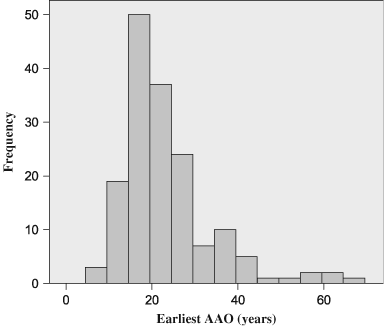
Three AAO subgroups were identified based on the distribution of the sample. These groups were defined by the participants' reported age at the first major affective episode (see Figure 1).
Distribution of the AAO for the sample.
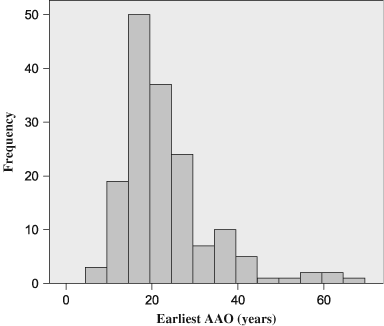
Table 1 summarises the demographics of the three AAO groups.
Demographics of the three AAO groups

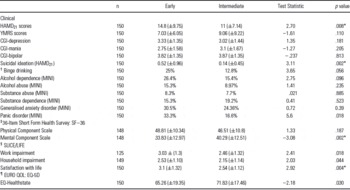
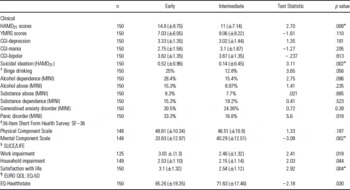
There was a significant difference overall between the current mean ages across the three AAO groups, F (2,161) = 13.46, p = .000. Post hoc tests indicated that significant differences existed between the early (M = 38.74, SD = 12.57) and late (M = 58.86, SD = 11.5), p = .000 and between the intermediate (M = 43.73, SD = 12.6) and late AAO groups, p = .001. However, there was no significant difference between the current mean ages of the early and intermediate AAO groups, p = .076. As only 7.4% (n = 12) of the sample were categorised into the late-onset group, this group was excluded from subsequent between-groups analyses for reasons of statistical power. Clinical and QOL variables can be seen in Table 2.
Clinical and QOL differences between the early and intermediate AAO groups

HAMD21, Hamilton Depression Rating Scale; YMRS, Young Mania Rating Scale; CGI, Clinical Global Impression Scale.
† Six or more alcoholic drinks on one occasion (22).
MINI, Mini International Neuropsychiatric Interview;
‡ SF–36 score of 100 = best imaginable health state.
§ SLICE/LIFE High scores indicate more severe impairment/dissatisfaction.
¶ EURO QOL score of 100 = best imaginable health state.
* p is significant at 0.05.
Symptoms
Higher HAMD21 scores indicate that the early AAO group experience significantly more severe depressive symptoms (14.8 vs. 11), including higher rates of suicidal ideation (0.52 vs. 0.14).
Other clinical differences
Based on responses from the illness history questionnaire, the type of first episode experienced (mania or depression), differed significantly between the two groups, χ2Reference Cate Carter, Mundo, Parikh and Kennedy(1) = 10.93, p = .001, such that the early AAO group was more likely to experience a depressive first episode (72%) whereas the intermediate-onset group typically experienced a manic first episode (55.5 %).
Participant-reported quality of life
SF-36 responses indicate that this group also experienced more frequent psychological distress and subsequent social and role disability (early AAO 33.83 vs. intermediate AAO 40.29). Additionally, the early AAO group reported feeling more dissatisfied with their lives in general (SLICE/LIFE early AAO 3.1 vs. intermediate AAO 2.54).
Objective quality of life differences
There were no significant differences between the two groups in terms of objective QOL measures such as income, χ2Reference Berk, Dodd and Callaly(5) = 2.02, p = .846; involvement in a relationship, χ2Reference Cate Carter, Mundo, Parikh and Kennedy(1) = .303, p = .582 (early = 42.6%, intermediate = 46.75%); or employment, χ2Reference Cate Carter, Mundo, Parikh and Kennedy(1) = 0.380, p = 0.538 (early = 51.4%, intermediate = 56.4% employed).
Discussion
In this study we sought to explore whether there were differences in clinical features of bipolar disorder based on AAO in an Australian sample. Given the small numbers in the late AAO group, a decision was made to exclude them from further analyses and explore potential differences between just the early and intermediate AAO groups. We found that the impact of bipolar disorder on early AAO individuals appears to be more severe than for those who develop the illness later in life. There are several important functional and clinical differences between these two AAO subgroups which may help to explain this finding. The current finding that depression is the predominant initial polarity in young people has been previously reported Reference Bowden(23,Reference Lish, Dime–Meenan, Whybrow, Price and Hirschfeld24). Further, there is evidence that an early initial episode of depression may result in a high probability of developing bipolar disorder Reference Rybakowski, Suwalska, Lojko, Rymaszewska and Kiejna(25,Reference Akiskal, Maser and Zeller26). This has substantial clinical importance as the initial presentation of bipolar disorder as depression increases the likelihood of misdiagnosis of bipolar depression as unipolar depression, thus delaying appropriate treatment and potentially adversely affecting the illness course. There is also data that antidepressant therapy can worsen course outcome in susceptible individuals, such that an iatrogenic component may be operating. (Reference McElroy, Kotwal, Kaneria and Keck27, Reference Ghaemi, Rosenquist, Ko, Baldassano, Kontos and Baldessarini28)
There also appears to be a greater degree of depression reported by the early AAO group compared with the intermediate group. This is consistent with the findings from several studies that have found those with early-onset bipolar disorder may experience a more severe form of the illness. Suicidal ideation/attempts, psychotic features, substance abuse/ dependence, anxiety disorders and the development of rapid cycling have all been associated with an early AAO (Reference Ernst and Goldberg2, Reference Berk, Dodd and Callaly5, Reference Carlson, Bromet, Driessens, Mojtabai and Schwartz29, Reference Schulze, Muller and Krauss30). This is also in keeping with the finding that rates of panic disorder, binge drinking and suicidal ideation were higher in the early-onset group. One third of the early AAO group reported experiencing panic disorder at some point in their illness history. Comorbid anxiety disorders in people with bipolar disorder may be associated with higher rates of suicidal ideation and substance abuse Reference Altindag, Yanik and Nebioglu(31,Reference Cassano, Pini, Saettoni and Dell'Osso32). Further, adolescent-onset illness interferes with the attainment of age appropriate developmental and educational tasks.
As the early AAO group may not have had the opportunity to develop functional coping strategies, this would limit their ability to cope with their symptoms, and could impact on the illness course. There is evidence that binge drinking is a maladaptive coping response adopted by individuals, such as those in the early AAO group, who may have inadequate coping strategies Reference Williams and Clark(33).
A novel finding from our study was that there appears to be a relationship between AAO- and participant-reported QOL. The early AAO group reported higher levels of psychological distress, including depression and anxiety, and subsequent social and role disability. There were no significant group differences in physical health domains. Despite there being no differences between the AAO groups in terms of employment, income and relationships, the early group still reported poorer subjective QOL, including higher levels of dissatisfaction with their life. This could be due to the fact that this group more depressed, and therefore tended to perceive that their QOL was impacted more negatively.
The current study aimed to examine differences in AAO of bipolar disorder in an Australian sample. The observed frequencies of the current sample were similar to previous studies (Reference Bellivier, Golmard and Rietsche10–Reference Manchia, Lampus and Chillotti12) suggesting the existence of three AAO groups. However, because of the small numbers in the late-onset group it was decided to exclude them in subsequent analyses. It should be acknowledged that other AAO cut-offs could be considered, for example < 13 years. The AAO cut-offs used for this study were based on the distribution of our sample, and appeared to be the most useful groupings. Again, it is important to note that this study is based on an Australian sample, and therefore extends the current research in this population. However, the research projects referred to in the current study are based on, for example French and American samples, which may differ in AAO groupings from those based on an Australian population. Regarding the later-onset individuals, future studies may consider assertively recruiting for this specific age group for which the frequency is lower. There is also concern regarding the accuracy and validity of retrospective self-report data. The involvement of family members in acquiring this information would strengthen the validity of the data.
Apart from the factors affecting illness outcome already discussed, there are several others involved that were not specifically looked at here. Qualitative data on the impact of an early AAO on education, relationships and employment was not obtained but could be expected to contribute to a poorer outcome. Lower rates of service usage by adolescents and young adults, which has been found to be less than 50% Reference Kessler, Avenevoli and Ries Merikangas(34,Reference Cheung and Dewa35), would also impact on the length of time for appropriate treatment, further contributing to a poorer outcome. Finally, duration of illness may have also impacted on the outcomes for our sample, as well as AAO.
The relationship of the AAO of bipolar disorder with the course of illness and outcomes is significant. This has important implications for the early detection, intervention and overall treatment of the disorder. Our ongoing naturalistic study will be able to provide further information about outcomes for people with bipolar disorder and their AAO.
Acknowledgements
We thank Eli Lilly for funding this study. We thank Kate Hoy, Peter Enticott, Stuart Lee, and Jerome Maller for their assistance with statistics and proof reading of this report.Katarina Kelin and William Montgomery are employees of Eli illy, who provided funding for this study. Jayashri Kulkarni, Paul Fitzgerald, Anthony de Castella, Michael Berk and Seetal Dodd have received research funding and/or speakers fees and/or funding to attend conferences from Eli Lilly, who provided funding for this study. Meg Smith has received an honorarium to participate in steering committee meetings for the study. Pam Callaly, Lesley Berk, Sacha Filia, Kate Filia, Steve Tahtalian and Frances Biffin have no conflicts of interest.