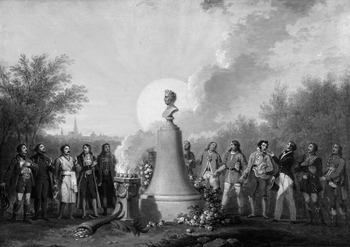
Historians usually portray the Congress of Vienna in a European frame—and rightly so. The actors and the diplomatic flashpoints spanned the European continent, and the negotiations began before and continued after the Congress. The rulers and statesmen had already started parleying and planning the reconstruction of Europe as they followed behind the armies in the campaigns of 1813–1814, a process that continued while making peace with France in Paris in the spring of 1814, and amid the mixed celebrations and conversations during their visit to London that summer. Even the Congress, successful as it generally was, did not clear all the outstanding issues, which instead carried over into the discussions surrounding the Second Peace of Paris after Napoleon's renewed defeat at Waterloo in 1815 and into the ambassadors' conferences in Paris and London in succeeding years.Footnote 1 Yet, there were good reasons why Vienna was selected as the venue for the main round of celebrations and negotiations in autumn 1814, and the location did help shape both the Congress and its diplomatic outcomes. Less often treated as a subject in its own right, however, is the question of what the Vienna Congress meant for and revealed about the history of the Habsburg monarchy, in European context to be sure, but with the focus on Austrian politics and society rather than on their contribution to the European narrative.
Here, I highlight some aspects of the Congress that illuminate several dimensions of the transition between the revolutionary-Napoleonic and Restoration-Biedermeier periods. The experience of the Vienna Congress illustrates that the Austrian restoration, and the Habsburg and Austrian patriotism that helped characterize it, was not as conservative or reactionary as often depicted. Civil society—understood in its broader social and economic senses rather than simply as a realm separate from the state or a Habermasian public sphere—showed strong development between police oversight and a patriotic upswell, the latter at once encouraged, tolerated, and restricted by the regime.Footnote 2 The public festivities of the Congress bore the imprint of voluntarist associational life, markets, and entrepreneurship, as well as of the court, state, and military establishments, and in ways that demonstrate the strength of reformist impulses in both Austrian society and administrative circles. There was more space for cultural-political discourse than often thought, and the messages, though not oppositional, still took up positions in the universe of patriotic liberal ideas of both enlightened and Romantic origin and gently pressured the government to do the same. Not least, more room existed for the expression of nationalist ideas than usually acknowledged for the multinational Habsburg realm, in part because notions of federative or multinational nationhood made it seem quite possible to strive to establish an Austrian identity—national or supranational, as one will—that was compatible with disparate ethnic identities rather than endangered by them. Reexamining the Congress in that wide and varied middle zone along the spectrum between more purely cultural and political activities proves as revealing for Austrian history in the post-Napoleonic period as it does for European.
I. Festive Display and Civil Society
In hosting and planning the Vienna Congress, Austrian leaders and officials sought to profit from the opportunity to make impressive show of the state's power, wealth, and taste. They also wanted to mark the end of two decades of war with suitably grand celebrations, and the Congress provided them the perfect occasion to accomplish both aims. The conspicuous display of power and wealth would help the Austrians achieve their even higher-priority goal of negotiating the best-possible settlement in the peace, as this gave them a significant home-court advantage in the various delegations' competitive power-political posturing to convey the impression of maximum strength.
In these plans, military parades and maneuvers, plus court and public festivities, clearly claimed paramount importance, but present-day observers should not overlook the significant part played by elements of civil society in the pageantry and the symbolic representation of power, wealth, and taste. Sociability, associational life, and the entrepreneurial spirit of the marketplace all contributed to the total Austrian display. Indeed, part of the demonstration of a state's power in this era involved the display of the strength of civil society and of spontaneous expressions of patriotism in order to showcase both the population's ability to mobilize for the cause when needed and its enthusiasm in doing so.
In his contribution to the planning for the Congress, for example, Count Moritz Dietrichstein set his sights on staging a “musical festivity that no other capital is capable of giving on such a scale.” By this, he meant not the court but Viennese society more broadly. In particular, he brought together a chorus and orchestra of more than seven hundred singers and musicians from Vienna's social circles and musical societies for a spectacular performance of Handel's oratorio Samson. With seven hundred performers, men and women, the massed forces surpassed even the five to six hundred performers in the occasional grand stagings of Handel oratorios in the metropole London, including in the great Handel Commemoration of 1784 in Westminster Abbey. The rehearsal itself two days prior already drew a full and loudly appreciative house.Footnote 3 Some expressed a desire for a more uplifting choice of Handelian oratorio, but almost all who witnessed the concert found it beautiful, sublime, and impressive, not least its scale and organization. Samson also had the virtue of being the only Handel oratorio not yet performed outside England, and thus allowed the Austrians to place themselves at the forefront of cosmopolitan connoisseurship. Just as striking as the music at the time was the fact that the volunteer performers were all mixed together, without regard to class or station, thus perforating the boundaries between high aristocrats and the bourgeoisie of wealth and education. The coverage in the court newspaper the Wiener Zeitung also emphasized this dimension of the concert, as the performers “count members of all estates, who as a group [gemeinschaftlich], without consideration of rank, sacrifice for art.”Footnote 4 Contemporary observers—and historians—might well begin to wonder whether Vienna and Austria lagged so far behind capitals such as London and Paris as hubs for a modern state and nation.
Equally drawing on the strength of civil society, this time in its entrepreneurial aspect, the so-called Volksfest in the Augarten on 6 October 1814 proved one of the most spectacular of the large public outdoor festivities. This extravaganza was orchestrated not by the court but by the businessman Franz Jan, who had been offering such entertainments for several years to admission-paying publics. Although Jan held the position of official court caterer, the court provided a partial subsidy, and the event appeared on the official list of Congress festivities, for the most part Jan threw the party on his own account and his own initiative. At the same time, the occasion counts among the era's abundant patriotic charitable initiatives, in this case in aid and honor of four hundred wounded Austrian veterans. Along with the crowned heads and entourages, the veterans formed the chief focus of the entertainment—ranging from circus trick riders and athletic contests to Tirolean singers and fireworks displays of dynastic and patriotic symbols of the allied powers—and they were also treated to a substantial cold collation, catered of course by Jan. Mixing social rank in its own way, after dinner the rulers visited the soldiers at their tables and exchanged toasts with them.Footnote 5
Demonstrating power and putting on an entertaining and impressive show could thus involve other actors beyond the court and military or could be conducted in cooperation with them, but ultimately the latter institutions played the major parts in the game of display. The government particularly wanted Austrian troops to make a better impression during the Congress than they had during the recent campaign, and with new uniforms, extra duty-pay, and a bolstered garrison for the duration of the Congress, the soldiers had ample opportunity to do so.Footnote 6 They already met the arrival of the various sovereigns with imposing parades, martial music, and cacophonous cannon fire, and the tramp of marching feet continued during numerous troop reviews over the coming weeks. The Austrian army also staged several maneuvers for the assembled rulers' and foreign generals' entertainment or edification, with the artillery and the pioneer corps in particular upholding their generally sound reputations. The grandest public festivity of the Congress, the celebration of the first anniversary of the victory over Napoleon at the Battle of the Nations at Leipzig on 18 October in the Prater, also occasioned the most favorable commentary at the time. Honoring the fourteen thousand veterans of the recent wars in the Vienna garrison, the event featured the soldiers' participation in an open-air mass presided over by the Bishop of St. Pölten. Numerous observers experienced the sight and sound of so many veterans commemorating the souls of the fallen as a sublime moment. The festival also offered another opportunity for the troops to parade and for the pioneers and artillery to contribute to its staging.Footnote 7
The court under Obersthofmeister Prince Ferdinand zu Trauttmansdorff organized numerous Congress festivities. Some were pure court occasions, such as the court balls and banquets that dotted the Congress social schedule as the weeks wore on, but many court events were also crafted with an eye to wider viewing publics (and of course the still wider readership for press accounts). The best-remembered such event must be the magnificent medievalizing Carousel or jewel-laden tournament cum equestrian ballet held in the Imperial Riding Academy for three performances in late November and early December. The opulently gilded court sleigh ride in January 1815 provided diversion for the thirty-three fur-clad pairs of rulers and high aristocrats of the Habsburg and European nobility who glided over the snow with an accompanying band, but it also entertained the watching crowds strung out along the procession's winding route through the city and environs between the Hofburg and Schönbrunn Palace, just west of the city. Both occasions were also served up to broader publics in color prints. The post-opera court banquet in the brilliantly illuminated Orangerie at Schönbrunn in October included only the most select guests, but there too, officials afterwards threw open the doors for the curious crowds who had gathered to witness the celebrities and the renewed festive splendor after decades of war.Footnote 8
The court also held two large Redouten or ridotto balls in the Hofburg Palace, and while the “smaller” of the two, with a mere four thousand guests, did cater primarily to European and local elites, the larger, boasting a full ten thousand tickets, followed the tradition set by Emperor Joseph II of admitting wider Viennese publics from considerably further down the social scale. Such an event facilitated at least the impression of social mingling and a certain lessening of the distances between elites and commoners or rulers and ruled. The English physician Richard Bright, in town for the Congress, was much struck at such royal elbow-rubbing in the Redoutensäle.Footnote 9 Such a narrowing of social distance has already been noted in the post-prandial toasts at the Volksfest, which thus turn out to be no isolated occurrence, or artifact of having been orchestrated by the entrepreneur Jan.
As with the Handel concerts and the Volksfest, dances and supper parties could be enjoyed by the illustrious guests more frequently than if the court alone had organized them. For one, court officials knew that prominent aristocratic families would throw their own superb balls and parties for the Congress elite, but they knew too that by the early nineteenth century Vienna had become quite well served by an array of public dance halls and party venues run by private entrepreneurs in both the inner city and the suburbs. The Apollo Rooms in the suburban Zieglergasse, for example, counted among Europe's most opulent, and soon even some of the royal guests were taking in the scene, and were noted as such in the official court ceremonial protocols.Footnote 10 The impresario Franz Jan enters the picture again in this context, as he operated elegant rooms in the Augarten for dance and sociability. When the British Admiral Sir Sidney Smith required a locale for his benefit “picnic” ball in aid of European captives on the North African coast, he, too, called upon Jan's expertise and establishment. The rooms in the Zur Mehlgrube and Zum Römischen Kaiser also figured prominently on the Viennese sociable scene during the Congress as before. The dance halls may not have been fully “democratic” or have collapsed social distinctions, but the more significant point is that they contributed to the overall mixing of social strata and the lessening of hierarchy that has already been identified as a feature of Congress festivities.Footnote 11
Considering the entrepreneurial and market side of Congress political culture also bears implications for assessing Viennese society's degree of politicization and patriotic commitment. Scholars have usually stressed the difference between the patriotic enthusiasm of the campaign of 1809, when the government under Count Stadion actively supported a wave of nationalist patriotic propaganda, and that of 1813–1814, when Kaiser Franz and Metternich proved much more cautious or even resistant to such appeals.Footnote 12 As a matter of balance and of government intent this is partly true, but when one steps back to survey the range of patriotic productions during the final campaigns against Napoleon and during the Vienna Congress, the picture looks quite different. Fewer patriotic poems may have been written in 1813 than in 1809, but numerous new effusions still appeared, even more than were probably necessary, given that those from 1809 could be and were reused for the new campaign. The poems in the collection Lyre and Sword by the adoptive Viennese dramatist and fallen volunteer Theodor Körner were by far the most famous but were not alone. Even Metternich's press organ the Oesterreichische Beobachter touted the virtues of the patriotic collection The German Spirit by “A Son of Austria.”Footnote 13 Poems were also imported from the enthusiastic north Germans, as when the local patriotic composer and poet Friedrich August Kanne set to music the war lyrics of the Prussian official Friedrich Staegemann (the two then cordially met at the Congress).Footnote 14 After Napoleon's defeat, the number of panegyrics and acclamatory poems celebrating the victory, the peace, and those who had brought them to a desperately longing population was greater still. The official Christoph von Felsenthal, the Veronese Giuseppe Peruffi, and the Salzburger Aloys Weissenbach all penned verses commemorating the victory and the Congress.
Several such productions were offered in a charitable spirit, with proceeds going to victims of the war. Weissenbach's poem celebrating Franz's entry of June 1814, for example, as well as the published libretto of his collaboration with Beethoven for the Congress (The Glorious Moment), went to benefit war wounded. Noteworthy at a meta- or multiplier level was the two-volume collection by the minor official Joseph Rossi, who in his capacity as a private citizen collated accounts of the peace and welcome festivities for Kaiser Franz from across the monarchy and earmarked the proceeds for victims of the Battle of Kulm.Footnote 15
In contextualizing the degree of popular mobilization for the war effort, it is important to emphasize that contrary to what one might think, the Landwehr militia saw more extensive use and formed a more integral part of the armed forces in 1813–1814 than it had in 1809.Footnote 16 Popular enthusiasm for the new units and their soldiers remained concomitantly high during the later wars, at least among the literate strata, and all the more so as the campaign this time succeeded. The army and the government knew in 1813, as they had four years prior, that they needed the willing or even eager support of the populace if they were to mount a powerful effort in an age of total, or at least national, war. Militia units from the Landwehr and the civic guard joined in the celebratory parades of the summer and autumn of 1814, including those for the emperor's return in June and the welcome to Tsar Alexander and King Friedrich Wilhelm of Prussia in September. Figures from plebeian and bourgeois to aristocratic appreciated the militia's participation.Footnote 17
Moreover, one has to consider the full gamut of patriotic productions, beyond the poetry and songs. Publishers marketed elaborate prints of battle scenes and numerous portrait series of rulers and military leaders as part of a flood of patriotic or current events memorabilia. Peter Krafft exhibited his painting Departure of the Militiaman to great acclaim, and prints of it or of similar themes began to reach still wider audiences almost immediately. The new cultural periodical the Friedensblätter featured Krafft's work as the first of its much-hyped quarterly copperplate engravings.Footnote 18 In material culture, noted Viennese porcelain painter Anton Kothgasser placed a militiaman being wrested from his wife's arms on a patriotic tumbler in the new medium of transparent painted glass, followed by several glasses celebrating the peace, Tsar Alexander, and Kaiser Franz. Several series of commemorative medallions appeared by medalists with Viennese connections, some celebrating the battles and the peace, others the rulers and generals headlining current events. Medalists usually had court connections, and some of the medallions were produced at government behest, but many were minted for the market, at different price points using different metals for different social strata.Footnote 19
Along with prints and poems, sheet music claimed the busiest market for patriotic memorabilia. The much-maligned genre of battle music proliferated during the wars against Napoleon. Beethoven's The Battle of Vitoria, or Wellington's Victory, is the only one widely remembered today but faced much competition at the time. The piece premiered in December 1813, but it was brought out again for Beethoven concerts during the early months of the Congress in November and December 1814.Footnote 20 Such occasional music took many other forms as well. There were pieces celebrating Kaiser Franz's triumphal return to Vienna in June 1814, and several were dedicated to the sovereigns' presence in Vienna for the Congress. Two major piano compositions glorified the grand Leipzig anniversary festival, one by Anton Diabelli, a second by Adalbert Gyrowetz, both noted composers then. Beethoven's student Ignaz Moscheles had won the commission for the music at the marvelous medievalizing equestrian ballet and duly saw its publication.Footnote 21 The most numerous compositions honoring the Congress, however, were not the programmatic pieces but the dance music: the “favorite” marches or polonaises of Tsar Alexander, or the waltzes or country dances played at this or that court ball. Dozens of such compositions graced the music shops and newspaper advertising columns. As one music historian has noted, at a moment when composers increasingly turned to the marketplace rather than to noble patronage, the opportunity to profit from patriotic sentiment or the pull of celebrity and current events was too great to miss.Footnote 22
Along with the private individuals speculating on the market for current events and patriotism, civil society in its core associational life also proved stronger, more diverse, and more vibrant in Habsburg Austria than the classic image of Biedermeier and Metternichian Austria allows. This holds for organizations in cultural life, as well as for institutions aiming to ameliorate poverty or other hardships. Alan Sked is probably correct to suggest that by the 1840s the Habsburg Empire had one of the best-developed constellations of charitable associations and institutions of any state in continental Europe, and the trend had already begun in the first decade of the nineteenth century.Footnote 23 If Austria could not match Britain or the young United States for robust associational life, Tocqueville might still have been less critical of it than of his native France.
A Court Chancellery decree of January 1817 made this tendency explicit, generously acknowledging “that it is therefore a high service to the fatherland when private persons at least partially and gradually accomplish what the state is not now able to accomplish.”Footnote 24 In this way, the government not only did not fully resist the growth of citizen activity in voluntary associations; to an extent, it actively promoted them. Indeed, some of the quoted language of the above decree was borrowed from the founding document of the Society of Noble Ladies for the Promotion of the Good and the Useful, which provides a still earlier example of both the government's support for such initiatives and the degree to which governmental and nongovernmental institutions were interwoven. The Society had its own entry in the Court and State Schematismus, which listed all the branches of court and state and the respective officials, and alongside the noblewomen of its board of directors, several court and government officials—men of course—served as advisors. Active beneath the noblewomen heading each district came the “working members” coordinating the subdistricts and the “contributing members from all estates.” By 1814, the organization boasted over two thousand members across two hundred branches in Lower Austria, plus one in Linz in Upper Austria. At the local level, membership and activity reached into the middle classes.Footnote 25
During the war, the government launched a separate male association specifically to look after veterans' families. This Central Verein, though headed by Count Franz Joseph von Saurau, was like the Society of Noble Ladies designed from the outset to reach across classes. “In the firm belief that the intended institution could only achieve growth and stability through the harmonious cooperation of all estates [Stände],” the emperor ordered “that the care for these families be conferred in the first instance upon an association of men of all estates.”Footnote 26 This period also saw the transformation of the originally private charity, the Vienna Institute for the Blind, into one partly funded by the government.Footnote 27
Associational activity probably grew most in the charitable realm, but just as important for present purposes, it also figured centrally in cultural life and the public sphere and in ways that could often also serve political and patriotic aims. In this way, associational life spread into a gray zone where culture and politics intertwined and were not so easily separable (in general, but particularly in this period). To take the most significant example, the still-extant Gesellschaft der Musikfreunde [Society of the Friends of Music] was and has remained one of the most successful experiments in Austrian civil society and a fixture on the cultural scene. The organization essentially grew out of a series of grand charitable concerts orchestrated by the Society of Noble Ladies, and it was in fact not long before the performance of Handel's Samson during the Vienna Congress, the grandest and most opulent concert of all, that Kaiser Franz approved the new association's statutes. The initial call for supporters and potential members was signed by two stalwarts of the Society for Noble Ladies, the Jewish salonnière and philanthropist Fanny von Arnstein and the Prioress of Vienna's Duke of Savoy Damenstift Maria Anna Countess Dietrichstein, alongside two male Maecenas, Prince Joseph Lobkowitz and Count Moritz Fries.Footnote 28
In addition to the mixing of genders, even this short list pointed to the equally significant cooperation between elements of Vienna's so-called first and second society, that is, the old established aristocracy such as the Lobkowitzes and Dietrichsteins and the newer ennobled or bourgeois movers and shakers from the world of officialdom, finance, and industry, with the Arnstein and Fries families. The same holds for the salon society, with which musical and patriotic culture were so deeply enmeshed.Footnote 29 The prominence of the Jewess Fanny Arnstein is also worth emphasizing, at a moment when the lesser gentry of the Lower Austrian Estates had just passed a motion barring the admission of even converted Jews, much less practicing ones like Fanny and her husband Baron Nathan Arnstein, to the Estates.Footnote 30
The connections between the Gesellschaft der Musikfreunde and the charitable Handel oratorio performances more generally go back still further than the founding of the Society of Noble Ladies and highlight the centrality of a specifically Austrian patriotism to Austrian musical life, and of Austrian musical life to Austrian patriotism. After their founding in 1811, when the Society for Noble Ladies was looking for means of raising funds and awareness for their causes, they chose the format of benefit concerts, already well established in Vienna for organizations such as widows and orphans funds among artists, musicians, doctors, and university professors. That they highlighted Handel oratorios among their charitable concerts points to the role of grand choral music in political and cultural thought and patriotic discourse in the late Enlightenment and Romantic periods. Opera, buffa or seria, was often criticized as frivolous entertainment, and somehow the effect of mass choral forces carried a sublime power greater than even programmatic patriotic instrumental music could provide.Footnote 31 A circle around the official and arts patron Gottfried van Swieten had already promoted the idea of looking to music's past masters as inspiring exemplars for the present, and in the 1790s and 1800s, the informal Gesellschaft der Associierten had organized several concert series in this vein of patriotic inculcation of taste, with Handel a prime model. In this same endeavor, they encouraged Joseph Haydn to immortalize his status as living legend, not only for his symphonies and chamber music created for princely houses and concert-going publics from Eisenstadt and Vienna to Paris and London, but also as a composer of oratorios. The group supported him in composing The Creation in 1797.Footnote 32 Beethoven too, it should be recalled, essayed a composition in this direction with his Christus am Ölberge. That paean to liberty, the choral movement of the Ninth Symphony, should also be considered in this context, or for that matter the celebration of Habsburg dynasticism and Viennese civic pride in Beethoven's cantata for the Vienna Congress, The Glorious Moment (which included a fugal tribute to Handel and ancient music in its closing chorale). When founding the Friends of Music in 1814, the desire to promote choral works on a grand scale that likely could not be stimulated by the music-publishing market appeared among the organization's express goals.Footnote 33
Significantly, the already-encountered Count Moritz Dietrichstein figured among the prime patriotic movers of this new direction in musical culture, along with the composer Ignaz von Mosel and the dramatist Joseph Sonnleithner; Dietrichstein and Sonnleithner also featured among the male advisors to the Society of Noble Ladies and the founders of the Society of the Friends of Music. Court Obersthofmeister Prince Ferdinand zu Trauttmansdorff, who oversaw the Congress festivities, was also active in van Swieten's original society and the later organizations, while Princess Trauttmansdorff served among the Directors of the Society of Noble Ladies. Fanny von Arnstein and the wealthy piano-maker Andreas Streicher (both also connected to the circles around van Swieten and Dietrichstein) had already arranged large amateur performances of a Handel oratorio in Streicher's home, but Fanny and the Noble Ladies decided to enlarge both the performing forces and the audience by seeking out grander concert venues, eventually receiving permission to hold the first public benefit performance of Handel's Alexander's Feast, or Timotheus, or the Power of Music as it was known in Vienna in Mozart's reworked arrangement, in the Hofburg Riding Academy, the first time it was used for a public concert.Footnote 34 The power of music to sway Alexander the Great provided a perfect theme to illustrate the relationship between culture and politics, as well as the hopes that patriotic music of the right sort—sublime product of associational life rather than market-driven and superficial—could influence Habsburg political culture. The theme of revenge in Napoleonic Europe of 1812 also struck a patriotic chord in listeners' hearts.
That Dietrichstein's contribution to the grand cycle of festivities in the opening weeks of the Congress should be Handel's oratorio Samson, in Mosel's arrangement, thus begins to seem quite consequential.Footnote 35 That the performers and performances sprang from civil society's power of association and were arranged without regard for rank but only for merit, in the enlightened and revolutionary-era spirit of equality (at least among the old and new elites), must have magnified the patriotic effect. The mixing of ranks, as well as the power of the performance, was remarked upon favorably by almost all. When the Congress dragged on into 1815, attendees were treated to another pair of benefit concerts by the Friends of Music. This time it was the Messiah, even then the most beloved of Handel's oratorios. Although the proceeds had originally been intended for the Society itself, the renewal of war after Napoleon's return from Elba saw the concert repurposed to the patriotic support of Landwehr soldiers and their families.Footnote 36
The significance of the Gesellschaft der Musikfreunde for Austrian patriotism and political culture went beyond the concerts to encompass the centrality of association itself. As announced in an extensive series of articles in the partly government-supported Vaterländische Blätter, the statutes had been drawn up by a small group of representatives chosen from a larger pool of delegates elected from the ranks of those interested in the new venture, all without regard (or without too much regard) for rank. The person most involved in the document's drafting was Joseph Sonnleithner.Footnote 37 When considering the history of Austrian liberalism and the relationship between culture and politics, it is always important to remember, as Pieter Judson has emphasized, that the forms and practices of associational life had political consequences as great as the associations' content.Footnote 38 In this case, the illustration of representative self-government in the semi-independent space of civil society stood out clearly.Footnote 39
The vibrancy of civil society shone through in the realm of concert and theater life well beyond the Friends of Music, again often in conjunction with charitable activity. Many of the newspaper reports of patriotic charitable acts in these years from across Austria involved donations of proceeds from musical or theater performances. It is true that much of the music-making at the Congress took place in court-based venues rather than in public concerts. Court Kapellmeister Antonio Salieri helped stage numerous court entertainments, and the Court Director of Music in the Redoutensaal Joseph Wilde provided much of the dance music for the crowned and other guests. But concerts in the public sphere still served important functions. Beethoven's premiere of Wellington's Victory in December 1813, for example, had gone to benefit wounded Austrian and Bavarian soldiers. His first two concerts during the Congress—featuring the battle symphony and his Seventh Symphony once more, this time with the addition of his Congress cantata—went to fill Beethoven's own not overfull coffers, but a third performance on Christmas Day supported a Viennese hospital. When the Congress lasted so long, into Fasching and Lent, Beethoven conducted another charity concert, one no doubt welcome to the Friends of Music. The entrepreneur of the hotel Zum Römischen Kaiser opened the establishment's stately dance and music venue for a performance of Beethoven's oratorio Christus am Ölberge by an orchestra and chorus of Viennese dilettantes, the proceeds to benefit a military fund.Footnote 40
Beethoven's 1813 benefit concert was a star-studded cooperative endeavor, with the finest musicians, composers, and conductors from Vienna and beyond coming together both to honor the master and to support the war effort. No less a figure than the aged Salieri conducted the percussion and artillery; the young Giacomo Meyerbeer of Berlin beat a drum. Nor was this an isolated instance of Vienna's professional music scene uniting for patriotic charitable purposes. Several of the composers in that concert cooperated again to produce the Singspiel Die Gute Nachricht in aid of the 1814 campaign. Playing on the German term for the Evangel and on the idea of “the good news” of Napoleon's defeat, the piece brought together Johann Nepomuk Hummel, Gyrowetz, and Kanne, with Beethoven contributing the closing chorus “Germania.” A similar ensemble spectacle from the same librettist celebrated the second victory over Napoleon in 1815 with The Triumphal Arch (which also included a choral piece from Handel, the appropriate “Fallen is the Foe” from Judas Maccabaeus).Footnote 41
As was not atypical in the period, concerts or other public musical entertainments at theaters could also feature additional art forms on the bill. Other patriotic charitable concerts included, for example, declamations of poetry by noted actors, or the still-novel art form, the so-called tableaux vivants, or living pictures. These presented living persons in costume posing with the proper gestures, expressions, and composition to present paintings on stage or in salons. A Lenten concert or “Academy” organized by the Society of Noble Ladies in February 1814 to benefit orphans, for instance, featured a tableau of Peter Krafft's ubiquitous Departure of the Militiaman, plus declamations. Toni Adamberger, fiancée of the fallen poet and dramatist Theodor Körner, provided the soundtrack to another tableau of a figure in the uniform of a Prussian volunteer, by reciting a poem commemorating Eleonore Prochaska, who had donned a man's uniform, fought, and died of combat wounds in the very same battalion of Lützow's Jäger as Körner (Beethoven's incidental music to a play about Prochaska never got beyond the first four numbers). The concert's musical offerings included a chorus by Salieri entitled “Remembrance of the Germans of the Year 1813.” During the Congress, in February 1815, the Society staged a similar mixed-entertainment benefit in aid of orphans.Footnote 42
Music has often been considered an exception in Austrian cultural life and civil society, as perhaps a rare space for public activity, and as the main focus of a salon culture deemed less intellectual or political than that in Paris or Berlin. Closer attention, however, reveals considerable activity in founding other resorts of sociability and education, ones moreover in which civil society and patriotic hopes for social development joined to promote political ends as well. The classic example from this period must be the Johanneum Museum in Graz, founded by Archduke Johann in 1811, in part as a historical and natural history museum for Styria and Inner Austria generally, in part as an educational institution to take the place of a university and polytechnic, and in part as a library and reading room, with a range of European scientific and cultural periodicals. The institution also offered well-attended lectures on subjects such as provincial history and mineralogy, supported a literary supplement to the Grazer Zeitung, and disseminated knowledge of industrial and agricultural techniques. This “National-Museum” bore the general patriotic goals of promoting enlightenment, progress, and identity-building. The statutes identified education as “the highest concern of the nation” and observed that “constant development, unceasing progress is the goal of the individual, of every state union, of humanity.”Footnote 43 By 1821, the Johanneum sported a historical society and historical journal, in cooperation with an association in Klagenfurt, and had added a music society to its raft of civil society institutions. Several Congress attendees made the journey to Graz to see the Johanneum during their stay in Vienna, including Duke Carl August of Saxe-Weimar; Tsar Alexander only managed to visit in the winter of 1820–1821 on the way to the Congress of Ljubljana (Laibach).Footnote 44
The Johanneum helped inspire other historical societies and mixed history-natural history museums across Austria—Hungary already having seen the foundation of the Hungarian National Library and Museum several years earlier, through the efforts of the patriotic Magyar magnate Count Ferenc Széchényi.Footnote 45 The Sternbergs in Prague, particularly Count Kaspar Sternberg, provided the impetus for its National Museum, which opened in 1818. In 1814, just before the Congress, Kaspar toured the Johanneum in search of ideas for his own foundation.Footnote 46 Similarly for Galician Poles, Count Józef Maksymilian Ossoliński began planning a national library and museum in 1809 for his other adopted city of Lemberg-L'viv-Lwów, a project that finally broke ground in 1817, commemorated with a medallion by Joseph Lang. In Vienna itself, a Polytechnic opened in 1815 after absorbing the Real-Akademie, also with public lectures drawing considerable attendance, allegedly down into the artisan class.Footnote 47 The Salzburg Museum (not a museum in the modern sense like those above) opened in 1810 as the union of two other associations to support new forms of sociability, including concerts, while also maintaining a well-stocked reading room.Footnote 48
With all of this emphasis on civil society's strength and space for independent action and expression, it is important not to lose sight of the oppressive and repressive power of the Austrian secret police and censors. This policing has always provided the strongest argument against the existence of a robust civil society or of political and even cultural life in the Habsburg monarchy of the Restoration and Vormärz. The Austrian police state's reputation had been earned well before the advent of Metternich and his “system,” and both the foreign visitors and the denizens of the Habsburg realm remained very much aware of the presence of spies and censors, and they took precautions accordingly. At the same time, we should beware of accepting older views of the Austrian police at face value, much as they had been inherited from Vormärz liberal oppositionists.Footnote 49 The evidence points as much to the limits of censorship as to its omnipresence.
The list of periodicals and newspapers available officially from the Post Office during the Congress already boasted an impressive range of titles in several languages from Britain, France, and the German states, as well as across the Habsburg monarchy. Even Joseph Görres's famed German nationalist and pro-Prussian organ the Rheinische Merkur—a publicistic thorn in Austria's as well as Bavaria's side—still appeared among the newspapers allowed in Vienna. Later, at the height of the crisis over Poland and Saxony, Metternich and Minister of Police Baron Hager still agreed that it would create too much “sensation” among the Congress public to ban it entirely, or even to censor single issues. Instead, they chose to curtail its distribution among wider publics by removing it from certain inns and coffee houses. By the time of the Congress, reading cabinets and lending libraries had begun to appear in Vienna again after the ban on them was lifted in 1811.Footnote 50
Even where officials wanted to be strict, enforcement sometimes proved difficult. With its calls to liberate Greece and push the Ottoman Empire from Europe, the incendiary pamphlet Der Wiener Congreß by the Erlangen University professor Alexander Lips had already provoked complaints from the Turkish consul in Vienna. The police intervened to halt distribution, but not soon enough, as before long Ottoman authorities protested that Greeks had been disseminating it along the military frontier in the Balkans. Metternich had to reassure them that everything possible was being done to suppress the text. The inflammatory Words of Encouragement before the Vienna Congress, by the radical nationalist Ernst Moritz Arndt under the pseudonym “XYZ,” was similarly “strictly forbidden” by Austrian police, yet that same month was nonetheless “read a great deal” in Vienna.Footnote 51
Furthermore, Austrian censors were divided between several different bureaus and could not always agree on or coordinate policy. Habsburg papers were supposed to follow a common line about what articles and information to publish, but Metternich's main subordinate Joseph von Hudelist and the chief censor in the State Chancellery Baron Bretfeld frequently complained of lax censors in various provincial papers. Even at the top and center, and within the same office, Hudelist and Metternich's other right hand Friedrich Gentz often found themselves at loggerheads over censorship policy. Coordination between the State Chancellery and the Ministry of Police, or between these and censors recruited from other bureaus to oversee specific categories—such as Archbishop Hohenwart for religious writings, or the official in the Court Library Jerneij Kopitar for Slavic literature—was no easier to achieve.Footnote 52
For the most part, this essay has focused on the existence, forms, and media of patriotic display and expression and on the actors and institutions of government and society who created them. At least briefly, something should be said about the poetic and musical outpourings' symbolic and communicative content. Was the dynastic patriotism expressed there essentially conservative or restorationist in nature, putting the bieder in Biedermeier, as most historians, particularly music historians, have tended to claim? Or did it show evidence of the liberal and nationalist languages that had done so much to shape preceding decades, and that would continue to be active in the ones to come? While radical or revolutionary voices certainly remained a small minority in the Habsburg realm, the desires of those open to reform and convinced of the virtues of an active citizenry—moderate liberals or reform conservatives—did find echoes in the patriotic productions of these years. This was perhaps not politics in the sense of contesting power, but it was political in trying to influence power. By praising the emperor or government in ways that reinforced reformist messages, members of the public could exert a certain pressure on officials to meet their expectations of good government, if such effusions were to continue.
References to Germania were not so welcome to the government at a time when they sought to distance themselves from the seemingly rising German nationalism of the Wars of Liberation period, nor were the references to Kaiser Franz as German Emperor or as Father of the Germans, now that he was Franz I of the Austrian Empire and had firmly rejected calls to resume the German crown of the Holy Roman Empire. Invocations of the language of liberty and freedom also struck a suspect note among officials and censors, but these terms nonetheless all resonated in the Austrian public sphere during these years. “GERMANIA,” the text by Kanne to Anton Diabelli's piano tone poem commemorating the Leipzig festival of 18 October exclaimed, “soars high on wings of eagles, which, shed of their oppressive chains, rejoice in their freedom.”Footnote 53 In their musical allegory for the evening of Kaiser Franz's triumphal entry in June 1814, Joseph Sonnleithner and Joseph Weigl likewise paraded across the stage a panoply of dynastic patriotic symbols, but they also spoke of “Freyheit” and evoked a more active citizenry. In an added verse to the Austrian national anthem “Gott erhalte Franz den Kaiser” (where the audience sang along), they observed that the returned emperor could now rest because “My Volk stands watch for me.” Some of the individuals cited in Rossi's compilation of celebratory illuminations for Franz's return similarly referred to him as German emperor and expressed German patriotism, and Rossi himself combined paternalist and liberal language when he stated of the work, “I lay it hereby as a loyal most obedient subject at the feet of my country's prince, and as an honest citizen in the hands of my dear German countrymen.”Footnote 54
The example of Beethoven proves instructive here. Well before the potentates gathered in Congress were treated to Wellington's Victory and the Congress cantata, they enjoyed a performance of Fidelio, the only opera of Vienna's greatest living master. Not a hit on its first appearances, the revised version of 1814 presented to the European elite was finally crowned with success, not despite its libertarian overtones, but perhaps because of them. If anything, the revised version was more liberal. The piece could still be acceptable to the rulers, including Kaiser Franz, since it was the Minister Don Fernando who comes to restore justice at the end, but it was still a prison rescue drama, true to the genre's message of liberation in its French revolutionary origins. Moreover, Fidelio-Leonore had basically already freed her husband at pistol-point from the villainous Don Pizarro before Don Fernando's arrival, suggesting that Leonore's “Tugend” that vanquished Pizarro has as much to do with masculine classical republican “virtù” as with feminized Christian virtue. The chorus, for that matter, similarly preempts Don Fernando in passing judgment on Pizarro in the final scenes.Footnote 55
Choruses and choral structure also play a politically significant role in the Congress cantata The Glorious Moment, joint product of Beethoven and the patriotic poet and man of medicine Aloys Weissenbach. The piece offers an amalgam of dynastic, national, and civic symbolism and identities, on a somewhat populist base. One music historian has suggested that the cantata offered a religious, hymnal quality to choreograph the building of “community.”Footnote 56 The “Chorus of Peoples” and the figure of the “Leader of the People” play prominent parts, while the closing sequential choruses of children, women, and soldier men feeling “patriotic ecstasy” culminate in another mass chorus that brings the whole population (nation) together in a manner reminiscent of French revolutionary festivals. The notion of the collective and the role of the people also allow a liberal interpretation, as the watching peoples both venerate the rulers and lay a certain expectation or accountability upon them, in their own eyes and in those of the divine. While the cantata opens with a progressive reminder that “The times are ever moving forward,” the fugal apotheosis of Vienna and the blessings of peace in the closing chorus perhaps shows connections to the victory Te Deum settings so prevalent at the time, but may also reflect Beethoven's broader interest in baroque choral music of the Handelian patriotic sort. The joyous melisma of the word “humanity” or “Menschheit” in the line “saved humanity kisses in an alliance of peaceful brothers” may also echo in the famous fraternal “all men become brothers” and “a kiss to the whole world” in the choral movement of Beethoven's Ninth.Footnote 57
Weissenbach, like Beethoven, was captivated by the “Volksjubel topos,” the “chorus of popular jubilation” that expressed social collectivity and consensus. In Weissenbach's panegyric for Franz's triumphal entry, for example, “all Austria” was “one Jubelchor,” as “the masses thronged through the arch with their Kaiser,” and as “German faithfulness hangs out its banners and cries out its hymns, from the high ones as from the burgher's house.”Footnote 58 Such references assume still stronger significance when weighed alongside Weissenbach's published account of his Congress travels. This somewhat whimsical narrative also shows Weissenbach's fascination with Öffentlichkeit or publicness generally, from the village mystery and passion plays that he likened to the model case of chorus and public theater in ancient Greece and Rome, to Viennese musical life itself. Inspired by a performance of Fidelio—which he claimed moved him as nothing since Aeschylus—he suggested that Vienna would maintain its place as music capital “because there this art [music] lives a public life in the feeling of the people [im Gemüth des Volkes ein öffentliches Leben]”, as poetry and theater had done in ancient Greece.Footnote 59
Weissenbach liked to mingle with the crowds at the big popular festivals, in part “to warm my heart directly at the great pulsebeat of public life, which all too seldom stirs in our times,” and in part to hear the political commentary from “the mouth of the popular estates.”Footnote 60 His text lauded the Habsburgs and monarchical sentiment generally, but it also bore a critical edge, as it excoriated the chicanery of secret diplomacy, or observed that the higher classes spoke too much of their own affairs rather than of the common good. Weissenbach, on the contrary, praised the well-informed political discussions of small-town dwellers, in part because they took the broader view.Footnote 61 Weissenbach, it should be added, also exercised his poetic bent on behalf of the Salzburg Museum in his adoptive city, and when it came time for Austrian censors to approve the institution and its reading matter, Weissenbach's name as a “well-disposed man” helped clear the way.Footnote 62
It is important to remember the numerous reformist impulses, and some reformist achievements, that could have caught contemporaries' attention when they expressed enthusiasm for Franz's regime. In this way, they might have seen in the Restoration a vehicle of reform rather than reaction and have looked ahead to a certain amount of liberal progress in the years to come. It was not a given, or at least not obvious at the time, that Metternich and the Austrian government would take as conservative a stance as they did, and in this context, patriotic support for the Austrian nation or the Habsburg dynasty need not have meant craven obeisance to absolute monarchy. Josephine era reforms lived on, for example, in the Austrian Civil Code of 1811, which was still based on ideas of natural law and rights, even if it had been stripped of the even more liberal-sounding definition of citizen rights that grounded its precursor code for Galicia in 1797. Helmut Rumpler has termed it (with some exaggeration) “the Magna Carta of a new society,” well-adapted for a middle-class world, and places it in the context of the period's economic reforms.Footnote 63
The buzz at the Congress was actually as much about reform as reaction. Both the Swiss representative from Aargau Albrecht Rengger and the Hessian delegation secretary Jacob Grimm felt encouraged by the “liberal spirit” and the prevalent talk of diets and landständische Verfassungen [estates-based constitutions] in Central European affairs. In addition to the clause guaranteeing estates-based constitutions and representation in the German constitution signed in Vienna in June 1815, Kaiser Franz made promises to revive old constitutions or to grant new ones for several of the territories returning to Habsburg rule in 1814–1816. Constitutional settlements were announced above all for the northern Italian Kingdom of Lombardy-Venetia and the province of Galicia, but also for Tirol, Carniola, Vorarlberg, and Salzburg. That for Salzburg remained only a promise and that for Vorarlberg existed mainly on paper, but the others came to pass relatively soon after the Congress. Franz and Metternich certainly rejected any talk of a parliament for the whole of the Austrian part of the monarchy, just as they eschewed any notion of popular sovereignty, and the constitutions they did approve would not qualify as “constitutional monarchy” in the stronger sense of the term, including parliamentary vetoes or powers of legislative initiative. Favoring written constitutions already marked a significant step past the real reactionary conservatives of Joseph de Maistre's ilk, however, and the Austrian constitutions of this period did all still allow elected representative bodies with consultative powers and placed some limits on royal-imperial as on noble authority. The new constitutions also generally maintained representation and recognition of status for new elites, bourgeois or recently ennobled, alongside the old aristocracy, as in the case of Lombardy-Venetia. Here too, a Rechtsstaat ideal and growing notions of equality shone through.Footnote 64 Hence, patriotic praise often bore a progressive implication that further patriotic enthusiasm would more likely be forthcoming if the regime continued with moderate reformist policies and respect for the rule of law.
II. Federative Nationhood and Austrian Identity as Policy and Patriotism
At least since 1918, the assumption has always been that nationalism in the Habsburg monarchy must have been a force for dissolution and that the government saw it as such and combated it accordingly. It has also usually been claimed that there was never an attempt to create a specifically Austrian national identity from such disparate ethnic components and that, instead, only the dynasty could figure as a binding tie—ultimately insufficient—across the lands of the empire.
Recent work on nationalism has undercut much of the premises on which these assumptions rest, but scholars have still not gone far enough in reassessing the nationality landscape in the formative decades of the early nineteenth century. It is now generally accepted that nationality and nationalism are social and cultural constructions, but we need to recognize just how plastic the definitions and boundaries of nationality were amid the numerous cross-cutting criteria for identity-building: ethnic, civic, historical, religious, dynastic. Particularly for the German states but also in the Habsburg realm, numerous studies over the past two decades have established that national and regional levels of identity could be as mutually reinforcing as conflicting. That this relationship can apply to the supranational, as well as the national and regional, levels makes it very relevant to the Habsburg case. If regional identities could smooth a path to national identification across dynastic rivalries, historical enmities, and confessional differences in the German states, then the possibilities in the mostly Catholic Habsburg monarchy for an overarching Austrian identity across lines of language and province were probably not much worse or even better. Above all, it was not yet clear that linguistic boundaries would become the hard rather than soft borders between ethnic nations. And as recent literature underscores the fact that battles of assimilation could pull nationally “indifferent” or bilingual populations in a Czech or German or Slovene direction (or two alternately), we also need to see the possibilities for patriotic identities that left room for ethnic coexistence, within provinces or across the empire.Footnote 65 Whatever one may think about the real, objective chances for such a “multinational nationality” looking forward in 1815, for present purposes it is important to emphasize that many observers and actors at the time at least thought that this was the way nationhood worked, or could be made to work. A closer look at the politics of the Vienna Congress shows that strong currents moved toward just this notion, in what I call federative nationality, both in government circles and among the wider public, middle-class and noble. The idea that the concept Bohemia in this period incorporated both Czech- and German-speaking inhabitants and identities is well established; efforts were also made to apply similar principles to Austrian identity as a whole.Footnote 66
In looking at the patriotic movement of the 1809 campaign, most accounts emphasize the invocation of German nationalism as the core of the effort to mobilize Austrians for the struggle against Napoleon. Some also note the desire to reach out to other language groups in the Habsburg realm and hence not to stress German nationhood to an extent that would alienate non-German-speakers. Above all, the literature on music catches this aspect of the story, particularly in highlighting the role of the Songs of Austrian Militiamen by the Austrian poet and dramatist Heinrich von Collin, which intentionally avoided German nationalist rhetoric and was translated into other languages of the empire. In general, the overlap between the patriotic reformist and anti-Napoleonic circles around Count Stadion and those of the movement for patriotic music discussed above is quite striking.Footnote 67 But this effort to construct a federative national identity for Austria—as a conglomerate composed of German, Magyar, Czech, Slovene, and other elements—across nationality or provincial divides, was central to the whole campaign as planned by Stadion and his collaborators and as publicized by the circles around Collin and the historian Joseph Hormayr in the salon of Caroline Pichler.Footnote 68 The idea was not to construct an Austrian identity that superseded or suppressed regional or minority identities, particularly not a solely German-speaking one, but rather to encourage each language group or regional-provincial population to cultivate its own heritage, language, and identity in ways that would then redound to Austrian identity and power as a whole, as each group recognized the mutual support and protection of the parts for the whole and the whole for the parts. In this framework, the parts and the whole could each be considered in terms of nationhood, without contradiction: an Austrian nation, or German, Slovene, or Polish; Bohemian, Tirolean, or even Vorarlbergian.Footnote 69
The plan came through clearly in the rationale behind the founding of the government-supported Vaterländische Blätter für den österreichischen Kaiserstaat, edited by Johann Michael Armbruster, the express purpose of which was to cultivate “love of the fatherland” (a dynastic Austrian patriotism) through “knowledge of the fatherland.” Knowledge here meant learning about the circumstances and histories of the monarchy's various provinces and peoples, that is, of fatherlands. From the many provincial and ethnic patriotisms would come the overarching national one: Austrian. One of Hormayr's main publicistic projects, the Archiv für Geographie, Historie, Staats- und Kriegskunst, similarly pulled together historical and geographical strands from across the monarchy in support of his ideas of an Austrian monarchy and nation based on equal rights of the component nations. The preface to Collin's Lieder collection reinforced the idea that Austria itself formed a worthy object of patriotism, in part because “under no other government would the constitution, language, customs, and distinctive qualities [Eigenthümlichkeiten] of each particular people be so nurturingly honored.” Collin also stressed Habsburg protection of civil liberties as part of the empire's patriotic appeal. As Stadion informed the Russian chargé Baron Anstett in 1808, even before this media blitz, “We have constituted ourselves as a nation.”Footnote 70
The connection between Stadion's politics and the musical patriotism highlighted above also came through in this specifically political context. Just as the patriotic circles around Gottfried van Swieten had encouraged Joseph Haydn to compose The Creation in 1796, the same constellation organized the famous apotheosis of Haydn at his final concert appearance, in the University Festsaal in 1808. Once again, the great oratorio The Creation was performed, but this time in the Italian translation of Giuseppe Carpani, and featuring mixed Italian and German musicians and singers, as a pointed way of maintaining the symbolic link to the Habsburgs' lost Italian territories.Footnote 71 Archduke Johann's project for a national museum in Graz devoted to Styria's history, peoples, and land, though partly independent, also reflects the patriotic networks and ideas of federative nationality. As Johann wrote to the Johanneum's curator, “Austria's strength consists in the provinces' difference, difference stemming from the natural setting, relationships, language, peoples ... which should be carefully preserved,” since the provinces still “saw themselves as independent from the rest, but worked loyally towards the common goal.” Cultivating provincial-national identities would bolster Habsburg power and, at the same time, accompanied hopes that with time, the provinces would be granted greater self-government and representation.Footnote 72
This federative conception of nationality did not simply collapse in the defeat of 1809, but rather remained part of the reform plans of the years following. It was revived, if more subtly and in a lower key, in the campaigns against Napoleon of 1813–1814 and in the political planning during the Congress and after, which should be considered a matter of reform as much as of restoration or reaction. Even at the highest level of government, with Prince Metternich, the idea was not to crush all expressions of cultural or historical nationhood in favor of a purely dynastic loyalty, but instead to support the development of provincial national identities in ways that contributed centripetally to Austrian strength, rather than only centrifugally as elements of Austrian dissolution (the latter tendency, based on exclusionary nationalism and competitive assimilation, lay decades in the future, and even then was much slower-developing than previously thought, leaving room for both Habsburg patriotism and “national indifference” into the twentieth century).
On the more subtle symbolic side, as part of Congress festive culture, this appeal to a Habsburg federative nationality could be seen in the theme chosen for a costume ball thrown by Metternich, as guests from across the Habsburg realm and from all over Europe were requested to attend in the allegedly traditional costume of one of the empire's constituent populations, from Italy to Transylvania to Austria itself. Metternich's press organ accordingly reported of the great event and its fifteen hundred guests that “one was tempted to believe that all the provinces of the Austrian Empire, particularly those that an envious fate had for a short time separated from the beloved motherland, had sent the flower of their youths and ladies in their richest and most splendid festive adornment in order to express worthily their joy and premonitions of a happy future.”Footnote 73
These ideas of federative nationhood also found echoes—largely independent of government encouragement—among the artists and entrepreneurs of Vienna's civil society and public sphere. The Volksfest of Court Caterer Franz Jan, for example, featured among other entertainments a display of folk dancing representing peoples from Lower Austria, Hungary, Bohemia, and Tirol, and the popular Tirolean a cappella singers—one of the hits of the Congress—performed as well. At a moment when Tirol was only just being reclaimed from Bavarian rule after the Napoleonic interlude, such patriotic demonstrations served some political purpose. Reminders of the abortive Tirolean uprising of 1813 that was quashed by order of Kaiser Franz, or even of the government's uninspiring dropping of support for Tirolean resistance fighters against the French and Bavarians in 1809 under Andreas Hofer, were likely not so welcome, but this did not prevent Hofer's image from featuring among the heroes and celebrities on display at Jakob Knillinger's wax museum.Footnote 74 On canvas, Johann Josef Schindler's painting Peace Festival of the Peoples of Austria featured a cornucopia and an altar with burning hearts celebrating Emperor Franz, all ringed by a semicircle of masculine figures representing twelve national or regional groups in native attire (see fig. 1). Vienna's St. Stephen's Cathedral marks the horizon, both sanctifying the patriotic scene and putting the stamp of Viennese civic pride upon it. A board or “society game” angled for the patriotic market, for three to fifteen players, with fifteen copperplate images of “inhabitants of the Austrian empire” in their “national costumes,” from Viennese, Upper Austrian, and Tirolean, to Polish, Hungarian, Bohemian, Transylvanian, and Croatian.Footnote 75
Peace Festival of the Peoples of Austria, by Johann Josef Schindler, c. 1815. Image © Wien Museum.

On the stage, Joseph Sonnleithner and Joseph Weigl's acclamatory musical The Consecration of the Future, which welcomed Emperor Franz back to his capital in June 1814, marched across the boards both allegorical female figures of “Austria” and the empire's component provinces and fifty pairs of men and women in more finely located regional and ethnic garb. The couples in “national costume” allegedly drew “the greatest attention” of the whole show. The audience responded as a vocal collective, when on this occasion, as so often in these years, they joined the fifty couples in Austrian Tracht in the Austrian national anthem, “God Save Franz the Kaiser,” with lyrics by Viennese poet Lorenz Leopold Haschka and music by Joseph Haydn. Inspired of course by Britain's “God Save the King,” the Austrian anthem was no less national than the British for being, like it, simultaneously a demonstration of monarchical and dynastic sentiment. It aimed to unite Germans, Magyars, Czechs, and the other peoples of the empire, just as the British anthem appealed beyond the English to the Scots and Welsh. Commissioned in 1796 by Count Franz Joseph von Saurau, Haydn's anthem was translated into all the main languages of the Habsburg monarchy.Footnote 76 Saurau also spurred the new Gesellschaft der Musikfreunde to begin a collection of folksongs from the various peoples of the empire, and he figured among the donors supporting Archduke Johann's regional-national museum in Graz. When the Johanneum announced its own folksong collection in 1820, it similarly specified “in German or Slavic language.”Footnote 77
Adherence to a program of multinational nationality went beyond the purely symbolic or publicistic realms and shaped government policy as well. Metternich showed his commitment to these ideas not only in his Habsburg nationality-themed costume ball, but also in his approach to rebuilding the Habsburg monarchy following the Napoleonic disruptions. In a report to Kaiser Franz of a planning session involving Metternich, Police Chief Baron Hager, and their Galician advisor Peter Count Goes, Metternich essentially expressed his belief in such a chain of patriotism, beginning with the provincial or ethnic and moving to the national and supranational. “Re the political provisions,” Metternich wrote, “Count Goes remarks quite correctly that their tendency primarily needs to move in the direction of, not making Poles all at once into Germans, but rather above all first making them into true Galicians, in order that they stop considering themselves Poles.” Nurturing Galician sentiments comprised part of a “stepwise path” toward the “final purpose” of incorporating Polish Galicians into a broader Habsburg identity. The promised estates-based constitution with limited representation formed an important part of the package to attract Galicians to identify with the province and the monarchy.Footnote 78
Count Ossoliński's previously mentioned Polish-national, Galician-provincial historical and cultural museum also fits in this political context. While Ossoliński received Kaiser Franz's initial sanction in 1809, around the time he was appointed Curator of the Court Library, the emperor's final approval came in 1816–1817, thus demonstrating his continued support for such policies during the Restoration. The museum opened in the 1820s. In addition, Ossoliński oversaw the production of a Polish dictionary by his secretary and subordinate official Samuel Gottlob Linde, published in 1814, and he was consulted on the creation and appointment of a chair of Polish literature at the German-language University of Lemberg after the Vienna settlement as well.Footnote 79 Throughout, Ossoliński's nationalist interests and the government's imperial identity-building aims combined to promote provincial Polish institutions.
Franz's and Metternich's policy in Italy was similar, as they hoped to combat the growth of an Italian nationalism aiming at full independence and unification, with appeals to regional and provincial forms of Italian identity, in a policy of “parcelization.” Hence, the government tried to invoke the historical “Lombard spirit” with the nomenclature of the new Kingdom of Lombardy-Venetia and the use of the old Lombard iron crown. Years before and after the Congress, Metternich also thought in terms of such “regionalism” as a solution to the problems of integrating Serbs and Montenegrins in the Habsburg and Ottoman Empires.Footnote 80 Some support for Italian cultural patriotism seemed useful as well. The government sponsored, for example, an Italian-language periodical edited by the poet Vincenzo Monti and maintained the Napoleonic institution of the Italian Academy of Fine Arts.Footnote 81
III. Conclusion
Both in considering ideas and policies regarding nationalities and nationhood in the Habsburg monarchy, and in assessing the varieties of patriotic expression there during the years of the Congress and the final campaigns against Napoleon, the image of a fully reactionary Restoration has to yield to one of a more open and vibrant civil society. Other themes from the Congress era would point to similar conclusions. Salon culture, for instance, itself bridging divides between aristocratic and bourgeois elites and between public and private, was at the same time deeply imbricated in Viennese musical, patriotic, and political life. In the realm of display, too, it was not just entrepreneurs who helped to amplify court and government pageantry, but also the broader mass of private citizens. As was traditional, Vienna's burghers constructed the triumphal arch through which the Kaiser reentered the capital after the victory over Napoleon in 1814, and individual residents and homeowners provided the candlepower and creativity in the illuminations of the city for the same occasion, or to honor Tsar Alexander's arrival. Reflecting the modern trends that have been the focus here, such scenes were captured both in the prints of the Artaria publishing house and in the colored engravings and descriptions in the aforementioned two-volume patriotic charitable compilation by Joseph Rossi.Footnote 82
All of this civic dynamism was enabled, fueled, and funded by economic growth and the development of an entrepreneurial class and bourgeoisie in Vienna and certain other cities and regions of the empire. These economic movers often came from outside Austria, particularly from other portions of the Holy Roman Empire and Switzerland, but also from Italy and southeastern Europe, and included a significant Jewish component. Sometimes adduced to show the weakness of Austrian society, this fact also highlights the strength of Austria's attraction and the benefits of a diverse and cosmopolitan economic elite.Footnote 83 Such growth had established itself at least since the 1780s, with a particular boom in the years 1800–1809, and while the defeat in the latter year and the government bankruptcy of 1811 made conditions difficult, the economy bounced back quickly. Growth resumed at a sound 2 to 3 percent per year through the 1820s and into the 1840s, and most significantly for the trends in culture and political culture treated here, throughout the period an alleged “consumption binge” or “Konsumrausch” prevailed. This consumer boom could be seen in the number of stone houses being built and the quantities of coffee and sugar or their various substitutes that were imbibed widely in the population, and it supported patriotic and charitable activity as well.Footnote 84 As has also been noted by historians, the invention and spread of national Tracht across the peoples of the empire came at approximately the same time and as part of the same wave of consumption. It thus became more available and visible at just the right time for use in patriotic display of the federative nationality sort seen here.Footnote 85
The focus in this essay has been on the implications of the Congress for Austrian history, but the question naturally arises: Did the display and the activity of civil society in Vienna affect the Congress's outcome at the level of European politics? It would be difficult to prove either way, but the answer is almost certainly yes. At the very least, the sphere of public opinion, as expressed in salons and the press, proved of considerable concern to many of the contending governments and shaped the outcome even of the most hotly contested power-political struggles, including those over the fates of the Polish and Saxon territories. The impact of the displays of power and wealth by the regime, and of dynastic and national patriotism by elites and wider publics alike, also seems to have swayed the power-political calculations of various governments, just as their participation in celebrations of European peace and concord helped incline them toward European compromise and reconciliation in Congress negotiations. Partly the statesmen and rulers were swept up in the atmosphere; partly they knew the pacific expectations of the Viennese and their own publics at home. Beethoven's and Weissenbach's exaggerated praise of European monarchs for forging an eternal bond of peace did not, presumably, convince the rulers to do so, but it did contribute to the overall mood and made it harder to disappoint public expectations.Footnote 86
Already in 1808, the Vaterländische Blätter remarked of the power of music in Viennese salons that it “daily works here the miracle that one otherwise ascribed only to love: it makes all estates equal.”Footnote 87 As we have seen, this held true not only for music, but also for the broader reaches of civil society in entrepreneurial and associational life and in the public sphere more generally. Not even in the musical world did this tendency of civil society level the social hierarchy between classes, but it did facilitate contact and draw them closer. Even in public display, rulers and ruled came nearer and were represented as such, in partial recognition of the increasing importance of a patriotic populace for supporting royal regimes in an age of growing nationhood and incipient total war.
If one brings together Beethoven and Weissenbach, Stadion and Metternich, the Society of Noble Ladies and the Society of the Friends of Music, and Jan's Volksfest and the Leipzig anniversary festival in the same historical frame, Austrian history begins to take on a different configuration, and new trajectories and possibilities emerge. Exploring jointly the politics and culture of the Vienna Congress suggests new interpretations of the Restoration and Biedermeier periods, or at least points to the need to rethink the nature of the Restoration as a path or process leading over several years to a more recognizably Metternichian or Biedermeier Austria.