


Introduction
Long-term conditions (LTCs) refer to physical conditions that cannot, as of yet, be cured. Research indicates that patients with LTCs often experience concurrent psychological distress due to uncertainty about health conditions, lifestyle changes, lengthy treatment, and pain caused by illnesses (Patten et al., Reference Patten, Williams, Lavorato, Wang, Jetté, Sajobi and Bulloch2018). On a positive note, access to mental health support that includes psychological interventions is known to improve quality of life and wellbeing for patients with LTCs (Sanders et al., Reference Sanders, Coppin, Moulson, Meola and Meyrick2020). Current practice guidelines specify that psychological interventions should be person-centred whereby patient goals guide clinical decision-making and represent primary outcomes of treatment (e.g. Roth and Pilling, Reference Roth and Pilling2015). In the United Kingdom (UK), these recommendations form part of the National Health Service (NHS) Five Year Forward View for Mental Health to introduce cognitive behavioural interventions into integrated primary care of physical and mental health support for patients with LTCs (Taggart, Reference Taggart2016). However, research to date has not investigated treatment goals in samples of patients with multiple or different types of LTCs, as well as possible mental health problems, which would be representative of patients referred for cognitive behavioural intervention in primary care.
Research indicates that patients with LTCs experience mental health difficulties that can adversely affect their quality of life and functional recovery. For instance, adults diagnosed with a LTC such as diabetes, hypertension or coronary heart disease are up to two to three times more likely to be diagnosed with a mental disorder compared with the general population (Byrne et al., Reference Byrne, Rosenfeld, Leung, Qian, Raudzus, Nunez and Bressler2017; Lim et al., Reference Lim, Shiue, Ho, Yu, Kao, Wang and Kuo2017; Löwe et al., Reference Löwe, Gräfe, Ufer, Kroenke, Grünig, Herzog and Borst2004). Furthermore, mental illness in conjunction with one or more LTCs predicts poorer clinical outcomes, quality of life and risk of premature death (Awan et al., Reference Awan, Mughal, Kingstone and Chew-Graham2022). Research findings suggest patients worry about their physical disease which consequently impacts their quality of life and emotional health (e.g. Lebel et al., Reference Lebel, Mutsaers, Tomei, Leclair, Jones, Petricone-Westwood and Laflamme2020). These findings emphasise the salience of providing access to mental health for patients with LTCs.
Current best practice guidelines recommend access to mental health support that includes cognitive behavioural therapy (CBT) for patients with LTCs (National Institute for Health and Care Excellence, 2016). In the UK, CBT is recommended as part of integrated primary care, guided by the Psychological Interventions with People with Persistent Physical Health Problems Competence Framework (Roth and Pilling, Reference Roth and Pilling2015). These guidelines recommend that CBT treatments are person-centred whereby the individual needs, preferences, priorities, lifestyle, and goals are included in shared decision-making about patient care. Indeed, setting collaborative treatment goals is fundamental to all CBT, but can be particularly important in guiding therapy focus for patients with LTCs (White, Reference White2001). For instance, treating each illness-related problem separately can lead to high treatment burden (Elwyn and Vermunt, Reference Elwyn and Vermunt2020). CBT is time limited, which means clear points for treatment review and cessation are required when multiple needs exist. Furthermore, traditional symptom-focused CBT treatment protocols may not comply with the priorities and needs of patients with multimorbidity. Research shows that discrepancies in treatment priorities between practitioners and patients risks undermining patient’s acceptability and satisfaction of treatment (Col et al., Reference Col, Solomon, Springmann, Garbin, Ionete, Pbert and Kutz2018). On the contrary, goal-focused therapy enables patients with LTCs to have greater control over their own psychological care leading to clear end-points for review and ceasing treatment (Roth and Pilling, Reference Roth and Pilling2015).
Elwyn and Vermunt (Reference Elwyn and Vermunt2020) presented a model of goal-based therapy for LTCs to guide practice in adapting psychological interventions for this population. They proposed that a comprehensive approach considers three levels of goals in shared decision-making during assessment and treatment planning. The first level relates to addressing symptom- or disease-specific goals (e.g. reduce pain; improve diabetes control; reduce falls), whereby patients seek help in obtaining relief from symptoms or answers to illness-related concerns. The second level relates to functional goals (e.g. better mobility; meet wider circle of friends; improve self-hygiene), whereby patients seek to improve daily and social functioning. The third level relates to fundamental goals which capture longer term outcomes (e.g. continue to live at home, independently; reduce loneliness). The three goals are presented in a multi-layered framework in recognition of the latent inter-relationships between the goal levels. Such categorisation of goals is posited to help move towards an evidence-based approach to assessment, selecting goal-oriented treatments and monitoring clinical outcomes for evaluating the effectiveness of treatment (Reuben and Tinetti, Reference Reuben and Tinetti2012).
To establish the clinical utility for goal-based therapy, one line of research has investigated the categorisation of treatment-goal themes reported by patients referred to psychological intervention. The research is notably sparse involving different samples of patient groups with mental health or physical conditions. These studies show that priorities for treatment can vary according to patient characteristics. For instance, patients with anxiety report wanting to focus on reducing symptoms, while patients with depression want to focus on interpersonal treatment goals, goals pertaining to social-occupational, physical health and personal-growth goals (Battle et al., Reference Battle, Uebelacker, Friedman, Cardemil, Beevers and Miller2010; Baur et al., Reference Baur, Trösken and Renneberg2023; Holtforth et al., Reference Holtforth, Wyss, Schulte, Trachsel and Michalak2009; Schöttke et al., Reference Schöttke, Trame and Sembill2014; Yusuf et al., Reference Yusuf, Gonka and Aynur2019). Furthermore, older patients report wanting to focus on wellbeing and functioning while younger patients want to focus on reducing mental health symptoms (Sittler et al., Reference Sittler, Lechner-Meichsner, Wilz and Kessler2022). Patients with physical conditions report wanting to focus on reducing the impact of specific symptoms on their day-to-day lives (Col et al., Reference Col, Solomon, Springmann, Garbin, Ionete, Pbert and Kutz2018; Heapy et al., Reference Heapy, Wandner, Driscoll, LaChappelle, Czlapinski, Fenton and Kerns2018). These findings suggest the assessment of treatment goals can provide information on diagnostic-specific and extra-diagnostic aspects of treatment motivation, which may enhance the individual relevance of therapy (Holtforth et al., Reference Holtforth, Wyss, Schulte, Trachsel and Michalak2009). However, a limitation of previous research is that none have analysed treatment goals in a mixed sample of patients with multiple types of LTCs. Thus, research has not yet ascertained which treatment goals may be salient to patients with different and multiple types of LTCs, alongside concurrent mental health problems, which is important to curricula development and growing practitioner competencies in CBT for patients with LTCs under NHS reforms.
The aim of the present study was to investigate the natural landscape of treatment goals in a large mixed clinical sample of patients with LTCs referred to psychology services based in NHS primary care. A map of the natural landscape of treatment goals at treatment outset is fundamental to a better understanding of how best to assess and plan treatments that meet the needs of patients of LTCs (Elwyn and Vermunt, Reference Elwyn and Vermunt2020). First, we used inductive thematic analysis to identify major themes and subthemes for treatment goals. Second, we conducted an analysis of the distribution of themes to identify the most common goals reported. It was hypothesised that the most common themes would converge with the three goal levels presented by Elwyn and Vermunt (Reference Elwyn and Vermunt2020). Third, we investigated whether the likelihood of a major goal theme being reported was associated with characteristics of gender, age, number of physical conditions, medication status (yes/no), severity of depression and anxiety, functioning, and socioeconomic status. It was hypothesised that participants would be more likely to report a fundamental or functional goal in the context of older age and greater severity in physical and mental health impairments, while more likely to report a mental health disease-specific goals in the context of greater mental health problems.
Method
Study design and procedures
Data used for this study were collected as part of the Accessible Depression and Anxiety Psychological Therapies for Individuals with Long-Term Conditions (ADAPT-LTC) service development funded by NHS Education for Scotland (NES). ADAPT-LTC was a pilot implementation of an integrated approach to co-occurring mental health problems and specific LTCs in primary care in Scotland, allowing access to treatment and joined-up, accessible services for patients with LTCs. The ADAPT-LTC trial was implemented within two NHS health boards in Scotland: Grampian and Lanarkshire. Each health board implemented specific project tasks independently but was supported by the NES ADAPT-LTC project team. Project tasks included: (i) expanding competencies of the existing workforce to deliver psychological interventions in the context of LTCs; (ii) increasing the workforce in primary care and providing training, supervision and consultation for the new primary care mental wellbeing workforce; and (iii) implementing a model of service delivery that enables cost-effective stepped care (Camacho et al., Reference Camacho, Ntais, Coventry, Bower, Lovell, Chew-Graham and Davies2016). Practitioners were employed as clinical associates in applied psychology (graduates of a masters training programme) and were trained in integrated collaborative care intervention model with CBT for LTCs as the primary modality. Practitioner training to enhance therapist competencies in adapting CBT for LTC was designed to form the key mechanism of change in implementing ADAPT-LTC into primary care. The training programme was based on the Psychological Interventions with People with Persistent Physical Health Problems Competence Framework (Roth and Pilling, Reference Roth and Pilling2015). These include competences in promoting self-management and behaviour change, and increasing knowledge of physical conditions. The project had a single group design evaluating outcomes in relation to accessibility, capacity of workforce to deliver CBT, and patient outcomes in relation to mental health and functioning.
Participants for this study were recruited using flyers distributed at GP practices and through usual GP referrals to the psychology service. Patients with LTCs were eligible for ADAPT-LTC if their GP referred them for the treatment for anxiety and depression within primary care. Patients not suitable for primary care, or whose treatment needs were beyond the scope of the service, were referred to appropriate secondary care services. Referral from the patient’s GP to primary care mental health was an eligibility criterion for the ADAPT-LTC trial. Participants provided consent to participate in the evaluation of ADAPT-LTC during their initial assessment. Participants completed a battery of routine outcome measures after giving consent, which included gathering information about demographics, physical health diagnoses, mental health, functioning, and treatment goals. Treatment goals for this study were identified using the Goal-Based Outcome measure (Law and Jacob, Reference Law and Jacob2013) as part of initial assessment and shared decision-making process. It should be noted that completion of the questionnaire assessing treatment goals was voluntary and was not a requirement to receive treatment. Data collected by the practitioner were de-identified and submitted to the central project team at NES for analyses.
Participants
Participants from the ADAPT-LTCs trial were included in the current analysis if they recorded at least one pre-treatment goal on the Goal-Based Outcome (Law and Jacob, Reference Law and Jacob2013) assessment measure (n=222; 86 males; 132 females). Participants were excluded if no treatment goals were reported (n=249; 85 males; 151 females; 13 missing gender information). Participants included for this study were not found to significantly differ from excluded participants in relation to gender, χ2 (1)=.684, p=.408, age, t 437=–1.226, p=.221, and socioeconomic status which was measured using the Scottish Index of Multiple Deprivation (SIMD), t 411=–.878, p=.381. Similarly, there were no significant differences between groups in relation to number of physical health conditions, t 347=.611, p=.541), depressive symptoms, t 350=.519, p=.604), anxiety symptoms, t 349=.317, p=.752, and functioning, t 321=.634, p=.526).
Sample characteristics of participants included in the current study are summarised in Table 1. The age of participants ranged from 18 to 85 with an average age of 47.09 (SD=14.39). Over half of the participants were female (59.1%). Most participants were unemployed (43.2%) while over a third were currently employed (37.7%). The remaining participants were retired (9.1%), homemakers (2.7%), studying (1.4%), or unpaid volunteers (1.4%). The majority of participants reported a primary physical health condition that was either chronic pain (41.4%) or diabetes (27.7%). The most common primary mental health problems recorded by treating practitioners were depression (50.0%) followed by anxiety (25.0%), and co-morbid anxiety and depression (14.1%).
Characteristics of participants

1 As recorded by treating practitioner.
Measures
Demographic and medical information
Demographics collected included gender, age, socioeconomic status, and employment status. Socioeconomic status was measured using the Scottish Index of Multiple Deprivation (SIMD). Medical information included primary physical condition and mental health problem(s) recorded qualitatively by the treating practitioner. Medical information was subsequently recoded by the NES project teams into health (pain, diabetes, heart condition, other) and mental health (anxiety, depression, co-morbid anxiety and depression, other) categories.
Depression
Severity of depressive symptoms was measured using the Patient Health Questionnaire (PHQ-9; Kroenke et al., Reference Kroenke, Spitzer and Williams2001). The PHQ-9 is a well-established screening measure of depressive symptoms with excellent psychometric properties (Kroenke et al., Reference Kroenke, Spitzer and Williams2001). Participants rate the severity of symptoms on each of the nine diagnostic criteria for major depressive disorder on a 4-point Likert scale, from 0 (‘not at all’) to 3 (‘nearly every day’). The PHQ-9 is valid for use in primary care (Cameron et al., Reference Cameron, Crawford, Lawton and Reid2008) and for detecting depression in adult patients with LTCs (Haddad et al., Reference Haddad, Walters, Phillips, Tsakok, Williams, Mann and Tylee2013). A total sum score indicates severity of depression.
Anxiety
The Generalised Anxiety Disorder Scale (GAD-7; Spitzer et al., Reference Spitzer, Kroenke, Williams and Löwe2006) was used as a measure of anxiety symptoms. The GAD-7 is a 7-item, self-rated scale developed as a screening tool and severity indicator for GAD (e.g. ‘worrying too much about different things’). Participants are asked to rate the frequency of anxiety symptoms on a 4-point Likert scale from 0 (‘not at all’) to 3 (‘nearly every day’). The GAD-7 is shown to have high sensitivity for detecting generalised anxiety disorder and moderate sensitivity for panic disorder, social anxiety disorder and post-traumatic stress disorder (Kroenke et al., Reference Kroenke, Spitzer, Williams, Monahan and Löwe2007). The GAD-7 demonstrates good reliability, and good criterion, factorial, and procedural validity in primary care samples (Spitzer et al., Reference Spitzer, Kroenke, Williams and Löwe2006). A total sum score indicates severity of anxiety.
Social and occupational functioning
Social and occupational functioning was assessed using the Work and Social Adjustment Scale (WSAS; Mundt et al., Reference Mundt, Marks, Shear and Greist2002). The WSAS requires respondents to rate the extent problems affect their ability to do day-to-day tasks in relation to work, home management, social and private leisure activities, and family and relationships. Items are rated on 9-point Likert scale, from 0 (‘not at all’) to 8 (‘very severely’). The WSAS is valid for use in samples with chronic physical conditions (Cella et al., Reference Cella, Sharpe and Chalder2011; Thandi et al., Reference Thandi, Fear and Chalder2017) and has been used in trials of integrated primary care for patients with LTCs in the NHS (Coventry et al., Reference Coventry, Lovell, Dickens, Bower, Chew-Graham, McElvenny and Gibbons2015).
Goals for treatment
Patient’s goals for therapy were identified using the Goal-Based Outcome measure (GBO; Law and Jacob, Reference Law and Jacob2013). The GBO asks participants to freely report up to three goals for treatment. Participants rate how close they feel they are in achieving each of their goals on 10-point Likert scale from 0 (‘goal not at all met’) to 10 (‘goal reached’), allowing for analysis of pre-to-post-treatment change in patient’s progress towards goal. The GBO features in trials of integrated primary mental health care in the NHS (UK) (Coventry et al., Reference Coventry, Lovell, Dickens, Bower, Chew-Graham, McElvenny and Gibbons2015; O’Reilly et al., Reference O’Reilly, McKenna and Fitzgerald2022).
Data analysis
The first aim of identifying the main themes of goals reported using the GBO was addressed using inductive thematic analyses (Braun and Clarke, Reference Braun and Clarke2006). First, the primary coders for this study (C.N. and X.L.) familiarised themselves with the data, noting potential themes. All potential themes were coded into preliminary themes and subthemes. These were reviewed by the wider research team (C.N., X.L. and V.S.) until consensus was reached, and then translated into a finalised classification system for coding of responses (see figure 1 in Supplementary material). A semantic approach to coding themes was adopted to minimise interpretive bias due to high frequency of non-specific responses. Classification of each participant’s responses on the GBO was performed independently by two primary raters (C.N. and X.L.). Level of agreement was high (93.6%). Discrepancies were resolved through discussion with the senior author (V.S.) until consensus was reached among the research team. Free responses on the GBO were primarily coded into one major theme. However, free responses were allowed to be coded into multiple themes if participants had explicitly reported more than one goal in a single free response (e.g. ‘To be able to cope with medical conditions and not rely on mum’).
A series of quantitative analysis was used to address our second and third aims of the current study. The distribution of major themes and subthemes in the sample was analysed using frequency analysis to identify the most common goals reported by participants. Associations between treatment goals and patient’ characteristics were subsequently analysed using binomial logistic regression. Separate regression models were analysed for each major theme identified during thematic analysis. Thus, across four models we investigated which patient characteristics were associated with wanting to improve functioning, emotional health, condition management, or self-appraisal. In each model, a binomial variable indicating whether the participant reported the specific theme as a treatment goal (0: no; 1: yes) was entered as the dependent variable. Variables representing participant’s gender (1: male; 2: female), age (years), socioeconomic status (SIMD), number of physical conditions, medication status (0: no; 1: yes), severity of depression (PHQ–9), severity of anxiety (GAD–7), and functioning (WSAS) were entered as independent variables in each model. The significance of regression coefficients was analysed at α=.05.
Results
Qualitative analysis of patient goals
Four major themes for goals of treatment were identified: (i) functioning, (ii) emotional outcomes, (iii) condition management, and (iv) self-appraisal. Each theme consisted of two to four subthemes with a total of 13 subthemes coded.
Major theme 1: Functioning
The major theme of improving functioning was related to the desire to move towards healthier or more positive functioning. This theme consisted of four subthemes: (i) Increasing Leisure Activity referred to participants wanting to be more active and increase mobility. For example, ‘To increase activity’, ‘Get back to gym’, or ‘To walk around street for 5 minutes per day’. It also referred to leisure activities such as ‘To do gardening 15 minutes per week’ or ‘To read for one hour each day’. Some participants also specified that they would like to increase leisure activity while decrease another activity. For instance, ‘To spend less time on phone - time dedicated to leisure activities once per week’; (ii) General Behavioural Change referred to non-specific behaviour change towards lifestyle improvements. For instance, participants reported wanting to improve sleeping patterns (e.g. ‘To improve sleep – sleep 3–4 hours per evening’), eating habits (e.g. ‘To stop overeating and eating incompatible foods’), and quitting harmful habits (e.g. ‘To reduce smoking’). It also included non-specific functional goals that did not fit into other subthemes, such as ‘To decrease avoidance’ or ‘Take better care of self’ or ‘Improve functioning’; (iii) Interpersonal Functioning referred to participants wanting to spend more time with other people and be more sociable. It was common for participants to have goals such as ‘To meet a friend for coffee once a week’ or ‘To go out/not cancel plans once per week’. Some participants also reported desires to be less dependent on others. For instance, ‘To travel on own [sic] once in month’; (iv) Working Towards Life Goals referred to participants wanting to achieve life goals. Examples of goals include schoolwork ‘Complete homework straight after school or gym Monday to Friday’, occupation ‘To return to work – one day per week’, or housework, ‘To complete housework 3 × per week’.
Major theme 2: Emotional health
The major theme of improving emotional health related to patients’ desire to reduce psychological distress and improve mental health. This theme consisted of three subthemes: (i) Reducing Anxiety/Worry referred to participants wanting to reduce the experience of anxiety and worry. The goals within this theme were explicitly phrased as ‘To reduce worry’, ‘To reduce worry/anxiety’, ‘To decrease anxiety’, while some participants indicated they wanted to reduce anxiety about a specific issue; for example, ‘Manage anxiety regarding health’, ‘To reduce social anxiety’, and ‘Worrying about having another heart attack’; (ii) Emotional Management referred to participants wanting more control over their emotional state. Example of goals include ‘Gain control of emotions’ and ‘Manage emotions better’. Some participants reported goals expressing a desire to have greater control over anger such as ‘Manage anger more appropriately [sic]’ and ‘Reduce feelings of frustration’; (iii) Emotional State referred to participants wanting to achieve a positive emotional state. Examples of goals include ‘Improve mood levels’ and ‘Being more peaceful and content’. Participants noted the importance of changing thoughts to achieving positive emotional states. Example of such goals include ‘Improve outlook on life’, ‘To have more positive thoughts’ and ‘Reduce negative thoughts’.
Major theme 3: Condition management
The major theme of condition management related to participants wanting to improve their ability to manage their LTC. This major theme consisted of four subthemes: (i) Reducing Impact of the Condition referred to participants wanting to achieve greater control over their condition and reduce the impact of the condition on their life. Examples of goals include ‘Greater control over how the condition impacted life’, ‘Reduce nightmares (about heart condition)’, ‘Cope with impact of condition’ and ‘Not have condition dominate life’; (ii) Learning Techniques included goals where participants explicitly wanted to learn techniques and strategies to manage the LTC and related stress. Example of goals include ‘Learn relaxation techniques’ and ‘To learn skills in pain management – mindfulness and pacing’. This subtheme included participants wanting to learn about their LTC. For instance, ‘Understand more about health or illness’ and ‘Would like more information on Type 2 diabetes’; (iii) Treatment of Condition referred to wanting to improve adherence to treatment. Example of goals include ‘To take evening and lunchtime pills’ and ‘Check bloods at each meal (4 times a day)’. This theme of goals also included reaching treatment goals for the LTC. For example, ‘Get blood glucose readings at 9 or 10 mm/l’; (iv) Working Towards Accepting the Condition referred to accepting living with the LTC. Example of goals include ‘To accept illness and still live my life/enjoy things’ and ‘To process experiences connected with physical health changes’.
Major theme 4: Self-appraisal
The focus of the major theme of self-appraisal was on how patients wanted to change the way they perceived themselves in context of the LTC. Responses were not related to illness specific beliefs or behaviours. This major theme consisted of two subthemes: (i) Self-Esteem referred to participants wanting to shift their appraisal of themselves. Example of goals reported include ‘Raise self-esteem [sic]’, ‘To feel better about self’ and ‘Improve self-worth’. These goals also included feeling more confident in their self-image. For example, ‘Feel better about self’ and ‘Feel more confident’; (ii) Self-Efficacy referred to participant’s appraisal of their capability or confidence in doing a task. This was distinct from self-esteem in that the goal related to belief in one’s ability to conduct a specific task rather than a more general self-perception; for example, ‘To increase confidence in driving again’.
Distribution analysis of patient goals for therapy
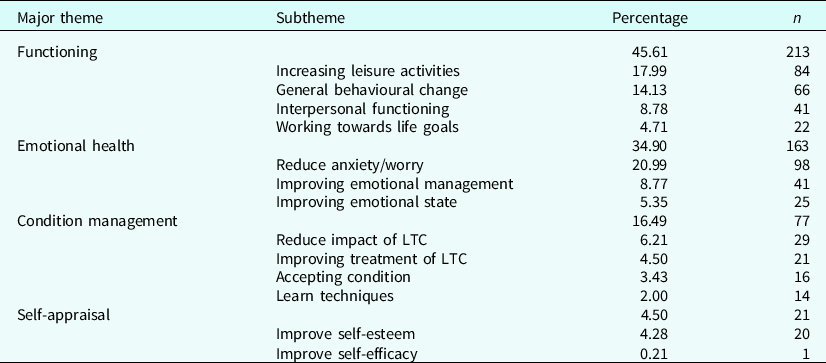
Table 2 summarises the frequency of each major theme and subtheme in the sample. The most common theme for treatment goals was wanting to improve functioning (45.6%). Increase leisure activities and general behaviour changes were the most commonly reported subtheme within this major theme. The second most common theme for treatment goals was emotional health (34.9%), with a focus on wanting to reduce anxiety and worries. Condition management was the third most reported theme for treatment goals (16.49%). Representation of goals within this theme were generally equal for wanting to reduce the impact of the LTC, improving treatment of condition, and acceptance of the LTC. Self-appraisal that emphasised improving self-esteem was the least reported theme in the sample (4.5%).
Breakdown of goal descriptions into themes and subthemes

LTC, long-term condition.
Associations between patient characteristics and treatment goals
Table 3 summarises the results from logistic regression investigating whether patient characteristics are associated with the likelihood of participants reporting a treatment goal of functional, emotional health, condition management, or self-appraisal outcomes. Participants reporting a treatment goal of improving functioning was significantly positively associated with age (β=.03, p=.048) and depression (β=.15, p=.003), while significantly negatively associated with anxiety (β=–.11, p=.031). No significant associations were found between participants reporting a treatment goal of improving functioning and the other patient characteristics included in the model. In relation to the likelihood of participants wanting to improve emotional health, there was a trend towards it being significantly negatively associated with depression (β=–.09, p=.051). No significant associations were found between participants wanting to improve emotional health and the other patient characteristics in the model. Furthermore, no significant associations were found between patient characteristics and either goals of improving condition management or self-appraisal.
Logistic regression investigating associations between patient characteristics and goals for treatment

No.=number; *p-value < .05; ‡p-value=.05; referent category for gender=female; referent category for medication=yes.
Discussion
The aim of this study was to investigate the treatment goals reported by patients with LTCs referred to cognitive behavioural therapy (CBT) in primary care, and their association with patient characteristics. Thematic analysis identified four major themes and 13 subthemes of treatment goals. The most common theme was improving functioning with a desire to increase leisure activities and healthier habits of living. This was followed by improving emotional health, especially reducing anxiety and worry, and better management of LTCs. Improving self-appraisal was also identified as a major theme, but was the least reported goal in the sample. Participants wanting to improve functioning was positively associated with age and depression and negatively associated with anxiety. There was a trend for severity of depression to be negatively associated with wanting to improve emotional health. No other patient characteristics were associated with any of the major themes.
Results from our analysis suggest that patients with LTCs referred for CBT in primary care have wide-ranging goals for psychological intervention that reflect wanting to reduce psychological distress, disability and quality of life. These results converge with previous analyses showing that coping with the psychological and physical impacts of physical conditions are a priority for patients with physical illness (Col et al., Reference Col, Solomon, Springmann, Garbin, Ionete, Pbert and Kutz2018; Heapy et al., Reference Heapy, Wandner, Driscoll, LaChappelle, Czlapinski, Fenton and Kerns2018). Furthermore, they converge with findings that emotional health and interpersonal goals (including social functioning and other relationships) are priorities among individuals with mental health difficulties (Holtforth et al., Reference Holtforth, Wyss, Schulte, Trachsel and Michalak2009; Schöttke et al., Reference Schöttke, Trame and Sembill2014). Addressing unwanted anxieties in day-to-day life regarding the physical condition is a key motivation for treatment. These results suggest that CBT treatment should address the wider psychological and functional needs of patients for it to be suitable for LTCs. There is need therefore to increase practitioner competences in knowing how to apply a bio-psychosocial framework to case formulation, goal-based assessment and treatment planning, promoting self-management and behaviour change, multi-dimensional assessment, and good knowledge of the presenting physical conditions (e.g. in line with the Psychological Interventions with People with Persistent Physical Health Problems Competence Framework; Roth and Pilling, Reference Roth and Pilling2015).
The results also highlight the importance for practitioners to attend to individual differences in treatment motivation based on patient characteristics as it partially influenced the types of goals patients reported for treatment. For instance, our results were consistent with previous research suggesting patients who are older and/or report higher levels of depression want to improve their functioning (Battle et al., Reference Battle, Uebelacker, Friedman, Cardemil, Beevers and Miller2010; Baur et al., Reference Baur, Trösken and Renneberg2023; Holtforth et al., Reference Holtforth, Wyss, Schulte, Trachsel and Michalak2009; Schöttke et al., Reference Schöttke, Trame and Sembill2014). This suggests that specific subgroups of patients with LTCs are likely to view the functional impacts from LTCs as problematic and therefore important to address in treatment. These results converge with previous findings that treatment goals only partially correspond to disorder-specific concerns for patients with depressive symptoms (Ramnerö and Jansson, Reference Ramnerö and Jansson2016). This was further supported by findings that patients with depressive symptoms were less likely to want to improve emotional health. While this result is tentative given there was only a trend towards significance, the finding support arguments that assessment of treatment goals can identify extra-diagnostic information regarding motivation for treatment (Elwyn and Vermunt, Reference Elwyn and Vermunt2020). Given that practitioners are inclined to want to focus on reducing symptoms (Col et al., Reference Col, Solomon, Springmann, Garbin, Ionete, Pbert and Kutz2018), these results emphasise the need to enhance practitioner competencies in aligning treatment with patient’s goals to ensure goal-based decision-making is achieved in practice.
Other results contrary to our expectations also warrant attention as they may serve to refine research methods for understanding treatment goals among patients with LTCs. For instance, patients with greater anxiety were less likely to view functional improvement as a treatment goal. This result partially converges with previous findings that patients with anxiety disorders are less likely to view functioning as problematic and therefore prioritise it for treatment (Holtforth et al., Reference Holtforth, Wyss, Schulte, Trachsel and Michalak2009). However, the current result diverges from Holtforth et al. (Reference Holtforth, Wyss, Schulte, Trachsel and Michalak2009) in that we did not find any support for patients with anxiety wanting to improve their emotional health. This finding is putatively novel given that the current study is the first to analyse treatment goals in a mixed sample referred for CBT in primary care, reflecting perhaps specific outcomes for this setting. However, in the absence of an unambiguous link between anxiety and treatment goals, we suggest erring on the side of caution in interpreting the result until replicated. For instance, the result may spuriously relate to the use of the GAD-7 which screens symptoms of generalised anxiety and thus may not detect variations in the nature of anxiety and the activities patients avoid. Additionally, we note that patient characteristics were not associated with patients wanting to improve condition management or self-appraisal. As the prevalence of these goals were lower than improving functioning or emotional health, the finding perhaps reflects low power to detect significant associations between patient characteristics and these treatment goals. Future research could adopt standardised measures of treatment goals such as using the Bern inventory of treatment goals (Grosse and Grawe, Reference Grosse and Grawe2002), alongside indicators of specific mental health problems, to ensure sufficient sensitivity and power to conduct robust correlational analysis.
Furthermore, it is crucial to interpret the results in the context of other limitations of the current study. The current findings relate to patients with LTCs referred for CBT in primary care, and thus may not generalise to patients referred to secondary care services. This study also consisted of only a cross-sectional analysis of patient-goals and their association with patient characteristics. Future research could extend analysis to whether these factors may influence treatment outcomes, with specific attention given to whether results vary across different LTCs. Another limitation was the loss of data due to patients not required to complete the GBO measure. Routine goal-based assessment will address this. Finally, some goals were vague and difficult to interpret. While the research team followed an essentialist/realist approach using semantic coding in thematic analysis, there was potential for dual coding of responses (e.g. the goal of reducing nightmares could either be patients wanting to reduce the impact of the condition or reducing anxiety), which may have implications for biased estimation in regression modelling. Notably, there was high agreement between raters in this study suggesting the risk of bias in this study was putatively minimal. However, we recommend using multiple-methods to gathering information about patient goals to help minimise risk of bias in analysis in future studies.
Implications for practice
Overall, the results serve to refine recommendations for goal-based shared decision making in CBT for patients with LTCs (Elwyn and Vermunt, Reference Elwyn and Vermunt2020). For instance, each of the major themes and subthemes identified in this study broadly map onto the three key levels of treatment goals (fundamental, functional, and disease- or symptom-specific goals) presented by Elwyn and Vermunt (Reference Elwyn and Vermunt2020). This suggests that the three-goal level model has macro-level utility in shared decision making and guiding therapy focus for patients with LTCs. However, our results suggest that patients with LTCs also have specific micro-level goals that cut across psychological, functional and health domains. Therefore, therapists and service providers need to be aware of the wide-ranging treatment goals patients with LTCs may have to address patient’s multi-disciplinary needs. This may entail engaging with medical professionals to enable access to integrated services to concurrently manage the LTC and psychosocial impacts of the physical illness. To that end, we suggest integrated structures of routine outcome measurement and standardised measures during assessment and the shared decision-making process as these help identify specific micro-level goals for treatment planning and help monitor progress to maximise treatment effectiveness in the context of LTCs (Law and Jacob, Reference Law and Jacob2013; Roth and Pilling, Reference Roth and Pilling2015). Additionally, the results reinforce developments in specialist training pathways (and training curricula) for practitioners working with patients with LTCs (e.g. Improving Access to Psychological Therapy programme, introduced in England in 2018). These developments highlight the importance of engagement between mental health and medical professionals, training clinicians in adapting CBT, and introducing clinical supervision structures for therapists delivering CBT to patients with LTCs (Panchal et al., Reference Panchal, Rich, Rowland, Ryan and Watts2020).
Conclusion
There is ongoing need to integrate new methods of goal-based assessment and treatment in providing mental health support for patients with LTCs. The results of the current study indicated that patients with LTCs referred for CBT in primary care can have wide-ranging goals that may only partially correspond with their specific condition. Our results highlight that patients with LTCs prioritise wanting to improve functioning and emotional health when referred for psychological intervention. Patients also reported wanting to improve their ability to manage their LTC and self-appraisal. Patients who were older and were suffering depression appeared to have stronger desires to improve functioning. These results emphasise the salience of needing to flexibly plan CBT treatments that address the multiple needs of patients with LTCs. Following recent developments, we propose models of measurement-based care using routine outcome measure can greatly enhance the individual relevance of cognitive behavioural interventions which is goal-oriented and tailored to patient’s needs. Future investment in implementation of such models of care for patients with LTCs has the potential to substantially reduce the burden of LTCs on patients and society.
Key practice points
-
(1) CBT therapists need to consider best-practice to personalisation to address patient’s multi-disciplinary needs, aligning treatment with patient’s goals that may cut across multiple domains of psychological and functioning.
-
(2) Recent developments in training curricula emphasise the salience of applying a bio-psychosocial framework to case formulation, promoting self-management and behaviour change, multi-dimensional assessment, and good knowledge of the presenting physical conditions.
-
(3) These developments should occur in the background of improving engagement between mental health and medical professionals, training for clinicians in adapting CBT, and introducing clinical supervision structures for therapists delivering CBT to patients with LTCs.
Supplementary material
The supplementary material for this article can be found at https://doi.org/10.1017/S1754470X23000272
Data availability statement
Data for this study are not available for public sharing.
Acknowledgements
We acknowledge Mr Xuanyu Li for independently coding themes for the qualitative analysis, the staff working in the ADAPT-LTCs services, and the patients who shared their time while taking part in this study.
Author contribution
All authors were involved in conceptualizing, data curation, formal analysis, and writing of the original draft. Vilas Sawrikar: Conceptualization (equal), Data curation (equal), Formal analysis (equal), Investigation (equal), Methodology (equal), Writing – original draft (equal); Christopher Newton: Data curation (equal), Formal analysis (equal), Investigation (equal), Writing – original draft (supporting); Leeanne Nicklas: Conceptualization (equal), Funding acquisition (equal), Project administration (lead), Writing – review & editing (equal).
Financial support
This project was funded by NHS Education for Scotland, UK.
Competing interests
Authors have no competing interests to declare.
Ethical standard
The project was registered as a service development with NHS research and development committees. Ethical approval to store and use the anonymised data for research purposes was provided by The Human Research Ethics Committee at the University of Edinburgh (reference number: CLPS154). Participants included in this study have provided written consent to share and publish the anonymised results. The authors of this study have abided by the Ethical Principles of Psychologists and Code of Conduct as set out by the British Association for Behavioural and Cognitive Psychotherapies (BABCP) and British Psychology Society (BPS).






Comments
No Comments have been published for this article.