

1 Introduction
Arabic poetry (Alšςr Alςrby,Footnote 2 ) is a form of metrical speech with a rhyme. The rhyme in Arabic poetry is achieved by every line of the poem ending upon a specific tone. Arabic poetry is categorized into two main types: rhymed (or measured), and prose, with the former greatly outnumbering the latter. The rhymed poetry falls within fifteen different meters (wzn,
 ) collected and explained by famous lexicographist, grammarian and prosodist Al-Khalil Bin Ahmad Al-Farahidi (791 A.D.) in what is known as the science of prosody (ςlm AlςrwD,
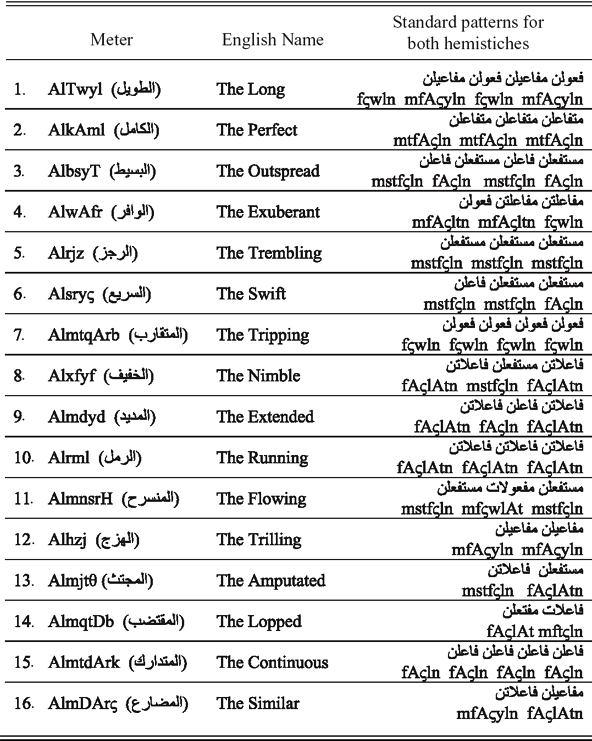
 ) (Al-Katib Reference Al-Hussian1971; Kushek Reference Kushek2004). His elaborate circle system remains directly influential in theories of meters to this day. Al-Akhfash later added one more meter to make sixteen meters, as listed in Table 1 (Al-‘edany Reference Al-‘edany2001; Mustajeer Reference Mustajeer2005). Arabic poetry must follow one of these to be correct (Uthman Reference Uthman2004; Mustafa Reference Mustafa2005). The meter of the rhythmical poetry is known as sea (bHr,
 ). The measuring unit of the meter is known as a foot (tfςylħ,
 ), with every meter containing a certain number of feet that the poet has to observe in every verse (byt,
 ) of the poem. A line of a verse is divided into two halves (šTr,
 ) or hemistiches (mSrς,
 ). The measuring procedure of a poem is very rigorous. Sometimes adding or removing a consonant or a vowel can shift the verse from one meter to another. Some of these meters can be identified, depending on the number of units (syllables) in each hemistich, with other sub-types such as completed (tAm,
 ) meters, which contain four units, or brachycatalectic (mjzw’,
 ) meters, which are verses where the last foot in both hemistiches is omitted (the last foot is called (ςrwD,
 ) ‘in a narrow sense’ in the first hemistich, whereas it is called (Drb,
 ) in the second hemistich). For instance, AlTwyl/The Long meter is always completed, whereas Alhzj/The Trilling meter is always brachycatalectic. On the other hand, Alrjz/The Trembling, AlbsyT/The Outspread and Alrml/The Running meters could be either completed or brachycatalectic. Furthermore, each one of these sixteen meters has many forms due to different forms of foot for each meter. So there are about 17,292 different forms representing sixteen meters for Arabic prosody. Also, in rhymed poetry, every verse has to end with the same rhyme (qAfyħ,
 ) throughout the poem.
The Arabic meters

The rest of the paper is organized as follows. Section 2 introduces an overview about the Arabic prosody and its basic elements. A brief review of related works are given in Section 3. Section 4 explains the algorithm for converting the dictation form to the prosodic form. The numerical prosody method description will be given in Section 5. Section 6 explains the BASRAH system and Section 7 reports the experiments performed using BASRAH. Finally, Section 8 presents the conclusions.
2 Arabic prosody and its basic elements
Arabic prosody, which was established by Al-Khalil, can be defined as, a science by which the right meter is recognized as opposed to a wrong one (Ahmad Reference Ahmad2006; Etmeesh Reference Etmeesh2006). In his analysis, Al-Khalil observed that every verse consists of an identical sequence of vowelless consonants (swAkn,  ), which are the letters provided with Sukun (
 ) or the prolongation letters (
 , i.e., Alif (
 ), Waw (
 ) and Ya (
 )) and vowelizes (mtHrkAt,
 ), which are the letters provided with diacritical marks, such as Damma (
 ), Fatha (
 ) and Kasra (
 ) (Maling Reference Maling1973; Abdullateef Reference Abdullateef2007; Wajeeh Reference Wajeeh2007). These are governed by determinate collocations of easily distinguishable rhythmic elements of a fixed length, which he called pegs (ÂwtAd,
 ), with elements of variable length, which he called cords (ÂsbAb,
 ). A cord consists of two letters, while a peg has three letters. A cord which is composed of a vowelize followed by a vowelless consonant is called a light cord (sbb xfyf,
 ), whereas it is called a heavy cord (sbb θqyl,
 ) if it consists of two vowelizes (Abdullateef Reference Abdullateef2007; Wajeeh Reference Wajeeh2007). A peg which is composed of two vowelizes followed by a vowelless consonant is called a joined peg (wtd mjmwς,
 ), while it is called a separated peg (wtd mfrwq,
 ) if it consists of two vowelizes separated by a vowelless consonant (Abdullateef Reference Abdullateef2007; Wajeeh Reference Wajeeh2007). Some prosodists refer to another rhythmic element called interspace (fASlħ,
 ), which is a combination of three or four vowelizes followed by a vowelless consonant. An interspace is called a small interspace (fASlħ Sγrý,
 ) when it consists of three vowelizes followed by a vowelless consonant, and called a large interspace (fASlħ kbrý,

 ) when four vowelizes are followed by a vowelless consonant (Harkat Reference Harkat2007). From these three elements, Al-Khalil determined larger entities called feet, which can be combined in different ways to generate the traditional meters of Arabic prosody. A foot must contain double cords or a peg and a cord, and must not contain two pegs or three consecutive cords. In order to grasp the above analysis, it has been compressed into a sentence:
 lam. Âra ςalaý Ďah.r jabalĩ samakatã
(lit.: I did not see a fish on top of a mountain).
Here,  lam is light cord,
 Âra is heavy cord,
 ςalaý is joined peg,
 Ďah.r is separated peg,
 jabalĩ is small interspace and
 samakatã is large interspace.
These names, like most of the metrical terminology, have been borrowed from Bedouin life, especially from the tent. Prosodists claim that there are ten feet known as primary feet (tfAςyl ÂsAsyħ, 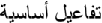 ) that were formed from cords, pegs and interspaces. These feet are (Al-Taweel Reference Al-Taweel2006; Abdullateef Reference Abdullateef2007; Wajeeh Reference Wajeeh2007; Khalil Reference Khalil2009) as follows: faςuwlan (
 ), mafaAςiyln (
 ), mufaAςaltun. (
 ), fAςi lAtun. (
 ), faAςiln (
 ), fAςilAatun. (
 ), mus.tafςilun. (
 ), mutafaAςiln (
 ), maf.ςuwlAatu (
 ) and mus.taf.ς lun. (
 ).
Minor changes may arise in some parts of the primary feet, which result in new types of feet called alternative feet (tfAςyl bdylħ,  ) (Mukhtar Reference Mukhtar1985; Al-‘Ali Reference Al-‘Ali1998; Isa Reference Isa2010). The first alteration is called minor relaxations (zHAfAt,
 ), which affect the cords of a verse. These relaxations are divided into twelve types (Shittu Reference Shittu2006), such as Alxbn (
 ), Alkf (
 ), AlTy (
 ), etc. The other, called major defects or diseases (ςll,
 ), only affects the end of the last foot of a hemistich (Mukhtar Reference Mukhtar1985). It arises through addition or omission on that basis. These defects also divide into twelve types (Shittu Reference Shittu2006), such as AlqTf (
 ), AlqTς (
 ), Albtr (
 ) etc.
3 Related work
Some attempts have been made to automate the process of determining the meter of Arabic verses. Among these attempts is Al-‘edany's system (Al-‘edany Reference Al-‘edany2001), which is based on Al-Hanafy's method (Al-Hanafi Reference Al-Hanafi1991). It takes as input a fully diacritized verse and outputs different information, such as the prosodic form, verse's codes in terms of the numbers (1, 2 and 3), feet and places of segmentation. This system does not specify the types of relaxations and defects. It recognizes only thirteen meters.
Al-Hussain's system (Al-Hussian, n.d.) is another attempt in this respect. It takes as input the code of one of the verse's hemistiches and outputs the hemistich's meter, feet, relaxations and defects. This system does not specify the places of segmentation for the verse. It recognizes all sixteen meters.
The Khalaf, Shahed and Ali's system (Reference Khalaf, Shahed and Ali2009), which is based on Al-Katib's (Reference Al-Hussian1971) method, recognizes all meters. It takes as input a partially diacritized verses (which contain the diacritics like Sukun, Tanwiyn, assimilation and end of each hemistich) and outputs the verse's meter, the prosodic form, the verse's code in terms of the numbers (1, 2, 4, 8 and 16), feet, place of segmentation and the types of relaxations and defects.
The current system, which we call BASRAH, is a step forward in automating the process of Arabic prosody. It uses the numerical prosody method (Khashan Reference Khashan2003, Reference Khashan2004, Reference Khashan2005, Reference Khashan2006), which depends on numerical patterns, and not on feet like the previous methods, to specify the verse's or poem's meter(s). BASRAH recognizes not only all Arabic meters but can also recognize Arabic poetry rhythms. BASRAH also identifies the types of relaxations and defects by using alternative codes that are derived from the codes of sixteen primary meters.
4 Prosodic form
Diacritization in Arabic is done by adding special symbols called diacritical marks (HrkAt,  ) to help in spoken language. Some of these special symbols are put above normal Arabic characters, such as the short vowels, known as Damma (
 ,
 , u), Fatha (
 ,
 , a), and a zero vowel, known as Sukun (
 ,
 , .), while others are put under them, such as the short vowel, known as Kasra (
 ,
 , i). For example, katab.tu (
 ) ‘I wrote’ and katab.ta (
 ) ‘you (masculine) wrote’.
Arabic prosody is considered a phonetic science. It depends on pronounced, not on written, letters. The prosodic form is based on the following principle rule:
Only the pronounced sounds are written down, even if they have no corresponding letters in dictation form. Also, what is not pronounced is left unprinted, even if it has a corresponding letter in dictation form. (Khalaf et al. Reference Khalaf, Shahed and Ali2009)
Accordingly, some letters are either inserted or deleted in the prosodic form.
The prosodic form is an essential step for any correct start to identify the meter of the verse because it represents the verbal components for any verse in order to facilitate the next steps of processing (Al-‘edany Reference Al-‘edany2001). This task needs a human knowledge level in the rules of Arabic and words diacritization, as well as the correct pronunciation of the Arabic lexical items.
The following algorithm (Al-Katib Reference Al-Hussian1971; Al-‘edany Reference Al-‘edany2001; Khalaf et al. Reference Khalaf, Shahed and Ali2009) shows the steps applied to convert the Arabic verse from the dictation form to the prosodic form:
(1) Duplicate the geminated letters (having Shadda (
 , , ~) over it) by making the first one a vowelless consonant (zero vowel) and the other a vowelize. For instance, md~a () becomes md.da ().
(2) Duplicate the prolongated Alif (
, Ā) by making the first one a vowelize and the other a vowelless consonant.(3) Replace any TanwiynFootnote 3 (or Nunation), known as Tanwiyn Damm (
, ũ), Tanwiyn Fath (, ã or , Aã) and Tanwiyn Kaser (, ĩ), by noon with Sukun (, n.). For instance, jnwbũ () becomes jnwbun. ().(4) Delete the conjunctive Hamza (
) within a word from the dictation form. For instance, wAktŷAb () becomes wktŷAb ().(5) Write down each pronounced letter (e.g., dagger Alif). Like: hðA (
) becomes hAðA (). Also, leave unprinted each letter that is not pronounced. For instance, ktbwA () becomes ktbw ().(6) Delete the assimilated Lam (
, ) from the definite article known as Al (), which exists before any one of the Sun letters or Solar letters (AlHrwf Alšmsyħ, , t , θ , d , ð , r , z , s , š , S , D , T , Ď , l and n ) and duplicate the Sun letter (making the first one a vowelless consonant and the other a vowelize). For instance, Alš~ams () becomes Aš.šams ().(7) Replace any of the short vowels Damma, Fatha and Kasra, which appears over the letter Ha (h
) at the end of a word or over the end of a hemistich, by its corresponding letters known as Waw (w ), Alif (A ) and Ya (y ), respectively.(8) Delete any other special symbols (
, !, (,), . . .) which exist in the verse. For instance, mn hðA? () becomes mn hAðA ().(9) Finally, the first vowelless consonant letter from a pair of consecutive vowelless consonant letters is deleted except where this pair appears at the end of each hemistich.





The result of this process contains the prosodic form only, i.e., the Arabic letters diacritized with the short vowels Damma, Fatha and Kasra, and the zero vowel Sukun.
Figure 1 shows an example of Arabic verse in dictation form and its prosodic form.
An example of Arabic verse in dictation form (first line), and its prosodic form (second line).

5 Numerical prosody method
The numerical prosody method (Khashan Reference Khashan2003, Reference Khashan2004, Reference Khashan2005, Reference Khashan2006) is an approach for presenting Al-Khalil prosody by using numbers as a form instead of feet. It aims at a comprehensive understanding that does not pay attention to terminology or ritual, and uses minimal basic necessary tools, which, in the case of prosody, are numbers (cord = 2) and (peg = 3). Thus, numerical prosody manifests itself in simple, short, almost mathematical rules representing a program. In addition, it does not burden man with the terms that loaded this science.
For instance, when we say that fAςilaAtun. ( ) is a heptameter, this means that it contains seven letters:
(fA = 10 = 2)Footnote 4 + (ςilaA = 110 = 3) + (tun. = 10 = 2) = 7 diacritical marks (vowelless consonants and vowelizes).
So the Arabic prosody is numerical from its beginning.
The following Arabic verse is taken as an example to explain the steps of the numerical prosody:

(lam. yaςud. qaw.miy. kamaA kaAnuwA wamaA ÂH.snwA γy.r Alt~ajAfy. ςmlA)
In numerical prosody two steps are used to indicate the meter for any verse:
(1) Representing each letter provided with sukun or the prolongation letters (i.e., Alif (
), Waw () and Ya ()); for example, m. () by code ‘0’, and everything else by code ‘1’, for example, qa ().Footnote 5The prosodic form of the first hemistich of the previous example verse is
lam. yaςud. qaw.miy. kamaA kaAnuw wamaA
So it can be written by these two codes (1 and 0) as follows:
(2) Grouping the binary codes into segments. Each segment must start with (1) and end with (0). Certain patterns of these segments are significant, in particular 110 (joined peg) and 10 (light cord). We segment the verse by matching the longest prefix that matches one of these, and we assign a code to each segment (i.e., 110 = 3 and 10 = 2). Sometimes there is still one vowelize letter (1) alone; in this case we leave it (e.g. 1110 (small interspace) = 13). Then we simplify (222 = 6 and 22 = 4). So the first hemistich of the previous example verse can be coded using cord and peg codes as follows:



Using the numbers as a form soon revealed mathematical properties for Arabic poetry verses' rhythm, which could be inferred from meters and their circles. The numerical prosody codes did not exceed the code (0, 1, 2, 3, 4 and 6), here lies the importance of the numerical prosody for its simplicity, accuracy and ability to be programmed. For this reason we used this method in our system to identify the meter of Arabic poetry.
The whole set of features for the Arabic prosody is summarized in the following specific rules:
(1) There are two main rhythms for Arabic poetry known as Amble (xbby,
) and Naval (bHry, ) rhythms. These two rhythms are overlapped according to specific rules, which are known as AltxAb ().(2) The Amble rhythm consists of the equivalent of light cord and heavy cord, where one of them is taking the place of the other, so there is no relaxation in the Amble rhythm.
(3) The Naval rhythm consists of alternations of light cord 2 and peg 3. All cords in this rhythm must be light cords only and able to do relaxation.
(4) The Amble and Naval rhythms are overlapped in interspace 22 in the two meters (AlkAml/The Perfect and AlwAfr/The Exuberant), which is called AltxAb.


The summary of these rules is that there are mathematical conditions that determine and describe the Arabic properties through which the meter is accepted. Also, there is a mathematical framework that controls these properties and the numerical prosody comes to determine proprieties' features.
6 BASRAH system
The system described in this paper, i.e., BASRAH, is used to identify the Arabic verse's or poem's meter using the numerical prosody method (Khashan Reference Khashan2003, Reference Khashan2004, Reference Khashan2005, Reference Khashan2006). BASRAH takes as input a partially diacritized verse and outputs the verse's meter, the prosodic form, the verse's code, place of segmentation and the types of relaxations and defects. BASRAH has many advantages when compared with the previous systems that were explained in Section 3. These advantages are as follows:
(1) All the previous systems depended on the feet to determine the meter of the Arabic verse, while BASRAH depends on mathematical patterns. The feet in BASRAH can be inferred from the mathematical patterns. This makes BASRAH simpler and faster than the other systems.
(2) The Previous systems find the meter for verses only, whereas BASRAH does so for both verses and poems.
(3) The Previous systems identify Amble (Alxbb,
) rhythm as a part of AlmtdArk/The Continuous meter, while in BASRAH it is identified as a separated notion. This makes the results of BASRAH nearest to the thought of the most of the Arabic prosody human experts.(4) BASRAH like Khalaf et al.'s (Reference Khalaf, Shahed and Ali2009) system works on partially diacritized verses (as input), whereas other systems work on fully diacritized verses (Al-‘edany Reference Al-‘edany2001) or the numerical coding of the prosodic form (Al-Hussian, n.d.).

To make BASRAH faster and effective, we created general standard patterns for each meter, instead of saving all the meter codes (see Section 5) as in the other systems. Sometimes, for the same meter there is more than one standard pattern. For example, the standard pattern of AlTwyl/The Long meter is coded as followsFootnote 6:

Footnote 7 In the above code, the square brackets [ ] mean that only one number between the brackets is selected.
In the standard pattern of AlmqtDb/the Loppped meter, the codes of both hemistiches are equivalent, as shown in the following pattern:

BASRAH proceeds in four stages, as follows:
Stage 1: This stage is responsible for inputting partial diacritization of Arabic verse or poem from the keyboard or selecting from the stored database system. Then the input is checked, whether it is acceptable according to the rules of Arabic poetry writing (i.e., does not contain numbers or special symbols) or not. If the input verse or poem is incorrect, an error message is displayed, otherwise the processing continues.
Stage 2: This stage uses the algorithm that was explained in Section 4 to convert the verse (or each verse in the poem) from the dictation form to the prosodic form.
Stage 3: This stage uses the principles of numerical prosody, which was described in Section 5, to replace the prosodic form for the verse (or each verse in the poem) into its equivalent numerical code in terms of the codes (0,Footnote 8 1, 2, 3, 4 and 6) only.
Stage 4: In this stage, the numeric code of the verse (or each verse in the poem) is compared with all general patterns for the sixteen meters to identify the meter(s) of the verse (or each verse in the poem) and then display the meter(s) if it is found. Otherwise ‘unknown meter’ is displayed.
Furthermore, when the input is a poem, the meter of each verse, as well as the meter of the whole poem, is displayed. Finally, if the verse or poem belongs to at least one meter, the user can save the input in a database system if it is not found in it.
7 Experimental results
To evaluate the effectiveness of BASRAH, we collected two corpora. The first corpus is a verse corpus that contains a set of 3,000 old and modern Arabic verses. The second corpus is a poem corpus that contains a set of over 500 old and modern Arabic poems (3,459 verses). Both corpora contain fully and partially diacritized verses and poems. These corpora are annotated by human experts and considered the gold standard corpora. Most of these samples are taken from the following websites: Adab: Al-Mawso‘a Al-‘lmya ll-Shi‘r Al-‘arabi,Footnote 9 Awzan Al-Shi‘r Al-‘arabi,Footnote 10 and Mawso‘at Al-Shi‘r Al-‘arabi.Footnote 11
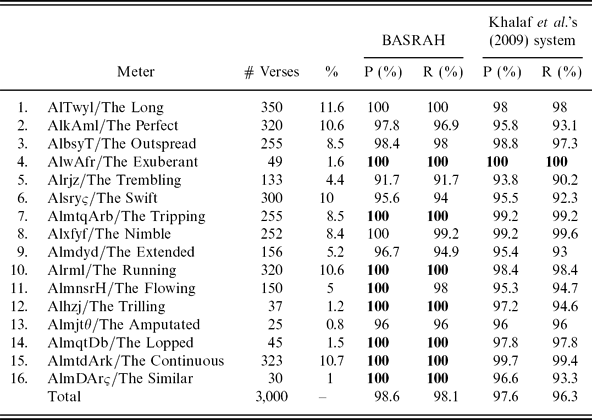
BASRAH achieves an overall 98.6 per cent precision and 98.1 per cent recall when it is tested on the verse corpus compared with 97.6 per cent precision and 96.3 per cent recall for Khalaf et al.'s (Reference Khalaf, Shahed and Ali2009) systemFootnote 12 on the same corpus as shown in Table 2. For all types of verses, BASRAH, which uses the numerical prosody method, gives better results than Khalaf et al.'s (Reference Khalaf, Shahed and Ali2009) system, which uses Al-Katib's method. This is because the numerical prosody method codes cover a wider range of Arabic samples than those covered by Al-Katib's method codes, which did not consider the old Arabic prosody problems (i.e., unreal relaxations and defects). As shown in Table 2, BASRAH achieves 100 per cent precision and recall for AlTwyl/The Long, AlwAfr/The Exuberant, AlmtqArb/The Tripping, Alrml/The Running, Alhzj/The Trilling, AlmqtDb/The Lopped, AlmtdArk/The Continuous and AlmDArς/The Similar meters compared with AlwAfr/The Exuberant meter for Khalaf et al.'s (Reference Khalaf, Shahed and Ali2009) system. On the other hand, Alrjz/The Trembling meter is the lowest precision and recall for both systems (91.7 per cent precision and 91.7 per cent recall in BASRAH compared with 93.8 per cent precision and 90.2 per cent recall in Khalaf et al.'s (Reference Khalaf, Shahed and Ali2009) system). This is due to the fact that this meter is overlapped with AlkAml/The Perfect meter (the same case with Alsryς/The Swift meter, which is overlapped by AlkAml/The Perfect as shown in Example 5). We also got 100 per cent accuracy when we tested BASRAH on the poem corpus. This is due to the fact that in a tested poem the system finds the meter for each verse in the poem and then finds the meter for the whole poem. So it gives more accurate result than a tested verse.
BASRAH's precision (P) and recall (R) compared with Khalaf et al.'s (Reference Khalaf, Shahed and Ali2009) system, verse corpus
BASRAH, for instance, identifies the verse # 1977Footnote 13 in verses corpus as having AlbsyT/The Outspread meter, which is correct, as shown in
Example 1. In each example below, lines represent the verse's transliteration, the prosodic form, segmentation and code respectively.
Example 1
BASRAH gives ‘unknown meter’ or gives incorrect results if there is an error in the diacritization of the input verses (e.g., if someone entered Example 1 by changing the diacritical mark of each hemistich ending from Damma to Sukun) as shown in
Example 2.
Example 2
Here BASRAH identifies this verse as ‘unknown meter’ because the final code does not belong to any meter codes, which corresponds to the judgment of a human expert because the verse's diacritization is not correct. BASRAH also gives ‘unknown meter’ if there is an error in the dictation form of the input verses.
BASRAH can also identify the sub-types of meters, e.g., if they are completed or brachycatalectic or other. For example, the verse in
Example 3 is identified correctly as having brachycatalectic of AlwAfr/The Exuberant (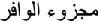 ).
Example 3
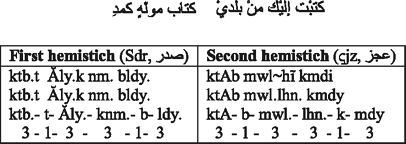
As we have mentioned before, BASRAH depends on codes and not on feet as the other systems do. It therefore identifies the types of relaxations and defects (which these types related to the feet method) by using alternative codes that are derived from the codes of sixteen primary meters rather than by using feet.
BASRAH also works perfectly on both fully and partially diacritized input verses. Since BASRAH does not work so well on non-diacritized verses, our plan therefore is to use an Arabic diacritizer system (e.g., MADA; Habash, Rambow and Roth Reference Habash, Rambow and Roth2009) for the input stage as the future work for BASRAH.
Example 4
In Example 4, in spite of the fact that the input verse is non-diacritized, BASRAH correctly identifies this verse as having AlmtqArb/The Tripping meter. This is a very rare case, especially when the verse contains the prolongation letters in the segmentation positions.
When testing poems, BASRAH assigns the commonest meter of the verses that make up a poem. For instance, BASRAH identifies the following poem, which contains four verses, as having Alsryς/The Swift meter, not AlkAml/The Perfect meter. This is because the first verse belongs to Alsryς/The Swift meter; whereas the other three verses belong to both AlkAml/The Perfect and Alsryς/The Swift meters. BASRAH, therefore, identifies the poem as having Alsryς/The Swift meter, because this is the commonest meter for the individual verses.
Example 5

Some of BASRAH's result screens are shown in the Appendix.
8 Conclusions
Arabic prosody is the science that studies the music of Arabic poetry, which is mainly meter and rhyme. The identification of meters for Arabic poetry verses or poems is a complicated task. This task needs human expertise to identify the meter of poetry's verse.
This paper is an attempt to simplify Arabic prosody by utilizing the computer to help inexperienced users to identify the meter of Arabic verses or poems and report the correctness of the verse (or poem). BASRAH uses the numerical prosody method to achieve its aim through coding the verse using (0, 1, 2, 3, 4 and 6) codes only. BASRAH was tested on a large set of old and modern Arabic verses and poems. We have shown that using numbers, by coding the vowel letter as ‘1’ and the consonant letter as ‘0’, instead of feet to identify the Arabic verse helps to reduce the burden of many terms that overload the Arabic prosody and make it a thorny and complex discipline. This will provide a new way of thinking about Arabic poetry itself, and will also open the door to applications of these ideas to another Arabic field such as music.
BASRAH achieves an overall 98.6 per cent precision and 98.1 per cent recall versus 97.6 per cent precision and 96.3 per cent recall by using Khalaf et al.'s (Reference Khalaf, Shahed and Ali2009) system over the same set of 3,000 old and modern Arabic verses. This is because our previous system used Al-Katib's method, which did not take into consideration the old Arabic prosody problems (i.e., unreal relaxations and defects). So BASRAH, which uses the numerical prosody method, can identify some verses that Khalaf et al.'s (Reference Khalaf, Shahed and Ali2009) system cannot identify because the codes of these verses do not match the Al-Katib's codes, whereas they do match the numerical prosody method codes. On the other hand, BASRAH achieves 100 per cent accuracy over a set of 500 Arabic poems. It is characterized by accuracy and simplicity. We therefore intend to add some other helpful information about Arabic prosody, such as general information about prosody, the definition of each meter, examples for each meter with its feet, the prosodic form conversion algorithm, spoken verses and poems etc., to enrich BASRAH's user knowledge, because we hope that it might be useful as an educational aid.
We speculate that further work by adding an Arabic diacritizer (e.g., MADA), which plays a vital role in these applications, for the input stage might further improve BASRAH's results.
Acknowledgments
We would like to thank Professor Allan Ramsay (The University of Manchester, UK), Dr. Yasser Sabtan (Al-Azhar University, Eygpt), Dr. Yavor Nenov (Oxford University, UK), Fatimah Furaiji (University of Szczecin, Poland), Siham Al-Rikabi (Humboldt University of Berlin, Germany) and Khamis Al-Qubaeissy (Manchester Metropolitan University, UK) for important suggestions and helpful discussions. We would also like to extend our thanks to the anonymous reviewers for their helpful comments. Zainab owes her deepest gratitude to USM and TWAS for financial support in her PhD study.
Appendix: Current System Example ScreensFootnote 14
AlTwyl/The Long meter example.
AlmtqArb/The Tripping meter example.
AlkAml/The Perfect or Alrjz/The Trembling meter example.
AlkAml/The Perfect or Alsryς/The Swift meter example.
AlmnsrH/The Flowing meter example.
Poem test example (identifying the meter for each verse).
Poem test example (the meter for the whole poem, which is Alsryς/The Swift meter).