Introduction
Scholars have long sought to explore what promotes entrepreneurial vitality and quality, as entrepreneurship may further contribute to employment, innovation, and economic growth (Van Praag & Versloot, Reference Van Praag and Versloot2007). The relevant literature proposes that entrepreneurship means taking risks because entrepreneurs need to make large resource commitments to seizing or creating entrepreneurial opportunities, and these activities may involve a higher likelihood of costly failure and high payoff (Alvarez, Reference Alvarez2007; Covin & Slevin, Reference Covin and Slevin1989; Guo & Jiang, Reference Guo and Jiang2020; Miller, Reference Miller1983). Therefore, risk-taking is frequently one of the core elements of the entrepreneurship literature (e.g., Block, Sandner, & Spiegel, Reference Block, Sandner and Spiegel2015; Bonte & Piegeler, Reference Bonte and Piegeler2013; Dimitratos, Amoros, Etchebarne, & Felzensztein, Reference Dimitratos, Amoros, Etchebarne and Felzensztein2014; Sebora & Theerapatvong, Reference Sebora and Theerapatvong2010), and the goal of this article is to further understand the risk-taking behaviour of startups in the digital era.
Over the last couple of decades, we have quickly entered the digital era, and many new phenomena have appeared in the business field (Caputo, Pizzi, Pellegrini, & Dabić, Reference Caputo, Pizzi, Pellegrini and Dabić2021; Rialti, Marzi, Caputo, & Mayah, Reference Rialti, Marzi, Caputo and Mayah2020; Ritter & Pedersen, Reference Ritter and Pedersen2020). In the field of entrepreneurship, digital technology, which has a significant influence on how startups are imagined and created, has reshaped the entrepreneurial process (Elia, Margherita, & Passiante, Reference Elia, Margherita and Passiante2020; Garzella, Fiorentino, Caputo, & Lardo, Reference Garzella, Fiorentino, Caputo and Lardo2021). In this digital era, the relationships, interactions, and social networks between individuals or organizations are also reshaped and have become the focus of many scholars (e.g., Smith & Smith, Reference Smith and Smith2021; Zhu, Wang, Wang, & Nastos, Reference Zhu, Wang, Wang and Nastos2020). Social networks and risk-taking are closely related, as risk-taking is a resource-consuming activity, and networks may help startups obtain resources more conveniently and cheaply (Ferris, Javakhadze, & Rajkovic, Reference Ferris, Javakhadze and Rajkovic2019; Luu & Ngo, Reference Luu and Ngo2019). The existing literature has deeply explained how different types of social networks (e.g., networks with different objects and networks with different characteristics) affect corporate resources and entrepreneur risk propensity and ultimately increase the level of risk-taking (e.g., Bembom & Schwens, Reference Bembom and Schwens2018; Boso, Story, & Cadogan, Reference Boso, Story and Cadogan2013; Carnabuci & Dioszegi, Reference Carnabuci and Dioszegi2015; Dbouk, Fang, Liu, & Wang, Reference Dbouk, Fang, Liu and Wang2020; Efendic, Mickiewicz, & Rebmann, Reference Efendic, Mickiewicz and Rebmann2015; Fogel & Nehmad, Reference Fogel and Nehmad2009). These relationships have undergone tremendous changes, as digital technology is empowering an unprecedented convergence of networks, computing, contents, and communicationsFootnote 1 (Elia, Margherita, & Passiante, Reference Elia, Margherita and Passiante2020). As Kohtamaki, Parida, Patel, and Gebauer (Reference Kohtamaki, Parida, Patel and Gebauer2020: 2) proposed, digitalization is profoundly affecting ecosystems and value chains of enterprises, changing the way enterprises interact with other entities. There have been many studies discussing the influence of digitalization on individual companies (e.g., Eller, Alford, Kallmunzer, & Peters, Reference Eller, Alford, Kallmunzer and Peters2020; Gebauer, Fleisch, Lamprecht, & Wortmann, Reference Gebauer, Fleisch, Lamprecht and Wortmann2020). However, existing literature fails to recognize the embeddedness of digitalization in inter-organizational contexts and ecosystems (Frick, Fremont, Age, & Osarenkhoe, Reference Frick, Fremont, Age and Osarenkhoe2020), and the network literature provides an appropriate perspective on this topic. On the other hand, some recent studies have also pointed out the role of digital networks in resource acquisition, which is different from the role of traditional face-to-face networks (e.g., Smith & Smith, Reference Smith and Smith2021). Resource and risk-taking are closely related, and thus digitization may further affect risk-taking. This article continues to explore the relationships between networks, risk-taking, and digitalization.
Furthermore, the behaviours of startups are influenced not only by their attributes or entrepreneurs but also by external circumstances. Many scholars in the field of entrepreneurship have begun to consider the broader entrepreneurial context, especially the entrepreneurial ecosystem, and explore the way to success for startups from the perspective of ecosystems (Audretsch, Cunningham, Kuratko, Lehmann, & Menter, Reference Audretsch, Cunningham, Kuratko, Lehmann and Menter2019; Autio, Nambisan, Thomas, & Wright, Reference Autio, Nambisan, Thomas and Wright2018; Cao & Shi, Reference Cao and Shi2021; Roundy, Bradshaw, & Brockman, Reference Roundy, Bradshaw and Brockman2018; Spigel & Harrison, Reference Spigel and Harrison2018; Stam & Van de Ven, Reference Stam and Van de Ven2021). Considering the impact of the ecosystem echoes the current trend in the field of entrepreneurship, that is, employing the concept of ecosystem to understand how digitalization affects entrepreneurial activities and the interactions among entities (Song, Reference Song2019: 570; Sussan & Acs, Reference Sussan and Acs2017). Entities in the ecosystem create value based on a shared vision, and thus, there will be complicated interactions between enterprises, including cooperation and competition (Elia, Margherita, & Passiante, Reference Elia, Margherita and Passiante2020; Ma & Hou, Reference Ma and Hou2020). Coopetition refers to a dynamic and paradoxical relationship, enabling companies to involve in cooperation and competition simultaneously (Bengtsson & Kock, Reference Bengtsson and Kock2000; Czakon, Srivastava, Le Roy, & Gnyawali, Reference Czakon, Srivastava, Le Roy and Gnyawali2020; Raza-Ullah & Kostis, Reference Raza-Ullah and Kostis2020). Coopetition activities between enterprises and organizations in the ecosystem constitute the overall characteristics of the ecosystem and may further influence the behaviour of individual adolescent companies. Coopetition reveals the conflicts and tensions within the ecosystem from a different perspective from Nambisan and Baron (Reference Nambisan and Baron2021), which may help us better understand how digitalization, networks, and ecosystems currently affect entrepreneurial activities. The ecosystem's basic attribute (i.e., coopetition) may influence startup risk-taking behaviour and moderate the relationships between networks and risk-taking behaviour, and the present article aims to explore this in depth.
Following Lim (Reference Lim2018), the present article proposes an integrated model that includes the entrepreneur, the entrepreneurial ecosystem, and corporate behaviour. We advance knowledge of how social networks affect startup risk-taking behaviours that vary in the characteristics of the entrepreneurial ecosystem. This research makes two principal contributions to the existing literature. First, we contribute to deepening the understanding of the risk-taking behaviour of startups in the ecosystem. Considering the impact of social networks, we embed the risk-taking theoretical model of Lim (Reference Lim2018) into the entrepreneurial ecosystem to explore new phenomena in the digital era. The natural ecosystem has the ability to resist external risks and maintain dynamic stability. At the same time, research on the relationship between ecosystems and risk-taking in the field of entrepreneurship is slightly insufficient. This article thus responds to the call by Dbouk et al. (Reference Dbouk, Fang, Liu and Wang2020) to explore the relationship between social networks and risk-taking in different situations. Second, we consider coopetition to be the essential feature of the entrepreneurial ecosystem. Previous studies in the field of coopetition mostly explored the coopetition activities of mature companies or high-tech companies (e.g., Luo, Slotegraaf, & Pan, Reference Luo, Slotegraaf and Pan2006; Raza-Ullah & Kostis, Reference Raza-Ullah and Kostis2020). In the digital era, some scholars have begun to discuss coopetition activities in some special spaces, such as innovation ecosystems, business networks, alliances, and coworking spaces (Bacon, Williams, & Davies, Reference Bacon, Williams and Davies2020; Bengtsson & Kock, Reference Bengtsson and Kock2000; Bouncken, Fredrich, Ritala, & Kraus, Reference Bouncken, Fredrich, Ritala and Kraus2017; Bouncken, Laudien, Fredrich, & Görmar, Reference Bouncken, Laudien, Fredrich and Görmar2018). Following these scholars, we extend coopetition to new situations and propose that coopetition should be regarded as one of the essential attributes of the ecosystem. The attributes of the ecosystem will adversely affect the behaviour of the enterprise.
For several reasons, we study the proposed model in the Chinese context. In the past few decades, China's entrepreneurial activities have flourished and contributed to China's rapid development, showing their global impact and relevance (Huang, Liu, & Li, Reference Huang, Liu and Li2020: 353). The Chinese context provides a potential opportunity to explore the role of the taken-for-granted entrepreneurial conditions and the influence of the entrepreneurial ecosystem (Ahlstrom & Bruton, Reference Ahlstrom and Bruton2002; He, Lu, & Qian, Reference He, Lu and Qian2019; Tan, Reference Tan2001; Welter, Reference Welter2011). The instability and uncertainty accompanying the transitional economy may affect startup risk-taking behaviour, and China's risk aversion culture may also have a subtle influence on entrepreneurs (Cai, Yu, Liu, & Nguyen, Reference Cai, Yu, Liu and Nguyen2015). Considering the recent changes in the mentality of Chinese entrepreneurs (Huang, Liu, & Li, Reference Huang, Liu and Li2020: 356) and the connection between entrepreneurship and network (Child, Reference Child2009), it is interesting and meaningful to choose Chinese startups as research objects.
The following section includes the theoretical framework, explaining the concepts of social networks, entrepreneurial ecosystems, coopetition, and risk-taking. The research expectations and model of this article are then discussed in the Hypotheses section. Then, our sample, measures, and methods are discussed in the Methodology section. The Results section presents the findings and the analytical techniques we employed. Finally, in the Discussion and Conclusions sections, we discuss the theoretical and practical implications, future research opportunities, and our limitations.
Theoretical framework
Risk-taking
There are roughly two main lines in the previous research on risk-taking, including managerial risk-taking from a general economic/management perspective and risk-taking from a special entrepreneurship perspective (i.e., entrepreneurial orientation [EO]). The first type of research is mainly based on various theories (e.g., agency theory, prospect theory, upper echelons theory, and behavioural theory of the firm; see Hoskisson, Chirico, Zyung, & Gambeta, Reference Hoskisson, Chirico, Zyung and Gambeta2017), discussing top managers' strategic choices that may bring uncertain outcomes. The related literature proposes that these choices may be affected by external and internal factors, such as economic, institutional, industry, policy, and cultural factors (e.g., Laeven & Levine, Reference Laeven and Levine2009; Su & Lee, Reference Su and Lee2013), and the characteristics of executives, corporate attributes, ownership, and shareholders (e.g., Chatterjee & Hambrick, Reference Chatterjee and Hambrick2007; Chrisman & Patel, Reference Chrisman and Patel2012; Walumbwa & Schaubroeck, Reference Walumbwa and Schaubroeck2009). On the other hand, risk-taking is one of the core elements of EO, which includes risk-taking, innovativeness, competitive aggressiveness, proactiveness, and autonomy (Covin & Slevin, Reference Covin and Slevin1989; Lumpkin & Dess, Reference Lumpkin and Dess1996; Miller, Reference Miller1983). As a latent variable, scholars have not yet reached a consensus on the nature of EO. Covin and Lumpkin (Reference Covin and Lumpkin2011) specifically discussed that EO should be regarded as disposition or behaviour. Following their discussion, this article defines risk-taking as the behaviours of startups to depart from tried-and-true paths and undertake initiatives with uncertain outcomes. This way of definition may better distinguish risk-taking from other organization-level latent variables and facilitate the study of its antecedent conditions (Wiklund & Shepherd, Reference Wiklund and Shepherd2003). Because managerial power is more concentrated in startups than mature firms, entrepreneurs may dominate the decision-making process, and their behaviour is highly related to organizational behaviour (Dai, Maksimov, Gilbert, & Fernhaber, Reference Dai, Maksimov, Gilbert and Fernhaber2014; Lumpkin & Dess, Reference Lumpkin and Dess1996). Therefore, in general, the discussion of risk-taking in this article combines the ideas of two types of literature and may help to promote the dialogue between them.
As mentioned above, risk-taking behaviours and entrepreneurial activities are closely related. Startup active risk-taking behaviour may promote innovation and further economic development (Faccio, Marchica, & Mura, Reference Faccio, Marchica and Mura2016). Thus, many scholars have studied the factors affecting corporate risk-taking behaviours, and currently, external entrepreneurial contexts have received special attention (Welter, Baker, Audretsch, & Gartner, Reference Welter, Baker, Audretsch and Gartner2017). Specifically, technology that develops rapidly has profoundly affected the business field and reshaped some behaviours of corporations. Some scholars proposed that today's competition is competition between ecosystems rather than competition between individual companies (Ma & Hou, Reference Ma and Hou2020; Hou & Shi, Reference Hou and Shi2021), and some scholars have employed the entrepreneurial ecosystem to explain startup behaviour and performance (e.g., Link & Sarala, Reference Link and Sarala2019; Yang & Zhang, Reference Yang and Zhang2021). This article regards startup risk-taking behaviour as an act of embedding in ecosystems and social networks (see Lim, Reference Lim2018). Therefore, we may deepen the understanding of startup risk-taking behaviours in the era of Industry 4.0.
Social network theory and social capital theory
The present study is underpinned by social network theory (SNT) and social capital theory (SCT). Some concepts of SNT are derived from graph theory. Graph theory believes that many point sets and lines between points can be depicted on a piece of paper (Kilduff & Brass, Reference Kilduff and Brass2010; Sharafizad & Coetzer, Reference Sharafizad and Coetzer2017). SNT regards the points as the actors or the network's nodes, and the lines are regarded as the corresponding links or paths (Neergaard, Shaw, & Carter, Reference Neergaard, Shaw and Carter2005). The basic concept is that actors' behaviour in social situations may be affected by the bonds between them (Lee & Yang, Reference Lee and Yang2014; Nicholson, Alexander, & Kiel, Reference Nicholson, Alexander and Kiel2004). SCT believes that actors may obtain tangible or intangible resources at the individual, group, and organizational levels through links or paths (Chang, Reference Chang2020; Nonino, Reference Nonino2013). The sum of actual and potential resources available from the network is called social capital (Nicholson, Alexander, & Kiel, Reference Nicholson, Alexander and Kiel2004). Further research on social capital shows that this capital may affect entrepreneur risk-taking propensity and cause startups to take risks more actively (e.g., Dbouk et al., Reference Dbouk, Fang, Liu and Wang2020; Masiello & Izzo, Reference Masiello and Izzo2019; Rodriguez-Gutierrez, Romero, & Yu, Reference Rodriguez-Gutierrez, Romero and Yu2020). Thus, based on SNT and SCT, the present article proposes that social networks may promote startup risk-taking behaviour through various resources in the network.
Social network
After decades of development, social networks have become a topic that cannot be ignored in the field of social science (Hoang & Yi, Reference Hoang and Yi2015; Slotte-Kock & Coviello, Reference Slotte-Kock and Coviello2010; Stuart & Sorenson, Reference Stuart and Sorenson2007). Networks can be regarded as ‘a specific set of linkages among a defined set of persons, with the additional property that the characteristics of these linkages as a whole may be used to interpret the social behavior of the persons involved’ (Mitchell, Reference Mitchell and Mitchell1969: p. 2). Social networks are an important source of information and resources, and therefore, they play a catalytic role in the creation, survival, and development of startups (Bembom & Schwens, Reference Bembom and Schwens2018; Birley, Reference Birley1985; Hoang & Antoncic, Reference Hoang and Antoncic2003; Nordstrom & Steier, Reference Nordstrom and Steier2015). Some scholars even view entrepreneurship as an activity embedded in social networks (e.g., Aldrich & Zimmer, Reference Aldrich, Zimmer, Sexton and Smilor1986; Rocha, Galvão, Marques, Mascarenhas, & Braga, Reference Rocha, Galvão, Marques, Mascarenhas and Braga2020). Based on several theories (e.g., strong-weak tie theory, structural hole theory, and SCT), scholars have conducted in-depth research on different types of social networks and their attributes (Capaldo, Reference Capaldo2007; Li et al., Reference Li, Huang, Ge, He, Cui, Huang and Fung2021; Shane & Cable, Reference Shane and Cable2002). The structure of the social network is one of the most concerning topics (Tichy, Tushman, & Fombrun, Reference Tichy, Tushman and Fombrun1979). Granovetter (Reference Granovetter, Nohria and Eccles1992) employed the term ‘embeddedness’ to refer to the decision-making and behavioural process in social relationships, which includes relational embeddedness and structural embeddedness (Czernek-Marszalek, Reference Czernek-Marszalek2021; Lashitew, Bals, & Van Tulder, Reference Lashitew, Bals and Van Tulder2020). The former embeddedness refers to the qualitative and strength attributes of the relation, and the latter refers to the overall pattern of the relation (Tichy, Tushman, & Fombrun, Reference Tichy, Tushman and Fombrun1979).
We focus on the entrepreneurial ecosystem, which pays particular attention to structure (see Adner, Reference Adner2017; Hou & Shi, Reference Hou and Shi2021) and may be formed based on networks (see Scott, Hughes, & Ribeiro-Soriano, Reference Scott, Hughes and Ribeiro-Soriano2021). This article provides an in-depth exploration of structural embeddedness. Combining the views of Tichy, Tushman, and Fombrun (Reference Tichy, Tushman and Fombrun1979) and the current literature, the research on structural embeddedness mainly focuses on individual network size, density, heterogeneity, and centrality (Wong & Boh, Reference Wong and Boh2010). Network size reflects the number of relationships and external resources that entities can effectively use. This means that the larger the size is, the richer the resources available to the entity (Roberts, Dunbar, Pollet, & Kuppens, Reference Roberts, Dunbar, Pollet and Kuppens2009). Network density refers to the sufficiency of direct contact between entities and their external network members, which indicates the proportion of the number of contacts that exist to the number of possible contacts. According to the strong–weak tie theory, it may be related to people's psychology and behaviour, facilitating the dissemination of information (Donati, Zappalà, & González-Romá, Reference Donati, Zappalà and González-Romá2016; Wang, Tjosvold, Chen, & Luo, Reference Wang, Tjosvold, Chen and Luo2014). Network heterogeneity reflects the degree of difference in the types of network members and resources. This means the possibility of collisions between different resources, knowledge, and information, contributing to the generation of new ideas and innovation (Estrada, Reference Estrada2010; Lee, Choi, Kim, & Kim, Reference Lee, Choi, Kim and Kim2014). Finally, network centrality refers to the position of an entity in the network, reflecting the entity's ability to acquire and control resources. The better the network location is, the shorter the path for the entity to acquire knowledge and resources, and thus, the entity is more likely to obtain competitive advantages (Gilsing, Nooteboom, Vanhaverbeke, Duysters, & Van de Oord, Reference Gilsing, Nooteboom, Vanhaverbeke, Duysters and Van de Oord2008; Li, Liao, & Yen, Reference Li, Liao and Yen2013; Reinholt, Pedersen, & Foss, Reference Reinholt, Pedersen and Foss2011).
The existing literature has well explored the relationships between social networks and corporate risk-taking behaviours. Social networks may provide various resources for entrepreneurs and startups, such as funds, materials, human capital, information, and knowledge (Ferris, Javakhadze, & Rajkovic, Reference Ferris, Javakhadze and Rajkovic2017). Networks may play an irreplaceable role in the growth of startups and enhance the propensity and capability of risk-taking. However, the exploration of relationships between networks and risk-taking behaviours in the context of ecosystems is insufficient. In nature, ecosystems can help entities combat risks, but existing empirical research seems to ignore this mechanism. Thus, this article verifies this mechanism by integrating different network features.
Entrepreneurial ecosystem
The ecosystem refers to ‘the alignment structure of the multilateral set of partners’ (Adner, Reference Adner2017, p. 40). Entrepreneurial ecosystems and networks are closely related. The ecosystem can be regarded as a concept that fundamentally relies on networks, and interorganizational networks may lead ecosystems to form or evolve (Scott, Hughes, & Ribeiro-Soriano, Reference Scott, Hughes and Ribeiro-Soriano2021). The ecosystem can be understood as a complex social construct composed of a network of entrepreneurs, investors, and supporting institutions (Neumeyer, Santos, & Morris, Reference Neumeyer, Santos and Morris2019). Both the network and the entrepreneurial ecosystem assume that firms or organizations operate as open systems, and they can improve performance by interacting with other complementary organizations (Shipilov & Gawer, Reference Shipilov and Gawer2020). Following these studies, the present article assumes that entrepreneurs or startups are embedded in the network and the ecosystem simultaneously. We also assume that the ecosystem is an exogenous concept and that the network is an endogenous concept, as the network of a single startup may have little impact on the whole ecosystem (Clarysse, Wright, Bruneel, & Mahajan, Reference Clarysse, Wright, Bruneel and Mahajan2014).
Furthermore, entities within the same ecosystem need to conduct value creation activities based on a shared vision (Pitelis, Reference Pitelis2012). There will be complex interactions and relationships between entities (Scott, Hughes, & Ribeiro-Soriano, Reference Scott, Hughes and Ribeiro-Soriano2021). Through such processes, startups that were originally scarce in resources can obtain the resources they need, as the ecosystem may provide access to resources and finance, facilitate the easing of institutional barriers, and stimulate the knowledge spill-over among entities (Feldman & Francis, Reference Feldman and Francis2004; Owen-Smith & Powell, Reference Owen-Smith and Powell2004; Powell, Reference Powell2002; Spigel, Reference Spigel2017; Yin, Hughes, & Hu, Reference Yin, Hughes and Hu2021). This article emphasizes that this kind of interaction is actually a kind of coopetition, and coopetition should be considered as a sine qua non condition of ecosystems (Bacon, Williams, & Davies, Reference Bacon, Williams and Davies2020; Selander, Henfridsson, & Svahn, Reference Selander, Henfridsson and Svahn2010). As Bengtsson and Kock (Reference Bengtsson and Kock2000) proposed, entities participating in coopetition activities do not necessarily have to be in the same industry but can also be other related companies, such as banks and car manufacturers. In the ecosystem, coopetition strategy is important for all entities, such as universities and incubators (e.g., Clarysse et al., Reference Clarysse, Wright, Bruneel and Mahajan2014; Miri-Lavassani, Reference Miri-Lavassani2017; Theodoraki, Messeghem, & Audretsch, Reference Theodoraki, Messeghem and Audretsch2020). If it is assumed that there is an ecosystem in a certain geographic area or virtual range, we can infer that there are corresponding coopetition activities between the research objects. Ecosystems also require firms to balance cooperation and competition (Basole, Park, & Barnett, Reference Basole, Park and Barnett2015; Ben Letaifa, Reference Ben Letaifa2014). If the startup cooperates too much, it may lose its unique resources and not capture enough value for survival. If startups compete too much, the ecosystem may fail to form (see Hannah & Eisenhardt, Reference Hannah and Eisenhardt2018). The coopetition behaviour and propensity of all actors in the ecosystem constitute the overall coopetition attribute of the ecosystem. This characteristic may shed light on why one ecosystem performs better than others (Scott, Hughes, & Ribeiro-Soriano, Reference Scott, Hughes and Ribeiro-Soriano2021).
In fact, there have been many articles discussing coopetition activities in different situations, such as innovation ecosystems, networks, alliances, and coworking spaces (Bacon, Williams, & Davies, Reference Bacon, Williams and Davies2020; Bengtsson & Kock, Reference Bengtsson and Kock2000; Bouncken et al., Reference Bouncken, Fredrich, Ritala and Kraus2017, Reference Bouncken, Laudien, Fredrich and Görmar2018; Bouncken & Fredrich, Reference Bouncken and Fredrich2016). However, research on coopetition from the perspective of the entrepreneurial ecosystem is relatively insufficient. Thus, the present article studies the ecosystem-level coopetition attribute, as Spigel (Reference Spigel2017) notes that ecosystem theory should more thoroughly consider the internal attributes of ecosystems and explore how these characteristics facilitate entrepreneurial activities.
Hypotheses
Social network and risk-taking
As one of the core elements of EO, dozens of studies have explored the relationship between social networks and risk-taking (Boso, Story, & Cadogan, Reference Boso, Story and Cadogan2013; Cao, Simsek, & Jansen, Reference Cao, Simsek and Jansen2015; Doblinger, Dowling, & Helm, Reference Doblinger, Dowling and Helm2016; Kreiser, Reference Kreiser2011; Presutti & Odorici, Reference Presutti and Odorici2019; Stam & Elfring, Reference Stam and Elfring2008; Tang, Tang, Marino, Zhang, & Li, Reference Tang, Tang, Marino, Zhang and Li2008; Wang & Altinay, Reference Wang and Altinay2012). The risk-taking level reflects the enterprise's risk preference in decision-making, which may be conducive to improving future financial performance and enhancing long-term competitive advantage (Acharya, Amihud, & Litov, Reference Acharya, Amihud and Litov2011; Boubakri, Cosset, & Saffar, Reference Boubakri, Cosset and Saffar2013; Cucculelli & Ermini, Reference Cucculelli and Ermini2012). However, risk-taking is a resource-consuming activity with strong resource dependence (Almeida & Campello, Reference Almeida and Campello2007). If startups cannot obtain sufficient resource support, they will face greater constraints when making decisions, leading to inefficiency or even failure. Social networks are one of the main sources of resources, and they may work as collective risk insurance and diversification, mitigating the negative impacts of risk-taking (Danso, Adomako, Damoah, & Uddin, Reference Danso, Adomako, Damoah and Uddin2016; Dimitratos et al., Reference Dimitratos, Amoros, Etchebarne and Felzensztein2014; Schneider, Fehrenbacher, & Weber, Reference Schneider, Fehrenbacher and Weber2017; Smith & Smith, Reference Smith and Smith2021). Based on SNT and SCT, social networks may promote startup risk-taking behaviour by providing actual and potential resources (social capital).
Specifically, first, entrepreneurs with extensive networks may be inclined to make more risky decisions, as the vast social network may serve as a safety net and offer help in case of loss (Hsee & Weber, Reference Hsee and Weber1999; Mandel, Reference Mandel2003). The risk-taking tendency of entrepreneurs will undoubtedly stimulate startups to take risks (Dai et al., Reference Dai, Maksimov, Gilbert and Fernhaber2014). Second, entrepreneurs with high density can work with others more easily, and they may have higher self-efficacy and are more willing to participate in risky activities (Donati, Zappalà, & González-Romá, Reference Donati, Zappalà and González-Romá2016; Roberson & Williamson, Reference Roberson and Williamson2012; Rosenkranz & Weitzel, Reference Rosenkranz and Weitzel2012). Third, heterogeneous relationships mean a diverse range of opinions, which may facilitate the generation of new ideas (Aral & Van Alstyne, Reference Aral and Van Alstyne2011; Carnabuci & Dioszegi, Reference Carnabuci and Dioszegi2015; Hemphala & Magnusson, Reference Hemphala and Magnusson2012). Entrepreneurs will have more novel ideas and may put them into practice because of their unique risk inclination and execution ability (Stewart & Roth, Reference Stewart and Roth2001). Innovation is also accompanied by uncertainty and risk (Iyengar & Sundararajan, Reference Iyengar and Sundararajan2020). In addition, network heterogeneity may also increase the possibility for startups to obtain complementary resources. Fourth, entrepreneurs at the centre of networks have more timely and critical information and resources (Li, Liao, & Yen, Reference Li, Liao and Yen2013; Su & Liu, Reference Su and Liu2019). These entrepreneurs are more likely to discover potential opportunities, which are under high uncertainty and may yield long-term high benefits (Markose, Giansante, & Shaghaghi, Reference Markose, Giansante and Shaghaghi2012; Wu, Liu, & Zhang, Reference Wu, Liu and Zhang2017). Startups in the central position may choose to embrace opportunities to pursue high benefits, which means a higher level of risk-taking. Thus, based on SNT and SCT, structural embeddedness may influence the risk-taking behaviour of entrepreneurs and startups through tangible and intangible resources. The present article proposes the following hypotheses:
Hypothesis 1a: Network size is positively associated with startup risk-taking behaviour.
Hypothesis 1b: Network density is positively associated with startup risk-taking behaviour.
Hypothesis 1c: Network heterogeneity is positively associated with startup risk-taking behaviour.
Hypothesis 1d: Network centrality is positively associated with startup risk-taking behaviour.
The moderating effect of ecosystem coopetition
Many scholars have studied the impacts of contingency factors on the relationship between networks and risk-taking. Research has confirmed the influences of external factors such as environmental dynamism, regional marketization, investment opportunity, information asymmetry, legality, culture, and economic development (Ferris, Javakhadze, & Rajkovic, Reference Ferris, Javakhadze and Rajkovic2017, Reference Ferris, Javakhadze and Rajkovic2019; Lim, Reference Lim2018; Su & Liu, Reference Su and Liu2019) and internal factors such as size, funds, corporate capability, manager characteristics, and shareholders (Eggers, Hatak, Kraus, & Niemand, Reference Eggers, Hatak, Kraus and Niemand2017; Ferris, Javakhadze, & Rajkovic, Reference Ferris, Javakhadze and Rajkovic2017; Li, Li, & Wang, Reference Li, Li and Wang2019; Tsai & Luan, Reference Tsai and Luan2016).
Following Lim (Reference Lim2018), this article integrates the entrepreneur network and external environment. Entrepreneurship is not separate from the external environment. As Szerb, Lafuente, Horváth, and Páger (Reference Szerb, Lafuente, Horváth and Páger2019) proposed, the entrepreneurial ecosystem significantly impacts the quality and quantity of entrepreneurial activities. Some studies have also shown that knowledge, finance, institutions, and culture in the ecosystem can promote entrepreneurial performance by alleviating resource constraints (e.g., Nicotra, Romano, Del Giudice, & Schillaci, Reference Nicotra, Romano, Del Giudice and Schillaci2018; Yang & Zhang, Reference Yang and Zhang2021). Due to the close relationship between ecosystems, networks, resource allocation, and entrepreneurial activity, we employ the entrepreneurial ecosystem as the moderating variable. As mentioned above, scholars are focusing on the coopetition activities of enterprises and organizations, as coopetition enables entities to benefit from competition and cooperation simultaneously, helping them access resources that were previously unavailable (e.g., Cortese, Giacosa, & Cantino, Reference Cortese, Giacosa and Cantino2021; Cozzolino, Corbo, & Aversa, Reference Cozzolino, Corbo and Aversa2021; Crick, Karami, & Crick, Reference Crick, Karami and Crick2021). We undertake Spigel's (Reference Spigel2017) task to further explore the internal attributes of ecosystems. More specifically, we explore the impact of coopetition at the ecosystem level, as ecosystem approaches pay special attention to coopetition activities among partners (Adner & Kapoor, Reference Adner and Kapoor2010: 309). Coopetition may create a sophisticated balance to facilitate the sustainable development of ecosystem and may help companies form their competitive advantages (Banc & Messeghem, Reference Banc and Messeghem2020; Basole, Park, & Barnett, Reference Basole, Park and Barnett2015; Miri-Lavassani, Reference Miri-Lavassani2017; Watanabe, Kondo, Ouchi, & Wei, Reference Watanabe, Kondo, Ouchi and Wei2004). There have been studies exploring the impact of the team coopetition climate on individuals (e.g., David, Kim, Rodgers, & Chen, Reference David, Kim, Rodgers and Chen2021), but little is known about the influences of coopetition at the entrepreneurial ecosystem level. The present article fills this research gap by exploring the moderating effects of ecosystem coopetition.
Based on SNT and SCT, the impact of coopetition on the relationship between the network and risk-taking is mainly reflected in three aspects: resource, propensity, and behaviour. First, in an entrepreneurial ecosystem with active coopetition activities, startups may have more opportunities to obtain scarce resources, supporting business adventures (Chai, Li, Tangpong, & Clauss, Reference Chai, Li, Tangpong and Clauss2020; Roig-Tierno, Kraus, & Cruz, Reference Roig-Tierno, Kraus and Cruz2018). This may reduce actor dependence on networks and thereby weaken the influence of networks. Second, with the accumulation of other resources, the marginal impact of social capital on risk-taking may decrease. For example, by engaging in coopetition activities, startups can enter markets that they could not enter before (Devece, Ribeiro-Soriano, & Palacios-Marqués, Reference Devece, Ribeiro-Soriano and Palacios-Marqués2019; Estrada, Faems, & De Faria, Reference Estrada, Faems and De Faria2016). We assume that the market's pioneers have already absorbed some of the risks, so startups that are imitators or followers can take lesser risks (Lieberman & Montgomery, Reference Lieberman and Montgomery1988; Su & Liu, Reference Su and Liu2019). When disadvantaged companies have relevant information and channels (i.e., network and coopetition) to engage in low-risk activities and obtain satisfactory returns, they may be inclined to engage in such activities (Han, Bose, Hu, Qi, & Tian, Reference Han, Bose, Hu, Qi and Tian2015; Lieberman & Asaba, Reference Lieberman and Asaba2006). Coopetition provides opportunities to startups and may reduce some unnecessary risks of startups. Third, social networks' influence on entrepreneurs may be affected by the coopetition atmosphere and organization-level interactions in the ecosystem (David et al., Reference David, Kim, Rodgers and Chen2021). Individual behaviour depends not only on their characteristics but also on the social context (Priesemuth, Schminke, Ambrose, & Folger, Reference Priesemuth, Schminke, Ambrose and Folger2014; Spurk, Keller, & Hirschi, Reference Spurk, Keller and Hirschi2019). For example, individuals working in highly competitive situations may prefer competition and refuse to cooperate (Fletcher, Major, & Davis, Reference Fletcher, Major and Davis2008). This kind of interaction (i.e., coopetition) may be more effective than personal networks, and entrepreneur behaviour may be affected by coopetition, which to some extent replaces the impacts of networks (Allen, James, & Gamlen, Reference Allen, James and Gamlen2007; Merlino, Reference Merlino2014). Thus, this article proposes the following hypotheses:
Hypothesis 2: Ecosystem coopetition is positively associated with startup risk-taking behaviour.
Hypothesis 3a: Ecosystem coopetition will weaken the positive relationship between network size and startup risk-taking behaviour.
Hypothesis 3b: Ecosystem coopetition will weaken the positive relationship between network density and startup risk-taking behaviour.
Hypothesis 3c: Ecosystem coopetition will weaken the positive relationship between network heterogeneity and startup risk-taking behaviour.
Hypothesis 3d: Ecosystem coopetition will weaken the positive relationship between network centrality and startup risk-taking behaviour.
Configuration
This research further employs fuzzy-set qualitative comparative analysis (fsQCA) to analyse the complex relationships between networks, coopetition, and risk-taking behaviour. The entrepreneurial ecosystem is a relatively new concept requiring new methodologies (Ketchen, Boyd, & Bergh, Reference Ketchen, Boyd and Bergh2008). FsQCA can be employed to explore phenomena that should be understood as clusters of interconnected structures (Di Paola, Reference Di Paola2020). Many scholars have recently employed fsQCA to study ecosystems (e.g., Bacon & Williams, Reference Bacon and Williams2021; Del Sarto, Isabelle, & Di Minin, Reference Del Sarto, Isabelle and Di Minin2020; Vedula & Fitza, Reference Vedula and Fitza2019). Among them, some scholars use both regression (or structural equation modelling) and fsQCA for analysis (e.g., Hernández-Perlines, Covin, & Ribeiro-Soriano, Reference Hernández-Perlines, Covin and Ribeiro-Soriano2021). The mixed use of the two methods can provide a more in-depth explanation of the original simple model (e.g., Lewellyn & Muller-Kahle, Reference Lewellyn and Muller-Kahle2020) from two perspectives and discover results that may be overlooked by traditional empirical methods.
Specifically, we believe that the characteristics of networks affect risk-taking and are also interrelated. According to SNT, network attributes may affect actor behaviour and thoughts, and these attributes can exist simultaneously. These structural attributes may form different combinations (configuration), and these different combinations may have different effects (see Gilsing et al., Reference Gilsing, Nooteboom, Vanhaverbeke, Duysters and Van de Oord2008: 1722). As Granovetter (Reference Granovetter1993b) proposed, there may be some substitution effects between different social network attributes, and sometimes different combinations may produce the same result (high level of risk-taking). Furthermore, as mentioned above, coopetition may have a moderating impact on the relationship between the network and risk-taking (Camarero, Garrido, & Hernandez, Reference Camarero, Garrido and Hernandez2020; Suseno & Ratten, Reference Suseno and Ratten2007). Based on SNT and SCT, the characteristics of the ecosystem (i.e., coopetition) in which the entrepreneur is located may affect the flow of resources (social capital) in individual networks and affect entrepreneur behaviour, propensity, etc. (Nicholson, Alexander, & Kiel, Reference Nicholson, Alexander and Kiel2004; Nonino, Reference Nonino2013; Ullah, Hameed, Kayani, & Fazal, Reference Ullah, Hameed, Kayani and Fazal2019). Thus, there may be differences in the effects of each network attribute and their combinations in different ecosystems. This article proposes the following hypothesis:
Hypothesis 4: Different combinations (configurations) of network size, density, heterogeneity, centrality, and coopetition will have different effects on risk-taking.
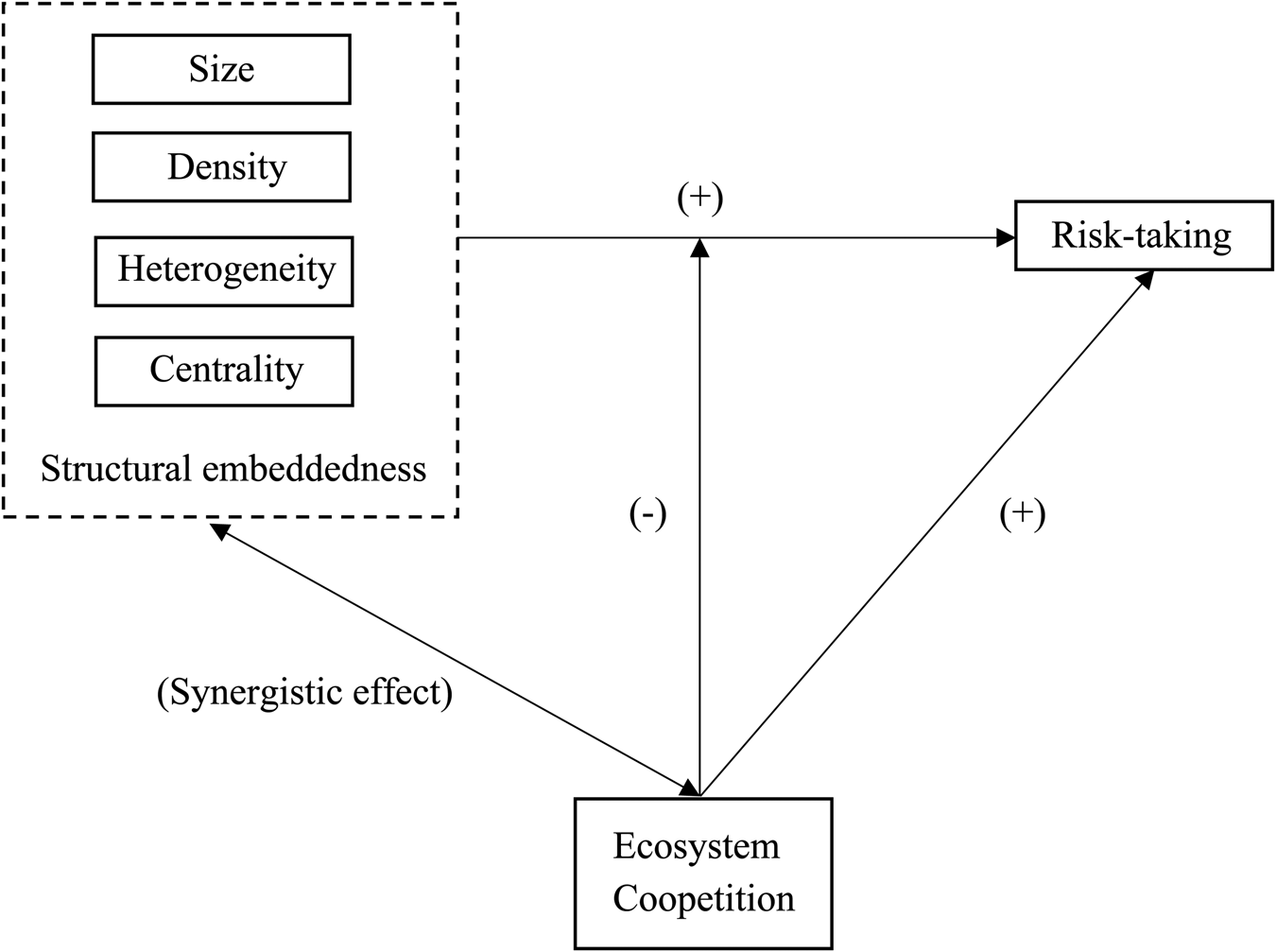
Figure 1 presents the research model, depicting the hypotheses of this study.
Proposed research model.

Methodology
Sample and data collection
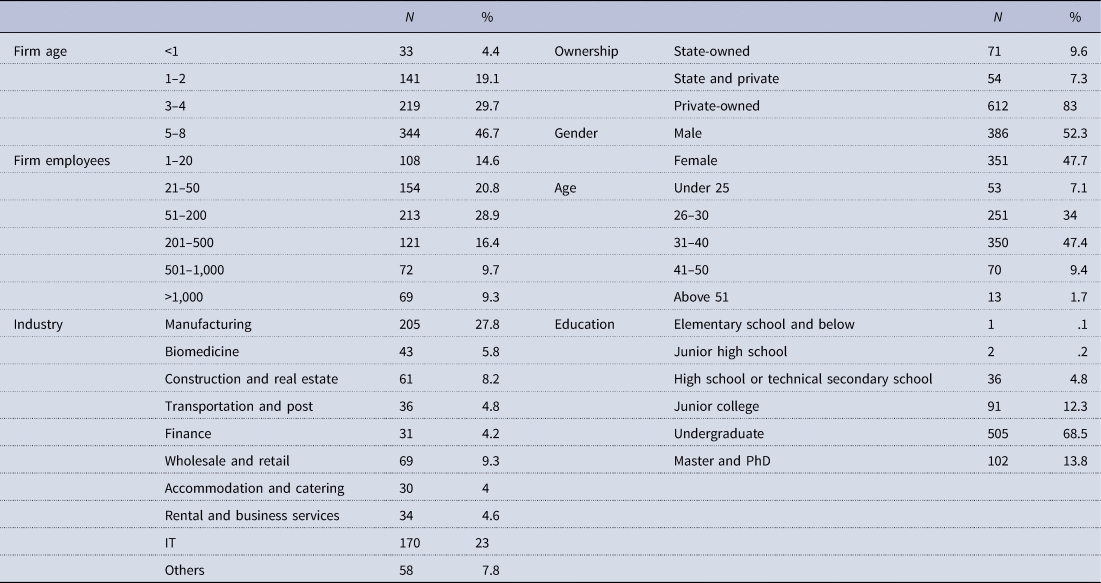
Following Zahra (Reference Zahra1993), we conducted research on companies established in Jiangsu, Zhejiang, and Shanghai within 8 years. The study was conducted from the beginning of July to the end of August 2020. According to the Amway Global Entrepreneurship Report, the Chinese government has provided effective support for startups, and enthusiasm for entrepreneurship has improved rapidly. Management research in the Chinese context has also attracted the attention of many scholars (e.g., Ren & Chen, Reference Ren and Chen2021; Wang, Yang, & Zhang, Reference Wang, Yang and Zhang2021; Zhang, Ji, Anwar, Li, & Fu, Reference Zhang, Ji, Anwar, Li and Fu2020). Jiangsu, Zhejiang, and Shanghai have the strongest entrepreneurial atmosphere, and their economic development is very close to that of Western countries (Yeh & Xu, Reference Yeh and Xu2010). After the COVID-19 pandemic, these areas are the first to resume normalization, and entrepreneurial activities in these areas may be relatively less affected by COVID-19. First, we conducted a preliminary quantitative study (guided by Hulland, Baumgartner, & Smith, Reference Hulland, Baumgartner and Smith2018) to determine the questionnaire items. In this study, we set up items, invited inner startups to fill out the questionnaire and provide their insights, and repeatedly modified the items through this dynamic process. Second, we compiled the startups' information through several methods (i.e., research reports, search engines, and government information disclosure platforms) and randomly selected several streets (e.g., Hangzhou Dream Village and Shanghai Zhang Jiang high tech Park) where startups gather to visit. We first explained the intention of the study and promised to keep the company's information confidential. We then introduced the concept of the entrepreneurial ecosystem, and only entrepreneurs who believed that the ecosystem existed were further investigated.Footnote 2 A total of 100 samples were obtained in the first round of the study. We conducted a pretest, and the results indicated that the items could be used for large-scale surveys. Third, we commissioned four intermediary platforms (e.g., credamo) to issue questionnaires. These platforms cooperate with many Chinese scholars and universities, and many authoritative journals have accepted their survey data. We compared the data obtained from three rounds of surveys, and they did not show significant differences. Through five channels, we obtained 737 samples, corresponding to a response rate of 21%. We also compared the basic information of nonrespondent firms and respondent firms to test for nonresponse bias. The results showed no significant differences; thus, our data were less impacted by selection bias. Table 1 presents details of the samples.
General sample information

Measures
Risk-taking was measured using the method of Lim (Reference Lim2018) and Sanders and Hambrick (Reference Sanders and Hambrick2007) method, which considers R&D spending, capital expenditures, and acquisition investments. They were all measured in RMB, and the unit was 10,000 yuan. We transformed them into natural logarithms and obtained a composite risk-taking index by summing them. Factor analysis indicated that these three risk proxies loaded well onto one factor (i.e., eigenvalue was 1.86, variance captured in a single factor was 61.98%, and factor loadings ranged from .767 to .818).
Network size and density were measured using the method of Lin, Tov, and Qiu (Reference Lin, Tov and Qiu2014) and Hammarfjord and Roxenhall (Reference Hammarfjord and Roxenhall2017). We used an item (i.e., number of your WeChat friends) to capture the number of direct relationships (size), as WeChat has become the main channel for Chinese people to communicate. Then, we employed an item (i.e., the number of WeChat friends you are still in contact with) to calculate the proportion of existing relative to potential connections (density).
Network heterogeneity was measured using a mature 5-point scale, which has been widely employed (see Hsueh & Gomez-Solorzano, Reference Hsueh and Gomez-Solorzano2019). Entrepreneurs were asked to report to what extent they communicate with different groups, including different genders, opinions, religions, majors, races/ethnicities, nationalities, places, and backgrounds. Following Lee et al. (Reference Lee, Choi, Kim and Kim2014), for each group, we used an item: On WeChat, how often do you communicate with people listed below? Factor analysis indicated that the eigenvalue was 2.2, variance captured in a single factor was 67.21%, and factor loadings ranged from .78 to .857. Those items were then averaged to create the index of heterogeneity (Cronbach's α = .85, AVE = .665, CR = .884).
Network centrality was measured using four items from the 5-point scale of Nyuur, Brecic, and Debrah (Reference Nyuur, Brecic and Debrah2018). We adapted these items for this article: (1) Networking with others is important to me; (2) I am very active among my network; (3) I am central within my network; and (4) I have extensive links with others. Factor analysis indicated that the eigenvalue was 1.89, variance captured in a single factor was 61.08%, and factor loadings ranged from .741 to .805. Those items were then averaged to create the index of centrality (Cronbach's α = .78, AVE = .611, CR = .825).
Coopetition was measured using four items from the 5-point scale of Bouncken et al. (Reference Bouncken, Fredrich, Ritala and Kraus2017) and Devece, Ribeiro-Soriano, and Palacios-Marqués (Reference Devece, Ribeiro-Soriano and Palacios-Marqués2019). It has been widely used in the field of coopetition. We adapted these items for this article: (1) In our ecosystem, entities cooperate with their competitors extensively; (2) In our ecosystem, entities cooperate with their competitors to achieve a common goal; (3) In our ecosystem, active collaboration with rival firms is important; and (4) In our ecosystem, competition will not hinder entity willingness to cooperate with rivals. The method of measuring ecosystem attributes through questionnaires is supported by Bischoff (Reference Bischoff2021). Factor analysis indicated that the eigenvalue was 1.72, variance captured in a single factor was 67.55%, and factor loadings ranged from .739 to .788. Those items were then averaged to create the index of coopetition (Cronbach's α = .72, AVE = .576, CR = .803).
Control variables included firm age (number of years since founded), size (number of employees), ownership (1 = state, 2 = state and private, 3 = private), industry (dummy variables of the industries mentioned in Table 1), entrepreneur gender (1 = male, 2 = female), and education (dummy variables of the academic qualifications mentioned in Table 1). These control variables have been employed by many scholars (e.g., Lim, Reference Lim2018).
Analytical techniques
Two main methods were employed in this study. Following Lewellyn and Muller-Kahle (Reference Lewellyn and Muller-Kahle2020), we used a regression model to examine Hypothesis 1a, Hypothesis 1b, Hypothesis 1c, Hypothesis 1d, Hypothesis 2, Hypothesis 3a, Hypothesis 3b, Hypothesis 3c, and Hypothesis 3d. We employed fsQCA to examine Hypothesis 4. Because the use of regression models is already common, we focus on describing fsQCA and why we employ both methods. Configuration analysis originates from scholars' interest in configuration problems and the limitations of traditional analysis methods in analysing these problems. This analysis assumes that organizational or individual behaviour and attributes are caused by multiple interdependent conditions (Palmer, Phadke, Nair, & Flanagan, Reference Palmer, Phadke, Nair and Flanagan2019; Yang & Zhang, Reference Yang and Zhang2021). FsQCA adopts a holistic perspective to conduct comparative analysis at the case level. In other words, each case can be regarded as a configuration of different conditions. In other words, fsQCA regards each sample as a case and then analyses the causal relationship between the combination of conditions (i.e., network attributes) and the result (i.e., risk-taking) through the comparison between cases. Thus, the logic of fsQCA is different from that of regression. The former focuses on the influences of different configurations, and the latter can indicate the specific relationship between variables by numerical values. Currently, in the field of management, the mixed use of these two methods is receiving increasing attention (e.g., Bouncken & Fredrich, Reference Bouncken and Fredrich2016; Hernández-Perlines, Covin, & Ribeiro-Soriano, Reference Hernández-Perlines, Covin and Ribeiro-Soriano2021; Lewellyn & Muller-Kahle, Reference Lewellyn and Muller-Kahle2020). This type of research suggests that these two methods can complement each other and make the study more in-depth. In our study, we believe that it is not enough to analyse only the impacts of various network attributes on risk-taking, as these attributes may exist at the same time and may influence each other.
Results
Assessing common method bias
We employed several methods to evaluate the magnitude of common method bias. First, we used Harman's one-factor test on all items, extracting three factors that accounted for 59.897% of the total variance (the first one explained 25.233%). Second, using MPLUS (i.e., conducting confirmatory factor analysis), we included common method deviation as a latent variable. The model fit did not improve, showing that common method bias was not significant.
Discriminant validity
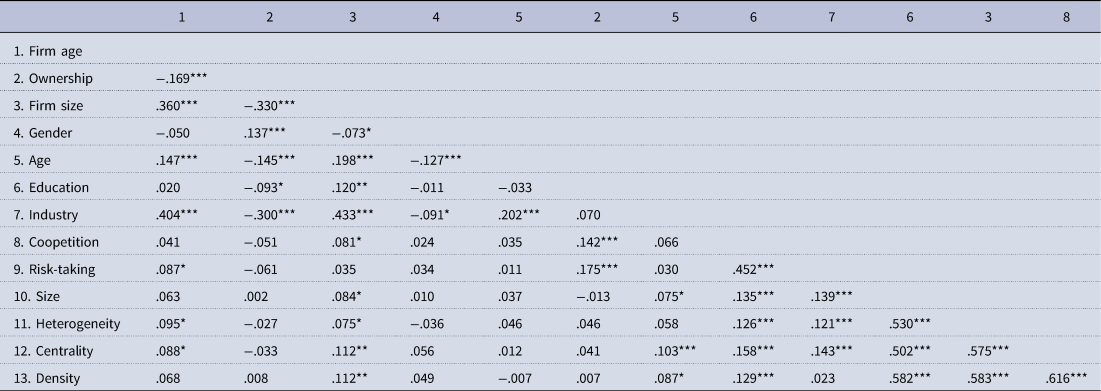
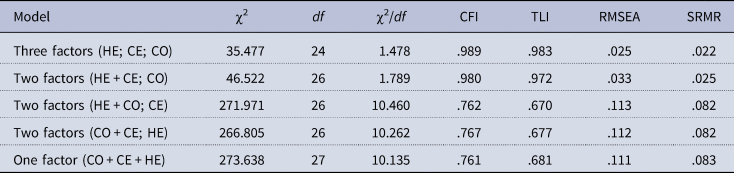
We also employed several methods to analyse discriminant validity. First, Table 2 summarizes the correlations between constructs. Our key variables show relatively high intercorrelations, with no correlation above .65 (Tabachnick & Fidell, Reference Tabachnick and Fidell1996). Second, following Kollmann and Stöckmann (Reference Kollmann and Stöckmann2014), we extracted the average variance by the variable's measure, which is larger than shared variances with others. Third, using MPLUS, we constructed a sequence of nested structural models to examine the discrimination and model fit (Table 3). The results indicate that the fit of the three-factor model is best (i.e., χ2 = 35.477, p < .001, CFI = .989 > .9, TLI = .983 > .9, RMSEA = .025 < .08, SRMR = .022 < .1). Thus, there are significant differences between the three variables, especially between coopetition and networks.
Correlation matrix

***p < .001, **p < .01, *p < .05.
Confirmatory factor analysis results

HE, heterogeneity; CO, coopetition; CE, centrality.
Regression results
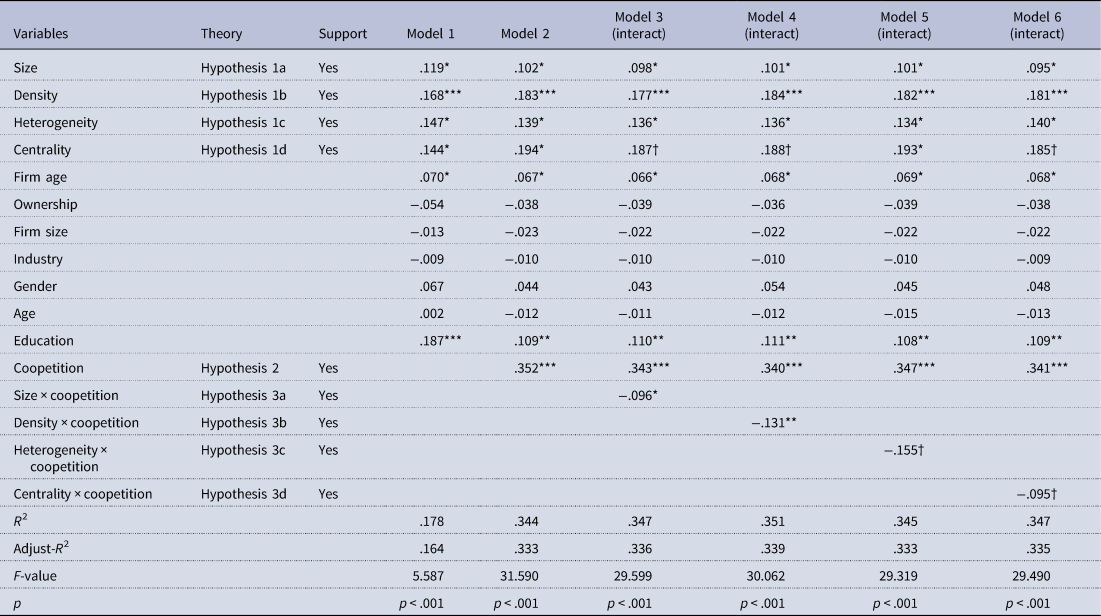
Table 4 shows the regression models, which were estimated using STATA. As expected, the results indicate that network size, density, heterogeneity, and centrality are positively related to startup risk-taking behaviour (b = .119, p < .05; b = .168, p < .001; b = .147, p < .05; b = .144, p < .05), supporting Hypothesis 1a, Hypothesis 1b, Hypothesis 1c, and Hypothesis 1d. The interactions between the networks and coopetition are shown in Models 3–6. From the results, we found that the moderating effects of coopetition were verified (b = −.096, p < .05; b = −.131, p < .01; b = −.155, p < .1; b = −.095, p < .1).
Regression models (DV: risk-taking behaviour)

***p < .001, **p < .01, *p < .05, †p < .1.
FsQCA results
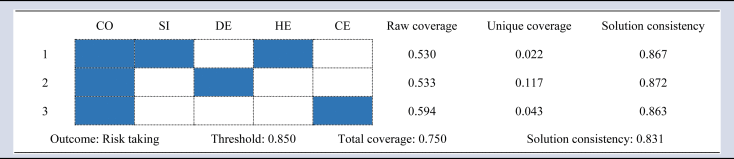
We employed STATA to examine Hypothesis 4 (Longest & Vaisey, Reference Longest and Vaisey2008). As there were no missing values, we calibrated the data using the upper quartile, lower quartile, and their mean. Following Longest and Vaisey (Reference Longest and Vaisey2008), the first step in the analysis indicated that 13.84% of startups were likely to experience all conditions at above-median levels, while the most common configuration (low coopetition and low network characteristics), with 14.79% of the sample best fitting it. The sufficiency and necessity matrix indicated that no variable was the necessary condition for risk-taking. Following Di Paola (Reference Di Paola2020), we employed .85 as the consistency threshold (the result no longer changed within the range of .7–.9). The results indicated that three configurations may stimulate startup risk-taking behaviour. These configurations can explain 75% of the cases whose risk-taking level was above average (total coverage = .75). All three configurations emphasized a high level of coopetition. At the same time, these three configurations showed the important roles of high-level density, high-level centrality, and high-level size and heterogeneity. Table 5 summarizes these configurations.
Configurations

CO, coopetition; SI, size; DE, density; HE, heterogeneity; CE, centrality.
Blue means above average, and white means the element has no influence on risk-taking.
Discussion
In this study, we explore the impacts of networks and ecosystems on startup risk-taking behaviour. As we hypothesized that coopetition and the dynamic balance of ecosystems are fit, this article combines the coopetitive attributes of ecosystems with networks. We solved the following questions: Do social networks influence startup risk-taking behaviour? How does ecosystem coopetition stimulate risk-taking and moderate the influence of networks? Is there substitution between different network characteristics?
We hypothesize four positive relationships between networks (i.e., size, density, heterogeneity, and centrality) and risk-taking to solve the first question. Through the flexible use of indicators such as finance and social media, this study adds to the literature that proposes that networks are positively associated with EO and startup risk-taking behaviour (Smith & Smith, Reference Smith and Smith2021; Su & Liu, Reference Su and Liu2019; Wu, Liu, & Zhang, Reference Wu, Liu and Zhang2017). The second question is whether coopetition influences risk-taking, and our results indicate that the characteristics of the ecosystem do affect startup behaviour. This result is consistent with Bischoff (Reference Bischoff2021); that is, the characteristics of ecosystems affect the behaviour of entrepreneurs and startups. Both methods verify the third question; that is, coopetition weakens the influences of networks, and all configurations emphasize the existence of high-level coopetition. The results of this article are consistent with previous studies (e.g., Ferris, Javakhadze, & Rajkovic, Reference Ferris, Javakhadze and Rajkovic2017), which propose that networks offer a way to share risks and intensify entrepreneurs' sense of power. Moreover, this article employs new methods to study the relationship between networks and risk-taking behaviour. Configuration results indicate that in some ecosystems (i.e., high coopetition), different structural attributes of the network may stimulate startup risk-taking behaviour. This result verifies our fourth question.
Although there have been many studies on the structural characteristics of networks, this article innovatively explores whether different features can achieve the same effect in a specific situation (i.e., entrepreneurial ecosystem). This result also indicates that there may be a certain correlation between previous studies focusing on different network characteristics. Unlike Sanou, Le Roy, and Gnyawali (Reference Sanou, Le Roy and Gnyawali2016) and Zhu et al. (Reference Zhu, Wang, Wang and Nastos2020), we did not explore coopetition from the perspective of a firm's network but explored the role of coopetition as the overall attribute of the ecosystem. We propose that coopetition activities within the ecosystem may significantly affect startups and entrepreneurs, even if the startups have not been able to participate. The moderating effects of coopetition and the results of fsQCA support the proposal of Spigel (Reference Spigel2017) and Bischoff (Reference Bischoff2021) that external ecosystem conditions do affect the behaviours of entrepreneurs and startups. Our results are consistent with some international studies. First, our configuration results support Granovetter's (Reference Granovetter1993b) proposal in the context of ecosystems; that is, different network attributes may achieve the same effect, showing homogeneity between different network attributes. Second, our regression results are similar to some previous studies, suggesting the important impact of networks and ecosystems on risk-taking (e.g., Allen, James, & Gamlen, Reference Allen, James and Gamlen2007; Boso, Story, & Cadogan, Reference Boso, Story and Cadogan2013; Cao, Simsek, & Jansen, Reference Cao, Simsek and Jansen2015).
Conclusion
The first theoretical contribution of this article relates to the attributes of ecosystems (coopetition). Unlike the traditional network perspective (Scott, Hughes, & Ribeiro-Soriano, Reference Scott, Hughes and Ribeiro-Soriano2021), although coopetition also emphasizes the interaction between entities, it may be more contradictory, dynamic, and closer to the natural ecosystem. The present article reveals the conflicts and tensions within the ecosystem from a different perspective from Nambisan and Baron (Reference Nambisan and Baron2021). Under the consensus that the ecosystem may significantly impact entrepreneurial activities (Szerb et al., Reference Szerb, Lafuente, Horváth and Páger2019), this study may help us better understand how digitalization, networks, and ecosystems currently affect value creation. Furthermore, as Spigel (Reference Spigel2017) proposed, future studies need to conduct in-depth research on the attributes of entrepreneurial ecosystems. Following Spigel (Reference Spigel2017) and Bischoff (Reference Bischoff2021), we discussed the relationship between coopetition and ecosystems and regarded coopetition as the basis of the formation and development of ecosystems. Thus, we introduce the concept of coopetition, which is defined as interactions between enterprises, into the field of ecosystems.
Our second theoretical contribution relates to the relationship between structural embeddedness and startup risk-taking behaviour. The existing literature has deeply explored the relationship between networks, resources, and risk-taking. Still, there is limited discussion on the relationship between networks and risk-taking in the context of digitalization (Elia, Margherita, & Passiante, Reference Elia, Margherita and Passiante2020). This relationship has undergone tremendous changes, and some scholars have begun to explore these changes (e.g., Smith & Smith, Reference Smith and Smith2021). Based on these studies, we expanded the model of Wong and Boh (Reference Wong and Boh2010) to integrate social networks and ecosystems in the digital era. Unlike Neumeyer, Santos, and Morris (Reference Neumeyer, Santos and Morris2019) and Scott, Hughes, and Ribeiro-Soriano (Reference Scott, Hughes and Ribeiro-Soriano2021), who deconstruct the ecosystem and explore the impacts of networks on ecosystems, this study explores how the ecosystem affects networks and risk-taking in the context of digitalization. Therefore, this article further explores SNT and SCT in the digital era, considering the roles of ecosystems and networks in providing sources. Furthermore, because of the unique attribute of ecosystems (i.e., resist risks), this article may deepen the understanding of startup risk-taking behaviour, which was always seen as a dimension of EO. Our research also shows replacement effects between different network characteristics proposed by Granovetter (Reference Granovetter1993b).
The managerial implications of the present article relate to the positive impacts of social networks and the moderating role of the ecosystem. As Ferris, Javakhadze, and Rajkovic (Reference Ferris, Javakhadze and Rajkovic2019) proposed, managers' characteristics and external situations influence risk-taking. Thus, entrepreneurs should actively cultivate their networks, which may enhance their risk-taking capability, and on the other hand, choose the appropriate ecosystem. Excellent ecosystems may compensate for the shortcomings of entrepreneurs and startups. Startups should actively participate in coopetition activities to shape the overall characteristics of the ecosystem. At the same time, it is crucial to stay or strive to stay in the key location of the network. Administrators or leaders of the ecosystem need to establish a reasonable evaluation index of the ecosystem, which some scholars have studied (e.g., Stam & Van de Ven, Reference Stam and Van de Ven2021), and work hard to maintain a healthy ecosystem.
There are also some limitations to this research, which may provide opportunities for future studies. First, we employed the questionnaire to measure the ecosystem attributes. Despite the support of the literature, we believe that using objective data or surveying regional managers may be more effective. Second, we encourage more longitudinal studies, as they may be better at explaining dynamic changes in ecosystems and startup behaviour.
Acknowledgements
This research is involved with the National Nature Science Foundation of China (71872167) and the National Social Science Fund of China under Grants (16ZDA057).
Junping Yang is a professor of management and the head of accounting department of Zhejiang Sci-Tech University. She earned her PhD from Jilin University. She has published in Chinese scholarly journals such as Management World and Nankai Business Review.
Min Zhu is a master student of Junping Yang.
Mengjie Zhang is a master student of Junping Yang. He has published in a scholarly journal Science & Technology Progress and Policy. He has an article accepted by Journal of Business-to-Business Marketing, which is scheduled to publish online on 31 August 2021.
Kai Yao is a Professor at the School of Management, Fudan University, Shanghai, China. His research interests include human resource management, entrepreneurship, and innovation management.