INTRODUCTION
Aristeus antennatus (Risso, 1816) is a shrimp species that occurs in the eastern Atlantic from Portugal to the Cape Verde Islands, and in the entire Mediterranean Sea (Udekem d'Acoz, Reference Udekem d'Acoz1999). It is an important commercial species for Mediterranean trawl fisheries. In the Balearic Islands, it represents an average 5% of the overall catch and up to 30% of the total value of these fisheries (Carbonell et al., Reference Carbonell, Carbonell, Monserrat, Grau and Demestre1999).
The larval stages of A. antennatus and Aristaeomorpha foliacea were described by Heldt (Reference Heldt1954, Reference Heldt1955) from specimens obtained from waters south and south-west of Majorca Island (Balearic Archipelago) by means of sub-surface horizontal plankton hauls carried out in late summer. Although the descriptions were based on larvae from plankton, they were comprehensive and provided sufficient morphological detail to allow the identification of the larval stages of this species, and are still used today in the key for identification of Dendrobranchiata larval stages from European waters (Dos Santos & Lindley, Reference Dos Santos and Lindley2001). Since then, A. antennatus larvae have not been found again in Balearic waters and have only been found twice in their distribution area, in the south-eastern Mediterranean by Seridji (Reference Seridji1971) and in north-eastern Atlantic waters by Dos Santos (Reference Dos Santos1998).
Several studies on the spatial distribution of A. antennatus adults and juveniles in the Mediterranean (Cartes & Demestre, Reference Cartes and Demestre2003; Sardà et al., Reference Sardà, Company and Castellón2003; Company et al., Reference Company, Puig, Sardà, Palanques, Latasa and Scharek2008) have shown that juvenile and adult red shrimp inhabit slope and bathyal areas in waters from 300 to 3300 m deep where spawning also occurs. In contrast, the spatial distribution of larval stages remains largely unknown. Therefore, new approaches are required to fill the gaps in our knowledge of the species dynamics, especially those relating to dispersal of the larval stages and recruitment to adult habitats by the decapodid stages. The availability of extensive zooplankton samples collected within the framework of the TUNIBAL project, in which around 200 stations covering all of the Balearic Sea were sampled for five years in the summer season and coinciding with the peak in red shrimp spawning (Alemany et al., Reference Alemany, Quintanilla, Velez-Belchi, García, Cortés, Rodríguez, Fernández, González-Pola and López-Jurado2010), has allowed us to partly fill this gap. Although only a portion of the available samples have been analysed so far, the results are of sufficient importance to be presented to the scientific community, as they can contribute to an understanding of the dynamic processes of larval dispersal and the connectivity of adult populations.
MATERIALS AND METHODS
The present study is based on hydrographic data and biological samples obtained within the framework of the TUNIBAL 0601 and TUNIBAL 0605 surveys, carried out from 15 June to 10 July 2001 and from 27 June to 23 July 2005, respectively, and described in detail in Alemany et al. (Reference Alemany, Quintanilla, Velez-Belchi, García, Cortés, Rodríguez, Fernández, González-Pola and López-Jurado2010). At each station, a vertical profile of temperature, salinity, oxygen, turbidity, fluorescence, pressure and a mesozooplankton oblique tow with a 60 cm Bongo net from 70 m depth to the surface was obtained. Twenty-six stations from the 2001 survey and 38 from the 2005 survey were examined (Figures 1 & 2), corresponding to those located over or near the red shrimp fishing grounds. The A. antennatus larvae were identified to species level, and their developmental stage determined, using the key provided in Dos Santos & Lindley (Reference Dos Santos and Lindley2001) (Table 1). The identifications were confirmed by reference to the descriptions in Heldt (Reference Heldt1955). Using flow-meter information, count data were standardized to ind. 100 m3.
Horizontal distribution of salinity during the 2001 survey at 10 m, with white lines for the isohalines every 0.2 salinity units, while the 36.4 isohaline is marked in thick grey. The arrows represent the geostrophic currents at 10 m depth. The white squares represent the plankton stations analysed, and the black squares the plankton stations.

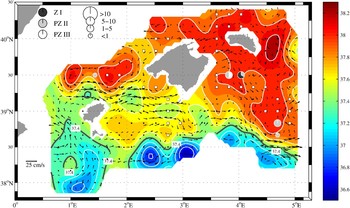
Horizontal distribution of salinity during the 2005 survey at 10 m, with white lines for the isohalines every 0.2 salinity units, while the 36.4 isohaline is marked in thick grey. The arrows represent the geostrophic currents at 10 m depth. The white squares represent the plankton stations analysed, and the black squares the plankton stations. Sampling spatial distribution and density (ind/100 m3) of the Aristeus antennatus larval stages, protozoea II and III and zoea I, are included, with the legend in the top left corner.

Stages and density (ind. 100 m−3) of Aristeus antennatus larvae found in the Balearic Archipelago in 2005 and additional information on the sampling date, GMT hour and geographical location.

RESULTS
The analysis of the presence of A. antennatus larvae confirm, not only their presence around the Balearic Archipelago, 55 years after their first and only recorded occurrence to date, but also that larvae can occur in the upper layers of the water column. No A. antennatus larvae were found in the 2001 samples, whereas they were present at five stations in 2005 (Figure 2). The larval stages protozoea II and III and zoea I were found in low numbers (from 0.44 to 1.4 ind. 100 m−3). Individuals of the older stage (zoea I) were found only in the north-eastern area, whereas the younger stages (protozoea II and III) were found at all five stations. Figure 2 shows that A. antennatus larvae were found at stations under the influence of Mediterranean waters.
DISCUSSION
Aristeus antennatus larvae were captured in the same area that Heldt (Reference Heldt1955) sampled (south-western area), but also in the south-eastern area off Majorca Island. Red shrimp larvae occur in the euphotic zone over a sea-bed of more than 1000 m deep, leading us to conclude that newly hatched larvae were able to perform a rapid and long vertical migration to the upper layers, where food availability is higher. The adult population is considered eurybathic, occurring at depths of between 400 and at least 3300 m (Sardà et al., Reference Sardà, Company and Castellón2003) and mature females were recorded at depths of up to 1000 m (Sardà et al., Reference Sardà, D'Onghia, Politou, Company, Maiorano and Kapiris2004). However, the discovery of larvae in the upper water layers leads us to propose a predictive model of reproductive dynamics, in which newly hatched larvae perform an ontogenetic migration through the water column to surface waters, where the later stages develop. This is an extraordinary migration considering the sizes of the larvae involved (around 2 mm long). The present results also corroborate the hypothesis proposed by Sardà et al. (Reference Sardà, D'Onghia, Politou, Company, Maiorano and Kapiris2004) that another major ontogenetic migration must take place when the decapodid stage move to deeper waters to reach the adults' habitat.
The circulation during 2001 (Figure 1) was characterized by an intense eastward current (velocities up to 40 cm s−1 at 20 m) associated with a strong density front crossing the Balearic Archipelago from the north of Ibiza Island to the south of Menorca Island, and following a meandering anticyclonic/cyclonic path. As a result, two anticyclonic structures were observed south of Menorca. In 2005, the situation was similar to 2001, with a density front between the northern Mediterranean waters and the southern Atlantic waters that crossed the Balearic Archipelago, and an associated jet flowing eastwards to develop an anticyclonic circulation south of Menorca (Figure 2). The main difference between the two years was that in 2001, the Atlantic waters (AW, with salinity <37.4) progressed further northwards up to the Menorca coast, even crossing the Menorca channel, as can be observed in Figure 2, where the 37.4 isohaline reached the Menorca coast and the Menorca channel. However, in 2005, the AW just reached the south of Majorca and did not flow up to Menorca, and all of the area east of Majorca and south of Menorca was occupied by typical Mediterranean waters (MW, salinity >37.8) (Alemany et al., Reference Alemany, Quintanilla, Velez-Belchi, García, Cortés, Rodríguez, Fernández, González-Pola and López-Jurado2010).
Regarding horizontal distribution, the absence of Aristeus larvae in the 2001 samples could be explained by the fact that, in that year, the surface water was AW inflowing directly from the Alborán Sea, which is far from the Balearic Islands red shrimp spawning grounds; this water covered all of the study area, displacing the surface MW northwards.
During 2005, the larval distribution shown in Figure 2 indicates that shrimp larvae appeared far from the adult fishing grounds, on the continental slope of Majorca and Menorca. However, the path of the surface (10 m) geostrophic currents north-east of Majorca and south-west of Menorca ends up south of Menorca, and therefore, these larvae could have originated in the known spawning grounds off the Balearic Islands, and afterwards been transported by oceanic currents.
Therefore, the relative distribution of both AW and MW, and the mesoscale hydrographic features associated with the interactions between these water masses and the topographic features of the Balearic Archipelago, could determine the red shrimp larvae spatial distribution and dispersal area.
ACKNOWLEDGEMENTS
This work was supported by the Autonomous Local Government of Balearic Islands and ‘the TUNIBAL projects: inner project of the IEO, and TUNIBAL II, competitive project of the Plan Nacional de I + D + I (MAR 01176)’ which provided the samples.