Introduction
Globally, climate change and anthropogenic disturbance have resulted in shifts in the distributions of many species (Parmesan Reference Parmesan2006; D'Andrea et al. Reference D'Andrea, Broennimann, Kozlowski, Guisan, Morin, Keller-Senften and Felber2009; Anderson et al. Reference Anderson, Panetta and Mitchell-Olds2012). Particularly high rates of habitat loss are predicted for bryophytes, plants and animals in mountain ecosystems (Parmesan & Yohe Reference Parmesan and Yohe2003; Raxworthy et al. Reference Raxworthy, Martinez-Meyer, Horning, Nussbaum, Schneider, Ortega-Huerta and Peterson2003, Reference Raxworthy, Pearson, Rabibisoa, Rakotondrazafy, Ramanamanjato, Raselimanana, Wu, Nussbaum and Stone2008; Bergamini et al. Reference Bergamini, Ungricht and Hofmann2009; Dullinger et al. Reference Dullinger, Gattringer, Thuiller, Moser, Zimmermann, Guisan, Willner, Plutzar, Leitner and Mang2012; Steinbauer et al. Reference Steinbauer, Grytnes, Jurasinski, Kulonen, Lenoir, Pauli, Rixen, Winkler, Bardy-Durchhalter and Barni2018). The Hindu Kush Himalayan (HKH) region is home to some of the richest and most varied ecosystems on the planet (Singh et al. Reference Singh, Bassignana-Khadka, Karky and Sharma2011) that now face substantial threats from changes in climate, land use and human population dynamics (Sharma Reference Sharma, Lamadrid and Ilan2012). Although meteorological data for the HKH region are scarce (especially for precipitation) and collected from a limited number of weather stations, they indicate that overall there is a moderate warming trend with a more pronounced temperature increase at higher compared with lower elevations (Singh et al. Reference Singh, Bassignana-Khadka, Karky and Sharma2011). The increase in average temperature ranged from 0·6 to 1·3 °C (Dimri & Dash Reference Dimri and Dash2012), the latter being considerably higher than the global average of 0·74 °C (IPCC Reference Solomon, Qin, Manning, Chen, Marquis, Averyt, Tignor and Miller2007). In general, most of the studies on precipitation in the Himalayas show a lack of any notable trends (Shrestha et al. Reference Shrestha, Wake, Dibb and Mayewski2000; Dimri & Dash Reference Dimri and Dash2012). However, it is reported that heavy rainfall events have become more common in the HKH region while the frequency of moderate rainfall events has decreased (Singh et al. Reference Singh, Bassignana-Khadka, Karky and Sharma2011). Besides the direct impact of global warming on temperature and precipitation, different climate-induced changes in Himalayan ecosystems have been reported, such as loss and fragmentation of habitats, decrease in forest biodiversity, increase in forest fire, wetland degradation and changes in land use pattern (Tse-ring et al. Reference Tse-ring, Sharma, Chettri and Shrestha2010). It is therefore very important to understand the impacts of climate change and subsequent climate-induced disturbances on the biodiversity and population dynamics of different taxa in the Himalayas because shifts in species distributions may increase their vulnerability to extinction (Lenoir & Svenning Reference Lenoir and Svenning2015; Allen & Lendemer Reference Allen and Lendemer2016).
As complex symbiotic organisms, lichens are very sensitive to environmental change including global warming (van Herk et al. Reference van Herk, Aptroot and van Dobben2002; Aptroot & van Herk Reference Aptroot and van Herk2007; Ellis et al. Reference Ellis, Coppins, Dawson and Seaward2007b; Allen & Lendemer Reference Allen and Lendemer2016). Previous studies have shown that the effect of climate change on lichens with different functional traits, including substratum preference and photobiont type, might vary considerably. For example, Aptroot & van Herk (Reference Aptroot and van Herk2007) reported the expansion of trentepohlioid epiphytic lichens in Central Europe while Ellis et al. (Reference Ellis, Coppins, Dawson and Seaward2007b) and Hauck (Reference Hauck2009) showed that significant declines have occurred for species from cold climates (i.e. arctic-alpine, boreal and montane lichens). A recent study of future climate impact on lichens on the Iberian Peninsula suggested that large cyanobacterial macrolichens are the most threatened, and as a result of climate warming they might lose c. 70% of their current habitats (Rubio-Salcedo et al. Reference Rubio-Salcedo, Psomas, Prieto, Zimmermann and Martinez2017). Over 93% of distributional loss has also been predicted under future climate change for high-elevation lichens, especially narrowly endemic species (Allen & Lendemer Reference Allen and Lendemer2016).
As a model species to evaluate the effect of climate change on the distribution of tripartite lichens (i.e. containing cyanobacterial and green-algal photobionts) in mountain areas, we chose Lobaria pindarensis Räsänen (Peltigerales; Lobariaceae), which is considered to be endemic to the Himalayas. This large foliose lichen is associated with a cyanobacterial photobiont in the genus Nostoc and the green-alga Symbiochloris reticulata (Škaloud et al. Reference Škaloud, Friedl, Hallmann, Beck and Dal Grande2016). The lichen reproduces mainly through vegetative propagules, cylindrical isidia formed at the margin of the thallus (Scheidegger et al. Reference Scheidegger, Nobis and Shrestha2010; Devkota et al. Reference Devkota, Cornejo, Werth, Chaudhary and Scheidegger2014). This epiphytic lichen grows on selected phorophyte species including Abies spectabilis, Viburnum erubescens, Ribes takare, Tsuga dumosa and Rosa sericea, though host species vary at different altitudes from temperate to subalpine zones (Devkota et al. Reference Devkota, Keller, Olley, Werth, Chaudhary and Scheidegger2017). Lobaria pindarensis was first described from the Pindar Valley in Kashmir, India (Joshi & Awasthi Reference Joshi and Awasthi1982) and was subsequently reported from several regions in eastern Nepal (Joshi & Awasthi Reference Joshi and Awasthi1982; Devkota et al. Reference Devkota, Cornejo, Werth, Chaudhary and Scheidegger2014), Bhutan (Upreti & Ranjan Reference Upreti and Ranjan1988; Upreti & Negi Reference Upreti and Negi1996; Aptroot & Feijen Reference Aptroot and Feijen2002) and China (Wang & Qian Reference Wang and Qian2013). However, there is limited knowledge about its distribution pattern, substratum and habitat requirements (Devkota et al. Reference Devkota, Keller, Olley, Werth, Chaudhary and Scheidegger2017).
Species distribution models (SDMs) are being widely used in ecological studies and conservation biology to predict the potential distribution of different species under current and future climates and to evaluate the impact of climate warming on species distributions (Guisan & Thuiller Reference Guisan and Thuiller2005; Hernandez et al. Reference Hernandez, Franke, Herzog, Pacheco, Paniagua, Qintana, Soto, Swenson, Tovar and Valqui2008; Elith & Graham Reference Elith and Graham2009; Merow et al. Reference Merow, Smith and Silander2013). This approach has also been successfully applied to lichen-forming fungi (Engler et al. Reference Engler, Guisan and Rechsteiner2004; Bolliger et al. Reference Bolliger, Bergamini, Stofer, Kienast and Scheidegger2007; Ellis et al. Reference Ellis, Coppins and Dawson2007a, Reference Ellis, Coppins, Dawson and Seawardb; Waser et al. Reference Waser, Kuechler, Schwarz, Ivits, Stofer and Scheidegger2007; Wiersma & Skinner Reference Wiersma and Skinner2011; Braidwood & Ellis Reference Braidwood and Ellis2012; Szczepańska et al. Reference Szczepańska, Pruchniewicz and Kossowska2015; Allen & Lendemer Reference Allen and Lendemer2016; Dymytrova et al. Reference Dymytrova, Stofer, Ginzler, Breiner and Scheidegger2016; Nascimbene et al. Reference Nascimbene, Gabriele, Benesperi, Catalano, Cataldo, Grillo, Isocrono, Matteucci, Ongaro and Potenza2016). In this study, we hypothesize that future climate change in the Himalayas will result in habitat loss for L. pindarensis. To test this hypothesis, we first mapped the present distribution of this epiphytic lichen based on extensive field studies in Nepal. We then used these locality data and the Random Forest algorithm to model the current distribution of L. pindarensis throughout the HKH region. Finally, we evaluated the loss of L. pindarensis habitats based on different climate scenarios in 2050 and 2070. The results of this study provide useful practical information on the distribution and substratum preferences of this endemic lichen, which is essential for further monitoring and effective conservation strategies.
Materials and Methods
Study area
The study area comprised the Hindu Kush Himalayan (HKH) region for the range-wide modelling. The HKH region extends for a distance of 3500 km over eight Asian countries from Afghanistan in the west to Myanmar in the east, encompassing four global biodiversity hotspots, 60 ecoregions and 488 protected areas. This mountainous region provides ecosystem services to more than 200 million people (Sharma & Tsering Reference Sharma and Tsering2009; Chettri et al. Reference Chettri, Shakya, Thapa and Sharma2010). The Nepal Himalaya lies within the phytogeographical transition zone between the dry western Himalaya and the wet eastern Himalaya, and is characterized by a rich regional biodiversity (Ohsawa et al. Reference Ohsawa, Shakya and Numata1986).
In the districts of Nepal which were sampled, the climate ranges from temperate to alpine along an altitudinal gradient. The temperate zone (2000–3000 m) is characterized by lower-temperate mixed broadleaved forests (1700–2200 m), temperate mixed evergreen forests (2100–2700 m), and upper temperate mixed broadleaved forests (2400–3000 m). Silver fir (2900–3850 m) and birch-Rhododendron forests (3300–3800 m) are dominant in the subalpine zone (3000–4000 m). The alpine zone (above 4000 m) contains Juniperus-Rhododendron bush (4000–4300 m), Caragana-Lonicera bush (4000–4800 m) and alpine meadows (Chaudhary Reference Chaudhary1998).
Field work and species data
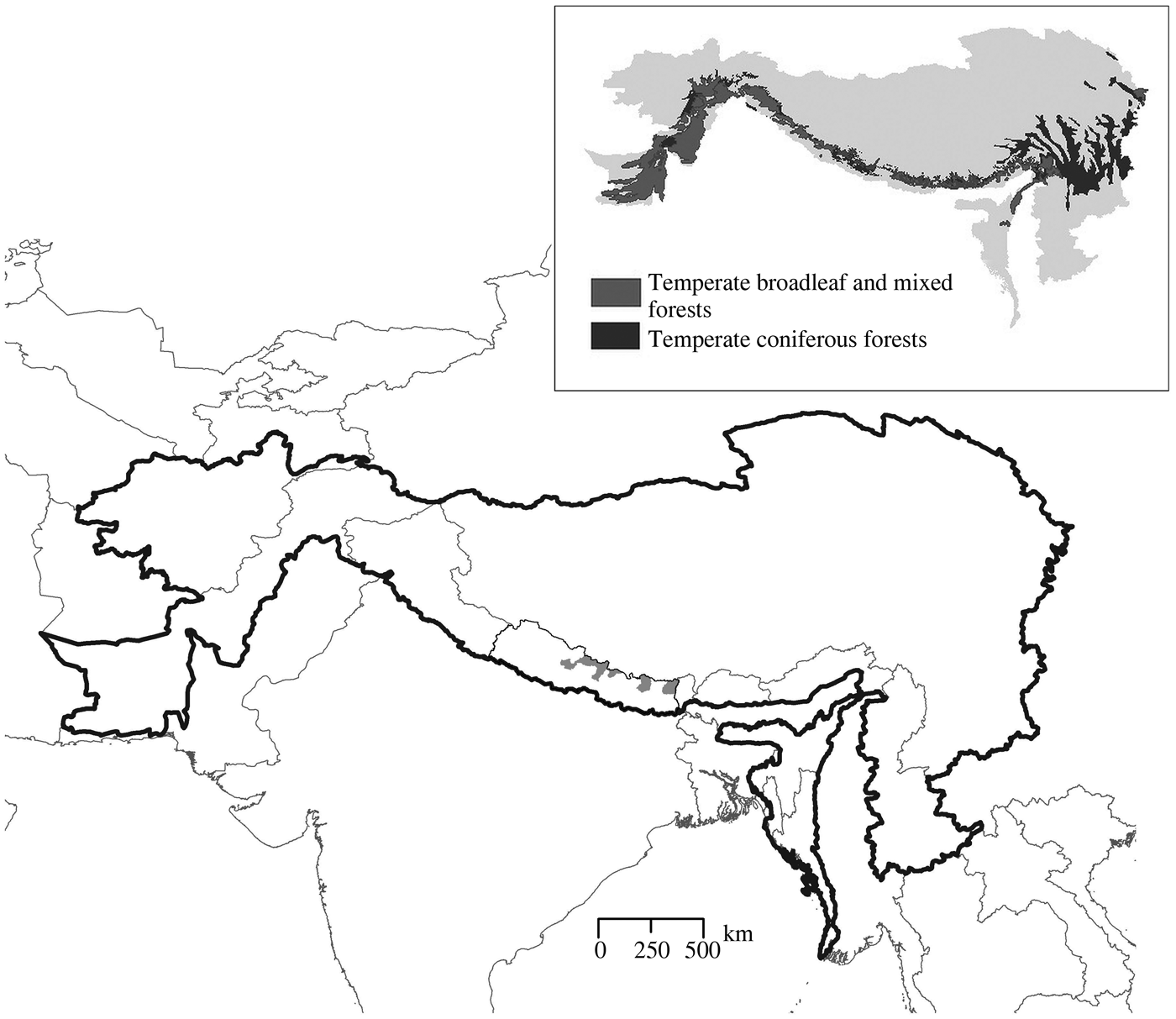
Specimens of L. pindarensis were collected during fieldwork between 2009 and 2014 in six valleys of three mountainous districts of Nepal (Fig. 1): Taplejung (Olangchung Gola and Ghunsa Valleys), Solukhumbu (Dudhkunda and Dudhkoshi Valleys) and Gorkha (Nubri and Tsum Valleys). Additional surveys were made in the Rasuwa (Gosaikunda and Kyanjin Valleys), Manang and Myagdi districts along the walking trails. The surveyed districts covered 16 655 km2 in Nepal. In total, 13 field surveys, each of 13–45 days, were organized from the mid-hills to very remote mountain areas, representing the temperate (2000–3000 m) to the alpine zones (5000 m and above) of Nepal. We searched for the presence of L. pindarensis along altitudinal and vertical gradients. In each valley, five elevation bands were selected at different locations (around 2200, 2400, 2800, 3200, 3800 m a.s.l.) (Scheidegger et al. Reference Scheidegger, Nobis and Shrestha2010; Katuwal et al. Reference Katuwal, Basnet, Khanal, Devkota, Rai, Gajurel, Scheidegger and Nobis2016; Rai et al. Reference Rai, Sharma, Shrestha, Gajurel, Devkota, Nobis and Scheidegger2016). At the “local level” (i.e. in each region and at each of the five locations), transects up to the highest elevation band were established at every 200 m to collect samples. In addition to our collections, earlier reports of L. pindarensis from Nepal (Joshi & Awasthi Reference Joshi and Awasthi1982; Devkota et al. Reference Devkota, Cornejo, Werth, Chaudhary and Scheidegger2014) and other countries of the HKH region (Joshi & Awasthi Reference Joshi and Awasthi1982; Upreti & Ranjan Reference Upreti and Ranjan1988; Aptroot & Feijen Reference Aptroot and Feijen2002) were also included in our analysis.
The Hindu Kush Himalayan (HKH) region (bold boundary) showing the districts of Nepal that were surveyed (shaded). The inset shows the distribution of temperate broad-leaved and mixed forest as well as coniferous forest in the HKH region where phorophytes suitable for Lobaria pindarensis colonization are present.

One presence point per 1 km2 from the original data set was randomly selected in order to minimize the spatial autocorrelation and to match the resolution of environmental data in the species distribution modelling. We used the ‘spThin’ package for random subsampling of our species data. The procedure was repeated 10 times resulting in 90 species occurrences to be used for further modelling.
Environmental variables
The altitude variable was derived from the Shuttle Radar Topography Mission (SRTM) digital elevation model (DEM). The SRTM DEM was obtained from http://srtm.usgs.gov/index.php in 3 arc seconds (c. 90 m resolution). The SRTM DEM features absolute vertical and relative vertical accuracies of ±16 m and ±10 m respectively, whereas absolute horizontal accuracy is ±20 m (Walker et al. Reference Walker, Kellndorfer and Pierce2007).
Bioclimatic data for both current and future climates were obtained from WorldClim in 30 arc seconds (c. 1 km resolution) (Hijmans et al. Reference Hijmans, Cameron, Parra, Jones and Jarvis2005; available at http://www.worldclim.org). WorldClim is a commonly used, freely accessible global database of temperature and precipitation variables in the form of raster data (Jarvis et al. Reference Jarvis, Yeaman, Guarino and Tohme2005). Of the original 19 bioclimatic layers, four with the lowest Pearson correlation coefficient (r ≤ 0·7) i.e. mean annual temperature, total annual precipitation, precipitation seasonality (Coefficient of Variation), precipitation of driest quarter (Table 1), were selected for further analyses (Dormann et al. Reference Dormann, Elith, Bacher, Buchmann, Carl, Carré, García Marquéz, Gruber, Lafourcade and Leitão2013).
Climatic variables at localities where Lobaria pindarensis has been observed in the Hindu Kush Himalayan region.

In this study we aimed to evaluate the impact of climate change on the species’ distribution, consequently only climatic variables were retained for modelling. Topographic predictors (i.e. altitude) were excluded from the analysis even though they are known to affect species distributions, especially in montane ecosystems (Oke & Thompson Reference Oke and Thompson2015), because they do not change in climate scenarios and their presence might render the species’ response to climate less sensitive.
Current climate refers to the period from 1960 to 1990 (Hijmans et al. Reference Hijmans, Cameron, Parra, Jones and Jarvis2005). The CCSM4 climate model (Community Climate System Model version 4.0; http://www.cesm.ucar.edu/models/ccsm4.0/) with lowest and highest concentration pathways (RCP (Representative Concentration Pathway) 2·6 and 8·5) for the years 2050 and 2070 was used for future climate scenarios. Calculated differences in temperature and precipitation based on the reference period revealed that a scenario with emission predictions of 2·6 represents a moderate future climate scenario while a scenario with emission predictions of 8·5 is considered an extreme future climate scenario. Information on habitat types in the HKH region (see insert in Fig. 1) was obtained as a digital polygon data set from the International Centre for Integrated Mountain Development (ICIMOD 2007).
Modelling and projection methods
To model the current and future distribution of L. pindarensis and evaluate the relative importance of each predictor variable, we used the Random Forest (RF) algorithm. RF is an advanced machine-learning method that can handle any type of variable (continuous or categorical), automatically considers interactions between them and produces accurate predictions with a control for overfitting data (Breiman Reference Breiman2001). RF has also been shown to be effective for future estimates of suitable habitat after climate change (Prasad et al. Reference Prasad, Iverson and Liaw2006). The model was run using the default parameters for RF with a total number of trees grown as implemented in the package ‘biomod2’ (n = 500) (Thuiller et al. Reference Thuiller, Georges and Engler2013). As the number of true absences was too small (c. 30), we randomly selected 1000 background points (pseudo-absences) from the whole HKH region. The selection of the pseudo-absences was repeated five times resulting in five data sets with 1000 pseudo-absence points in each. For classification and machine-learning techniques, randomly selected pseudo-absences and averaging several runs with a small number of pseudo-absences, yields the most reliable distribution models (Barbet-Massin et al. Reference Barbet-Massin, Jiguet, Albert and Thuiller2012). We calibrated the models with a random subset of 70% of the species’ occurrence data and evaluated them with the remaining 30%. Three evaluation metrics were calculated using the repeated cross-validation procedure (n = 10) to evaluate the accuracy of the predicted models: the area under the receiver operating characteristic curve (AUC) (Fielding & Bell Reference Fielding and Bell1997), Cohen's kappa statistic (к) (Cohen Reference Cohen1960), and the true skill statistic (TSS) (Allouche et al. Reference Allouche, Tsoar and Kadmon2006).
Variable importance values were estimated based on a randomization procedure as described by Thuiller et al. (Reference Thuiller, Lafourcade, Engler and Araújo2009). Variable importance ranges from 0, if the predictor is assumed to have no influence on the model, to 1 if the predictor is very important. The variable importance values were further transformed to the relative scores which add up to 1.
The obtained probabilities of species occurrence were projected in species distributions based on both current and future climates. Finally, we generated the ensemble distribution maps under current and future conditions by averaging the projected probabilities over fitted models (a combination of 10 repetitions and 5 runs for the pseudo-absence selection) for each climate scenario (i.e. the current, 2050 CCSM4 RCP 2·6, 2050 CCSM4 RCP 8·5, 2070 CCSM4 RCP 2·6 and 2070 CCSM4 RCP 8·5). A TSS score > 0·7 was used as a threshold to exclude the low-quality models when building the final ensemble model. To produce binary maps, the ensemble maps for current and future climate scenarios were reclassified into presence/absence values using the threshold at which the sum of sensitivity and specificity calculated on the test data (averaged over the 10 cross-validation replicates) was maximized.
The projected distribution maps (km2) were used to estimate species distribution shifts under future climate scenarios. The relative exposure (%) of species to climate change was calculated according to Rubio-Salcedo et al. (Reference Rubio-Salcedo, Psomas, Prieto, Zimmermann and Martinez2017) as follows:
 $$\displaystyle{{{\rm future\ distribution}-{\rm current\ distribution}} \over {{\rm current\ distribution}}} \times 100$$
Finally, a map providing information on habitat types in the HKH region was used as a last step to filter current predictions in order to remove areas where the presence of L. pindarensis is highly improbable (no suitable substrata available). Under a future climate, two possible scenarios of species distributions were considered: 1) without migration of species to new (previously unoccupied) locations; 2) assuming species migration (by dispersal) to new climatically suitable habitats. Since information on habitat types in the HKH region under a future climate was not available, we could not evaluate the real impact of future changes in forest areas on predicted species distribution and, therefore, our assessment of future L. pindarensis habitat loss must be accepted with caution.
Results
Occurrence of Lobaria pindarensis in HKH region
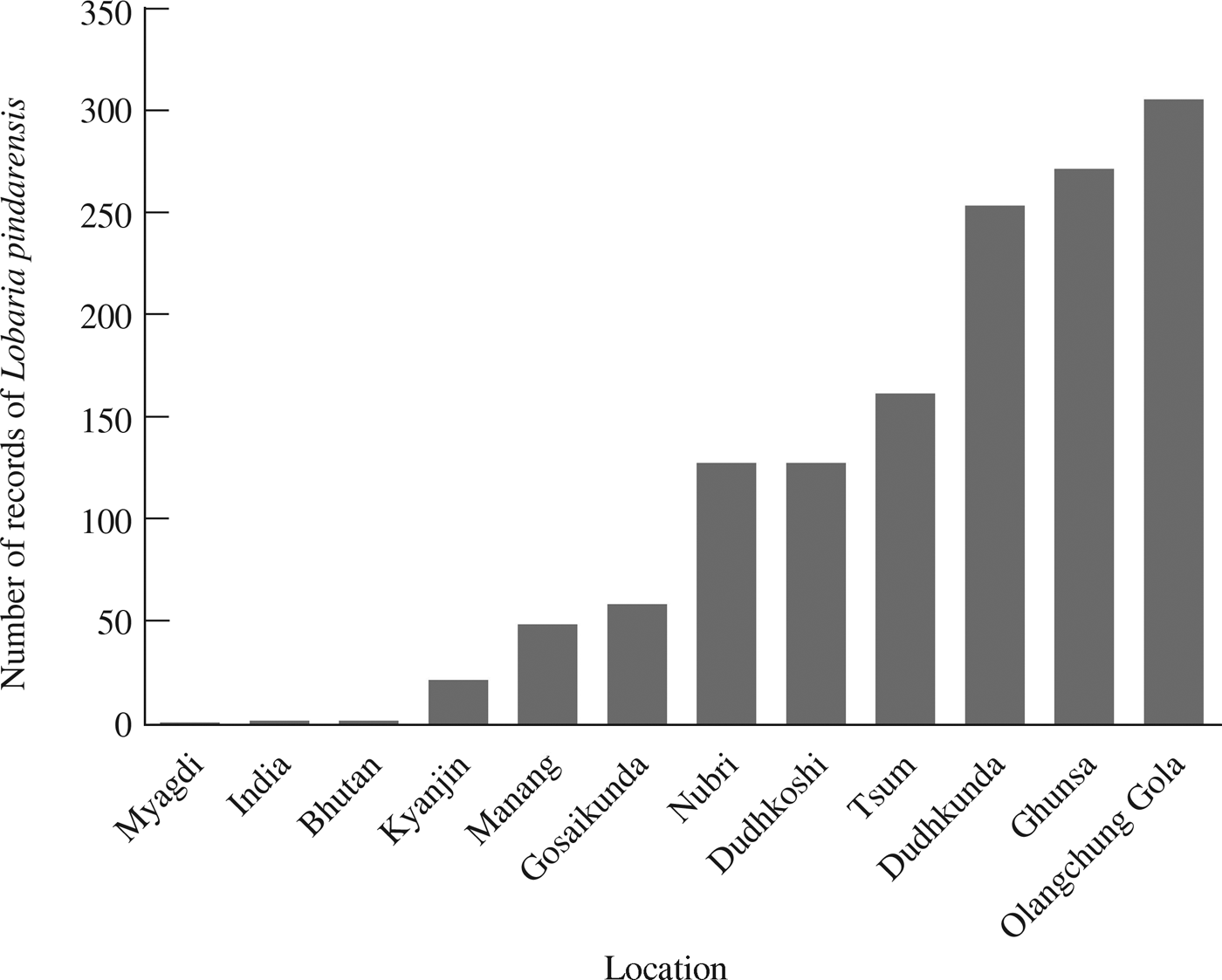
We collected a total of 1397 records of Lobaria pindarensis, comprising 1391 from Nepal and three records each from India and Bhutan. The taxonomic status of records from China (mainly Yunnan Province) in an ongoing project needs confirmation and those records were excluded in this study. The Nepal Himalayas is the stronghold for L. pindarensis, where it occurs in a wide range of locations in semi-humid to humid areas from the central to the eastern part of Nepal. The Olangchung Gola and Ghunsa Valleys of Taplejung District and the Dudhkunda Valley of Solukhumbu District in Nepal harboured the maximum number of species records, 307, 273 and 255 individuals, respectively. Very low numbers were recorded from the Myagdi District of Nepal (Fig. 2).
Number of records of Lobaria pindarensis in India, Bhutan and ten valleys in Nepal.

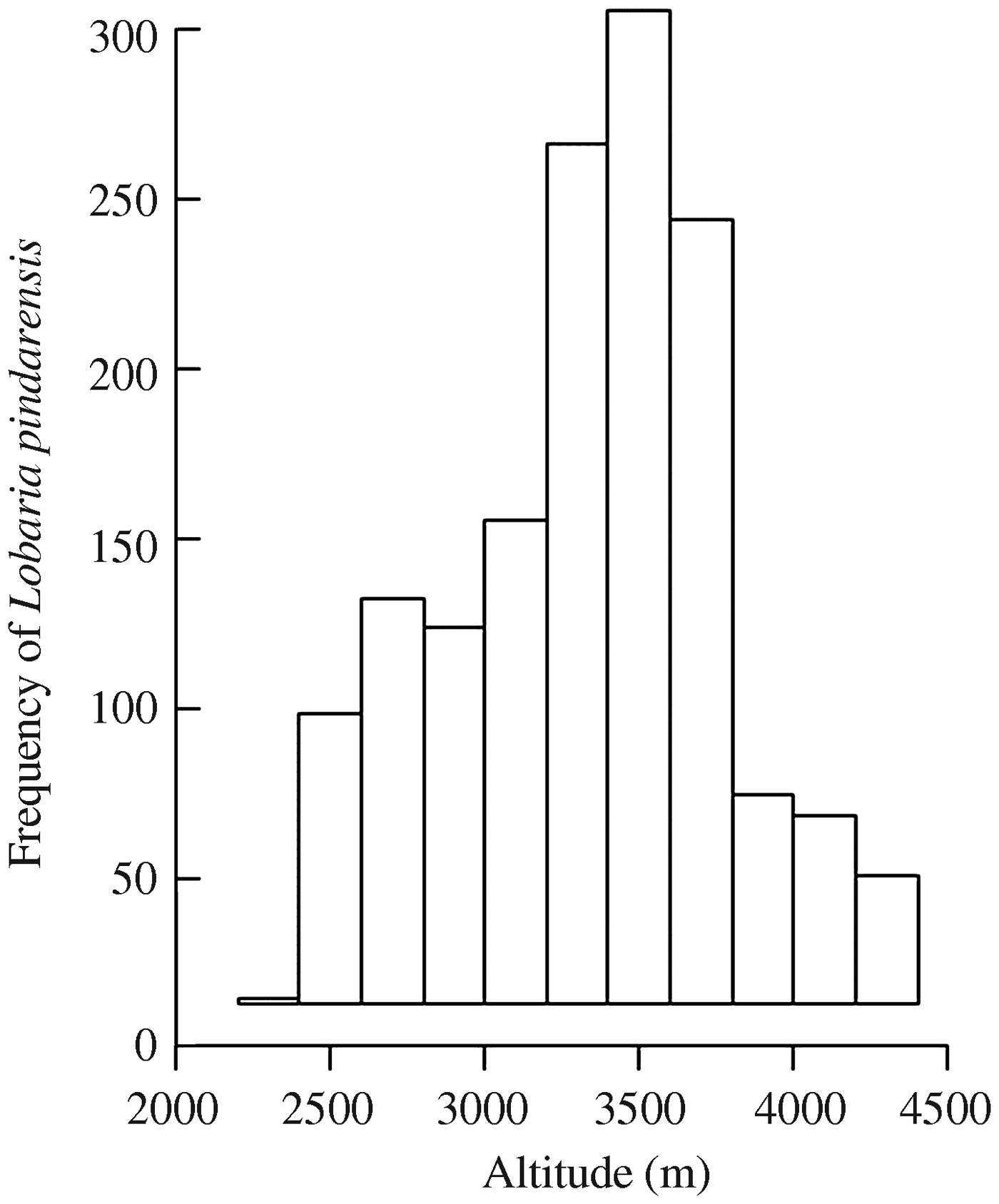
The highest number of individuals (922 or 66% of the total number) was observed between 3200 m and 3800 m (Fig. 3). The lower limit of distribution (2036 m) was recorded in Kyanjin Valley, Rasuwa, Nepal (28°09·458′N, 85°25·19′E, 21 Apr 2009), while the upper limit (4000 m) was found near Dinga Samba, Olangchung Gola Valley, Taplejung, Nepal (27°43·010′N, 87°43·998′E, 20 May 2011). The highest and lowest altitudinal limits reported for India and Bhutan were 2700–3048 m and 2400–3000 m, respectively.
The change in frequency of Lobaria pindarensis with altitude in Nepal.

Our study showed that L. pindarensis occurs mainly in coniferous (silver fir), birch-Rhododendron and varying shrub forests from temperate to subalpine zones (more than 90% of the total occurrences). Only 7% of records were documented in temperate broadleaved and mixed forests.
Model accuracy and predicted current distribution
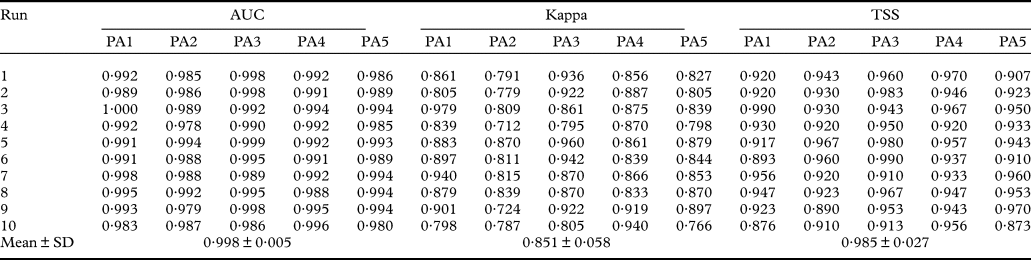
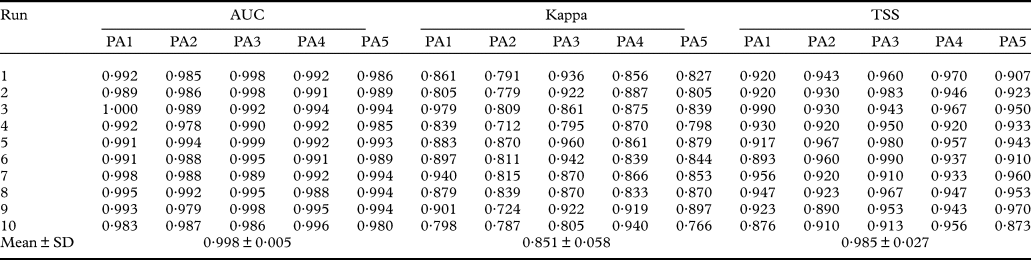
All fitted models showed high values of model accuracy regardless of the evaluation metric (Table 2). The AUC score of the final ensemble model (averaged over the repetitions and all pseudo-absence data sets) was 0·998 ± 0·005, indicating a highly predictive model performance. Among the climatic variables tested, precipitation of the driest quarter (42%) and mean annual temperature (36%) contributed most to the predicted species distribution. The mean annual temperature of current suitable habitat (obtained from the observed species localities) ranged from 0·4 °C to 13·2 °C, while the total annual precipitation ranged from 369 mm to 1898 mm (Table 1).
Model accuracy values (AUC, Kappa and TSS) for each of 10 cross-validation repetitions (runs) and each of five random pseudo-absence data sets (PA). Model accuracy (mean ± SD) is given for the final ensemble model used for the projection of species distribution to current and future climate scenarios.
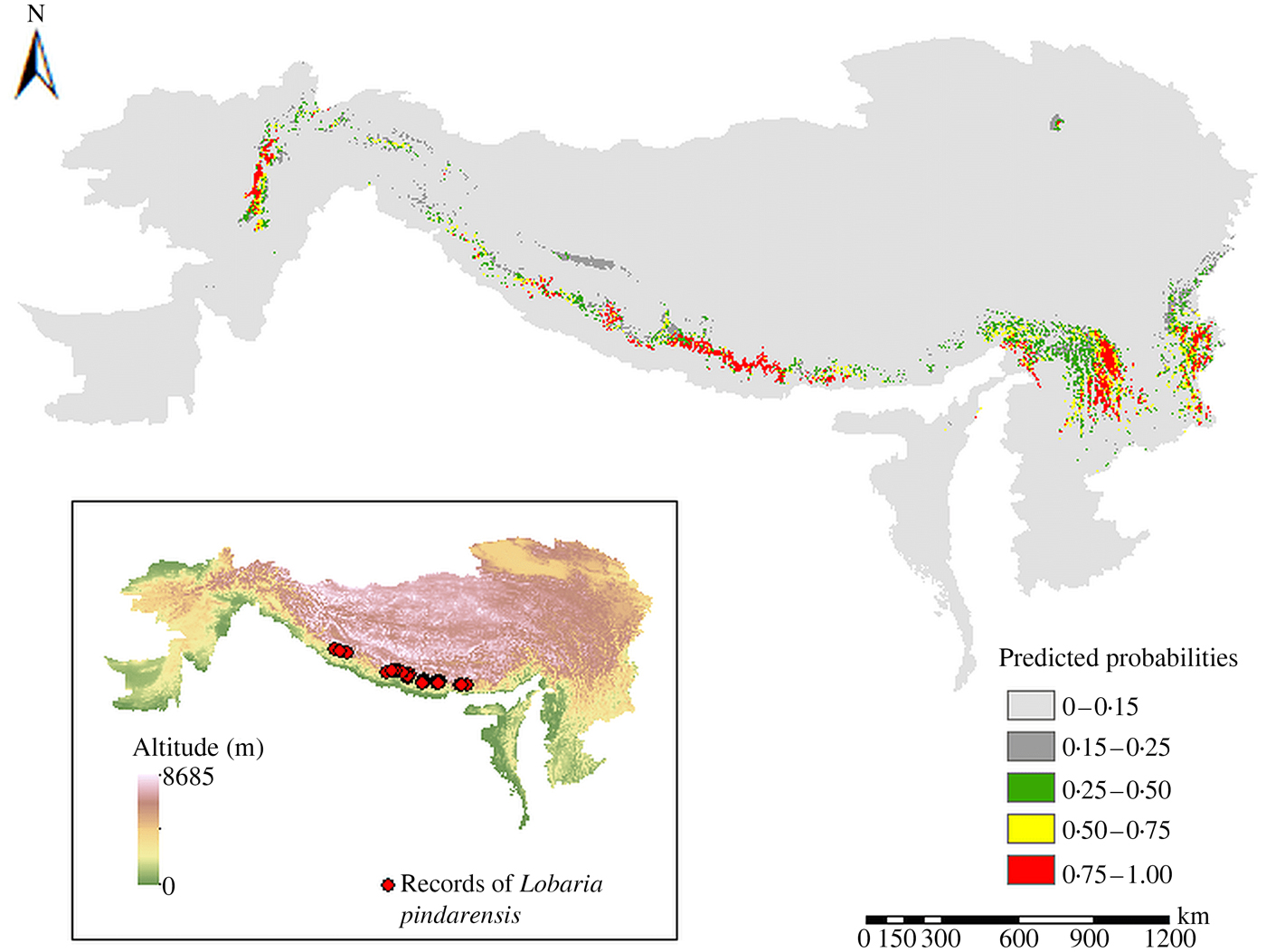
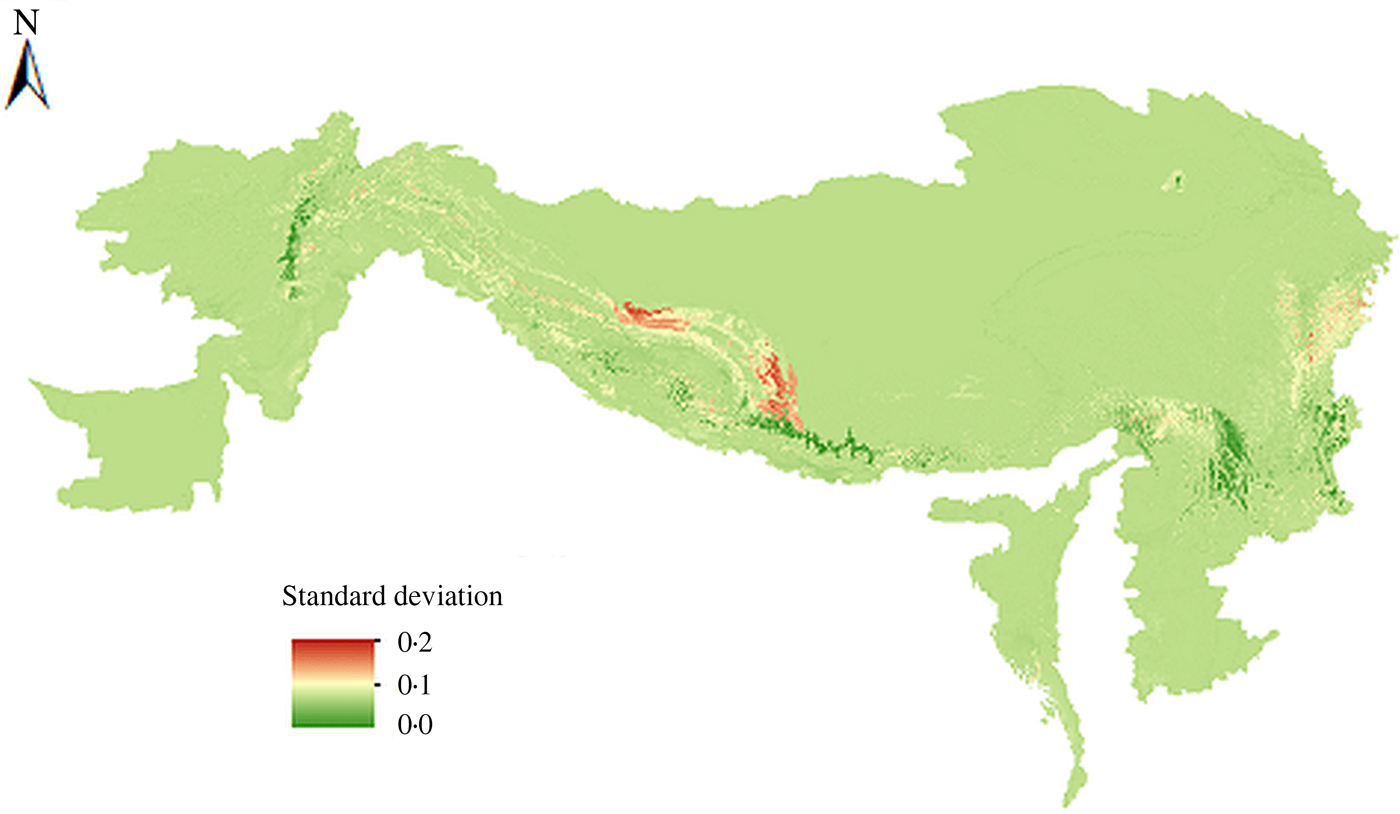
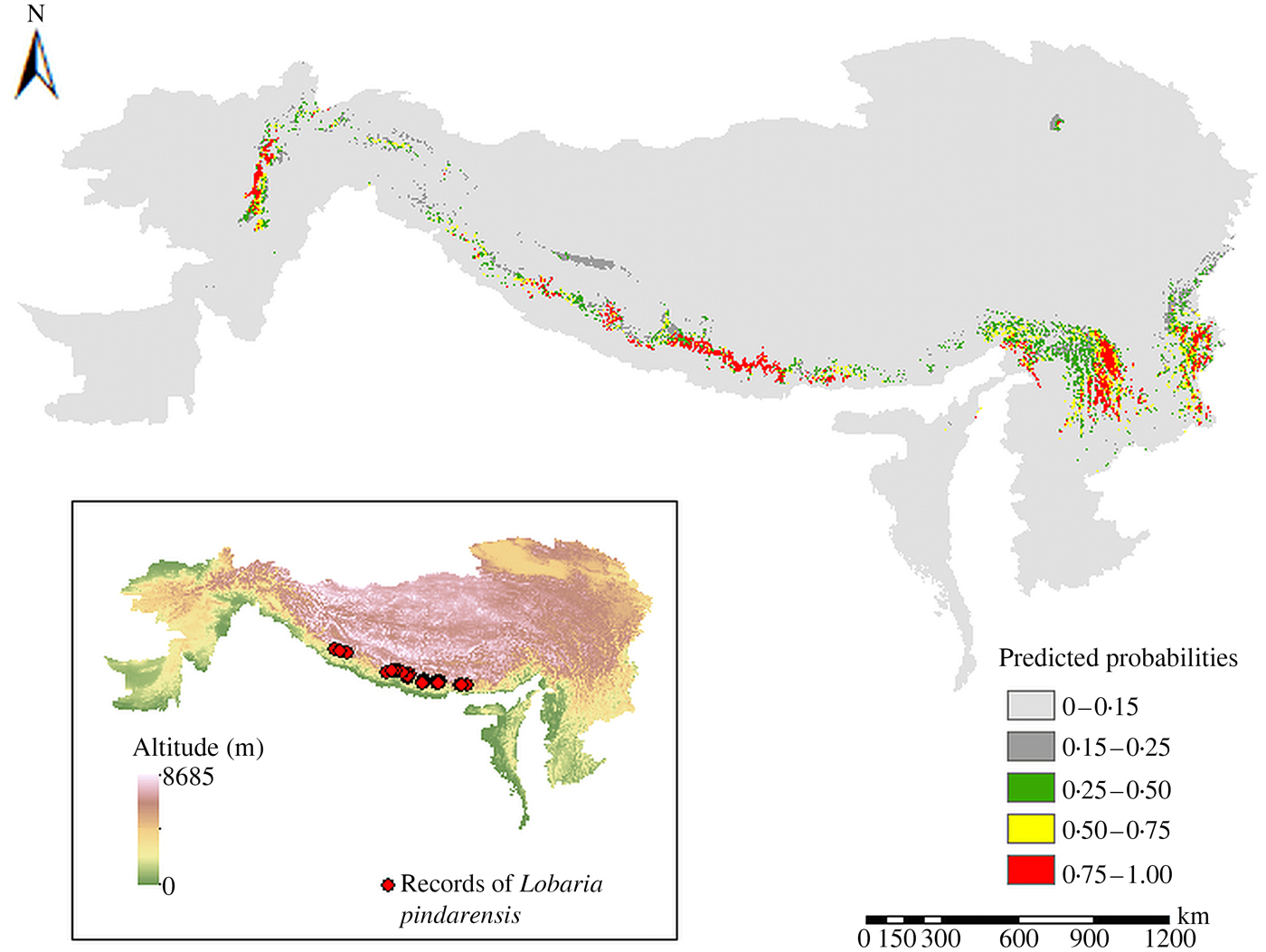
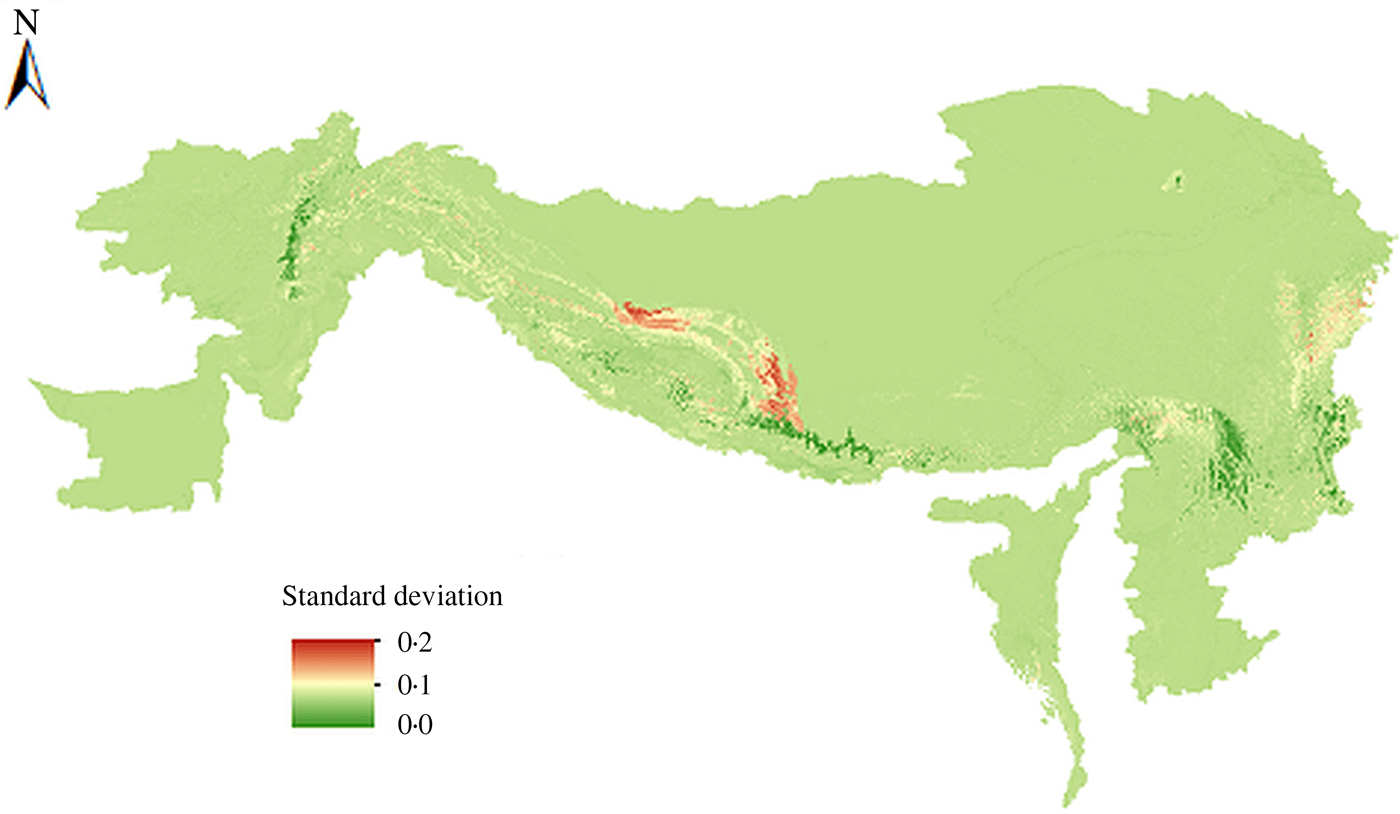
The total area of current suitable habitat (≈ climate space) for L. pindarensis in the HKH region is 74 552 km2, 28% of which is located in Nepal (Fig. 4, Supplementary Material Fig. S1, available online). The model predicted three fragmented areas where L. pindarensis might potentially occur under the current climate. When ensemble modelling uncertainty is mapped, the predicted values are highly consistent within these three potential areas (SD < 0·05; Fig. 5), with higher values of standard deviations indicating locations where the predictions of L. pindarensis distribution are uncertain. The area predicted in the middle ranges from central to the eastern Nepal corresponding to the known distribution of L. pindarensis based on observed records. In addition, new localities for this species were predicted in the Sichuan and Yunnan Provinces of China and along the northern part of the Afghanistan-Pakistan border.
Potential habitat areas of Lobaria pindarensis in the Hindu Kush Himalayan region predicted using the ensemble model. This model represents a mean of projected probabilities using all fitted models calibrated with climatic variables determined from the current climate. The inset shows current records of L. pindarensis in India, Nepal and Bhutan.
A map of the ensemble modelling uncertainty in the Hindu Kush Himalayan region. A high standard deviation indicates locations where the predicted values for the distribution of Lobaria pindarensis are highly uncertain.
Range shifts under future climate scenarios
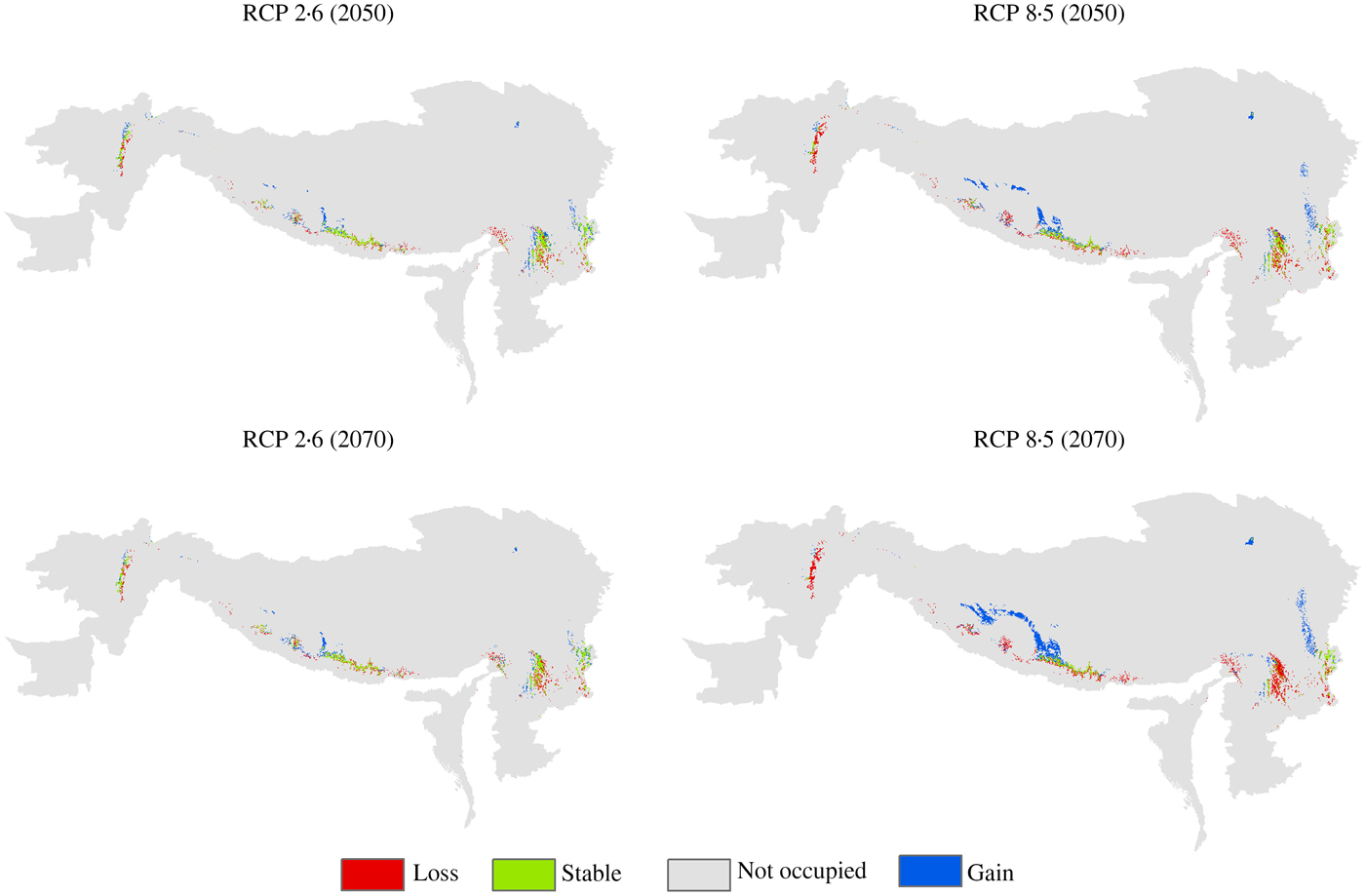
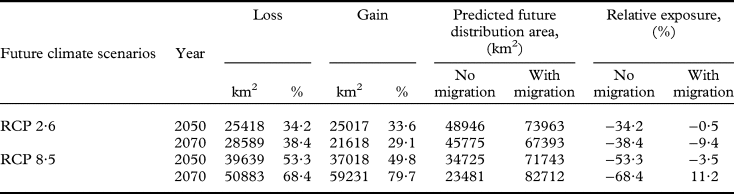
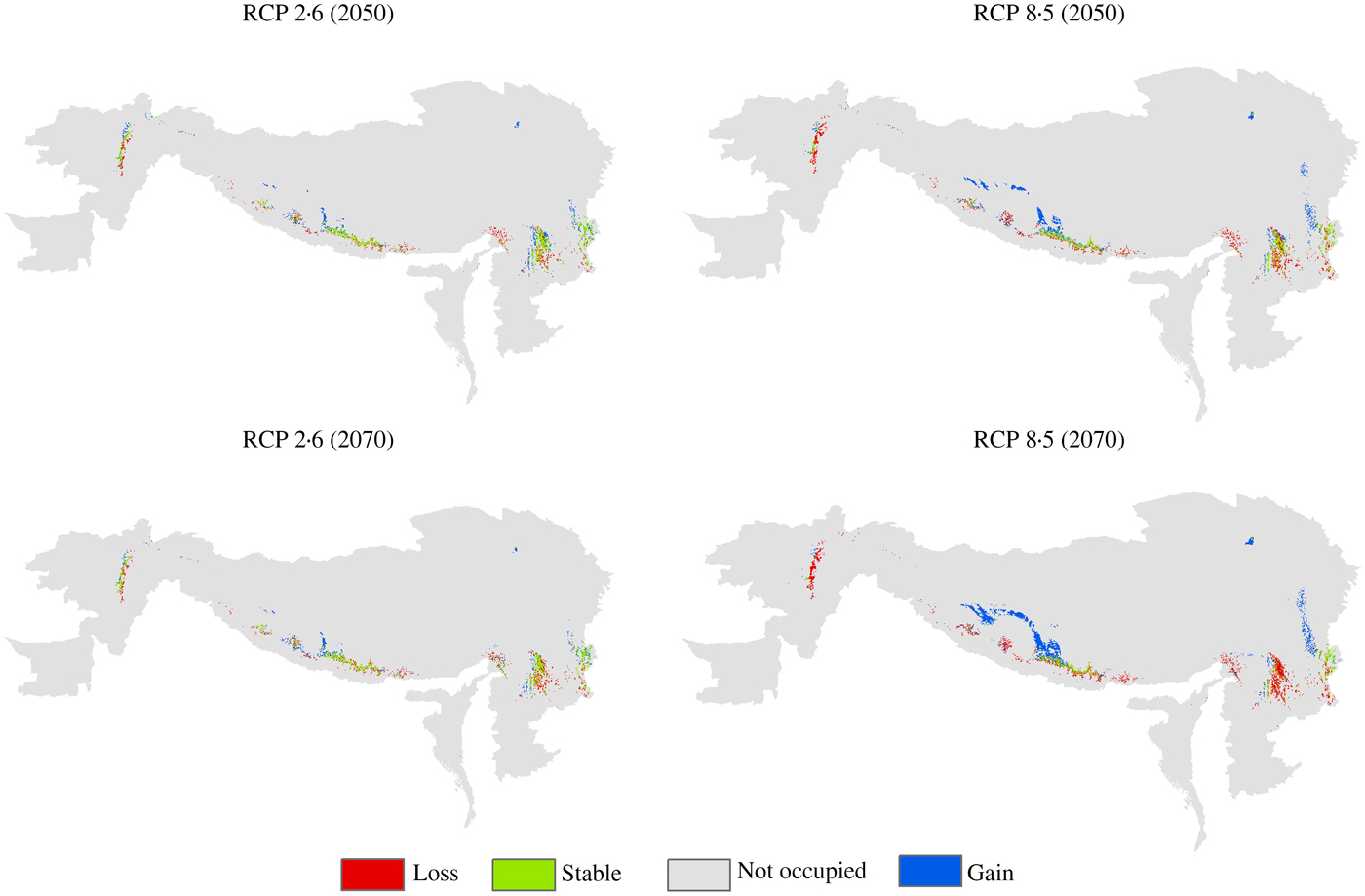
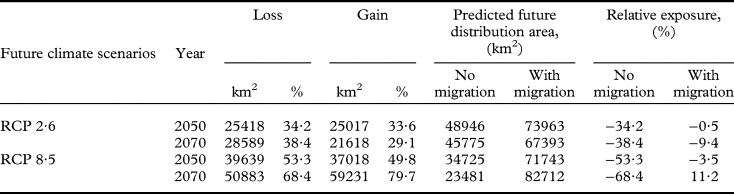
Our results showed that, depending on different climate scenarios, the existing area suitable for L. pindarensis in the HKH region will decline overall by 30–70% (Table 3, Fig. 6). The extreme future climate scenario predicted a considerably higher habitat loss (53–68%) compared to the moderate future climate scenario (34–38%). However, assuming dispersal of L. pindarensis to previously unoccupied areas which become climatically suitable for colonization, predicted habitat loss is less extreme (c. 1–9%). The extreme future climate scenario even predicted an 11% increase in distribution, based on suitable habitat and assuming successful migration of the species, though achieving this seems rather unlikely considering limited substratum availability.
Predicted change in habitat availability for Lobaria pindarensis in the Hindu Kush Himalayan region under moderate (RCP 2·6) and extreme (RCP 8·5) future climate scenarios in 2050 and 2070. Loss = predicted to be a loss of habitat; stable = stable habitat; not occupied = habitat unoccupied and will remain so in the future; gain = habitat previously unoccupied but is predicted to be occupied in the future.
Predicted loss, gain and relative exposure of Lobaria pindarensis habitats in the Hindu Kush Himalayan region in 2050 and 2070, under moderate (RCP 2·6) and extreme (RCP 8·5) future climate scenarios.
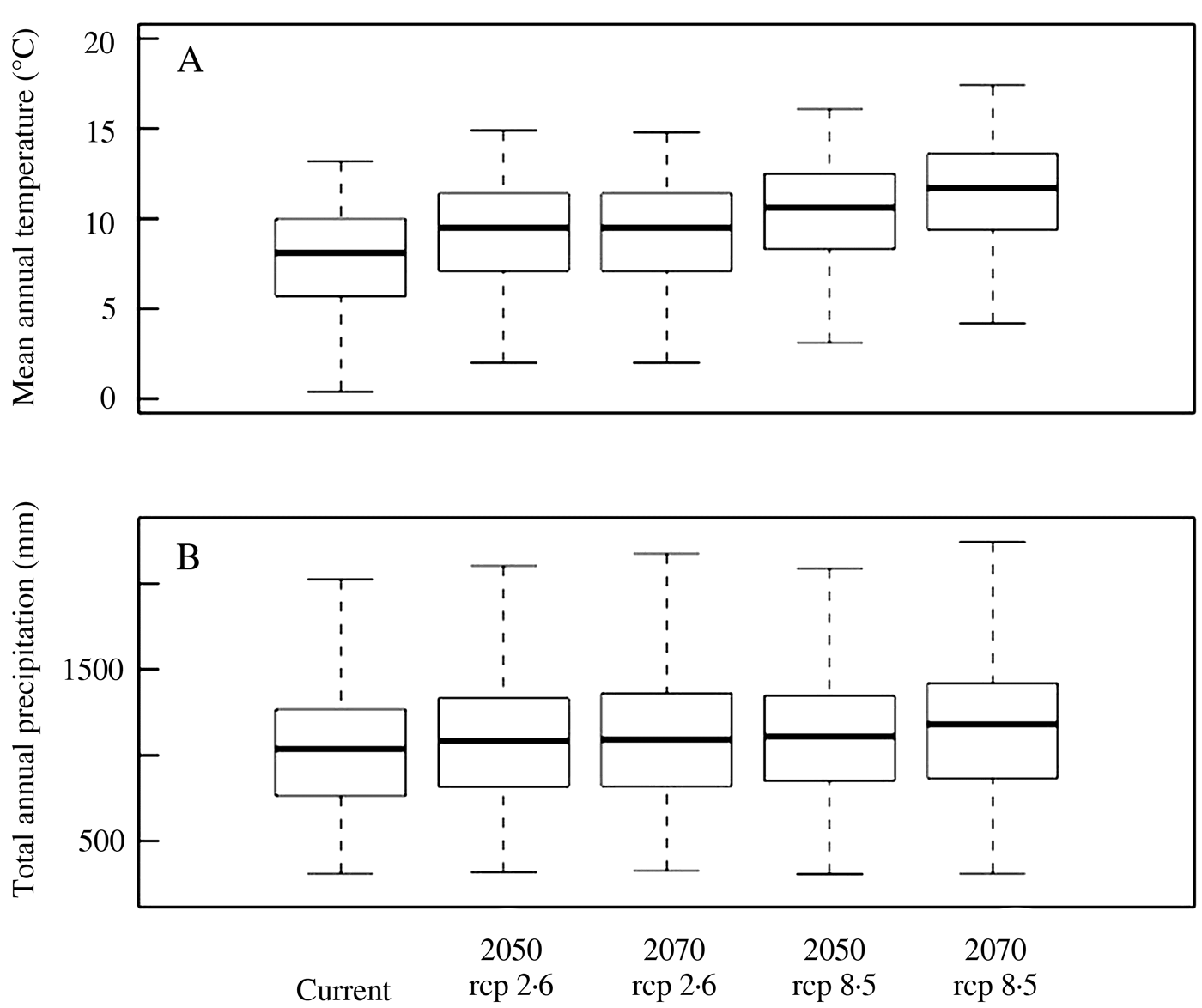
The main reason for the predicted habitat loss of L. pindarensis in the HKH region is the expected increase in temperature and precipitation. Based on the predicted changes in climate, the mean annual temperature in the predicted current L. pindarensis habitats will increase by 1·5 °C (2050) and 1·4 °C (2070) under the moderate future climate scenario; and more dramatically, by 2·7 °C (2050) and 3·7 °C (2070), under the extreme future climate scenario (Fig. 7). The mean annual precipitation in the species’ current habitats will increase by 56 mm (2050) and 64 mm (2070) under the moderate future climate scenario and by 79 mm (2050) and 125 mm (2070) under the extreme future climate scenario (Fig. 7).
Changes in mean annual temperature (A) and total annual precipitation (B) in the predicted habitats of Lobaria pindarensis in the Hindu Kush Himalayan region under moderate (RCP 2·6) and extreme (RCP 8·5) future climate scenarios in the 2050s and 2070s. ‘Current’ refers to the range of temperature and precipitation found under the current climate in the predicted localities shown in Fig. 4.

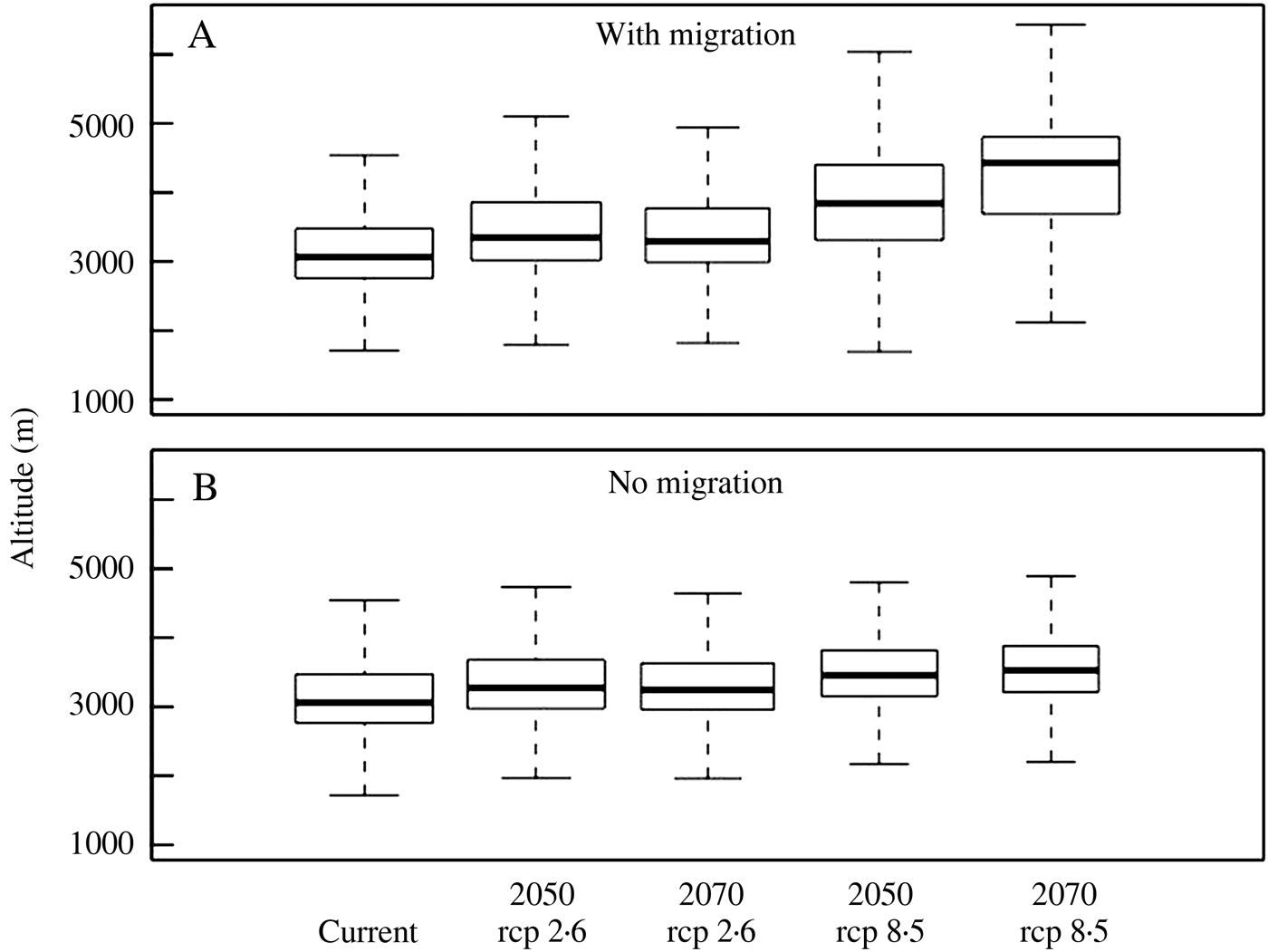
The distribution of L. pindarensis is also predicted to shift to higher elevations (Fig. 8) with a more pronounced loss of habitat under an extreme future climate scenario. In general, the southern central range of current suitable habitat is predicted to move further north by 90–100 km and then expand to the east by c. 500 km (Supplementary Material Fig. S2, available online). The potential range shift would be considerably less under a moderate climate scenario. The current habitat area in Nepal is also predicted to shift towards the north-east (Supplementary Material Fig. S2, available online), while a dramatic habitat loss is shown under future climates if species dispersal is limited by natural or human-related factors (Supplementary Material Fig. S2, available online). Furthermore, a geographical shift in species distribution is predicted to an area where the model is highly uncertain (Fig. 5).
Changes in the altitudinal range of Lobaria pindarensis in the Hindu Kush Himalayan region under moderate (RCP 2·6) and extreme (RCP 8·5) future climate scenarios in the 2050s and 2070s. A, with migration = assumption of migration to new (previously unoccupied) habitats; B, without such migration. ‘Current’ represents altitudinal range of L. pindarensis in the HKH region derived from predicted localities (shown in Fig. 4) under current climate conditions.

Discussion
Potential distribution of Lobaria pindarensis in the Hindu Kush Himalayan region
Our extensive field study in Nepal revealed an altitudinal range for L. pindarensis of 2036–4000 m. The highest frequency of occurrence was found at 3200–3600 m. This altitudinal optimum of the species coincides with the mid-elevational maximum of lichen species richness in Nepal (Baniya et al. Reference Baniya, Solhøy, Gauslaa and Palmer2010), which was reported at 3100–3400 m. Mid-elevation peaks in species richness of higher plants (Vetaas & Grytnes Reference Vetaas and Grytnes2002; Bhattarai & Vetaas Reference Bhattarai and Vetaas2003; Rokaya et al. Reference Rokaya, Münzbergová, Shrestha and Timsina2012; Subedi et al. Reference Subedi, Bhattarai and Chaudhary2015), orchids (Acharya et al. Reference Acharya, Vetaas and Birks2011), bryophytes (Grau et al. Reference Grau, Grytnes and Birks2007), birds (Poudel & Sipos Reference Poudel and Sipos2014; Katuwal et al. Reference Katuwal, Basnet, Khanal, Devkota, Rai, Gajurel, Scheidegger and Nobis2016) as well as lichens (Wolf Reference Wolf1993; Negi Reference Negi2000; Pinokiyo et al. Reference Pinokiyo, Singh and Singh2008; Baniya et al. Reference Baniya, Solhøy, Gauslaa and Palmer2010; Rai et al. Reference Rai, Upreti and Gupta2012) have previously been observed in the Himalayas. Similarly, Wolf (Reference Wolf1993) showed that lichen species richness tends to peak at intermediate altitudes in the northern Andes.
The evergreen cloud forest zone at high altitudes is composed of deciduous (Quercus semecarpifolia or Betula utilis forests) and pure or mixed coniferous forests with Abies spectabilis and Tsuga dumosa dominant (Miehe Reference Miehe1989, Reference Miehe, Miehe, Pendry and Chaudhary2015). The high rainfall (c. 4000 mm on southern slopes) and cool summer temperatures (c. 14–17 °C) of this zone favour luxuriant forests compared to the mid-hills and lowlands of Nepal (Miehe Reference Miehe1989; Bhattarai et al. Reference Bhattarai, Vetaas and Grytnes2004). Similarly, in the western dry areas of Nepal (Miehe et al. Reference Miehe, Winniger, Boehner and Zhang2001), lower abundance of foliose lichens including L. pindarensis would be expected than in the central and eastern parts of the country. Indeed, we did not observe L. pindarensis in the Dadeldhura, Baitadi, Jajarkot and Rolpa districts in western Nepal.
The potential distribution of species predicted by the SDM approach could be useful for finding suitable sites for the reintroduction and re-colonization of species or for discovering unknown populations (Pearce & Lindenmayer Reference Pearce and Lindenmayer1998; Feria & Peterson Reference Feria and Peterson2002; Raxworthy et al. Reference Raxworthy, Martinez-Meyer, Horning, Nussbaum, Schneider, Ortega-Huerta and Peterson2003; Araújo & Peterson Reference Araújo and Peterson2012). However, for the realistic forecasting of distribution patterns for epiphytic lichens, the characteristics of their host trees should also be taken into consideration (Dymytrova et al. Reference Dymytrova, Stofer, Ginzler, Breiner and Scheidegger2016; Eaton et al. Reference Eaton, Ellis, Genney, Thompson, Yahr and Haydon2018). In our study we filtered current predictions to remove areas outside of the coniferous and broadleaved mixed forests where the substrata suitable for L. pindarensis colonization occurs. Hence, three fragmented areas were predicted where L. pindarensis might potentially occur under the current climate. In addition to locations in Nepal that correspond to current records, new localities outside its known distribution were predicted in the Sichuan and Yunnan Provinces of China and along the northern part of the Afghanistan-Pakistan border. The Yunnan and Sichuan Provinces of China are situated in the eastern part of the Himalayas and south-western part of China. These provinces represent fragile mountain ecosystems harbouring diverse climatic zones and vegetation (Zomer et al. Reference Zomer, Xu, Wang, Trabucco and Li2015). Similar to Nepal, the climate of this region is also influenced by the monsoon, with dry (November–May) and wet (June–October) seasons (Yang et al. Reference Yang, Skidmore, Melick, Zhou and Xu2006). Thus, we postulate that L. pindarensis might also occur in China. On the other hand, 11 species of Lobaria (i.e. L. adscripturiens, L. dentata, L. isidiophora, L. isidiosa, L. kurokawae, L. meridionalis, L. orientalis, L. pseudopulmonaria, L. retigera, L. yoshimurae and L. yunnanensis) that need further taxonomic revision have been previously reported from these provinces (Yoshimura Reference Yoshimura1969; Wang et al. Reference Wang, Narui, Harada, Culberson and Culberson2001; Cornejo et al. Reference Cornejo, Chabanenko and Scheidegger2009; Wang & Qian Reference Wang and Qian2013). It is well known that SDM is an effective approach for predicting and discovering previously unknown populations of various taxa, in particular genetically and ecologically related species (Raxworthy et al. Reference Raxworthy, Martinez-Meyer, Horning, Nussbaum, Schneider, Ortega-Huerta and Peterson2003; Fordham et al. Reference Fordham, Brook, Moritz and Nogués-Bravo2014; Morales-Castilla et al. Reference Morales-Castilla, Davies, Pearse and Peres-Neto2017). Taking this into consideration, we believe that our distribution model might also be representative for other Lobaria species that have similar climatic and substratum preferences and, therefore, are ecologically related to L. pindarensis. In future, an intensive field survey will be necessary in these potential new areas to check for Lobaria species.
Range shifts under future climate change
Previous studies have revealed significant habitat loss for many lichen species in different geographical regions caused by climate change (Ellis et al. Reference Ellis, Coppins, Dawson and Seaward2007b; Hauck Reference Hauck2009; Lang et al. Reference Lang, Cornelissen, Shaver, Ahrens, Callaghan, Molau, Ter Braak, Hölzer and Aerts2012; Ellis Reference Ellis2013; Rubio-Salcedo et al. Reference Rubio-Salcedo, Psomas, Prieto, Zimmermann and Martinez2017). Allen & Lendemer (Reference Allen and Lendemer2016) have recently shown that climate change poses a significant threat to montane lichens, especially narrowly endemic species of high altitudes. Our models also predicted a loss of habitat (30–70%) in the Hindu Kush Himalayan region for the endemic lichen L. pindarensis under future climate change. These losses were generally more pronounced for the extreme future climate scenario (with emission predictions of 8·5) than for the moderate climate scenario (with emission predictions of 2·6). We found that under future climate change the distribution area of L. pindarensis might be shifted to high altitudes and expand further to the north-east where temperature and precipitation values will remain within the optimal range for this species. Northward and uphill migration as a response to climate change has been shown for other taxa (Parmesan & Yohe Reference Parmesan and Yohe2003; Pauli et al. Reference Pauli, Gottfried, Dullinger, Abdaladze, Akhalkatsi, Alonso, Coldea, Dick, Erschbamer and Calzado2012). However, accounting for the geographical pattern of forests where the substrata suitable for colonization by L. pindarensis occur had a significant impact on the distribution pattern of this epiphytic lichen. Information on habitat types in the HKH region is not available under future climate scenarios and, therefore, we were unable to adequately evaluate whether the predicted future distributional and altitudinal shifts in L. pindarensis habitat would be realistic. Nevertheless, we postulate that shifts to high altitudes is highly probable within the observed range of this species (up to 4000 m), while further altitudinal expansion of L. pindarensis would be limited by the timberline of coniferous and shrub forests. The Himalayas have the highest timberlines in the world (Shi & Ning Reference Shi, Ning, Ning, Rawat, Joshi, Ismail and Sharma2013; Gaire et al. Reference Gaire, Koirala, Bhuju and Borgaonkar2014) but at the same time are one of the areas most severely affected by anthropogenic and climatic impacts (Myers et al. Reference Myers, Mittermeier, Mittermeier, da Fonseca and Kent2000). Therefore, protection of high altitude forests is very important to ensure that epiphytic species can disperse upwards as the climate warms. This will mainly require fencing of some pastures to facilitate establishment of tree and shrub species at uphill sites. Furthermore, scientific evidence-based forest management at the timberline would help to balance pressure caused by the overharvesting of forests by hoteliers and the local population.
On the other hand, a distributional shift of L. pindarenis as a result of climate change is likely to be limited, as together with other species of Lobaria, it is mainly associated with undisturbed old-growth forests, which allows time for effective dispersal given the low dispersal capacity of such species (Sillett et al. Reference Sillett, McCune, Peck, Rambo and Ruchty2000; Werth et al. Reference Werth, Wagner, Gugerli, Holderegger, Csencsics, Kalwij, Scheidegger and Jesse2006; Devkota et al. Reference Devkota, Keller, Olley, Werth, Chaudhary and Scheidegger2017). Moreover, natural barriers such as mountain peaks and valleys, are expected to limit the predicted species expansion to the north-east. These factors (i.e. low dispersal capacity and natural barriers) are likely to counteract the range gain (11%) predicted by the extreme future scenario (2070) because this increase in L. pindarenis distribution is predicated on the long-distance (>100 km) migration of this species.
Finally, it should be emphasised that the predicted habitat loss of L. pindarensis in the HKH region should be interpreted with caution due to limitations of the SDM approach (Pearson & Dawson Reference Pearson and Dawson2003; Araújo & Peterson Reference Araújo and Peterson2012; Ellis et al. Reference Ellis, Geddes, McCheyne and Stansfield2017). For instance, the geographical shift in species distribution resulting from climate change includes a shift into an area for which model predictions are highly uncertain. In addition, our future models do not incorporate data on forest patterns, or species migration rates that are crucial for realistic projections of species distribution in any future climate (Engler et al. Reference Engler, Randin, Vittoz, Czáka, Beniston, Zimmermann and Guisan2009; Meier et al. Reference Meier, Lischke, Schmatz and Zimmermann2012).
Our study contributes further evidence of the high sensitivity to climate change of tripartite macrolichens in mountain areas. The predicted habitat loss for L. pindarensis in the Himalayas caused by future climate change and weak dispersal capacity emphasizes the vulnerability of this endemic species and necessitates precautionary strategies for sustainable management of the region and consequently effective species conservation.
Author ORCIDs
Shiva DEVKOTA 0000-0002-5290-1113.
We are grateful to Krishna K. Shrestha for his cooperation in implementing a collaborative research project between the Central Department of Botany, Tribhuvan University and the Swiss Federal Research Institute WSL. The Department of National Parks and Wildlife Conservation (DNPWC), Ministry of Forests and Environment (previously Ministry of Forests and Soil Conservation), the Government of Nepal and the National Trust for Nature Conservation (NTNC) are thanked for providing research permissions. Sanjeev K. Rai, Jyoti P. Gajurel, Laxmi Sankhi, Til B. Chongbang and Hem B. Katuwal are acknowledged for their valuable assistance during field trips. This research was supported by the Swiss National Science Foundation (grant JRP IZ70Z0_131338/1 to CS).
Supplementary Material
For supplementary material accompanying this paper visit https://doi.org/10.1017/S002428291900001X.