Countries that privilege men and have more men in politics are more likely to fight compared to those with more women in politics. Numerous studies support this finding (e.g., Caprioli, Reference Caprioli2000; Hudson et al., Reference Hudson, Caprioli, Ballif-Spanvill, McDermott and Emmett2009; Bjarnegård and Melander, Reference Bjarnegård and Melander2011). Less understood, however, is whether international conflict and insecurity affects male privilege in domestic politics. As McDermott (Reference McDermott2015, 754) argues, “Topics revolving around sex and gender can just as easily serve as dependent variables because many institutions and structures in international relations profoundly affect the lives and rights of women, children, and sexual minorities.” Following McDermott, recent works suggest that the relationship between gender inequality and international conflict is bidirectional. Countries that have unresolved tensions with external rivals have lower levels of women's legislative representation (Schroeder, Reference Schroeder2017; Kang and Kim, Reference Kang and Kim2020) and fewer women defense ministers (Barnes and O'Brien, Reference Barnes and O'Brien2018). These studies provide macro-level evidence that countries facing security threats have fewer women in politics.
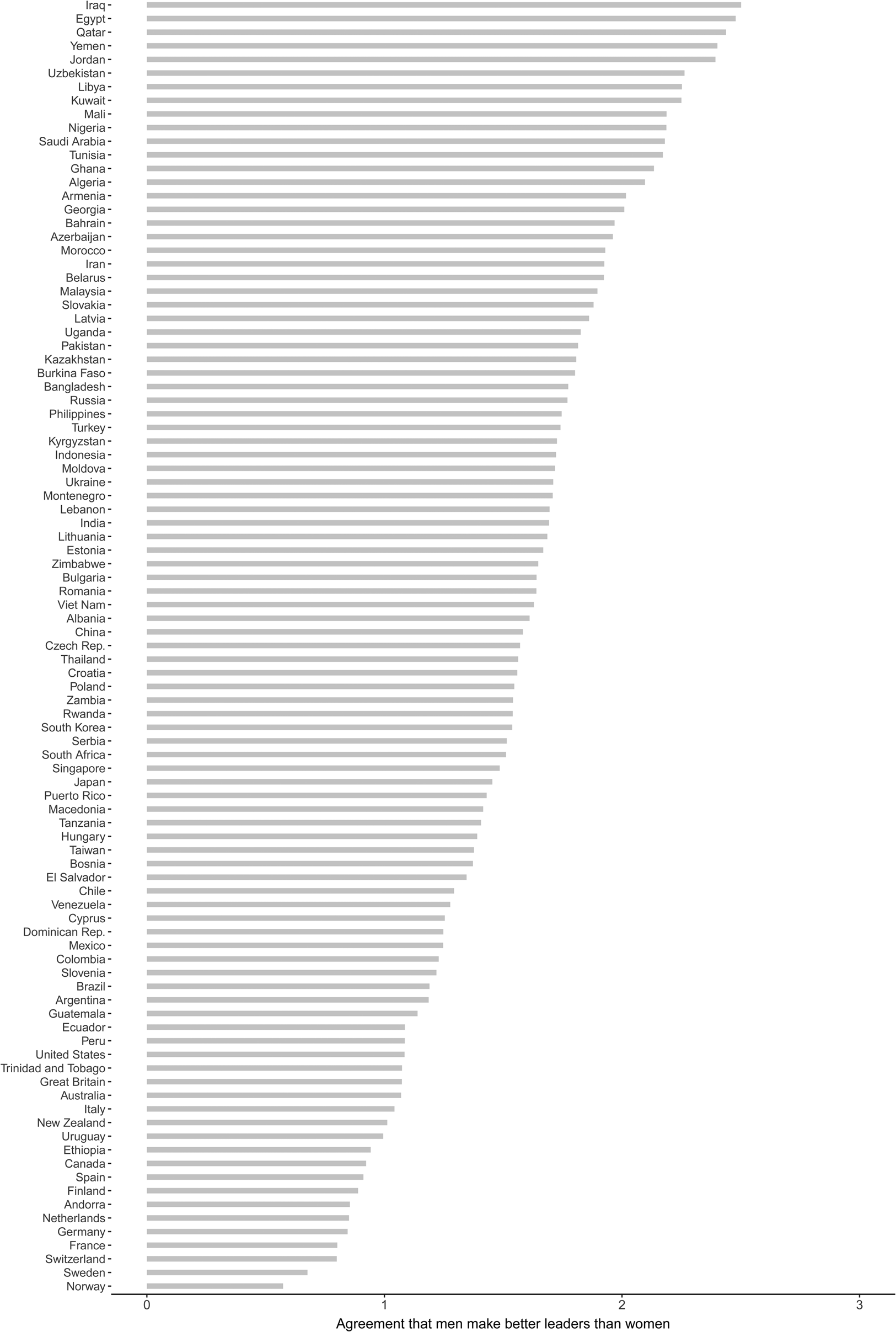
To our knowledge, scholars have not empirically examined the relationship between external security threats and support for female politicians at the micro-level, particularly outside the US context. Attitudes toward female leaders influence female political representation and empowerment, making it important to understand the sources of such attitudes (Inglehart and Norris, Reference Inglehart and Norris2003; Alexander, Reference Alexander2012). As illustrated in Figure 1, prejudice against female leaders pervades many societies despite more women holding positions of power in recent decades. At the same time, the extent to which societies prefer male over female leaders varies. External security threats have been proposed as an important source of bias against female leaders (Falk and Kenski, Reference Falk and Kenski2006; Holman et al., Reference Holman, Merolla and Zechmeister2016; Schroeder, Reference Schroeder2017; Kang and Kim, Reference Kang and Kim2020), but there has been no attempt to cross-nationally examine the relationship between external threats and individual support for female politicians. Further, existing studies have proposed but not systematically tested potential mechanisms connecting external threats to attitudes about women in politics.
Negative attitudes toward female leaders by country (scaled 0–3; averaged for each country). Data source: WVS.

This article examines whether and how external security threats shape individual-level attitudes toward female leaders across a large number of countries. We focus on the aggregate level of threat that emanates from other countries in the international system. We define a country's level of external threat as its expectations about other countries’ potential intention and ability to harm it.Footnote 1 Countries find their external security environments more threatening when they have more hostile relationships with countries that possess greater ability to cause harm. Examining the total level of threat emanating from the structural security environment is distinct from theorizing about conflict events. A country's security environment can widely differ even in the absence of actual violence. Additionally, individual preferences for male versus female leaders are shaped by socialization over an extended period as well as the immediate context. Thus, it is important to examine external security environments in addition to immediate security threats emanating from ongoing conflict events.
We argue that support for male over female leaders is higher in countries facing hostile security environments. We propose three main mechanisms in which hostile security environments lead to higher preferences for male leaders. Building on existing studies, we first hypothesize that external security threats are associated with higher demand for leaders who are strong on defense, which is stereotyped to be a male domain (Lawless, Reference Lawless2004; Falk and Kenski, Reference Falk and Kenski2006; Holman et al., Reference Holman, Merolla and Zechmeister2016). Second, drawing on the social psychology literature, we expect that threatening environments can increase prejudice against female leaders indirectly through their impact on ideological attitudes such as authoritarianism and social dominance orientation. The last mechanism we posit is a slow-moving process via militarization. Countries facing threatening security environments have larger armies and spend more on defense. This militarization incrementally reinforces gender roles in national security and socializes individuals to value men in politics over women.
For our empirical analyses, we use the World Values Survey (WVS) data on more than 200,000 individuals in more than 80 countries. We construct a country-level indicator of external threat, which is operationalized as the sum of all interstate relationships weighted by relative capability ratios and geographical proximity. Our analyses reveal that the more hostile the country's security environment, the more people are likely to agree that men make better political leaders than women. The same can be said when we control for various conflict events, such as militarized interstate disputes, terrorist attacks, and civil war. Our results are robust to using alternative measures of the external threat environment, model specifications, and estimation methods.
Additionally, we find supporting evidence for two of our mechanisms. We find that in countries with more hostile security environments, people are more likely to emphasize strong defense as a national priority, and that people who prioritize defense are more likely to prefer male over female leaders. We also find that higher levels of militarization, proxied by military size and military conscription, are associated with more unfavorable attitudes toward female leaders. However, we fail to find evidence for the second mechanism in which the security environment affects preferences for female leaders through authoritarian attitudes. Last, we hypothesize that the relationship between the security environment and preferences for male versus female leaders is conditional on the individual's gender. The result shows that the effect of hostile security environments on preferences for male leaders is greater for male respondents than for female respondents. We also find that the gap between female and male respondents regarding leaders widens as a country's security environment becomes more hostile.
By presenting the first cross-national test of the relationship between the external threat environment and individual bias against female leaders, our research contributes to the scholarship on conflict, security, and gender. Our study theorizes about and empirically examines the microfoundations of the relationship between a country's external threat environment and women's access to positions of political power. Theorizing about security threats as structural and not epiphenomenal helps us more fully understand the effect of external threats on attitudes toward male and female leaders. We test for the plausibility of three mechanisms and one set of heterogeneous effects across a large number of countries.
To the international relations literature on the impact of external threats on individual attitudes, we add a gendered lens. Previous studies show that salient threats from an outside source produces lower tolerance toward ethnic and religious minorities (Hutchison and Gibler, Reference Hutchison and Gibler2007), an enhanced willingness to restrict civil liberties (Berinsky, Reference Berinsky2009), an increase in national self-identification (Gibler et al., Reference Gibler, Hutchison and Miller2012), and a greater preference for “strong” leaders who can rule without bothering with legislatures and elections (Miller, Reference Miller2017). These works propose that external threats evoke psychological responses in individuals. We contend that these processes are gendered and that individuals in contexts of external threat are more prejudiced against female political leaders.
1. Prior work on gender, conflict, and security
While for decades, the relationship between gender and international politics was ignored in mainstream international relations theory, the study of gender and international relations has grown in recent years. Researchers have theorized and consistently found that the greater the subordination of women in a society, the more likely the country experiences armed conflict (e.g., Caprioli, Reference Caprioli2000; Hudson et al., Reference Hudson, Caprioli, Ballif-Spanvill, McDermott and Emmett2009). Together, these studies suggest that the inclusion of women in society and politics makes countries more peaceful.
Importantly, researchers have explored the relationship between gender, conflict, and security in the reverse direction. Does conflict and insecurity influence women's status relative to men? Some studies have examined the negative effects of major armed conflict on women's well-being. In wartime, sexual violence against women (and men) can be widespread (Cohen, Reference Cohen2013). Scholars also find that even if there is no outright war, countries facing ongoing threats have fewer women in positions of power and higher levels of women's unemployment (Schroeder, Reference Schroeder2017; Barnes and O'Brien, Reference Barnes and O'Brien2018; Tir and Bailey, Reference Tir and Bailey2018; Kang and Kim, Reference Kang and Kim2020). Other studies focus on civil war and find that when war results in the disruption of social norms and political institutions and mobilization of women, women can make gains relative to men, if for a short-period (Hughes and Tripp, Reference Hughes and Tripp2015; Tripp, Reference Tripp2015; Agerberg and Kreft, Reference Agerberg and Kreft2020).
Focusing on terrorist threats, research conducted in the US suggests that individuals prefer male over female candidates when national security is on the agenda. In a survey conducted after the September 11, 2001 attacks, Lawless (Reference Lawless2004) finds that 61 percent of respondents deemed male candidates and officials to be more likely to competently handle a military crisis, compared with 3 percent favoring women and 36 percent stating that men and women are equally competent. Similarly, using survey data from 2003, Falk and Kenski (Reference Falk and Kenski2006) observe that respondents who state that terrorism, homeland security, and the US war in Iraq are the most important problems were more likely to prefer a male over a female president. Further, survey experiments have found a causal link between terrorist threat, gender stereotypes, and preferences for male leaders (Holman et al., Reference Holman, Merolla and Zechmeister2016). These studies suggest that in contexts of national insecurity, manifested in the form of terrorist threats, women—especially liberal women—are evaluated more critically than other candidates.
All together, these works lead us to the general hypothesis that individuals in countries facing external security threats are more likely to prefer male over female leaders. Despite important advances in understanding the relationship between conflict, security, and gender, however, much remains obscure about the ways in which national insecurity influences individual attitudes about male and female leaders. Below, we differentiate between short-run mechanisms and long-run mechanisms that unfold gradually via societal and political changes produced by external threat environments. Despite considerable variation in international security environments, to our knowledge, few cross-national studies analyze whether a country's security environment influences gender attitudes.
2. How international security environments influence individual gender attitudes
We theorize that people are more likely to prefer male over female leaders in countries that face hostile security environments. We focus on structural security environments rather than conflict events for two reasons. First, a country experiencing no violent conflict or attack can have a hostile relationship with other countries without actively fighting or have a high level of cooperation with other countries without any possibility of war. As Goertz et al. (Reference Goertz, Diehl and Balas2016, 23) point out, “[P]eace is much more than the absence of war, …peace is a relationship, not an event.” Many hostile interstate relationships, such as the Cold War competition between the US and the Soviet Union or the post-war relationship between South and North Korea, were maintained for long periods of time without experiencing severe military confrontation. Therefore, to fully understand the effect of external threats on individual attitudes toward female leaders, we should move beyond the focus on conflict events and examine the effect of a country's threat environment that determines the expectation of future militarized confrontations.
Moreover, variation in preferences for male versus female leaders are affected by different expectations regarding the traits and competencies held by male and female leaders, as shown in a recent study conducted in eight established democracies (Geva and Taylor-Robinson, Reference Geva and Taylor-Robinson2019). These expectations are shaped by socialization over an extended period as well as by immediate social and political contexts. Thus, an exclusive focus on immediate, albeit acute, threats hinders us from fully understanding the effect of external threats on attitudes toward male and female leaders. It is important to consider external security environments as a structural determinant of gender attitudes.
2.1 Three mechanisms
We propose direct and indirect mechanisms connecting the international security environment to preferences for male over female leaders. First, we posit that the external security environment affects the evaluation of male versus and female leaders by increasing the level of perceived threats. This idea is built on studies conducted in the US on terrorist threats and gender stereotypes (Lawless, Reference Lawless2004; Falk and Kenski, Reference Falk and Kenski2006; Holman et al., Reference Holman, Merolla and Zechmeister2016). When a country faces a more threatening environment, people in the country perceive a higher level of threat and an increased need for national security. As the issue of national security becomes more salient to individuals, they tend to prefer strong leaders who are competent at defending the country against foreign enemies (Berinsky, Reference Berinsky2009). The ability to provide security becomes an important criterion for choosing leaders.
According to studies generated from a US context, people expect male candidates to be capable on military and defense and women to be competent on education, health, and poverty (e.g., Huddy and Terkildsen, Reference Huddy and Terkildsen1993; Kahn, Reference Kahn1994). Gendered expectations that men are strong on defense may stem from several sources. First, people tend to perceive men and male candidates as having aggressive, ambitious, assertive, and tough personality traits (Huddy and Terkildsen, Reference Huddy and Terkildsen1993; Schneider and Bos, Reference Schneider and Bos2014). Next, people generally assume women to have more liberal political beliefs than do men (Huddy and Terkildsen, Reference Huddy and Terkildsen1993; Kahn, Reference Kahn1994). Left-leaning ideologies are usually associated with competency in domestic and social welfare issues. Last, according to role congruity theory, a gendered division of labor in which men hold the majority of jobs in defense and women predominate in childrearing and the education and welfare sectors may contribute to different expectations about male and female leaders (Eagly and Karau, Reference Eagly and Karau2002). Given these pre-existing beliefs about the domains in which men and women excel, people in insecure environments would think men are better suited for leadership and rather have men than women in national-level office. By contrast, in times of certainty and peace, people's attention turns away from issues of national security, have less of a demand for a strong military, and are less interested in having men over women in office. The more threatening the country's security environment, and even in countries that are not militarized, the more salient is national security to individuals and the more likely they prefer male over female leaders.
Second, threatening security environments may increase prejudice against female leaders indirectly through their impact on ideological attitudes such as authoritarianism and social dominance orientation. Studies in social psychology show that external threats, including economic, social, terrorist, and political threats, are related to authoritarian attitudes, characterized by beliefs in obedience and respect for existing authorities, norms, and values (Duckitt, Reference Duckitt2001; Duckitt and Fisher, Reference Duckitt and Fisher2003; Feldman, Reference Feldman2003). Several empirical studies based on experimental and longitudinal analyses provide supporting evidence for the causal relationship between external threats and authoritarianism (Stenner, Reference Stenner2005; Onraet et al., Reference Onraet, Van Hiel, Dhont and Pattyn2013).
Particularly, Duckitt (Reference Duckitt2001) and Duckitt and Fisher (Reference Duckitt and Fisher2003) provide a theoretical framework connecting social situations, world views, personality, and ideological attitudes. According to Duckitt (Reference Duckitt2001), when social situations are more threatening, individuals are more likely to view the world as more threatening and dangerous, which activates the motivational goals of social control and security and thereby increases right-wing authoritarian ideological beliefs. Similarly, when social situations are more competitive, individuals are more likely to hold the worldview that “the world is a ruthlessly competitive jungle” (Duckitt and Fisher, Reference Duckitt and Fisher2003). This worldview leads to ideological attitudes of social dominance emphasizing the importance of power, hierarchy, and inequality.
Ideological attitudes of authoritarianism and social dominance are significantly related to prejudice toward groups such as women, homosexuals, ethnic minorities as well as militaristic attitudes and nationalism (Altemeyer and Altemeyer, Reference Altemeyer and Altemeyer1996; Stellmacher and Petzel, Reference Stellmacher and Petzel2005). Right-wing authoritarians, motivated by threat to establish social order and stability, support specific gender roles that maintain traditional values. Studies find that men and women who express ideals of right-wing authoritarianism and prioritize security are more likely to endorse hostile sexist statements (Sibley et al., Reference Sibley, Wilson and Duckitt2007). To the extent to which right-wing authoritarianism and social dominance orientation are correlated with stronger bias against women, this constitutes a second mechanism, distinct from the first mechanism above, in which the external security environment affects individual preference for male over female leaders. This mechanism has been neglected in the existing scholarship. However, we admit that this mechanism is conjectural since the link between national insecurity and authoritarianism or social dominance has not been established.
The third mechanism that we propose connects the external security environment to individual attitudes is militarization. States care about their survival and security since anarchy is an ordering principle of the international system, and states can never be certain about other states’ intentions (Waltz, Reference Waltz1979). To enhance their security and autonomy, states seek power and prepare for the possibility of future conflict. The degree of this effort depends on the country's external threat environment. Some countries face very hostile threat environments. For instance, India and Pakistan are engaged in a severe rivalry, having experienced repeated military conflict. Thus, they increase military expenditure and size, conducting and conceiving much of their foreign policy in military terms (Goertz et al., Reference Goertz, Diehl and Balas2016, 30).
Countries facing external security threats, especially threats that are structural and not epiphenomenal, are more militarized than countries that do not face such issues. As national security becomes a top political agenda, and countries invest in war preparedness, the military develops into not just a politically but also a socially powerful force. Kim (Reference Kim2019) shows that sustained threats to homeland territory create an environment conducive to the presence of military regimes. Furthermore, a political culture of militarism often reproduces over decades.
Scholars of feminist international relations show that militarization is a set of diffuse processes that shapes what men and women expect of themselves and each other. More specifically, the building of large militaries reinforces traditional gender roles because militaries are gendered to favor male conscripts and leaders (Enloe, Reference Enloe1983; Goldstein, Reference Goldstein2003; Moon, Reference Moon2005; Schroeder, Reference Schroeder2017). To recruit men into these roles, militaries rely on notions of masculinity and symbols of the male “Just Warrior” to make it thinkable for men to sacrifice their lives for the nation (Enloe, Reference Enloe1983; Elshtain, Reference Elshtain1995; Goldstein, Reference Goldstein2003). Men are expected to serve as protectors of the nation. Women are relegated to playing support roles for their sons and husbands in battle. Even in Israel where women in addition to men are drafted into the military, gendered roles are still reinforced: women are often assigned to auxiliary positions (e.g., office secretaries) (Sasson-Levy, Reference Sasson-Levy2007).
Militarization, intensified by a hostile security environment, reinforces gender roles in national security and socializes men and women to prefer male over female national-level leaders. The more militarized the society, the more people presume men are better able to handle matters of national security, even if individuals do not prioritize national defense. By focusing on the factors that influence how people are socialized, this mechanism is distinct from the first two mechanisms that are mainly driven by individuals’ perceived threats.
2.2 Conditional effects
Last, we hypothesize that the relationship between a country's security environment and preferences for male versus female leaders is conditional on the gender of the respondent. Eichenberg (Reference Eichenberg2019) reviews the large and rich literature on women's and men's attitudes toward security threats and the use of force. Studies have found that women respond to security threats differently than men (e.g., Eichenberg, Reference Eichenberg2003, Reference Eichenberg2019). Scholars agree that gendered socialization helps make men more open to taking violent measures. Women are less likely to support the use of military force and more likely to prefer peaceful solutions for interstate disputes. This may be because women are raised from a young age to compromise and to seek out peaceful solutions for conflict. Men, however, are encouraged early on to use force to resolve disputes. If women are more prone than men to seek peace in response to external threats, the effect of external threats on preferences for male leaders will be weaker among women than among men. If men do not shy away from the use of force in contexts of high external threat, they may prefer to have strong, aggressive leaders even more, either to act as a deterrent or to actually fight. This suggests that the effect of hostile security environments on preferences for male versus female leaders is greater for men than for women.
The interactive relationship between gender and the international security context also indicates that the gender gap on attitudes toward male leaders can be conditional on the security context. Women and men, on average, hold different beliefs about women's subordination and gender equality (Morgan and Buice, Reference Morgan and Buice2013). This gender gap in attitudes may be due to self-interest, as individuals adopt positions that favor their own group. In contexts of gender inequality, women are likely to prefer a more level playing field. When asked about policies such as gender quotas, women in Latin America are more likely to be supportive than men (Barnes and Córdova, Reference Barnes and Córdova2016). Women compared to men are more favorable toward giving boys and girls equal chances at having an education and toward giving women and men employment when jobs are scarce. Women are also more likely than men to disagree with the statement that men make better leaders (Seguino, Reference Seguino2011). Thus, in general, women have less patriarchal attitudes than do men (Inglehart and Norris, Reference Inglehart and Norris2003; Alexander and Welzel, Reference Alexander and Welzel2011). We expect that the gender gap on attitudes toward male leaders will widen in contexts of external threat.
2.3 Testable hypotheses
Consistent with the discussion above, we test the following hypotheses. H1 concerns the relationship between the total level of external threats and preferences for male over female leaders.
H1 The more threatening the country's security environment, the more likely individuals prefer male over female leaders.
Next, we formulate three hypotheses that examine mechanisms linking external security environments to preference for male over female leaders.
H1a The more threatening the country's security environment, the more individuals prioritize national defense, which in turn makes them more likely to prefer male over female leaders.
H1b The more threatening the country's security environment, the more individuals possess right-wing authoritarianism, which in turn makes them more likely to prefer male over female leaders.
H1c Threatening security environments are associated with higher levels of militarization (military spending and military size), which in turn makes individuals more likely to prefer male over female leaders.
Last, we formulate two conditional hypotheses regarding the gender gap in attitudes toward male and female leaders:
H2a The effect of the country's security environment on preferences for male versus female leaders is greater for men than for women.
H2b The gap between women and men in preferring male leaders widens the more threatening the country's security environment.
3. Data and method
We hypothesize that the more threatening the country's security environment, the more likely individuals prefer male over female leaders. To test this hypothesis, we use the WVS individual-level data. Our dependent variable comes from responses to the statement, “On the whole, men make better political leaders than women do.” Possible answers include “strongly disagree,” “disagree,” “agree, “agree strongly,” or “don't know.” Following previous studies, we collapse this measure into a binary variable where one indicates a response of agree strongly or agree, and zero indicates a response of disagree strongly or disagree.Footnote 2 Figure 1 at the beginning of this article displays the average responses across countries.Footnote 3 The figure illustrates a high degree of heterogeneity across countries, with the average response ranging from 1.57 in Norway to 3.50 in Iraq. The maximum sample includes 94 countries. The sample period is 1995–2014 since WVS's first two waves (1981–1984 and 1990–1994) do not contain this question.
Our primary independent variable is the country's external security environment. To create a country-level indicator of external threat, we posit that three factors influence the level of threat a state faces from another state: the degree of hostility, the relative distribution of military capabilities, and the distance between the pair of countries. As the relationship between two countries is more hostile, and the other state is more militarily powerful and geographically close, the state perceives greater potential threat from the other state. We operationalize total external threat as the sum of all interstate relationships weighted by relative capability ratios and geographical proximity.Footnote 4

d ijt is the distance between state capitals, r ijt is the interstate relationship between two countries, and p ijt is the ratio of military power. This operationalization summarizes a country's dyadic relationships and produces an indicator of each country's external security environment in a given year.Footnote 5
To measure interstate relationships r ijt, we conceptualize hostility between two countries as a relationship rather than an event. To identify pairs of countries, Goertz et al. (Reference Goertz, Diehl and Balas2016) use several criteria: contiguity, major power relationships with other states, military alliances, common membership in a strong regional economic organization, rivalry, or colonial relationship. They measure the level of peace for a dyad that meets at least one of the criteria. Accordingly, N it above is the number of interstate relationships for country i in year t. Goertz et al. construct a five-point peace scale to evaluate the relationship between two countries ranging from very hostile to very peaceful. The five levels are “severe rivalry,” “lesser rivalry,” “negative peace,” “warm peace,” and “security community.” Severe and lesser rivalries denote hostile relationships in which the two countries have war plans and the main issues are salient and unresolved. When two countries are at negative peace, there is an absence of violent conflict but still the possibility that military force could be used in the future. Warm peace and security community belong to the category of positive peace, a situation where the use of military force as a means to resolve disputes is unthinkable. We collapse warm peace and security community into one categoryFootnote 6 and then invert the dyadic indicator so that larger values indicate a more hostile security environment.
For relative capability ratios p ijt, we need a measure of a state's military capabilities. Following the international relations literature, we use the Correlates of War Composite Index of National Capabilities (CINC) score that combines population, urban population, iron and steel production, energy consumption, military personnel, and military expenditures. We calculate p ijt as a proportion of the other state's CINC score relative to the sum of CINC scores in each dyad. It ranges between zero and one. We measure the distance between state capitals using the CEPII gravity database (Head and Mayer, Reference Head and Mayer2014).
Building on previous studies, we include a variety of individual-level and country-level controls (Inglehart and Norris, Reference Inglehart and Norris2003; Seguino, Reference Seguino2011; Morgan and Buice, Reference Morgan and Buice2013). The individual-level controls include a respondent's age, gender, marital status, highest educational level attained, religiosity, and two binary variables indicating whether the respondent reports to be Catholic or Muslim. These covariates come from the WVS. For country-specific controls, we include the natural log of real gross domestic product per capita, the Polity2 score to measure the level of democracy, the percentages of Muslim and Catholic adherents in a country, the percentage of female employment, and the percentage of seats held by women in the lower or single house of each country's national legislature.Footnote 7
To account for non-independence due to clustered observational units and country and temporal heterogeneities, we estimate multilevel models that nest individuals inside countries and years. Thus, the intercepts are allowed to vary randomly across years and countries.
4. Results
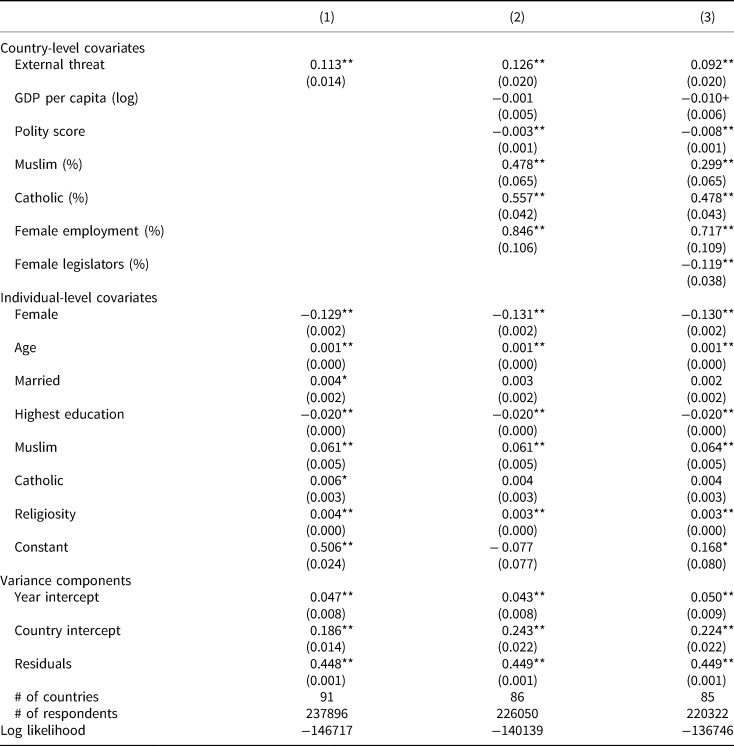
We first explore whether facing a more hostile security environment corresponds with preference for male over female leaders. Column 1 of Table 1 only includes External threat and individual-level controls. Consistent with our expectation, External threat is associated with negative attitudes toward female leaders. In countries facing a more threatening security environment, citizens are more likely prefer to have men in political office. The result holds when we include country-level covariates in column 2 of Table 1. Even when we add potential country-level confounding variables such as the log of GDP per capita, the level of democracy, the percentage of the Muslim population, and the percentage of female employment, External threat remains positive and statistically significant. Substantively, an increase in External threat of two standard deviations (≈ 0.63) is associated with an 8 percentage point increase in the probability of expressing agreement with the statement that men make better political leaders than women do. This effect size is quite large given that the same change in Polity score is associated with a 3.4 percentage point decrease.
Multilevel models of preferences for male leaders

Note: +p < 0.1, *p < 0.05, **p < 0.01
Studies find that having more women in legislatures is associated with a reduced likelihood of experiencing war and militarized interstate disputes (e.g., Caprioli, Reference Caprioli2000; Hudson et al., Reference Hudson, Caprioli, Ballif-Spanvill, McDermott and Emmett2009). This suggests the possibility of reverse causality that greater individual preferences for male leaders produce a smaller number of women in legislatures, which may play a role in deteriorating a country's security environment. In column 3, we add the level of female legislative representation to control for this pathway, although we cannot firmly rule out reverse causality.Footnote 8 Column 3 shows that the coefficient on the level of female legislative representation is negative and significant. However, even after adjusting for the level of female legislative representation, External threat remains positive and statistically significant, although External threat decreases in magnitude.Footnote 9
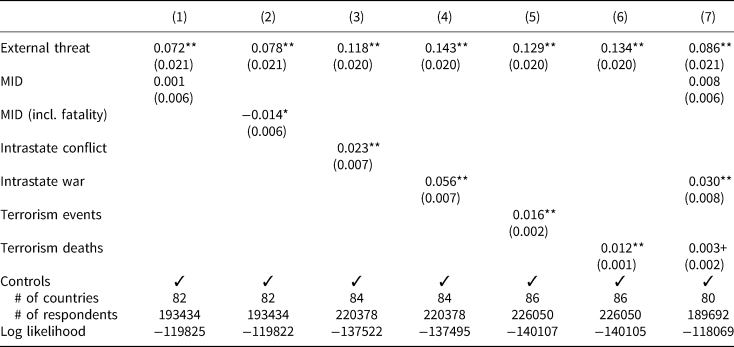
Next, Table 2 examines whether the international security environment correlates with individual attitudes toward leaders when we control for recent violent events. To capture immediate threats from conflict events, we consider three different measures: militarized interstate disputes, internal conflict, and terrorist attacks. For militarized disputes, we use the Militarized Interstate Dispute (MID) dataset. We create two binary variables that record whether a state engaged in a MID or a MID with any fatalities. To measure internal conflict, we use the UCDP/PRIO Armed Conflict Dataset to construct a variable for civil conflict (battle deaths≥ 25) and a variable for civil war (battle deaths≥ 1,000). Last, we use information on terrorism from the Global Terrorism Database on the number of terrorist attacks and deaths from such attacks in a given country-year. All these variables are lagged by one year.
Adding measures of immediate security threats

Note: +p < 0.1, *p < 0.05, **p < 0.01. Controls refer to the set of control variables included in Column 2 of Table 1
Even when we add each measure of violent conflict events to our main model, the coefficient estimates on External threat are consistently positive and significant. This shows that the structural security environment exerts a distinct influence on individual attitudes toward female leaders, regardless of whether outright armed conflict or terrorist attacks occur. At the same time, we find that some indicators of conflict events, such as civil war and terrorism attacks, are correlated with individual preference for male leaders. In countries experiencing civil war or terrorism attacks, people are more likely to prefer male leaders than female leaders, consistent with previous studies (Lawless, Reference Lawless2004; Falk and Kenski, Reference Falk and Kenski2006; Holman et al., Reference Holman, Merolla and Zechmeister2016). The same can be said when we remove External threat from the models (see Table A3).
4.1 Exploring mechanisms
Having found that hostile security environments negatively correlate with attitudes toward female leaders, we turn to testing H1a–H1c to explore three mechanisms that may drive the relationship: (1) through individual emphasis on national defense, (2) through individual authoritarian attitudes, (3) and through society's level of militarization.
We first test whether hostile security environments correlate with individual emphasis on national defense and authoritarian attitudes, both of which are derived from the WVS data. Strong defense is a binary indicator capturing whether a respondent chooses “strong defense forces” as her first choice of goals for her country. To measure authoritarian attitudes, we use two variables, Authority and Obedience. Authority is a binary variable for the response that greater respect for authority as a future change would be a good thing, while Obedience is a binary variable for the response mentioning obedience as an important trait for children. We report the result using Authority here and the result for Obedience in the supporting appendix since both results are similar (see Table A5). We also examine the relationship between individual attitudes about defense and authority and attitudes toward female leaders.
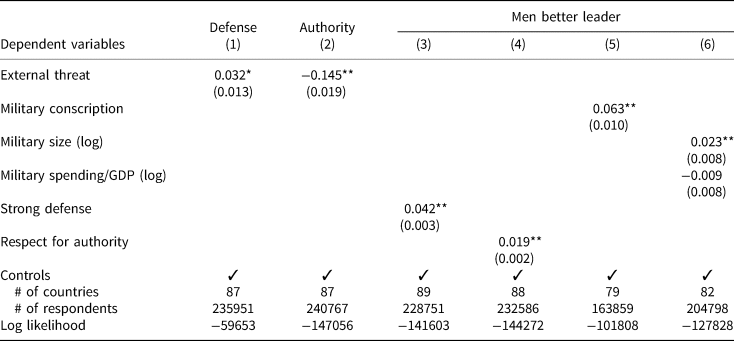
Columns 1 and 3 of Table 3 provide supporting evidence for H1a. External threat is positively associated with Strong defense, which correlates with unfavorable attitudes toward female leaders. This indicates that a hostile security environment is related to preferences for male leaders by increasing perceived threats and the importance of national security. Columns 2 and 4 produce mixed results for H1b. External threat is negatively correlated with Authority, although Authority is positively associated with unfavorable attitudes toward female leaders. Little evidence suggests that hostile security environments promote ideological authoritarianism. The same can be said when we use Obedience as a proxy for authoritarianism. Thus, we cannot conclude that external security environments increase gender unequal attitudes by increasing authoritarian attitudes emphasizing hierarchy and authority.
Exploring mechanisms linking security environment to preferences for male leaders

Note: +p < 0.1, *p < 0.05, **p < 0.01
We test a part of H1c by investigating the relationship between a country's level of militarization and individual preferences for male over female leaders. Column 5 uses military conscription as a proxy of militarization, while column 6 uses the logged size of the military per 1000 inhabitants and the logged percentage of military spending relative to GDP. The results show that citizens in countries with military conscription or larger militaries tend to have more unfavorable attitudes toward female leaders. However, the ratio of military spending to GDP is negative, close to zero, and statistically insignificant. The result shows that the effects of militarization on attitudes toward female leaders tend to operate through building and maintaining large militaries or military conscription. H1c assumes that militarization is driven by the external security environment. In Table A6, we demonstrate that External threat is significantly associated with a greater likelihood of military conscription, a larger military, and a higher level of military spending. Taken together, these results provide support for two of our three hypothesized mechanisms. A hostile external threat environment shapes preferences for male leaders by making national security a higher priority and promoting the militarization of society.
4.2 Conditional relationships
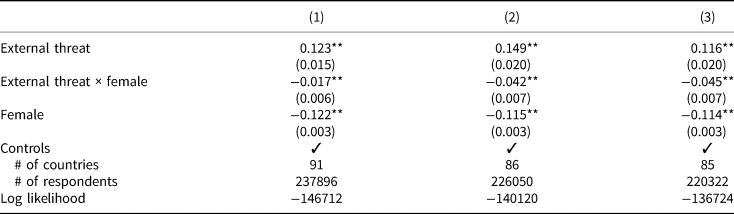
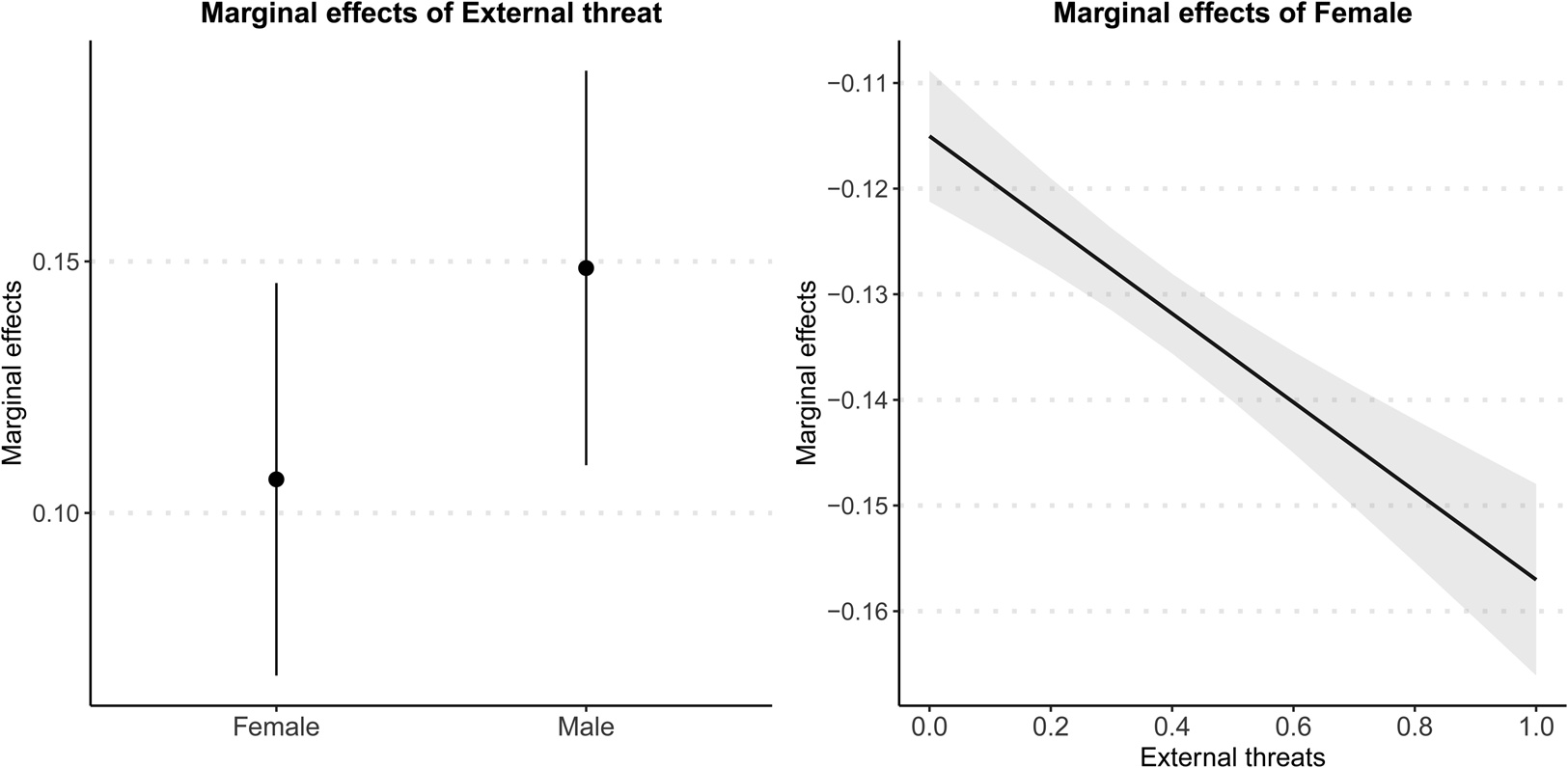
Last, we examine whether the relationship between external threats and bias against female leaders is conditioned by the respondent's gender. We add an interaction between External threat and female respondents to the models of Table 1. Table 4 presents the estimation result, and Figure 2 displays the substantive effects of External threat scale and Female. As expected, the interaction variable is negative and significant, indicating that the effect of the external security environment is smaller for female respondents than for male respondents. As illustrated in Figure 2, the effect of increasing External threat two standard deviations on preferences for male leaders is smaller for female respondents and than for male respondents (9.4 percent versus 6.7 percent). This supports H2a. The same pattern emerges when we split the sample into male and female respondents, as reported in Table A4. However, it is worth noting that the relationship between external threats and bias against female leaders is not driven by men since the effects of External threat are positive for both types of respondents.
The interaction between gender and external threat

Note: +p < 0.1, *p < 0.05, **p < 0.01
Consistent with H2b, we also find that the gap between female and male respondents regarding leaders widens as a country's security environment becomes more hostile (see the right panel of Figure 2). For instance, the gender gap in Sweden is a 11.7 percentage point difference in the likelihood of agreeing with the statement that men are a better political leader than women. The gender difference is 15.2 percentage points in South Korea, which faces one of the most threatening security environments. Taken together, the results suggest that the international security environment significantly interacts with gender in influencing preferences for male leaders.
4.3 Robustness checks
To ensure the robustness of our results, we perform additional supplementary analyses. We report all estimation results in the supporting appendix. First, to ensure that our main finding is not driven by our choice of a specific estimator, we examine the robustness of our results to several alternative estimators. Given the exogeneity assumption of random-effects estimators that require no correlation between the covariate of interest and the unit effects, we estimate fixed-effects models. Columns 1–3 of Table A7 present estimation results with country fixed effects, while columns 4–6 report estimation results with country and year fixed effects. We also estimate alternative multilevel models with country-year random effects or three-level models (reported in Table A8). These alternative estimators produce substantively similar results.
Substantive effects of External Threat (left) and Female (right). We use the estimated coefficients from column 2 of Table 4 to compute the substantive effects.

Next, we measure the country's external security environment with alternative variables. We exclude the ratio of CINC scores in computing the external threat scale and create an inverse-distance weighted average of the dyad-level peace scales. Another measure of external threat is Geopolitical competition developed by Markowitz and Fariss (Reference Markowitz and Fariss2018). This variable reflects the distance-weighted power of potential opponents, based on a relative distribution of economic power and conditioned by the level of interest compatibility, which is determined by relative regime type. The constituent terms of geopolitical competition suggest that Geopolitical competition captures a different dimension of a state's external threat environment, distinct from External threat that is coded subjectively. As Table A9 shows, we find similar results when we use these alternative measures of external threats.
Last, we examine whether our central finding is robust to alternative model specifications. Column 1 of Table A10 removes all control variables to see how the inclusion of other control variables influence the estimate of External threat. Column 2 adds a natural log of democracy duration, while Column 3 adds per capita oil and gas production. The last two columns include two dimensions of modernization, economic modernization, and material culture (Chatagnier and Castelli, Reference Chatagnier and Castelli2019). However, none of these alter our central finding.
5. Conclusion
Bias against female leaders remains pervasive in the 21st century. Our study seeks to improve our understanding of individual variation in preferences for male over female leaders. We build on the gender politics literature and theorize that a country's international security context shapes people's attitudes toward having men versus women in positions of political power. Our study points to the international security environment as a major reason why individuals prefer to have men rather than women in office.
Using survey data for more than 80 countries, we found that individuals in societies facing a more hostile security environment have higher preferences for male leaders than those in a secure context. Further, we proposed three mechanisms connecting a country's international security context to individual attitudes. First, the more threatening the security environment, the higher the level of perceived threats and demand for leaders who are competent on defense. Second, a threatening environment can increase bias against female leaders indirectly by influencing ideological attitudes such as authoritarianism and social dominance orientation. Third, threatening security contexts increase a country's level of militarization, which socializes people to prefer having men in office than women. In addition to finding strong evidence for our broad hypothesis about the relationship between the international security context and bias against female leaders, we found empirical support for some of the mechanisms: by influencing the demand for national defense and level of militarization, particularly the size of the military.
An important question that remains unanswered is whether gender attitudes significantly shape a country's external threat environment. Our empirical analysis does not rule out the possibility that individual preferences for male leaders in the aggregate make societies more likely to have antagonistic relationships with foreign countries. Nor does our work examine whether biased attitudes against women leaders, in the aggregate, also lead countries to pursue higher levels of militarization. Future research ought to look further into the feedback effects between international insecurity and bias against women political leaders. Studying the relationship between changes in external security threats and changes in citizens’ beliefs about female leaders would be a logical next step. This would require surveys on gender attitudes toward male and female leaders on the same individuals over time. It may be fruitful to focus on countries where a new external security threat recently appeared to better understand the relationship between bias against female leaders and security threats.
Another major question that our article does not fully explore is the relationship between security threats and broader gender norms. Previous studies show that various attitudes about gender roles correlate with one another (e.g., Alexander and Welzel, Reference Alexander and Welzel2011; Seguino, Reference Seguino2011). We found that individuals in countries with a more threatening security environment are more likely to agree that university education is more important for boys than girls and that men deserve jobs more than women (see Table A11). There may be a wider phenomenon at work in which higher expectations of future international conflict lead individuals to hold more patriarchal attitudes across sectors. At the same time, we find that the effect of militarization, one of our key mechanisms, differs across attitudes. Thus, further research is necessary to find how external threats influence various gender attitudes and what the relationship among these gender attitudes is.
The 21st century has witnessed the rise of women in politics but also backlash against women's rights and violence against women in politics. Another important question that our paper does not address is whether opposition to women's political agency also shapes individual bias against women in politics. Further studies ought to consider the relationship between gender backlash, systemic security threats, and individual attitudes toward male and female leaders.
Last, we hypothesized that a threatening security environment increases bias against women in politics indirectly by influencing ideological attitudes such as authoritarianism and social dominance orientation. We have found that individuals who value obedience and authority are more likely to favor male over female political leaders. Contrary to our expectation, however, we found that individuals are less likely to emphasize authority and obedience the more hostile the country's external security environment. Future research is needed to theorize and examine the relationship between external security threats and attitudes about authority.
Supplementary material
The supplementary material for this article can be found at https://doi.org/10.1017/psrm.2020.54.
Acknowledgements
Previous versions of the article were presented at the 2019 American Political Science Association meeting, the EGEN at the University of Pennsylvania, the CVP brownbag at the PRIO, the Uppsala Forum Guest Lecture at Uppsala University, and the IR/CP Brownbag at the University of Nebraska-Lincoln. The authors thank Dona-Gene Barton, John Hibbing, Robert Schub, Sarah Shair-Rosenfield, Daizaburo Shizuka, Pär Zetterberg, and the participants of these meetings.
Financial support
Nam Kyu Kim was supported by the Ministry of Education of the Republic of Korea and the National Research Foundation of Korea(NRF-2020S1A3A2A02092791).