

“It’s cool that you’re strong. I respect it, I do. But in the end everybody breaks, bro. It’s biology.”
—Mark Boal, Zero Dark Thirty, 2011James Elmer Mitchell, the Central Intelligence Agency (CIA) contract psychologist who, along with another psychologist, designed, sold, and executed the CIA’s torture program also successfully sold the claim that it was scientific. “I knew [interrogating Saudi detainee Abu Zubaydah] would have to be based on what is called Pavlovian classical conditioning … , and I was very familiar with that because my early training was as a behavioral psychologist.”Reference Mitchell and Harlow1 In Mitchell’s view, the techniques he designed “would lend themselves to a Pavlovian process to condition compliance,”2 even though the idea that language can be controlled by Pavlovian processes is a far-reaching and unsupported (indeed, insupportable) claim.Reference O’Mara, Barela, Fallon, Gaggioli and Ohlin3 When a Federal Bureau of Investigation (FBI) agent and experienced terrorist interrogator challenged Mitchell about his methods at the black site in Thailand where Zubaydah was being held, Mitchell replied, “This is science.”Reference Soufan and Freedman4 Even some who are critical of the program accept the CIA’s claim to scientific torture. Bloche, for example, adopts the heading “The CIA’s Behavioral Science Model of Torture” in a 2017 paper in which he mistakenly claims that critics adopt a strawman model of CIA torture when it was really derived from the work of Alfred Biderman and other psychological scientific research in the 1950s.Reference Bloche5, Reference Schiemann and Pérez-Sales6 Such statements are revealing in two ways.
First, there is the implicit assumption that breaking a human being psychologically and physically is the same thing as effectiveness, as getting good intelligence. In other words, there is nothing new here; this is interrogational torture as it always has been and is today, which is about imposing suffering to “break” human beings. Second, there is the claim that this method of breaking was “scientific,” rooted in the biology of the human being, and therefore failsafe and surefire. The CIA—and the policymakers higher up who approved the torture program—embraced the second claim but denied the first. Indeed, the “scientific” approach to torture was claimed to be something different from torture, which we define, following the United Nations Convention Against Torture, as follows:
Any act by which severe pain or suffering, whether physical or mental, is intentionally inflicted on a person for such purposes as obtaining from him or a third person information … , when such pain or suffering is inflicted by or at the instigation of or with the consent or acquiescence of a public official or other person acting in an official capacity.7
Thus, we do not accept the distinction between interrogational torture and coercive interrogations; the latter is a euphemism for the former. Torture can, of course, be employed for other purposes (e.g., intimidation or confession), and the nontorturous psychological pressure associated with the Reid technique used in police interrogations can also lead to false confessions; however, if physical or mental suffering is imposed to coerce information from the unwilling, there is no meaningful distinction from coercive interrogation.
We challenge both claims above, showing that the decision to use torture as well as the so-called scientific approach adopted by the CIA had nothing to do with science and that the program in practice differed little from age-old practices of torture. We also show what the science on—not of—torture actually tells us about both its effectiveness and its brutality. This is all the more important given President Donald Trump’s open embrace of torture worse than waterboarding and his appointment of Gina Haspel, a participant in the CIA torture program, to be director of the CIA.
The article proceeds as follows: The next section reconstructs the decision by the George W. Bush administration to employ torture immediately after 9/11, prior to any research or justifications based on science. The following section outlines the pseudoscientific justification for the CIA’s torture model before showing that the program in practice did not correspond to this model in any case. Then we present what the actual science has to say about the informational effectiveness of torturing human bodies and brains and show how an evidence-based policy brake would have prevented the adoption of the CIA torture program.
Making torture policy
It may be unsurprising that countries tend to react strongly—some might say overreact—and quickly after a surprise attack like 9/11, but it is just as unsurprising that haste may make bad policy, especially in a program designed to capture, detain, and question terrorist suspects around the world. Even if one acknowledges that the core problem—better intelligence on terrorist plots—was immediately known from the very surprise of 9/11, an effective and evidence-based policy response might take some time given that the CIA had few case officers with the relevant linguistic and area studies training, as well as little institutional experience or structure for detaining and interrogating terrorist suspects trying to hide information.8 We focus on the CIA program, rather than the military, but the same shortage of trained, linguistically competent interrogators created problems for the military as well, as evidenced by the reliance on SERE (Survival, Evasion, Resistance, and Escape) instructors, especially early on, and the widespread use of civilian contractors. CIA officers were trained to debrief possible defectors and to assess individuals for their potential intelligence value, their likelihood of being “turned,” and so on, but they were not trained in eliciting information from resisting captives shackled to a chair.
This is not to say that the CIA did not have institutional experience with coercive interrogations.Reference McCoy9, Reference Otterman10 This experience reflected the interweaving of two influences: CIA-funded 1950s-era research by U.S. and Canadian psychologists and the importation of French counterinsurgency techniques in Algeria. In an effort to understand the false confessions made during communist show trials and by U.S. airmen captured during the Korean War, the CIA supported research first into drugs and later into the effects of isolation, various forms of deprivation, and stress positions. The results of this research were employed both defensively by the military in an effort to “inoculate” U.S. soldiers in its SERE schools and offensively by the CIA in its 1963 counterintelligence interrogation manual.11, Reference McCoy12 The manual called for “inducing regression … to [a] weaker level … required for the dissolution of resistance and the inculcation of dependence” by “prolonged exertion, extremes of heat, cold or moisture, and deprivation or drastic reduction of food or sleep,” and “pain,” while psychological measures included, among many specific ploys, the general strategies of “threats and fear.”13 In the interim decades, both psychology and neuroscience have undergone revolutions in theory, data, and experiment, discarding primitive theoretical notions such as “regression” derived from the hydraulic theory of personality proposed by Freudian psychoanalysis.
The other influence, what we might call the “French connection,” was the influence on the U.S. military and the CIA of French counterinsurgency strategies and tactics used against the Algerian national independence movement, particularly during the Battle of Algiers in 1957–1958. That approach involved identifying suspects; launching small operations to capture them; torturing them using waterboarding and other techniques immediately for information about other suspects, hideouts, and the like; and then summarily executing them. General Paul Aussaresses, who helped lead the French efforts, took 10 of his junior officers to the United States and taught a “Counter Insurgency Officer Course” to U.S. Special Forces at Fort Bragg in late summer 1961—ironically, just as the French lost the war in Algeria, partly as a result of the outrage from torture, and began withdrawing their troops. The course involved a detailed study of the book La Guerre Moderne by one of the architects of the French approach, Roger Trinquier. Aussaresses admitted that, among other things, he taught students about “seizure, interrogation, and torture.” Students at the school sent the Trinquier book to a CIA official in the White House who later led the CIA’s Phoenix Program in Vietnam.Reference Robin14
Even the 1963 KUBARK manual (KUBARK being a code name for the CIA) acknowledged some doubts about the effectiveness of coercive techniques, noting that “[i]n fact, most people underestimate their capacity to withstand pain” and “highly motivated” prisoners “have been known to carry out rather complex tasks while enduring the most intense pain.” As a result, “[t]he subject finds that he can hold out, and his resistances are strengthened.” Moreover, it went on,
Intense pain is quite likely to produce false confessions, concocted as a means of escaping from distress. A time-consuming delay results, while investigation is conducted and the admissions are proven untrue. During this respite the interrogatee can pull himself together. He may even use the time to think of new, more complex “admissions” that take still longer to disprove. KUBARK [the CIA] is especially vulnerable to such tactics because the interrogation is conducted for the sake of information and not for police purposes.”15
However, blowback in 1984 following revelations of Nicaraguan Contras’ use of a CIA “assassination manual” led to disavowal of coercive interrogation methods by the CIA in revisions to the 1983 version of its KUBARK manual and the military’s revision of its U.S. Army Field Manual in 1992.16 Indeed, a top CIA official said as much in a statement to Congress: “Inhumane physical or psychological techniques are counterproductive because they do not produce intelligence and will probably result in false answers.”17 In short, by 2001, the CIA had repudiated the teaching of interrogational torture techniques, and in any event, “throughout most of its history the CIA did not detain subjects or conduct interrogations” and “therefore had no institutional experience or expertise in that area,” though it did occasionally rendition subjects to other countries for torture.18
The FBI, of course, did have experience interrogating or interviewing adversaries, both in its law enforcement and counterintelligence roles, including questioning (and gaining convictions of) al-Qaeda terrorists and foreign spies. Those interrogation methods eschewed coercion for what is often referred to (and sometimes derided) as a “rapport-based” approach, but it also included psychological trickery, deceit, and reliance on cultural and other contextual knowledge. The FBI’s experience was deemed less relevant by some since its ultimate goal was securing a conviction and probative statements in counterintelligence cases, rather than intelligence gathering and monitoring. This criticism is, of course, ironic given torture’s long association with false confessions. More importantly, it ignores both the FBI’s substantive expertise (linguistic, cultural, and terrorist-group specific) and institutional experience in ferreting out terrorists and their networks.
Although the “all hands on deck” response in the immediate aftermath of 9/11 meant that the FBI did join the CIA in the fight against al-Qaeda in Afghanistan, the Bush administration did not turn to the FBI—or any “other elements of the U.S. Government with interrogation expertise”—to craft a detention and interrogation policy.19 Nor did the CIA “review its [own] past experience with coercive interrogations.”20 Nor, apparently, did the experience of those American servicemen such as Senator John McCain and Admirals James Stockdale and Jeremiah Denton on the receiving end of torture who provided no valuable information to the North Vietnamese factor into the decision. Finally, there is no evidence of serious engagement with the services or agencies of other countries that had dealt with similar problems over many decades without torturing.
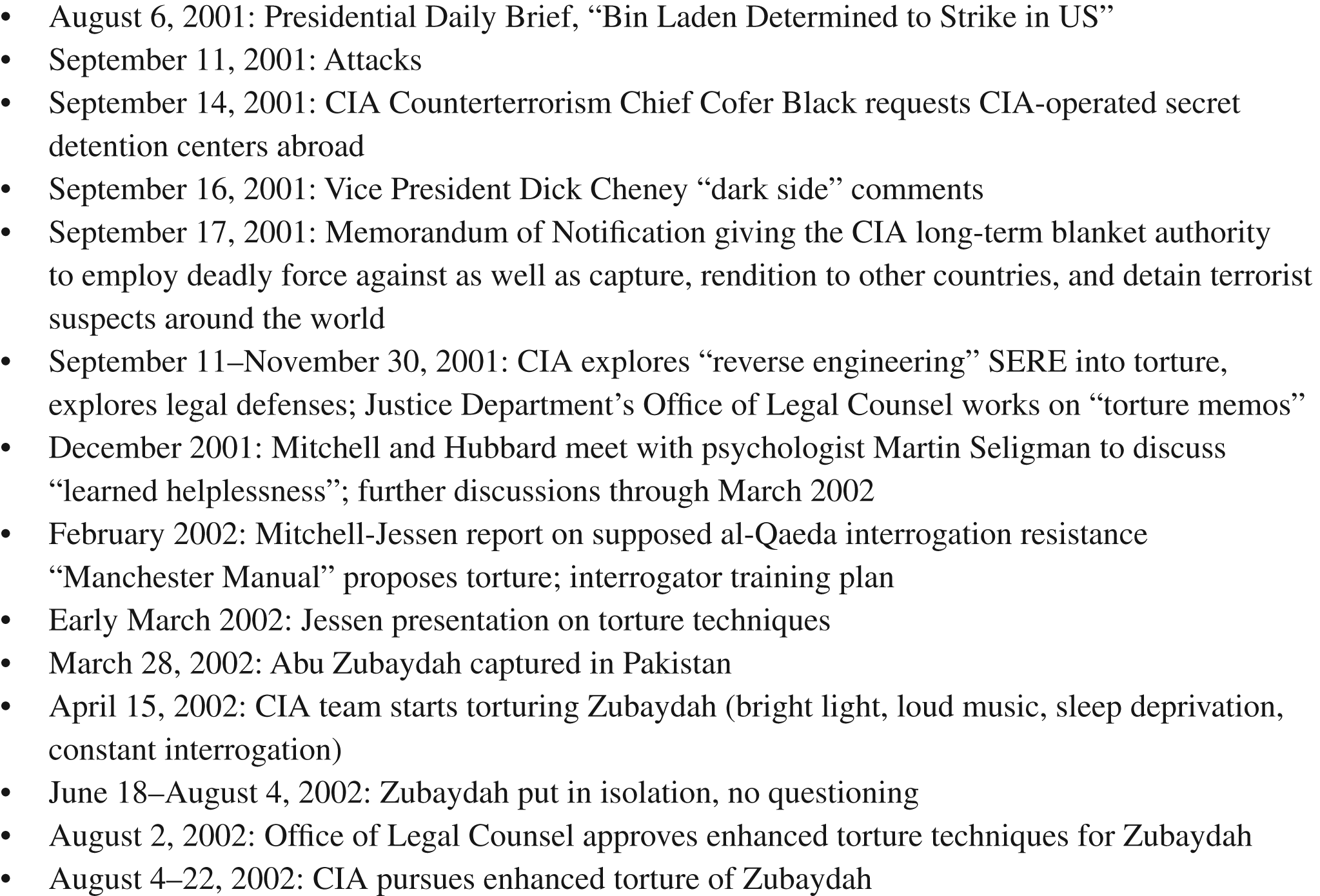
In fact, the decision to use torture was almost instantaneous, as the timeline in Figure 1 shows. Within three days of the attacks, Cofer Black, chief of the Counterterrorism Center, was requesting input on where to locate CIA-operated detention centers abroad, where they would be insulated from international law and human rights groups such as the International Committee of the Red Cross. The request went out on September 14, 2001. Two days later, Vice President Dick Cheney stated in an interview on NBC,
We also have to work, though, sort of the dark side, if you will… . A lot of what needs to be done here will have to be done quietly, without any discussion, using sources and methods that are available to our intelligence agencies, if we’re going to be successful. That’s the world these folks operate in, and so it’s going to be vital for us to use any means at our disposal, basically, to achieve our objective (emphasis added).21
Timeline of key events and decisions.

This is an early indication that the administration was unencumbered by concerns about limits and restraints. On September 17, the day after Cheney’s interview, President Bush incorporated Black’s requests into a Memorandum of Notification giving the CIA long-term blanket authority to employ deadly force against, as well as to capture, rendition to other countries, and detain terrorist suspects around the world.22, Reference Mayer23, Reference Woodward24 Although the Memorandum of Notification did not discuss interrogations, the CIA was already working on it.
“In the weeks after 9/11,” a CIA psychologist, Kirk Hubbard, brought James Mitchell, a retired SERE psychologist in the same “informal network of military and civilian psychologists and psychiatrists with shared interests in psyops [psychological operations], Special Forces selection, resistance training, and the reliability of ‘humint’ (human intelligence)” as Hubbard, to the attention of higher-ups in the CIA.Reference Bloche25 Although he had no “experience as an interrogator, nor … specialized knowledge of al-Qa’ida, a background in counterterrorism, or any relevant cultural or linguistic expertise,” Mitchell believed he could reverse engineer the SERE techniques into interrogation techniques that would elicit accurate and valuable information. “By the end of November 2001,” the CIA was already exploring legal defenses for outright torture relying on the ticking-bomb scenario.26 At the end of 2001, the CIA asked Mitchell to analyze the “Manchester Manual,”27 a document seized in a raid in Britain that described resistance techniques mistakenly attributed to al-Qaeda that in reality was written by a smaller group opposed to the Egyptian regime and so was “like the Pittsburgh Steelers prepar[ing] for a game against the Dallas Cowboys by reviewing the playbook from Tuscaloosa High School.”Reference Eichenwald28 Mitchell asked Bruce Jessen, a senior SERE psychologist, to help him prepare the assessment.
They completed their memo, titled “Recognizing and Developing Countermeasures to Al Qaeda Resistance to Interrogation Techniques: A Resistance Training Perspective,” by February 2002, and it was circulated within the top levels of the CIA.29, Reference Warrick and Finn30 Around this same time, Mitchell, perhaps with Jessen, wrote the “Interrogator Training, Lesson Plan, Title: A Scientific Approach to Successful Interrogation.”31 Meanwhile, Jessen had, “[b]y early March, … developed slide presentations, titled ‘Al Qaeda Resistance Contingency Training’ and ‘Exploitation,’ [which] included slides on ‘isolation and degradation,’ ‘sensory deprivation,’ ‘physiological pressures’ (a SERE euphemism for beatings and other physical abuse) and ‘psychological pressures.’”32 These documents are classified, but it is known that Mitchell and Hubbard met several times between December 2001 and March 2002 with the psychologist Martin Seligman to discuss his theory of “learned helplessness.”33
We discuss this further later, but the point for now is that inducing learned helplessness, like the SERE techniques, involved torturing detainees. Indeed, between September and December 2001, the Office of Legal Counsel in the Justice Department had been crafting what would later be known as the “torture memos’” denying the protections of the Geneva Convention to captured Taliban fighters in Afghanistan as well as suspected al-Qaeda operatives captured there and elsewhere around the world.Reference Cole34 Thus, the die for coercion was already cast, and Hubbard, Mitchell, and Jessen would get the chance to implement their program just a few months later, after Zubaydah was captured in Pakistan at the end of March 2002.
Although Zubaydah was already providing valuable information to two FBI agents, Mitchell was sent to the CIA’s secret prison in Thailand to take over the interrogation. At about the same time, Mitchell proposed 12 tortures, all but two of which would be approved by the Justice Department and the CIA as “enhanced interrogation techniques” on August 2, 2002, in one of the torture memos. On August 4, after having been left in isolation with no questions put to him for 47 days after Mitchell took over, Zubaydah was dragged out of his cell and subjected to round-the-clock torture for the next three and a half weeks.Reference Schiemann35 As Counterterrorism Center director Black put it on September 26, 2002, when speaking at a congressional hearing, “the gloves [had] come off.” In short, rather than rely on traditional methods of interrogation or research the effectiveness of other methods, multiple sources all reveal that the Bush administration, including both the CIA and the military, “reversed two centuries of official policy by adopting torture for interrogation purposes” without investigating its efficacy for intelligence gathering.Reference Lightcap and Pfiffner36, 37
The pseudoscience of torture
We use “pseudoscience” in its epistemological rather than pejorative sense, following Bunge, namely, “any field of knowledge that is nonscientific but is advertised and sold as scientific.”Reference Bunge38 A field of knowledge is nonscientific if it fails to satisfy “even approximately” 12 conditions. It is sufficient, therefore, to demonstrate that the CIA program was nonscientific by showing that it fails to satisfy several or even one of these necessary conditions, without having go through all 12. In the foregoing and what follows, we focus on just the most obvious conditions, showing that the knowledge supporting the CIA torture program (original emphasis):
1. Was supported by “a community of believers who call themselves scientists … although they do not conduct any scientific … research” (neither Mitchell nor Jessen were researchers, let alone on interrogations)
2. Reflected in its “general outlook … an epistemology making room for arguments from authority, or for paranormal modes of cognition accessible only to the initiates or to those trained to interpret certain” outward behaviors (e.g., Mitchell’s claim to be able to read poker tells)
3. Instead of “a collection of up to date and reasonably well confirmed … data, hypotheses and theories, and of reasonably effective research methods, obtained in other research fields relevant,” the CIA program “learn[ed] little or nothing from other fields of knowledge” directly relevant to its subject of inquiry (e.g., from neuroscience)
4. Was characterized by a “fund of knowledge … contain[ing] numerous untestable or even false hypotheses in conflict with well confirmed scientific hypotheses” (e.g., effects of sleep deprivation on memory recall)
5. Reflected “the aims … of the members … [were] practical rather than cognitive … [a]nd they do not include the typical goals of scientific research, namely the finding of laws and their use to understand and predict facts” (e.g., the goal was information such as names and locations of other terrorist suspects)
6. Employed methods and “procedures that are neither checkable by alternative (in particular scientific) procedures nor are they justifiable by well confirmed theories” (“reverse-engineered SERE training techniques”)Reference Bunge39
The “scientific” model of interrogational torture sold by Mitchell and Jessen was a patchwork stitched together from three sources: the CIA’s own Cold War interrogation model represented by its 1963 KUBARK manual; the reverse engineering of military survival school (SERE) training, where Mitchell and Jessen had both worked; and Seligman’s theory of learned helplessness. Troubled by confessions made under duress first by victims of Soviet show trials and later by American prisoners of war to the Chinese and North Korean military during the Korean War, the United States responded by researching various “mind-control techniques,” including drugs, hypnosis, sensory deprivation, and psychological and physical coercion such as sleep deprivation and stress positions.Reference McCoy9, Reference Otterman10 The findings were used both offensively and defensively: offensively in the development of an interrogation manual used not only by the CIA but also by client militaries and intelligence agencies in Latin America, and defensively in the different SERE schools for members of the U.S. military.Reference Otterman10, 11 A retired SERE psychologist, Mitchell was aware of learned helplessness from SERE instructor manuals emphasizing the danger of inducing it.Reference Bloche40 Indeed, more than simply aware, another former SERE instructor who knew Mitchell said that “Learned Helplessness was [Mitchell’s] whole paradigm.”Reference Mayer41 It played such an important role in his thinking, in fact, that he and CIA psychologist Hubbard arranged several meetings with Seligman, seeking ways to apply it to the SERE techniques that Mitchell was reverse engineering for the CIA.Reference Bloche42
The result of grafting learned helplessness onto SERE techniques, Mitchell claimed, was a “[s]cientific [a]pproach” to interrogating terrorist suspects.43 According to this two-phase approach, the combination of detention conditions such as temperature, light, food, and auditory manipulation, on the one hand, and various “enhanced interrogation” tortures, on the other, would induce a state of learned helplessness in its victims, causing them to move from resistance to compliance. This successful interrogation phase would be followed by a “debriefing” phase in which suspected terrorists would be questioned using more traditional rapport-based methods. There are multiple problems with this model, from its theoretical underpinnings through the “data,” both adduced and ignored, and the actual practice of the program.
The theory behind the 1963 CIA interrogation (KUBARK) manual and the SERE program was based on 1950s-era psychological research by Harold Wolff, Albert Biderman, Lawrence Hinkle, Malcolm Meltzer, I. E. Farber, and others. Biderman, for example, sought to ascertain why some U.S. Korean War prisoners of war had made absurd confessions. One of his conclusions was that the communist techniques first induced compliance through sensory manipulation, sleep deprivation, and stress positions rather than direct physical assaults and then molded that compliance into confessions. The techniques induced compliance by creating “despair,” “debility, dependency and dread,” and “regression.”Reference Bloche44, Reference Farber, Harlow and West45, 46
What is often overlooked, however, is that Biderman readily acknowledges that “the final outcomes [of prisoner behavior] were distributed through the broad range of intermediate possibilities” in between total compliance and total resistance—that “[i]n almost all, resistance was the dominant ingredient,” and none behaved in “complete accordance” with their communist captors.Reference Biderman47 In another paper, Biderman notes that while his focus is on the cases in which interrogation was effective, he “does not wish to convey an exaggerated impression of its potency” for “[m]ost Air Force repatriates, on the contrary, claim considerable success in evading, deceiving, and delaying their interrogators. Further, over two-thirds of the repatriates, in anonymous replies to a mail questionnaire, expressed the opinion that such information as the Communists did elicit was such as to have little effect, if any, on military operations.”Reference Biderman48
Moreover, Biderman emphasizes “that the distinction between inducing compliance and shaping compliance is purely an analytic division. The two kinds of methods are not independent of one another nor separate in time.”Reference Biderman49 When one also notes Biderman’s insistence that the same methods were also used to gain compliance for false confessions as “for eliciting factual intelligence information,” the value of the distinction in practice breaks down further.Reference Biderman50 In short, using Biderman’s exploration of a few cases of limited success to design an interrogation program is like looking for factors that allowed the tiny fraction of people who survived falls from airplanes without a parachute rather than simply issuing parachutes.
The second part of the theory veneering the CIA program with a patina of science was the concept of learned helplessness, though Mitchell’s fascination with it did not translate into any understanding of what the theory of learned helplessness actually entailed. Learned helplessness has its historical origin in Pavlovian conditioning procedures, but using unpredictable and uncontrollable aversive stimuli (typically electric shock), rather than rewarding and predictable appetitive stimuli (such as food reward). Animals exposed repeatedly to uncontrollable and unpredictable electric shocks showed a characteristic syndrome of apathy, akinesis, and amotivation once they learned their situation was inescapable. Learned helplessness was the name given to this behavioral syndrome, and in its clinical application to humans was devised to provide a theory for the development of major depressive disorder (MDD) in humans.
MDD is disabling neuropsychiatric condition characterized by “a depressed mood or a loss of interest or pleasure in daily activities consistently for at least a two week period. This mood must represent a change from the person’s normal mood; social, occupational, educational or other important functioning must also be negatively impaired by the change in mood.”51 Additionally, MDD comes with a panoply of well-recognized impairments of cognition, including catastrophizing, excessive rumination with a preponderantly negative bias, a pessimistic explanatory style, and deficits in learning and memory. Clinically, learned helplessness is associated with a loss of perceived control over major and minor life events, resulting in the symptomatology of MDD.Reference Otte52
It is unclear how learned helplessness could ever have been thought to be a viable theory for interrogation; the clinical literature is quite clear regarding the typical MDD syndrome,Reference Bortolato, Carvalho and McIntyre53 and some reflection and consultation of the clinical psychological literature would have revealed its inadequacy in the domain of interrogation. In fact, the Farber et al. piece quoted in the KUBARK manual notes that the result for many is permanent apathy; they never move to compliance.Reference Farber54 Mitchell himself notes the danger in a deposition he was forced to provide as part of a lawsuit against him by a victim of his program: “profound helplessness that leads to depression, passivity and withdrawal.”Reference Salim and Soud55 And yet, the psychologically primitive view seems to have been adopted that inducing a state of learned helpless would equal a state of compliance that would facilitate information elicitation. Note the causal chain posited here: learned helplessness, compliance, information elicitation—crucially, no rationale is provided in theory or experiment that this causal chain in any way represents a likely sequence of neuropsychological information processing. The idea that inducing the state of learned helplessness might result in a loss of information, because the brain systems regulating learning and memory are the self-same systems affected by the extreme stressors involved in inducing learned helplessness, seems never to have occurred to those who devised the program.
Whereas the Mitchell/CIA model dressed up the first, compliance-inducing phase in the garb of psychological science, even this pretense was dropped for the second phase: detecting deception from supposedly compliant detainees. None of the released documents references a scientific theory on separating accurate from inaccurate information, comparable to the references to learned helplessness. The likely reason is that the research on detecting deception by scrutinizing nonverbal cues “present[s] a bleak picture.”Reference Vrij, Meissner, Fisher, Kassin, Morgan and Kleinman56 In the face of this substantial research to the contrary, Mitchell simply claimed in his memoir that he could identify “poker tells, or body language that would tip [interrogators] off to when he was telling the truth and when he was being deceitful.”57 The scientific consensus is that this is not so, and the cues that people use for detecting deception are faint and unreliableReference Vrij58; this literature is unreferenced in Mitchell’s memoir. It has also been claimed that Mitchell and the other interrogators could detect falsehoods by immediately checking information. Not only does the Senate report provide abundant evidence of false information, but Mitchell himself asked participants at a CIA-organized psychological conference on detecting deception, “If we are interviewing a terrorist, how can we tell if he is lying?”Reference Hoffman, Carter, Lopez, Benziller, Guo, Latifi and Craig59 This conference took place in July 2003, nearly a year after Mitchell had personally tortured Zubaydah and just a month after Khalid Sheikh Mohammed (KSM) had retracted information on a plot he had provided to stop being waterboarded.60, 61
In reality, therefore, no more than a folk or lay theory of neuropsychological functioning was applied to information retrieval from a human sourceReference O’Mara62, Reference O’Mara63—a theory that would collapse under the slightest contact with empirical reality and would not, if elaborated as a theory, pass any form of objective peer review. It is thus unsurprising that the only “data” for the effectiveness of the CIA model was anecdotal, based on Mitchell and Jessen’s experience in the SERE program. What is more, that experience was supervising mock interrogations carefully controlled to avoid actually inducing learned helplessness, rather than personal experience conducting actual interrogations in which the goal was to fully induce it.64 Not only was there no systematic data on the effectiveness of the CIA model, neither the CIA nor Mitchell/Jessen conducted any review of the relevant psychological, neurobiological, or neuroscience literature on the possible negative cognitive and memory recall effects of the techniques they proposed. As discussed further later, even a cursory review of this literature would have called claims of effectiveness into question.
Whatever the problems besetting Mitchell and the CIA’s theory, it did not function that way in practice. Instead, the program operated essentially no differently than other interrogational torture programs. First, there was little initial attempt to ascertain compliance, with most of the detainees subjected to the most severe methods having been subjected to them “immediately after being rendered to CIA custody.”65 Indeed, this was despite the fact that some had either already indicated to the CIA their desire to cooperate or even had already provided information prior to their rendition.66 Second, the stepwise (if generally rapid) escalation of the torture’s severity based on detainee answers differed little from other accounts of torture, both historical and contemporary. Nor was there some magic moment when compliance was reached and then maintained thereafter. Many detainees (e.g,. Abu Zubaydah, KSM, Abu Faraj al-Libi, Ammar al-Baluchi, and Khalid bin Attash) who were supposedly compliant were later found to have provided false information or left out important information.67 Indeed, given that seven out of 39 detainees subjected to enhanced interrogation techniques provided absolutely no information, and assuming that two innocent detainees in the 39 were among these seven, then about one in six CIA detainees subjected to the harshest treatment would never become “compliant.”68 With others, the CIA could not figure out whether a detainee was compliant or not. Abd al-Rahim al-Nashiri, for example, was waterboarded at least three times at the secret prison in Thailand before being transferred to the Polish black site where he was tortured with enhanced interrogation techniques during four periods: December 5–8, 2002; December 27, 2002, to January 1, 2003; January 9–10, 2003; and January 15–27, 2003. Jessen concluded nearly two years later that al-Nishiri provided “essentially no actionable information,” and “the probability that he has much more to contribute is low.”69
In short, the torture model sold to the CIA for more than $80 million was pseudoscience in both method and substance. The pseudoscience amounted to a presumption of well-founded theory and knowledge, in particular that inducing states of dependency and learned helplessness would induce compliance, which would, in turn, allow the source to subsequently reveal otherwise withheld information: this would be the royal road to truth finding. Instead, it served to varnish a program of interrogational torture that differed little from its historical predecessors.
The science on torture
By choosing torture, however much adorned with the trappings of science, policymakers in the Bush administration ignored both the long history of torture and the study of that history from multiple perspectives.Reference Schiemann35, Reference O’Mara62, Reference O’Mara63, Reference Lea and Peters70, Reference Peters71, Reference Langbein72, Reference Rejali73, Reference Mialon, Mialon and Stinchcombe74, Reference Baliga and Ely75, Reference O’Mara76 However, they ignored more than history and social science. They also ignored the science of stress, sensory deprivation, and other torture-like stimuli on animals and humans available in the psychological, neurobiological, and neuroscience literature.
This actual science overwhelmingly demonstrates that interrogational torture fails as a veridical, reliable and predictable information-gathering and information-discovery practice.Reference Aggleton, O’Mara, Vann, Tsanov, Wright and Erichsen77 Torture fails for predictable reasons rooted in our deepest cognitive, neurobiological, and physiological functions. The information sought from the source by the torturer is, by definition, stored in the cognitive and memory systems of the brain of the source; it can be nowhere else. Interrogators want sources to retrieve explicit, long-term memories. Explicit memory is defined as memory for past, personally experienced facts and events extending over at least one sleep-wake cycle (and beyond). Memories also include intentions for future action—remembering what it is that you intend to do. A nonexhaustive list of information (memories) sought from the source includes where they were; what they were doing; what they were planning to do; their social network; monetary and other resourcing; the particulars of their worldview; their reasoning regarding world events; their mental health; their salient intellectual, social, religious, familial commitments; their general mind-set; potential personality problems (e.g., narcissism, egoism, grandiosity); the degree of their sublimation to their cause; the extent to which they are knowledge-rich or knowledge-poor about the world; and much more besides.
Much is known about how the brain supports cognitive, executive, mnemonic, and affective function. Similarly, much is known about likely optimal means and methods for probing the contents of cognition and memory. A network of mutually interacting and coregulating brain regions supports these functions; moreover, these brain regions can easily be compromised by stress, infection, injury, and the limitations of their intrinsic design features. The brain is, for example, a limited storage entity, with the consequence that human memory does not function like a video recorder, faithfully recording the events of the past. Human explicit memory is dynamic, preserving largely the gist of experienced events, and it is subject to revision through subsequent experience.
Human memory is fragile and labile, with a well-defined forgetting curve. Moreover, recollective acts can change memories of the past, and leading questions can cause people to recall events that have not happened to them. Within the brain, explicit memory is supported by interactions between the hippocampal formation, the prefrontal cortex, and the anterior thalamus. Interactions between these regions, combined with regular sleep, are required for the encoding, storing, and retrieving of memories, as well as for normal cognitive function.Reference Aggleton, O’Mara, Vann, Tsanov, Wright and Erichsen77
The stressor states employed during interrogational torture involve assaults on the core functioning of brain and body: they include sleep deprivation, caloric restriction, hypoxia, and predator threat. Predator threat can arise directly (through the repeated near-death and revival experiences that occur during waterboarding) or vicariously (through death threats to family members, other loved ones, or community members); predator threat is perhaps the most severe stressor that living organisms can face. Interrogational torture as a theory posits that imposing these extreme stressor states facilitates the release of information withheld by the source: a deliberate program, carefully calibrated and imposed by appropriately skilled and trained practitioners, torture will cause the detainee to reveal the contents of their long-term memories. Further, the source will reveal these memories in a reliable, veridical, and replicable fashion—without affecting the rate at which confabulation, misdirection, or false recall will occur—either within or between interrogational torture sessions. However, this folk model of neuropsychological function fails, and fails dramatically, on contact with what is known about the brain. The brain operates within a narrow adaptive and homeostatic range: brain temperature must be maintained in a narrow range, and a continuous supply of oxygen and nutrients is also required or brain structure and function will be compromised, perhaps irreversibly.
The extreme stressors employed during torture force the brain away from this narrow adaptive range. These stressors cause dysregulation across a wide range of organ systems in the brain and body. Predictable changes in the brain’s structure and function occur when these stressor states are imposed. The stressors employed result in tissue loss in the brain regions supporting memory (particularly of the hippocampal formation), resulting in enduring deficits in explicit memory. By contrast, the volume of the amygdala—the principal brain region concerned with the processing of fear and threat-related information—increases in size under chronic and severe stress. A resulting and persistent state of hypervigilance and lowering of startle reflexes ensues, as seen in post-traumatic stress disorder and related conditions. Brain regions supporting intention and general behavioral control (the prefrontal cortices) become less responsive as a result of chronic and extreme stress, resulting in deficits in directed and intentional recall of memories.Reference Roozendaal, McEwen and Chattarji78
Numerous studies of these stressors in combat and elite soldiers, certain neuropsychiatric patient groups (including those previously subject to torture), athletes, normal populations, and animal models have found that these stressors substantially compromise memory, mood, and cognitive function. Sleep deprivation is a widely employed method of “white” torture: the consensus is that sleep deprivation is possibly the most effective tool for causing chronic and substantial deficits in cognition, mood, and memory. The effect of sleep deprivation is in direct proportion to the dose of sleep deprivation imposed. The sleep deprived show substantial deficits in psychomotor and general cognitive function (they are also more likely die in auto accidents, for example); the sleep deprived manifest profound problems in explicit memory, with deficits in the encoding, consolidation, and retrieval of memory. They are much more likely to make false confessions in laboratory situations. Supervening states of pain reliably impair cognition, memory, and mood in volunteers, chronic pain patients, and animal models.
The evidence all points in the same direction: extreme stressors of the type used during torture impair cognition, memory, and mood in all of their phases. Hence, the historic and contemporary veridical information yield from torture has been nugatory, while the false positive rate and false confession rate have been remarkably high. The extreme stressor states employed during torture need to be seen for what they are: utterly inimical to reliable and veridical information gathering and information discovery. Better and more reliable ethical methods are available, using approximately the skill set of a skilled clinician; these skills are ethical, transferable, and reliable, and they ensure the minimal contamination of the information supplied by the source.Reference O’Mara79
The past 10 or so years have seen the development of a remarkable evidence base on information elicitation—even from the unwilling—using noncoercive means with what is now generically referred to as “investigative interviewing.”Reference Bull80 Experience from World War II showed across a variety of intelligence services the futility of torture and, moreover, the difficulty of getting policymakers to pay attention to intelligence contrary to their beliefs.Reference Hasting81 Joseph Stalin’s refusal to listen to evidence of the imminent Nazi invasion is a particularly salient example. What has become known as the Scharff Technique—a conversational style of interviewing with open-ended questioning, conducted in a situation of respect and active listening—is at the core of many modern investigative interviewing methods.Reference Meissner, Kelly and Woestehoff82 Similarly, there have been remarkable developments in the detection and understanding of lies and deception during investigative interviewing.Reference Vrij58 Finally, there has been a remarkable series of field- and captive-based studies of terrorist interrogations focused on information elicitation and the minimizing of counterinterrogation tactics.Reference Alison and Alison83 These developments are based on modern theory in the brain and behavioral sciences; they are ethical, trainable, and transferable; they provide a remarkable evidence base for future policy. The United Nations Special Rapporteur on Torture, in a major report to the UN General Assembly, advocated the use of a universal investigative interviewing protocol based on these other evidence-based methods to eliminate the false convictions resulting from confession evidence.Reference Méndez84
Evidence-based policy brakes
A decision on any major policy change—and especially one as serious and as morally, legally, and ethically fraught as torture—should be undertaken only after placing the appropriate evidence-based policy standards in place. This would ensure that if a policy is enacted, the evidence, legal principles, and ethical review in favor of the policy are so strong that it can be defended easily and rigorously. However, in the case of the CIA program, there is no evidence that the experience of other nation-states was solicited. Similarly, there is no evidence of a rigorous exploration of the historical use of torture. Internationally, the evidence suggests that torture is most frequently employed for the elicitation of confessions—which, regrettably, are probative in many legal systems. There has been a marked evolution away from confession-based legal processes in many Western European jurisdictions. The quashing of many unsafe and unsatisfactory confession-based convictions for terrorist offences in the United Kingdom during the 1970s is an especially germane example.
Where, therefore, was the evidence-based policy brake? A policy brake sets a threshold for a policy decision and action to meet a particular evidential moral and legal basis. It provides the necessary backstop to ensure that a policy cannot go ahead if the countervailing evidence is against any likelihood of success. There is little in the way of public evidence that a well-founded set of policy guidelines with the appropriate and necessary evidence-based policy brake was ever considered. To take a salient example: sleep deprivation was employed as a method of coercive interrogation. O’Mara reviewed the evidence available on the effects of sleep deprivation at the time the memos were written and concluded that “contrary to the thinly researched and poorly discussed impression provided by the memos, there was available a large and extensive literature about sleep deprivation in healthy volunteers, in chronic insomniacs, and in shift workers and other occupational groups.Reference Aggleton, O’Mara, Vann, Tsanov, Wright and Erichsen77 The literature of this time converges on a strong and consistent message: that sleep deprivation causes deficits across a wide set of affective, cognitive, physiological, and immune functions and that the effects are dose dependent. The more sustained the period of sleep deprivation, the greater the effects.” In other words, no good-faith attempt was made to review the likely effects of sleep deprivation: if one had been conducted, it would have recommended against the use of sleep deprivation because of the widespread deleterious effects of this very profound stressor on brain and body.
Conclusions
In Zero Dark Thirty, the 2012 film about the CIA’s hunt for Osama bin Laden, a CIA operative named Daniel has just waterboarded Ammar, who is refusing to provide any information about a Saudi-based terrorist group. When Ammar has recovered sufficiently to listen, Daniel says, “It’s cool that you’re strong. I respect it, I do. But in the end everybody breaks, bro. It’s biology.”Reference Boal85 This is, of course, art. But art imitates life all too closely in this case. It is even more dangerous when the direction is reversed, when life imitates art and public policy is chosen based on “folk intuition” reflected in television shows like 24. 86
The “enhanced interrogation technique” program provides many object lessons for students of government policy formation, especially at the intersection of the life sciences and politics. The information sought from the source is, by definition, located in the memory system of the source. Substantial evidence exists from multiple disciplines—law, neuroscience, psychology, among others—showing the extreme fragility and malleability of human memory and human self-reported and generated testimony. No serious, good-faith effort was made to engage with this large evidence base; instead, policy was created around a preexisting base of assumptions that were never interrogated and dissenting voices ignored.Reference Zelikow87 Furthermore, no policy brake was ever instituted to allow the preemptive aborting of a policy that was likely to fail, given the evidence that was available.