INTRODUCTION
Farfantepenaeus paulensis (Pérez Farfante, Reference Pérez Farfante1967) is one of the most important fishery resources in south-east/southern Brazil. The majority of the total capture in these regions is due to artisanal fishery at Patos Lagoon estuary where this activity is the main source of income of the fisheries and provides the largest nurseries of the species (Valentini et al., Reference Valentini, D'Incao, Rodrigues, Rebelo-Neto and Rahn1991; D'Incao et al., Reference D'Incao, Valentini and Rodrigues2002).
Pink shrimp is distributed from Ilhéus in Bahia (Brazil—14°50′S) to Mar del Plata (Argentina—38°30′S) and its life cycle presents two distinct phases, one oceanic, marked by the reproduction and larval development, and the other estuarine, characterized by juvenile growth until the migration season to the ocean (D'Incao, Reference D'Incao1991, Reference D'Incao, Buckup and Bond-Buckup1999). According to D'Incao et al. (2002), the fishery of this resource is made over this two population stratum with the capture of juveniles and pre-adults in estuarine and lagoon areas (artisanal fishery) and adults in oceanic waters (industrial fishery).
The interaction between the atmospheric circulation and the terrestrial and marine environment has importance, many times decisive, on the fishery landings. The pink shrimp at Patos Lagoon depends on two factors, the seawater penetration in the estuary and the post-larval abundance available in the oceanic area around the estuary mouth. The salt water in the estuary depends on the prevalence of southerly winds and the low rainfall in the drainage basin. These favourable environmental conditions must be accompanied by post-larval abundance—enough to ensure a good recruitment.
The post-larval availability gains importance from the fact that the oceanic adult stock has been considered to be in a fishery collapse situation (D'Incao et al., 2002).
This study aims to indentify the influence of climatic and synoptic factors on the landing, relating the rainfall and the crops associated with the southern oscillation phenomena, (El Niño and La Niña), and assess the effect of reducing the adult stock of the pink shrimp south of Brazil in the recruitment of post-larvae in the estuary for the period considered.
MATERIALS AND METHODS
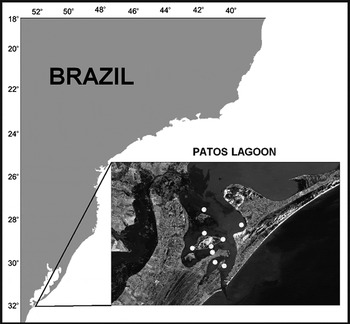
The study area corresponds to the Patos Lagoon estuary, covering an area of the Rio Grande bar to an imaginary line that connects Ponta da Feitoria (31°41′S 52°02′W) to Ponta dos Lençóis (31°48′S 51°52′W) (Figure 1).
Estuarine region of Patos Lagoon, Rio Grande (RS), showing the main points of pink shrimp fishery (white dots).

The annual landing data (t) of pink shrimp in Patos Lagoon estuary were extracted from the statistics generated by IBAMA (Instituto Brasileiro do Meio Ambiente e dos Recursos Naturais Renováveis) (2000, 2001, 2002, 2003, 2004, 2005, 2006, 2007) and industrial fishing data were extracted from the Statistical Bulletins of the industrial fishery in Santa Catarina State from the Grupo de Estudos Pesqueiros (GEP)—Centro de Ciências Tecnológicas da Terra e do Mar—Universidade do Vale do Itajaí (UNIVALI).
The rainfall data used are provided by the Instituto Nacional de Meterologia (INMET) (8° Distrito de Meterologia—Porto Alegre), Ministério da Agricultura, Pecuária e Abastecimento (MAPA) and Fundação Estadual de Pesquisas Agropecuárias (FEPAGRO) da Secretaria de Ciência e Tecnologia (SCT) in Rio Grande do Sul State, while the El Niño and La Niña data are available at the NOAA website (National Oceanic and Atmospheric Administration: www.esrl.noaa.gov).
The study period was subdivided taking into consideration the levels of adult stock exploitation identified by D'Incao et al. (2002) and the period after this study. The first period (1965 to 1972) corresponded to catches and relatively high abundances (6797 t and 8.12 kg/hour, respectively). The second period (1973 to 1986) is characterized by a slow decline in abundance, with oscillations and catches above 2000 t, without major variation (average of 1970 t and 3.81 kg/hour, respectively). The third period (1987 to 1999) is marked by low catches and relative abundance (average of 1970 t and 3.81 kg/hour, respectively). The fourth period (2000 to 2007) shows a slight tendency towards adult stock recovery (average 2158.2 t).
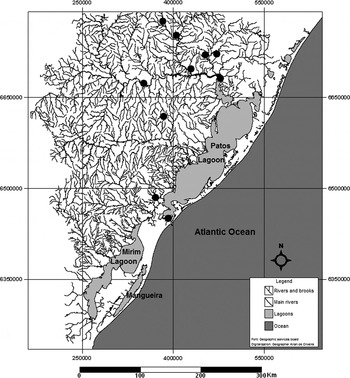
The sum of mean annual rainfall corresponds to 10 active automatic weather stations and covers the Patos Lagoon basin, as shown in Figure 2, a period from July to December. A Kolmogorov–Smirnov test was performed with the rainfall, landing and adult stock data to verify homoscedasticity.
Hydrographic basin of Patos Lagoon. The black circles represent the location of the automatic meteorological station where were obtained the rainfall data. They are: Veranópolis, Bento Gonçalves, Farroupilha, Caxias do Sul, Taquarí, Porto Alegre, Cachoeira do Sul, Encruzilhada do Sul, Pelotas and Rio Grande, respectively in the north–south direction.

Linear regression analysis was performed for each period; this gauged the correlation degree between two linear variables in metric scale. The correlation analysis indicates a relationship between two linear variables and the values will always be between +1 and –1. The sign indicates the direction, that is, if the correlation is positive or negative, the size of the variable indicates the strength of correlation.
This analysis was performed between the total rain of the second half of each year and the annual landing of pink shrimp in the estuary of the following year, and between the exploitation level of the adult stock available in the ocean represented by the annual landing of adult pink shrimp in Santa Catarina State and the annual landing of pink shrimp in the estuary in the following year. The annual shrimp landing in the estuary reflects the effect of environmental and biological variables of the previous year (main breeding peak of the species in spring).
Since there is no information on the actual values of the adult stock, of the spawning females or the availability of post-larvae, we used the annual landing (t) values of industrial fishery of pink shrimp, as an indicator of adult abundance.
RESULTS
The normality test showed that the data follow a normal distribution, therefore, they are homoscedastic.
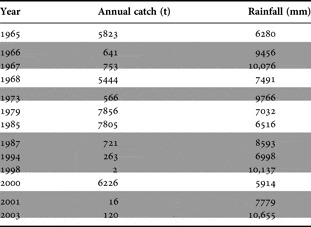
The years with higher captures (up to 5000 t) coincide with periods of La Niña and low pluviometric index, meanwhile the years of lower captures (below 1000 t) correspond to the El Niño periods and high pluviometric index, as shown in Table 1. This relationship confirms the hypothesis that the shrimp landings are influenced by climatic events, although not always presenting high correlation probably due to recruitment problems generated by the decrease in breeding stock in the ocean as a consequence of the increment in fishery effort.
Comparison between the rainfall and annual pink shrimp harvest in the Patos Lagoon estuary, considering only the years in which the harvests were higher than 5000 t and lower than 1000 t, and showing the importance of the occurrence of El Niño/Southern Oscillation phenomena (white rows: La Niña; grey rows: El Niño).

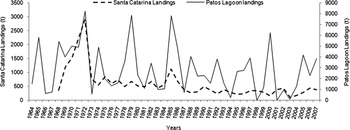
These factors were important for the reduction of the annual artisanal and industrial fishery gradually, as shown in Figure 3.
Comparison between oscillations of the annual pink shrimp harvests landed by the Santa Catarina State industrial fleet and the artisanal harvest in Patos Lagoon estuary, between the years 1964 and 2007.

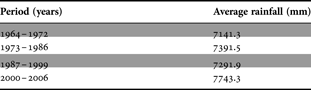
The less abundant capture of shrimp fishery was observed in subsequent years in periods of high pluviometric values. Particularly, in 1998, the annual landing value was excessively low (two tons), as a consequence of the effect of rainfall in 1997, when the most intense El Niño is registered (Grimm et al., Reference Grimm, Bartros and Doyle2000). The observation shown in Table 1 can allow to affirm that there is a regular occurrence of El Niño and La Niña during the periods of analyses, that is, the hypothesis that a higher occurrence of El Niño or La Niña alters the real relation between rainfall and the annual landings of shrimp is disregarded—the occurrence average of both phenomena is the same for the four analysed periods, therefore, the rainfall is also very similar in these periods, as shown in Table 2.
Average rainfall calculated for each period of the study (white rows: La Niña; grey rows: El Niño).

Data for pink shrimp landing in Patos Lagoon estuary provided by CEPERG/IBAMA include a period of 43 years. The last year provided was 2007. D'Incao et al. (2002) analysed these data till 1999 and subdivided the period taking in consideration the variation of the abundance index of industrial fishing. This division into three sub-periods was used in this analysis with the addition of a fourth sub-period between 2000 and 2007. The last sub-period shows a recovery tendency of the stock after the fishery collapse and has resulted in a meaningful modification in the dynamics of the commercial fleet in the search for alternative resources, probably leading to a reduction in effort over the population.
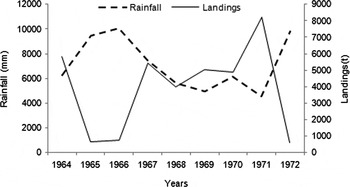
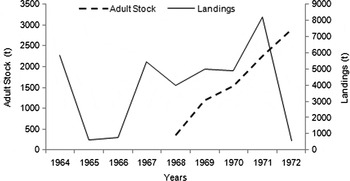
Figures 4 and 5 correspond to the first period. The relationship between the pluvial rainfall and the annual landing was extremely significant (R = –0.89), while the relationship between landings (Santa Catarina (spawning stock) and Patos Lagoon (juvenile stock)) was less evident (R = –0.21).
Variation of rainfall and the fluctuations of annual harvest of pink shrimp in Patos Lagoon estuary between the years 1964 and 1972.

Variation of the annual landing of the pink shrimp oceanic fishery of Santa Catarina State and the fluctuations of the annual harvests in Patos Lagoon estuary between the years 1964 and 1972.

Figure 4 shows a good correlation between the rain data and landing in Patos Lagoon estuary, that is, periods with heavy rain preceding the less abundant captures.
Figure 5 shows that there is no significant relationship between the capture data of the adult stock and the annual landings in the Patos Lagoon estuary.
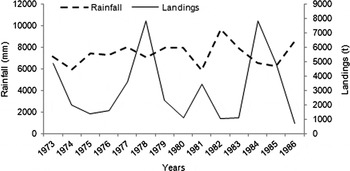
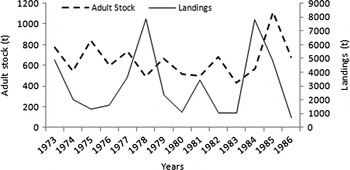
Figures 6 and 7 refer to the second period in which was observed a meaningful decrease in landings and adult stock abundance (D'Incao et al., Reference D'Incao, Valentini and Rodrigues2002).
Variation of pluvial rainfall and the fluctuation of the annual pink shrimp harvest in Patos Lagoon estuary between the years 1973 and 1985.

Variation of annual landing of pink shrimp oceanic fishery of Santa Catarina State and the fluctuation of annual harvests in Patos Lagoon estuary between the years 1973 and 1985.

In Figure 6, although there is a discernible relation between the increase of rain and decrease in annual landings, this relationship is less evident, the correlation coefficient having decreased to R = –0.50.
Figure 7 shows a low correlation between the adult stock and the landing on the estuary (R= –0.05), indicating that in this period the relation between the adult stock size in the ocean and the recruitment of the Patos Lagoon estuary did not reflect the effect of the availability of post-larvae.
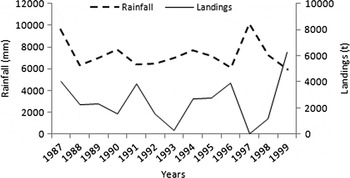
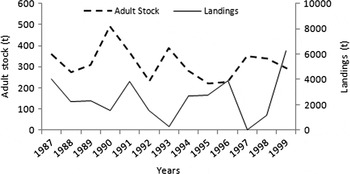
The correlation between the rain and the annual harvest in the Patos Lagoon estuary drastically diminished (R = –0.38) in the third period (Figure 8). However, the size of the adult stock in the ocean, represented by the landing of the industrial fleet of Santa Catarina started to show a major importance, indicated by the value of its linear correlation coefficient (R = –0.29) (Figure 9).
Variation of pluvial rainfall and the fluctuation of annual harvests in Patos Lagoon estuary between the years 1987 and 1999.

Variation of annual landing of pink shrimp oceanic fishery of Santa Catarina State and the fluctuation of annual harvests in Patos Lagoon estuary between the years 1987 and 1999.

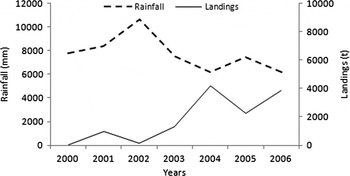
The last period shows the present situation of the fishery in the estuary. Figure 10 demonstrates almost perfect symmetry between variables, increase of rain and decrease of the annual harvest indicated by the high correlation coefficient between them (R = −0.80).
Variation of pluvial rainfall and the fluctuation of annual harvests in Patos Lagoon estuary between the years 2000 and 2007.

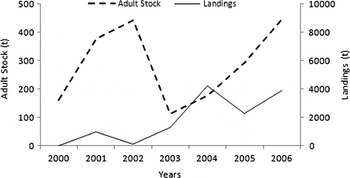
Figure 11 again shows a low correlation between the adult stock and landings on the estuary (R = 0.03) in the period between 2000 to 2007.
Variation of annual landing of pink shrimp oceanic fishery of Santa Catarina State and the fluctuation of annual harvests in Patos Lagoon estuary between the years 2000 and 2007.

DISCUSSION
Between 1964 and 1972 the resource abundance was high in the ocean. The relationship between the annual landings in the Patos Lagoon estuary and the rainfall in the adjacent basin was consistent, allowing us to deduce that the adult stock was producing enough post-larvae for recruitment. The correlation of the annual landings did not present any relation with the adult stock in the ocean and this fact was expected given that the abundant adult stock allows that the availability of post-larvae would not constitute a limiting factor. A final issue to be reviewed and which may also explain this low correlation is the fact that the adult stock data are available only from 1968, the start of industrial fishing in Santa Catarina (Valentini et al., Reference Valentini, D'Incao, Rodrigues, Rebelo-Neto and Rahn1991). At this time the captures of the industrial fleet were in the upswing in the yield curve, a condition of under-exploited stocks (D'Incao et al., 2002), reinforcing the assumption that the recruitment of post-larvae was sufficiently abundant to minimize its importance in the analysis.
Castello & Moller (Reference Castello and Moller1978) found a correlation (R = –0.89) between rain and shrimp production in Patos Lagoon for the period 1967 to 1976, but did not discuss their relation to Niños, nor the influence of the adult stock size.
Moller & Castello (Reference Moller, Castello and Vaz2009) identified a good correlation (R = –0.87) between 70% of the flow rate in Patos Lagoon and the pink shrimp landings in Patos Lagoon estuary. However, they did not consider the fluctuation in the existing fishing effort in this region (D'Incao et al., 2002) and the situation of the adult stock in the ocean during the study period.
In the second period we observed a decrease in annual landings. This decrease led probably to a decrease in the number of spawning females in the ocean and the decrease in the availability of post-larvae for recruitment in the estuary. This fact may be responsible for the accentuated decrease in the correlation between rain and the Patos Lagoon landing size, masking its importance as a determinant factor for the success of the captures, since there was no significant change in rainfall between periods. The low correlation between adult stock and craft landing (R = –0.05) can be explained by pink shrimp stock in this period being relatively stable. The fleet size maintained around 200 vessels has led to some stabilization of the fishing effort (D'Incao et al., 2002).
The third period is characterized by the accentuated collapse in breeding stock, driven by increased overfishing due to growth of the fleet (D'Incao et al., 2002). The decrease in the relative abundance of stock also meant a decrease in the number of spawning females. This fact leads to a possible masking of the meteorological effects in shrimp harvest. The rain, which was so important, has become less evident, although its ecological importance continues to be the same. The flaws in the post-larvae recruitment, except for the year 1997, would lead to less important recruitment independently of environmental factors.
The relation between adult stock and landings in the Patos Lagoon estuary shows certain symmetry that was not previously observed. Since 1987, the decrease in the adult population size in the ocean began to influence the success of annual recruitment in the Patos Lagoon estuary. Although the landing values of the commercial fleet are not the best indicators for detecting changes in the post-larvae recruitment, these are the only data available.
In the fourth and last analysed period, the meteorological factors are again indicating good correlation with the annual harvest values. This may result from the fact that the shrimp fleet, after the fishery collapse, changed their operational strategy. The pink shrimp is no longer the target species of this fleet, but a component of a multi-species fishery (D'Incao et al., 2002) performed on a much wider area of the continental shelf than that occupied by the pink shrimp stock. This new situation probably decreased the strain on the shrimp population leading to an improvement in relative abundance of the the breeding stock. This fact in turn leads to a recovery tendency of the adult stock allowing the assumption that the variation in the availability of the post-larvae would not be a factor that could significantly affect the recruitment in the Patos Lagoon estuary.
ACKNOWLEDGEMENTS
We thank the Universidade Federal do Rio Grande and the Conselho Nacional de Desenvolvimento Científico e Tecnológico (CNPq) for financial support.