



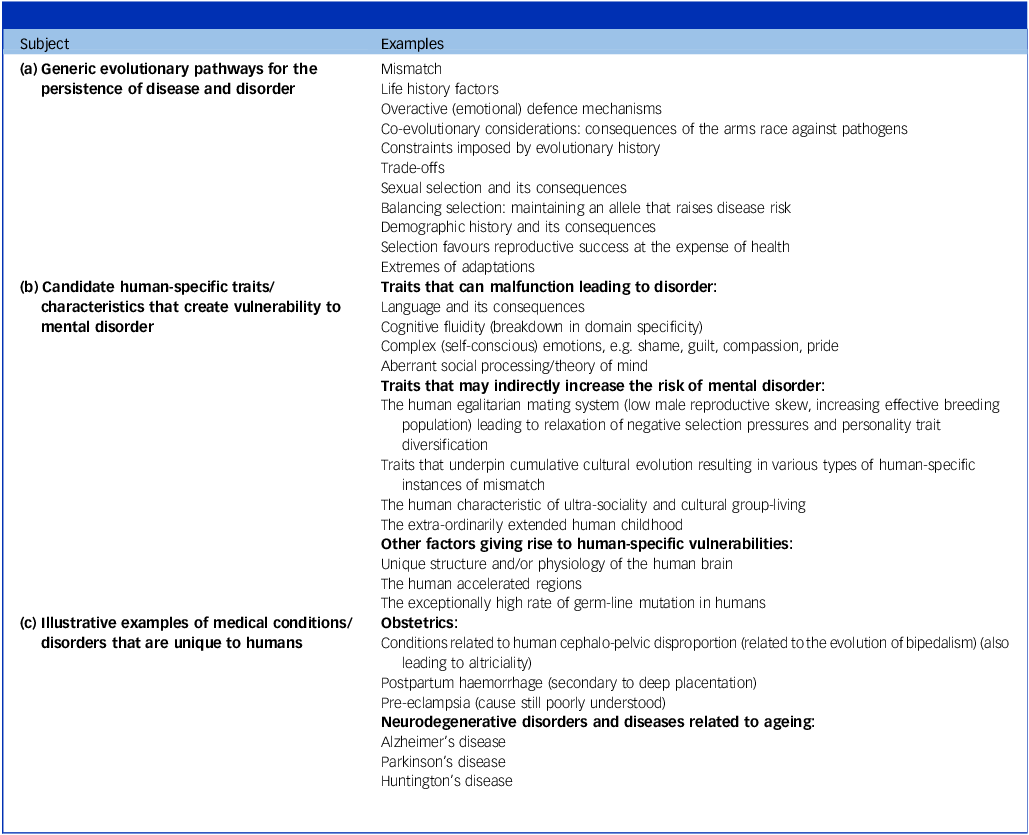
Evolutionary medicine highlights a fundamental Darwinian paradox: if natural selection shapes functional systems to promote survival and reproductive success, why do diseases and disorders persist? Evolutionary psychiatry has taken up this question as it pertains to psychopathology, applying the generic evolutionary explanations developed in evolutionary medicine (Box 1, subsection a). These explanations apply across all species.

Box 1 Long description
The table has three main sections: (a) Generic evolutionary pathways for the persistence of disease and disorder, (b) Candidate human-specific traits/characteristics that create vulnerability to mental disorder, and (c) Illustrative examples of medical conditions/disorders that are unique to humans. Section (a) includes examples such as mismatch, life history factors, and trade-offs. Section (b) is divided into traits that can malfunction leading to disorder, traits that may indirectly increase the risk of mental disorder, and other factors giving rise to human-specific vulnerabilities. Section (c) lists conditions related to obstetrics and neurodegenerative disorders. Each section provides specific examples relevant to the subject.
A striking but often overlooked feature of our species is the exceptional prevalence and diversity of mental disorders. Although some non-human animals display behaviours analogous to human affective disturbances – such as anxiety-like avoidance or depression-like lethargy – the complex syndromes identified in psychiatry, with their characteristic psychological, cognitive and social manifestations, appear to be uniquely human. Moreover, clinical entities such as schizophrenia, bipolar disorder, autism and eating disorders appear to have no clear analogues elsewhere in the animal kingdom. They are found only in Homo sapiens, and thus their very expression seems to require evolved capacities that only humans possess.
This observed asymmetry demands explanation. If other primates share the vast majority of our genes and neurobiology yet do not exhibit these conditions, then something about the specifically human evolutionary trajectory must have introduced novel forms of psychological vulnerability. Hence, the persistence of the diverse array of psychopathology that afflicts humans cannot be understood purely through the aforementioned generic evolutionary explanations for disorder. Instead, their ultimate causes must be traced to the distinctive evolutionary processes by which human speciation occurred. Reference Crow1 This includes investigating the suite of cognitive, emotional and social adaptations that have evolved through selection following divergence from our last common ancestor with chimpanzees, around 7–8 million years ago. Importantly, these novel capacities, and the vulnerabilities associated with them, are unlikely to reflect the emergence of entirely new, human-specific single genes, but rather changes in gene regulation, developmental timing and the complex coordination of polygenic systems. The roles of epigenetics and allostatic load are additional important areas to consider. Reference Savva, Griffin and Abed2 This evolutionary insight raises deep and important questions about the validity of the many animal models used to study and understand psychopathology in humans.
We propose that the full syndromal expressions we see in psychiatry probably arise from human-specific capacities such as language, complex thought processes, self-reflection, extreme culture dependence and ultra-sociality, and are therefore not seen in species that do not possess those capacities. However, the underlying processes that contribute to these syndromes, including defensive emotions (e.g. fear), attachment and reward schedules, are widely shared with other species. Hence, human uniqueness is shaped by higher-order capacities that produce complex and unstable experiences that become human-specific. Furthermore, we recognise that psychiatric diagnoses as syndromic constructs are themselves shaped by language, history, culture and clinical practice, and do not map onto discrete biological entities. As a result, both the experience of disorder and its classification are mediated by the very traits under investigation. Recognising this recursive process can help avoid the reification of current diagnostic categories, supporting instead a more provisional and model-based view of psychiatric knowledge that moves beyond disorder-specific explanations towards a broader account of species-level vulnerability.
As such, it may now be time for evolutionary psychiatry to take a critical next step: to attempt to identify and explore the human species-specific vulnerabilities to mental disorders. Whereas evolutionary science teaches us that there are no unbridgeable gaps in the evolution of life and the evolutionary literature, starting with Darwin, has emphasised the phylogenetic continuity between humans and other species (in both structural and behavioural traits), it is vitally important to also recognise the existence of the discontinuities between species. The proposal that species possess unique properties distinguishing them from all others is axiomatic and uncontroversial, and applies equally to Homo sapiens.
We suggest, particularly in view of the extraordinary and unprecedented ecological dominance exerted by humans over all other life forms on our planet, Reference Flinn, Geary and Ward3 that overlooking the unique behavioural and psychological traits that characterise Homo sapiens within the current evolutionary psychiatry literature is a significant omission. Thus, evolutionary psychiatry’s frameworks aimed at understanding human vulnerability to mental disorder will remain incomplete and even seriously defective without the systematic integration of the vulnerabilities arising from the salient human, species-specific traits.
Are humans more likely to suffer from mental disorder compared with non-human animals?
Although there have been some attempts in the existing evolutionary literature to highlight specific human vulnerabilities, most have been piecemeal rather than systematic. These include evolutionary models proposing a specifically human vulnerability to psychosis, such as Crow’s hypothesis that the vulnerability to schizophrenia arose in humans as a by-product of the evolution of language, Reference Crow1 Burns’ cortical dysconnectivity model Reference Burns4 and Savva et al’s modified aberrant salience hypothesis. Reference Savva, Griffin and Abed2 Other disorder-focused accounts have addressed different forms of psychopathology, including Baron-Cohen’s empathising–systemising hypothesis in relation to autism, Reference Baron-Cohen5 and evolutionary accounts of eating disorders, particularly anorexia nervosa and bulimia nervosa, which are notable for their recent emergence in humans, predominance in Western societies and probable human specificity. Reference Abed6 Although these models are consistent with the thesis advocated in this editorial, they focus on specific disorders rather than the wider question of human-specific traits and the vulnerabilities arising from them.
The exception to this is Soper’s Reference Soper7 wide-ranging evolutionary framework for common mental disorders, where it is proposed that all common mental disorders (with the exception of organic, neurodevelopmental and anxiety disorders) are anti-suicide adaptations. However, although Soper’s framework recognises the specific human vulnerability to mental disorders proposed as arising from the unique human vulnerability to suicide, tying the evolutionary roots of all common mental disorders to suicide prevention has its own challenges.
In the wild, non-human primates can show evidence of depression-like and anxiety-like behaviours. Reference Sapolsky8 There is also evidence of bereavement-like states that show clear similarities with human responses to loss. For example, the death of an adult female baboon through predation produces a rise in glucocorticoid levels in her relatives that may last for a month or so (but this does not occur in non-relatives). Reference Goldsborough, van Leeuwen, Kolff, de Waal and Webb9 Such death also triggers increased frequency and intensity of grooming among related individuals, which is likely to be an adaptive soothing response that helps hasten recovery from states of stress. Another example of adaptive responses to loss is the evidence of chimpanzees consoling other bereaved members of the group. Reference Soper7
We agree with Sapolsky Reference Sapolsky8 (pp. 1389) that ‘all species are unique, but some are unique in particularly unique ways’. We propose that one important and overlooked aspect of human uniqueness is our species’ distinctive vulnerability to mental disorder. The fact that a whole range of mental disorders do not appear to have clear analogues in non-human species justifies treating this as a plausible evolutionary proposal. On this view, human psychopathology should be understood not merely as a collection of discrete disorders but as reflecting a broader species-typical vulnerability arising from the same cognitive, emotional, social and cultural capacities that distinguish Homo sapiens. This vulnerability has probably been amplified and magnified by the novel conditions of the modern environment: an environment created and shaped by human behaviour and cultural activity.
Salient human, species-specific traits/characteristics likely to give rise to vulnerability to mental disorders
Comprehensively mapping out all the significant human, species-specific psychological, behavioural and genetic differences that produce vulnerabilities for mental disorder is a major scientific undertaking that is beyond the scope of this short editorial. Our aim is to raise awareness of the importance of the phylogenetic dimension to the understanding of the roots of mental disorder, and to restore scientific respectability to the concept of human uniqueness. Placing the concept within the purview of researchers and theorists in mental health will help create the scientific critical mass that can help in the vital task of exploring the evolutionary roots of the unique human vulnerability to mental disorder. Thus, in Box 1 (subsection b) we tentatively propose a way to classify human-specific psychological and behavioural traits that can give rise to vulnerability to mental disorder: traits that can directly malfunction, and traits that indirectly increase risk of disorder. This should be considered as an informed ‘first stab’ at answering this important question that will no doubt require future refinement and revision.
Implications of human uniqueness for the future of psychiatry
The question of human uniqueness is relevant, of course, to the whole of medicine (see Box 1, subsection c). However, we argue that psychiatry has a special and unique place in medicine because its primary focus is on breakdowns in recently evolved functional capacities related to human sociocultural living: traits that have uniquely arisen in Homo sapiens. We propose that a number of potential practical implications follow from the recognition of the significance of human uniqueness. Examples include:
-
(a) Augmenting the current theoretical framework of evolutionary psychiatry, which has focused only upon generic vulnerabilities shared across species, with new ultimate-level explanations centred on the evolution of distinctively human adaptations that may create vulnerability to mental disorder. This would complement, rather than replace, existing accounts of vulnerabilities shared across species, and should benefit mainstream psychiatry by underlining the importance of the phylogenetic dimension.
-
(b) We propose that ‘human uniqueness and mental health’ deserves its own interdisciplinary research programme, drawing on work from diverse fields including psychology, anthropology, genetics, neuroscience, ethology and others.
-
(c) A human uniqueness framework imposes principled, scientifically informed limits on the use of animal models in psychiatry. Where the disordered function depends on species-specific adaptations (see Box 1, subsection b), animal models can at best illuminate peripheral mechanisms rather than the disorder itself. This calls for explicit justification of which aspects of a condition are evolutionarily shared and which are uniquely human. Currently, scant attention is paid in the non-evolutionary animal-models literature to the nature of the dysfunctional systems leading to mental disorder. For example, if schizophrenia is related to language and the human social brain it will not be found in species lacking these systems. Also, animal models based on the use of psychoactive substances and ablative procedures are not necessarily good analogues of spontaneously arising psychosis in humans.
-
(d) Appreciating human uniqueness sharpens the distinction between behavioural resemblance and evolutionary homology. Anxiety-like or depression-like behaviours in non-human animals may reflect conserved affective systems, whereas disorders involving delusions, identity disturbance, eating psychopathology or altered self-experience probably depend on psychological architectures absent in other species. Treating these as equivalent risks category errors.
-
(e) Because humans uniquely inhabit environments constructed through cumulative cultural evolution, many psychiatric vulnerabilities may arise not merely from generic evolutionary mismatch, but from mismatches between evolved human-specific traits and rapidly changing, human-generated, symbolic, social, technological and institutional contexts. These mismatches are uniquely human phenomena and may be a central source of vulnerability (see Box 1, subsection b).
-
(f) Also, psychiatric vulnerability is not incidental but may represent an intrinsic cost of the very traits that underpin human ecological dominance and cultural complexity. Mental disorders may thus reflect failure modes of otherwise adaptive human-specific capacities (that have been derailed), rather than malfunctions of ancient biological systems alone.
-
(g) Is this model testable? We suggest that the proposal that human-specific psychological traits create the vulnerability to mental disorder is a high-level theoretical framework that is not directly testable. However, the framework generates hypotheses that are testable and refutable. Examples include implications for animal model research (see points (c) and (d) above).
Recognising human uniqueness as a central explanatory framework has important implications for the future of psychiatry and mental health generally. It has the potential for uncovering the deep structure of Homo sapiens’ unique vulnerability to mental disorder. If many psychiatric disorders arise from breakdowns in species-specific psychological adaptations, then these cannot be fully understood through models that abstract away from what makes humans distinctive. Psychiatry is therefore not merely applied neuroscience or behavioural medicine, but the clinical science of the uniquely human mind situated at the intersection of biology, culture and evolution. By systematically integrating human uniqueness into its theoretical foundations, evolutionary psychiatry can move beyond piecemeal explanations and towards a more coherent account of why Homo sapiens, alone among animals, is so vulnerable to mental disorder.
Acknowledgement
The authors thank the anonymous reviewers for their helpful comments and suggestions that helped improve this editorial.
Author contributions
R.T.A. initiated this project and wrote the first draft. R.T.A., B.G. and P.S.J.-S. contributed equally with ideas, editing, proofreading and approval of the final manuscript.
Funding
This work received no specific grant from any funding agency, commercial or not-for-profit sectors.
Declaration of interest
None.



eLetters
No eLetters have been published for this article.