Introduction
Clinical findings reporting different activation patterns for first (L1) and second language (L2) (Ojemann & Whitaker, Reference Ojemann and Whitaker1978) and distinct recovery patterns for L1 and L2 (Albert & Obler, Reference Albert and Obler1978; Silverberg & Gordon, Reference Silverberg and Gordon1979) in bilinguals have informed and motivated the first bilingual neuroimaging studies investigating L1 and L2 neural representation (Dehaene, Dupoux, Mehler, Cohen, Paulesu, Perani, Van de Moortele, Lehericy & Le Bihan, Reference Dehaene, Dupoux, Mehler, Cohen, Paulesu, Perani, Van de Moortele, Lehericy and Le Bihan1997; Kim, Relkin, Lee & Hirsch, Reference Kim, Relkin, Lee and Hirsch1997; Klein, Milner, Zatorre, Meyer & Evans, Reference Klein, Milner, Zatorre, Meyer and Evans1995; Klein, Zatorre, Milner, Meyer & Evans, Reference Klein, Zatorre, Milner, Meyer and Evans1994; Perani, Dehaene, Grassi, Cohen, Cappa, Dupoux, Fazio & Mehler, Reference Perani, Dehaene, Grassi, Cohen, Cappa, Dupoux, Fazio and Mehler1996). Despite providing first steps investigating the bilingual brain, these clinical studies mainly addressed word production and comprehension, neglecting the more complex use of word inflection or word combinatorials subsumed under the term morphosyntaxFootnote 1
The investigation of morphosyntax is an intriguing topic for L2 brain research, as, differently from lexical- and semantic processing, L2 morphosyntax attainment seems to be more delicate and subject to age of acquisition effects (AoA) (Birdsong, Reference Birdsong2006; Johnson & Newport, Reference Johnson and Newport1989; Weber-Fox & Neville, Reference Weber-Fox and Neville1996). The effects of acquiring a second language later in life, i.e., after a first language has been acquired, have been linked to the critical period hypothesis (CPH). According to this hypothesis, adult L2 attainment relies on different mechanisms used during first language acquisition as a result of reduced brain plasticity, i.e., biological constraints (Lenneberg, Reference Lenneberg1967) or failure to access the Universal Grammar, UG, (Bley-Vroman, Reference Bley-Vroman, Gass and Schachter1989) (for a review of CPH, see (Singleton, Reference Singleton2005). Despite support arguing for an existing critical period in L2 acquisition (DeKeyser, Reference DeKeyser2000; Johnson & Newport, Reference Johnson and Newport1989), more recent findings seem to point towards a different direction. That is, the level of L2 proficiency seems to play a more important role in L2 morphosyntactic processing than the age, in which the language was acquired.
In this review, we revisit the main neuroimaging findings accrued in the past 20 years on L2 morphosyntactic representation and processing (for a general neuroimaging review of L2 language representation, see Abutalebi, Reference Abutalebi2008 and for ERP and some previous neuroimaging findings on L2 syntax, see Kotz, Reference Kotz2009; Steinhauer, Reference Steinhauer2014). Our goal is to provide the reader with an overview of the main research questions addressed by these neuroimaging studies investigating L2 morphosyntax, their findings, and implications for L2 language research. We will also briefly address these studies’ shortcomings and remaining questions that need to be further investigated.
2. L1 and L2 morphosyntactic processing: Overlap or segregation?
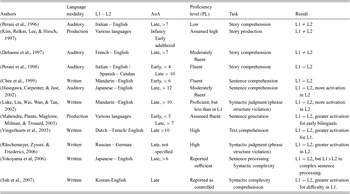
L2 studies investigating sentence level representation and processing have mainly addressed the question of whether L1 and L2 neural representations at different linguistic levels, such as the lexicon, semantics or syntax, are shared or segregated (Chee, Caplan, Soon, Sriram, Tan, Thiel & Weekes, Reference Chee, Caplan, Soon, Sriram, Tan, Thiel and Weekes1999; Dehaene et al., Reference Dehaene, Dupoux, Mehler, Cohen, Paulesu, Perani, Van de Moortele, Lehericy and Le Bihan1997; Hasegawa, Carpenter & Just, Reference Hasegawa, Carpenter and Just2002; Kim, Relkin, Lee & Hirsch, Reference Kim, Relkin, Lee and Hirsch1997; Mahendra, Plante, Magloire, Milman & Trouard, Reference Mahendra, Plante, Magloire, Milman and Trouard2003; Perani et al., Reference Perani, Dehaene, Grassi, Cohen, Cappa, Dupoux, Fazio and Mehler1996; Perani, Paulesu, Galles, Dupoux, Dehaene, Bettinardi, Cappa, Fazio & Mehler, Reference Perani, Paulesu, Galles, Dupoux, Dehaene, Bettinardi, Cappa, Fazio and Mehler1998; Vingerhoets, Borsel, Tesink, Van de Noort, Deblaere, Seurinck, Vandemaele & Achten, Reference Vingerhoets, Borsel, Tesink, van den Noort, Deblaere, Seurinck, Vandemaele and Achten2003). Despite their similar motivation, methodological differences may have contributed to differences in research findings. Methodological diversity can be found with respect to the choice of a task, i.e., the language task that was used, e.g., production as well as comprehension at the prose (Dehaene et al., Reference Dehaene, Dupoux, Mehler, Cohen, Paulesu, Perani, Van de Moortele, Lehericy and Le Bihan1997; Kim et al., Reference Kim, Relkin, Lee and Hirsch1997; Perani et al., Reference Perani, Dehaene, Grassi, Cohen, Cappa, Dupoux, Fazio and Mehler1996, Reference Perani, Paulesu, Galles, Dupoux, Dehaene, Bettinardi, Cappa, Fazio and Mehler1998; Vingerhoets et al., Reference Vingerhoets, Borsel, Tesink, van den Noort, Deblaere, Seurinck, Vandemaele and Achten2003) and sentence level (Chee et al., Reference Chee, Caplan, Soon, Sriram, Tan, Thiel and Weekes1999; Hasegawa et al., Reference Hasegawa, Carpenter and Just2002; Mahendra et al., Reference Mahendra, Plante, Magloire, Milman and Trouard2003). Furthermore, these studies varied in terms of the age of acquisition, early learners (Chee et al., Reference Chee, Caplan, Soon, Sriram, Tan, Thiel and Weekes1999), late learners (Dehaene et al., Reference Dehaene, Dupoux, Mehler, Cohen, Paulesu, Perani, Van de Moortele, Lehericy and Le Bihan1997; Hasegawa et al., Reference Hasegawa, Carpenter and Just2002; Perani et al., Reference Perani, Dehaene, Grassi, Cohen, Cappa, Dupoux, Fazio and Mehler1996; Vingerhoets et al., Reference Vingerhoets, Borsel, Tesink, van den Noort, Deblaere, Seurinck, Vandemaele and Achten2003), early vs. late learners (Kim et al., Reference Kim, Relkin, Lee and Hirsch1997; Mahendra et al., Reference Mahendra, Plante, Magloire, Milman and Trouard2003; Perani et al., Reference Perani, Paulesu, Galles, Dupoux, Dehaene, Bettinardi, Cappa, Fazio and Mehler1998), and language proficiency level, i.e., low to moderate (Dehaene et al., Reference Dehaene, Dupoux, Mehler, Cohen, Paulesu, Perani, Van de Moortele, Lehericy and Le Bihan1997; Kim et al., Reference Kim, Relkin, Lee and Hirsch1997; Perani et al., Reference Perani, Dehaene, Grassi, Cohen, Cappa, Dupoux, Fazio and Mehler1996) and moderate to high (Chee et al., Reference Chee, Caplan, Soon, Sriram, Tan, Thiel and Weekes1999; Hasegawa et al., Reference Hasegawa, Carpenter and Just2002; Perani et al., Reference Perani, Paulesu, Galles, Dupoux, Dehaene, Bettinardi, Cappa, Fazio and Mehler1998; Vingerhoets et al., Reference Vingerhoets, Borsel, Tesink, van den Noort, Deblaere, Seurinck, Vandemaele and Achten2003).
In three of these studies (Dehaene et al., Reference Dehaene, Dupoux, Mehler, Cohen, Paulesu, Perani, Van de Moortele, Lehericy and Le Bihan1997; Kim et al., Reference Kim, Relkin, Lee and Hirsch1997; Perani et al., Reference Perani, Dehaene, Grassi, Cohen, Cappa, Dupoux, Fazio and Mehler1996) a difference between L1 and L2 neural representation was reported for late learners with low to moderate proficiency. While L1 responses were left-lateralized, L2 representation was less left-lateralized or even completely right-lateralized (Dehaene et al., Reference Dehaene, Dupoux, Mehler, Cohen, Paulesu, Perani, Van de Moortele, Lehericy and Le Bihan1997; Kim et al., Reference Kim, Relkin, Lee and Hirsch1997; Perani et al., Reference Perani, Dehaene, Grassi, Cohen, Cappa, Dupoux, Fazio and Mehler1996). However, when L2 proficiency is high or comparable to first language, early and late bilinguals seem to activate similar brain areas when processing both languages (Chee et al., Reference Chee, Caplan, Soon, Sriram, Tan, Thiel and Weekes1999; Hasegawa et al., Reference Hasegawa, Carpenter and Just2002; Perani et al., Reference Perani, Paulesu, Galles, Dupoux, Dehaene, Bettinardi, Cappa, Fazio and Mehler1998; Vingerhoets et al., Reference Vingerhoets, Borsel, Tesink, van den Noort, Deblaere, Seurinck, Vandemaele and Achten2003). Even though these studies were the first to address L2 representation at sentence level, their choice of task, i.e., prose and sentence comprehension or production, may have engaged, additionally to morphosyntax, other linguistic domains, such as phonology and semantics. This renders a coherent interpretation of the results somewhat inconclusive.
The investigation of morphosyntax per se requires a more controlled task, which should consider the manipulation of morphosyntactic parameters such as gender or number agreement or other syntactic structures (e.g., phrase structure) or syntactic complexity. When investigating active vs. passive syntactic structures, Yokoyama and colleagues (Reference Yokoyama, Okamoto, Miyamoto, Yoshimoto, Kim, Iwata, Jeong, Uchida, Ikuta, Sassa, Nakamura, Horie, Sato and Kawashima2006) report activation in left inferior frontal gyrus (IFG) for L1 and L2 in high proficient late learners. However, during the processing of the more difficult syntactic structure, i.e., passive sentences, different activation patterns were observed for L1 and L2. Greater activation pattern was encountered for passive sentences in comparison to active ones found in L1, while no such difference was observed in L2 processing (Yokoyama et al., Reference Yokoyama, Okamoto, Miyamoto, Yoshimoto, Kim, Iwata, Jeong, Uchida, Ikuta, Sassa, Nakamura, Horie, Sato and Kawashima2006). Further, late high proficient bilinguals display stronger activation in the left temporal superior gyrus (STG) and left middle frontal cortex during L2 processing of phrase structure violation (Luke, Liu, Wai, Wan & Tan, Reference Luke, Liu, Wai, Wan and Tan2002; Rüschemeyer, Fiebach, Kempe & Friederici, Reference Rüschemeyer, Fiebach, Kempe and Friederici2005; Rüschemeyer, Zysset & Friederici, Reference Rüschemeyer, Fiebach, Kempe and Friederici2006) in comparison to L1. Such stronger activation pattern during L2 processing would reflect participants’ greater difficulty during L2 processing in comparison to L1, as a result of reduced proficiency in the former than in the latter.
Moreover, late bilinguals show stronger activation patterns in left IFG in L1, but not in L2 when processing syntactically complex sentences, i.e., center-embedded in comparison to simple joint sentencesFootnote 2 (Suh, Yoon, Lee, Chhung, Cho & Park, Reference Suh, Yoon, Lee, Chung, Cho and Park2007). This would result from differences in language automatization. While simple joint sentences would be automatically processed in L1, center embedded sentences, that are syntactically more complex, would not. As for L2, neither simple nor complex sentences would be automatically processed. Thus, as both sentence types would not be automatically processed in L2, they would generate similar activation patterns, thus failing distinction. The used methodology as well as the main findings of the studies discussed above is summarized in Table 1.
Summary of studies investigating L1 and L2 morphosyntactic representation: overlap vs. segregation.

3. L2 morphosyntactic processing, age of acquisition, and proficiency level
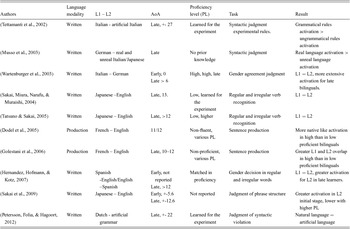
In order to gain a better understanding of the impact of AoA and the proficiency level on L2 morphosyntactic neural representation and processing, neuroimaging research has been conducted comparing early vs. late L2 learners, controlling for levels of proficiency. Highly proficient early and late L2 learners displayed similar activation patterns during morphosyntactic processing. Late learners, however, showed a greater extent of activation in the left IFG than early learners. Furthermore, in a study investigating the role of AoA, Sakai and colleagues (Reference Sakai, Nauchi, Tatsuno, Hirano, Muraishi, Kimura, Bostwick and Yusa2009) reported different correlation patterns between neural activation and task performance in early and late L2 learners with matched proficiency. There results suggest that morphosyntactic processing is subject to AoA despite of comparable proficiency levels (Hernandez, Hofmann & Kotz, Reference Hernandez, Hofmann and Kotz2007; Sakai et al., Reference Sakai, Nauchi, Tatsuno, Hirano, Muraishi, Kimura, Bostwick and Yusa2009; Wartenburger et al., Reference Wartenburger, Heekeren, Abutalebi, Cappa, Villringer and Perani2003).
The impact of proficiency on L2 morphosyntactic processing has been investigated in terms of regular (morphologically marked) and irregular (morphologically unmarked) verb recognition (Sakai, Miura, Narafu & Muraishi, Reference Sakai, Miura, Narafu and Muraishi2004; Tatsuno & Sakai, Reference Tatsuno and Sakai2005). Reported findings indicate an overlap between L1 and L2 neural representation, i.e., the left inferior frontal gyrus (IFG) (Sakai et al., Reference Sakai, Miura, Narafu and Muraishi2004; Tatsuno & Sakai, Reference Tatsuno and Sakai2005). This activation pattern was, nevertheless, modulated by the level of proficiency in regular and irregular past-tense forms (Sakai et al., Reference Sakai, Miura, Narafu and Muraishi2004; Tatsuno & Sakai, Reference Tatsuno and Sakai2005). With proficiency increase, less activation was found for the processing of irregular past-tense forms, while the processing of regular past-tense verbs elicited a non-significant activation in the IFG area. (Tatsuno & Sakai, Reference Tatsuno and Sakai2005). Furthermore, high proficiency contributes to a more native-like interaction of different functional areas, i.e., left IFG, putamen, insula, precentral gyrus, and supplementary motor areas (Dodel, Golestani, Pallier, ElKouby, Bihan & Poline, Reference Dodel, Golestani, Pallier, ElKouby, Bihan and Poline2005) and greater activation overlap of L1 and L2 in the left IFG for higher proficient individuals in comparison to low proficient ones (Golestani, Alario, Mariaux, Le Bihan, Dehaene & Pallier, Reference Golestani, Alario, Meriaux, Bihan, Dehaene and Pallier2006).
Further relevant contributions for the understanding of L2 syntactic processing and neural representation has been provided by studies using artificial languages. It has been shown that even after a short training, L2 learners seem to master artificial grammar rules and to detect their violation recruiting similar neural areas, such as BA44 and BA45, as in their native language (Petersson, Folia & Hagoort, Reference Petersson, Folia and Hagoort2012) and other natural languages (Musso, Moro, Glauche, Rijntjes, Reichenbach, Buechel & Weiller, Reference Musso, Moro, Glauche, Rijntjes, Reichenbach, Büchel and Weiller2003; Tettamanti, Alkadhi, Moro, Perani, Kollias & Weniger, Reference Tettamanti, Alkadhi, Moro, Perani, Kollias and Weniger2002). For an overview of the above mentioned studies, see the table below (Table 2).
Summary of studies investigating the impact of L2 age of acquisition and proficiency level on morphosyntactic processing.

In summary, previous research suggests that proficiency as well as AoA affects L2 morphosyntactic processing. What remains unclear is whether continuous exposure to a L2 may compensate for late age of acquisition by making L2 morphosyntactic processing more similar to L1. It has been argued that this form of automatization also found in L1 acquisition is core to the so called Procedural/Declarative model (Ullman, Reference Ullman2001, Reference Ullman2004).
According to this model, two different memory systems are involved in language processing, namely, the procedural and declarative memory system. The declarative system is involved in the storage of a mental lexicon of a language, and engaged in lexical and semantic processing. The declarative system relates to explicit learning and is not subject to a critical period (Tettamanti et al., Reference Tettamanti, Alkadhi, Moro, Perani, Kollias and Weniger2002). The procedural memory system, on the other hand, represents automatic language processing, relates to implicit learning of combinatorial rules applicable to the lexicon and may be constrained by biological maturation. Hence, morphosyntactic processing in L1 would rely more on the latter memory system, while in L2 the former system may be more active.
Such differences may explain the diverse L1 and L2 activation patterns reported in the L2 literature. However, it is not clear whether the explicit learning of rules, in late L2 learners would help to overcome late AoA, when proficiency is high. Perhaps with high proficiency and intense learning, automatization of L2 morphosyntactic rules could be achieved similarly to L1. Hence, to better understand whether high proficiency may ever overcome delayed AoA, further longitudinal neuroimaging studies, with bilinguals who undergo an extended time of L2 exposure and explicit learning to achieve high proficiency, are needed.
4. L1 to L2 transfer and morphosyntactic processing
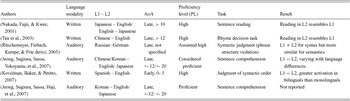
Together with the parameters AoA and proficiency, L1 and L2 differences also contribute to the characterization of L2 morphosyntactic processing. Luke and colleagues have shown (Luke, Liu, Wai, Wan & Tan, Reference Luke, Liu, Wai, Wan and Tan2002) that late high proficient L2 learners of languages containing similar grammatical surface structures, such as Russian and German, show similar activation patterns in L1 and L2, i.e., in the superior temporal gyrus (STG) with stronger activation in L2 (Luke et al., Reference Luke, Liu, Wai, Wan and Tan2002).
On the other hand, late and high proficient bilinguals of languages with orthographic encoding differences such as English and Japanese or English and Chinese, reveal similar activation patterns during L1 and L2 sentence (Nakada, Fujii & Kwee, Reference Nakada, Fujii and Kwee2001) and rhyme reading (Tan., Spinks, Feng, Siok, Perfetti, Xiong, Fox & Gao, Reference Tan, Spinks, Feng, Siok, Perfetti, Xiong, Fox and Gao2003), respectively. However, different activation patterns are found for each language in native reading. It could therefore be that, regardless of proficiency, late learners make use of L1 neural substrates to read in L2. Furthermore, greater syntactic differences between L1 and L2 may result in stronger activation of the left IFG (Jeong, Sugiura, Sassa, Yokoyama, Horie, Sato, Taira & Kawashima, Reference Jeong, Sugiura, Sassa, Haji, Usui, Taira, Horie, Sato and Kawashima2007); however, this activation difference tends to decrease with increased proficiency (Jeong, Sugiura, Sassa, Haji, Usui, Taira, Horie, Sato & Kawashima, Reference Jeong, Sugiura, Sassa, Haji, Usui, Taira, Horie, Sato and Kawashima2007).
A possible interpretation for these results can be found in the unified competition model (UCM) (MacWhinney, Reference MacWhinney, Kroll and de Groot2005). According to this model, whenever a surface structure, such as morphosyntax, is shared between languages, there will be a transfer of the mechanisms used in L1 to process morphosyntactic information in L2. If, however, L1 and L2 structures are not shared, a negative transfer, namely, the absence of information about a certain morphosyntactic structureFootnote 3 , from L1 to L2 is predicted, even if proficiency is high. Whether early L2 learners of languages with different syntactic structures would show language transfer, or a different neural network organization from native speakers of each language, is still an unanswered question.
To the best of our knowledge, only one study attempted to contrast early bilinguals with monolinguals in terms of morphosyntactic processing and language differences (Kovelman, Baker & Petitto, Reference Kovelman, Baker and Petitto2007). Kovelman and colleagues investigated high proficient early bilinguals and monolingual controls during a grammatical judgment task manipulating morphological markers and syntactic order. Results revealed greater activation pattern in Broca's area for L2 learners than monolinguals, even though no behavioral differences between groups were reported (Kovelman et al., Reference Kovelman, Baker and Petitto2007). Nonetheless, the previously mentioned study tested monolinguals of only one language as a control group. Thus, one cannot rule out the possibility that reported results may be explained by a transfer of L1 to L2 and not solely as a result of a bilingual neural signature. Therefore, to better understand why a bilingual neural signature of language processing independently of AoA and proficiency exists, more studies investigating high proficient early L2 learners and monolingual controls for both languages are needed. A summary of the main findings of language transfer studies can be found in Table 3.
Summary of studies investigating the impact of language transfer on L2 morphosyntactic processing.

4. Conclusion and future direction
In the past 20 years neuroimaging studies have significantly contributed to our understanding of L2 morphosyntactic neural representation and processing. Neuroimaging data seem to point towards an overlap of a neural network, e.g., left IFG, left STG recruited during L1 and L2 morphosyntactic processing with, nonetheless, differences in strength or extent of activation as a function of AoA, proficiency level and L1 and L2 surface structure similarities and differences. However, there are still remaining questions that should be addressed by future studies. For example, it remains unclear, whether with explicit learning of L2 morphosyntactic features in L2 late learners may overcome the effects of late AoA, and process L2 similarly to L1. Longitudinal studies, in which high proficient late learners would undergo explicit morphosyntactic learning, would help to shed more light on this matter.
Moreover, for a better understanding of how first and second language similarities and differences may affect L2 morphosyntactic processing, further studies with divergent language pairs should be conducted. Studies with early bilinguals showing comparable proficiency in first and second languages with divergent morphosyntactic structures may help to better understand if and which of these structures can be processed similarly to L1.
If, for instance, in a given language pair, one language relies on morphological markers while the other relies on syntactic order for morphosyntactic processing, investigating early L2 learners with comparable proficiency in these languages would be of great interest. Such an investigation would help to shed more light on how morphosyntactic information is being used during L1 and L2 processing and the extent to which language differences may shape its processing. It could very well be that simply acquiring a second language, regardless of an early AoA and a comparable proficiency level to L1, is already enough to start shaping neural organization in the L2 brain.