




No CrossRef data available.
Article contents
- Abstract
- ACCOUNTS OF VOTER BEHAVIOR: CHOICE OVER PLATFORMS
- VOTING TO ACHIEVE OUTCOMES: A MODEL OF INSTITUTIONAL BALANCING
- FROM INSTITUTIONS TO VOTERS: OBSERVABLE IMPLICATIONS
- EMPIRICAL ANALYSIS
- RESULTS: INSTITUTIONALLY DEPENDENT VOTERS
- DISCUSSION AND EXTENSIONS
- APPENDIX I: ANALYTIC SOLUTION
- APPENDIX II: COMPREHENSIVE RESULTS
- References
When Moderate Voters Prefer Extreme Parties: Policy Balancingin Parliamentary Elections
Published online by Cambridge University Press: 08 June 2005
Article contents
- Abstract
- ACCOUNTS OF VOTER BEHAVIOR: CHOICE OVER PLATFORMS
- VOTING TO ACHIEVE OUTCOMES: A MODEL OF INSTITUTIONAL BALANCING
- FROM INSTITUTIONS TO VOTERS: OBSERVABLE IMPLICATIONS
- EMPIRICAL ANALYSIS
- RESULTS: INSTITUTIONALLY DEPENDENT VOTERS
- DISCUSSION AND EXTENSIONS
- APPENDIX I: ANALYTIC SOLUTION
- APPENDIX II: COMPREHENSIVE RESULTS
- References
Abstract
This work develops and tests a theory of voter choice in parliamentary elections. I demonstrate that voters are concerned with policy outcomes and hence incorporate the way institutions convert votes to policy into their choices. Since policy is often the result of institutionalized multiparty bargaining and thus votes are watered down by power-sharing, voters often compensate for this watering-down by supporting parties whose positions differ from (and are often more extreme than) their own. I use this insight to reinterpret an ongoing debate between proximity and directional theories of voting, showing that voters prefer parties whose positions differ from their own views insofar as these parties pull policy in a desired direction. Utilizing data from four parliamentary democracies that vary in their institutional design, I test my theory and show how institutional context affects voter behavior.
Information
- Type
- ARTICLES
- Information
- Copyright
- © 2005 by the American Political Science Association
At the core of democratic theory is the notion of competitive elections taking place at regular intervals. Citizens use elections as mechanisms by which they hold politicians accountable and express discontent, as tools for pointing in the direction they want policy to take, as means for placing issues on the public agenda, as an occasion for public deliberation, and as opportunities for choosing delegates or trustees. As Powell (2000) describes them, elections are instruments of democracy.
How do voter preferences on issues translate into vote choice? To understand outcomes of any given election, one needs to sort out both the currency of the election—what voters care about—and how what they care about affects their choice. There is a general agreement among students of elections that issues matter (e.g., Barnes 1997). How they matter is unclear. According to current approaches, voters assess party positions (platforms) on the relevant issues with respect to their own views, employ some decision rule (e.g., similarity between party positions and voter views), and evaluate parties based on this rule. However, despite the voluminous literature on voter behavior, as far as issues go, much of the cross-national and cross-individual variation in voter behavior is left unexplained; political scientists disagree about which theoretical approach best explains how preferences on issues affect vote choice (e.g., Iversen 1994a and Lewis and King 2000).
Would we imagine voters employing the same decision rule in, say, the 2001 British elections, where, as expected, the Labour Party alone secured a solid majority in the House of Commons, as in the 2003 Israeli elections, where 13 parties gained seats in the Knesset, four of which hold cabinet positions at the time of writing? More generally, do voters in majoritarian systems employ the same strategy as their counterparts in consensual democracies? Under current scholarly frameworks, the answer is a clear yes. Focusing on voter evaluation of party positions, current frameworks of issue voting imply that postelectoral bargaining is of little importance. If platforms are indeed the object of voter evaluation, then the path from votes to seats to government formation to legislation to policy—and therefore much of what is regularly considered as the heart of politics—is inconsequential for voter assessment of parties. Thus, if voters evaluate parties based on their platforms, we should expect the principles that underlie their choices to hold across institutional environments regardless of the length and features of the path leading from votes to policy. The unexplained variation in voter behavior across democratic systems, however, suggests, that, possibly, something else is at work.
When a party wins election in majoritarian system, it can usually implement its preferred policy with little compromise; when Blair and his party are in power, they are in power. In contrast, according to standard portrayal of a victory in consensual systems, the winning party faces a long and winding path leading from election results to policy, with bargaining and compromise awaiting at each turn. If voters are at all concerned with policy outcomes, then the path from the announcement of election returns to policy is of much relevance to their choice. They might prefer one party when they predict that their vote will be watered down by institutionalized bargaining and a different one when they predict a short, straight, path from votes to policy.
How voters' opinions on issues affect their vote choice is critical for our understanding of representation. In many systems we observe ideological discrepancy between parties and their constituencies, with the former often being more extreme than the latter on issues (e.g., Adams and Merrill 1999 and Iversen 1994b). Does it imply that party elites do not listen to voters' voice? Or perhaps they do, and this discrepancy is consistent with voter preferences. Perhaps voters, predicting their vote to be watered down along the path, prefer parties to hold positions more extreme than their own opinions. This discrepancy between voter opinions and party positions on issues may or may not be a concern, depending on the decision rule voters employ when evaluating party positions on issues. If voters are concerned with platforms, ideological incongruence between voters and parties raises a potential concern of deficient representation. If, however, voters are concerned with policy outcomes, they might prefer parties' positions on issues to differ from their own views, and therefore this discrepancy is of less concern.
The answer one offers to the question posed above holds implications not only for our understanding of voter behavior and of questions of representation, but also for our practice as students of electoral politics. If current frameworks hold empirically, and voters evaluate party positions vis-à-vis their own views, then voter behavior will be the same when the rules of the game vary. However, if voters are concerned with policy outcomes, endorsing parties that pull outcomes in their direction and shunning those that push outcomes away from them, they might take into consideration the institutional mechanisms that convert votes to policy, and so their choice will depend on how much they expect their vote to be watered down by these mechanisms. In other words, voter behavior will reflect expectations about postelectoral bargaining in the legislature. If this is the case, to understand voter choice with regard to issues, political scientists ought to move beyond the institutional/behavioral dichotomy and incorporate institutional context into the study of behavior.
ACCOUNTS OF VOTER BEHAVIOR: CHOICE OVER PLATFORMS
The spatial model (Downs 1957; Hotelling 1929) characterizes party competition in a two-party system where the winner can implement his or her policy platform. Under this system, each voter chooses a party such that the outcome is spatially closest to his or her own bliss point. The result of this model is well known; the two parties will adopt the policy position of the median voter. However, in the Downsian world, a two-party system where the winner can implement his or her preferred policy, policy outcome is identical to the winner's position (assuming a binding platform), and thus the same result can be achieved by either voting over policy outcomes or voting for the party whose position is the most similar to the voter's position. Empirical research adopts the latter motivation—voting over platforms—and formulates voter utility for parties as negatively related to the distances between the voter's and the parties' issue positions (Enelow and Hinich 1984).
With a few exceptions, the vast empirical literature holds that voter evaluation of parties depends on party positions on issues (platforms). This literature revolves around a major point of contention: whether voters prefer parties whose platforms are most similar to their own or parties whose platforms are more extreme than their own. Proponents of Proximity Model argue that voters prefer parties that are ideologically similar to their own views on the issues (e.g., Blais et al. 2001 and Westholm 1997). Disparately, supporters of the Directional Model argue that voters prefer parties that are ideologically in the same direction as, but are more intense than, their own views on the relevant issues (e.g., Macdonald, Listhaug, and Rabinowitz 1991 and Macdonald, Rabinowitz, and Listhaug 2001). Despite the conviction of scholars within each camp, numerous studies comparing the explanatory power of the two models in accounting for voter choice find mixed evidence (e.g., Cho and Endersby 2003, Lewis and King 2000, and Pierce 1997).
In the heated debate between the two camps, Downs's original argument of outcome-oriented voting has been set aside. But as Bailey (2001, 6) reminds us, to the extent that a voter wakes up in sweat in the middle of the night thinking about politics, it is policy outcomes and their immediate effect that are on his or her mind. According to Downs, the voter “weigh(s) the performance that the opposition party would have produced in period t if it had been in power” (40).1
For a more extensive discussion, see Downs's (1957) account of “The Logical Structure of the Voting Act” (38–49).
… [T]he most important part of a voter's decision is the size of his current party differential, i.e., the difference between the utility income he actually received in period t and the one he would have received if the opposition had been in power. (40, emphasis in the original)
, where t is the current period (40). While still assuming a winner-take-all setup, Downs extends this decision rule to multiparty systems: “In the latter, the voter follows the same rules as in the former, but compares the incumbent party with whichever of the opposition parties has the highest present performance rating, i.e., would yield him the highest utility income if it were now in office” (47).2
Building on Downs, Grofman (1985) follows a similar logic. He offers a model of voter choice based on “directionality and magnitude of expected shifts from the status quo” (abstract). In Grofman's model voters examine “how successful potential officeholders are likely to be in implementing changes from the status quo in the direction they intend” (230) and make their choice accordingly. Grofman sets an inequality whereby a voter would prefer party L to party R iff L shifts the status quo closer to his or her ideal point than party R does (233, Eq. 1). Each party in the model has a performance weight, and it is predicted to shift the status quo in the direction of its platform according to its performance weight.
In the following section I present a model in line with the (neglected) Downsian notion of outcome-oriented behavior. Contrary to the voluminous empirical literature, I contend that even when focusing on issues, voter behavior is largely policy-oriented. Under my framework, the rationale for preferring a party whose positions are different from (and not necessarily in the same direction as) the voter's views is policy oriented—voters endorse parties insofar as the parties pull policy outcomes in a desired direction.
VOTING TO ACHIEVE OUTCOMES: A MODEL OF INSTITUTIONAL BALANCING
Intuition
“What Would It Look Like Without Them”
Imagine a German voter sitting at home, watching the evening news, and asking him- or herself: What would it have looked like if nobody cared about the environment? What would it have looked like without the Greens? Do the Greens pull policy in my direction or away from it? He or she then evaluates the party's impact on policy by comparing policy to a counterfactual policy, the policy we would have observed were the Greens absent from the policy-formation process. The voter rewards the Greens if they pull policy toward his or her position and penalizes them if they pull it away.
A policy outcome that best represents a voter's issue position in a parliamentary system can be produced— depending on the institutional environment—either by a single party in the parliament holding the same position as the voter or by compromise among multiple parties in parliament. In the case of the latter, outcome-oriented voters may prefer a party to their right (left) if the center-of-gravity in the parliament is to their left (right) to a party whose position is identical to their own. Other things equal, a party placed exactly at the voter's position will be less effective in balancing out any force than a party at the opposite side of the force with respect to the voter.
Similar to the German voter, we can imagine a moderate-left Swedish voter endorsing the Left Party not necessarily because she hopes for socialism to guide policy but, rather, out of concern that “if the Social Democrats are in power, they will coalesce with the Center Party and privatize, privatize, privatize, privatize….” Indeed, coalition constraints and the need to rely on legislative support of centrist parties often “lock” the two major parties from pursuing divergent policies and serve as an opportunity for voters to support extremist parties. Kitschelt (1995) describes this pattern as one of the forces leading to the strengthening of the Danish Progress Party and its Norwegian counterpart in the 80s (126–27).
The incentive for moderate voters to vote for extreme parties is magnified under coalition governments, as well as under other institutionalized mechanisms of power-sharing such as minority governments and opposition control of committee chairmanship. It potentially leads to what I refer to as compensational voting; in order to compensate for the watering down of their vote by the institutional power-sharing, when facing a powerful Right, left-leaning voters may be more likely to vote for the extreme Left even if their positions are closer to the moderate Left. However, in the case of a single-party government, outcome-oriented voters might be better off voting for the party whose positions are most similar to their own views and so represents them best; they have less of an incentive to compensate by “overshooting.” I refer to this as representational vote. Generally, other things equal, the more power-sharing allowed by the electoral system, the greater the incentive for voters to prefer a party whose position is different from their own. The strategy underlying voter behavior, then, is institutionally dependent.
The counterfactual thought-experiment described above and the evaluation of parties' marginal impact in the Compensational Vote Model follow a logic similar to the counterfactual alluded to by Downs and Grofman. Once modeled explicitly, embedded in institutional context, and applied empirically, it provides leverage for understanding cross-system regularities in voter behavior unaccounted for by current theories. I turn now to presenting these layers in detail.
Assumptions
The model is decision theoretic. Although voters under my framework are forward-looking, they do not necessarily possess knowledge or expectations regarding what all other voters choose and coordinate their behavior accordingly. This setup is reflected in both the theoretical modeling and the empirical analyses that follow. In addition, the model (as well as the intuition above) is in one dimension. Neither the theoretical results, nor the empirical ones, however, hinge on its being unidimensional.3
This assumption can be relaxed without a qualitative change of the results. It is possible, for example, for a voter to vote for the party spatially closest to him or her on some dimensions but employ a compensational strategy on others.
The model relies on three additional assumptions regarding information voters possess. First, I assume that voters hold positions on the relevant issues. Second, I assume that they have a perception of parties' positions. The perception, however, need not be “correct” (Westholm 1997). Finally, I assume that voters hold a belief about the prospects and nature of power sharing—a belief as to whether the party winning the prime ministry will be able to govern alone or will need to bargain with others—as well as about the distribution of power among parties. My empirical analysis below examines voter strategy in four polities. Focusing on two of the cases, I examine the plausibility of this last assumption.
Leading a majoritarian system in which a coalition has not emerged since the war, a British prime minister can implement his or her party's preferred policy almost as is; there is little pulling by the opposition parties.4
The Lib–Lab pact in 1977–78 is an exception.
As for the distribution of power among parties, in the case of consensual democracies, voters, I assume, hold predictions (or behave as if they hold ones) about the nature of the distribution of power and the coalition that is likely to emerge. To capture what these predictions might be, I employ alternative measures of party impact on policy, which serve as proxies for power distribution and for coalitions that might evolve, accounting for different ways in which voters might perceive the composition of power.
The Compensational-Vote Model
Under the proximity model, the utility of voter i(i = 1, …, n) for party j(j=1, …, m) is inversely related to the ideological distance between i and j. In one dimension,

where vi is the ideal point of voter i, pj is the position of party j, and β1 is an unknown constant.
As mentioned above, representation or expression of opinions is only one motivation for choosing one party over another. Voters might also use their vote to shift policy outcomes toward their ideal points. According to this logic, they reward parties that pull outcomes in their direction and penalize parties that pull outcomes away from them. How do voters perceive political outcomes? One possibility is that voters utilize a “naïve understanding of democracy” in which policy outcome is a weighted average of policy positions of parties in the legislature, where the weights are the relative impacts of the different parties. Policy outcome is then calculated by

where sj is the relative impact of party j, such that
and sj ∈ [0, 1) ∀j. The relative impact of each party depends on the distribution of power in the parliament, and in particular, on the composition of the parliament, the composition of the governing coalition, and portfolio allocation within the government. While theories of bargaining and coalition formation are not within the scope of this study, I address this issue here briefly.
One might wonder why I allow all parties in the legislature to have an impact greater than zero. After all, some parties are highly unlikely to be members of the government. There are several motivations for not completely discounting the role of small nongovernmental parties. First, in some cases opposition parties are often partners in ad hoc pacts with factions of the governing coalition and thereby get part of their agenda implemented. Second, in some systems (e.g., Norway), the governing coalition is often a minority government, such that it structurally depends on factions of the opposition supporting it (Strøm and Leipart 1993). Third, some parliamentary systems allow the opposition to have partial control over policy formation via authority in permanent legislative committees (including committee chairmanship), conferences between parliamentary leaders, and other mechanisms (Strøm 1990, 207–11). Finally, even uninvolved in the policy process itself, opposition parties affect policy outcomes by shaping the discourse, placing issues on the agenda, and forcing established parties to address these issues. (See Avakumovic 1978 for discussion of the effect of the CCF-NDP in Canada and Meguid 2002 for the impact of rising parties in western Europe.)
When assessing each party, outcome-oriented voters may entertain a counterfactual: how did politics look in the old days when nobody cared about issue X? Utility from policy-motivated voting is then represented by

where β2 is an unknown constant and
is a counterfactual policy outcome—an outcome that would have been produced had all parties except party j taken part in the policy-formation process:

The intuition behind the bracketed term in Equation (3) is a counterfactual analysis in line with Downs's (1957) counterfactual discussed above (40). If party j pulls the outcome closer to the voter, this term is positive. If j pulls it away from the voter, it is negative. The voter's utility for party j approaches maximum when P approaches the voter's bliss point and
is far from it. Since the model describes an outcome-oriented yet naïve voter, I assume that (from the voter's point of view) in j's absence other parties do not relocate to fill the “vacuum,” nor do their impacts change relative to one another. Note that this formulation does not imply that the voter believes the impact of his or her participation in the elections to be the presence or absence of the party from the map. Rather, he or she is concerned with the impact of the party.
is the marginal impact of party j in policy space, and hence

is the marginal benefit of party j for voter i.
I incorporate the two motivations and normalize β1+β2 to 1. In addition, I include a parameter (θ) that indicates the salience of issue voting5
In a multidimensional setup with d dimensions, θ is a d×1 vector where each element represents the salience of a certain issue area.

where β∈(0, 1) is a relative weight of the two components of voter utility such that the more proximity-lead is voting, the larger is β. Finally, δj is a vector indicating the effect of background variables zi on voter utility for party j.
Interpreting β is key, and while voter behavior is represented as a combination of two motivations with β as a mixing parameter, examining the two extremes is helpful for interpretation of the entire range. If voting for a party whose positions differ from those of the voter bears no psychological/representational costs such that voting over policy outcomes is the sole consideration in mind as far as issues are concerned, β will be arbitrarily close to 0, and so the vote will be almost entirely compensational. When the proximity component is dominant β will approach 1, and depending on the institutional context, two interpretations are possible. An empirically large β can be an indication of a voter expressing his or her views and thus voting for the party closest to him or her (representational vote), ignoring considerations of power-sharing and hence the postelection policy-formation process. Alternatively, in majoritarian systems with little bargaining in the policy-formation process, a large β can result from policy-oriented vote (as only little compensation is needed).
To illustrate the calculation in Equation (4), imagine a three-party legislature with parties A, B, and C (sA=1 − sB − sC). In this case,
, and by substituting this into Equation (4), voter i's utility for party A can be expressed as

Calculating the utility for party B as in Equation (5) and taking the difference between the two gives the net utility of voting for A versus B:

Differentiating Equation (5) with respect to pA and setting the result to 0, we get the optimal placement of pA for voter i (second-order conditions established in Appendix I):

For a clearer intuition of the solution, consider the two extremes. When β→1 (representational voting), not surprisingly, the prediction of the model reduces to the proximity prediction:

When β→0 (compensational voting) it reduces to

That is, when voting is purely compensational, the ideal placement of party A is the mirror image of policy outcome produced by the combination of parties B and C alone weighted by the impact of party A. Other things equal, the less powerful party A is (the smaller the denominator in Equation [7b]), the farther away it has to locate in order to shift policy outcome in its direction. In addition, holding party impact constant, the more extreme parties B and C are, the more extreme the voter would like party A to locate in the opposite direction with respect to his or her views in order to balance the other two parties. In the extreme case of a β arbitrarily close to 0, the ideal placement of party A is the point in the policy space that yields a policy compromise P identical to the voter's bliss point. Given
(Equation [7b]), that compromise is expressed by

When β is marginally close to 0 (i.e., voting is almost entirely compensational), voter utility still peaks at a point different from his or her own views and then declines. When a party is too extreme or pulls policy “too much” the benefit for the voter declines. Therefore, a voter's decision to vote for a party that is not necessarily ideologically most similar to him or her is moderated by an endogenous feature of my model.6
Unlike in the Directional Model, where the moderation depends on the exogenously posed constraint, the region of acceptability, moderation is an endogenous feature of the Compensational Vote Model.
The mixing parameter represents a summary of a nuanced political reality. In both the theoretical model above and the empirical model below, individuals vary in the extent to which they vote out of representational or compensational considerations insofar as the institutional context in which they vote varies. Under this specification β captures the extent to which voter choice in a given system is motivated by compensational or representational considerations; the model does not allow for heterogeneity among voters in the strategy they employ. Nonetheless, in addition to variation across institutional environments, voter characteristics within an institutional environment may affect the strategies employed. β can be interpreted, then, as an average of voter strategies in a given system.
In addition to a summary of multiple voters, the mixing parameter can be thought of as a summary of multiple selves. As discussed above, each individual carries conflicting considerations; while advancing beneficial policy outcomes, compensational voting for a party whose position differs from the voter's position can be psychologically costly, and conversely, while carrying psychological representational benefits, proximity voting does not necessarily advance one's policy interests. The two motivations often translate to conflicting strategies. The mixing parameter, then (even when estimated at the individual level), also represents the relative extent to which an individual's choice is guided by compensational versus representational considerations.
FROM INSTITUTIONS TO VOTERS: OBSERVABLE IMPLICATIONS
The core of the model leads to my empirical predictions. If, in addition to party platforms, voters are concerned with policy outcomes, they will not necessarily vote for the party whose positions are most similar to their own positions, but rather, they will compensate for postelectoral bargaining resulting in watering-down of their vote and will often prefer parties whose positions differ from their own. Indeed, as I discuss above, because opposition parties affect policy indirectly by placing issues on the agenda, even in a hypothetical case of pure majoritarian regime I expect to find voters employing a mixed decision rule.
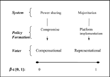
How does the argument depend on institutional environments? In my analysis, voters vote over parties available on the ballot but are concerned with policy outcomes. The conversion mechanism from parties on the ballot to policy outcomes varies greatly by institutional context. In some institutional environments political bargaining is an everyday matter, while in others the winner can implement his or her ideal policy with little compromise. Figure 1 summarizes the institutional component of my argument. When institutionalized bargaining takes place voters compensate for the watering-down of their vote by voting for a party whose positions are different from, and are often more extreme than their own ideal points. Since voters utilize their vote to affect policy outcomes, the more power-sharing allowed by the institutional environment, the more voters will compensate for the watering-down of their vote by voting for parties whose positions differ from their own positions. Therefore, empirically, I expect β to decrease with institutional power- sharing.

From Institutions to Voters
This prediction also observationally distinguishes my framework of outcome-oriented behavior from existing theories of issue voting. If voters are concerned with either proximity or direction of platforms, the same regularities should hold irrespective of post-electoral bargaining. If, on the other hand, voters vote to achieve preferred policy outcomes, their taste for compensational versus representational strategies will vary with institutional context as specified above.
Compensational voting is observationally distinguishable from directional voting in three additional ways. The model predicts that the extent to which voters employ compensational strategy depends on institutional context. However, it is likely that the taste for a particular voting strategy also varies across individuals within a given system. Indeed, allowing for individual-level heterogeneity in β, I demonstrate that in the Netherlands, the higher the level of education and the weaker the attachment to a party, the more compensational is one's vote. Behavior of those less educated and strongly attached to a party is more likely to follow principles of proximity voting (Kedar 2003).7
The average of strategies across individuals is similar to the results reported here.
Contrary to their prediction, the authors find that directional voting dominates proximity voting regardless of voter sophistication.
In addition, under the Compensational Vote Model, since voter utility for each party—and hence voter choice—depends on predicted outcomes, it depends on the configuration of other parties in a way that it does not under directional voting. As discussed above, a Left-leaning voter might prefer to endorse the extreme left when predicting an outcome to his or her right but might endorse the moderate left (or even a party to his or her right) when predicting that “overshooting” is not necessary (or is even necessary in the opposite direction). Finally, compensational voting does not specify a neutral point that (in one dimension) divides the ideological continuum into two, and therefore, unlike under directional voting, centrist voters will not necessarily be indifferent among parties, in particular, between moderate and more extreme parties.
EMPIRICAL ANALYSIS
Selection of Cases and Data
With the institutional hypothesis in mind, I select my cases. I examine four parliamentary polities that vary in their institutional design: Britain, Canada, Norway, and the Netherlands. The former two represent majoritarian systems, while the latter two represent consensual systems. Obviously, the four vary institutionally in different ways. Deducing differences from principles of majoritarianism and power-sharing, Lijphart (1984) famously specifies 10 indicators that cluster into two dimensions of institutional features of democracies, offering a subtle classification of democratic systems (see also Powell 2000). Four cases do not allow me to parse out the effects of the nuanced institutional mechanisms. However, examining the electoral systems in these polities and the way they score on Lijphart's Executive Parties dimension indicates clearly that Britain and Canada are highly unitary, while the Netherlands and Norway are highly consensual.
I utilize surveys conducted by the British Election Study (Heath et al. 1987) and the Norwegian Election Study (Aardal and Valen 1989), as well as the Comparative Study of Electoral Systems survey conducted in Canada (1997) and the Netherlands (1998; The National Election Studies 1995–98). Also, I utilize data about the results of these elections: vote shares, distribution of seats in the parliament, and portfolio allocation in government.
In addition to the institutional variation, the cases exhibit variation on an additional dimension. As mentioned above, issue voting has become a more significant determinant of voter choice in many Western democracies. The selection of cases from both the 1980s and the 1990s allows me to at least partly control for this change, allaying the concern that voter employment of certain strategies depends on the overall importance of issues.9
For simplicity, the results, for Canada presented below include all provinces with the exception of Quebec and therefore the Bloc Québécois. However, both an analysis of voting behavior in Quebec and a nationwide analysis produce results similar to those reported here.
Measurement
Question wording for each of the surveys employed is available at the author's URL (see above). Operationalization of two concepts—party position and party impact—merits a separate discussion.
Party Position
The choice of measure of party position relies on both theoretical and empirical considerations. Since voters are the focus of this study as well as of the theories from which this study departs, I conduct most of the analysis measuring party position as perceived by the individual voter (measured in the relevant survey). This procedure follows Blais et al. (2001), Westholm (1997), and many others. In particular, Westholm (1997) writes, “Although voters may at times be mistaken about these locations, it is their personal beliefs…that will guide preference formation” (870).10
In addition, Blais et al. (2001) write about the use of aggregate measures of party position: “This does not make theoretical sense because there is no reason to believe that voters react to an aggregate score of which they are unaware” (85).
Still, the skeptic might argue that using perceived party positions may bear the risk of projection bias; to the extent that voters tend to perceive a party closer to their own position on an issue when they support the party, the results might overstate support for the Proximity Model. However, accounting for such support by including control variables in the estimation (such as union membership, which is likely to make one feel close to the Labour Party; church attendance, which fosters closeness to the Christian Democrats; and the like), I reduce the risk of projection bias (see also Blais et al. 2001 for a similar argument). Finally, under the worst-case scenario, to the extent that projection bias still exists, using this measure simply means a conservative test for my theory: the empirical analysis is less likely to yield support for my model and more likely to support the restricted model—the Proximity Model. Overall, the analysis of multiple cases mitigates methodological concerns often mentioned in the proximity–directional debate; in line with previous studies (Merrill, Grofman, and Adams 2001), I have neither theoretical nor empirical reason to suspect that my methodology biases the results in different directions across the four systems in a way correlated with institutional design.11
In fact, in a study comparing voter placement of party positions in the United States, France, and Norway, Merrill, Grofman, and Adams (2001) report no systematic differences across the three systems. (The authors note that Republicans perceive the Democratic candidate to be substantially more liberal than the Democrats do, and that this bias is greater than all other comparisons in their study, but their findings do not suggest any systematic difference across the three systems.)
As the theoretical model, the empirical analysis, too, is unidimensional. In three of the cases (the Netherlands, Canada, and Norway) the survey offers a general left–right placement scale.12
Indeed, in the first two this is the only available question of ideological placement.
Party Impact
Since voters are the focus of this study, the measures of party impact on policy employed is a reflection of voter perception of party impact. As I mention above, although important in itself, theoretical accounts of parliamentary bargaining, party impact, and intracoalition bargaining are within the scope of this study. Yet, to establish the robustness of my findings and to allay a potential concern that my results are an artifact of measurement decisions, I conduct my analysis using three alternative measures of party impact. I describe these measures below.
Following the naïve view of democracy, I first use a simple (probably the simplest) approximation of party impact that voters might entertain—party seat share in the parliament. It is often the case, however, that public opinion polls prior to the elections report the expected popular vote rather than the expected seat-share, and thus voters' expectations regarding the results of the election are based on these reports. The second measure I employ, then, is the actual popular vote, which, I assume, is a proxy for the average public opinion poll prior to the elections.
Although all members of the legislature have some impact on policy formation, members of the opposition—it might be argued—are not as influential as their colleagues in the coalition, even controlling for the number of seats they hold. Similarly, parties that hold the lion's share of portfolios may be more powerful than junior partners in the governing coalition.
Unfortunately, I could not find relevant surveys that ask voters for their prediction of the coalition that will emerge after the election. However, by averaging seat-share in the legislature with portfolio-share in the government I assign seat-share different weights, depending on whether the party is in the governing coalition or not. Parties in the opposition score 0 on the portfolio scale and thus their seat-share is down-weighted, while parties in the governing coalition have their seat-share in parliament weighted more heavily, and more so the more senior in the government they are.13
Cooperative game theory offers combinatorial power indices, such as the Shapley–Shubik Power Index and Banzhaf Power Index. However, in the two majoritarian cases where a single party holds the majority of the seats, these indices assign the majority party an absolute power and all other parties no power. This is contrary to the model definition, where sj<1, and therefore a comparison across institutions using the indices is impossible.
I also conducted the analysis utilizing a simple average. The general direction of the results holds, although the results are weaker.
In employing these measures I implicitly suggest that the institutional procedure leading to outcomes is similar across these polities. This is, of course, not the case. As I discuss above, numerous studies suggest that the executive has more impact vis-à-vis the legislature in Britain, for example, than in the Netherlands (Döring 1995; Lijphart 1984). Indeed employing measures that incorporate procedural differences will pull the results in my favor, running the risk of employing a measure that assumes the answer. Given the theoretical argument in this study, then, I conservatively employ identical measures of policy formation across polities.
Notice that while the model is decision theoretic, incorporating parties' expected impact into voter calculation implies an interaction among voter actions. The impact voters attribute to different parties, and hence their utility for each party, takes into consideration their beliefs on others' behavior. Once party position and impact are measured, policy, as well as counterfactual policy, can be calculated as illustrated in the previous section in Equations (2) and (3a), respectively.
The Statistical Model
I derive a statistical model that corresponds with the theoretical model. First, I derive a likelihood function for multinomial choice:

where the dependent variable is vote choice, such that yij=1 if the ith voter votes for party j (j=1, 2, …, m), and 0 otherwise, and πij is the probability of individual i (i=1, 2, …, n) voting for party j. This probability is a function of his or her utility for that party and his or her utility for all other parties, such that for each voter

where I employ a logistic error structure such that f(a)=exp(a).
Second, the systematic component of the statistical model is in parallel with the theoretical model as it appears in Equation (4); it contains representational and compensational motivations weighted by β and 1−β, respectively, as well as the salience parameter (θ), and m−1 vectors of party-specific effects (δj) of the background variables, zi (δj for j=1 is set to 0 for identification purposes), such that each δj is a vector including effect coefficients for each variable in zi, as well as a party-specific constant.15
The estimated vectors of background-variable coefficients (including party-specific intercepts) vary across polities depending on the relevant cleavages in each particular political system as established in previous research. The models are presented in Appendix II.

Finally, I employ both quadratic and city-block utilities, different model specifications, and different measures of the dependent variable.
The optimization is unconstrained, so in order to compare the relative effects of proximity vs. compensational voting across countries I parameterize β using logistic transformation.16
In the theoretical model, I defined β1+β2=1, so the two parameters are reduced to one, β∈(0, 1). In parallel, in the empirical model I reparameterize β using a logistic transformation such that β=(1+exp(−α))−1. This parameterization ensures that β will be bounded between 0 and 1.
To estimate Equations (8) through (10) I multiply through and rearrange terms. I rewrite the bracketed term as

I then multiply through and estimate the model in the form
, which allows separate identification of β and θ. In combination with the description in footnote 16, I maximize the likelihood function with respect to α, θ, and the vector δ.
RESULTS: INSTITUTIONALLY DEPENDENT VOTERS
To test my theory, I first estimate Equations (8) through (10) in each of the four polities. While the issue component of the model is identical across the four, the background variables vary across systems depending on the relevant political cleavages established in previous research. Model specification and comprehensive results of the estimations are presented in Appendix II.18
Results of all coefficients estimated in the 12 sets of estimation (four cases times three measures of party impact) can be obtained from the author.
.
Table 1 focuses on the estimated β in each of the four polities. Each column presents the results for one of the four polities, and each row indicates the measure used. How do the results vary by electoral system? In almost all cases, vote in the consensual systems is more compensational than vote in the majoritarian systems. Voting in Britain, for example, follows the proximity model more closely than voting in the Netherlands across all measures (0.833, 0.730, and 0.849 in the former and 0.543, 0.543, and 0.597 in the latter), and the same pattern evolves from a comparison of the Netherlands with Canada (0.770, 0.613, and 0.880 in the latter). The results for Norway are somewhat weaker yet still in the expected direction. The results produced by utilizing the seat-share measure indicate that voting behavior in Norway is more compensational than in Britain, and, similarly, results produced by the mixed measure indicate that voting in Norway is more compensational than in Canada. The rest of the results for Norway do not allow me to generally infer that voter behavior in Norway is different from that in Canada and Britain (the confidence intervals overlap substantially). Overall, however, with one exception (vote-share measure in Norway and Canada), all confidence intervals in the power-sharing systems are centered around smaller βs than in the majoritarian cases. In other words, the pushing and pulling, bargaining, and compromise—all consequences of institutional features—are reflected in voter behavior.19
These results generally hold employing city-block rather than quadratic functions for measures of distance. Employing the seat-share measure, for example, the estimation produces
with a 95% confidence interval (0.51, 0.55),
(0.57, 0.68),
(0.70, 1), and
(0.55, 0.82).

In addition, I conduct a set of robustness tests for the empirical predictions of the model. These tests include variations on the specification reported above. In particular, I repeat the test for each of the three measures of party impact varying: (a) the utility function from quadratic to city block, (b) the dependent variable to thermometer rating for parties, (c) the measure of party position to average perceived position, and (d) the addition of retrospective voting and candidate evaluation as further covariates. I also conduct the tests with combinations of these changes: (e) city block—thermometer ratings, and (f) thermometer rating—average perceived party placement. Overall, the original results and these tests provide 21 different estimates of β for each polity (with the exception of the Netherlands, where they provide 14 such estimates).
In all specifications except c the point estimate of β in either of the majoritarian cases is greater than the estimate in either of the proportional cases on at least two of the measures. In the cases of city-block utilities, thermometer ratings for parties, and the combination of the two, the results hold for all three measures, and in the cases of the original model, additional covariates, and the combination of party thermometers and average perceived party position, they hold for two of the three measures and for three of the four polities in the third measure. All these results are in the expected direction, but while most of these differences are statistically significant, in some cases they statistically overlap.
The results of specification c show no systematic pattern. Examination of these results in combination with specification f (where the results are in the right direction but are not statistically significant for two of the three measures) suggests that the measure of party placement as average perceived placement by voters is the reason for the weak results. As discussed above, and as Blais et al. (2001), and Westholm (1997) argue, given that the focus of this study is individual voter's choice, the appropriate measure of party position is the position as it is perceived by the individual voter, rather than an average.
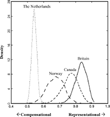
To complement these figures, Figure 2 presents density plots of the four estimates of β based on the seat-share measure.20
The estimation procedure itself is described above. Postestimation random draws are taken from the sample distribution, such that the distribution of βNetherlands is centered at 0.543, etc.

Issue Voting in Four Systems
In comparing the βs across the models I assume that the estimates of β in the different countries are independent of one another conditioning on the covariates in each model. This implies, for example, that the taste of Dutch voters for compensational/representational strategy in the Netherlands is independent of the taste of Canadian voters for these strategies. Indeed, it is hard to imagine why there would be dependence in taste for vote-choice strategy among voters in different polities, conditioning on systematic factors of voter choice. Relying on this assumption, and in addition to the analyses above, I compute the differences in β between each majoritarian case and each proportional case (not reported). The results are consistent with the results presented in Table 1. All the point estimates of the differences are positive, indicating that β in the majoritarian systems is greater than β in the proportional systems. The Netherlands is consistently distinguishable from both Britain and Canada. Norway is not always statistically distinguishable from the majoritarian systems, although the direction of the results is as expected.
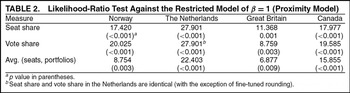
Does the Proximity Model sufficiently capture the information in the data? To further address this issue, I compare the results above to a restricted model consisting of the proximity component and the background covariates.21
The Compensational Vote Model reduces to the Proximity Model when β=1.

That β is removed from the upper bound not only in the power-sharing systems but also in the majoritarian systems is particularly interesting. Although Britain and Canada are extreme cases of the majoritarian models, they are not ideal types of the model (see Lijphart 1999, 10–21, for detailed discussion of Britain, and Figure 14.1 there for placement of the four cases on the Executive-Parties dimension). Even in First-Past-the-Post systems, where opposition parties do not participate directly in the policy-formation process, they indirectly affect policy outcomes by shaping the political discourse and forcing other parties to adapt their policies (Avakumovic 1978; Meguid 2002). By the same token, the results presented in Table 1 show that β in the proportional cases is safely away from the lower bound—issue voting is not entirely compensational even in the proportional cases. This is consistent with both the theoretical expectation and the nature of the empirical cases; similar to Canada and Britain on the majoritarian end, both Norway and the Netherlands are strong, yet not pure, cases of consensual democracy. Finally, a comparison of the cases from the 1980s (Britain and Norway) with those from the 1990s (Canada and the Netherlands) does not reveal a systematic pattern with respect to timing.
These results shed light on the institutional component of the argument and on the extent to which the Proximity Model captures voter behavior. Voters in the power-sharing systems behave differently from voters in the majoritarian systems. Under the former, voters compensate for the watering-down of their vote, often voting instrumentally for a party whose positions differ from their own. Under the latter, votes are hardly diluted, and voters make their choice accordingly.
DISCUSSION AND EXTENSIONS
How do voters' positions on issues translate into vote choice? The common wisdom of issue voting holds that voters make their choice based on their evaluations of party positions (platforms). Since, according to this framework, platforms are the object of voter evaluation, any given theory of voter choice based on platform evaluation should account for voter behavior irrespective of the way votes are converted to policy.
I demonstrated that this is not the case. Regularities of voter behavior vary by institutional context. In particular, voter choice reflects variation in postelection bargaining. This finding suggests that something else is at work, namely, outcome-oriented behavior. My framework is not only consistent with the unaccounted-for variation observed in current studies, it also allows me to reinterpret (rather than declare a winner in) the current debate between the two leading theories of issue voting, proximity and directional voting.
In itself, the notion that voters are concerned with policy outcomes is not a novel insight (Austen-Smith and Banks 1988; Baron and Diermeier 2001). However, my framework allows me to explain how variation in institutional mechanisms, types of democracy, and even individual-level characteristics account for variation in strategies voters employ. This article has focused on the first component; I have shown that outcome-oriented motivation leads voters in parliamentary regimes to endorse parties whose positions differ from the voters' own positions depending on the institutional environment in which voters make their choice.
As formalized in this article, the theory is captured by a single parameter. But as mentioned above, β stands for a complex reality. One can estimate, for example, the extent to which each voter's motivation is compensational or representational, the extent to which voters are compensational or representational on different policy dimensions, the extent to which supporters of different parties are motivated by compensational or representational considerations, and the like.
In addition, the argument travels across types of democracy. In fact, it applies to any political system where no single player can implement his or her preferred policy in its pure form. While the bargaining units in parliamentary systems are parties (or subsets of members of the parties) in the parliament, in presidential systems the power is distributed between the executive and the legislature, and in federal systems bargaining takes place between regional and federal agents.
Indeed, scholars of presidential systems have examined policy balancing by voters in both general and midterm elections (e.g., Alesina and Rosenthal 1995 and Mebane 2000 for analysis of the American case). As some of these studies argue, depending on the voter's position, the more extreme and/or more powerful the president is, the more extreme and/or powerful the voter prefers Congress to be in order to balance the president. But policy balancing in the United States is a specific case of policy balancing by voters in general—voters incorporate postelectoral bargaining into their choice: their vote in legislative elections depends on their prediction of (or in Midterm elections, knowledge of) partisan control of the executive.
While in presidential systems voters balance the legislature vis-à-vis the executive, in federal systems the branches balanced are regional and federal governments. Examining electoral returns from almost three decades in Germany (Lohman, Brady, and Rivers 1997), and adding analysis from the postunification era (Gaines and Crombez 2004, Kedar 2004), scholars have demonstrated that the party in control of the chancellery systematically loses seats in subsequent state elections. While partisanship and the economy explain part of the gap, controlling for differential in turnout between elections at the two levels, these studies demonstrate that voters use Land elections to counterbalance the federal government and, thus, engage in vertical policy balancing.
Whether parliamentary, federal, or presidential forms of power-sharing, the conceptual difference between the analysis of voter choice in this study and the classic formulations of voter choice has to do with the transformation from the set of possible parties (platforms) to the set of possible policy outcomes. This study shows that while voters choose a party (a platform) from a set of competing parties, they are often concerned with policy outcomes. The complexity of policy formation and the mapping from vote choice to policies often result in voter preference for a party that is not necessarily the most ideologically proximate to the voter. Unpacking the fashion in which institutional mechanisms convert votes to policy outcomes is a crucial step toward better understanding of voter choice.
APPENDIX I: ANALYTIC SOLUTION
Second-order condition on
with respect to pA:

Rewriting Equation (A1), it is easy to see that this is a maximum:

Since 0<β<1 and θ>0, both expressions are negative, and therefore
. Differentiating
with respect to pB, we get

Setting the result to 0 and solving for pB:

Second-order condition with respect to pB:

Rewriting Equation (A4), it is easy to see that this is a minimum:

Since all elements are positive and 0<sB+sC<1,
. These results are symmetric with respect to pC.
APPENDIX II: COMPREHENSIVE RESULTS
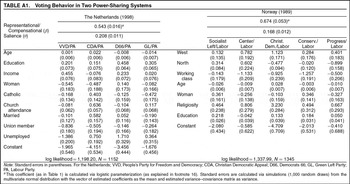
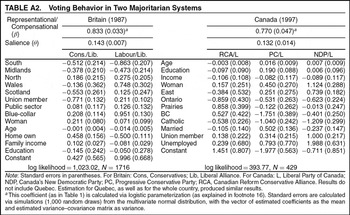
Table A1 presents results for the power-sharing cases—the Netherlands and Norway—and Table A2 presents results for the majoritarian cases—Britain and Canada. Each model introduces an estimate for compensational–representational voting, salience, and party-specific effects of the background covariates (as in Equation [10]). Coefficients of the covariates represent effects of the respective variables on the log odds of voting for the relevant party compared to the reference party (coefficients of the reference party are normalized to 0).


Model specification for each polity depends on the relevant political cleavages established in previous research. Model specification for Canada is based on Clarke, Kornberg, and Wearing (2000) and Johnston et al. (1992). The results include all regions but Quebec, which I estimate separately. Results for Quebec (not reported here) are similar to the general results presented here. Model specification for the Netherlands is based on Dorussen and Taylor (2001), Quinn, Martin, and Whitford (1999), and Taylor and Dorussen (2000). The model for Britain is based on Alvarez, Nagler, and Bowler (2000). I also draw on Whitten and Palmer (1996) for model specification in the British and the Dutch cases.
Additional related materials (question wording, placement of parties, and values of party impacts) can be found at www.umich.edu/~oritk.
For invaluable advice and support at different stages of the project, I am grateful to Torben Iversen, Gary King, Skip Lupia, and Ken Shepsle. An early version of the paper was presented at the Annual Meeting of the Midwest Political Science Association, 2002, where Christopher Way provided particularly helpful comments. I also benefited greatly from comments on early versions of the manuscript from early Chris Achen, Jim Adams, Jim Alt, Laia Balcells, Larry Bartels, Torbjorn Bergman, Jake Bowers, Ethan Bueno de Mesquita, Barry Burden, Jamie Druckman, Rob Franzese, Bernie Grofman, Mark Hansen, Don Herzog, Ken Kollman, Mika LaVaque-Manty, Ola Listhaug, RobMickey, Jim Morrow, BeckyMorton, Tony Mughan, Jasjeet Sekhon, Michael Shalev, Mark Tessler, Jonathan Wand, Greg Wawro, Anders Westholm, seminar participants at ECPR Joint Sessions, Harvard University, NYU, Tel Aviv University, University of Michigan, and Yale University, participants of a conference on Multilevel Data Analysis at Princeton University, the editor, and three anonymous reviewers. I am grateful to Jonathan Nagler; ideas in this paper evolved out of many fruitful conversations. I thank Daniela Stockmann for superb research assistance. Finally, I gratefully acknowledge the financial assistance of the Center for Basic Research in the Social Sciences at Harvard University. All remaining errors are, of course, my own.
References
Aardal Brent, and
Henry Valen.
1989.
“Norwegian Election Study 1989”
[computer file]. Norwegian Gallup Institute [producer]. Norwegian Social Science Data Services (NSD) [distributor].Google Scholar
Adams James, and
Samuel Merrill,III.
1999.
“Party Policy Equilibrium for Alternative Spatial Voting Models: An Application to the Norwegian Storting.”
European Journal of Political Research
36
(October):
235–
55.Google Scholar
Alesina Alberto, and
Howard Rosenthal.
1995.
Partisan Politics, Divided Government, and the Economy.
New York:
Cambridge University Press.
Alvarez Michael R.,
Jonathan Nagler, and
Shaun Bowler.
2000.
“Issues, Economics, and the Dynamics of Multiparty Elections: The 1987 British General Election.”
American Political Science Review
94
(March):
131–
49.Google Scholar
Austen-Smith David, and
Jeffrey Banks.
1988.
“Elections, Coalitions, and Legislative Outcomes.”
American Political Science Review,
82
(2):
405–
22.Google Scholar
Avakumovic Ivan.
1978.
Socialism in Canada: A Study of the CCF-NDP in Federal and Provincial Politics.
Toronto:
McClelland and Stewart.
Bailey Michael.
2001.
“An Institutional Reconcilliatoin of Proximity and Directional Voting.”
Georgetown University.
Mimeo.
Barnes Samuel H.
1997.
“Electoral Behavior and Comparative Politics.”
In Comparative Politics: Rationality, Culture, and Structure,
ed. Mark I.
Lichbach and Alan S. Zuckerman. Cambridge:
Cambridge University Press,
115–
41.
Baron David P., and
Daniel Diermeier.
2001.
“Elections, Governments, and Parliaments in Proportional Representation Systems.”
Quarterly Journal of Economics
116
(3):
933–
67.Google Scholar
Blais André, et al.
2001.
“The Formation of Party Preferences: Testing the Proximity and Directional Models.”
European Journal of Political Research
40
(August):
81–
91.Google Scholar
Cho Sungdai, and
James W. Endersby.
2003.
“Issues, the Spatial Theory of Voting, and British General Elections: A Comparison of Proximity and Directional Models.”
Public Choice
114
(March):
275–
93.Google Scholar
Clarke Harold D.,
Allan Kornberg, and
Peter Wearing.
2000.
A Polity on the Edge.
Peterborough, Ontario:
Broadview Press.
Döring Herbert.
1995.
“Time as a Scarce Resource: Government Control of the Agenda.”
In Herbert Döring, ed.
Parliaments and Majority Rule in Western Europe.
New York:
St. Martin.
Dorussen Han, and
Michaell Taylor,
2001.
“The Political Context of Issue-Priority Voting: Coalitions and Economic Voting in the Netherlands, 1970–1999.”
Electoral Studies
20:
399–
426.Google Scholar
Downs Anthony.
1957.
An Economic Theory of Democracy.
New York:
Harper & Row.
Enelow James M., and
Melvin J. Hinich.
1984.
The Spatial Theory of Voting: An Introduction.
New York:
Cambridge University Press.
Gaines Brian J., and
Christophe Crombez.
2004.
“Another Look at Connection across German Elections.”
Journal of Theoretical Politics
16
(July):
289–
320.Google Scholar
Grofman Bernard.
1985.
“The Neglected Role of the Status Quo in Models of Issue Voting.”
Journal of Politics
45
(February):
230–
37.Google Scholar
Heath A., et al.
1987.
“British General Election Study, 1987”
[computer file].
2nd ed.
Colchester, Essex:
UK Data Archive [distributor];
SN 3887.
Herron Michael C.
2000.
“Postestimation University in Limited Dependent Variable Models.”
Political Analysis
8
(Winter):
83–
98.Google Scholar
Iversen Torben.
1994a.
“Political Leadership and Representation in West European Democracies: A Test of Three Models of Voting.”
American Journal of Political Science
38
(February):
45–
74.Google Scholar
Iversen Torben,
1994b.
“The Logics of Electoral Politics: Spatial, Directional, and Mobilizational Effects.”
Comparative Political Studies
27
(July):
155–
89.Google Scholar
Johnston Richard,
et al.
1992.
Letting the People Decide.
Stanford, CA:
Stanford University Press.
Kedar Orit.
2003.
“Policy Balancing in Comparative Context: Institutional Mediation of Voter Behavior.”
Ph.D. Dissertation.
Harvard University.
Kedar Orit.
2004.
“The Micro Foundations of (Vertically) Divided Government: Evidence from Germany.”
Paper presented at the Annual Meeting of the American Political Science Association, Chicago, IL.Google Scholar
King Gary,
Michael Tomz, and
Jason Wittenberg.
2000.
“Making the Most of Statistical Analyses: Improving Interpretation and Presentation.”
American Journal of Political Science
44
(April):
341–
55.Google Scholar
Kitschelt Hebert.
1995.
The Radical Right in Western Europe.
Ann Arbor:
Michigan Universty Press.
Lewis Jeffrey B., and
Gary King.
2000.
“No Evidence on Directional vs. Proximity Voting.”
Political Analysis
8
(1):
21–
33.Google Scholar
Lijphart Arend.
1984.
Democracies; Patterns of Majoritarian and Consensus Government in Twenty-One Countries.
New Haven, CT:
Yale University Press.
Lijphart Arend
1999.
Patterns of Democracy: Government Forms and Performance in Thirty-Six Countries.
New Haven, CT:
Yale University Press.
Lohman Suzanne,
David W. Brady, and
Doug Rivers.
1997.
“Party Identification, Retrospective Voting, and Moderating Elections in a Federal System: West Germany: 1961–1989.”
Comparative Political Sudies
30
(May):
420–
49.Google Scholar
Macdonald Stuart Elaine,
Ola Listhaug, and
George Rabinowitz.
1991.
“Issues and Party Support in Multiparty Systems.”
American Political Science Review
85
(December):
1107–
31.Google Scholar
Macdonald Stuart Elaine,
George Rabinowitz, and
Ola Listhaug.
1995.
“Political Sophistication and Models of Issue Voting.”
British Journal of Political Science
25
(October):
453–
83.Google Scholar
Macdonald Stuart Elaine,
George Rabinowitz, and
Ola Listhaug.
2001.
“Sophistry versus Science: On Further Efforts to Rehabilitate the Proximity Model.”
Journal of Politics
63
(May):
482–
500.Google Scholar
Mebane Walter R.,Jr.
2000.
“Coordination, Moderation, and Institutional Balancing in American Presidential and House Elections.”
American Political Science Review
94
(March):
37–
58.Google Scholar
Meguid Bonnie M.
2002.
“Competition between Unequals: The Role of Mainstream Party Strategy in Rising Party Success.”
Ph.D. dissertation,
Harvard University.
Merrill Samuel,III
Bernard Grofman, and
James Adams.
2001.
“Assimilation and Contrast Effects in Voter Projections of Party Locations: Evidence from Norway, France, and the USA.”
European Journal of Political Research
40
(October):
199–
221.Google Scholar
The National Election Studies and the Comparative Study of Electoral Systems. 1995–98. Electronic resources from the NES World Wide Web site (www.umich.edu/nes).
Ann Arbor:
University of Michigan,
Center for Political Studies [producer and distributor].
Pierce Roy,
1997.
“Directional versus Proximity Models: Verisimilitude as the Criterion.”
Journal of Theoretic Politics
9
(January):
61–
74.Google Scholar
Powell G. Bingham, Jr.
2000.
Elections as Instruments of Democracy: Majoritarian and Proportional Visions.
New Haven, CT:
Yale University Press.
Quinn Kevin M.,
Andrew D. Martin, and
Andrew B. Whitford.
1999.
“Voter Choice in Multi-Party Democracies: A Test of Competing Theories and Models.”
American Journal of Political Science
43
(October):
1231–
47.Google Scholar
Strøm Kaare.
1990.
Minority Government and Majority Rule.
Cambridge:
Cambridge University Press.
Strøm Kaare, and
Jorn Y. Leipart.
1993.
“Policy, Institutions, and Coalition Avoidance: Norwegian Governments, 1945–1990.”
American Political Science Review
87
(December):
870–
87.Google Scholar
Taylor Michael, and
Han Dorussen.
2000.
“Group Economic Voting: A Comparison of Three Countries.”
Presented at the Special Conference on Institutions and Economic Voting, Trondheim, Norway.Google Scholar
Westholm Anders.
1997.
“Distance Versus direction: The Illusory Defeat of the Proximity Theory of Electoral Choice.”
American Political Science Review
91
(December):
865–
85.Google Scholar
Whitten Guy D., and
Harvey D. Palmer.
1996.
“Heightening Comparativists' Concern for Model Choice: Voting Behavior in Great Britain and the Netherlands.”
American Journal of Political Science
40
(March):
231–
60.Google Scholar
From Institutions to Voters

Issue Voting in Four Political Systems (0= Compensational, 1= Representational)
Issue Voting in Four Systems
Likelihood-Ratio Test Against the Restricted Model of β=1 (Proximity Model)
Voting Behavior in Two Majoritarian Systems
Voting Behavior in Two Majoritarian Systems
 You have Access
- 270
- Cited by
Comments
No Comments have been published for this article.