INTRODUCTION
Western corn rootworm (WCR) (Diabrotica virgifera virgifera LeConte) is one of the most serious pests of maize in North America. In the USA maize yield loss caused by the species, together with the costs incurred to control it, is estimated to be c. US$1 billion a year (Metcalf Reference Metcalf, Krysan and Miller1986). In the early 1990s D. virgifera was accidentally introduced from the USA to southeastern Europe. The first individuals were identified in 1992 in Serbia (Bača Reference Bača1994), and by the end of 2011 the pest could be found in 22 countries (EPPO 2014). Its spread throughout Europe was facilitated when the adults were carried again from North America to Italy, France and Great Britain (Ciosi et al. Reference Ciosi, Miller, Kim, Giordano, Estoup and Guillemaud2008).
Adult D. virgifera is the most mobile stage of the species. They feed on pollen, maize silk, leaves and soft maize seeds (Moeser & Vidal Reference Moeser and Vidal2005), but prefer pollen and new maize silk (Ball Reference Ball1957). The availability of this kind of food affects the egg-laying process and life-span of beetles. A short flowering period stimulates frequent migrations of adult D. virgifera in search of food when the availability of their preferred food diminishes (Elliot et al. Reference Elliot, Gustin and Hanson1990; Moeser & Hibbard Reference Moeser, Hibbard, Vidal, Kuhlmann and Edwards2005). Darnell et al. (Reference Darnell, Meinke and Young2000) indicated that changes in the phenological stages of maize stimulate beetle migration. Assuming that maize varieties of different maturity classes, i.e. entering the flowering stage at different times, attract the adults at different times during the growing season, then the changes in pest population size would correspond with the plant's growth stages.
Diabrotica virgifera has been monitored since it became an important maize pest in European countries. Various types of trap are used for that purpose. The most commonly used are pheromone traps (PT) with female attractant pheromones, which lure males, and floral baited traps (FT) with host plant extracts, which lure both sexes. Monitoring of the adults using different traps helps detect new sites infested by WCR, measure the pest population size, identify migration dynamics and develop strategies for effective control (Kiss et al. Reference Kiss, Edwards, Berger, Cate, Cean, Cheek, Derron, Festić, Furlan, Igrc-Barčić, Ivanova, Lammers, Omelyuta, Princzinger, Reynaud, Sivcev, Sivicek, Urek, Vahala, Vidal, Kuhlmann and Edwards2005). In recent years numerous studies have been conducted on the applicability of various attractant pheromones and types of traps to monitor the population size and distribution of D. virgifera (Imrei et al. Reference Imrei, Tóth, Vörös, Szarukán, Gazdag, Szeredi and Carollo2001; Tóth et al. Reference Tóth, Sivcev, Ujváry, Tomasek, Imrei, Horváth and Szarukán2003, Reference Tóth, Csonka, Szarukán, Vörös, Furlan, Imrei and Vuts2006; Schaub et al. Reference Schaub, Furlan, Tóth, Steinger, Carrasco and Toepfer2011).
Knowing the details of D. virgifera population dynamics is essential to determine the optimal timing of chemical pest control. Moreover, controlling the adults helps slow down their expansion to new territories, as the adults of D. virgifera are capable of long-distance flights and can be carried easily by different means of transportation and plant material (Bača Reference Bača1994; Baufeld & Enzian Reference Baufeld, Enzian, Alford and Backhaus2005).
The aim of the current study was to investigate the effect of maturity class (expressed as FAO number) of six different maize varieties on the population dynamics of D. virgifera beetles, and the performance of PTs v. FTs produced by the Csalomon company.
MATERIALS AND METHODS
Adult D. virgifera were collected in Krzeczowice (49°59′N, 22°27′E, 200 m a.s.l.) in south-eastern Poland.
In both study years (2009 and 2010), maize was grown on the plots in a crop rotation system: winter wheat, winter rape and sugar beet were grown on the fields in the immediate vicinity of the experimental maize field, or on it in previous years. The nearest other maize fields were 1–2 km from the experimental field. An experiment was established to investigate the preferences of D. virgifera beetles in infesting six varieties of maize of different maturity classes using the random block method with four replications for each variety. Seeds of six maize varieties well adapted to the soil and climate conditions of Central and Eastern Europe were sown in 24 square plots of 20 × 20 m2 (400 m2) located within one field of a total area of 9600 m2. There was a 3-m wide buffer strip between each plot, free of maize or any other crop known to be an alternative host crop for D. virgifera. Soil and climate conditions on each of the 24 plots were comparable. The maize varieties used in the study belonged to three different maturity classes:
-
- early varieties: KB1903 (FAO 190) and Wilga (FAO 190);
-
- medium-early varieties: Monumental (FAO 250) and NK Nekta (FAO 250);
-
- medium-late varieties (stay green type): KB2704 (FAO 280) and Clarica (FAO 300).
All six varieties were sown at the same time: on 23 April 2009 and 30 April 2010, with a seeding rate of 80 000 seeds per hectare.
Changes in the number of D. virgifera adults in each variety were monitored with two types of trap manufactured by Csalomon (Plant Protection Institute, Centre for Agricultural Research, Hungarian Academy of Sciences, Budapest, Hungary): PTs – CSALOMON® PAL transparent sticky ‘cloak’ trap, baited with synthetic sex pheromone (lures only males), and FTs – CSALOMON® PALs yellow sticky ‘cloak’ trap (lures females and males). The chemical formula of the pheromone used in the study is a trade secret of Csalomon. Both types of traps are used in other European countries, e.g. Hungary, Italy, Germany, Austria, and France (Tóth et al. Reference Tóth, Tóth, Ujváry, Sivcev, Manojlovic and Ilovai1996, Reference Tóth, Sivcev, Ujváry, Tomasek, Imrei, Horváth and Szarukán2003). Additionally, an EU-research project conducted between 2000 and 2003 recommended using PT traps as the standard detection tool for D. virgifera in Europe (CORDIS 2003; Tóth Reference Tóth2005).
One trap of each type was placed in the centre of each of the 24 plots, 3 m from the edge. The distance between PT and FT traps was c. 14 m: this distance prevented interference between the traps because the attraction of the PTs is estimated to be <10 m (Tóth et al. Reference Tóth, Sivcev, Ujváry, Tomasek, Imrei, Horváth and Szarukán2003). The traps were set on maize plants in the first half of July, shortly before silk emergence started in the early varieties of maize (BBCH growth stage 51–53, BBCH 1997), while the medium-early and medium-late varieties were still developing nodes on stems (BBCH 34–37) (BBCH 1997). The traps were checked consistently every 2 or 3 days (depending on the weather conditions) until harvest (mid-October), when either the test varieties had matured, or their kernels were fully ripe (BBCH 87–89). The attractant and the traps were replaced every 2–4 weeks depending on the weather conditions, as recommended by EPPO (2006). Each time, the D. virgifera adults captured in the traps were counted, and their sex was identified before being removed from the traps. Due to unequal periods between the trap checks (2–4 days), data for statistical analysis were expressed as the number of captured insects per day.
The Statistica software package, version 10, from 2011 (StatSoft Inc., Tulsa, OK, USA) was used for statistical data analyses. Significant differences or homogeneity in the number of captured insects between the maize varieties at particular intervals of days of the season and between the traps were estimated with ANOVA and post-hoc analysis of variance with Tukey's HSD test for equal sample size (P < 0·05). Pearson's linear correlation coefficients between insect counts, temperature and rainfall were calculated at P < 0·05.
RESULTS
Occurrence of Diabrotica virgifera adults in pheromone traps
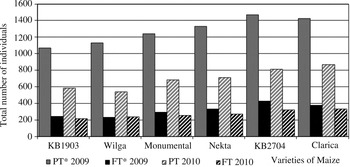
In the 2009 growing season, the highest number of D. virgifera males was found for the two medium-late varieties of maize, which remained green for a longer period of time, whereas the lowest number was found in the early varieties, which dried and matured the fastest (Fig. 1).
Total number of Diabrotica virgifera adults captured with PT and FT traps on tested varieties of maize in 2009 and 2010. Abbreviations: PT, pheromone trap; FT, floral baited trap.

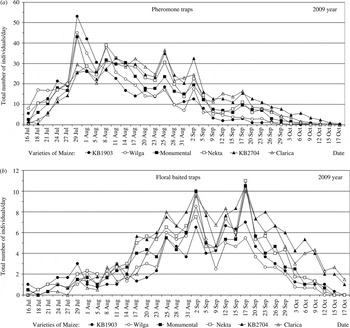
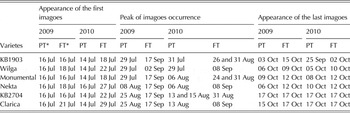
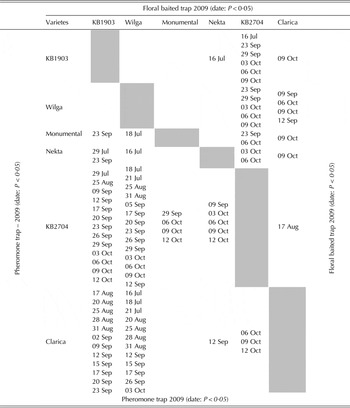
In 2009, the first WCR adults were captured in maize fields on 16 July, when the early varieties, KB1903 and Wilga, started to shed pollen (BBCH 63), and silk emerged in the medium-early and medium-late varieties (BBCH 51–55). From the very beginning, when the first adults were captured (16, 18 and 21 July), statistically significant differences (P < 0·05) were observed in their numbers between the early (FAO 190), medium-early (FAO 250), and medium-late (FAO 280–300) varieties (Tables 1 and 2: compare with Fig. 2(a)). A graph illustrating the dynamics of male D. virgifera populations found in the PT traps only shows the data for 2009 (Fig. 2(a)). The dynamics for 2010 were similar.
Dynamics of Diabrotica virgifera adults captured (total number of individuals/day) during the growing season on different varieties of maize in 2009. Significant differences in the number of captured adults on particular varieties and on particular days are shown in Table 2. (a) Pheromone trap (PT); (b) Floral baited trap (FT).

Dates of occurrence of Diabrotica virgifera adults on maize varieties of different maturity classes

* PT, pheromone trap; FT, floral baited trap.

There were a few WCR adult population peaks during the capture period using the PTs, and each peak correlated with the different growth stage of maize variety used in the current study. The first and most numerous was the peak observed on 29 July, and it concerned mainly the early variety of KB1903. On that day the early varieties were at the end of flowering and entering the milk stage of kernel development (BBCH 69–71), the medium-early varieties were at full flowering (BBCH 67), whereas the medium-late varieties were about to start flowering (BBCH 63–65). At the first population peak the number of WCR males found on the Nekta medium-early maize variety (P < 0·05) and the KB2704 medium-late variety (P < 0·05) were significantly lower than the number of adults found on the early variety of maize, KB1903, with the highest capture rate of beetles. During the first peak, the number of adults was significantly lower (P < 0·05) in the early maize varieties compared to the medium-late varieties, whereas during the second peak, the number of beetles in the Clarica variety was significantly higher than in KB1903 (P < 0·05) and Wilga (P < 0·01). The last WCR males in the early and medium-early maize varieties were captured in the PTs in early October, whereas in the medium-late varieties, WCR flights ended later, i.e. in mid-October (Tables 1 and 2; Fig. 2(a)).
Findings on the population dynamics of WCR males and the differences in their counts on selected maize varieties in 2010 and 2009 were comparable.
Occurrence of Diabrotica virgifera adults in floral baited traps
Similarly to the PTs, the number of WCR adults found in the FTs during the active growing season of maize was highest for the medium-late varieties, compared to the earliest ones (Fig. 1).
The dynamics of male and female D. virgifera populations found in the FTs placed on the maize varieties of different maturity classes in 2009 are presented in Fig. 2(b) (the dynamics for 2010 were similar). The first WCR beetles were captured in FTs on 16 July. In comparison to the PTs, there was a clear time shift for the population peak of adults found in FTs, i.e. from the end of July or first half of August to the first half of September (Figs 2(a) and (b); Table 1).
From late September to October, when the early maize varieties began to ripen quickly, significantly more adults were found on the medium-late variety KB2704 than on the two early varieties. For KB2704 and Clarica, the difference was most prominent mainly in October in relation to the early Wilga variety (Table 2). The last D. virgifera specimens were found in FTs on 17 October (Fig. 2(b)).
Findings on the population dynamics of WCR males and the differences in their counts on the selected maize varieties in 2010 and 2009 were comparable.
Effectiveness of PTs and FTs in capturing Diabrotica v. virgifera adults
The current study revealed significant differences in the number of D. virgifera adults captured in the PTs and FTs among the varieties of maize of different maturity classes for 2009 and 2010 (P < 0·001 in both cases).
In 2009, depending on the variety, 1070–1469 individuals (on KB1903 and KB2704 varieties, respectively) were captured with PTs. In 2009, the FTs lured 234 and 425 adults (on Wilga and KB2704 varieties, respectively). In 2010 the number of captured D. virgifera beetles significantly decreased, which, as indicated earlier, was a significant difference in the analysis considering the daily counts of insects. The PTs lured 539 and 869 individuals (on Wilga and Clarica varieties, respectively); and the FTs lured 215 and 331 individuals (on KB1903 and Clarica varieties, respectively). Similarly to 2009, in 2010 the highest numbers of WCR adults were collected on the medium-early and medium-late varieties (Fig. 1).
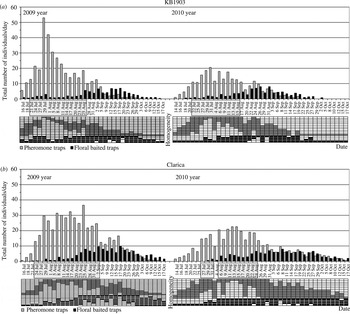
Due to the large amount of data (N = 5124), the population dynamics of WCR adults in the PT and FT traps, and the significant differences in the number of D. virgifera beetles between the two types of traps, are only presented for two varieties of maize with the most distant maturities, i.e. the early KB1903 and medium-late Clarica (Figs 3(a) and (b)). The days with significant differences in the number of captured adults between the PTs and FTs which were observed from the second and third 10 days of July to the second and third 10 days of August are enclosed on the X axis (Figs 3(a) and (b)).
Dynamics of changes in the number of Diabrotica virgifera adults captured (total number of individuals/day) with PT, pheromone traps (grey bars) and FT, floral baited traps (black bars). (a) KB1903m (b) Clarica. Enclosed dates (X axis) indicate days when there were statistically significant differences in the number of individuals captured (total number of individuals/day) between PT traps and FT traps on the particular day. Grey (PT) and black (FT) boxes under graphs in particular lines show homogeneous groups in respect of the number adults captured (total number of individuals/day) for particular days of monitoring.

Because of the great number of statistically significant differences in the mean number of WCR individuals captured on particular days, both with PT and FT traps, Figs 3(a) and (b) shows homogeneous groups, with grey representing the PTs and black representing FTs. The squares in grey or in black for particular dates represent days when there were no differences in the number of captured individuals.
For PTs placed on the varieties of maize of different maturity classes in 2009, there were 9–13 homogeneous groups, mostly for the KB1903 and Clarica varieties. In 2010, there were 7–11 homogeneous groups, again in the Clarica variety.
For FTs in 2009, the number of homogeneous groups was 4–10. The lowest number of groups was observed for the early KB1903 variety (Fig. 3(a)), and the highest for the medium-early Nekta variety (data not shown). In 2010, the number of homogeneous groups was lower: 3–5 (lowest for the early variety Wilga; highest for the medium early Nekta and medium-late KB2704) (data not shown).
An analysis of the number of homogeneous groups (per variety) indicated that the use of FTs increased the number of homogenous groups for the varieties maturing later. This was consistent with the fact that during the population peak of adults on the early varieties, FTs were not very effective. Moreover, there was an increase in the number of homogeneous groups as the plants were maturing (between mid-August and late September or early October).
Sex structure and the population dynamics of adults captured in floral baited traps
Because FTs are designed to lure males and females, and they are captured accidentally, the study compared significant differences in the counts of captured adults, and sex structure was analysed for the FTs only. Statistical analysis showed that in 2009 and 2010 the numbers of males and females were significantly different (P < 0·001). Taking into consideration the differences between sexes in 2009 and 2010, they were observed in males in both years (P < 0·001), but not in females.
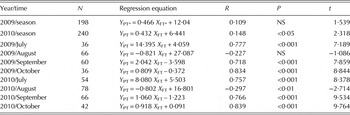
All the results of the statistical analysis carried out to test a correlation between the number of captured D. virgifera beetles and the type of trap are presented in Table 3. Throughout the growing season of 2010 the results showed no, or very weak, positive correlation. A more detailed analysis of closely monitored months revealed that in July, September and October there was a strong or very strong significant (P < 0·001) positive correlation (i.e. with an increase in the number of adults in one type of trap, the number of individuals in the other one also increased). In August of both 2009 and 2010 there was a negative correlation, where an increase in the number of adults in one type of trap caused a decrease in the other. However, the correlation was statistically significant only for the growing season of 2010 (Table 3).
Correlations between pheromone and floral baited traps and number of Diabrotica virgifera adults captured (individuals captured per day) in 2009 and 2010

NS, not significant.
* X, Y subscript abbreviations: PT, pheromone trap; FT, floral baited trap.
DISCUSSION
The analysis of both types of trap indicated that in south-eastern Poland the first WCR adults occured in maize in the second ten days of July. The date is very close to that observed for the area in previous years (Bereś & Sionek Reference Bereś and Sionek2010), as well as in several states of the USA (i.e. Nebraska and Iowa) (Darnell et al. Reference Darnell, Meinke and Young2000; Nowatzki et al. Reference Nowatzki, Tollefson and Calvin2002). Adult individuals were not observed in June, unlike in the former Yugoslavia (Bača et al. Reference Bača, Camprag, Keresi, Krnjajic, Manojlovic, Sekulic, Sivcev and Camprag1995), Hungary (Imrei et al. Reference Imrei, Tóth, Vörös, Szarukán, Gazdag, Szeredi and Carollo2001) and Romania (Pălăgesiu et al. Reference Pălăgesiu, Grozea, Hâncu and Agricoltura2001; Ciobanu et al. Reference Ciobanu, Sandor, Domuta, Ciobanu, Albu and Vuscan2007). The occurrence of the first D. virgifera beetles in mid-July may be associated with the date of sowing maize in this region of Poland, which is usually from the last third of April to mid-May. The sowing date is determined by the temperature, ensuring proper germination and development of young plants. Research conducted by Ciobanu et al. (Reference Ciobanu, Sandor, Ciobanu, Domuta, Samuel, Vuscan and Chereji2009) on the variety Fundulea 376 in Romania (FAO 500–600), sown between 15 April and 25 May, showed that the date of sowing affects the size of the WCR population. The research also showed that with early sowing larvae were more harmful to the plants (Ciobanu et al. Reference Ciobanu, Sandor, Ciobanu, Domuta, Samuel, Vuscan and Chereji2009) than adults. Other results indicated that the date of sowing affects the number of captured adults, with the maximum count occurring between July and October (for sowing on 10 and 20 May), and the minimum for sowing on 15 April (Ciobanu et al. Reference Ciobanu, Sandor, Domuta, Ciobanu, Albu and Vuscan2007).
The period of maximum counts of captured adults by PTs was slightly longer than that observed previously in Serbia (between 30 July and 12 August, with the maximum count on 6 August) (Tančic et al. Reference Tančic, Bača and Gošic Dondo2006). The research in Hungary showed maximum counts during the first and second ten days of July (Bayar et al. Reference Bayar, Komáromi, Kiss, Edwards, Hatala-Zsellér and Széll2003). Statistical analysis of the current results indicated a correlation between the maximum of captured adults and the maturity class of the maize variety where traps were placed. This was particularly evident in 2009, when the beetle count peaked on the early and medium-early varieties in late July and early August, and on the medium-late varieties the peak occurred in late August and early September.
The findings regarding WCR adults lured to FTs look different. Despite the fact that the date of capturing adults with FTs was similar to the date they were captured with PTs, the counts of beetles found in FTs were different. Similar patterns of changes in the number of adults captured with FT traps were observed in Hungary (Imrei et al. Reference Imrei, Tóth, Vörös, Szarukán, Gazdag, Szeredi and Carollo2001). Sex analysis for adults showed that there was a significantly higher number of females observed in the FTs at the end of the growing season of maize. This finding could result from the fact that at that time females outnumbered males. Earlier research (2007 and 2009) conducted in the same area found that there were significantly more females captured between August and the end of the growing season (59·7 and 84·1% in the respective years) (Bereś & Sionek Reference Bereś and Sionek2010).
In both types of traps used in the current study, the last individuals were captured in mid-October, which is consistent with the results obtained in Romania (Pălăgesiu et al. Reference Pălăgesiu, Grozea, Hâncu and Agricoltura2001; Ciobanu et al. Reference Ciobanu, Sandor, Domuta, Ciobanu, Albu and Vuscan2007). Adult flights may end earlier (e.g. in September), as shown by results obtained in Italy (Boriani et al. Reference Boriani, Agnosti, Kiss and Edwards2006), Serbia (Tančic et al. Reference Tančic, Bača and Gošic Dondo2006), Hungary (Imrei et al. Reference Imrei, Tóth, Vörös, Szarukán, Gazdag, Szeredi and Carollo2001) and Poland (Bereś & Sionek Reference Bereś and Sionek2010).
An important factor that affected the number of adults captured on the different maize varieties was their maturity class, expressed by the FAO number. Adult WCR prefer pollen and fresh maize silk (Ball Reference Ball1957; Moeser & Vidal Reference Moeser and Vidal2005). It is important that the pollen contains phagostimulators, amino acids such as proline (95·3 μmol free amino acid/g pollen), serine, alanine, γ-aminobutyric acid (GABA). Dominant contents in a similar amount of β-alanine are found in squash (Cucurbita pepo) pollen, histidine in sunflower (Helianthus sp.) and proline in goldenrod (Solidago sp.) (Hollister & Mullin Reference Hollister and Mullin1999). This suggests these plants should not be in flower near the maize field during the time of adult flight. In particular, this refers to North American goldenrod, which flowers in late autumn and can be an excellent source of food for adult D. virgifera in Polish weather conditions. Considering the nutrition and energy values, pollen and maize silk are the best food for females and affect their reproductive processes (Elliot et al. Reference Elliot, Gustin and Hanson1990).
The current results show that WCR adults occur on varieties of maize on different dates and in different numbers. In July, the beetles are more numerous on early varieties, which flower and develop maize silk at this time. As these plants mature, other varieties that flower later in the growing season begin entering the growth stage that adults D. virgifera find more attractive. This is probably the major factor stimulating frequent migrations of WCR in search of more attractive food. Research conducted in the USA confirms this finding (Prystupa et al. Reference Prystupa, Ellis and Teal1988). Other researchers have shown that changing the phenological phases of maize plants influences the occurrence of adults and their migration (both in small and large fields) (Naranjo Reference Naranjo1991; Campbell & Meinke Reference Campbell and Meinke2006). How intensive the migrations are also depends on the phenological differences between varieties of maize, which are ‘detected’ by the adults (Darnell et al. Reference Darnell, Meinke and Young2000). This finding can be used in developing control measures against D. virgifera beetles in fields with crop rotation by sowing the edges of the fields with early flowering maize plants, while the rest of the field is sown with later flowering varieties. The strips, for some time providing large amounts of preferred food, would attract more insects, which could then be controlled with local pesticide sprays without the need to protect the whole plantation.
Research conducted in the USA shows that such an approach is reasonable. Maize sown on two different dates, one early and one late, had different attractiveness for WCR adults. That caused seasonal migration of the adults from early varieties to late ones, as the plants flowered and developed maize silk at different times (Naranjo Reference Naranjo1991). Beetle flight between maize fields is initiated and stimulated by volatile compounds released by pollinating maize and developing maize silk e.g. (E)-6,10-dimethyl-5,9-undecandien-2-one, α-terpineol, tridecan-2-one, (E,E)-3,5-octadien-2-one, (E,Z)-2,6-nonadienal and (E)-2-noneal, and deteriorating conditions in the field currently infested with the adults (Prystupa et al. Reference Prystupa, Ellis and Teal1988; Hammack Reference Hammack1996; Hibbard et al. Reference Hibbard, Randolph, Bernklau, Abou-Fakhr and Bjostad1997; Darnell et al. Reference Darnell, Meinke and Young2000; Moeser & Vidal Reference Moeser and Vidal2005). Maize silk is an important source of volatile compounds attractive for WCR beetles. The presence of developing and ripening maize silk, if prolonged, may attract the beetles, which would mean that they prefer settling in later varieties of maize (Hibbard et al. Reference Hibbard, Randolph, Bernklau, Abou-Fakhr and Bjostad1997). Volatile compounds released by maize and other host plants, attractive for D. virgifera beetles, are the subject of intensive research (Lampman & Metcalf Reference Lampman and Metcalf1987; Lance Reference Lance1988; Metcalf et al. Reference Metcalf, Lampman and Deem-Dickson1995; Hammack Reference Hammack1996, Reference Hammack2001; Hammack et al. Reference Hammack, Hibbard, Holyoke, Kline and Leva1999). They may show new directions in protecting maize against the pest.
In the current study, PT traps captured significantly more D. virgifera beetles than FT traps. Tóth et al. (Reference Tóth, Sivcev, Ujváry, Tomasek, Imrei, Horváth and Szarukán2003) obtained similar results and concluded that the number of adults captured with PTs is four times higher than in the case of FTs. Initially, traps catch mostly males, followed by females (Imrei et al. Reference Imrei, Tóth, Vörös, Szarukán, Gazdag, Szeredi and Carollo2001). Similar observations of female beetles being captured after males have already been reported in Poland (Bereś & Sionek Reference Bereś and Sionek2010), Hungary (Imrei et al. Reference Imrei, Tóth, Vörös, Szarukán, Gazdag, Szeredi and Carollo2001), Romania (Grozea & Lauer Reference Grozea and Lauer2004) and the USA (Darnell et al. Reference Darnell, Meinke and Young2000). It was also observed that the peak count of males on maize plants comes earlier than in the case of females (Darnell et al. Reference Darnell, Meinke and Young2000; Bereś & Sionek Reference Bereś and Sionek2010). The presented research confirmed this type of correlation with the counts found in PTs and FTs. The lower number of beetles captured with FTs raises concerns about the conclusions on the natural sex structure of the WCR population (Imrei et al. Reference Imrei, Tóth, Vörös, Szarukán, Gazdag, Szeredi and Carollo2001).
So far, there have not been any detailed studies to measure the dynamics of the flight of D. virgifera in maize varieties of different maturity classes. In the countries where the growing season of maize is longer and varieties of FAO 300 and over, and usually FAO of over 500 are grown, it would be necessary to repeat the research with a different selection of varieties. Similar studies could also be conducted in the countries where, because of cold climate, ultra early varieties of maize (FAO 150) are grown.
The results of the current study showed that PTs (containing sex attractant) were the best tool for effective monitoring of D. virgifera in maize when a natural source of food was widely available. For the second half of the growing season the FTs (containing an extract of the host plant) were more effective, especially in early varieties and medium-early varieties. The current results have considerable practical implications for pest monitoring, which is especially important for countries where the population of WCR is still spreading, e.g. in Poland (Kiss et al. Reference Kiss, Edwards, Berger, Cate, Cean, Cheek, Derron, Festić, Furlan, Igrc-Barčić, Ivanova, Lammers, Omelyuta, Princzinger, Reynaud, Sivcev, Sivicek, Urek, Vahala, Vidal, Kuhlmann and Edwards2005). Therefore, the monitoring of the pest may help identify new sites infested by WCR, track its spread routes, and develop strategies for effective control. It is also helpful in raising farmers’ awareness of how harmful the species is, and to get a better understanding of its biology and development in local conditions.
This research project, no. N310 088936, was financed by the Ministry of Science and Higher Education in Poland from funds for science in the years 2009–2011. The authors thank the technical staff of the Institute of Plant Protection – National Research Institute in Rzeszów and Sośnicowice, as well as the staff from the Department of Animal Physiology and Ecotoxicology of the University of Silesia in Katowice for their assistance in collecting and dissecting the D. virgifera beetles.