Implications
Sows are ideal candidates for diets containing maize distillers dried grains with solubles (DDGS) because of its moderately high fiber content, and rich nutrients. However, DDGS contains 10% maize oil, which are prone to peroxidation. This implies that diets containing high levels DDGS might lead to oxidative stress in sows and their offspring. l-carnitine plays a key role in cell metabolism, and dietary supplementation of l-carnitine is beneficial to sows by enhancing reproduction and milk production for reducing the potential adverse effects of DDGS in sows and their offspring.
Introduction
With the expansion of the biofuel industry and availability of co-products, such as DDGS, the use of these products in swine diets has increased. Many studies have indicated that dietary DDGS supplementation in sows during gestation and lactation did not affect the sow and litter performance (Wilson et al., Reference Wilson, Whitney, Shurson and Baidoo2003; Crowder and Johnston, Reference Crowder and Johnston2011; Li, Reference Li2012; Hanson, Reference Hanson2014). However, the lipids in DDGS predominantly consist of polyunsaturated fatty acids (PUFAs), which are prone to peroxidation (Weber and Kerr, Reference Weber and Kerr2011). Lipid peroxidation is a free-radical chain reaction that produces peroxidized lipids and a series of toxic aldehydes (Blokhina et al., Reference Blokhina, Virolainen and Fagerstedt2003; Hanson, Reference Hanson2014). During drying, DDGS is heated to relatively high temperatures, potentially leading to the formation of secondary lipid oxidation products (Song and Shurson, Reference Song and Shurson2013). Therefore, DDGS might be prone to significant lipid peroxidation. In addition, dietary DDGS containing highly peroxidized oil might lead to oxidative stress in sows during late gestation and inhibit placental development (Li, Reference Li2012). l-carnitine plays an essential role in intermediary metabolism. Its primary function is the transport of long-chain fatty acids across the inner mitochondrial membrane for β-oxidative degradation. The results of in vitro assays have shown that l-carnitine is an effective antioxidant (Gulcin, Reference Gulcin2006). Previous studies have focused on the influence of l-carnitine on the reproductive performance and milk production of sows (Ramanau et al., Reference Ramanau, Kluge and Eder2005; Birkenfeld et al., Reference Birkenfeld, Doberenz, Kluge and Eder2006), but these studies did not provide the influence of dietary l-carnitine on the antioxidant capacity of sows and their offspring. Moreover, most studies ignored the potential risk of oxidative stress due to the addition of DDGS to the diets of sows.
The objective of this study was to examine the effects of DDGS and/or l-carnitine in diets fed to gestating and lactating sows on the reproductive performance, milk composition, l-carnitine and antioxidant status of sows and their offspring.
Material and methods
This experiment was conducted at a commercial pig farm with 5000 sows in Mudanjiang, Heilongjiang, China during May 2013 and April 2014. The sows in one group (30 sows) were breed in same day. In addition, the sows farrowed and weaned at the same duration.
Animals, experiment design and housing
One hundred and twenty multiparous sows aged 30 to 35 month (Landrace × Large White crossed with Duroc boar; BW=230 kg) with an average parity of 4.2 were assigned to 1 of 4 dietary treatments in a 2×2 factorial arrangement (30 sows per treatment), with two levels of dietary DDGS (0 v. 250 g/kg from days 1 to 90 of gestation, and 400 g/kg from day 91 of gestation to day 21 of lactation) and two dietary levels of l-carnitine (0 v. 100 mg/kg from day 1 of gestation to day 90 of gestation, and 200 mg/kg from day 91 of gestation to day 21 of lactation). The DDGS used for the experiment is full-fat DDGS (crude fat: 10.4%) and obtained from a single plant (Jilin Alcohol Company Limited, Jilin, China). The samples of DDGS were collected for chemical analyses (Supplementary Table S1). Results of these analyses were used in diet formulation. l-carnitine (CarnikingTM, purity: 50%) was obtained from Lonza Inc., Guangzhou, China. All diets were formulated to meet or exceed all nutrient requirements of the sows (National Research Council (NRC), 2012). The composition and nutrient levels of sow diets are shown in Supplementary Table S2.
Sows were kept in single crates until day 30 of pregnancy. From days 30 to 110 of pregnancy, the sows were kept in groups of six in pens and were fed individually by hand. On day 110 of pregnancy, they were moved to the farrowing accommodation where they were housed in single farrowing pens with a solid concrete floor. The parturitions were watched, but the observers interfered as little as possible in the farrowing process. The sows and piglets had free access to water from nipple drinkers. Piglets were weaned after day 21 of lactation and sows were returned to gestation crates to be rebred for the next reproductive cycle.
Diets and feeding
Two experimental sow diets were used. The first diet, fed from the start of the experiment until day 90 of pregnancy (gestation diet). The second diet, fed from day 91 of pregnancy until weaning (lactation diet). From the beginning of experiment until day 30 of pregnancy the sows were given 2.0 kg of gestation diet/day; from days 30 to 90 were given 2.5 kg of gestation diet/day. From day 90 to farrowing each sow was fed 3.0 kg of the lactation diet. On the day of farrowing, the sows were not fed, which was successively increased (2.0 kg/day on days 1 and 2 of lactation; 4 kg/day on days 3 and 4 of lactation; ad libitum consumption from day 5 of lactation to weaning). The sows were fed three times daily, one-third of the daily allowance being dispensed at each meal. The native concentration of carnitine was below 5 mg/kg in all feed mixtures used.
On day 3, the piglets received an iron injection (Iron Dextran, Jiangxi Chuangdao Animal Health Co., Ltd, Nanchang, China). Commercial creep feed (15.8MJ metabolizable energy/kg, 210.0 g CP/kg and 15.6 g lysine/kg) was offered to the piglets at day 7 after birth. Intake of the creep feed was not recorded. Piglets had no access to sow feed before weaning. At day 7, male piglets were castrated. Piglets were weaned at day 21 of lactation. In each treatment, 60 weaning piglets were selected from 20 litters (three piglets per litter, regardless of sex) and 40 weaning piglets were selected from the other 10 litters (four piglets per litter, regardless of sex). A total of 400 piglets (100 piglets per treatment) earmarked based on the treatment and litter. Then, these piglets were transferred to the nursery room and housed in pens for 8 weeks with 10 piglets per pen (from three litters) and 10 pens per treatment. After nursery phase, 30 pigs were selected from each treatment with three pigs per pen and one pig per litter. A total of 120 pigs were moved to finishing room and housed in pens with six pens per treatment and five pigs per pen. All offspring were fed the same diets (Supplementary Table S3) and provided free access to water and the standard diet throughout the experiment. All diets for offspring were formulated to meet or exceed the recommended requirements of the NRC (2012).
Litter size and litter performance
The numbers of total piglets, born alive and piglets per litter at weaning were recorded and identified by tattooing. The piglets were individually weighted at farrowing and weaning.
Samples collection
Blood samples were collected from the ear vein of sows on days 30, 60 and 110 of gestation, and days 1, 14 and 21 of lactation before the morning feeding. The samples collection methods were used as described by Wei et al. (Reference Wei, Nie, Meng, Qu, Shan and Chen2016). Piglets were selected from each treatment as follows: 24 similar average-weight piglets regardless of sex were selected and slaughtered, and blood samples were collected. The 24 slaughtered newborn piglets were selected from 24 sows (six sows per treatment, one piglet per sow) without fostered piglets. The selected newborn piglets were removed from their mothers immediately after birth, never having suckled colostrum. The slaughtered weaning piglets were selected from their mothers (six sows per treatment, one piglet per sow), which corresponded to the mothers of slaughtered newborn piglets, respectively. Twenty-four growing-finishing pigs with similar weight of 110 kg and regardless of sex from the four treatments (six pens per treatment, one pig per pen) were transported to the abattoir for slaughter, and blood samples were collected in labeled heparinized tubes by vena puncture. The 24 slaughtered growing-finishing pigs were born from sows (one pig per sow), which corresponded to the mothers of slaughtered newborn and weaning piglets according to their ear marks. Blood samples were centrifuged at 2500×g for 10 min, the plasma was partially transferred to a 1.5 ml Eppendorf tube and immediately stored at −20°C until analysis.
The selected newborn and weaned piglets slaughtered by an intra-arterial injection of pentobarbital (200 mg/kg) after general anesthesia. The selected growing-finishing pigs were stunned by electric shock and killed by exsanguination. The liver and kidney were quickly removed, pooled, labeled, frozen in liquid N and stored at −20°C for later determination. After thawing, the liver and kidney tissues (1.0 g) were weighted and homogenized in ice-cold normal saline (0.9%) at a ratio of 1 : 9 (wt/vol) and then centrifuged at 2200×g for 15 min at 4°C, and the supernatant was used to determined concentration of l-carnitine, total superoxide dismutase (T-SOD), glutathione peroxidase (GSH-Px), glutathione (GSH), malondialdehyde (MDA), and protein.
Milk samples were collected from 10 sows per treatment on day 1 and 14. Sows were given an intramuscular injection of 40 IU oxytocin to stimulate milk release before collection. Milk samples were collected manually from teats and stored at −20°C until analysis.
Chemical analysis
Fatty acid composition of DDGS samples was analyzed and iodine value (IV) was calculated using following equation: IV=[C16:1]×0.95+[C18:1]×0.86+[C18:2]×1.732+[C18:3] ×2.616+[C20:1]×0.785+[C22:1]×0.723, where brackets indicate concentration (Wang et al., Reference Wang, Shi, Gao, Su, Wang, Shi and Shan2015). The lipid in the DDGS was extracted with n-hexane according to the procedure described by Song et al. (Reference Song and Shurson2013). Then, the thiobarbituric acid reactive substances (TBARS) level in the lipid was measured and expressed as nanogram MDA eq/mg oil using the method described by Buege and Aust (Reference Buege and Aust1978). Total solids, protein, fat, and lactose in colostrum and milk were analyzed by a fully automatic milk analyzer (MilkoScan, FT+, Foss, Denmark). The concentrations of L-carnitine in the plasma, milk and tissue samples were determined by commercial ELISA kits (ELISA Quantification Kit; Jinma Experimental Equipment Co., Ltd, Shanghai, China), according to the manufacturers’ instructions.
The antioxidant capacities of the plasma and tissue homogenates were determined using assay kits according to the manufacturers’ instructions (Nanjing Jiancheng Bioengineering Institute, Nanjing, China). The T-SOD activity was measured by monitoring the inhibition of nitroblue tetrazolium reduction at 550 nm. The GSH-Px activity was measured using 5, 50-dithiobis-p-nitrobenzoic acid, and the change in absorbance was recorded at 412 nm. The GSH concentration was analyzed using a yellow compound (dithiobis nitrobenzoic acid reacts with sulfhydryl compound), and the change in absorbance was read at 420 nm. The MDA concentration was analyzed using 2-thiobarbituric acid, and the change in absorbance was read at 532 nm. The liver and kidney protein concentrations were expressed as milligrams per gram wet weight and compared with a known bovine serum albumin concentration standard curve colourimetrically measured at 595 nm.
Statistical analysis
All analyses were conducted by SPSS 20.0 (IBM-SPSS Inc., Chicago, Illinois, USA). Homogeneity of variance was confirmed throughout the data set by F-test. For the reproductive performance and milk composition, data were analyzed using Two-way ANOVA and included the main effects of DDGS and L-carnitine, and their interaction. For the L-carnitine and antioxidant status of sows and offspring, data were analyzed using Mixed Model and included the main effects of DDGS and L-carnitine, and their interaction with day or age serving as the repeated measure. Differences were considered significant if P<0.05, and trends were reported when 0.05<P<0.10. The interaction was initially included in the statistical model and subsequently removed if not significant (P>0.05). The results were presented with mean values and the standard error of the mean (SEM).
Results
There were no significant interaction effects between dietary DDGS and dietary L-carnitine in gestating and lactating sows on reproductive performance, milk composition, L-carnitine and antioxidant status of sows and their offspring (P>0.05).
Reproductive performance of sows
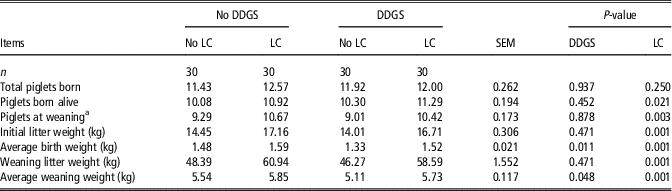
Inclusion of DDGS did not affect the numbers of total piglets born, piglets born alive and piglets at weaning (P>0.05; Table 1). In addition, the initial litter weight and weaning litter weight were not affected by inclusion of DDGS (P>0.05). However, supplementation of DDGS decreased the birth weight and weaning weight of piglets (P<0.05). Supplementing the diets with L-carnitine had no significant effect of total litter size (P>0.05) but increased the number of piglets born alive and piglets weaned, birth weight and weaning weight of piglets and litter weight at birth and weaning (P<0.05).
Effects of including distillers dried grains with solubles (DDGS) and l-carnitine (LC) in diets of gestating and lactating sows on reproductive performance and piglet performance

a Piglets were weaned on day 21 of lactation.
Composition of colostrum and milk
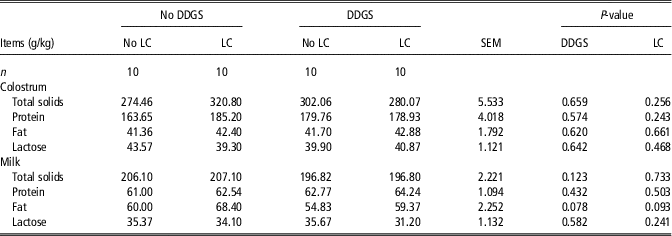
As shown in Table 2, the compositions of colostrum and milk were not influenced by inclusion of DDGS and dietary L-carnitine (P>0.05).
Effects of including distillers dried grains with solubles (DDGS) and l-carnitine (LC) in diets of gestating and lactating sows on the compositions of colostrum and milk

L-carnitine concentration in the plasma of sows
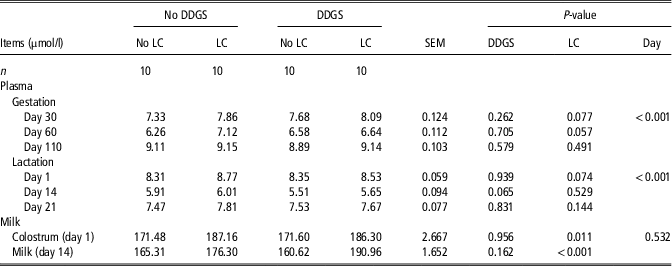
Inclusion of DDGS did not influence the L-carnitine concentration in the plasma of sows (P>0.05, Table 3). Sows fed L-carnitine-supplemented diets tended to have higher concentrations of L-carnitine at day 30 of gestation (P=0.077), day 60 of gestation (P=0.057), and day 1 of lactation (P=0.074). Time significantly influenced the concentration of L-carnitine in the plasma of sows (P<0.001).
Effects of including distillers dried grains with solubles (DDGS) and l-carnitine (LC) in diets of gestating and lactating sows on the concentration of LC in sows plasma and milk

L-carnitine concentration in colostrum and milk
Sows fed L-carnitine-supplemented diets increased L-carnitine concentrations in the colostrum and milk (P<0.05; Table 3), but inclusion of DDGS and time had no effect on the concentration of L-carnitine in colostrum and milk (P>0.05).
L-carnitine concentration in the plasma and tissue of offspring
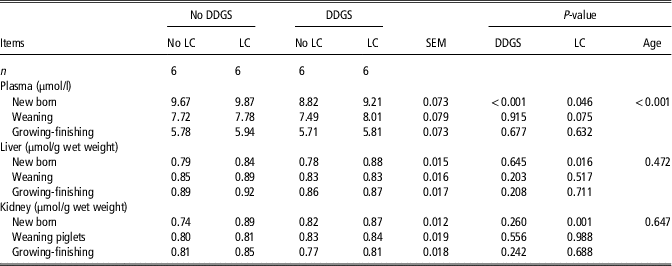
Sows fed diets containing DDGS decreased the concentration of L-carnitine in the plasma of newborn piglets (P<0.001; Table 4). Dietary L-carnitine supplementation increased the L-carnitine status of the plasma, liver and kidney (P<0.05) in newborn piglets. However, inclusion of DDGS did not affect (P>0.05) the L-carnitine status in weaning piglets and finishing pigs. Age significantly influenced the concentration of L-carnitine in the plasma (P<0.001), but there were no effects in liver and kidney (P>0.05).
Effects of including distillers dried grains with solubles (DDGS) and l-carnitine (LC) in diets of gestating and lactating sows on the concentration of LC in the plasma and tissue of their offspring

Antioxidant status of sows
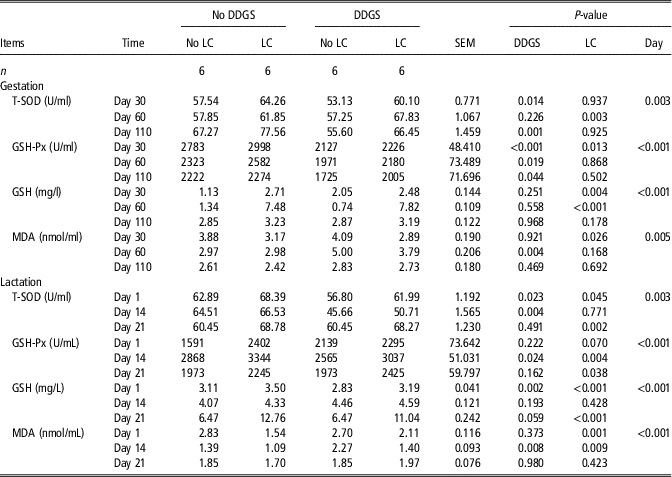
As shown in Table 5, feeding DDGS decreased the activities of T-SOD and GSH-Px in the plasma of sows (P<0.05) at day 30 of gestation. Sows fed L-carnitine-supplemented diets increased the activities of GSH-Px and the level of GSH, and decreased MDA concentration in the plasma of sow at day 30 of gestation (P<0.05). At day 60 of gestation, sows fed DDGS diets decreased GSH-Px activity (P<0.05) and increased MDA concentration (P<0.01) in the plasma of sows. Sows fed L-carnitine-supplemented diets increased the activity of T-SOD and the level of GSH in the plasma of sows (P<0.01). At day 110 of gestation, inclusion of DDGS reduced the activities of T-SOD and GSH-Px (P<0.05), but L-carnitine did not affect the antioxidant status in the plasma of sows (P>0.05).
Effects of including distillers dried grains with solubles (DDGS) and l-carnitine (LC) in diets of gestating and lactating sows on the plasma antioxidant status of sows

T-SOD=total superoxide dismutase; GSH-Px=glutathione peroxidase; GSH=glutathione; MDA=malondialdehyde.
Inclusion of DDGS diets decreased the activity of T-SOD and level of GSH in the plasma of sows (P<0.05) at day 1 of lactation. Furthermore, sows fed L-carnitine-supplemented diets increased the activity of T-SOD and level of GSH (P<0.05) and decreased (P<0.01) concentration of MDA in the plasma of sows. At day 14 of lactation, dietary DDGS supplementation decreased the activities of SOD and GSH-Px, and increased the level of MDA (P<0.05). Sows fed L-carnitine-supplemented diets increased the activity of GSH-Px (P=0.004) and decreased the concentration of MDA in the plasma of sows (P=0.009). At day 21 of lactation, inclusion of DDGS did not affect the activities of SOD and GSH-Px and the contents of MDA and GSH in the plasma of sows. Furthermore, sows fed l-carnitine-supplemented diets increased the activities of T-SOD and GSH-Px and the level of GSH in the plasma of sows (P<0.05). Time significantly influenced the antioxidant status in the plasma of sows during gestation and lactation (P<0.01).
Antioxidant status of their offspring
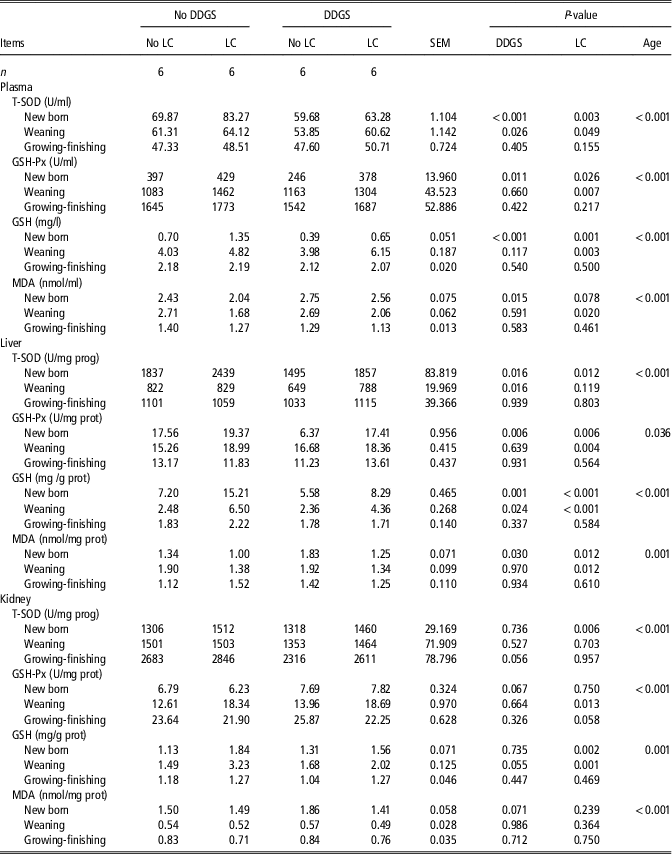
Sows fed DDGS decreased the activities of T-SOD and GSH-Px and level of GSH (P<0.05), and increased the content of MDA (P<0.05) in the plasma and liver of newborn piglets (Table 6). Sows fed l-carnitine-supplemented diets increased (P<0.05) the activities of T-SOD and GSH-Px and level of GSH in the plasma, liver and kidney of newborn piglets, and decreased the content of MDA in liver of newborn piglets.
Effects of including distillers dried grains with solubles (DDGS) and l-carnitine (LC) in diets of gestating and lactating sows on the plasma, liver and kidney antioxidant status of their offspring

T-SOD=total superoxide dismutase; GSH-Px=glutathione peroxidase; GSH=glutathione; MDA=malondialdehyde.
Sows fed DDGS decreased the activities of T-SOD in the plasma and liver and the level of GSH in the liver of weaning piglets (P<0.05). Similar to newborn piglets, sows fed l-carnitine-supplemented diets increased the activities of T-SOD and GSH-Px and level of GSH in the plasma, liver and kidney of weaning piglets (P<0.05), and decreased the contents of MDA (P<0.05) in the plasma and liver of weaning piglets. However, inclusion of DDGS in sows failed to affect the antioxidant status of finishing pigs (P>0.05). Age influenced the antioxidant capacity in the plasma, liver and kidney of offspring (P<0.05).
Discussion
Our results showed that including 25% DDGS in the gestation diet had no effect on litter size and litter weight at birth, which are in line with the findings of previous studies (Thong et al., Reference Thong, Jensen, Harmon and Cornelius1978; Monegue and Cromwell, Reference Monegue and Cromwell1995; Wilson et al., Reference Wilson, Whitney, Shurson and Baidoo2003; Song et al., Reference Song, Baidoo, Shurson and Johnson2007; Wang et al., Reference Wang, Su, Shi, Shi and Shan2013). However, the reduction in birth and weaning weights of piglets associated with including DDGS in the sow diets differed from these previous reports. Li et al. (Reference Li, Shurson, Baidoo, Gallaher, Anderson and Johnston2013) did report that the number of dead pigs farrowed per litter tended to increase when sows consumed DDGS containing moderated or highly peroxidized corn oil. According to Li et al. (Reference Li, Baidoo, Li, Shurson and Johnston2014), sows fed DDGS produced fewer live-born pigs and tended to have fewer pigs weaned over three reproductive cycles compared with sows fed corn soybean meal diets. This difference may be because DDGS containing highly peroxidized oil, which may result in oxidative stress in sows during late gestation and inhibit placental development (Li, Reference Li2012). The potential inefficiency in nutrient and oxygen transfer through the placenta during late gestation may have caused death or reduced the viability of fetuses before or during parturition.
In this study, dietary supplementation with l-carnitine in sows increased the numbers of piglets born alive and piglets weaned and the birth and weaning weight of piglets. Our results were in agreement with Ramanau et al. (Reference Ramanau, Kluge, Spilke and Eder2004) who reported that dietary supplementation with l-carnitine during pregnancy and lactation increased the number of piglets born alive and weaning weight of piglets. Musser et al. (Reference Musser, Goodband, Tokach, Owen, Nelssen, Blum, Dritz and Civis1999) also reported that dietary supplementation with l-carnitine reduced the number of stillborn piglets. Moreover, Ramanau et al. (Reference Ramanau, Kluge, Spilke and Eder2002) observed that dietary supplementation with l-carnitine during pregnancy and lactation increased the weights of piglets and litters at birth, weight gains of litters during suckling and weights of litters at weaning over three reproductive cycles.
Neither DDGS nor l-carnitine in sows gestation and lactation affected the composition of colostrum or milk. This observation agreed with the findings of Wang et al. (Reference Wang, Su, Shi, Shi and Shan2013), who concluded that feeding diets containing 200 or 400 g of DDGS/kg to late gestation and lactation sows did not affect the colostrum composition, and Ramanau et al. (Reference Ramanau, Kluge, Spilke and Eder2004) who reported that dietary l-carnitine supplementation did not influence the milk composition.
Supplementing the diets with l-carnitine did, however, increase the l-carnitine levels in colostrum and milk and the l-carnitine levels in the milk might have played a role in the better performance of piglets reared on l-carnitine sows since piglets have low capacity for endogenous carnitine synthesis in the first few days after birth (Coffey et al., Reference Coffey, Shireman, Herman and Jones1991; Eder, Reference Eder2009). Similar results have been reported by Birkenfeld et al. (Reference Birkenfeld, Doberenz, Kluge and Eder2006).
Traditional corn DDGS contains about 10% corn oil (Stein and Shurson, Reference Stein and Shurson2009). Compared with other vegetable oils, corn oil contains relatively high levels of PUFAs, which are highly susceptible to lipid oxidation (Boler et al., Reference Boler, Fernandez-Duenus, Kutzler, Zhao, Harrell, Campion, Mckeith, Killefer and Dilger2012; Hanson, et al., Reference Hanson, Wang, Johnston, Baidoo, Torrison, Chen and Shurson2015). Large amounts of secondary lipid peroxidation products, such as aldehydes, carbonyls and ketones, are produced when lipids are heated to relatively high temperatures. These secondary lipid peroxidation products are highly reactive and potentially unhealthy. Even though many ethanol plants in some parts of the world have implemented processes to extract oil from DDGS so the fat content of DDGS can be reduced (Wu et al., Reference Wu, Johnston, Urriola, Hilbrands and Shurson2016). However, the problem of lipid oxidation cannot be ignored when animals are fed a high level of DDGS for a long time.
The effect of dietary DDGS on the growth performance, lipid peroxide, oxidative status and meat quality had been well documented in several animal species (Eun et al., Reference Eun, ZoBell and Wiedmeier2009; Heincinger et al., Reference Heincinger, Balogh, Mezes and Febel2012; Min et al., Reference Min, Li, Waldroup, Niu, Wang, Gao and Liu2012; Hanson et al., Reference Hanson, Wang, Johnston, Baidoo, Torrison, Chen and Shurson2015). In our study, including DDGS in the diets partially reduced the activities of antioxidant enzymes and increased MDA level in the plasma of sows, which indicated increased lipid oxidation and some degree of induced oxidative stress. Our results were in line with the studies in poultry conducted by Min et al. (Reference Min, Li, Waldroup, Niu, Wang, Gao and Liu2012) who observed reduced SOD activity in the breast meat and liver, and increased MDA concentration in the liver of birds fed diets containing 150 g/kg DDGS, and Heincinger et al. (Reference Heincinger, Balogh, Mezes and Febel2012) who reported that the higher proportion of PUFAs in the diets containing 15% DDGS increased the MDA content in the liver and muscle homogenate of fattening turkeys. However, no effects were observed when diets containing DDGS were fed to growing pigs (Weber and Kerr, Reference Weber and Kerr2011). Hanson et al. (Reference Hanson, Wang, Johnston, Baidoo, Torrison, Chen and Shurson2015) reported that inclusion of peroxidized DDGS failed to influence the activity of GSH-Px and TBARS level in the serum of nursery pigs. However, Boler et al. (Reference Boler, Fernandez-Duenus, Kutzler, Zhao, Harrell, Campion, Mckeith, Killefer and Dilger2012) observed an increase in the plasma TBARS values, a decrease in the plasma GSH-Px enzyme activity of barrows fed diets containing oxidized corn oil. In the present study, the TBARS value of corn DDGS is 2.0 ng MDA Eq/mg oil, which is close to the average level of common DDGS as described by Song and Shurson (Reference Song and Shurson2013) and less than the peroxidized DDGS (5.2 ng MDA Eq/mg oil) as reported by Hanson et al. (Reference Hanson, Wang, Johnston, Baidoo, Torrison, Chen and Shurson2015) and Song et al. (Reference Song, Chen, Johnston, Kerr, Weber and Shurson2014). Interestingly, we also observed the antioxidant status of sows was partially decreased by inclusion of DDGS. It may be due to that sows during gestation and lactation is easier to be influenced by external oxidative stress source. During pregnancy and lactation of sows, high energy and oxygen levels are required to satisfy increasing metabolic burdens for fetal growth, placenta development and milk production, which could cause elevated reactive oxygen species (ROS) production and lipid peroxidation (Meng et al., Reference Meng, Guo, Li, Sun, He, Cheng, Shi and Shan2018). Previous studies have confirmed that sows suffer elevated and systemic oxidative stress especially during gestation and lactation compared with early gestation or non-pregnancy state as indicated by elevated DNA damage and elevated levels of oxidative stress markers, including ROS, 8-hydroxydeoxyguanosine and thiobarbituric acid-reactive substance (Berchieri-Ronchi et al., Reference Berchieri-Ronchi, Kim, Zhao, Correa, Yeum and Ferreira2011; Tan et al., Reference Tan, Wei, Ao, Long and Peng2016). In addition, the inconsistent results may be due to the DDGS source have different levels of sulfur-containing amino acid or other inherent antioxidant compounds, which resulted in an increase antioxidant compounds in serum and liver, and may have provided adequate antioxidant protection (Song et al., Reference Song and Shurson2013; Hanson et al., Reference Hanson, Wang, Johnston, Baidoo, Torrison, Chen and Shurson2015).
l-carnitine has been reported to prevent oxidative stress and regulate nitric acid level, cellular respiration (Brown, Reference Brown2007) and the activity of enzymes involved in defense against oxidative damage (Kremser et al., Reference Kremser, Stangl, Pahan and Singh1995). In the present study, dietary l-carnitine partially increased the activities of antioxidant enzymes and decreased the MDA level in the plasma of sows during gestation and lactation. Malondialdehyde is one of the final products of the peroxidation of PUFAs and its concentration reflects the body’s antioxidant status (Esterbauer et al., Reference Esterbauer, Schaur and Zollner1991). Previous results had demonstrated that supplementation of antioxidants (vitamin E, selenium and glycitein) could reduce oxidative stress and improve the reproductive performance of sows (Mahan, Reference Mahan1994; Mahan and Peters, Reference Mahan and Peters2004; Hu et al., Reference Hu, Gao, Zheng, Wu, Yang, Wang, Ma, Zhou and Jiang2015). In the present study, the beneficial role of dietary l-carnitine on the antioxidant status of sows may contribute to the increases in the number of piglets born alive and birth and weaning weight of piglets.
In the present study, supplementation of DDGS in sows partially decreased the activities of antioxidant enzymes and increased the level of MDA in the plasma, liver and kidney of newborn piglets and weaning piglets. These results are consistent with those of Hanson et al. (Reference Hanson, Wang, Johnston, Baidoo, Torrison, Chen and Shurson2015), who reported that the addition of DDGS to the diets of sow increased the TBARS concentration in the serum of offspring during nursery phase, and decreased the vitamin E level in the serum of offspring at weaning. In the current study, the addition of l-carnitine to the diet of pregnant and lactating sows increased the activities of antioxidant enzymes in plasma, liver, and kidney of newborn and weaning piglets, but did not affect finished pigs. This effect may be due to supplementation of l-carnitine increased the l-carnitine status of sows and consequently increased the transfer of l-carnitine from the maternal blood or milk to the fetuses or piglets. Therefore, the improved antioxidant status of sows fed l-carnitine was clearly reflected in the maternal effects and presumably increased the l-carnitine and antioxidant status of newborn and weaning piglets, but did not influence the finished pigs.
Conclusions
In conclusion, inclusion of DDGS during gestation and lactation induced metabolic oxidative stress in sows, and decreased the birth weights and weaning weights of piglets. Dietary supplementation with l-carnitine improved the reproductive performance and the antioxidant and l-carnitine status of sows, newborn piglets and weaning piglets. However, maternal l-carnitine supplementation failed to influence the finishing pigs.
Acknowledgements
This work was supported by the National Key Research and Development Plan of China (2016YFD0501207), the China Agriculture Research System (CARS-35) and the National Basic Research Program (2012CB124703).
Declaration of interest
The authors declared that there are no conflicts of interest.
Ethics statement
All experimental protocols were approved by the Ethical and Animal Welfare Committee of Heilongjiang Province, China (2008).
Software and data repository resources
All data are available upon request.
Supplementary material
To view supplementary material for this article, please visit https://doi.org/10.1017/S1751731118003105