In chapter eleven of Mein Kampf, Adolf Hitler, having constructed aneal type “culture-bearing” Aryan race,Footnote 1 came to elucidate his views on the history of Jews within Germany. Until the time of Frederick the Great, he argued, “it still entered no one's head to regard the Jews as anything else but a ‘foreign’ people.”Footnote 2 Thereafter, he asserted, came a period of transition wherein Jews had “the effrontery to turn Germanic.”Footnote 3 The rest of the chapter, for Hitler, was an attempt to reverse this putative historical mistake, and presents the reader with a vitriolic casting out of Jews, described as “parasites” and a “noxious bacillus,” from the German body politic.Footnote 4 The aim of this textual expulsion, Hitler explained, was to ensure that the Germans would not be destroyed from within, as had “all great cultures of the past.”Footnote 5 To Hitler, Jews were what Julia Kristeva has called “the abject”Footnote 6—that which is simultaneously part of the self but radically rejected by the self. In seeking to expel the “Germanic Jews” from the Volkskörper, Hitler sought to expel that part of the German self that, in his view, was a source of weakness and taint.Footnote 7
Kristeva's concept of the abject as that which is neither self nor other is in essence a modification of Lacan's earlier binary understanding of the relation of the self to the other in the process ofentity formation during the “mirror stage.” In 1949, Lacan described the mirror stage as a pivotal moment in the construction of the self. The infant gazed upon itself in the mirror and assumed for itself anentification with an image that was at once external to itself and a projection of the self. Thisentification with a translocated, external reflection, an exterior image of the self (the imago) established an irrevocable change in the way in which the self was delineated,Footnote 8 creating a nexus between what Lacan called the Innenwelt and the Umwelt—the internal world and the environment within which this self is situated. For Lacan, “this development is experienced as a temporal dialectic that decisively projects the formation of the individual into history. The mirror stage is a drama … which manufactures for the subject, caught up in a lure of spatialentification, the succession of phantasies that extends from a fragmented body image to a form of its totality …”Footnote 9 For the historian, this neat self/other dichotomy, as Teresa Brennan has argued,Footnote 10 is intrinsically about the way in whichentity is linked to questions of place, power, and domination. In effect, Lacan had reproduced the master-slave dialectic that would be familiar to historians versed in Hegelian dialectics, as an explanatory mechanism that accounts for the interconnectivity between personal subjectivity, social, and historical conditions and events in the world.
Yet, this neat reconstruction of Hegelian dialectics was problematized by Kristeva through her elaboration of the abject. According to Kristeva, the abject, that which was once considered a part of the self, is apprehended as the unclean detritus of the self that evokes a powerful sense of disgust, nausea, and a desire to expel that impure element, as a simultaneousentification and refusal to assimilate is experienced. It is “an extreme state of subjectivity—a crisis in which the borders of self and other radically break down.”Footnote 11 This radical breakdown in the ability to discern between self and other leads to fear and anxiety as unproblematic patterns ofentification, enabled by the neat binaries of the dialectic, are confounded by the confrontation with something that is neither wholly subject nor object.Footnote 12 Ultimately, this anxiety can feed into an “abject response,” a form of radical violence elicited by the desire to expel the abject from the self.Footnote 13
This seemingly esoteric debate about subjects, objects, and the abject, far from inconsequential, actually constitutes an immensely useful heuristic framework within which concepts of race, nationalentity, and the history of modern German imperialism might be interrogated. At the level of concrete historical investigation, this framework offers suggestive paths for approaching key questions in German historiography. How did those oppressed during different periods of modern German history figure within the epochal epistemological context—as an objectified other (the state of alterity) or as the liminal abject? More concretely, how well do comparisons between the status of Jews under the Nazi Weltanschauung and colonized peoples during the Kaiserreich hold up? Can epistemological continuities (which might have translated into material continuities) in the delineation of nationalentity be traced between the colonial and Nazi eras? Was race, as a marker of social inclusion and exclusion, a static or fluctuating concept from the late nineteenth to the mid twentieth century? All of these questions might be fruitfully explored with reference to both the Lacanian/Hegelian delineation between the self and the other,Footnote 14 and, more importantly via the Kristevan notion of the abject that refuses the mechanics of the dialectical approach.
The questions of continuity in the treatment and understanding of Jews under Nazism and colonized peoples prior to World War One have become the subject of heightened attention as the colonial era has emerged as a central area of research. In particular, the extent to which Hitler's biological racism had its origins in the racial politics of Germany's colonial period has become a central issue for researchers working on the Kaiserreich, as has the question of the extent to which racialized thinking led to the implementation of genocidal policies both in German Southwest Africa and in the east during the latter stages of Nazi imperialism. Peculiarly, within the discussions of those involved in this comparison of German Southwest Africa and Nazi Germany, the ghosts of previous historiographical disputes have reemerged to haunt the histories written today. Historians of an earlier era who were engaged in the Sonderweg and Historikerstreit interludes can now witness the astonishing spectacle of their debates reemerging within postcolonial histories of Germany. In the Sonderweg and Historikerstreit debates, historians, too, grappled with their own form of the abject, as they variously sought to place, control, and even expel a polluting element of the German past represented by the years of Nazi rule.Footnote 15 Indeed, within some narrations of German history, elements of the national past that failed to serve nation-building purposes were quarantined or rationalized lest they trigger the revulsion that might unpick a nationalist historical consciousness within both the scholarly and broader communities.Footnote 16 If a nation is an imagined community,Footnote 17 the abject past is that repellent element of the national self that must be disconnected from or safely contained within the larger collective imaginary or imago of the nation if a national historiography is to unify, without sparking expressions of (anti)national existential dread.Footnote 18 The attempt to explain the relationship of the abject Nazi past to the broader history of Germany, a unifying feature of both the Sonderweg and Historikerstreit interludes, now plays a prominent role in the debate about German colonialism and in particular colonial genocide. Faced with a rediscovered national genocidal colonial past, the historian of the German nation-state is once again confronted with the questions of continuity and uniqueness that so taxed the historians of the second half of the twentieth century.
Historicizing Uniqueness
Hitherto, Germany's abject past has been viewed exclusively as the twelve years of NSDAP rule. The existential, “blood-poisoning” wounds inflicted by Nazism on the German body politic, however, have not been cauterized, but rather have festered in postwar historiographical debates within German history, which have seen numerous attempts to negotiate the abject Nazi past within a discipline closely and publicly aligned with the (re)formation of nationalentity.Footnote 19 As the term Vergangenheitsbewältigung intimates, the German past has been seen as something requiring active mastering, and as such, as qualitatively different from the histories of other nations that permitted the intergenerational transmission of less problematic national histories.Footnote 20 As such, the Sonderweg and Historikerstreit interludes reflect (depending upon the particular participant) attempts to process and assimilate or conversely to resist the unproblematic assimilation of the abject Nazi past into German nationalentity. In terms of paradigmatic assumptions, these debates asserted contending understandings of the exclusivity and uniqueness of a genocidal past underwritten by a shared revulsion and recognition of the historic weight of the crimes of Nazism.
The Sonderweg thesis, as the name suggests, emphasized that nineteenth- and early twentieth-century Germany suffered the stain of a uniqueness stemming from a maimed path to modernity, a path via which Germany became not another England, the putatively normative successful nation, but a “conservative utopia”Footnote 21 in which liberalism was only weakly anchored.Footnote 22 Ineluctably, this narrative suggested, by reaching its historic turning point and “failing to turn,”Footnote 23 Germany missed the path to modernity and was only shocked into becoming a “normal” liberal state by undergoing the purgative rigors of National Socialism.Footnote 24 The necessary corrective to this “uniqueness” argument came with David Blackbourn and Geoff Eley's Mythen deutscher Geschichtsschreibung, translated and expanded into English as The Peculiarities of German History: Bourgeois Society and Politics in Nineteenth-Century Germany.Footnote 25
With the Historikerstreit, issues of uniqueness intruded once again into the process of positioning the crimes of Nazism within the nationalentity of Germany. Despite the at times complex exchanges and the delineation of numerous positions and subpositions, this exchange is perhaps most easily seen at a glance through the (at times admittedly distorting) lens of the polemics between Jürgen Habermas and Ernst Nolte.Footnote 26 Nolte, distressed about a Nazi past that would not pass (“die Vergangenheit, die nicht vergehen will”), sought an alternative narration of Nazism as part of a prolonged European civil war between “Asiatic” Bolshevism and western civilization.Footnote 27 Ingeniously, Nolte insisted that the genocidal “original sin” belonged to the Soviets, and that Nazism was “a fear-borne reaction to the acts of annihilation that took place during the Russian revolution.”Footnote 28 Habermas, viewing this as an attempt to rehabilitate, even legitimize Nazism, remonstrated against the historicizing and therefore (in his view) normalization of the Nazi past.Footnote 29 Importantly for the future of transnational history, he cordoned off the Holocaust from comparison by affirming its historical uniqueness, through a modified Sonderweg rendering of German history. “Should we,” he asked of his fellow Germans, “with the help of historical comparisons, attempt macabre squarings of accounts in order to sneak out of the liability for the encumbered history of the Germans?”Footnote 30 Since this debate, Habermas has been joined in this uniqueness position by an odd assortment of bedfellows, ranging from Steven KatzFootnote 31 and Yehuda BauerFootnote 32 to Daniel Goldhagen.Footnote 33
The problem for Habermas, one that the discipline of comparative history has inherited, is that of the question of moral equivalence—the notion that by comparing atrocities and genocides, the Holocaust is diminished through its linkage with other “lesser” events.Footnote 34 As Dirk Moses, reworking Inga Clendinnen's evocative phrase, has argued, the Holocaust has exercised a “Gorgon effect” on those that would otherwise pursue the study of radical violence and genocide in any systematic, transnational fashion.Footnote 35 In its own way, the trope of uniqueness belies a kind of moral hubris or Sündenstolz, perhaps even a chauvinism that implies that only Germany's past is one that is sufficiently difficult to master, that it is only the German nation that must face the profound existential questions related to states whose histories are steeped in programs of eradication, genocide, and the politics of violent exclusion. It does not deny the horrors, nor the scale, of the Holocaust to investigate whether there were other horrors throughout history that may or may not have borne structural or intellectual similarities, perhaps even links. There is, it might be said, enough disgrace and sorrow to overturn a number of nationalist historiographies.Footnote 36
If, however, contrary to the understanding of the Sonderweg historians, the uniquely atavistic complexion of the German nation-state prior to 1945 is not to blame for Nazi genocide, where might an historian look for causality when dealing with the Holocaust? One path has been opened by scholars who have countered the Sonderweg narrative of uniqueness with the assertion that genocide stems from the nature of modernity and the limitations of an epistemology borne of the Enlightenment.Footnote 37 This position, that genocide stems from modernity and western liberalism, is partially useful insofar as it enables a decoupling of “genocide” from a uniquely German nationalentity; however it explains not the phenomenon of genocide itself,Footnote 38 but, more narrowly, modern genocidal method. In terms of a broader history of la longue durée, modernity is also not a terribly useful category for analyzing the events of, for example, 146 BC and Cato's preceding dictum Carthago delendum est, nor does it explain Thucydides' Mytilean debate, as well as the genocidal impulses unleashed in the Crusader conquest of Jerusalem in 1099 and the Mongol sack of Baghdad in 1258. If these pre-modern incidents are not excluded from transnational/transhistorical discussions about “genocide,” then all that remains is the redundant stance that modernity is a necessary (but not sufficient) condition for modern genocide—that modern genocides are modern. If the events of antiquity and ever since are (sensibly) permitted to a broader discussion of the dynamics of genocide,Footnote 39 then something other than modernity requires consideration in attending to questions of underlying causality, including in the cases of German Southwest Africa and the Holocaust.
Interestingly, Moses has posited genocide, imperialism, and nation-state formation as inextricably linked.Footnote 40 This, it appears, is a fruitful basis for a study of various genocides, including the Holocaust, although again the modern nation-state might be a dispensable category, particularly for historians seeking out possible commonalities and differences between modern and ancient genocides. Across time, it seems, there appears to be a connection between genocide, expansionism, and/or the mechanisms of group cohesion at work during times of domestic or external hegemonic transformations (whether “national,” “civilizational,” or “imperial”) that rely upon the delineation of either an internal, “abject” threat or an external, alterior threat.
To return to Germany, the relationship between the events of 1904–1908 in German Southwest Africa and the Holocaust is presently being contested between historians who variously posit continuities between the two events and those who foreground difference(s). The implications of this debate are, of course, enormous, both for historical understanding and any concomitant flow-on effects to contemporary attempts at fashioning a post-Holocaust German nationalentity. Nazi genocide, as the end point of a cumulatively more radical anti-Semitic politics borne of a Nazi Weltanschauung that positioned Jews as an abject citizenry, has itself been institutionalized as central to the narration of the modern German nation, with the Holocaust positioned, through memorialization, historiography, and popular culture, in a rather strange liminal position between negation andentification, as neither a contingent aberration (in the sense of having no historical origins) nor a necessary event (in the sense of being overdetermined, as it appears in Goldhagen's thesis).Footnote 41 So positioned, it continuously provokes caustic national self-examination that engenders furtherentification as well as revulsion, repudiation, and a sense of defilement. As an abject rather than heroic past, it disrupts the construction of the kind of harmonious national historical narrative envisioned by Nolte.
The attempts at positioning, or “mastering,” the Nazi past, however, have recently been joined by other German pasts that seem to require mastering, most notably that of the German Democratic Republic. While Jarausch and Geyer have included the past of the GDR as part of Germany's abject history,Footnote 42 it has in fact hitherto (rightly or wrongly) been emplotted as a type of German-speaking Russian alterity, the simple negation of which serves the unproblematic enunciation of a nationalist history focused on the successes of postwar Western Germany; that is, it enables a relatively straightforward, Manichaean narration of the dichotomous histories of the normative and deviant German states. The GDR is thereby viewed as an unproblematic, easily disowned history, a past that is easy to master, inauthentic (Ostalgie notwithstanding), when compared to its parallel neighboring German nation-state project. Far from abject, the positioning of the GDR as “the second German dictatorship” actually enables a heroic national history through a pseudo-dialectical study of a Russified and a westernized Germany.Footnote 43 This historiography is in fact a variant of Nolte's Asiatic Bolshevism/western civilization reading of the German past, replete with the trope of German victimhood.
Somewhat more problematic is the narration of Germany's colonial history, and in particular, the attempts to come to terms with yet another German genocide, this time as enacted in Southwest Africa between 1904 and 1908. Once again, a genocidal past casts a shadow over nationalist narrations of German history, marking out Germany as having followed an exceptionally brutal colonial Sonderweg that (through a Euclideanentification of two points) posits a narrative, even causal line from German Southwest Africa to Auschwitz. In the wake of a flurry of research aimed at understanding the place of Germany's colonial era in the history of both the German nation-state and European imperialism, the authors whose works have successfully constituted a new interpretative paradigm include those of Jürgen Zimmerer, Birthe Kundrus, Lora Wildenthal, Susanne Zantop, Pascal Grosse, Ulrich van der Heyden, and Joachim Zeller, among others.Footnote 44 With justification, they have reinforced and elaborated on the attempts of early pioneers such as Horst Drechsler and Helmut BleyFootnote 45 to overturn the “streng aber gerecht” narration of German colonial history, through which German colonial history was presented as a period in which Germany's merchants, missionaries, and settlers largely avoided unnecessary excesses in the process of bringing civilization to the wider world.Footnote 46
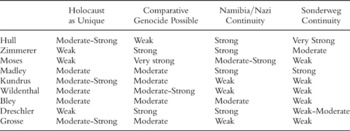
Yet it would be misleading to claim that this reorientation of the focus of German historiography toward the colonies is entirely homogeneous in its treatment of some fundamental issues, and the question of the emplotment of German history as following (genocidal) lines of continuity “from Windhoek to Auschwitz”Footnote 47 is one area within which postcolonial research has often disagreed. A variety of positions have emerged as historians grapple with the extent to which an overtly teleological narration of German colonial society, expansion, warfare, and genocide that is explicitly linked to Nazi society, politics, racial theory, and genocide is both possible and enlightening. Crucially, this disagreement about transhistorical links or a lack thereof is conducted within the parameters of a shared understanding that the events in German Southwest Africa between 1904 and 1908 did indeed constitute genocide. Only the relationship of this colonial genocide to the Holocaust as the “prototypical genocide,” is disputed. As such, it is a debate conducted in what Moses has called Lemkin's “ecumenical spirit,” which effectively occludes the uniqueness arguments of Katz, Bauer, and Habermas.Footnote 48 The cacophony of recent positions taken by the various protagonists in the postcolonial debate on the questions of the uniqueness of the Holocaust and a German Sonderweg has been summarized (albeit in a necessarily overly schematic manner) in Table 1.
Historikerstreit/Sonderweg positions of sample historians working on German colonial genocide

At issue is the extent to which structural links connect the genocidal Herero-Nama wars and their aftermath with Germany's conduct during the Second World War and ultimately Nazi genocide.Footnote 49 As a debate over the extent to which it is possible to postulate a genocidal continuity, and (in some formulations) a possibly uniquely genocidal tendency in German history, this is a radicalized revisitation of the earlier Sonderweg and Historikerstreit debates that posited a unique trajectory of German history.
In a forthright contribution to the debate, Jürgen Zimmerer, perhaps the premier researcher currently working in the field, has postulated that, as the “first German genocide,” the “genocide in German Southwest Africa is also significant as the pre-history of the Holocaust.” Furthermore, according to Zimmerer, this is not a symbolic or metaphorical linkage; rather, “there are in fact structural similarities between the genocide of the Herero and Nama and the Holocaust that are worth thinking about.”Footnote 50 The central link that Zimmerer refers to is “the willingness … to exterminate designated groups of people” displayed by a state apparatus. The actual mechanics of the state-sanctioned deaths, he argues, differed, but with the Herero-Nama wars the German state experienced a “breaking of an ultimate taboo” that made the Holocaust “conceivable” and therefore possible.Footnote 51 For Zimmerer, the attempted extermination of the Herero was a necessary midpoint between colonial warfare and the Nazi Vernichtungskrieg in the east.
An example of how Zimmerer attempts to delineate structural continuity is worth analyzing, so as to illustrate the degree to which his intuitively compelling narration of causality might be problematic. With seeming promise, Zimmerer points to an overlap not merely in procedure oreology but also personnel in the two epochs of German genocide, pointing to the way in which ex-colonial governor Franz Ritter von Epp, as director of the Colonial Office, attempted to mobilize ex-colonial “farmers and experts” to support the Nazi Lebensraum project in eastern Europe in 1941.Footnote 52 Unfortunately for a continuity thesis, while this recruitment attempt did indeed occur, it is best seen in light of the contemporary internal dispute between members of the by-then Nazified Colonial Society who were resisting directives from the upper echelons of the NSDAP to drop references to African colonies in their propaganda and agitation and to focus exclusively on the east. Resistance to this directive lasted up until 1943, when the regime used the simple expedient of cutting the paper ration of the intransigent Africanists, who were still claiming that not to mention Africa represented “a betrayal of oureals and mission.” Indeed, no lesser personality than Goebbels had, on January 6, 1941, banned all propaganda from the Colonial Society's successor organization, the Reichskolonialbund, which speculated on future colonial imperial holdings outside eastern Europe. For many colonial “old-hands,” this was the last straw that demonstrated once and for all that the Nazis had always had little interest in their beloved Africa, and they duly complained about this neglect. Von Epp had no choice but to combat this by urging the Bund to follow the party's policy of focusing on the east.Footnote 53 As such, it would be interesting to know how many, if any, ex-African farmers and experts heeded von Epp's call to abandon their decades-old visions of colonial Africa and to become involved in the colonization of the east.Footnote 54 Hitler had little time for ex-liberal Africanists and their history, and what is interesting about von Epp is not that he exemplifies a through-line between Germany's two genocidal imperialist ventures, but that his profound difficulties in carrying other colonists with him in transferring old African dreams to Russia demonstrates neatly the split between Kaiserreich and Nazi imperialism. Nazi overtures toward Kaiserreich Africanists and Weimar enthusiasts served the purposes of facilitating Gleichschaltung rather than representing a truly overlapping politics, as astute contemporary observers noted.Footnote 55
While Zimmerer argues strongly for a historical continuity that links the two German genocides, he does not argue that this amounts to a German Sonderweg. His diligently researched monograph and numerous other interventions have focused on the continuities within the history of Germany, lending his work an exceptionalist sheen, expressed in expressions such as “from Windhoek to Auschwitz.” Yet in those instances where he has had the latitude to explore transnational cases, he has made it clear that other colonial massacres and wars in non-German settings can be expressed in terms of genocide,Footnote 56 or more tentatively, following Moses, “genocidal moments”Footnote 57 (and elsewhere, somewhat confusingly “genocidal massacres”Footnote 58). Ultimately, Zimmerer does not quarantine the Holocaust and the Herero-Nama wars from comparisons with other colonial genocides—they do not “constitute a fundamentally different category from the Nazi genocides.”Footnote 59 Yet, importantly, he nevertheless views them as qualitatively different, largely due to the driving role of the state apparatus and the highly organized method of extermination that characterized the Final Solution.Footnote 60 For Zimmerer the Holocaust, as a genocide, was not unique, rather it had clear origins in Germany's colonial past and in the colonial practices of other European powers, but it was nevertheless different from Namibia in 1904–08 and from other colonial genocides, not because of any difference in epistemological foundations, but in that it represented a refinement of technique and state organization. A path between the two is established, with Namibia supplying the intellectual, conceptual preconditions for Nazi genocide as a means of destroying an undesired alterity. This path, however, is not, for Zimmerer, necessarily a unique or particularly German one.
Perhaps most overtly situated within a Sonderweg reading of German history is Isabel V. Hull's Absolute Destruction, which points in a very forthright fashion to a military culture that fostered wars of annihilation and to a political climate that was unable to restrain it as effectively as in other nations. Although the narrative culminates with World War One, the emplotment of genocide within the work points to an unerringly German tendency toward either genocidal acts or support for genocidal acts. Wilhelmine Germany was, for Hull, the site of “institutional extremism,” that gravitated toward the (always lower case, thereby ostensibly circumventing uniqueness debates) “final solutions.” German military culture was one predispositioned toward “total, unambiguous, permanent results.”Footnote 61
Hull does deviate from traditional Sonderweg histories in her assertion that these military tendencies were not “atavistic” but modern.Footnote 62 This is an important innovation in and of itself, but does not alter the “uniqueness” trajectory of her overall thesis. Indeed Hull is at pains not to broaden this out to mean that Germany had a “modern” political system, society, or culture (where modernity, as per the Sonderweg, signifies the ascendancy of liberalism). Indeed she rehearses precisely the “feudalization of the bourgeoisie” thesis that Blackbourn and Eley effectively refuted in the 1980s.Footnote 63 Similarly, her causality invokes the nature of “Bismarck's constitution,” “Germany's political structure,” “the incapacities of Wilhelminian government,” and “the incomplete political system of Imperial Germany” as the site for a German uniqueness that explained its apparent hyper-militarism.Footnote 64 And veterans of the Sonderweg debate would no doubt recognize the lineage of her assertion that “the government's constant search for popular legitimacy in lieu of more democratic processes condemned it to a kind of Caesarism in which it posed as the guarantor of the national enthusiasms of the ‘loyal’ classes.”Footnote 65 Hull's belated suggestion that “Germany was at the end of a spectrum it shared with the rest of the Western world” does not obscure the fact that her argument, evident on the same page as this claim, as throughout the rest of the book, focuses on Germany's political exceptionalism that found its expression in an inability to control military “final solutions”—acts of genocide.Footnote 66
With the political circumstances required for “final solutions” found within a unique Germany, it is a great temptation for Hull to position Germans not only as perpetrators in German genocides, but also as accomplices in other, seemingly unrelated genocides, such as the Armenian genocide—perhaps not as willing executioners, but certainly as tutors, or at the very least, as Hull describes them, “(willing) victims” of Turkish duplicity on the issue.Footnote 67 It is German advice to deport the Armenians that paved the way to genocide in Turkey. That advice, Hull argues, gave the Turks “the cover they wanted.”Footnote 68 Unable to link Germany's officials in Turkey conclusively to the genocide going on there, Hull declares that German military culture encouraged genocidal tendencies in military settings and they were intellectually predisposed toward equanimity when allies (under their tutelage) did the same.Footnote 69 A footnote buries the fact that the U.S. State Department no less than Germany “accepted Turkish claims of military necessity,”Footnote 70 and it is fair to say that U.S. civil society was equally as unsuccessful as those Germans galvanized by the reports of Johannes LepsiusFootnote 71 in intervening in stopping the genocide—a policy that would have amounted to Germany invading an ally that was defending its southeastern flank while they fought a two-front war in Europe against Russia, Britain, and France.Footnote 72 The United States had no such pressing military limitations on their capacity to intervene on behalf of the Armenians yet still embraced the same Realpolitik that Hull uses to condemn Germany.
What is missing from this picture are the transnational links that make German Southwest Africa and indeed Turkey during the First World War intelligible not only with recourse to Clausewitz and von Schlieffen, Germany's “feudalized” bourgeoisie, or a history oriented toward the moral and historiographical black hole of the Holocaust,Footnote 73 but also by linking these genocides to other sites of radical imperial violence and genocide in North America, the Belgian Congo, Australia, and Spanish Latin America, to name but a few. Hull knows this, as her 2002 review of Alison Palmer's comparative work on Namibia and Australia demonstrates,Footnote 74 yet it is not offered in any serious sense as worthy of consideration in what has become an important monograph. Her chosen parallel, the British waging of the Boer War, while potentially illuminating, is instrumentalized to make the types of points about the “deficiencies” of German political culture and society (when compared with Britain) that Ralf Dahrendorf made in his Gesellschaft und Demokratie in Deutschland.Footnote 75 Whereas in Britain, civil society and parliament could exercise control over the military to ensure that genocide did not occur in military settings, in Germany this was impossible, according to Hull, due to “the thinness of civilian institutions” in a “narrowly military monarchical state.”Footnote 76 The question then arises, why were the genocidal policies of Lothar von Trotha stopped? It was, of course, precisely because German civil society and politics mobilized to stop it, as Helmut Bley originally argued.Footnote 77 This is not unlike how the excesses of the Boer War were brought to an end—both through civil and parliamentary channels, both sadly ex post facto. Hull cannot concede this and have her Sonderweg argument survive. In fact, Hull gives the impression that Chancellor Bülow supported Trotha's genocidal politics when she quotes him as declaring himself to be “typically” on the side of “the justified national sentiment of indignation and fury over the [Herero] atrocities,”Footnote 78 even though Bülow made this (and similar) statements between May and July 1904—prior to the Battle of Waterberg and a full three months before the Vernichtungsbefehl. As Dreschler, Bley, and Zimmerer (the three leading researchers into the war) all make clear, once Trotha's campaign was reported to Bülow, he roundly condemned it and was at the forefront of the wave of denunciations for the genocidal war that saw it halted.Footnote 79
Hull did touch upon the transnational theme, however, in her contribution to Robert Gellately and Ben Kiernan's The Specter of Genocide,Footnote 80 where, in contrast to Zimmerer, she posited that “final solutions,” as utopian visions of destruction (seemingly quarantined to German colonialism), must be differentiated from “colonial atrocities and massacres” which were “standard operating procedures” in other colonial settings.Footnote 81 In this article, German military culture is once again the key driver of German uniqueness, differentiating Germany from France and Britain, through the permissibility of “final solutions” in the military sphere. Once again, in this contribution, due to “certain high-ranking German military advisers to the Turks [who] recommended the deportations,” the only other power instigating “final solutions” in the administration of empire was “Germany's ally, Turkey”—and at the behest of Germany.Footnote 82 Genocide is seen by Hull as best viewed through the blood-spattered spectacles of a German Sonderweg.
In his contribution to the debate, Benjamin Madley has similarly attempted to establish direct lines of continuity between Namibia and Auschwitz.Footnote 83 Far more than Zimmerer, but less so than Hull, Madley's article positions itself comfortably within the tradition of Sonderweg historiography, despite evidence that he presents that complicates this narrative structure. “German South West Africa,” Madley argues, “was colonial but not typically so.” Although Madley concedes that violence was common in other colonial settings, he is at pains to insist that “what distinguishes the German South African genocide from most other colonial atrocities is the fact that the Germans in colonial Namibia articulated and implemented a policy of Vernichtung.”Footnote 84 Yet Madley also concedes that the only thing stopping Cecil Rhodes from a policy of Vernichtung in Zimbabwe was not moral scruple but the prohibitive financial cost. Similarly, King Leopold's no less official policy of the destruction of a non-compliant servile labor force in the Congo is also cited as an example of colonial violence,Footnote 85 but the methodical, structural, state-sanctioned violence of the Belgian monarch against Africans condemned to servitude in the “red rubber” colony does not receive the same weighting as Lothar von Trotha's belated but nonetheless genocidal Vernichtungsbefehl. Again, it is admitted that both the English and Spanish used concentration camps in their empires, with disastrous results for their inhabitants, but only the German ones were “a transitional institution” leading to “Nazi death camps.”Footnote 86 This ignores the fact that, for his part, Hitler (admittedly in a wartime context) stated overtly that concentration camps were a trick that he had learned from the British.Footnote 87
Hull and Madley's Sonderweg continuity arguments have a long pedigree in post-World War Two thinking on German history. Helmut Bley made the link between two genocidal incidents linked by their “irrational search for power” and their use of “modern methods of economic and administrative control”Footnote 88 while Helmuth Stoecker drew explicit parallels between German Southwest Africa and the Nuremberg laws.Footnote 89 Admittedly, some link seems at least intuitively compelling, yet there are no records of Hitler or indeed any high-ranking Nazi referring to von Trotha's genocidal proclamation or the Battle of Waterberg or the concentration camps of Shark Island, although anecdotal references to the Armenian genocide and British concentration camps have been noted, giving some (not uncontroversial) strength to the notion that the example of the genocidal colonial past had made an impression on Hitler—only not the German colonial past, which he apparently viewed with disdain as an example best not followed.Footnote 90 And it is worth remembering that when both Hannah Arendt and Frantz Fanon proffered the judgments that fascist atrocities represented colonial methods of oppression brought back to Europe, their critique, quite correctly, was not limited to the German colonial sphere.Footnote 91
Limits to the Continuity Thesis
The positing of continuities between colonial settings and the Nazi racial state has been problematized by a number of historians, who, in examining the gender dimension to the question of racial theory in German colonial settings have come to caution against structural and epistemological continuities between Windhoek and the Nazi state.Footnote 92 Interestingly, both Birthe Kundrus and Lora Wildenthal have done so through an analysis of the legal and popular discourse surrounding “mixed marriages” and the offspring that resulted from “interracial” sexual relations. Through the close analysis of the gendered nature of imperialist oppression and racial theoretics, both have come to similar conclusions that complicate Hull's, Madley's, and (to a lesser extent) Zimmerer's continuity-oriented narration of “structural similarities” between the colonial and Nazi past.
Kundrus, in several interventions, has insisted that it is difficult to equate the biological racism of the NSDAP with the logic of legal attempts at marital and sexual separation in the German colonies, as Hitler understood, when he fulminated against existing citizenship laws that ostensibly bestowed German citizenship not on the basis of race, but the nationality of the parents.Footnote 93 During the Kaiserreich, Kundrus argues, German citizenship was a juridical construct without explicit biological prerequisites.Footnote 94 In terms ofentity, race, important as its function was, was used primarily as an external marker of European/German political dominance and the subordinate position of the indigenous population. That is, race in colonial-era Germany was a marker of hierarchical distinctions that were essentially social in nature rather than a biologically derived understanding of an intrinsic, genetic Germanity that stood to be polluted through racial mixing. For this reason, Kundrus asserts, there is no clear path from Windhoek to Nuremberg.Footnote 95
This has been confirmed in a number of studies that point to the prominence of hierarchical rather than biologically racist thinking as crucial during the colonial period. Cornelia Essner, for example, has examined how race served as a line of demarcation between ruling Europeans and the African “object of rule,” adding that “superstitiousness about blood was rather marginal prior to 1914.”Footnote 96 Helmut Bley, too, has categorically concluded that “legal discrimination was intended only to guarantee the Europeans' claim to social and political power.”Footnote 97 Erik Grimmer-Solem's study of the colonial discourse surrounding the 1907 elections illustrates clearly that Africans were constructed in terms of their use value as a servile helot population, as farmers and railway workers.Footnote 98 Radical violence, within this discourse, was presented not as the necessary elimination of an abject pollutant within the body politic, but rather “the price of spreading civilization” (or work discipline) to an alterior indigenous population that had to be made productive by all necessary means.Footnote 99 Similarly, Dieter Gosewinkel, in studying the position of Mischlinge in concepts of German citizenship has pointed out that a biological, blood-fixated racism was not the prevailing epistemological framework within which either colonial violence or the broader metropolitan discourse of citizenship was situated, and that the term “race” prior to the First World War was understood in a different way from the way in which it was deployed during the Nazi era. As such, “the inter-temporal transfer of colonial racial law of the German Kaiserreich to the racial and colonial law of National Socialism is the more difficult to establish.”Footnote 100
Of course, within a colonial setting, “racial mixing” was viewed less flexibly than in the Colonial Office in Berlin, and to “go native” (verkaffern) was indeed viewed as a disgrace, even unlawful, as the gradual legal codification of “mixed marriages” and the position of Mischlinge in the colonies illustrates. The disgrace pertained not to notions of blood pollution, however, but lay rather in the sense “that a part of the ruling population lost its personal, cultural, and nationalentity and in terms of social praxis, according to mass opinion, placed itself on the same level as the ruled.” More starkly, those that acculturated to their African surroundings “committed treason against their own culture, their own nation, and to the scientifically grounded belief in the principle of white German preeminence.”Footnote 101
With respect to the question of miscegenation, Kundrus also argues that “more frequently expressed than the eugenicist notion of racial purity was the sense that mixed heritage children were damaging the ‘prestige of the white man.’ ” Rather than questions of blood purity, the concern was for “the hegemonic position” of the Germans within their colonies.Footnote 102 The discourse surrounding miscegenation reflected “a far-reaching phobia of the Germans that they would lose their ownentity and as a result lose political control.”Footnote 103
Lora Wildenthal, too, has discussed the dominance of racialized hegemonic politics rather than racialized biological thinking in the colonial setting by demonstrating how social and “racial” stratification were conflated as a necessary consequence of the economic requirement of maintaining indigenous Africans as a servile, laboring social stratum. In the case of a black African male and his German wife, for example, the issue raised in the press was not racial pollution, but “racial prestige,” where the threat was that “African servants would lose respect for their European bosses, teasing them with the prospect of becoming in-laws.”Footnote 104 In Samoa, too, the main concern of the liberal governor Solf in banning mixed marriages was “its political implication of racial equality.” Biology and fears of pollution were at this early stage certainly not in the forefront of discussions about the offspring of hybrid coupling, with “fluency in the German language, a European education, and a generally European way of life” sufficient for Mischlinge to make the list of those “to be treated as white.”Footnote 105 In Cameroon, political hegemony over an African helot class was also of foremost concern, Wildenthal demonstrates, with one colonist affirming that “It is our world-historical calling to rule in Africa, not over black brothers, but over black subjects.”Footnote 106
For Kundrus, Wildenthal, Essner, Gosewinkel, and Grimmer-Solem, race during the Kaiserreich was a marker not of a putatively intrinsic biological inferiority but of an asserted socio-political inferiority. While later racial theorists such as Eugen Fischer might have been stalking the colonies in the process of elaborating a biologically oriented concept of raceFootnote 107 that Hitler would use in chapter eleven of Mein Kampf, this was not the understanding of those involved with colonial administration at the time of the Herero uprising, when the main objective was the maintenance of a system of dominance over a servile workforce whose external color, along with their cultural, religious, and social practices were markers of their ostensible political inferiority.
On the other hand, “interracial” relationships and their resulting offspring militated against the hitherto visible and politically necessary racial dichotomy between ruler and ruled and therefore constituted a threat to the hierarchical complexion of the colonial state. At this point, when the easily policed divide between the colonizer and the colonized broke down through biology and reproduction, reproduction became politicized and (very gradually and unevenly, as the case of Solf's Samoan legislation illustrates) the fear of a polluted, debased Self began to appear in colonial discourse as intrinsic rather than extrinsic markers of difference became more important in the maintenance of a hierarchical ordering of colonial society. It is no surprise therefore that the question of miscegenation arose for the first time during the crisis of the colonial order during the Herero-Nama Wars.Footnote 108 The focus on intrinsic, biological difference, apparent but still in its infancy in colonial times, was not the guiding instrumental logic of colonial genocides such as that in Namibia between 1904 and 1908. Rather, biological racism (as an epistemology of rule under Nazism) emerged only as a result of the gradual breakdown in the binary “racial” oppositions that underwrote the previous colonial forms of hegemonic thinking.Footnote 109
Such observations have been made by others studying the regulation of sexuality and the body in colonial settings occupied by others rather than the Germans. In her Foucauldian study of the place of racial and imperialist theoretics in the history of the regulation of sexuality, Ann Stoler, too, has asserted that it is not so much that any preexisting concepts such as blood or racial pollution (Blutschande) and purity operated as the leitmotif of cultural and political codifications of colonial sexuality. Rather, an anxiety about the social and political allegiances of the Mischlinge was critical, refusing as they did through their very existence the binary opposition between the ruler and the ruled, and confusing the power dynamics necessary to govern a settler colonial society. As a potential “enemy within,” as a population capable of transgressing the “internal frontiers” of empire, the products of miscegenation came to be feared as a potential site for treasonouseas and practices.Footnote 110 It is this fear that gave rise to the discourse of biological racism. Miscegenation was a social and intellectual impediment to neat hierarchical thinking because it transgressed conceptual barriers that had been erected for clear reasons of hegemony maintenance. A new epistemological basis, a new conceptual framework that viewed race as both an intrinsic (biological) and extrinsic (socio-political) category was therefore necessitated if European rule was to be preserved in imperialist settings.
This suggestion is critical for an understanding of the nature of nineteenth-century and twentieth-century attitudes toward subject peoples in the systems of domination that comprised German, and more broadly, European imperialism, in that it refuses the teleologically contrived privileging of Nazi biological racism as an explanatory tool for the suppression and genocide of indigenous peoples in earlier colonial settings. If Stoler is correct, colonial oppression, warfare, and genocide (unlike eliminationist Nazi anti-Semitism), has more in common with the harsh discipline of radicalized and racialized class warfare than with the biologically framed Existenzkampf that lay at the heart of the Holocaust, in that it is an issue of disciplining an economically useful but socially inferior, helot underclass that was immediately recognizable through visible physiological differences. Thus, if Third Reich comparisons must be drawn, the more proper analogy would be the Nazi treatment of the Russians, conceived of as a servile workforce for an imperial German elite, expendable in the particular but economically indispensable as a universal.Footnote 111 Yet even here the parallel is ill-advised, as “Slavic blood,” too, was seen as a danger to the “Aryan race,” because by this time the discourse of biological racism, embryonic in the colonies, was endemic. While it is entirely likely that the issues of blood and genetics that the NSDAP elevated into a governing metanarrative arose from the colonial experience of attempting to codify and police a conceptual dividing line (blurred by miscegenation) for the purpose of hierarchical imperialist governance, Nazi genocide was predicated on a discourse of biology that was largely absent from colonial settings prior to the Herero uprising, where the requirements of governing relations between master-slave populations were of foremost concern and generally manageable through the apprehension of external, visible difference. The racializing of the sciences instrumental in imperialism—biology, anthropology, law, geography, history, and ethnology—of the twentieth century might conceivably have its origins in the practical demands of colonial imperialism, but the paradigmatic assumptions of what “race” signified within these disciplines in the colonial era was radically different from those that were the hallmark of Nazi scholarship.Footnote 112 As such, neat equations between colonial and Nazi racial theory and ultimately colonial and Nazi genocide are less compelling. Although qualitatively the genocides were the same in their purpose—the elimination of a no-longer desired population segment, the genocidal mentalities in the two instances were quite distinct, with concerns about a rebelling alterity on the one hand and a fear of the pollution of the body politic by an “abjectified” segment of the citizenry on the other.Footnote 113 This is critical simply because it illustrates that genocide is not the product of a particular intellectual tradition or political context (such as Nazi imperialism) but can spring from others as well (in the case of German Southwest Africa, liberal imperialism).
An important intervention that helps shed some light on this was made by Pascal Grosse, who has argued for a nuanced approach to apparent links between the Holocaust and colonial genocide. He deftly shows how arguments for causal connections are implicitly Sonderweg arguments, because “if German colonialism led in some causal way to National Socialism, then the German colonial order must have been different from its European rivals.”Footnote 114 In essence, this is a critique of Isabel Hull's contention that the Germans colonized in a manner that was different from other European colonizers.
Grosse refutes this by positing a radical break resulting from the traumatic loss of World War One and the effect of the Versailles settlement on earlier discourses of colonial hierarchy. “Rather than making claims of continuity,” Grosse argues, “we would do well to focus on what distinguished Germany from other colonial powers: the traumatic defeat in World War One and the ‘premature’ end of its colonial rule.”Footnote 115 Colonialism is for Grosse a necessary but not sufficient condition for Nazism. With colonialism suppressed by the victorious French and British, it was transformed into a vehicle for a hypertrophic expansionist nationalism that sought internal as well as external grounds for the catastrophic failure of the German nation-state to maintain parity with or hegemony over other European powers.Footnote 116
What this suggests is precisely what Arendt and Fanon argued: that imperialism returned to its point of origin and wrought the havoc in Europe that it had wrought in Africa. But in Germany its return with decolonization was both early and involuntary, a product of the hated Versailles peace which, as Grosse points out, sparked the radicalization of a stymied expansionist politics. And upon its return to Europe, expansionism predicated on racial difference was fundamentally altered, with “inner,” biological categories of difference inferred in a colonial discourse tailored for Europe, where external markers of racial difference were not apparent and would therefore not serve the purposes of imperial social stratification. New biological categories were consolidated—a biologically inferior alterity—the “Asiatic” Slav, and an abject, polluting, debased German self, the biologically deficient but nonetheless assimilated “Germanic Jew” that Hitler fulminated against in Mein Kampf. One was to be conquered and ruled, even at the risk of a war of annihilation. The other was simply to be eliminated ruthlessly, expelled from the body politic.Footnote 117
In other European states, as Stoler makes clear, the gradual transition toward biological, eugenic racism was also underway, necessitated by miscegenation that obscured the colonial social hierarchy. In a revanchist Germany, this biological race theory, courtesy of the ascendancy of NSDAP, became a program for not only external eastern expansion, but a radically violent, genocidal amputation or purge of “polluting” abject elements of Germany's citizen body that was most obvious in its impact upon Jews, but also extended to the mentally and physically disabled.Footnote 118 The Holocaust, unlike the genocidal Herero-Nama wars, might be considered a genocidal eugenicist euthanasia program writ large.Footnote 119
Summary
To return to Kristeva, while colonial genocides amounted to the attempt to exterminate an objectified alterity in response to attempts by indigenous peoples to overturn the European construction of them as a servile helot class, the Holocaust is best seen as the attempt to exterminate not the objectified other but the abject, that element of the body politic that, when apprehended through a prism of biological anxiety, instills loathing and the fear of pollution. Both of these processes are clearly genocidal, yet their epistemological origins are different, suggesting that genocide can emerge in historical settings that are less overtly racialized and much less authoritarian than Nazi Germany.
Historical attention to the politics of miscegenation enables an archaeology of the Holocaust via the history of abjection in Germany's colonies, and thence, in Germany itself. First applied to the progeny of miscegenation, then to the “Germanic” Jewish citizenry of Germany, the politics of racial disgust and fear arose in response not to that which was alterior, but that which was perceived as an abject, polluting element of the Volkskörper. The abject, perceived as the national self debased, was in the late colonial period viewed as the “Mischlinge,” whose very existence challenged the purposively dichotomous social hierarchy between ruler and ruled. Thereafter, transposed to a domestic setting, the fear and disgust of the abject was projected onto Jews, who ultimately became the target for radical, genocidal violence predicated upon not status differentials but racial differentials that were viewed in biological, pseudo-medical terms as grounds for wholesale euthanasia in the interests of the nation.Footnote 120
On this basis, questions of continuity and uniqueness can be, tentatively, resolved. Objectively, colonial and Nazi genocides are, albeit distantly, linked; yet not via the trajectory of a uniquely German history, as Hull would have it. Rather, a tenuous link can be located between colonial genocides, the Armenian genocide, Soviet democide, and the Holocaust in (the rather weak sense) that they offered mechanisms for the eradication of an ostensibly surplus population, a means of clearing the ground. They created a situation of tabula rasa (or perhaps terra nullius) for others deemed more worthy of the space.Footnote 121 Yet this link is more definitional than explanatory. It merely states that these are genocides because they meet a posited definition of genocide.Footnote 122 Questions of causality are left unanswered, and little more than denying or bestowing the moral power associated with the term genocide has been accomplished. It is a symbolic or political act, but ultimately, in historiographical terms, nothing new has been learned about the nature of these genocides.
In terms of the more interesting questions of causal connections, explanatory narratives that posit a deterministic continuity between the Herero-Nama wars and the Holocaust are problematic, as Grosse has pointed out.Footnote 123 As has been argued here, the epistemological origins are different. The origins of the Holocaust can indeed be traced back to colonial settings—just not to colonial genocide. In staring at colonial genocides, such as the Herero-Nama wars of 1904–08, which were the apocalyptic culmination of the radicalization of the liberal imperialist desire to resolve Hegel's master-slave dialectic through the annihilation of an obdurate alterity, we miss the more likely colonial origins of Hitler's loathing of the “blood poisoning” German Jews—the fear of a “polluting segment” of the body politic, the Mischlinge, as theorized in the German case by the eugenicist Eugen Fischer.
Importantly, such distinctions are only possible if a comparison between genocides is not ruled “out of bounds,” as Habermas did during the Historikerstreit. Indeed, had Habermas pursued the comparative approach rather than reach the conceptual cul de sac enforced by Sonderweg narrations of the German past, he would have been able to elucidate the startlingly different aspects of the Holocaust: that it was not a merciless genocidal war against the entire social base of a rebellious alterior foe, but the ruthless euthanasic extermination of millions of civilians deemed irretrievably diseased by virtue of their biological composition.
The questions of continuity and uniqueness that lay at the heart of the Sonderweg and Historikerstreit controversies have returned to plague yet another generation of historians. This time, however, the transnational, comparative approach, in its ability to contextualize German Southwest Africa within the broader framework of radical colonial violence in European liberal imperialism, offers a way out of the impasse. Germany's abject colonial past is best placed not within a “from Windhoek to Auschwitz” narrative as a sub-branch of the “from Bismarck to Hitler” genre; rather, it might more profitably be read against the backdrop of the “deep structure” of subjugation and displacement within European settler colonialism that, while not necessarily genocidal, always left the door open for extirpation, should subjugation prove unsuccessful.Footnote 124