INTRODUCTION
The fruits of typical endozoochorous melastomes (Melastomataceae) are small berries with a sweet and watery pulp that are consumed by many species of frugivorous birds (Charles-Dominique Reference CHARLES-DOMINIQUE1993, Snow Reference SNOW1965, Wheelwright et al. Reference WHEELWRIGHT, HABER, MURRAY and GUINDON1984). Sympatric species of melastome produce fruit at different times, but these species collectively provide a continuous food supply, maintaining bird populations over the entire annual cycle and providing the energy required for reproduction (Galetti & Stotz Reference GALETTI and STOTZ1996, Stiles & Rosselli Reference STILES and ROSSELLI1993). The fruiting periods of melastomes may be influenced by abiotic and biotic factors. Flowering and fruiting periods of plants may respond to climatic variables, which act as proximate cues that trigger the different phenological events (van Schaik et al. Reference VAN SCHAIK, TERBORGH and WRIGHT1993).
Fruiting cycles of plants may also be moulded by selection caused by plant–animal interactions (Jordano Reference JORDANO and Fenner2000, Rathcke & Lacey Reference RATHCKE and LACEY1985). For example, if plants compete for seed dispersers, selection will favour staggered fruiting phenologies (competition avoidance hypothesis; Poulin et al. Reference POULIN, WRIGHT, LEFEBVRE and CALDERON1999, Snow Reference SNOW1965, Wheelwright Reference WHEELWRIGHT1985). Alternatively, simultaneous fruiting in a neighbourhood may enhance the attractiveness of the area for frugivores, thereby increasing fruit removal rates and the movement of frugivores between plants of different species (facilitation hypothesis; Rathcke & Lacey Reference RATHCKE and LACEY1985, Saracco et al. Reference SARACCO, COLLAZO, GROOM and CARLO2005, Sargent Reference SARGENT1990).
The fruiting patterns of plants, in turn, play a central role in the ecology of frugivores (Jordano et al. Reference JORDANO, BASCOMPTE and OLESEN2003). Fruiting periods strongly influence the reproductive activity and seasonal movements of frugivores that depend on plants (Levey Reference LEVEY1988, Loiselle & Blake Reference LOISELLE and BLAKE1991, Thies & Kalko Reference THIES and KALKO2004).
The staggered fruiting seasons exhibited by sympatric bird-dispersed species of melastome in tropical lowland rain forest in Trinidad (Snow Reference SNOW1965), is frequently cited as evidence of segregation in fruiting times as a result of competition for dispersal agents (Potts et al. Reference POTTS, CHAPMAN and LWANGA2009, Sloan et al. Reference SLOAN, ZIMMERMAN and SABAT2007, Wheelwright Reference WHEELWRIGHT1985). However, Gleeson (Reference GLEESON1981) reanalysed the data of Snow (Reference SNOW1965) and found that the fruiting pattern was statistically indistinguishable from a random pattern generated by a null model. Studies in a tropical lowland rain forest in Panama (Poulin et al. Reference POULIN, WRIGHT, LEFEBVRE and CALDERON1999) and a lower-montane rain forest in Colombia (Hilty Reference HILTY1980) also reported a staggered pattern, but melastome fruit abundance was markedly seasonal. Stiles & Rosselli (Reference STILES and ROSSELLI1993) also found that the fruiting peaks of the three most common bird-dispersed melastomes overlapped in a mid-elevation tropical forest in Costa Rica. Therefore, segregated fruiting is not necessarily the norm for melastomes.
The factors that affect fruiting times, such as climatic seasonality, the community context with which plants interact, and the outcome of the interactions themselves vary extensively across space (Thompson Reference THOMPSON1982). Therefore, geographical differences in phenological patterns and in the role that particular resources play in the ecology and annual cycles of frugivores are expected. In particular, in relatively aseasonal environments such as Andean cloud forest, biotic interactions may be more important than physical factors in determining fruiting times. In this study, we document the melastome fruiting pattern and determine the role of melastome fruits for frugivorous birds, in a mid-elevation cloud forest in the Colombian Andes. We contrasted temporal patterns of melastome fruit production with a null model of temporally random fruiting. To establish the role of melastomes for birds, we quantified fruit consumption of melastomes and other species in relation to fruit abundance, under the null hypothesis that birds should consume melastomes in proportion to their abundance.
METHODS
Study area
Our study site was the Santuario de Fauna y Flora Otún Quimbaya (SFFOQ; 4°43′N, 75°34′W), on the western slope of the Central Cordillera of the Andes, Municipality of Pereira, Risaralda Department, Colombia. SFFOQ is a montane forest at 1800–2100 m asl. The rainfall regime is bimodal, with a mean annual precipitation of 2700 mm. Peaks of precipitation occur in April–May and October–November. A mild dry season occurs in December–January, and a more pronounced one in July–August, when monthly rainfall is < 100 mm. Mean annual temperature is 15 °C. The SFFOQ encompasses 459 ha and is adjacent to Ucumarí Regional Park, with 4000 ha of continuous forest. Vegetation cover in SFFOQ includes successional stages from early second-growth to mature forest, and non-commercial tree plantations of native and exotic species.
Data collection
Most studies that have evaluated melastome phenologies have included only species in the genus Miconia (Hilty Reference HILTY1980, Poulin et al. Reference POULIN, WRIGHT, LEFEBVRE and CALDERON1999, Snow Reference SNOW1965). In the areas studied by Snow (Reference SNOW1965) and Hilty (Reference HILTY1980), this genus included most of the bird-dispersed melastomes, but in those studied by Stiles & Roselli (1993) and Poulin et al. (Reference POULIN, WRIGHT, LEFEBVRE and CALDERON1999) other genera were also well represented. In this study we included all bird-dispersed melastome genera that were represented in transects: Miconia, Ossaea, Leandra and Henriettella. All these genera are closely related (Michelangeli et al. Reference MICHELANGELI, PENNEYS, GIZA, SOLTIS, HILLS and SKEAN2004) and their fruits are consumed by birds (MKR, pers. obs.).
Field work was carried out in two phases. Phase one (6 mo) was conducted between November 2001 and April 2002, when we simultaneously evaluated fruit abundance and consumption by birds. Phase two (2 y) was conducted between October 2002 and September 2004, during which we evaluated monthly melastome fruit abundance.
To estimate fruit abundance and consumption, in phase one we established 18 transects (30 × 4 m) separated by at least 100 m. Transects were scattered throughout the SFFOQ to cover habitat heterogeneity and were located in 5–15-y-old second-growth (six transects) and in old-growth forest (six on hillsides and six on ridges). In each transect we marked and monitored all individual plants (melastomes and non-melastomes) with fleshy fruits that might be consumed by frugivorous birds. We only included individuals rooted within the transect. Fruits were considered as potentially consumed by birds based on our observations over 4 y and reports in the literature (Snow Reference SNOW1981, Wheelwright et al. Reference WHEELWRIGHT, HABER, MURRAY and GUINDON1984). We made monthly counts of fruit abundance in all trees and shrubs of all species bearing fruit (low understorey to canopy). For each individual plant we made direct counts of fruits but for individuals with large numbers of fruits (> 1000) we counted a subsample of fruits (dividing the crown in four equal parts and estimating the number of fruits in one of the parts) and extrapolated to the entire plant. Counts were carried out by a single observer and count calibrations, in which counts of the actual numbers of fruits in a tree were compared to extrapolated values, were carried out before and during the study.
For analyses of fruit abundance we included both ripe and unripe fruits. For each month we counted the number of species and individuals in fruit and total fruit abundance per individual, per species, and per transect. Monthly biomass of fruits was calculated by multiplying a species’ mean dry pericarp mass by its fruit crop, then summing across species and dividing by sampled area. To estimate fruit biomass we separated the pericarp and dried it until constant mass. For melastome species with the smallest fruits (< 6 mm), pericarp and seeds were weighed together due to the difficulty in separating the tiny seeds from the pulp. We calculated monthly fruit biomass for melastomes and for the entire plant community (overall fruit abundance). We tried to estimate fruit abundance from a ‘bird's perspective’. Nevertheless, we recognize this may involve some degree of error due to the inclusion of potential resources actually not consumed by birds, the underestimation of fruit abundance because of ripe fruits falling to the ground or plants having ephemeral fruit crops, and the inherent error in the estimation of large crops, particularly of canopy species (Blake et al. Reference BLAKE, LOISELLE, MOERMOND, LEVEY and DENSLOW1990).
For each melastome species we determined the length of the fruiting period by assessing the presence of mature fruits every month. For species represented by few individuals in transects, additional focal individuals were observed to confirm the pattern at the species level. Only for one species in phase one (Leandra melanodesma) and another in phase two (Miconia sp. 2), less than five individuals were monitored for phenological records. The fruiting peak for each species was defined as the period when more than 50% of the individuals were recorded producing large quantities of fruits (Frankie et al. Reference FRANKIE, BAKER and OPLER1974).
We documented frugivore diets using two methods: direct observations of birds visiting fruiting plants in transects, and collecting faecal samples. We chose focal species of fruiting plants and did 231 h of observations on melastomes and 297 h on non-melastome species in the 18 transects. Observations were made in three sessions, 06h00–09h00, 11h00–13h00 and 15h00–18h00, alternating sessions in transects in different months. The duration of observation periods differed among focal plants, so we used the rate of individual feeding visits to a plant as a measure of consumption for each bird and plant species. An individual visit was defined as the first time a bird was observed in the focal tree feeding on fruits, independently of the time the bird remained in the plant. Faecal samples were obtained from birds captured in mist nets and held in cloth bags for 5–10 min. We captured birds using six mist nets (9 × 2.6 m, 38-mm mesh) for 4 d each month. Each month nets were randomly set in different sectors of the study area. Nets were opened between 05h30 and 12h00 and checked hourly. Faecal material was preserved in alcohol and seeds were later identified using a reference collection (Rios et al. Reference RIOS, GIRALDO and CORREA2004). The frequency of melastome seeds in faecal samples was established based on the percentage of samples containing melastome seeds. We counted the presence of seeds of each species in a faecal sample as a consumption event.
Phase two was conducted as part of a phenological study of fruit production in the SFFOQ. We established 15 transects (50 × 4 m) in forest interior (old- and second-growth). These transects were placed in different places than those of phase one. Along each transect we marked all individual melastomes with dbh > 2.5 cm and counted fruit abundance each month. The method used during phase one was also used to estimate fruit abundance during this phase.
To determine whether melastome species differed in their ecological attributes, we characterized each species according to the habitat where individuals were most frequently found, their abundance and morphological characteristics of plants and fruits. To calculate species density we counted all the individuals of melastomes found in transects. To describe fruit characteristics, we collected 5–10 fruits from each of 2–10 trees of every species. We recorded fruit colour and measured the diameter of the whole fruit.
Data analysis
We used a null model analysis to test the hypothesis that the fruits of Melastomataceae species mature independently in time. The hypothesis was tested for the entire fruiting period and fruiting peaks during phase two. The observed fruiting period for each species was randomly placed along the time axis by randomizing the mid-point while preserving its length. Five thousand randomizations were performed for each data set with algorithms written in MatLab v.6.0 (Math Works Inc., Natick, MA, USA). We calculated the number of overlapping fruiting species for each month in each simulation (resulting in 5000 simulated fruiting curves), and for the observed fruiting data. We obtained the expected number of fruiting species per month as the mean of the 5000 iterations and calculated a displacement value (D) as the absolute difference between the expected value and the number of species per month in each simulation. Then we obtained a mean Dnull value for each iteration by averaging Dnull. The Dobs value for the observed fruiting curve was calculated as the absolute difference between the expected value and the number of species per month in the observed fruiting period. Dobs was compared with the distribution of Dnull values. With a two-tailed test, the Dobs value is significantly different from the expected if 97.5% or 2.5% of Dnull values are greater than the Dobs value. P-values > 0.975 indicate staggered fruiting and P < 0.025 indicate aggregated fruiting.
To test for temporal variation in melastome fruit abundance, we evaluated monthly differences in number of fruiting individuals, number of fruits and fruit biomass by using repeated-measures ANOVA or the equivalent non-parametric Friedman test. To assess the role of melastome fruits for frugivorous birds we compared melastome fruiting and consumption patterns with those at the community level (all non-melastome fruiting species).
Spearman correlations were used to evaluate the association between melastome fruit abundance (number of fruiting species, fruiting individuals, number of fruits and biomass) and overall fruit abundance (non-melastome species) in phase one, and between mean melastome fruit biomass and precipitation during both phases. The R statistical framework (R Development Core Team, v. 2.4.0) was used for all statistical analyses.
To determine whether melastome fruit consumption by birds was selective, we used Jacobs’ index, which tests for the proportion of use of a resource in relation to its abundance (Loiselle & Blake Reference LOISELLE and BLAKE1990): Dfr = (r – p)/(r + p – 2rp), where r is the proportion of the diet made up of melastome fruits (measured as feeding events) and p is the proportional abundance of melastome fruits (measured as fruit biomass) with respect to the overall fruit abundance. For this analysis we only considered species for which we recorded consumption by birds at our study site. Negative values of Dfr indicate avoidance and positive values indicate preference. To interpret Dfr values we defined the following categories: from 0 to ±0.15 = no preference; from ±0.16 to ±0.40 = slight preference or avoidance; from ±0.41 to ±0.80 = moderate preference or avoidance; and from ±0.81 to ±1.00 = strong preference or avoidance (Morrison Reference MORRISON1982).
RESULTS
Melastome fruiting patterns
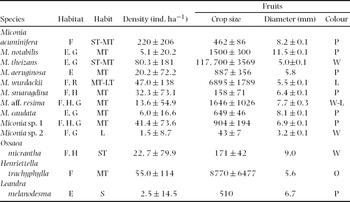
We found 19 species of melastomes producing fleshy fruits in the SFFOQ, 14 of which belong in the genus Miconia, two in Blackea and one each in Henriettella, Ossaea and Leandra. Six species were represented by few individuals and did not produce fruit during the study. Of the other 13 species, ten produced fruit during phase one and nine during phase two, six of them in common between the two sampling periods. All the melastome species included in the sample produced small and juicy berries, but they differed in several ecological and morphological traits such as habitat, habit, abundance, crop size, and fruit colour and size (Table 1). During phase one Miconia theizans (56.2%), M. aeruginosa (20.5%) and M. wurdackii (6.5%) made the highest contribution to melastome fruit biomass. During phase two M. acuminifera (44.1%), M. wurdackii (28.0%) and H. trachyphylla (14.8%) made the highest contribution.
Ecological characteristics of endozoochorous melastome species (species of Miconia, Ossaea, Leandra and Henriettella; nomenclature according to Tropicos. Missouri Botanical Garden http://www.tropicos.org) at the Santuario de Fauna y Flora Otún Quimbaya, Central Andes of Colombia. Data are mean ± SE. Habitat: R = ridge, H = hillside, E = early second growth, open areas and forest edges, G = forest gaps, F = forest-interior. Habit: ST = small tree, MT = medium-sized tree, LT = large tree, S = shrub, L = liana. Colour: P = purple, W = white, L = lilac, O = orange.

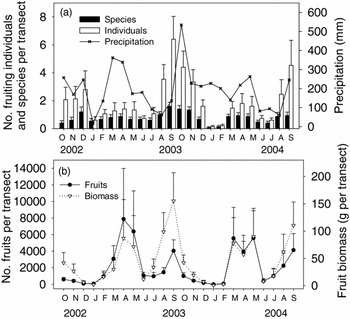
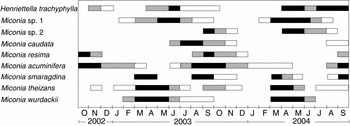
Melastome fruiting (N = 15 transects) exhibited temporal variation in the number of fruiting individuals (F 23,14 = 6.3, P < 0.0001), number of fruits (χ2 = 87.3, df = 23, P < 0.0001) and biomass (χ2 = 88.3, df = 23, P < 0.0001) (Figure 1). The null model indicated that in the 2-y sampling period, both fruiting periods and fruiting peaks were temporally aggregated (P = 0.0001 and P = 0.0002, respectively; Figure 2). Melastome fruit abundance, as measured by the three variables, exhibited two annual peaks, one in March–May and the second one in August–October. The lowest melastome fruit abundance was observed during January–February, but there was always some fruit available (Figures 1, 2).
Monthly rainfall and fruiting phenologies of melastomes evaluated in 15 transects (50 × 4 m) at the Santuario de Fauna y Flora Otún Quimbaya, Colombia. Graphs show mean number of fruiting individuals and species per transect (a), and mean number of fruits and fruit biomass per transect (b). The horizontal axis represents the period October 2002–September 2004. Error bars represent 1 SE.

Fruiting phenologies of nine melastome species in the Santuario de Fauna y Flora Otún Quimbaya, Colombia, that produced fruits in sampling transects during the study period. The length of the bar indicates the duration of the fruiting season. Black bar portions represent > 50% of individuals fruiting (fruiting peak), shading represents between 30% and 40% of individuals fruiting, and white < 25%. The horizontal axis represents the period October 2002–September 2004.

Melastome fruit abundance was correlated with non-melastome fruit abundance for number of fruits (r s = 0.27, P = 0.005) and fruit biomass (r s = 0.23, P = 0.01). Mean monthly melastome fruit biomass was not significantly correlated with the rainfall recorded for that period during phase one (r s = 0.65, N = 18, P = 0.17) nor phase two (r s = 0.11, N = 24, P = 0.60). However, the months of maximum fruit abundance coincided with the months of highest precipitation and the periods of low fruit abundance coincided with the dry season as well.
Patterns of fruit consumption by birds
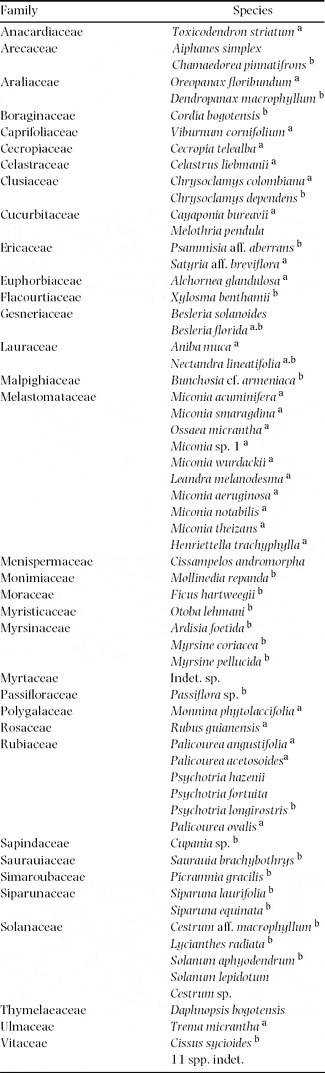
A total of 75 shrub and tree species belonging to 34 families produced bird-dispersed fruits over the first phase of this study (Appendix 1). Species with the highest fruit production were Cecropia telealba (Cecropiaceae), Trema micrantha (Ulmaceae), Miconia theizans and Satyria aff. breviflora (Ericaceae). We recorded fruit consumption by birds for 27 plant species and 1044 fruit feeding events by 61 species of bird during phase one (Appendix 2). Birds mostly fed on the fruits of ten species of melastome (37.4% of feeding events), C. telealba (19.7%), T. micrantha (18.0%) and S. aff. breviflora (10%).
Melastome fruits contributed 61.1% of total number of fruits (25.7% of ripe fruits) during phase one. In terms of biomass, however, melastomes contributed only 23.7% (8.4% of ripe fruit biomass) of overall fruit availability. This contribution ranged from a low of 3.5% in February to 38.6% in April (Figure 3). Birds fed on melastome fruits in all months, with the highest consumption rates observed in November–December and April (χ 2 = 13.9, df = 5, N = 18, P = 0.016; Figure 3). In all months, consumption of melastome fruits was higher than expected in relation to their abundance (χ 2 = 1430, df = 5, P < 0.001). Jacobs’ index indicated that birds showed a moderate to strong preference for melastome fruits (Table 2). The most often consumed melastomes were M. theizans (58% of melastome consumption and 21.9% of overall fruit consumption) and M. wurdackii (23.2% of melastome consumption and 8.6% of overall fruit consumption).
Melastome fruit biomass and consumption by birds evaluated in 18 transects (30 × 4 m) at the Santuario de Fauna y Flora Otún Quimbaya, Colombia, between November 2001 and April 2002. Total fruit biomass available in transects (a); black bars represent the contribution of melastome fruits to total fruit abundance each month. Rates of consumption by birds of melastomes and other fleshy fruits during the same period (b); black bars represent the contribution of melastome fruits to the total rate of consumption. Numbers above bars represent the percentages contributed by melastomes to biomass and consumption.

Jacobs’ index (Dfr) as a measure of consumption preferences of melastome fruits by frugivorous birds in the Colombian Andes, for the period November 2001–April 2002. P = Proportional availability of melastome fruits for each month, r = consumption of melastome fruits by birds.

Fruit-eating birds in the SFFOQ comprised species of 19 different families (Appendix 2). Of the 61 fruit-eating bird species recorded, 47 (77.0%) fed on melastomes. The main melastome consumers belonged to the families Thraupidae (36.2% of feeding events), Parulidae (10.6%), Turdidae (8.5%) and Emberizidae (8.5%). Overall, feeding observations were dominated by several tanagers (Ramphocelus flammigerus, Tangara arthus, T. heinei, Thraupis episcopus), a thrush (Turdus ignobilis) and a cotinga (Pyroderus scutatus). Melastome fruits were particularly important for five species of tanager (Anisognathus sumptuosus, Tangara heinei, T. labradorides, T. arthus, Ramphocelus flammigerus), a migratory thrush (Catharus ustulatus) and a migratory warbler (Dendroica fusca), each of which accounted for more than 5% of the melastome feeding records (Appendix 3).
We captured 70 individual birds in 930 net-h, but only 23 produced faecal samples (12 Myadestes ralloides, 5 Euphonia xanthogaster, 4 Mionectes striaticollis, 1 Xenopipo flavicapilla and 1 Ramphocelus flammigerus). Twelve samples (52.2%) contained melastome seeds. We identified the seeds of 26 species in all faecal samples, including six melastomes (20.7%). When counting the presence of seeds as a consumption event, we had 49 such events, with melastomes representing 32.6%, Rubiaceae 14.3% and Ericaceae 12.2%. Most of the samples containing melastome seeds (83.3%) included more than one fruit species and 33.3% included at least two different melastome species.
DISCUSSION
The melastome fruiting pattern
Fruiting periods of melastomes are aggregated at our study site in the Central Andes of Colombia. Aggregated fruiting suggests a high potential of competition for dispersal agents. However, depending on the community context, the advantages of synchronous fruiting may balance or outweigh the costs of potential competition for dispersers (Lortie et al. Reference LORTIE, BROOKER, CHOLER, KIKVIDZE, MICHALET, PUGNAIRE and CALLAWAY2004, Saracco et al. Reference SARACCO, COLLAZO and GROOM2004). For example, multispecific fruiting neighbourhoods have been reported to attract more frugivores than those with a single fruiting species (Blendinger et al. Reference BLENDINGER, LOISELLE and BLAKE2008, Carlo Reference CARLO2005, Sargent Reference SARGENT1990). Likewise, fruit consumption and seed dispersal of species with small crops, low densities, or less-preferred fruits may be facilitated by the presence of species with large crops, high densities, or more preferred or more rewarding fruits (Blendinger et al. Reference BLENDINGER, LOISELLE and BLAKE2008, Thompson & Willson Reference THOMPSON and WILLSON1979).
Although faecal samples underestimate the amplitude of bird diets, the presence of seeds of several melastome species in some samples is evidence that birds feed from different plant species in a single feeding foray. Thus, synchronous fruiting may be beneficial by (1) increasing the probability that seeds are dispersed away from conspecifics (Poulin et al. Reference POULIN, WRIGHT, LEFEBVRE and CALDERON1999), (2) broadening the dispersal pattern (Carlo Reference CARLO2005), or (3) providing directed dispersal (Carlo & Aukema Reference CARLO and AUKEMA2005). For instance, for species with particular germination and establishment requirements, as occurs in several melastome species (Ellison et al. Reference ELLISON, DENSLOW, LOISELLE and BRENES1993), the overlapping fruiting periods may attract a wider spectrum of dispersers, which increases the chances of seeds being dispersed into spatially unpredictable germination sites that have suitable conditions for each species (Thies & Kalko Reference THIES and KALKO2004).
Aggregated fruiting patterns seem to be widespread. In a review of phenological patterns of terrestrial plants, Rathcke & Lacey (Reference RATHCKE and LACEY1985) found that in general, fruiting times of animal-dispersed species tend to be aggregated or random rather than temporally displaced. Similarly, in a meta-analysis of data from 14 biogeographic locations including temperate and tropical forest, Burns (Reference BURNS2002) found a geographically consistent pattern of phenological synchrony in fruit production and bird abundances, in support of this hypothesis.
The temporally aggregated fruiting of melastomes in this Andean forest contrasts with the segregated pattern originally reported by Snow (Reference SNOW1965) and supported by the findings of Hilty (Reference HILTY1980) and Poulin et al. (Reference POULIN, WRIGHT, LEFEBVRE and CALDERON1999). These studies were carried out in sites that differed in the magnitude and distribution of peaks and troughs in fruit abundance, which suggests that differences among sites are probably related to the community context. Species interactions exhibit spatial and temporal variability in their nature and outcomes (Peres Reference PERES2000, Thompson Reference THOMPSON1982). Variation in the community context in which melastomes are immersed, such as the type and diversity of mutualists and competitors, probably plays a role in melastome phenology. For example, manakins, the most important dispersers of melastome fruits in Neotropical lowland forests, are poorly represented in our study area, whereas other frugivores such as tanagers and thrushes strongly interact with melastomes at our site.
A variety of factors, therefore, may be interacting to determine melastome phenology. First, the broad spectrum of ecological characteristics of melastomes such as fruit display, habitat and spatial distribution (Table 1), in addition to requirements for seed germination and seedling establishment, may dilute competition by attracting different sets of dispersers (Stiles & Rosselli Reference STILES and ROSSELLI1993). Second, because fruiting is only one component of fitness, selection acting on time of flowering, germination, or seasonal avoidance of herbivores may override selection on fruiting time (Sloan et al. Reference SLOAN, ZIMMERMAN and SABAT2007, van Schaik et al. Reference VAN SCHAIK, TERBORGH and WRIGHT1993). Third, although there is no strong evidence that fruiting phenologies are phylogenetically conserved (Smith-Ramírez & Armesto Reference SMITH-RAMÍREZ and ARMESTO1994), aggregated fruiting may reflect a physiological response of closely related species to similar environmental conditions. Although we found no correlation between monthly melastome fruit abundance and rainfall, peaks of melastome fruit production coincided with rainfall maxima. Thus, abiotic factors may also determine the melastome fruiting pattern by synchronizing fruiting time with the optimal conditions for seed dispersal and germination. Hilty (Reference HILTY1980) and Stiles & Rosselli (Reference STILES and ROSSELLI1993) also reported strong seasonality in melastome fruiting.
The role of melastome fruits for frugivorous birds
Melastomataceae were the most important plant family in the diet of frugivorous birds at the SFFOQ, both in terms of the number of consumed species and consumption frequency. Two of the top five species in the diets of birds belonged to this family and its fruits were a preferred food both during times of high and low fruit abundance.
Melastome fruit availability exhibited two peaks. One peak occurred in March–May, in coincidence with the breeding season of many bird species in mid-elevation Andean forest sites (Beltrán & Kattan Reference BELTRÁN and KATTAN2001, Miller Reference MILLER1963, Rios et al. Reference RIOS, MUÑOZ and LONDOÑO2006). The second peak, in August–October, coincides with the moulting season for some species (Beltrán & Kattan Reference BELTRÁN and KATTAN2001). Although birds fed on melastome fruits throughout the year, they particularly relied on these fruits during the March–May breeding season, when melastomes constituted 54% of the feeding records. Additionally, we recorded adults of several bird species feeding fledglings with melastome fruits (Tangara arthus, T. heinei, Chlorochrysa nitidissima and Ramphocelus flammigerus) and juveniles of several species were also observed feeding on melastome fruits (Pyroderus scutatus, Chamaepetes goudotii, Penelope perspicax and Pipraeidea melanonota). The breeding season is the most energy-demanding time for these birds and melastome fruits may supply an important part of their energetic requirements, both for adults and juveniles.
Melastomataceae, and particularly the tribe Miconieae, are a diverse taxon in Andean forest. At our study site, melastomes are locally abundant and some species exhibit extended fruiting periods. Their fruits are moderately abundant and are eaten by many frugivorous birds, particularly during the breeding season. Even when melastome fruits were scarce, birds showed a moderate preference for these fruits. Some species, such as Miconia theizans, were particularly important food sources for frugivorous birds. Although this species exhibited discrete peaks of fruit abundance, some ripe fruits were available throughout the year. A large number of bird species fed on fruits of this species, and its seeds were present in 35% of the faecal samples analysed. Muñoz et al. (Reference MUÑOZ, LONDOÑO, RIOS and KATTAN2007) found that M. theizans constituted 22% of the feeding events of the Cauca guan (Penelope perspicax) in April 2003, when fruits of other species were also abundant.
The plants that produce fleshy fruits eaten by birds, and the birds that disperse their seeds, constitute mutualistic interaction networks. The resilience of such networks depends on their architecture, represented in features such as the strength and asymmetry of the interactions (Bascompte & Jordano Reference BASCOMPTE and JORDANO2007). Melastomes constitute an important module of these networks in Neotropical forests because they are highly connected, i.e. they interact with a large number of bird species. In addition, birds strongly depend on melastomes throughout their annual cycles. Highly connected species are critical elements of interaction networks, because their disappearance may cause networks to collapse (Bascompte & Jordano Reference BASCOMPTE and JORDANO2007). Projects that seek to conserve or restore Neotropical forests should include fleshy-fruited melastomes as pivotal elements that greatly influence community dynamics.
ACKNOWLEDGEMENTS
We thank the National Parks Unit of Colombia for permits and logistic support to conduct research in the Santuario de Fauna y Flora Otún Quimbaya. Thanks to Gustavo Londoño, Marcia Muñoz and Isadora Angarita for their help with data collection, and to Humberto Álvarez-López for advice and discussion. Miguel Angel Fortuna helped with the use of MatLab. Alice Boyle reviewed a preliminary version of this paper. Financial support was provided by the Wildlife Conservation Society and the John D. and Catherine T. MacArthur Foundation.
Plant species (nomenclature according to Tropicos. Missouri Botanical Garden http://www.tropicos.org) with fleshy fruits potentially consumed by birds, that fruited in the Santuario de Fauna y Flora Otún Quimbaya, Colombia, during November 2001–April 2002. The table indicates fruits consumed by birds during the first (a) and second (b) phases of the study.

Bird species (nomenclature according to Remsen et al. A classification of the bird species of South America. American Ornithologists’ Union http://www.museum.lsu.edu/~Remsen/SACCbaseline.html) eating melastome fruits between November 2001–April 2002 at the Santuario de Fauna y Flora Otún Quimbaya, Colombia. The table indicates species recorded feeding on melastomes during the first phase of the study (a), and species recorded feeding on Miconia acuminifera (b) and M. theizans (c) during the first and second phases.

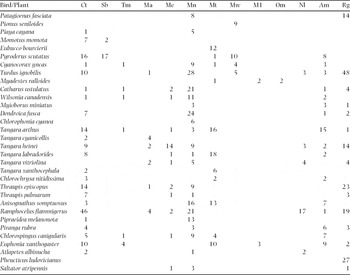
Matrix of fruiting plants and their main bird consumers recorded between November 2001–April 2002 at the Santuario de Fauna y Flora Otún Quimbaya, Colombia. Values in table are the number of consumption events recorded during this period. Ct (Cecropia telealba), Sb (Satyria aff. breviflora), Tm (Trema micranta), Ma (Miconia acuminifera), Me (Miconia aeruginosa), Mn (Miconia notabilis), Mt (Miconia theizans), Mw (Miconia wurdackii), M1 (Miconia sp. 1), Om (Ossaea micrantha), Nl (Nectandra lineatifolia), Am (Aniba muca), Rg (Rubus guianensis).