Introduction
Several observations have indicated that approximately 90 per cent of malignant tumour cells have readily detectable telomerase activity, while most normal tissues and benign tumours do not.Reference Shay and Baccheter1, Reference Masutomi, Yu, Khurts, Ben-Porath, Currier and Metz2 Most laryngeal cancer cells persistently express a high level of telomerase activity, which is displayed only rarely in normal laryngeal epithelium.Reference Luzar, Poljak, Marin, Fischinger and Gale3, Reference Curran, Gullane, Irish, MacMillan, Freeman and Kamel-Reid4 The proliferation of malignant tumour cells is out of control, partly due to high rates of telomerase activation. Telomerase consists of three subunits: a ribonucleic acid (RNA) component,Reference Feng, Funk, Wang, Weinrich, Avilion and Chiu5 a telomerase-associated proteinReference Harrington, McPhail, Mar, Zhou, Oulton and Bass6, Reference Nakayama, Saito, Nakamura, Matsuura and Ishikawa7 and a telomerase catalytic unit.Reference Meyerson, Counter, Eaton, Ellisen, Steiner and Caddle8, Reference Nakamura, Morin, Chapman, Weinrich, Andrews and Lingner9 Of these three components, the telomerase catalytic unit is a major rate-limiting determinant of telomerase activation.Reference Kang, Kameta, Shin, Baluda and Park10, Reference Kyo and Inous11 Research has shown that suppressing both telomerase RNA and telomerase catalytic unit messenger RNA (mRNA) can reduce telomerase activity, restraining the growth of cancer cells.Reference Kang, Kameta, Shin, Baluda and Park10, Reference Mittal, Pate, Wylie, Tollefsbol and Katiyar12, Reference Tao, Chen, Wu, Xiao, Liu and Hou13 However, none of these techniques suppresses telomerase activity completely, and all have some potential side effect on healthy cells. Therefore, developing a highly efficient and safe method of inhibiting telomerase activity is one focus of cancer gene therapy.
In cells, RNA interference is triggered by the presence of double-stranded RNA and results in rapid destruction of mRNA that contains an identical or nearly identical sequence to the double-stranded RNA.Reference Hannon14, Reference Liu, Ma, Liu, Liu and Sehon15 It is a post-transcriptional mechanism. RNA interference is thought to have evolved as a defence mechanism to suppress viral replication and transposon mobilisation.Reference Montgomery16 Ribonucleic acid interference differs from antisense nucleic acids; it involves selective gene silencing, which is triggered by the double-stranded RNA sequence. Ribonucleic acid interference has rapidly become one of the most widely applied technologies in molecular and cellular research, since its discovery in 1998.Reference Fire, Xu, Montgomery, Kostas, Driver and Mello17 In 2001, Elbashir and colleagues made revolutionary progress in RNA interference research. They demonstrated that RNA interference operates in mammalian cells.Reference Elbashir, Harborth, Lendeckel, Yalcin, Weber and Tuschl18 Subsequently, ribonucleic acid interference has been shown to potently ablate targeted mRNA within a variety of species.Reference Paddison, Caudy, Bernstein, Hannon and Conklin19
The use of deoxyribonucleic acid (DNA) vectors constructed to mediate RNA interference by expressing short hairpin RNA from RNA polymerase III promoters is a newly established technique which can produce long-term, stable and highly specific gene silencing.Reference Brummelkamp, Bernards and Agami20 These findings have opened a completely new avenue for gene function and gene therapy research. In our previous work, we found that treatment with short hairpin RNA expression vectors induced a significant decrease in telomerase catalytic unit mRNA expression, telomerase catalytic unit protein levels, telomerase activity and cell viability in vitro.Reference Chen, Tao, Hua, Liu, Chi and Cai21 In order to test whether this treatment was effective in therapeutic animal models of laryngeal cancer, we investigated the influence of these short hairpin RNA expression vectors on the growth of human laryngeal squamous cell carcinoma in vivo.
Materials and methods
Cell line and cell culture
Cells from the Hep-2 human laryngeal squamous cell carcinoma line were purchased from Type Culture Conservation (Wuhan, PR China). The cells were cultured with 5 per cent CO2 in Roswell Park Memorial Institute-1640 Medium (Gibco, Carlsbad, California, USA) with 10 per cent heat-inactivated fetal calf serum (Hyclone, Logan, Utah, USA), 100 U/ml penicillin and 100 µg/ml streptomycin.
Construction of short hairpin RNA expression plasmids
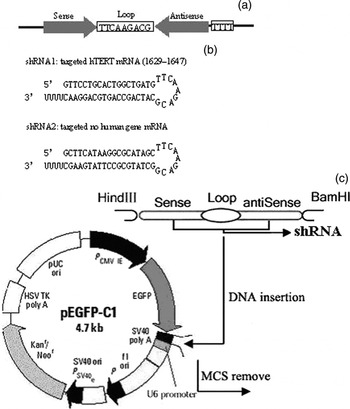
Short hairpin RNA one was designed according to the complementary DNA sequence of the telomerase catalytic unit (GenBank accession number AB085628). Short hairpin RNA two, which did not target any specific human gene, was also designed as a control. Short hairpin RNA segments encoding the DNA template were designed as follows: a 19-nucleotide target sequence (as a sense strand), followed by a spacer and complementary antisense strand, and then four continuous thymines as a terminate signal (Figure 1a and 1b). The short hairpin RNA segments were subcloned into the plasmid gene of enhanced green fluorescent protein-production number (Figure 1c), with human U6 promoter between the BamHI and HindIII restriction sites. A short hairpin RNA expression plasmid which carried an enhanced green fluorescence protein gene, constructed by Wuhan Genesis Biotechnology Co., Ltd (Wuhan, PR China), was used.Reference Chen, Tao, Hua, Liu, Chi and Cai21 All of the constructs used in this study were verified by DNA sequencing.
The structure of the short hairpin ribonucleic acid segments (shRNAs) and their vector. (a) Predicted structure of shRNAs. (b) Design of shRNA template. (c) Schematic diagram of the vector. A shRNA encoding template was inserted between BamHI and HindIII restriction sites downstream of the U6 promoter. Transcripts of the template (see 1b) will form a 19-nucleotide, double-stranded stem with a 9-nucleotide loop hairpin that targets either human telomerase reverse transcriptase messenger (m) RNA or no human gene mRNA. T = thymine; C = cytosine; G = guanine; A = adenine; hTERT = telomerase catalytic subunit; HindIII = HindIII restriction sites; BamHI = BamHI restriction sites; DNA = deoxyribonucleic acid; CMV IE = immediate early promoter of cytomegalovirus; EGFP = enhanced green fluorescence protein; SV40 PolyA = simian viru 40 polyadenylation; SV40 ori = simian viru 40 origin of replication; Psv40 = Sv40 plasmids; f1 ori p = f1 origin and f1 promoter; Kan/Neo = Kanamycin/Neomycin; HSV TK = herpes simplex virus thymidine kinase; pUC ori = pUC origin of replication; pEGFP-C1 = plasmid involved EGFP gene and the customer is C1; MCS = multiple cloning site

Mice
Twenty-four female Balb/c nude mice, aged between five and six weeks (body weight 16–18 g), were purchased from the Experimental Animal Centre of Hubei province. All the mice were housed in a cage, under laminar air flow, in pathogen-free conditions. The mice were maintained at a constant temperature (18–22ºC) and relative humidity (50–80 per cent), with 12-hour dark/light cycles. They were fed on a standard diet and given water ad libitum. All experiments were performed with aseptic technique under laminar airflow. The animals were inspected daily and any sign of discomfort was recorded. The animals were divided into three groups: group A (short hairpin RNA one plasmid injected), group B (short hairpin RNA two plasmid injected) and group C (saline control). There were eight mice in each group.
Tumour implantation, transfection and tumour tissue collection
Approximately 1 × 10⁷ cells in 0.2 ml media free of serum were inoculated subcutaneously into the right flank. Tumour growth was monitored using a caliper every two or three days. Tumour volume (V) was calculated by the formula (L × WReference Masutomi, Yu, Khurts, Ben-Porath, Currier and Metz2)/2, where L = length (mm) and W = width (mm). Treatment was commenced when the maximum tumour diameter reached 5–7 mm. Twenty micrograms of short hairpin RNA one plasmids or short hairpin RNA two plasmids, dissolved in 300 µl medium free of serum with 30 µl transfection reagent (Metafectene, Biontex, Munich, Germany), were directly injected into the tumour once every two days, for a total of seven times. Saline injection was used as a control. Mice were sacrificed by beheading, seven days after the final treatment. The tumours were then removed and weighed. Part of the tumour tissue was frozen instantly, cryosectioned at 20 µm and used for fluorescence observation under a confocal laser scanning fluorescent microscope. The rest of the tumour tissue was fixed in 4 per cent paraformaldehyde in phosphate-buffered saline overnight, embedded in paraffin wax and then sectioned at 5 µm. Peripheral blood was also collected for haematological and biochemical analysis.
Haematoxylin and eosin staining and in situ cell apoptosis detection
Tumour sections were stained with haematoxylin and eosin for morphological observation.
In order to study how the short hairpin RNA inhibited tumour growth, apoptotic tumour cell death was examined. Apoptotic cells were identified using the modified end-labelling technique originally described by Zhang et al. All procedures were performed following the manufacturer's instructions (in situ cell apoptosis detection kit, Wuhan Boster Biological Technology, Wuhan, PR China).Reference Zhang, Zhang, Yin and Zhao22 Positive cells were visualised by diaminobenzidine tetrahydrochloride and counterstained with methyl green. Apoptotic cells were quantified according to morphological criteria and in situ cell apoptosis detection (TUNEL) reactivity. Cells undergoing apoptosis have a shrunken cell body and pyknotic nucleus,Reference Zhang, Zhang, Yin and Zhao22 and brown particles in the nucleus on TUNEL labelling. The numbers of apoptotic cells and total cells within a microscope viewing field were counted at ×400 magnification. The cells counted in five viewing fields selected randomly by computer were used to calculate the apoptotic index. The apoptotic index was obtained by dividing the number of apoptotic cells by the total number of tumour cells, multiplied by 100 (i.e. apoptotic index = (apoptotic cells/total cells) ×100).
Telomerase catalytic unit protein expression
To detect telomerase catalytic unit protein expression, tumour sections were immunostained with an anti-telomerase catalytic unit antibody. Briefly, the paraffin sections were routinely deparaffinised and incubated in 3 per cent H2O2 for 10 minutes to block endogenous peroxidase. To prevent nonspecific antibody binding, the sections were pre-incubated in normal goat serum for 15 minutes, then incubated with rabbit anti-human telomerase catalytic unit immunoglobulin (Ig) G (Santa Cruz Biotechnology, Santa Cruz, California, USA) at 4ºC overnight. After rinsing with distilled water, the sections were incubated with biotin-labelled anti-rabbit IgG at 37ºC for 10 minutes, then treated with streptavidin–horseradish peroxidase complex at 37ºC for 10 minutes. The labelled cells were visualised using 0.05 per cent 3, 3'-diaminobenzidine as the chromagen. Finally, the sections were counterstained with Meyer's haematoxylin and dehydrated through serial ethanols. Negative control sections were prepared by substituting phosphate-buffered saline for anti-telomerase catalytic unit antibody.
Positive cells were stained brown. The method for scoring telomerase catalytic unit expression was modified from that described by Zhou et al. Reference Zhou, Yu, Liu, Luo, Chen and Yu23 Positive tumour cells were quantified by two independent observers, and a mean percentage of positive tumour cells was determined in at least five random microscope viewing fields (at a magnification of ×400) and assigned to one of five categories: zero (<5 per cent); one (5–25 per cent); two (25–50 per cent); three (50–75 per cent); or four (>75 per cent). The intensity of telomerase catalytic unit immunostaining was scored as: one (weak), two (moderate) or three (intense). For tumours showing heterogeneous staining, the predominant pattern determined the scoring. Cases with weighted scores of less than two were defined as negative; otherwise, they were defined as positive.
Statistical analysis
Values are expressed as the mean ± standard deviation of multiple experiments. Analysis of covariance using the Dunnett or Tukey–Kramer post-tests was employed for multiple groups, and Fisher's test was used for comparison of the three groups, using the Statistical Package for the Social Sciences software (version 11.5; SPSS Inc, Chicago, Illinois, USA).
Results
During the experiments, the general condition of all the treated animals was good and did not differ from that of the controls.
Tumour growth inhibited by short hairpin RNA plasmid treatment
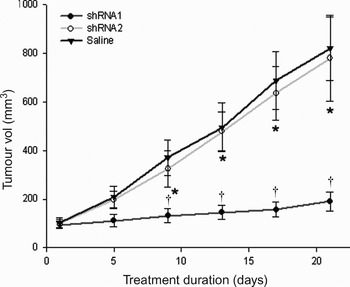
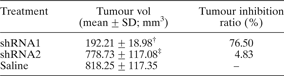
As shown in Table I and Figure 2, the growth of the Hep-2 subcutaneous tumours treated with short hairpin RNA one plasmid was significantly suppressed, compared with that of tumours treated with short hairpin RNA two plasmid and with saline (p < 0.01). In animals treated with short hairpin RNA one for 20 days, the mean tumour volume was 192.21 ± 18.98 mm3. In contrast, the mean tumour volumes of the short hairpin RNA two group and the saline control group were 778.73 ± 117.08 mm3 and 818.25 ± 117.35 mm3, respectively. There was no statistically significant difference between the mean tumour volumes of the short hairpin RNA two and saline groups (p > 0.05), suggesting that injection with short hairpin RNA two, with short hairpin RNA two and saline had no obvious inhibitory effect on the tumour.
Subcutaneous tumour growth. Tumour growth was greatly suppressed following short hairpin ribonucleic acid (shRNA) 1 treatment, compared with shRNA2 and saline. *p > 0.05, compared with saline treatment; †p < 0.01, compared with saline treatment. Vol = volume

effect of shRNA treatment on tumour volumes and inhibition ratios in nude mice*

* After 20 days' treatment; eight animals in each group. †p < 0.01, compared with short hairpin ribonucleic acid (shRNA) 2 group and saline control group; ‡p > 0.05, compared with saline control group. Vol = volume; SD = standard deviation
Expression of short hairpin RNA plasmid in the tumour
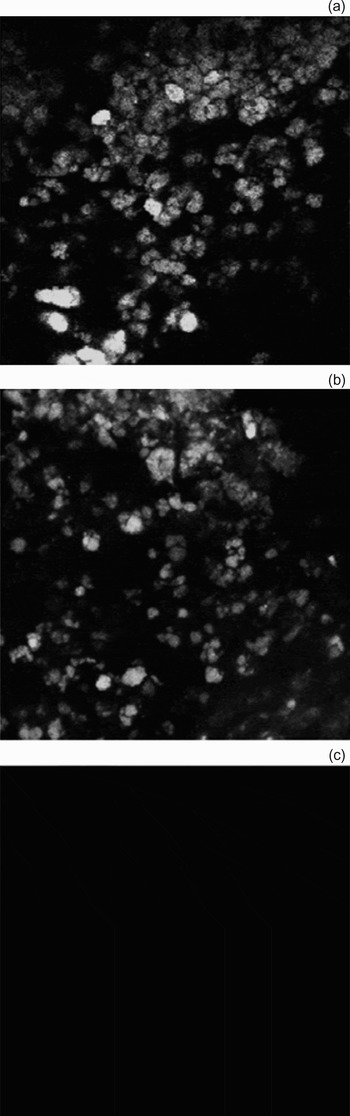
Green fluorescence was found in the majority of tumour cells harvested from mice injected with short hairpin RNA one or short hairpin RNA two plasmids, suggesting that these tumour cells were successfully transfected with the plasmids. As expected, no green fluorescence was detected in tumours from the saline group (as shown in Figure 3).
Fluorescent protein expression in the tumours. Many tumour cells with green fluorescence were present in the mice transfected with (a) short hairpin ribonucleic acid (shRNA) 1 plasmid and (b) shRNA2 plasmid. (c) No fluorescence was found in tumours from mice transfected with saline.

More cell death in short hairpin RNA one plasmid transfected tumours
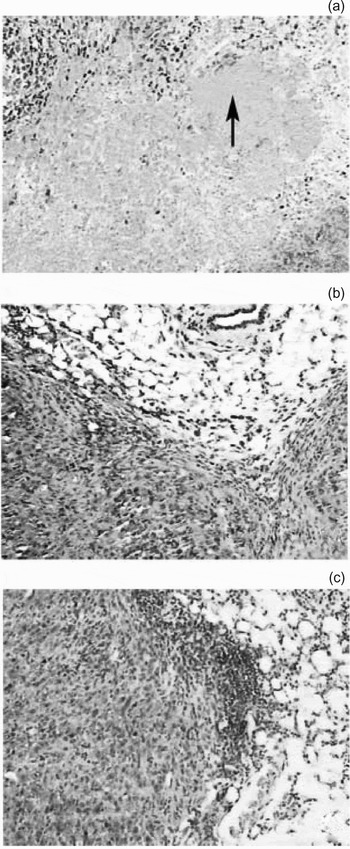
Many necrotic tumour cells were present in the tumour tissue from mice treated with short hairpin RNA one. However, tumour cells grew well in the mice treated with short hairpin RNA two or saline (as shown in Figure 4).
Structure of the subcutaneous tumours. (a) Many necrotic tumour cells were present in the mice transfected with short hairpin ribonucleic acid (shRNA) 1 plasmid. However, tumour cells grew well in mice transfected with (b) shRNA2 plasmid and (c) saline. (H&E; ×100)

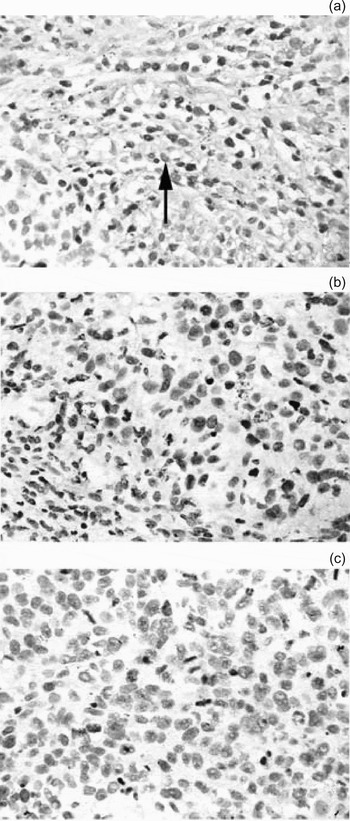
More apoptotic cells were found in the tumours transfected with short hairpin RNA one plasmid. However, only a few apoptotic cells were detected in the tumours transfected with short hairpin RNA two plasmid or saline. The apoptotic index of tumours receiving short hairpin RNA one treatment (26.47 ± 4.25%) was much higher than that of those receiving short hairpin RNA two treatment (3.40 ± 1.41%) or saline treatment (2.73 ± 1.35) (p < 0.01) (as shown in Figure 5).
Apoptosis within the subcutaneous tumours. (a) Scattered apoptotic tumour cells (arrow), with umber particles in the nuclei, were present in mice transfected with short hairpin ribonucleic acid (shRNA) 1 plasmid. However, only a few apoptotic tumour cells were present in mice transfected with (b) shRNA2 plasmid and (c) saline. (in situ cell apoptosis ×400)

Telomerase catalytic unit expression significantly down-regulated after short hairpin RNA one treatment
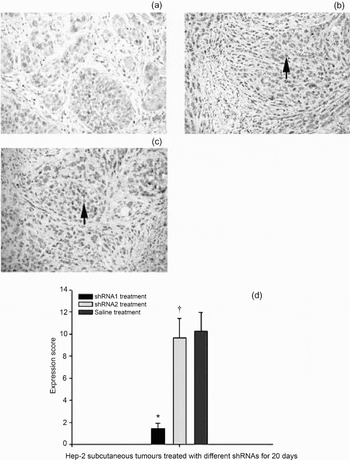
Few cells expressing telomerase catalytic unit were observed in any of the tumours treated with short hairpin RNA one. However, telomerase catalytic unit protein expression was detected in all tumours treated with short hairpin RNA two or saline (seen by brown staining, as shown in Figure 6). This suggests that the expression of telomerase catalytic unit protein was significantly down-regulated by short hairpin RNA one.
Telomerase catalytic unit protein expression in the subcutaneous tumours. (a) Only a few tumour cells with telomerase catalytic unit protein expression (staining in brown) were present in mice transfected with short hairpin ribonucleic acid (shRNA) 1 plasmid. However, many such cells were present (arrows) in mice transfected with (b) shRNA2 plasmid and (c) saline. (d) Telomerase catalytic unit expression scores in tumour samples, following the three treatments; the score after shRNA1 treatment was much lower than that after shRNA2 and saline treatments. *p < 0.001, compared with saline treatment; †p > 0.05, compared with saline treatment. (Streptavidin-horseradish peroxidase; ×200)

The weighted telomerase catalytic unit expression scores were calculated. In short hairpin RNA one treatment cases, these scores were in the range zero to two (1.4 ± 0.56). In short hairpin RNA two and saline treatment cases, these scores were in the range six to 12 (9.67 ± 1.76) and eight to 12 (10.26 ± 1.71), respectively. The score level for short hairpin RNA one treatment was much lower than that for short hairpin RNA two treatment and saline treatment; this difference was statistically significant (p < 0.001).
Short hairpin RNA did not affect blood, liver or kidney
All the mice survived the whole experiment. There was no significant difference in peripheral blood haematological and biochemical parameters between the short hairpin RNA one group, the short hairpin RNA two group and the saline group, suggesting that the short hairpin RNA treatment did not affect haematological, hepatic or renal functions (p > 0.05) (Tables II and III).
effect of shRNA treatment on peripheral blood in nude mice*

* After 20 days' treatment. †p > 0.05, compared with short hairpin ribonucleic acid (shRNA) 2 group and saline control group. RBC = red blood cells; Hb = haemoglobin; PLT = platelets; WBC = white blood cells
effect of shRNA treatment on biochemical parameters in nude mice*

* In peripheral blood, after 20 days' treatment. †p > 0.05, compared with short hairpin ribonucleic acid (shRNA) 2 group and saline control group. ALT = glutamate-pyruvate transaminase; AST = glutamic oxalacetic transaminase; ALP = alkaline phosphatase; TP = total protein; ALB = albumin; BUN = urea nitrogen; TB = total bilirubin; DB = direct bilirubin; GLU = glucose
Discussion
Previous studies have shown that telomerase plays an important role in cancer cell biology. Firstly, telomerase activity is detected in most malignant tumour cells but not in normal cells, suggesting that such activity may be involved in cancer development.Reference Simonsen, Rosada, Serakinci, Justesen, Stenderup and Rattan24 Secondly, in most cancers, telomerase activity levels generally correlate with the state of tumour cell proliferation. Several investigations have indicated that telomerase expression is essential for the continued growth of malignant cells, and that inhibition of telomerase function may alter the growth of malignant cells.Reference Mittal, Pate, Wylie, Tollefsbol and Katiyar12, Reference Folini, Brambilla, Villa, Gandellini, Vignati and Paduano25 Furthermore, the presence of telomerase is almost always required for unlimited cell proliferation (i.e. immortality), whereas its absence may dictate a finite cell life span. However, of the three subunits, telomerase catalytic unit is a particularly attractive target, since its content has been observed to correlate with telomerase activity.Reference Tao, Chen, Wu, Xiao, Liu and Hou13
In our previous work, we found that treatment with short hairpin RNA expression vectors induced a significant decrease in telomerase activity and cell viability in vitro.Reference Chen, Tao, Hua, Liu, Chi and Cai21 All of these effects were seen regardless of the target site, and the short hairpin RNA control produced none of these effects. In the present study, a short hairpin RNA expression plasmid targeting telomerase catalytic unit mRNA was transfected into Hep-2 cells in vivo. After the tumours were transfected by the short hairpin RNA plasmid, many green fluorescent cells were observed under confocal microscopy. This result indicates that the constructed plasmid effectively transfected the tumour cells in vivo.
The decreased tumour volume found in the short hairpin RNA one group demonstrates that short hairpin RNA can significantly inhibit tumour growth. The inhibitory rate in the experimental group was 76.50 per cent. No difference in tumour volume was found between the short hairpin RNA two group and the saline group, suggesting that the short hairpin RNA two, and the transfection reagent had no toxic effect on the Hep-2 cells. Furthermore, inhibition of tumour growth was induced only by special hairpin RNA segments. These results also indicate that the telomerase catalytic unit plays a key role in the growth of head and neck squamous cell carcinoma.
The apoptotic index of the short hairpin RNA one group was significantly higher than that of the short hairpin RNA two group and the saline group. Most tumour cells underwent necrotic or apoptotic cell death following short hairpin RNA one plasmid transfection, providing a mechanism for tumour growth inhibition by short hairpin RNA. In some types of human cancer cells (e.g. leukaemia cells), the introduction of a dominantly acting, catalytically inactive mutant of the telomerase catalytic unit also resulted in similar cell death.Reference Liu, Snow, Hande, Baerlocher, Kickhoefer and Yeung26, Reference Koyanagi, Kobayashi, Yajima, Asanuma, Kimura and Sato27 We speculate that our short hairpin RNA one plasmid expressed specific short hairpin RNA segments and selectively degraded the telomerase catalytic unit mRNA, inhibiting expression of telomerase catalytic unit protein and eventually down-regulating telomerase activity. Loss or down-regulation of telomerase activity can lead to the decurtation of telomere length, resulting in telomere loss and limitation of cancer cell growth. At last, these cells undergo cell death through necrosis or apoptosis when their telomeres reach a critically short length. This is consistent with our observation that short hairpin RNA one could direct a low level of telomerase catalytic unit protein expression in the transplanted tumours, as shown by immunohistochemistry.
• Small, interfering ribonucleic acid (RNA) segments have been shown to be effective tools for inhibiting the expression of a given gene in human cells. This study examined the effect of short hairpin RNA expression vectors on the growth of laryngeal squamous cell carcinoma in nude mice
• The results demonstrated that short hairpin RNA plasmids can inhibit the growth of tumour cells by 76.5 per cent, with many tumour cells undergoing necrotic or apoptotic cell death
• A short hairpin RNA expression vector which targeted telomerase catalytic unit messenger RNA significantly inhibited the growth of laryngeal carcinoma in nude mice, with no significant side effects on the experimental animals
• The main advantages of short hairpin RNA treatment are efficient tumour growth inhibition and systemic safety. This suggests that RNA interference has a potential application in treating laryngeal squamous cell carcinoma
The mice injected with short hairpin RNA were healthy; the treatment did not affect their haematological, hepatic or renal function. This indicates that short hairpin RNA treatment may possibly be safer than chemotherapy. The main advantages of short hairpin RNA treatment are efficient tumour growth inhibition and systemic safety. This suggests that RNA interference has a potential application in treating laryngeal squamous cell carcinoma.
Conclusion
The present study demonstrated that short hairpin RNA targeting telomerase catalytic unit mRNA was able to down-regulate the expression of telomerase catalytic unit protein and suppress the growth of Hep-2 cells by inducing apoptosis and necrosis in the tumour. Ribonucleic acid interference technology may represent a promising strategy for the treatment of laryngeal cancers.
Acknowledgement
We thank Professor Xiaoping Du (Department of Anatomy and Neurobiology, University of Tennessee Health Science Center, Memphis, Tennessee, USA) for helpful advice and critical reading of the manuscript. This work was supported by grants from the National Natural Science Foundation of China (number 30471873 and 30672313, Beijing, PR China).