Many children, world-wide, learn language to a substantial degree from the speech of non-native speakers. The literature suggests that language exposure provided by non-native speakers, particularly less proficient non-native speakers, is less beneficial to children's lexical and grammatical development than is exposure to the speech of native or highly proficient non-native speakers (Buac, Gross, & Kaushanskaya, Reference Buac, Gross and Kaushanskaya2014; Chondrogianni & Marinis, Reference Chondrogianni and Marinis2011; Hammer, Komaross, Rodriguez, Lopez, Scarpino, & Goldstein, Reference Hammer, Komaroff, Rodriguez, Lopez, Scarpino and Goldstein2012; Paradis Reference Paradis2011; Place & Hoff, Reference Place and Hoff2011, Reference Place and Hoff2016). That literature does not say why.
An extensive body of research documents differences between the speech of native speakers and second language learners (e.g., Housen, Kuiken, & Vedder, Reference Housen, Kuiken and Vedder2012), but these differences are in speech used among adults. A small number of studies have investigated properties of the speech native and non-native speakers address to children, focusing on acoustic properties of speech sounds – specifically voice onset time (VOT) for plosives. These studies have documented differences in VOT between native and non-native speakers (Fish, García-Sierra, Ramírez-Esparza, & Kuhl, Reference Fish, García-Sierra, Ramírez-Esparza and Kuhl2017) and associations between VOT in non-native mothers’ speech and their bilingual children's VOT (Stoehr, Benders, van Hell, & Fikkert Reference Stoehr, Benders, van Hell and Fikkert2019). Thus, there is evidence that the language input provided to children by adult non-native speakers differs from the input of native speakers, and that these differences are reflected in bilingual children's speech. However, no research, to date, has investigated lexical or grammatical properties of non-native speakers’ child-directed speech that might explain why the amount of native input bilingual children receive is a stronger predictor of their lexical and grammatical development than the amount of input they receive from non-native speakers.
The present study addresses this question, testing the hypothesis that speaker language proficiency is associated with properties of child-directed speech in ways that make the child-directed speech of more proficient speakers a better database for language learning than the speech of less proficient speakers. Of course, finding a relation between speakers’ proficiency and lexical or grammatical properties of their speech would not be news – except if that relation occurs in child-directed speech among mothers who report using English with their children on a regular basis. Such a finding would be news, because child-directed speech makes use of a smaller vocabulary and simpler syntax than adult-directed speech and therefore might not be expected to be sensitive to speaker proficiency differences. Also, mothers who use English on a regular basis with their children might not be expected to be limited in their proficiency to a degree that would affect properties of their child-directed speech. A finding that the quality of child-directed speech depends on the language proficiency of the speaker would have broad implications for immigrant parents’ language choices at home and for staffing practices in early care and education centers.
Evidence of effects of adults’ language proficiency on their children's language development
Studies of children ranging in age from two to seven years and including adults with multiple non-English first languages have found evidence that native speaker input is more supportive of children's language growth than non-native input. Two separate studies of Spanish–English bilingual children in the US found that the proportion of English exposure provided by native speakers was a unique, positive predictor of English vocabulary at 25 months (Place & Hoff, Reference Place and Hoff2011) and of English expressive vocabulary and general language comprehension at 30 months (Place & Hoff, Reference Place and Hoff2016). Among immigrant children in western Canada, English growth was not predicted by how much English was spoken by their immigrant parents at home but was predicted by how much English they heard outside the home – often in interaction with native speakers (Paradis, Reference Paradis2011). And finally, English use at home has been found to be a stronger predictor of four-year-old children's English skills when one parent is a native English speaker than when both parents are non-native speakers of English (Hoff, Giguere, Quinn, & Lauro, Reference Hoff, Giguere, Quinn and Lauro2018; Hoff, Rumiche, Burridge, Ribot, & Welsh, Reference Hoff, Rumiche, Burridge, Ribot and Welsh2014).
Differences in proficiency among non-native sources also seem to matter. The English proficiency of immigrant mothers for whom English was a second language has been found to predict their five- to seven-year-old children's English receptive and expressive vocabulary (Buac et al., Reference Buac, Gross and Kaushanskaya2014). Similarly, the self-rated English proficiency of first, second, and third generation immigrant mothers predicted their four- to five-year-old children's English expressive vocabulary and story recall (Hammer et al., Reference Hammer, Komaroff, Rodriguez, Lopez, Scarpino and Goldstein2012). And the English proficiency of parents who spoke Turkish as their native language predicted their Turkish–English bilingual children's English abilities across multiple linguistic domains (Chondrogianni & Marinis, Reference Chondrogianni and Marinis2011). Among young adults whose families immigrated to the US when they were children, mothers’ English proficiency was a significant predictor of the young adults’ performance on a grammaticality judgement task (Jia, Aaronson, & Wu, Reference Jia, Aaronson and Wu2002). Finally, a potentially related finding is that among Spanish–English bilingual children with native Spanish-speaking mothers, their mothers’ level of education attained in English was a positive predictor of the children's English vocabulary, whereas their level of education attained in Spanish, including advanced degrees, was not (Hoff, Burridge, Ribot, & Giguere, Reference Hoff, Burridge, Ribot and Giguere2018). One possible reason is that level of education attained in English is an indicator of English proficiency, while level of education attained in Spanish is not.
In sum, the evidence is consistent in suggesting that the language proficiency of children's sources of language input is related to the value of that input for children's language growth. For suggestions as to what might be responsible for this relation we looked to the literature on the properties of input that support language development.
Properties of child-directed speech that benefit child language growth
Children's language development is related to both the quantity and quality of the speech they hear (Hoff, Reference Hoff2006; Rowe, Reference Rowe2012). Relevant quality features include social–pragmatic features, such as maternal responsiveness, mutual engagement, joint attention, and turn-taking between adult and child (Hirsh-Pasek et al., Reference Hirsh-Pasek, Adamson, Bakeman, Owen, Golinkoff, Pace and Suma2015; Hoff, Reference Hoff2006; Zimmerman et al., Reference Zimmerman, Gilkerson, Richards, Christakis, Xu, Gray and Yapanel2009), which have been argued to support language acquisition via supporting communicative understanding and engagement and by providing language that matches the child's interest and attention (Tamis-LeMonda, Kuchirko, & Song, Reference Tamis-LeMonda, Kuchirko and Song2014). Relevant linguistic features include lexical diversity, utterance length, lexical diversity in specific grammatical slots, and a variety of measures of syntactic properties of input (Hoff & Naigles, Reference Hoff and Naigles2002; Huttenlocher, Waterfall, Vasilyeva, Vevea, & Hedges, Reference Huttenlocher, Waterfall, Vasilyeva, Vevea and Hedges2010; Rowe, Reference Rowe2008), which have been argued to support language acquisition by providing an informative database from which children can glean the regularities that reveal the words and structures of the language they are learning. Hence, these linguistic features have also been referred to as the data-providing features of input (Hoff & Naigles, Reference Hoff and Naigles2002).
Although limited proficiency could have broad effects on both the social–pragmatic and data-providing features of speakers’ child-directed speech, the connection between proficiency and lexical properties of child-directed speech seems more direct and more certain. Vocabulary size is the most reliably observed difference between native speakers and even quite proficient non-native speakers (Bialystok, Reference Bialystok2009), and multiple predictors of children's lexical and grammatical development that have been identified in the literature depend on the size of the vocabulary the speaker uses. Linguistic features of child-directed speech that have been found to predict children's vocabulary development include the number of different words used, the frequency with which advanced (i.e., infrequently used) vocabulary words are used, and the average length of utterances in child-directed speech (Beals, Reference Beals1997; Hoff, Reference Hoff2003; Rowe, Reference Rowe2012; Weizman & Snow, Reference Weizman and Snow2001). It should not be surprising that children who hear more different words also learn more different words. Utterance length in input has been argued also to predict vocabulary growth in children because longer utterances are likely to provide more information about the meaning of a new word they contain – either through content or through information provided in the syntactic frames in which new words appear (Hoff, Reference Hoff2003). Linguistic features of child-directed speech that have been found to predict children's grammatical development include the number of different verbs used as main verbs and the number of different lexical nouns (i.e., not pronouns) used as sentence subjects (Hadley, Rispoli, & Holt, Reference Hadley, Rispoli and Holt2017; Hsu, Hadley, & Rispoli, Reference Hsu, Hadley and Rispoli2017; Plante et al., Reference Plante, Ogilvie, Vance, Aguilar, Dailey, Meyers, Lieser and Burton2014). The theoretical argument for why these latter variables predict grammatical development is that input that contains many different lexical items serving as sentence subjects and many different lexical items serving as main verbs provides a basis for children's abstracting the patterns that are regular across different words serving these grammatical functions (Hadley et al., Reference Hadley, Rispoli and Holt2017; Hsu et al., Reference Hsu, Hadley and Rispoli2017). Those patterns include, for example, the order of subjects and verbs in sentences and the verb inflections (i.e., -ed and -ing) that mark tense and aspect.
The current study
We compared lexical and grammatical properties of the child-directed English of three groups of mothers who differed in their English proficiency: monolingual native English speakers, non-native speakers of English who rated their proficiency as ‘good’, and non-native speakers of English who rated their proficiency as ‘limited’. The proficiency ratings were self-report measures obtained from mothers who were native Spanish speakers and whose children were participating in a larger study of children's bilingual development. All the mothers reported using English with their children on a regular basis. Out of 31 mothers, 23 responded to an interview question by selecting ‘good’ (buen dominio) and 8 by selecting ‘limited’ (dominio limitado) as descriptors of their own English proficiency. Comparisons of the three proficiency groups were made in terms of measures of the quantity of the mothers’ speech to their two-year-old children and in terms of five measures of the linguistic properties of their child-directed speech that previous research has found to index the quality of that speech as input to language-learning children. In making these comparisons, we controlled for effects of maternal educational attainment and child language level – factors that have also been found to affect child-directed speech.
Method
Participants
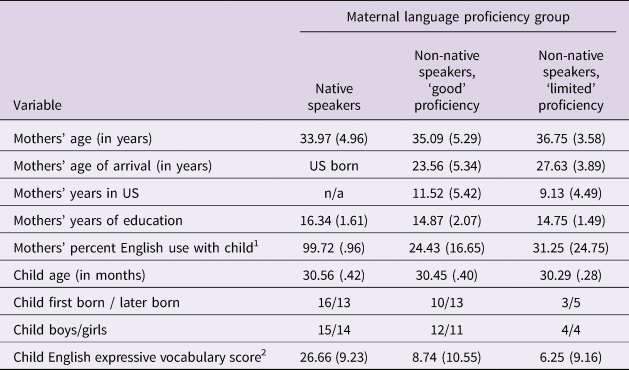
The participants were 60 mothers, each with a child aged 2;6. Twenty-nine mothers were monolingual native speakers of English; 31 mothers were native speakers of Spanish whose first regular exposure to English began after age fifteen. Among the native English speakers, 2 reported their child's ethnicity as African-American, 2 as Hispanic White, 22 as European American, and 3 as Other. Among the non-native speakers, 30 described their children as Hispanic White and 1 as Other. According to self-report, all the non-native speakers used English in their daily lives and they used it in talking to their children. Participants were recruited through advertisements in local, free English and Spanish language magazines aimed at parents of young children, through flyers, and through word of mouth. Characteristics of the mothers and their children are presented in Table 1, calculated separately for three different proficiency groups. Years of education were calculated treating Less than high school degree as 10 years, High school degree as 12, a 2-year AA degree as 14, a 4-year college degree as 16, and all advanced degrees as 18 years.
Means (and Standard Deviations) for characteristics of mothers who were native speakers (n = 29), non-native speakers with ‘good’ proficiency (n = 23), and non-native speakers with ‘limited’ proficiency (n = 8) and their children

Notes. 1 The overall percent of mothers’ speech to their children that is in English, according to mothers’ self-report. Mothers’ speech in the transcripts were 100%, 95%, and 97% in English for native, non-native with good proficiency, and non-native with limited proficiency, respectively. Only utterances in English are analyzed.
2 Raw scores on the Expressive One-Word Vocabulary Test. The mean score for the monolingual children of native, monolingual English mothers was equivalent to a standard score of 103. There are no norms for English-only administration to bilingual children.
Procedure
The present data were collected as part of a larger investigation of early bilingual development. For the present study, the participants were those mothers from the larger study who were either native monolingual speakers of English or native speakers of Spanish who were late learners of English (age of US arrival fifteen years or older), who reported interacting with their children in English on a regular basis, and who consented to video-recording of mother–child interaction in English. Demographic information and mothers’ estimates of their English use and English proficiency were collected in an extended interview conducted by a bilingual researcher in the language of the mothers’ choice. Standardized tests of children's language skills were administered over the course of multiple visits. The recordings of mother–child conversation were collected in toy play with two sets of examiner-provided toys. For 10 minutes, the mothers and children played with pretend picnic materials, and for 10 minutes they played with toy animals and an outdoor scene. The native Spanish-speaking mothers were instructed to speak only English during these play sessions, and, for the most part, they complied. Ninety-six percent of mothers’ utterances were entirely in English, and these utterances provide the database for estimates of properties of their child-directed English. As part of the larger study, mother–child book-reading was also recorded, and the native Spanish-speaking mothers were also recorded interacting in Spanish. The protocol for this study was approved by the Florida Atlantic University Institutional Review Board.
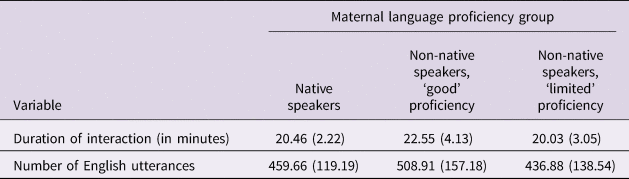
In the present study we analyze only the toy play interactions because book-reading produces mean level changes in lexical and grammatical properties of maternal speech (Hoff-Ginsberg, Reference Hoff-Ginsberg1991). We analyze only the English interactions because the focus is on using the proficiency differences associated with being a late second language learner to test the hypothesis that proficiency influences properties of child-directed speech. Means for the duration of the recorded interactions and the number of English utterances that formed the database are presented in Table 2 for each group of mothers.
Means (and Standard Deviations) for characteristics of transcripts of mother–child conversation for mothers who were native speakers (n = 29), non-native speakers with ‘good’ proficiency (n = 23), and non-native speakers with ‘limited’ proficiency (n = 8)

Measures
Native speaker status and English language proficiency
Mothers reported whether they were native speakers of English or Spanish, and the mothers who were native Spanish speakers were asked, in interview, to describe their oral English proficiency by selecting one of the three following descriptors: “Cannot speak the language, I know few words or phrases, I cannot produce sentences, I only understand a few words (in Spanish, “No puede hablar el idioma indicado, sabe muy pocas palabras o frases, no puede producir oraciones, solamente entiende algunas palabras”),“Limited proficiency with grammatical errors, limited vocabulary, understand the general idea of what is being said” (in Spanish, “Dominio limitado con pocos errores gramaticales, vocabulario limitado, entiende la idea general de lo que se dice”), and “Good proficiency, few grammatical errors, good vocabulary, understand most of what is being said” (in Spanish, “Buen dominio con pocos errores gramaticales, buen vocabulario, entiende casi todo o la mayoría de lo que se dice”). These questions were taken from Restrepo's (Reference Restrepo1998) instrument, which asks parents to select among these descriptors to characterize their children's proficiency. Responses to this instrument have been validated against direct assessments of children's language skill (Restrepo, Reference Restrepo1998).
Child English vocabulary
The children's English vocabulary was assessed so that a measure of their language level could be controlled for in analyses of properties of their mothers’ child-directed speech. The monolingual children (of native English-speaking mothers) were administered the Expressive One-Word Picture Vocabulary Test (EOWPVT) in English (Brownell, Reference Brownell2000). The bilingual children (of non-native English speakers) were administered the EOWPVT - Spanish-Bilingual Edition (Brownell, Reference Brownell2001), separately and on different days to obtain measures of their English and Spanish vocabularies. All items up to the eleven-year-old level on the bilingual version are identical in these two versions of this test.
Properties of child-directed speech
Properties of child-directed speech were assessed from transcripts of the video-recordings of mother–child interaction, which were produced by trained research assistants using the Child Language Data Exchange System (CHILDES; MacWhinney, Reference MacWhinney2000). Transcribers were trained until they reached 90% agreement relative to a standard. Utterances to or from outside sources (e.g., talking with the experimenter or another child) were not transcribed. These transcripts provided the basis for calculating the following properties of mothers’ child-directed English:
Word Tokens: the amount of speech counted in words, was calculated using the FREQ procedure in CLAN.
Mean Length of Utterance in Words (MLUw) was calculated from the count of words and utterances produced by the MLT procedure in CLAN.
Word Types, the number of different lexical items, was also calculated using the FREQ procedure in CLAN.
Rare Word Types were identified using the same method as in previous studies that found positive relations between number of rare word types and child language (Beals, Reference Beals1997; Rowe, Reference Rowe2012; Weizman & Snow, Reference Weizman and Snow2001). That method is to count as rare words those words on the FREQ output that are not on the Dale–Chall list of common words that teachers judged to be words known by fourth grade children (Dale & Chall, Reference Dale and Chall1948).
Verb Types and Lexical Noun Types used as Subjects were generated for each participant by automated procedures in CLAN as follows: we used the MOR command in the CLAN program from CHILDES to generate a %mor tier and a %gra tier. These tiers generated labels for morphemes and grammatical relations for each word in the transcripts. We used automated procedures in CLAN to count the total number of main verbs used by the mother (freq + t%mor -t* +s“v\|*” -t*CHI + f); and the number of nouns in subject position of the mothers’ utterances (freq + d7 + s“m|n” +s“g|SUBJ” +t*MOT + f). We conducted a reliability procedure for noun and verb output by manually checking the CLAN output for each participant. We revised the automated values to exclude any form of verbs ‘have’ and ‘do’ to avoid miscounting auxiliary uses as main verbs. We also excluded from the count any words that were ambiguous as main verbs, such as blanket and water. Following Hsu, Hadley, and Rispoli (Reference Hsu, Hadley and Rispoli2017) we counted irregular verbs with forms such as ‘fly’ and ‘flew’ as two different types and verbs with regular inflectional morphemes such as ‘eat’ and ‘eating’ as one type. Similarly, for nouns in subject position we counted plural inflections such as ‘animal’ and ‘animals’ as one type. Each transcript was then reviewed by a second lab assistant for accuracy in adjustment counts. The second author reviewed verb and noun counts for ten participants and found them to be accurate.
Data analysis plan
The distributions of the measures of the data-providing properties of child-directed speech were examined for normality. Calculated on the entire sample, all measures had skewness and kurtosis values between –1 and 1, which indicate normal univariate distributions. However, within each group there were some significant departures from normality. Therefore, distributions of all measures were examined for outliers that might distort results. No individual score in any group was more than 3 standard deviations from the sample mean, suggesting that between-group differences would not be the driven by extreme outliers. One-way ANCOVA was employed to test for differences among the three proficiency groups, because it provided a way to control for effects of other potential sources of influence. As an additional check on the robustness of the between-group differences, all ANCOVAs yielding significant effects of group were repeated with non-parametric statistics.
ANCOVAs were conducted for each measure comparing native English speakers, non-native speakers with self-reported good English proficiency, and non-native speakers with self-reported limited English proficiency, controlling for the mothers’ highest level of education, regardless of the language in which it was obtained, and controlling for children's English vocabulary score. The control for education level provides a rough control for socioeconomic status, and it also provides a control for language-general effects of education. There is evidence that among Latin American immigrant mothers, years of education completed has an effect on academically related parenting practices regardless of whether the education was received in Latin America or the US (Crosnoe, Ansari, Purtell, & Wu, Reference Crosnoe, Ansari, Purtell and Wu2016). The control for child vocabulary score controls for potential effects of children's language skill on their mothers’ speech (Cross, Reference Cross, Snow and Ferguson1977). For each comparison other than MLUw, the ANCOVAs additionally controlled for the duration of the interactions. Thus, the measures of the number of word types, overall and in subcategories, are rates of word type production. They are not corrected for the number of tokens produced because the findings in the literature that identify these measures as positive predictors of children's language growth also did not control for amount of speech. It turns out not to make a difference, however, because there were not significant between-group differences in the number of word tokens produced. Significant effects of Proficiency Group were followed with independent group t-tests, using the Bonferonni correction for multiple comparisons, to identify the locus of the effects.
Results
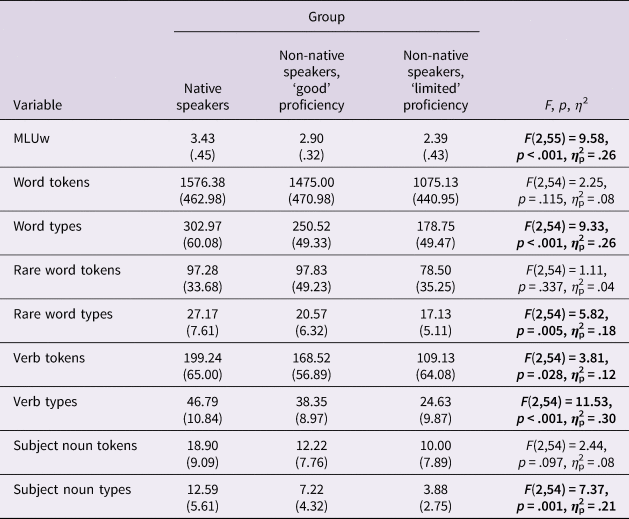
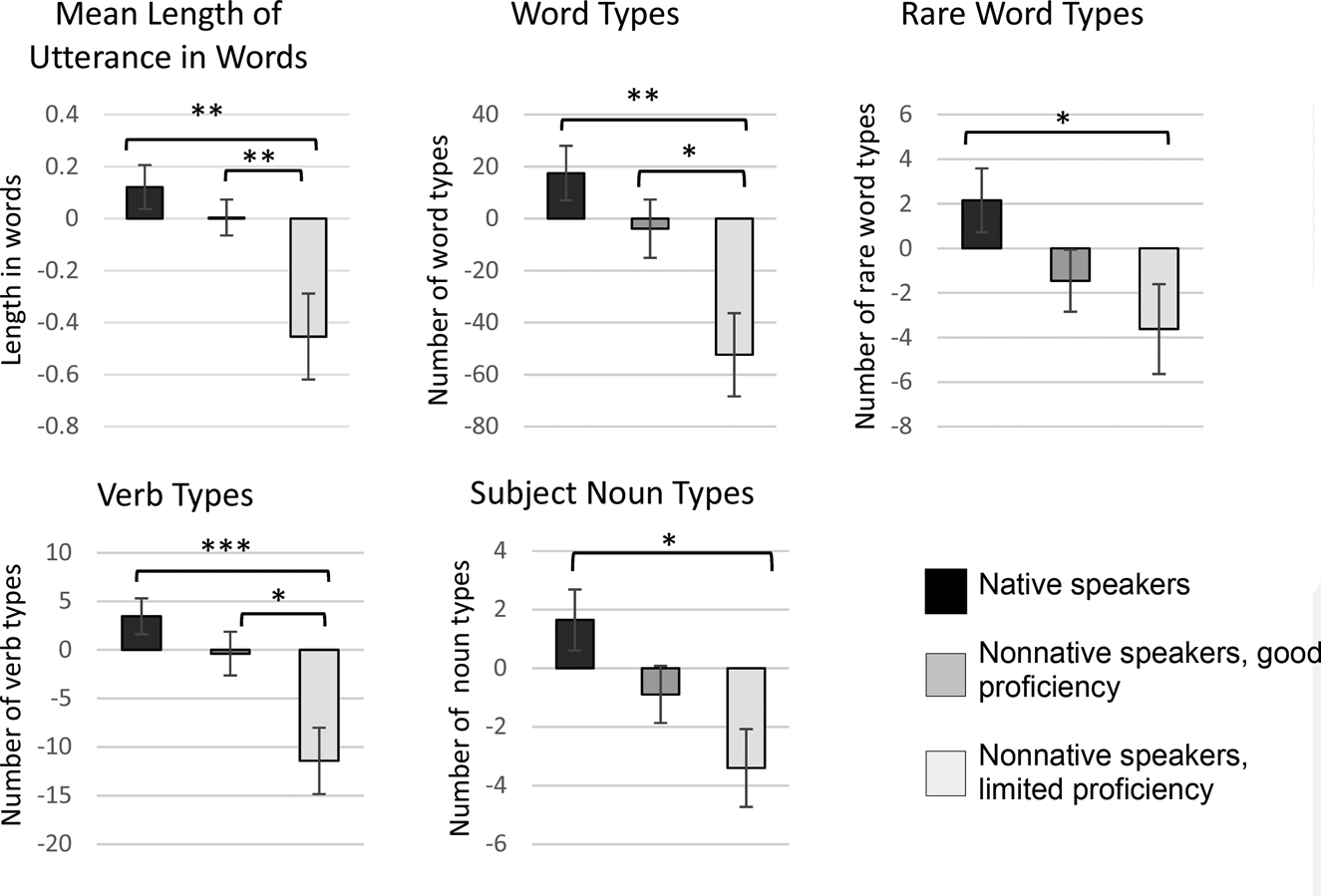
Table 3 presents the means and standard deviations for each measured property of child-directed speech in each group of mothers along with the ANCOVA results. Figure 1 plots the residualized means that the ANCOVAs compared. These plots of residualized means show the between-group differences with effects of maternal education, child language level, and duration of the interaction removed (except for MLUw where duration did not need to be controlled). The ANCOVA findings were that mothers’ Proficiency Group was a significant source of variation in every measure of input quality tested. These between-group comparisons were repeated using the non-parametric Kruskal–Wallis test with the same result: all tests were significant with p < .001. The only non-significant effects were on quantity measures: the total quantity of speech, measured as the number of word tokens, and the quantity of rare words, measured as rare word tokens, and the quantity of lexical nouns used as sentences subjects. All measures of the number of different word types – overall number of types, rare word types, verb types, and lexical noun types used as subjects – showed significant effects of Proficiency Group, as did mean utterance length in words. The nature of the variation associated with maternal language proficiency was that native speakers consistently showed the highest level of the supportive properties of input in their child-directed speech, followed by the non-native speakers with good proficiency, and the non-native speakers with limited proficiency consistently showed the lowest levels.
Means (and Standard Deviations) and statistical comparisons of properties of child-directed speech for mothers who were native speakers (n = 29), non-native speakers with ‘good’ proficiency (n = 23), and non-native speakers with ‘limited’ proficiency (n = 8)

Notes. All means are uncorrected means. Statistical tests for the effect of Mothers Proficiency Group on MLUw were controlled for maternal education and child English vocabulary score; all other tests are controlled for maternal education, child English vocabulary score, and duration of the interaction. Significant effects are presented in boldface.
Mean residual differences from a sample mean of zero for measures of child-directed speech by speaker Proficiency Group, with variance attributable to maternal education level and child English vocabulary scores removed from MLUw, and with variance attributable to maternal education, child English vocabulary score, and duration of the recorded interaction removed from all other measures. Error bars indicate 1 standard error above and below the means. *** p < .001, ** p < .01, * p < .05.

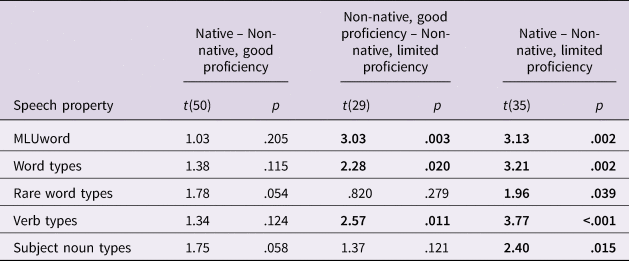
The post-hoc comparisons reported in Table 4 indicated that the native speakers differed from the non-native speakers with ‘limited’ proficiency on every measure, whereas none of the differences between the native speakers and the non-native speakers with ‘good’ proficiency were significant. The non-native speakers with ‘good’ proficiency differed from the non-native speakers with ‘limited’ proficiency in MLUw, number of word types, and number of verb types.
Post hoc comparisons of properties of child-directed speech for mothers who were native speakers (n = 29), non-native speakers with ‘good’ proficiency (n = 23), and non-native speakers with ‘limited’ proficiency (n = 8)

Notes. Significant contrasts indicated in boldface. The p values indicate the probability of a Type I error for one-tailed tests with the Bonferonni correction for multiple comparisons.
Discussion
The speech of non-native speakers is a significant source of language exposure for many children. Previous studies of the relation between the source of input and input's benefit to child language have found that input from non-native speakers is less supportive of language growth than input from native speakers (e.g., Place & Hoff, Reference Place and Hoff2011, Reference Place and Hoff2016), and that differences in proficiency among non-native parents are also related to their children's language outcomes (e.g., Chondrogianni & Marinis, Reference Chondrogianni and Marinis2011; Jia et al., Reference Jia, Aaronson and Wu2002). The results of the present study contribute to explaining those previous findings. Controlling for differences in education and controlling for differences in the language skill of the children to whom they were talking, there were significant differences in properties of mothers’ child-directed speech associated with their language proficiency, even among mothers who report using English in interaction with their children on a regular basis. That is, the mothers who described their own English proficiency as limited also reported speaking English in 30 percent of their talk to their children (see Table 1). The child-directed English of non-native speakers with self-described limited English proficiency differed from the child-directed English of native speakers on every measure of linguistic features with previously identified positive relations to language growth. The child-directed English of non-native speakers with limited proficiency also differed from the child-directed English of more proficient non-native speakers on three of those five measures. In all cases, the direction of the difference was that the more proficient speakers provided more supportive input than the less proficient speakers.
The overall size of the effect of group was large, accounting for between 20 and 30 percent of the variance in these measures of child-directed speech, as indicated in Table 3. As another means of gauging effect size, even the non-significant differences in word types and MLU observed between the native speakers and non-native speakers with good proficiency were similar to the sizes of the differences between high-school educated and college educated native English-speaking mothers observed for these same measures in a different sample (Hoff, Reference Hoff2003). In the current small samples, differences of this size were not statistically reliable, but differences of this size created statistically significant differences in the language growth of the children of high-school educated and college educated mothers in Hoff.
Speaker proficiency did not detectably affect the quantity of child-directed speech, as measured by number of word tokens. And it may well be that proficiency does not affect the social–pragmatic features of mother–child communication that support language development (Tamis-LeMonda et al., Reference Tamis-LeMonda, Kuchirko and Song2014). However, the present data clearly suggest, that in addition to affecting acoustic properties of speech sounds in child-directed speech (Fish et al., Reference Fish, García-Sierra, Ramírez-Esparza and Kuhl2017; Stoehr et al., Reference Stoehr, Benders, van Hell and Fikkert2019), proficiency also affects lexical and grammatical features of child-directed speech that have been empirically demonstrated to support children's acquisition of vocabulary and grammar. The speakers with limited proficiency illustrated a smaller vocabulary for their children to learn, used those words in shorter utterances, and their utterances contained less diversity in the lexical items that fill grammatical roles, compared to native English speakers.
Limitations
The present study has limitations. There are many aspects of child-directed speech and of mother–child interaction that benefit children's language growth that we did not study. Thus, the present findings do not provide a comprehensive picture of how children's communicative interactions are affected by their interlocutors’ language proficiency. We did not look at the bilingual mothers’ child-directed speech in their native Spanish. Thus, the present findings are not a complete picture of the language support these mothers provide for their children's bilingual language development. The present study only looked for and found effects of mothers’ proficiency in their late-acquired second language on some linguistic properties of their speech to their children in that second language. The measures of proficiency were limited to a coarse-gained self-report measure, and the sample size for the mothers reporting ‘limited’ proficiency was smaller than optimal for statistical purposes. Additionally, differences in English proficiency among the non-native speakers could be confounded with differences in their acculturation to American ways of talking to children. Thus, effects of proficiency observed here may include effects of cultural differences in communication with children. Further research is needed to more fully characterize the effects of adults’ language proficiency on their conversations with children.
Conclusion
Children's early language exposure provides the foundation for their language development, thus the factors that shape that language exposure shape language development (e.g., Bergelson, Casillas, Soderstrom, Seidl, Warlaumont, & Amatuni, Reference Bergelson, Casillas, Soderstrom, Seidl, Warlaumont and Amatuni2019; Hoff, Reference Hoff2006). The findings of the present study demonstrate that the language proficiency of children's sources of exposure is one such factor. It is a factor that particularly affects children in immigrant families and immigrant communities where the majority of their input in the language of the host country may come from non-native speakers (Place & Hoff, Reference Place and Hoff2011, Reference Place and Hoff2016).
Many families and many countries struggle with how best to support the language development of children in immigrant families. Because these children's input is divided between their parents’ heritage language and the language of their host country, it is particularly important that they hear high-quality input in each language. The present data suggest that one route to increasing the quality of their host language input is to provide ways for their parents to become more proficient host language speakers. This need not diminish the children's heritage language exposure if heritage language acquisition is also valued and supported. Children can and do become bilingual; more successfully where both languages have societal value (Smithson, Paradis, & Nicoladis, Reference Smithson, Paradis and Nicoladis2014).
Another potential route to supporting young children's bilingual development is through the language exposure provided in early care and education (ECE) settings. The value of input provided there will depend on the proficiency of the staff – if the present findings generalize from mothers to other adults. Previous research among monolingual English-speaking children has found that variation in properties of teachers’ speech predict variation in children's language growth over the course the school year (Huttenlocher, Vasilyeva, Cymerman, & Levine, Reference Huttenlocher, Vasilyeva, Cymerman and Levine2002). Thus, not all school- or ECE-based exposure is equal, and other findings suggest that ECE attendance does not guarantee a benefit to host language acquisition among children from immigrant families (Hoff, Giguere et al., Reference Hoff, Burridge, Ribot and Giguere2018).
A final implication of the present findings resides in their potential extension to native speakers. Although the term ‘proficiency’ is most frequently used to refer to non-native speakers’ language skill, one could argue that differences observed among native speakers in their talk to adults and children, which are often associated with educational attainment (Hoff-Ginsberg, Reference Hoff-Ginsberg1991), might also be termed proficiency differences. If so, then providing more educational opportunities for native speakers might be a route to closing other language gaps, such as those associated with socioeconomic status (Hoff, Reference Hoff2013; Rowe, Reference Rowe2008).
Author ORCIDs
Erika HOFF, 0000-0002-5850-6958.
Acknowledgments
We thank Pamela Hadley for comments on an earlier version of this manuscript. This work was supported by the Eunice Kennedy Shriver National Institute of Child Health and Human Development (grant number HD068421 to E. Hoff. The authors have no conflicts of interest.