Introduction
Insomnia symptoms are common among old people, and it is important to identify these symptoms due to their association with reduced quality of life, poor health, and various diseases (Krishnan and Hawranik, Reference Krishnan and Hawranik2008). The prevalence ranges between 17%–65% depending on definition, study design, and study population (Monane et al., Reference Monane, Glynn and Avorn1996; Voyer et al., Reference Voyer, Verreault, Mengue and Morin2006; Makhlouf et al., Reference Makhlouf, Ayoub and Abdel-Fattah2007). Insomnia includes symptoms such as difficulty initiating sleep, difficulty maintaining sleep, or waking up too early in the morning despite adequate opportunity and circumstances for sleep (Darien, Reference Darien2014). Among people with dementia, resistance to going to bed at the appropriate time can also be regarded a symptom of insomnia (Darien, Reference Darien2014).
Sleep can be negatively influenced by many factors; increasing age is one of them. Findings suggest sleep architecture changes with increasing age, resulting in decreased rapid eye moment (REM) sleep time, increased amount of time spent in light sleep phases, and shorter, more fragmented, and more easily disturbed sleep (Van Cauter et al., Reference Van Cauter, Leproult and Plat2000; Ohayon et al., Reference Ohayon, Carskadon, Guilleminault and Vitiello2004). Aging has also been associated with an altered circadian rhythm (Luik et al., Reference Luik, Zuurbier, Hofman, Van Someren and Tiemeier2013).
In addition, there seems to be a female predisposition to insomnia. There also seems to be a progression with age, with elderly women having the highest risk of developing insomnia (Zhang and Wing, Reference Zhang and Wing2006).
Further, cognitive impairment might influence sleep. Insomnia symptoms such as night-time disturbances presented by old people with cognitive impairment seem to be more common than among people without cognitive impairment, and the symptoms are reported to increase in severity with further cognitive impairment (Beaulieu-Bonneau and Hudon, Reference Beaulieu-Bonneau and Hudon2009). Disrupted circadian rhythm such as fragmented nocturnal sleep, excessive daytime sleepiness, and sundowning are examples of common symptoms in people with Alzheimer's disease, while people with Lewy body dementia commonly present rapid eye movement sleep behavior disorder (RBD), disrupted night sleep, and hypersomnia (Yaffe et al., Reference Yaffe, Falvey and Hoang2014; Porter et al., Reference Porter, Buxton and Avidan2015).
Hypnotics and sedative drugs are commonly prescribed to old people living in nursing homes in spite of relatively small benefits and the increased risk of adverse side effects such as falls and confusion (Glass et al., Reference Glass, Lanctot, Herrmann, Sproule and Busto2005). One study showed a prevalence of 38% among people with dementia living in nursing homes (Gustafsson et al., Reference Gustafsson, Karlsson, Gustafson and Lovheim2013). However, the use of hypnotic and sedative drugs appears to have declined, perhaps due to the increasing attention in recent years. There have been several investments for more appropriate drug use, for example the guidelines from the National Board of Health and Welfare (Gustafsson et al., Reference Gustafsson2015). One study demonstrated a decrease in long-acting benzodiazepines and propiomazine from 2007 to 2013 among old people living in nursing homes in the county of Västerbotten, Sweden (Gustafsson et al., Reference Gustafsson2015). Also, the general use of hypnotic and sedative drugs declined considerably between 2007 and 2013 among people with cognitive impairment living in nursing homes (Gustafsson et al., Reference Gustafsson, Isaksson, Karlsson, Sandman and Lövheim2016). The decrease of hypnotic and sedative drug use is also seen outside Sweden, for example in Canada where the use of benzodiazepines declined among people with dementia between 2004 and 2013 (Vasudev et al., Reference Vasudev2015). Still, hypnotics and sedative drugs are used to a high extent, and considering the relatively small benefits, it is important to study the use and possible associations of these drugs.
Previous estimates of the prevalence of insomnia symptoms have varied greatly, and most studies have focused on estimating the prevalence of insomnia symptoms among old people living in the community rather than individuals in nursing homes (Ohayon, Reference Ohayon2002). Also, the prevalence of insomnia symptoms seems to differ between people with and without cognitive impairment. Arguably, there is a need for more knowledge about the prevalence of different insomnia symptoms to better describe the phenomenon, especially in nursing homes. Furthermore, little is known about the relationship between different insomnia symptoms, prescription of hypnotics and sedatives and cognitive level. Therefore, the aims of this study were to estimate the prevalence of various insomnia symptoms, and to analyze the association between insomnia symptoms, cognitive level, and prescription of hypnotics and sedatives among old people living in nursing homes.
Methods
Participants
The analysis is based on a cross-sectional questionnaire survey that was sent out to all nursing homes in the county of Västerbotten in northern Sweden in 2013. Nursing homes also includes specialized care units for people with dementia. In 2013, the number of people in the county of Västerbotten living in nursing homes was 3,210 (6.1% of the population aged 65 and above) (Statistics Sweden). Altogether, 2,262 questionnaires were completed and returned, corresponding to a response rate of 70.5%. Completed and returned questionnaires for people aged less than 65 years were excluded from the analysis, resulting in a total of 2,135 participants included in the analysis.
The study was approved by the Regional Ethical Review Board in Umeå (registration number 2012-646-31M).
Procedures
The questionnaire that was sent out to all nursing homes included written instructions on how to fill out the form and how to use the provided assessment scale. The member of care staff with the best knowledge about each resident was asked to fill out the questionnaire based on observations made during the preceding week. The member of the staff who was responsible of completing the questionnaire was informed about the possibility to contact the research team in case of questions or about other concerns regarding the survey. A registered nurse working at respective unit and responsible for the care of the resident supplied the data on the residents’ current drug prescriptions by using each resident's prescription record.
Assessments
The questionnaire used consisted of the Multi-Dimensional Dementia Assessment Scale (MDDAS) (Sandman et al., Reference Sandman, Adolfsson, Norberg, Nystrom and Winblad1988) which also includes a cognitive scale developed by Gottfries and Gottfries (Adolfsson et al., Reference Adolfsson, Gottfries, Nystrom and Winblad1981; Gustafsson et al., Reference Gustafsson, Isaksson, Karlsson, Sandman and Lövheim2016). The MDDAS includes items concerning functioning in activities of daily living (ADL), cognition, behavioral, and psychological symptoms and a registration of the resident's current drug prescriptions. The MDDAS has shown good inter- and intra-rater reliability (Sandman et al., Reference Sandman, Adolfsson, Norberg, Nystrom and Winblad1988). Information about insomnia symptoms was gathered using the following items: “interrupted night-time sleep,” “does not want to go to bed,” “unruly in bed, throws bedclothes on the floor,” “difficulty initiating sleep,” “awake much of the night,” “wakes up early in the morning,” and “sleeps for long periods during the day.” Four out of the seven items (difficulty initiating sleep, awake much of the night, wakes up early in the morning, and sleeps for long periods during the day) were rated on a five-point scale depending on whether the symptom had occurred every day, multiple times per week but not every day, one or two times per week, less than once a week, or never during the last two weeks. The three remaining items (interrupted night-time sleep, does not want to go to bed and unruly in bed, throws bedclothes on the floor) were rated on a three-point scale depending on whether the symptom had occurred every day, at least once a week or never during the observation week. The residents were assigned a dichotomous value for each of the seven insomnia symptoms, with a cut-off between at least once and less than once a week.
The cognitive scale by Gottfries and Gottfries (Adolfsson et al., Reference Adolfsson, Gottfries, Nystrom and Winblad1981; Gustafsson et al., Reference Gustafsson, Isaksson, Karlsson, Sandman and Lövheim2016) was used to estimate cognitive function. The scale consists of 27 items assessing cognitive function with a maximum result of 27 points. A result of fewer than 24 points suggests cognitive impairment, with a sensitivity of 90% and specificity of 91% (Adolfsson et al., Reference Adolfsson, Gottfries, Nystrom and Winblad1981) to the generally accepted cut-off of 24 out of 30 points on the Mini-Mental State Examination (MMSE) (Folstein et al., Reference Folstein, Folstein and McHugh1975). The sample was divided by Gottfries’ cognitive score into four groups: no (scores 24–27), mild (16–23), moderate (8–15), and severe cognitive impairment (0–7) (Lövheim et al., Reference Lövheim, Bergdahl, Sandman, Karlsson and Gustafson2010).
The data on drugs currently used by each resident was grouped and coded by the research team, resulting in each participant having a dichotomous value assigned for each drug group. Information regarding doses, pro re nata (as needed) medication and whether the resident was prescribed one or more drugs belonging to the same drug group was not coded. The WHO ATC (Anatomical Therapeutic Chemical Index) classification system was used to divide the drugs into separate drug groups. Hypnotics and sedatives (N05C) was the only drug group included in this study.
Statistics and calculations
Comparisons were made using χ 2 test and Student t-test when appropriate. A p value of less than 0.05 was considered statistically significant.
A linear logistic regression model was constructed for each of the seven insomnia symptoms, with each symptom as dependent variable and Gottfries’ cognitive score as independent variable. A separate linear logistic regression model was constructed with hypnotics and sedatives as dependent variable and Gottfries’ cognitive score as independent variable. Polynomial regression curves were calculated using mean values from the whole sample.
Multivariate logistic regression models were used to further explore the relationships. One model had hypnotics and sedatives as dependent variable and included age, sex, cognitive level (divided into four groups: no, mild, moderate, and severe cognitive impairment) and seven insomnia symptoms as independent variables. Models were also constructed with the particular symptom as dependent variable and age, sex and cognitive level (divided into four groups as mentioned above) as independent variables. Hence, each of the seven insomnia symptoms was analyzed separately. Spearman's rho was used to analyze the correlation between the different insomnia symptoms.
Analyses and statistical calculations were performed using SPSS® version 22 and Microsoft® Excel 2013 for Microsoft® Windows 7 Professional.
Results
Demographic characteristics
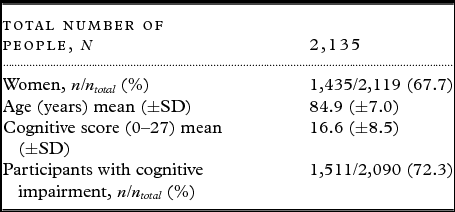
The basic characteristics of the sample are presented in Table 1. Over two-thirds of the participants were women (67.7%), the mean age was 84.9 years and 72.3% of the study population had cognitive impairment.
Basic characteristics of the study population

Note: Cognitive impairment corresponds to a score of less than 24 on Gottfries’ cognitive scale.
SD = standard deviation.
Prevalence of insomnia symptoms
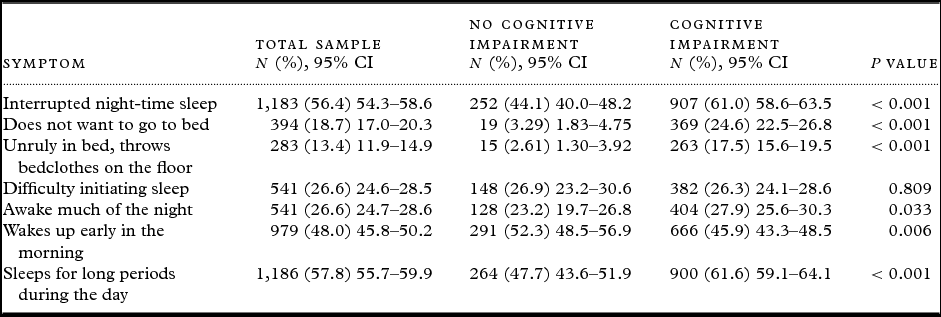
The prevalence of insomnia symptoms is presented in Table 2. The three most common symptoms were “sleeps for long periods during the day,” “interrupted night-time sleep,” and “wakes up early in the morning,” with 57.8%, 56.4%, and 48.0%, respectively, of the residents exhibiting the symptoms at least once a week. “Unruly in bed, throws bedclothes on the floor” and “does not want to go to bed” were the least common symptoms, with a prevalence of 13.4% and 18.7%, respectively.
Prevalence of insomnia symptoms in the study population

Note: Prevalence numbers correspond to participants having exhibiting the symptom at least once a week. The number of completed questionnaires for each item varied between 2,031–2,112 in the total sample, between 551–578 in the group with no cognitive impairment and between 1,446–1,500 in the group with cognitive impairment. Cognitive impairment corresponds to a score of less than 24 on Gottfries’ cognitive scale. CI = confidence interval.
A higher proportion of residents with cognitive impairment exhibited the symptoms “interrupted night-time sleep” (61.0% vs. 44.1%, p < 0.001), “does not want to go to bed” (24.6% vs. 3.3%, p < 0.001), “unruly in bed, throws bedclothes on the floor” (17.5% vs. 2.6%, p < 0.001), “awake much of the night” (27.9% vs. 23.2%, p = 0.033) and “sleeps for long periods during the day” (61.6% vs. 47.7%, p < 0.001) compared to those without cognitive impairment. A lower proportion of the residents with cognitive impairment exhibited the symptom “wakes up early in the morning” (45.9% vs. 52.3%, p = 0.006), and there was no significant difference regarding the symptom “difficulty initiating sleep” (26.3% vs. 26.9%, p = 0.809) between participants with and without cognitive impairment.
Correlations between insomnia symptoms
The full correlation analysis is presented in a supplementary figure (see Figure S1 available as supplementary material, attached to the electronic version of this paper at http://journals.cambridge.org/ipg). The strongest correlation was between “difficulty initiating sleep” and “awake much of the night,” with a correlation coefficient of 0.54. “Awake much of the night” and “interrupted night-time sleep,” “awake much of the night” and “wakes up early in the morning,” and “difficulty initiating sleep” and “interrupted night-time sleep” all showed correlation coefficients between 0.3–0.4. The remaining symptoms showed correlation coefficients below 0.3.
Insomnia symptoms in relation to age, sex, and cognitive level
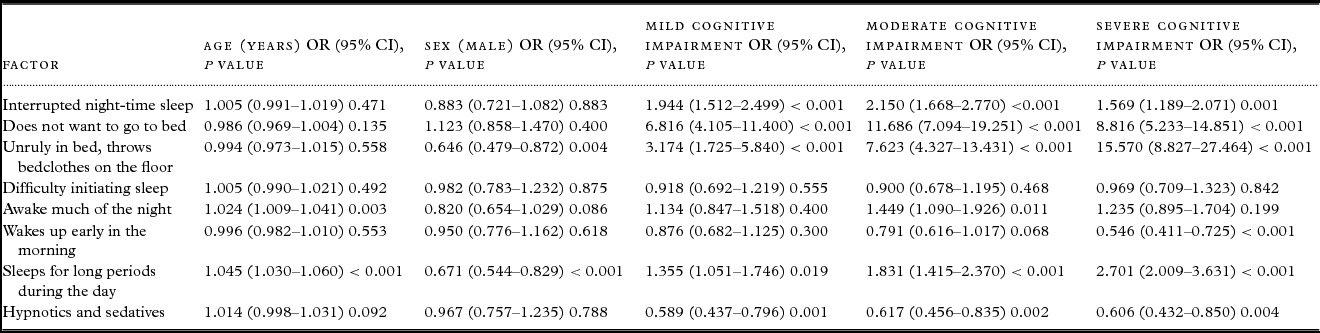
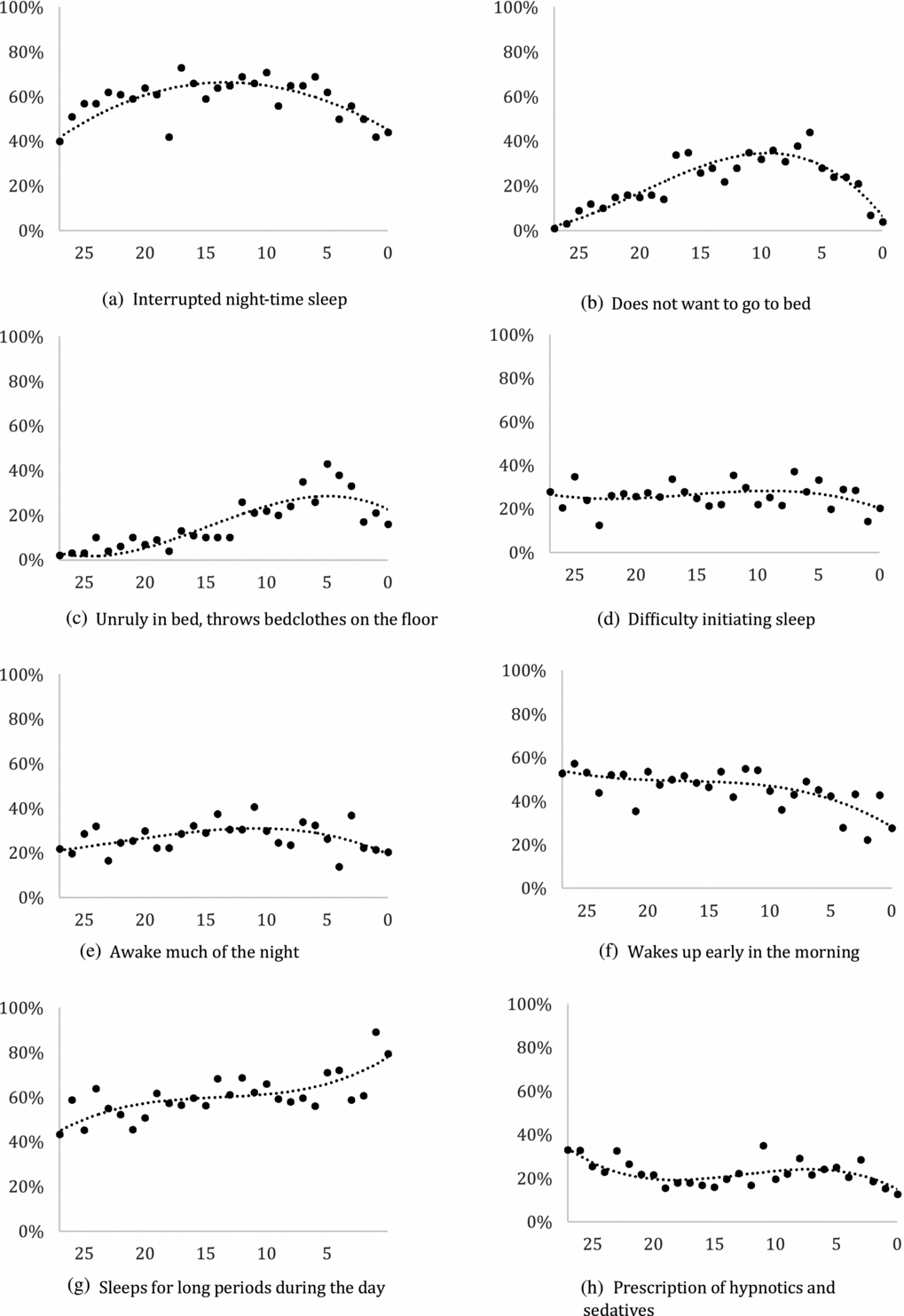
The associations between insomnia symptoms and age, sex. and cognitive level are presented in Table 3. The relationship between insomnia symptoms and cognitive level is further explored in Figures 1(a)–(g). “Unruly in bed, throws bedclothes on the floor” and “sleeps for long periods during the day” were less common among females. There was no significant association between sex and other insomnia symptoms. Increased age was associated with a higher probability of exhibiting “sleeps for long periods during the day” and “awake much of the night”. No association was found between age and any of the other insomnia symptoms.
Multivariate logistic regressions regarding insomnia symptoms and hypnotics and sedatives in relation to age, sex, and cognitive level

Note: Multivariate logistic regression models with each of the particular symptoms and hypnotics and sedatives as dependent variables, and age, sex, and cognitive level (mild, moderate, and severe cognitive impairment) as independent variables. Each of the dependent variables was analyzed separately. Mild cognitive impairment corresponds to scores 16–23, moderate cognitive impairment to scores 8–15, and severe cognitive impairment to scores 0–7 on Gottfries’ cognitive scale. Odds ratios for mild, moderate, and severe cognitive impairment were calculated in comparison to no cognitive impairment. OR = odds ratio, CI = confidence interval.
Insomnia symptoms and prescription of hypnotics and sedatives in relation to cognitive level. Note: The x-axis represents Gottfries’ cognitive scale (0–27 points, < 24 points = cognitive impairment) (Figures 1(a)–(h)). The y-axis represents the proportion of participants exhibiting each symptom at least once a week (Figures 1(a)–(g)) and the proportion of participants prescribed at least one hypnotic and sedative drug (Figure 1(h)). Each dot represents mean values from groups with a minimum of 26 and a maximum of 362 people with a specific cognitive score. Polynomial regression curves were calculated using mean values from the whole sample.

“Interrupted night-time sleep,” “does not want to go to bed,” and “awake much of the night” showed the strongest association with moderate cognitive impairment, while “sleeps for long periods during the day” and “unruly in bed, throws bedclothes on the floor” were primarily associated with severe cognitive impairment. “Waking up early in the morning” was less common among people with severe cognitive impairment. There was no significant association between “difficulty initiating sleep” and cognitive level.
Prevalence of hypnotics and sedatives
The prevalence of hypnotics and sedatives was 24.0% ((457/1,902), 95% CI 22.1–26.0) in the whole sample. Prescription of hypnotics and sedatives was less common among residents with cognitive impairment (21.2% (289/1,362), 95% CI 19.0–23.4) compared to participants without cognitive impairment (31.1% (155/499), 95% CI 27.0–35.1) (p < 0.001).
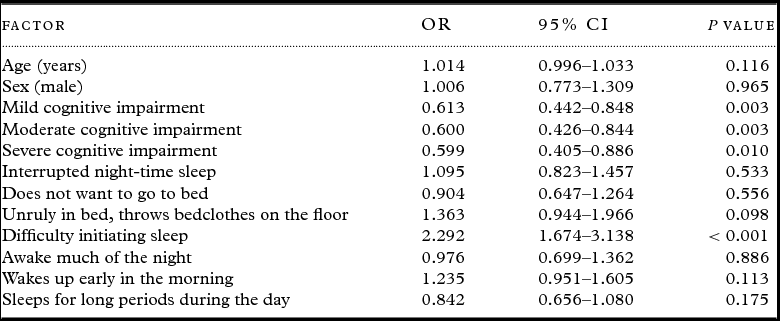
Prescription of hypnotics and sedatives in relation to insomnia symptoms, age, sex, and cognitive level
Prescription of hypnotics and sedatives in relation to insomnia symptoms, age, sex, and cognitive level is presented in Tables 3 and 4. The association between prescription of hypnotics and sedatives and cognitive level is further explored in Figure 1(h). Residents without cognitive impairment and participants exhibiting “difficulty initiating sleep” showed the greatest association with prescription of hypnotics and sedatives. There was no significant association between hypnotics and sedatives and sex, age, or any of the other insomnia symptoms.
Multivariate logistic regression regarding prescription of hypnotics and sedatives in relation to insomnia symptoms, age, sex, and cognitive level

Note: The multivariate logistic regression model used hypnotics and sedatives as dependent variable and age, sex, cognitive level (mild, moderate, and severe cognitive impairment) and seven insomnia symptoms as independent variables. Mild cognitive impairment corresponds to scores 16–23, moderate cognitive impairment to scores 8–15, and severe cognitive impairment to scores 0–7 on Gottfries’ cognitive scale. Odds ratios for mild, moderate, and severe cognitive impairment were calculated in comparison to no cognitive impairment. OR = odds ratio, CI = confidence interval.
Discussion
Insomnia symptoms were common among old people in nursing homes. Different insomnia symptoms showed different association patterns with cognitive level and age. However, most insomnia symptoms were more common among people with cognitive impairment compared to those with no cognitive impairment. Furthermore, prescription of hypnotics and sedatives was more common among those with no cognitive impairment and those exhibiting the symptom “difficulty initiating sleep.”
Previous research has, in line with the present study, reported high and varied prevalences among different insomnia symptoms (Monane et al., Reference Monane, Glynn and Avorn1996; Voyer et al., Reference Voyer, Verreault, Mengue and Morin2006; Makhlouf et al., Reference Makhlouf, Ayoub and Abdel-Fattah2007). For example, the prevalence of “difficulty initiating sleep” (27%) in the present study can be compared to the results published by Voyer et al. (Reference Voyer, Verreault, Mengue and Morin2006) showing that 30% of over 2,300 nursing home residents reported difficulties falling asleep. Further, 29% had problems with waking up too early in the morning, compared to 48% in the present study. Makhlouf et al. (Reference Makhlouf, Ayoub and Abdel-Fattah2007) found that among nursing home residents without dementia aged 60 years and older, 65% had difficulty initiating sleep, and 28% reported early morning awakenings. In the same study, problems maintaining sleep were reported by 51% of the participants, which is slightly higher than the comparable item “interrupted night-time sleep” in the present study (44%). A comparison of the prevalence numbers in the present study with results from other studies is, however, difficult since most studies have focused on non-institutionalized populations, excluded participants with dementia and/or psychiatric disorders, used a different study design, used a different definition of insomnia or used a different cut-off when defining insomnia.
In the present study, there was an increased risk of exhibiting “awake much of the night” and “sleeps for long periods during the day” with advanced age. A possible explanation might be previous findings that aging is associated with increased comorbidity, changes in sleep architecture, and altered circadian rhythm (Van Cauter et al., Reference Van Cauter, Leproult and Plat2000; Foley et al., Reference Foley, Ancoli-Israel, Britz and Walsh2004; Ohayon et al., Reference Ohayon, Carskadon, Guilleminault and Vitiello2004; Luik et al., Reference Luik, Zuurbier, Hofman, Van Someren and Tiemeier2013), which could affect the sleep quality negatively.
As previously mentioned, cognitive impairment has been associated with both increased severity and a high prevalence of insomnia symptoms (Foley et al., Reference Foley, Ancoli-Israel, Britz and Walsh2004; Beaulieu-Bonneau and Hudon, Reference Beaulieu-Bonneau and Hudon2009; Luik et al., Reference Luik, Zuurbier, Hofman, Van Someren and Tiemeier2013; Yaffe et al., Reference Yaffe, Falvey and Hoang2014; Luik et al., Reference Luik, Zuurbier, Hofman, Van Someren, Ikram and Tiemeier2015), and in line with these findings, most insomnia symptoms were more common among people with cognitive impairment compared to those with no cognitive impairment in the present study. A possible explanation might be that these symptoms are more connected to either circadian rhythm dysfunction (interrupted night-time sleep, does not want to go to bed, awake much of the night, sleeps for long periods during the day) or RBD (unruly in bed, throws bedclothes on the floor), both of which are disorders with strong associations with dementia (Yaffe et al., Reference Yaffe, Falvey and Hoang2014). Aggressive behavior or agitation might also increase the risk of some of these symptoms. Further, it seems that most of the insomnia symptoms tend to increase with increased cognitive impairment, but among those with the lowest cognitive scores, these symptoms appear to decline. These findings could indicate that there is a point in the progress of cognitive decline where the probability of exhibiting insomnia symptoms reaches a peak. People with cognitive impairment may with further cognitive decline turn into a more vegetative state, where the probability of exhibiting insomnia symptoms may be lower. These results agree with findings that the probability of exhibiting behavioral and psychological symptoms in dementia (BPSD) reaches a peak in people with moderate to severe cognitive impairment and decreases with further cognitive decline (Lövheim et al., Reference Lövheim, Sandman, Karlsson and Gustafson2008).
In the present study, there was a lower probability of being prescribed hypnotics and sedatives among people with severe cognitive impairment, and also in mild and moderate impairment as compared to no cognitive impairment, despite the finding that the majority of insomnia symptoms showed a strong association with cognitive impairment. This might be explained by an increased fear of adverse side effects among people with cognitive impairment (Ganjavi et al., Reference Ganjavi2007). There is also a possibility that people without cognitive impairment are more prone to request hypnotics and sedatives in comparison to people with cognitive impairment. Another explanation could be that sleep problems may be perceived as part of the dementia disorder, and the persons were not treated with these drugs for that reason.
The difference in prevalence of hypnotics and sedatives between residents with and without cognitive impairment is consistent with the results from a Finnish study (Bell et al., Reference Bell, Taipale, Soini and Pitkala2010). “Difficulty initiating sleep” stands out as the only insomnia symptom with a significant association with prescription of hypnotics and sedatives. One possible explanation might be that this particular symptom produces more complaints among the residents and thereby increases the chance of the symptom being noticed by the care staff, hence leading to a higher probability of prescription of hypnotics and sedatives.
In contrast to previous work, there was no significant association between female gender and prescription of hypnotics and sedatives (Petek Ster and Cedilnik Gorup, Reference Petek Ster and Cedilnik Gorup2011). Furthermore, females had a lower probability of exhibiting “unruly in bed, throws bedclothes on the floor” and “sleeps for long periods during the day” compared to males. As already mentioned, these symptoms might be more or less connected to circadian rhythm dysfunction or RBD. The circadian rhythm seems to be more stable in old women in contrast to men, who show a greater intradaily variability in circadian rhythm (Luik et al., Reference Luik, Zuurbier, Hofman, Van Someren and Tiemeier2013). However, little is known about the gender difference in circadian rhythm in those with cognitive impairment. Moreover, RBD is seen as a male-predominant disorder (Bodkin and Schenck, Reference Bodkin and Schenck2009), commonly present among people with Lewy body dementia. These factors might partly explain the lower probability of females exhibiting these insomnia symptoms in the present study.
The main advantages of this study are the good quality of the recorded data, the relatively high participation rates and the large, unselected sample of old people with and without cognitive impairment residing in nursing homes.
There are some limitations in this study. First, conclusions about causality could not be drawn due to the cross-sectional design of this study. Also, the observation period was just one week and therefore reflects only the symptoms the person exhibited during that time. Further, the insomnia assessment used in this study is not an objective assessment, which would have been desirable. A staff member answered the assessment and even if it was done by a staff member who knew the resident best, it is still an estimation and a possible source of error as compared to direct measurements.
Cognitive impairment was measured using a scale developed by Gottfries and Gottfries (Adolfsson et al., Reference Adolfsson, Gottfries, Nystrom and Winblad1981). This scale has good sensitivity and specificity to the usual 24/30 MMSE cut-off. However, the lack of data on diagnoses means that we cannot know the cause of the cognitive impairment and subsequently there could be other factors that might have influenced the persons’ cognitive status. Further, it means that it is impossible to link particular insomnia symptoms or prevalence numbers to specific dementia disorders.
The lack of detailed information regarding drug use limits the analyses, i.e. no information was available concerning pro re nata (as needed) prescription, doses, reasons behind prescription, and duration of prescription. The lack of data on pro re nata prescription might lead to an underestimation of the actual use of hypnotics and sedatives, as these drugs are sometimes used intermittently rather than daily.
These limitations should be borne in mind when interpreting the results.
Conclusion
Insomnia symptoms and prescription of hypnotics and sedatives are common among old people living in nursing homes. The probability of exhibiting most of the insomnia symptoms seems to reach a peak in people with moderate to severe cognitive impairment, subsequently decreasing with further cognitive decline. Considering the risk of adverse effects, it is important for clinicians to regularly re-evaluate the need for hypnotics and sedatives.
Conflict of interest
None.
Description of authors’ roles
A. Skottheim and H. Lövheim analyzed the data. A. Skottheim, H. Lövheim, and M. Gustafsson interpreted the data and prepared the manuscript. P.O. Sandman and U. Isaksson were responsible for the study concept, study design, and acquisition of subjects. All authors critically revised, contributed comments and approved the final version of the manuscript.
Acknowledgments
This study was supported financially by grants from the Swedish Dementia Association, Västerbotten County Council and Swedish Brainpower.
Supplementary material
To view supplementary material for this article, please visit https://doi.org/10.1017/S1041610217001703