Implications
This paper discusses the importation, performance and utilization of the five Northern European short-tailed (NEST) breeds of sheep present in North America (Finnsheep, Romanov, Shetland, Icelandic and Gotland). Use of Finnsheep and Romanov breeds to produce ewes with high reproductive rates has improved the efficiency of lamb meat production. Shetland and Icelandic breeds are widely used in the production of unique fleeces that are in high demand by fiber craftspeople and artists.
Introduction
The several breeds of sheep known collectively as Northern European short-tailed (NEST) or Scandinavian short-tailed are native to Northwestern Russia, the Scandinavian countries, Iceland, Greenland and several of the Northern islands of Scotland (Ryder, Reference Ryder1983). A companion paper has documented the current world distribution, population numbers and current uses of these breeds (Dýrmundsson and Niżnikowski, Reference Dýrmundsson and Niżnikowski2010).
The five NEST breeds present in North America are the Finnish Landrace (Finnsheep), Romanov, Icelandic, Shetland and Gotland. The Finnsheep and Romanov breeds were imported into North America due to their high reproductive performance documented in European studies (e.g. Donald and Read, Reference Donald and Read1967 and Ricordeau et al., Reference Ricordeau, Tchamitchian, Thimonier, Flamant and Theriez1978, respectively) with the goal of improving the efficiency of commercial lamb production. The Icelandic, Shetland and Gotland breeds were imported for the uniqueness of their physical appearance and their unique fleeces desired by fiber craftspeople and artists.
All but the Gotland breed first entered into North America through Canada. Finnsheep were first imported into Canada (four rams and eight ewes from Scotland) in 1966, the United States in 1968 and Mexico in 1985 (Fahmy, Reference Fahmy1996a). Canada imported Romanov sheep (seven rams and 17 ewes) in 1981 from France. From Canada, the Romanov was imported into the United States in 1986 and into Mexico in 1994 (Fahmy, Reference Fahmy1996a). Shetland sheep (four rams and 28 ewes) were first imported into Canada in 1980 from the United Kingdom and from Canada to the United States in 1986 (Doane, Reference Doane2008). Icelandic sheep were first imported into Canada (two rams and 10 ewes) from Iceland in 1985 (Briggs, Reference Briggs2008) and into the United States from Canada in 1991 (Schneider, Reference Schneider2008). Gotland semen from the United Kingdom was imported into the United States in 2005 with the first crossbred Gotland lambs born in 2006 (GSBANA, 2008).
Thomas (Reference Thomas2008) reviewed the published research results and industry utilization of these breeds in North America in a theater presentation at a special session of the 2008 annual meeting of the European Association of Animal Production entitled ‘Use and Importance of Short Tailed Sheep Breeds’. This paper is an expansion of the information contained in that theater presentation.
Results from research with NEST breeds in North America
Earlier reviews that have included performance of some NEST breeds and their crosses on research stations in North America have been published by Dickerson (Reference Dickerson1977) on Finnsheep in the United States, Baker (Reference Baker1988) on Finnsheep in temperate countries and Young et al. (Reference Young, Fahmy and Torres-Hernandez1996) on Finnsheep and Romanov in North America.
Finnsheep v. domestic breeds
A large volume of published literature exists comparing the Finnsheep and its crosses with domestic breeds in North America. A search of the scientific literature in late 2009 revealed 125 articles published in a journal on the topic from 1972 through the time of the search in 2009. The number of papers published each decade were 23 (1970s), 49 (1980s), 38 (1990s) and 15 (2000s). However, not all of these papers were utilized in this review. Only papers that evaluated the traits of female reproduction, wool production, lamb survival, lamb growth and lamb carcass traits and that allowed an unconfounded comparison of the Finnsheep breed with domestic breeds were included.
Finnsheep fertility
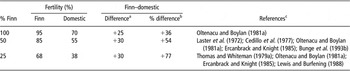
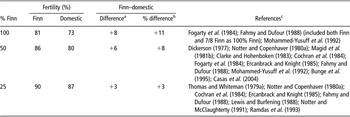
Ewe fertility (number of ewes lambing/number of ewes mated) of Finnsheep, Finnsheep-cross and domestic and domestic-cross ewes averaged across studies is presented in Tables 1 and 2. Some studies evaluated yearling ewe fertility (number of yearling ewes lambing/number of ewe lambs mated) separate from the fertility of older ewes, and yearling ewe fertility is presented in Table 1. Yearling ewe fertility was greater in Finnsheep and Finnsheep-cross ewes than in domestic and domestic-cross ewes (Table 1). In these studies, the increase in number of yearling ewes lambing per ewe lamb exposed was similar across the different percentages of Finnsheep breeding; that is, 25 more Finnsheep and 30 more Finnsheep-cross yearling ewes lambed per 100 ewe lambs mated compared with domestic or domestic-cross ewes.
Mean fertility, averaged across studies, of Finnsheep (Finn), Finn-cross and domestic/domestic-cross yearling ewes in North America

aDifference between the Finn and Domestic means in each row.
b((Finn mean–domestic mean)/domestic mean) × 100.
cFall mating was used in all studies.
Mean fertility, averaged across studies, of Finnsheep (Finn), Finn-cross and domestic/domestic-cross ewes of various ages in North America

aDifference between the Finn and Domestic means in each row.
b((Finn mean–domestic mean)/domestic mean) × 100.
cFall mating occurred in all studies, but some studies used an accelerated lambing system where some additional mating occurred in spring.
The yearling fertility advantage of Finnsheep breeding would be expected to decrease as the percentage of Finnsheep breeding decreased, but this was not the case. A possible explanation is that the set of studies with one-quarter Finnsheep ewes contained more studies with late sexual maturity breeds (e.g. Rambouillet, Columbia, western whiteface) than the sets of studies with half-Finnsheep and pure Finnsheep ewes, and the set of studies with one-half Finnsheep ewes contained more studies with late sexual maturity breeds than the set of studies with pure Finnsheep ewes. Therefore, these results indicate greater yearling ewe fertility in ewes of Finnsheep breeding compared with many domestic breeds in North America, and the increase would be expected to be larger when Finnsheep breeding replaced particular domestic breeding with a much older age at sexual maturity.
Fertility of ewes of various ages, but primarily of ewes greater than 1 year of age, is presented in Table 2. At older ages, Finnsheep and Finnsheep-cross ewes still have an advantage in fertility over domestic and domestic-cross ewes, but the advantage is considerably less than in yearling ewes. Three to eight more ewes of Finnsheep breeding are expected to lamb for each 100 ewes mated compared with ewes of domestic breeding when mated at age greater than 1 year.
Finnsheep prolificacy
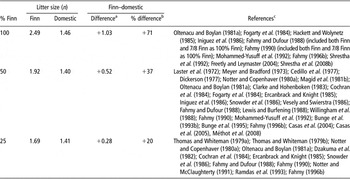
The primary reason for the importation of the Finnsheep breed into North America was because of its large litter size as reported in European studies. Litter size or prolificacy (number of lambs born/number of ewes lambing) of Finnsheep, Finnsheep-cross and domestic and domestic-cross ewes averaged across studies is presented in Table 3. Finnsheep and Finnsheep-cross ewes produced much larger litters than domestic and domestic-cross ewes, and there was a very close relationship between the proportion of Finnsheep breeding and the increase in litter size. Pure (100%) Finnsheep ewes gave birth to 1.03 more lambs per litter than domestic and domestic-cross ewes, 50% Finnsheep ewes produced 0.52 more lambs per litter and 25% Finnsheep ewes produced 0.28 more lambs per litter – each 1% increase in Finnsheep breeding increased lambs per litter by approximately 0.01.
Mean litter size per ewe lambing, averaged across studies, of Finnsheep (Finn), Finn-cross and domestic/domestic-cross ewes in North America

aDifference between the Finn and domestic means in each row.
b((Finn mean–domestic mean)/domestic mean) × 100.
cStudies included ewes of various ages lambing in various seasons.
The polygenic inheritance of litter size in Finnsheep and the ability to titrate the amount of Finnsheep breeding to obtain a desired litter size were observed in the first review of Finnsheep performance in North America by Dickerson (Reference Dickerson1977) when he stated, ‘By using either 1/4 or 1/2 Finn crossbred ewes, producers can increase numbers of lambs born per 100 ewes by about 20 or 50 lambs, respectively, above levels for domestic breeds or crosses’. As the present review indicates, more data from additional studies has confirmed the statement by Dickerson (Reference Dickerson1977) and further tightened the very close to 1 : 1 relationship between percentage of Finnsheep breeding and the increase in number of lambs born per 100 ewes lambing.
Finnsheep lamb survival
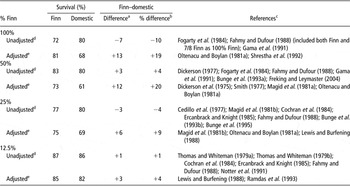
Survival rates to weaning of Finnsheep, Finnsheep-cross and domestic and domestic-cross lambs are presented in Table 4. In most cases, the Finnsheep breeding in the lamb came from the lamb’s dam. For example, the values reported for 25% Finnsheep lambs were generally from studies where lambs were born from 50% Finnsheep and 50% domestic breed dams and 100% domestic breed sires. Therefore, the Finnsheep and Finnsheep-cross lambs were born, on average, in larger litters than the domestic and domestic-cross lambs. The major exception to this is in the 50% Finnsheep comparisons where most studies reported results for lambs born from domestic or domestic-cross ewes mated to purebred Finnsheep rams. The studies were divided into those that analyzed survival rate with no adjustment for litter size and those that adjusted survival rate for litter size in some manner. When survival rate was unadjusted for litter size, Finnsheep and Finnsheep-cross lambs had similar survival rates to domestic or domestic-cross lambs, with less than a 10% difference in survival rates between lambs with and without Finnsheep breeding. However, larger differences existed between lambs with and without Finnsheep breeding when survival rate was adjusted for litter size with greater survival rates for Finnsheep and Finnsheep-cross lambs. Within the same litter size, lambs of Finnsheep breeding are expected to have greater survival rates than lambs of only domestic breeding.
Mean lamb survival to weaning, averaged across studies, of Finnsheep (Finn), Finn-cross and domestic/domestic-cross lambs in North America

aDifference between the Finn and Domestic means in each row.
b((Finn mean–Domestic mean)/Domestic mean) × 100.
cStudies included various lambing seasons.
dLamb survival is unadjusted for lamb’s litter size.
eLamb survival is adjusted for lamb litter size by including type of birth or type of birth and rearing in the model or lambs were raised from birth artificially on milk replacer.
Both the environment provided by the dam (maternal effects) and the lamb’s breeding value for survival (direct genetic effect) will affect the lamb’s ability to survive. Since ewes of Finnsheep breeding produce less milk than ewes of many domestic breeds (see discussion on milk production later), they would be expected to provide a less desirable maternal environment than many domestic breeds. Therefore, the increased litter size-adjusted survival rate of lambs of Finnsheep breeding is probably due primarily to large positive direct genetic effects for survival of the Finnsheep breed. When the litter size-adjusted survival rates of the lambs of Finnsheep and domestic breeding of the four groups of comparisons in Table 4 are evaluated further using the direct genetic and maternal effects of the various crosses as defined by Dickerson (Reference Dickerson1969), the Finnsheep breed is expected to have a direct genetic effect of 0.24 to 0.48 more lambs weaned per lamb born and a maternal effect of 0.0 to 0.12 fewer lambs weaned per lamb born compared with the average of the domestic breeds.
Finnsheep weaning weight
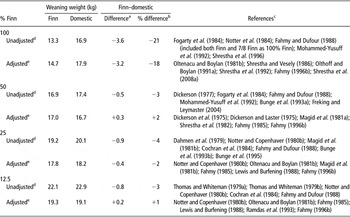
Since the number of lambs in a litter has a large effect on lamb weaning weight, and since lambs born from ewes with Finnsheep breeding are generally born in larger litters than lambs born from ewes of domestic breeding, results from studies that reported lamb weaning weights adjusted or unadjusted for litter size are reported separately in Table 5. As expected, the differences between lambs of Finnsheep breeding and lambs of domestic breeding were less when the weaning weights were adjusted for lamb’s litter size. When weights were not adjusted for litter size, lambs of Finnsheep breeding were lighter at weaning than lambs of domestic breeding. The disadvantage of Finnsheep breeding varied from a −21% for purebred Finnsheep to −3% to −4% for Finnsheep crosses. When weaning weights were adjusted for lamb’s litter size, purebred Finnsheep lambs were still 17% lighter than domestic and domestic-cross lambs. However, there was only a 1% to 2% difference between Finnsheep-cross and domestic or domestic-cross lambs for weaning weights adjusted for litter size, and the lambs of 50% and 12.5% Finnsheep breeding were slightly heavier than domestic or domestic-cross lambs.
Mean lamb weaning weight, averaged across studies, of Finnsheep (Finn), Finn-cross, and domestic/domestic-cross lambs in North America

aDifference between the Finn and domestic means in each row.
b((Finn mean–Domestic mean)/domestic mean) × 100.
cStudies included various lambing seasons.
dLamb weaning weight is unadjusted for lamb’s litter size.
eLamb weaning weight is adjusted for lamb litter size by including type of birth or type of birth and rearing in the model or lambs were raised from birth artificially on milk replacer.
The results from the studies using purebred Finnsheep animals indicate that the Finnsheep breed has poorer growth to weaning than many domestic breeds, even if weights are adjusted for lamb’s litter size. This may be due to genes for slower growth rate in the Finnsheep breed, lower milk production of Finnsheep ewes or a combination of both relative to domestic breeds. There is good evidence for lower milk production in Finnsheep ewes. Of four F1 crosses studied by Torres-Hernandez and Hohenboken (Reference Torres-Hernandez and Hohenboken1979), the F1 Finnsheep ewes had the lowest milk yield, and it was 18% lower than the average milk yield of F1 ewes sired by Cheviot, Dorset and Romney rams. In the study of Boylan and Sakul (Reference Boylan and Sakul1988), purebred Finnsheep ewes had a 130-day milk yield of 64.0 l and it was 12% lower than the average milk yield of purebred Dorset, Lincoln, Rambouillet, Suffolk and Targhee ewes. At the same location of the previous study and using some of the same raw data, purebred Finnsheep ewes were estimated to have an average breeding value for milk yield that was 12.2 l lower than the average breeding value of Dorset, Lincoln, Rambouillet, Suffolk and Targhee ewes (Sakul et al., Reference Sakul, Boylan and Shrestha1999). The small differences between Finnsheep-cross and domestic or domestic-cross lambs for weaning weights observed in Table 5 may be due to greater milk production from the domestic breeding in the dams of the Finnsheep-cross lambs, allowing them to express their potential for growth more completely.
Heterosis may also be involved. Some of the studies compared Finnsheep-cross lambs with purebred domestic lambs, and therefore, heterosis effects were definitely confounded with breed effects in those studies. Even if Finnsheep-crosses were compared to domestic-crosses, they may show greater amounts of heterosis than some domestic-crosses. Therefore, heterosis effects will tend to increase the differences in weaning weight between Finn crosses and domestic breeds and crosses in Table 5. These effects of heterosis are not limited to the weaning weight trait, but may be a source of confounding in the comparisons of Finnsheep-crosses with domestic breeds and crosses for all traits.
Finnsheep postweaning growth rate
Postweaning average daily gains tended to be only slightly lower for lambs with Finnsheep breeding compared to lambs without Finnsheep breeding. Of 19 studies reporting postweaning average daily gains, only four studies reported slightly greater gains from lambs with Finnsheep breeding (Shrestha et al., Reference Shrestha, Peters and Heaney1982; Fahmy, Reference Fahmy1985; Shrestha and Vesely, Reference Shrestha and Vesely1986 and Fahmy, Reference Fahmy1989), while 15 studies reported the same or slightly lower gains for lambs of Finnsheep breeding (Dickerson and Laster, Reference Dickerson and Laster1975; Dickerson, Reference Dickerson1977; Hohenboken, Reference Hohenboken1977; Dahmen et al., Reference Dahmen, Hinman, Jacobs and Everson1979; Notter and Copenhaver, Reference Notter and Copenhaver1980b; Magid et al., Reference Magid, Swanson, Brinks, Dickerson and Smith1981a and Reference Magid, Swanson, Brinks, Dickerson, Crouse and Smith1981c; Cochran et al., Reference Cochran, Notter and McClaughtery1984; Notter et al., Reference Notter, Ferrell and Field1984 and Reference Notter, Kelly and McClaughterty1991; Olthoff and Boylan, Reference Olthoff and Boylan1991a; Fahmy et al., Reference Fahmy, Boucher, Poste, Gregoire, Butler and Comeau1992; Freking and Leymaster, Reference Freking and Leymaster2004; Shrestha et al., Reference Shrestha, Boylan and Rempel2008a) compared to lambs without Finnsheep breeding. Averaged across all 19 studies and all percentages of Finnsheep breeding, lambs with Finnsheep breeding had postweaning average daily gains that were only 4.1 g/day lower than lambs without Finnsheep breeding.
The similar postweaning gains between lambs of Finnsheep and domestic breeding is somewhat surprising since mature weights of Finnsheep are generally lighter than mature weights of domestic breeds (e.g. Shrestha et al., Reference Shrestha, Boylan and Rempel2008b), and mature weight has a positive genetic correlation with postweaning weight (0.93 in the review of Safari et al., Reference Safari, Fogarty and Gilmour2005). The similar postweaning gains of lambs of Finnsheep and domestic breeding may be due to their greater compensatory gain because of lower pre-weaning milk consumption due to being raised in larger litters by dams of Finnsheep breeding with lower milk production.
Finnsheep ewe productivity
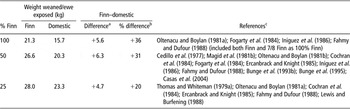
Weight of lamb weaned per ewe exposed, a composite trait dependent upon ewe fertility, ewe prolificacy, lamb survival to weaning and lamb weaning weight for Finnsheep, Finnsheep-cross and domestic and domestic-cross ewes are presented in Table 6. Due largely to their superior litter size, Finnsheep and Finnsheep-cross ewes weaned 20% to 36% more weight of lamb per ewe exposed than did domestic or domestic-cross ewes. Only the studies of Oltenacu and Boylan (Reference Oltenacu and Boylan1981a and Reference Oltenacu and Boylan1981b) adjusted lamb survival and lamb weaning weight for size of the litter in which the lamb was born before calculating the weight of lamb weaned per ewe exposed. Therefore, Oltenacu and Boylan’s (Reference Oltenacu and Boylan1981a, Reference Oltenacu and Boylan1981b) estimates of superiority of Finnsheep and Finnsheep-cross ewes were higher than the averages reported in Table 6. However, when the results of these two studies were deleted from the averages, Finnsheep and Finnsheep-cross ewes still weaned 15% to 30% more weight of lamb per ewe exposed than domestic and domestic-cross ewes.
Mean weight of lamb weaned per ewe exposed, averaged across studies, of Finnsheep (Finn), Finn-cross, and domestic/domestic-cross ewes in North America

aDifference between the Finn and Domestic means in each row.
b((Finn mean–domestic mean)/domestic mean) × 100.
cStudies included ewes of various ages lambing in various seasons.
Finnsheep out-of-season breeding
The ability of ewes to conceive to a spring mating is critical for production systems that wish to lamb once-per-year in the autumn or for accelerated lambing systems where ewes have the possibility to lamb every 7 to 8 months. Two domestic breeds that have been commonly used in autumn lambing or accelerated lambing systems in North America are the Dorset and Rambouillet due to their greater conception rates to a spring mating compared to many other domestic breeds.
Comparisons between ewes of Finnsheep breeding and ewes of domestic breeding for length of the breeding season have been made in North America. In Saskatchewan, Canada, F1 mature Rambouillet × Finnsheep and Columbia × Finnsheep ewes had an average length of 213.5 days of breeding season (average date of first estrus: August 9, average date of last estrus: April 8), and mature Rambouillet and Columbia ewes had an average length of 155.5 days of breeding season (average date of first estrus: August 12, average date of last estrus: March 18; Jeffcoate et al., Reference Jeffcoate, Rawlings and Howell1984). Likewise, January- and February-born ewe lambs in central California, USA, of Finnsheep and Finnsheep × Dorset breeding had longer (P < 0.05) breeding seasons than Suffolk, Rambouillet and Dorset ewe lambs by 28 or more days when measured from the first to the last ovulation and by 40 or more days when measured from the first to the last estrus (Quirke et al., Reference Quirke, Stabenfeldt and Bradford1985). Jenkins and Ford (Reference Jenkins and Ford1982) found that 50% Finnsheep, 25% Dorset and 25% Rambouillet mature ewes had 24 days longer (P < 0.01) length of estrous activity than mature Morlam ewes (a composite breed containing Merino, Dorset Horn, Targhee, Columbia and Southdale breeding selected for a long breeding season) in Central Nebraska, USA. In the Jenkins and Ford (Reference Jenkins and Ford1982) study, the greatest advantage of Finn-cross ewes over Morlam ewes in percentage of ewes detected in estrus occurred in April and May while Morlam ewes actually had a higher percentage of ewes detected in estrus in August compared to Finn-cross ewes. Very few ewes of either breed group exhibited estrus in June or July. A similar pattern of estrous activity was reported by Lamberson and Thomas (Reference Lamberson and Thomas1982) with mature ewes in Western Oregon, USA. Ewes of 50% Finnsheep breeding had a higher percentage of ewes exhibiting estrus in April and May and a lower percentage of ewes exhibiting estrus in August compared to mature ewes of 50% Dorset breeding. These studies on estrous activity suggest that ewes of Finnsheep breeding would be more successful in an autumn lambing program than many domestic breeds in North America, especially if matings took place during the months of April or May.
However, actual trials comparing ewes of Finnsheep breeding with ewes of domestic breeding for conception rates to once-per-year spring mating have generally not given the results predicted by the estrous activity studies. Thomas and Whiteman (Reference Thomas and Whiteman1979b) in Oklahoma, USA and Notter and McClaughterty (Reference Notter and McClaughterty1991) in Virginia, USA evaluated the effect of substituting 25% Finnsheep breeding for 25% Rambouillet breeding on spring- and summer-mating conception rates. The substitution of 25% Finnsheep for Rambouillet breeding had no effect on ewe conception rate in Notter and McClaughterty’s (Reference Notter and McClaughterty1991) study, and decreased (P < 0.05) conception rate by 24% in Thomas and Whiteman’s (Reference Thomas and Whiteman1979b) study. In the study of Iniguez et al. (Reference Iniguez, Bradford and Mwai1986) conducted with mature ewes in Central California, USA, Rambouillet, Dorset, Finnsheep and reciprocal F1 ewes among these three breeds were exposed to rams from April through September each year for 2 years, and average lambing dates were determined. All breed groups with Finnsheep breeding had later lambing dates than all breed groups with no Finnsheep breeding. There was a 21-day later average lambing date for the breed groups with Finnsheep breeding, indicating no advantage in conception rate in April and May for the Finnsheep breed compared to the Dorset and Rambouillet breeds. Only a more recent study (Casas et al., Reference Casas, Freking and Leymaster2005) utilizing a March or May breeding season in central Nebraska, USA showed an advantage in conception rate of 50% Finnsheep ewes (81.9% conception rate) over 50% Dorset (72.5%), 50% Texel (70.9%) and 50% Montadale (69.8%) ewes.
A common program of accelerated lambing is to give ewes the opportunity to lamb every 8 months with breeding seasons in spring (e.g. April), winter (e.g. December) and summer (e.g. August). When Finnsheep or Finnsheep-cross ewes have been compared to Suffolk ewes, a breed known to have a short breeding season, the ewes of Finnsheep breeding have had much greater overall fertility under an accelerated lambing program compared to Suffolk ewes (Fogarty et al., Reference Fogarty, Dickerson and Young1984; Hackett and Wolynetz, Reference Hackett and Wolynetz1985; Rawlings et al., Reference Rawlings, Jeffcoate and Howell1987). When Finnsheep and Finnsheep-cross ewes were compared to Dorset, Dorset-cross, Rambouillet or Rambouillet-cross ewes for fertility under an accelerated lambing program, the breeds have tended to rank from the highest to the lowest: Dorset, Finnsheep and Rambouillet; but differences between the breeds have been very small (Notter and Copenhaver, Reference Notter and Copenhaver1980a; Dzakuma et al., Reference Dzakuma, Stritzke and Whiteman1982; Fogarty et al., Reference Fogarty, Dickerson and Young1984; Vesely and Swierstra, Reference Vesely and Swierstra1986; Rawlings et al., Reference Rawlings, Jeffcoate and Howell1987; Fahmy, Reference Fahmy1990; Mohammed-Yusuff et al., Reference Mohammed-Yusuff, Dickerson and Young1992). Of course, the increased prolificacy of ewes of Finnsheep breeding over ewes of domestic breeding resulted in greater lamb production per ewe from ewes of Finnsheep breeding under an accelerated lambing program.
Finnsheep carcass traits
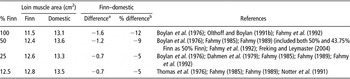
It is quite obvious from a visual observation of Finnsheep that they lack the muscle conformation of many other breeds of sheep found in North America, which would lead one to assume that they would produce a less desirable carcass. An objective measure of muscle size, the cross-sectional area of the Longissimus dorsi muscle between the 12th and 13th ribs (loin muscle area), confirms this lack of natural muscling in lambs of Finnsheep breeding (Table 7). Finnsheep and Finnsheep-cross lambs had 5% to 12% smaller loin muscle areas than domestic and domestic-cross lambs.
Mean loin muscle area, averaged across studies, of Finnsheep (Finn), Finn-cross and domestic/domestic-cross lambs in North America

aDifference between the Finn and domestic means in each row.
b((Finn mean–domestic mean)/domestic mean) × 100.
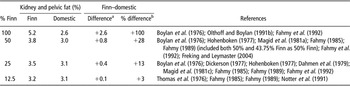
A unique carcass characteristic of Finnsheep lambs is the greater amount of internal fat in the abdominal cavity compared to many other breeds (Table 8). Pure Finnsheep lambs had twice the percentage of their carcass weight in kidney and pelvic fat compared to domestic and domestic-cross lambs. While the percentage of kidney and pelvic fat was much less in Finnsheep-crosses than in pure Finnsheep lambs, the Finnsheep-crosses still had 3% to 28% more internal fat than domestic and domestic-cross lambs.
Mean percentage kidney and pelvic fat of carcass weight, averaged across studies, of Finnsheep (Finn), Finn-cross and domestic/domestic-cross lambs in North America

aDifference between the Finn and Domestic means in each row.
b((Finn mean–domestic mean)/domestic mean) × 100.
Differences between carcasses from lambs with and without Finnsheep breeding for the depth of subcutaneous fat were variable across studies. Of 13 studies that evaluated fat depth, six studies found Finnsheep and Finnsheep-crosses to be fatter than domestic and domestic-crosses (Dahmen et al., Reference Dahmen, Hinman, Jacobs and Everson1979; Fahmy, Reference Fahmy1985; Fahmy, Reference Fahmy1989; Notter et al., Reference Notter, Kelly and McClaughterty1991; Fahmy et al., Reference Fahmy, Boucher, Poste, Gregoire, Butler and Comeau1992; Freking and Leymaster, Reference Freking and Leymaster2004), and seven studies found Finnsheep and Finnsheep-crosses to be the same or leaner than domestic and domestic-crosses (Boylan et al., Reference Boylan, Berger and Allen1976; Thomas et al., Reference Thomas, Whiteman and Walters1976; Dickerson, Reference Dickerson1977; Hohenboken, Reference Hohenboken1977; Magid et al., Reference Magid, Swanson, Brinks, Dickerson and Smith1981a and Reference Magid, Swanson, Brinks, Dickerson, Crouse and Smith1981c; Olthoff and Boylan, Reference Olthoff and Boylan1991b). On average, across the 13 studies, differences between carcasses from lambs with and without Finnsheep breeding were very small; lambs with Finnsheep breeding had 0.01 mm less subcutaneous fat depth than lambs without Finnsheep breeding.
Finnsheep fleece traits
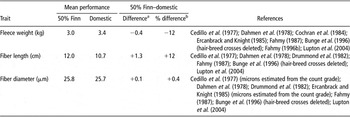
Most comparative breed studies for fleece traits compared fleeces of ewes of 50% Finnsheep breeding to fleeces of domestic and domestic-cross ewes, and a summary of the results from these studies is presented in Table 9. Ewes of 50% Finnsheep breeding produced fleeces that were 12% lighter but with fibers that were 12% longer than fleeces of domestic and domestic-cross ewes. Finnsheep fleeces are popular among fiber artists and craftspeople because of their long fiber length and bright luster (e.g. Firefly Fields, 2009).
Means for fleece traits, averaged across studies, of 50% Finnsheep and domestic/domestic-cross ewes in North America

aDifference between the 50% Finn and domestic means in each row.
b((50% Finn mean–domestic mean)/domestic mean) × 100.
Averaged across studies, fiber diameter was not different between fleeces from 50% Finnsheep ewes and fleeces from ewes of domestic breeding (Table 9). However, the domestic breeds in these studies that were compared to the 50% Finnsheep ewes varied greatly in fiber diameter from Merino and Rambouillet (small fiber diameter) to Cheviot and Romney (large fiber diameter). Ewes of 50% Finnsheep breeding produced fleeces that were approximately 2 microns greater in fiber diameter than the average of the finer-wooled breeds of Merino, Rambouillet, Targhee and Columbia and approximately 2 microns lower in fiber diameter than the average of the medium- and coarse-wooled breeds of Border Leicester, Cheviot, Dorset, Montadale, Panama, Romney, Suffolk and Texel.
Many of the animals in small Finnsheep flocks that are maintained primarily for their specialty fleeces will contain a large number of animals with natural colored (non-white) fleeces. An importation of Finnsheep semen to the United States from Finland was made in 1998, specifically to access colored fleece genetics (Firefly Fields, 2009).
Summary of Finnsheep performance
The Finnsheep was originally brought to North America because of its high reproductive rate, as reported in European studies. Comparative breed studies conducted in North America confirmed the breed’s exceptional reproductive performance. Compared to ewes of domestic breeding, ewes of 100%, 50% and 25% Finnsheep breeding had 36% to 77% higher conception rates as ewe lambs, 3% to 11% higher conception rates at older ages, and 20% to 71% greater litter sizes. Even though lambs of Finnsheep breeding (12.5% to 100%) had similar survival rates and lower weaning weights (−3% to −21%; both traits unadjusted for litter size), ewes of Finnsheep breeding still weaned 20% to 36% more weight of lamb per ewe exposed than domestic or domestic-cross ewes.
Ewes of Finnsheep breeding had similar fertility to spring mating or under an accelerated lambing program compared to ewes of Dorset or Rambouillet breeding, two domestic breeds recognized for greater spring fertility rates; but lamb production per ewe with spring mating or under an accelerated lambing program was still higher for ewes of Finnsheep breeding compared to ewes of domestic breeding due to their greater prolificacy.
Lambs of Finnsheep breeding had similar or slightly poorer postweaning BW gains compared to domestic and domestic-cross lambs, and Finnsheep breeding resulted in poorer carcasses (5% to 12% less loin muscle area and 3% to 100% more kidney and pelvic fat) compared to domestic breeding.
Even though Finnsheep fleeces are lighter in weight than fleeces of many domestic breeds, they are valued by fiber artisans because of their longer fiber length and brighter luster.
Romanov v. Finnsheep
The Romanov breed was imported into North America in 1981, 25 years after the Finnsheep, and therefore, fewer comparative studies with the Romanov have been conducted and published than with the Finnsheep. A search of the literature produced 32 papers in refereed journals with comparative data on the Romanov breed in North America. Since the Romanov, like the Finnsheep, was imported due to its reputation for high reproductive rate and since there is a large volume of North American literature on the comparative performance of the Finnsheep breed with domestic breeds, this paper will limit itself to a review of studies that have compared ewes and lambs of Romanov and Finnsheep breeding in North America.
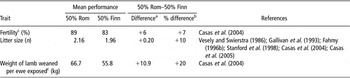
Studies that compared ewes and lambs of 50% Finnsheep breeding with ewes and lambs of 50% Romanov breeding were most numerous in the literature, and the results of these studies are summarized in Tables 10 to 12. Ewes of 50% Romanov breeding had 7% greater fertility (autumn mating), 10% larger litters (autumn and spring matings) and weaned 20% more weight of lamb per ewe exposed than did ewes of 50% Finnsheep breeding (autumn mating; Table 10). The Romanov also was superior to the Finnsheep for fertility and lamb production in once-per-year spring mating or under an accelerated lambing program (Fahmy, Reference Fahmy1996b; Stanford et al., Reference Stanford, Wallins, Jones and Price1998; Casas et al., Reference Casas, Freking and Leymaster2005).
Means for reproductive performance and lamb production, averaged across studies, of 50% Romanov (Rom) and 50% Finnsheep (Finn) ewes in North America

aDifference between the 50% Romanov and 50% Finnsheep means in each row.
b((50% Romanov mean–50% Finnsheep mean)/50% Finnsheep mean) × 100.
cFall mating.
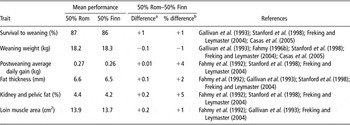
Means for survival, growth, and carcass traits, averaged across studies, of 50% Romanov (Rom) and 50% Finnsheep (Finn) lambs in North America

aDifference between the 50% Romanov and 50% Finnsheep means in each row.
b((50% Romanov mean–5% Finnsheep mean)/50% Finnsheep mean) × 100.
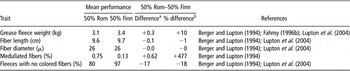
Means for fleece traits, averaged across studies, of 50% Romanov (Rom) and 50% Finnsheep (Finn) ewes in North America

aDifference between the 50% Romanov and 50% Finnsheep means in each row.
b((50% Romanov mean–50% Finnsheep mean)/50% Finnsheep mean) × 100.
Survival, growth and carcass traits were very similar between lambs of 50% Finnsheep and 50% Romanov breeding with a 5% or less difference between the two breeds for all traits (Table 11).
Ewes of 50% Romanov breeding produced fleeces that were 10% heavier than fleeces produced by 50% Finnsheep ewes; however, fiber length and diameter were similar between the two breeds (Table 12). Larger differences between the two breeds existed for percentage of medullated fibers and fleeces with colored fibers. Ewes of 50% Romanov breeding produced fleeces with 4.8 times more medullated fibers and had 18% fewer fleeces without any colored fibers compared to ewes of 50% Finnsheep breeding. Even though the fleeces of F1 Romanov-sired ewes generally appear to be white, the large number of medullated and colored fibers results in very undesirable fleeces for the commercial wool industry.
Summary of Romanov performance
Ewes of 50% Romanov breeding are superior to ewes of 50% Finnsheep breeding for reproductive rate and lamb production per ewe under both autumn and spring matings and under an accelerated lambing program. The few studies that have compared pure Finnsheep and Romanov ewes for reproductive rate (Fahmy, Reference Fahmy1996b; Stanford et al., Reference Stanford, Wallins, Jones and Price1998; Shrestha et al., Reference Shrestha, Boylan and Rempel2008b) also have found Romanov ewes to be superior to Finnsheep ewes. Lambs of 50% Finnsheep or Romanov breeding are similar for survival, growth and carcass traits. Crossbred Romanov ewes may produce heavier fleeces than crossbred Finnsheep ewes, but the Romanov-cross fleeces are heavily contaminated with medullated and colored fibers and of very low commercial value.
When deciding between the Romanov or Finnsheep breed for production of commercial crossbred ewes, the higher lamb production of Romanov crosses needs to be evaluated against the higher fleece value of Finnsheep crosses. Recent commercial lamb and wool values in North America would favor lamb production over wool production and give preference to the Romanov breed.
Other NEST breeds
There are no North American breed evaluation studies in the refereed scientific literature that have included the Shetland, Icelandic or Gotland breeds. Most of the animals of these breeds are found in small flocks and are raised primarily for their unique fleeces that are used by fiber craftspeople and artists. The niche market for such fleeces is growing, and breeds that produce these types of fleeces are growing in popularity as evidenced by an increase in the number of Shetland (CLRC, 2009; Deakin, Reference Deakin2009) and Icelandic (CLRC, 2009) sheep registered between 2000 and 2008, especially in the United States.
New breed formation in North America
Three new maternal composites utilizing various proportions of Finnsheep breeding have been developed in Canada (Outaouais Arcott, Rideau Arcott) and the United States (Polypay). These three composites are recognized breeds and are represented by official associations that maintain pedigrees and promote their respective breed.
Arcotts
The Outaouais Arcott and Rideau Arcott composites were developed by a Canadian government research institute, the Centre for Food and Animal Research (formerly Animal Research Institute), at Ottawa, Ontario, Canada (Shrestha and Heaney, Reference Shrestha and Heaney2003). The base populations were assembled from 1966 to 1972 and then closed to outside breeding. Minimal selection was practiced through 1981. From 1982, selection of replacement ewe and ram lambs in both populations was primarily on the prolificacy of their dams and their maternal and paternal grand-dams with secondary emphasis on heavy lamb BW. The composites were recognized as official Canadian breeds of sheep in 1989 and released to the industry (Shrestha and Heaney, Reference Shrestha and Heaney2004).
The Outaouais Arcott is estimated to be 49% Finnsheep, 26% Shropshire and 21% Suffolk breeding with <1% additional contribution from each of the following breeds: Ile de France, East Friesian, Dorset, North Country Cheviot, Leicester and Romnelet (Shrestha and Heaney, Reference Shrestha and Heaney2003). The Rideau Arcott is estimated to be 40% Finnsheep, 20% Suffolk, 14% East Friesian, 9% Shropshire and 8% Dorset breeding with <1% additional contribution from each of the following breeds: North Country Cheviot, Leicester, Romnelet and Corriedale (Shrestha and Heaney, Reference Shrestha and Heaney2003). As might be expected given the breed composition of these new breeds, they have slightly lower prolificacy and significantly heavier lambs at weaning than the Finnsheep breed, but they produce a similar total weight of lamb weaned per ewe as the Finnsheep breed (Shrestha and Heaney, Reference Shrestha and Heaney1992).
Polypay
Initial development of the Polypay breed started in 1968 at the US Sheep Experiment Station (USSES), Dubois, Idaho, a government research station of the United States Department of Agriculture. The Polypay is a four-breed composite containing approximately 25% of each of the following breeds: Dorset, Finnsheep, Rambouillet and Targhee. Within a few years of formation of the initial composite population, a few private breeders purchased composites from the USSES and, in conjunction with the USSES, developed the breed (APSA, 2009).
At the USSES in 1968, Dorset rams were mated to Targhee ewes and Finnsheep rams were mated to Rambouillet ewes. Selected F1 ewe and ram lambs from these matings were mated reciprocally in 1969 to produce the first four-breed composites. Additional matings between the two two-breed crosses to produce new four-breed composites and inter se matings among the four-breed composites followed for several years. Primary selection emphasis in ewe replacements was on dam’s lamb production when given an opportunity to lamb twice per year plus each ewe’s own lambing performance at 12 to 14 months of age. Rams were selected on dam’s lifetime lamb production plus their own growth rate from birth to weaning (Hulet et al., Reference Hulet, Ercanbrack and Knight1984). The American Polypay Sheep Association was formed in 1980 (APSA, 2009).
Contemporary to the Polypay flock at USSES, inter se-mated and selected flocks of Dorset–Targhee and Finnsheep–Rambouillet flocks were maintained. With autumn mating, the Finnsheep–Rambouillet ewes gave birth to the most lambs per ewe mated, but the Polypay ewes weaned the greatest weight of lamb per ewe mated among the three groups. With spring mating, the Polypay ewes were superior to the other two groups for both traits (Hulet et al., Reference Hulet, Ercanbrack and Knight1984).
Industry utilization of NEST breeds and their composites in North America
The NEST breeds and their composites are medium-to-small in body size and excel for reproductive rate or the production of specialty fleeces. Therefore, they are classified as maternal breeds and are used in purebreeding, as straightbred ewes mated to meat-breed terminal sires, or in the production of crossbred ewes to be mated to meat-breed terminal sires.
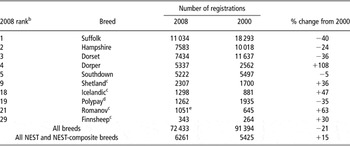
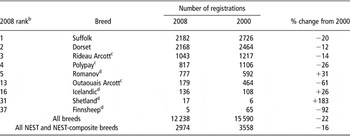
Estimates of the total number of sheep by breed in the United States and Canada are not available. However, the number of new purebred animals registered annually of each breed is available and is an indication of the relative popularity of each breed. Tables 13 and 14 present the number of purebred animals registered in 2008 of the top five breeds and all the NEST and NEST-composite breeds in the United States and Canada, respectively.
Annual purebred registrations of Northern European short-tailed (NEST), NEST-composite and other popular breeds of sheep in the United States in 2008 and 2000Footnote a

a Sources: North American Romanov Sheep Association (2008) (personal communication), CLRC (2009), Deakin (Reference Deakin2009).
b Among 35 breeds with registration numbers in 2008.
c NEST breed.
d NEST-composite breed.
e 2007 registration numbers.
Annual purebred registrations of Northern European short-tailed (NEST), NEST-composite and other popular breeds of sheep in Canada in 2008 and 2000Footnote a

a Source: CLRC (2009).
b Among 37 breeds with registration numbers in 2008.
c NEST-composite breed.
d NEST breed.
The NEST and NEST-composite breeds accounted for a minority of all breed registrations in both the United States (8.6%) and Canada (24.3%) in 2008, but these percentages are higher than in 2000 (5.9% and 22.8%, respectively), indicating an increased interest in the NEST and NEST-composite breeds relative to other breeds over the past 9 years. In the United States, there has been a 15% increase in NEST and NEST-composite registrations from 2000 to 2008 while registrations of all breeds decreased by 21% during the same period. While the number of registrations of NEST and NEST-composite breeds in Canada decreased from 2000 to 2008, the percentage decrease was less than for all breeds (−16% and −22%, respectively).
In Canada, the Rideau Arcott, Polypay and Romanov breeds ranked among the top five breeds for registrations in 2008 indicating an active interest among Canadian sheep producers in the lamb production advantages of these breeds. In contrast, the most popular NEST breeds in the United States in 2008 were the Shetland and Icelandic, and both breeds have shown large increases in number of registrations from 2000. The large amount of interest in the Shetland and Icelandic breeds is largely due to the unique fleeces produced by both breeds that are desired by wool craftspeople and fiber artists. The number of people in the United States who knit or crochet with yarn is estimated to be approximately 38 million; the numbers are increasing (CYCA, 2009), and these people prefer unique and natural fibers.
Romanov registrations have increased between 2000 and 2008 in both the United States and Canada, suggesting some increased interest in both countries among commercial producers in maximizing lamb production per ewe. While the Finnsheep was the first of the NEST breeds to be imported into North America, and it made valuable contributions to three popular composite breeds (Polypay, Rideau Arcott and Outaouais Arcott), the Finnsheep breed itself is not popular. It ranked 29th out of 35 breeds in the United States and 37th out of 37 breeds in Canada for the number of registrations in 2008. Commercial producers interested in increasing the number of lambs raised per ewe appear to be moving toward the Romanov breed for the production of crossbred ewes if very large litters are desired or to the direct use of Polypay or Rideau Arcott ewes to obtain relatively high litter sizes without having to resort to a crossbreeding program to produce maternal females.