Introduction
Ascaridia galli is the most common intestinal roundworm of chickens and other domestic and wild birds, with a worldwide distribution (Abdelqader et al., Reference Abdelqader, Gauly, Wollny and Abo-Shehada2008). Chicken ascaridosis caused by A. galli has been associated with reductions in overall growth in chickens and egg production in laying hens (Ramadan & Abou Znada, Reference Ramadan and Abou Znada1991). In addition, A. galli may also play an important role in the transmission of Salmonella (Eigaard et al., Reference Eigaard, Schou, Permin, Christensen, Ekstrøm, Ambrosini, Cianci and Bisgaard2006) infection, and enhances infection with Pasteurella multocida (Dahl et al., Reference Dahl, Permin, Christensen, Bisgaard, Muhairwa, Petersen, Poulsen and Jensen2002), posing a threat to the health of chickens and other birds, and causing economic losses to the poultry industry. Currently, chicken ascaridosis control is predominantly dependent on anthelmintic treatment with benzimidazole and flubendazole (Höglund & Jansson, Reference Höglund and Jansson2011). Other strategies for controlling this parasite include housing systems, hygiene and management practices. Despite good efforts to control this avian roundworm, the prevalence of this parasite is still very high in populations of chickens, and several surveys have reported prevalences varying from 22 to 64% in some countries (Permin & Ranvig, Reference Martín-Pacho, Montoya, Arangüena, Toro, Morchón, Marcos-Atxutegi and Simón2001; Martín-Pacho et al., Reference Martín-Pacho, Montoya, Arangüena, Toro, Morchón, Marcos-Atxutegi and Simón2005; Abdelqader et al., Reference Abdelqader, Gauly, Wollny and Abo-Shehada2008).
Recent years have witnessed the ready availability of molecular approaches for studying the taxonomy, systematics and population genetics of animals. Mitochondrial DNA (mtDNA) sequences have been proven to be useful and reliable genetic markers due to their maternal inheritance, fast rate of evolutionary change and relatively conserved genome structures compared to the nuclear ribosomal genome (McManus & Bowles, Reference McManus and Bowles1996; Blouin, Reference Blouin2002). To date, genetic variability in a number of parasites of socio-economic significance has been studied, including nematodes, trematodes and cestodes (Li et al., Reference Li, Lin, Song, Sani, Wu and Zhu2008; Zhao et al., Reference Zhao, Mo, Zou, Weng, Lin, Xia and Zhu2009; Cerutti et al., Reference Cerutti, Citterio, Bazzocchi, Epis, D'Amelio, Ferrari and Lanfranchi2010; Dai et al., Reference Dai, Liu, Song, Lin, Yuan, Li, Huang, Liu and Zhu2012; W. Liu et al., Reference Liu, Liu, Li, He, Wang, Sheng, Zeng, Yang and Liu2012). However, there is a paucity of information on sequence variability among populations of A. galli of socio-economic significance.
The objectives of the present study were to examine sequence variability in three mtDNA genes, namely cytochrome c oxidase subunit 3 (cox3) and NADH dehydrogenase subunits 1 and 4 (nad1 and nad4), among A. galli isolates from different geographical origins in China. Based on the combined sequences of these three mtDNA regions, phylogenetic relationships of A. galli in China with other roundworms were also re-constructed.
Materials and methods
Parasites and DNA extraction
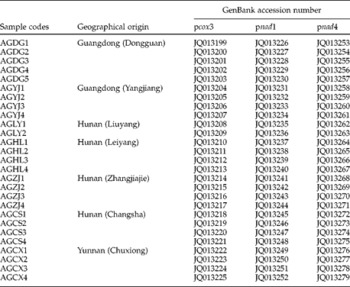
All adult worms of A. galli (n= 27) were obtained from free-range adult chickens, located in different regions of China, which were naturally infected with A. galli. These samples were fixed in 70% (v/v) ethanol and stored at − 20°C until use. Total genomic DNA was extracted from individual samples using sodium dodecyl sulphate (SDS)/proteinase K treatment, followed by spin column purification (TIANamp Genomic DNA Purification System, Tiangen, Beijing, China) and eluted into 50 μl water according to the manufacturer's recommendations. The sample codes, geographical origins and GenBank accession numbers are listed in table 1.
Geographical origins in China of Ascaridia galli samples used in the present study, as well as their GenBank accession numbers for sequences of partial mitochondrial cytochrome c oxidase subunit 3 gene (pcox3), and NADH dehydrogenase subunits 1 and 4 genes (pnad1 and pnad4).

AGDG and AGYJ represent Ascaridia galli samples from chickens in Dongguan and Yangjiang cities, Guangdong province, respectively; AGLY, AGHL, AGZJ and AGCS represent A. galli samples from chickens in Liuyang, Leiyang city, Zhangjiajie and Changsha cities, Hunan province respectively; AGCX represents A. galli samples from chickens in Chuxiong city, Yunnan province.
Enzymatic amplification and sequencing
The primer sets for amplifying cox3 (AGcox3F: 5′-TGGTATTTTCTGGACTTTTTTTGAT-3′; AGcox3R: 5′-CCAAACTACATCTACAAAATGCCAA-3′) and nad4 (AGnad4F: 5′-CTTATTATTTAATTTTTTATGCTGCT-3′; AGnad4R: 5′-AAGCGGCTAAAGCCTTAGCATCACT-3′) were designed based on well-conserved sequences among the distantly related taxa Ascaris suum (NC_001327), Anisakis simplex s.l. (NC_007934) and Toxocara malaysiensis (NC_010527). The nad1 was amplified with primers JB11 (5′-AGATTCGTAAGGGGCCTAATA-3′) and JB12 (5′-ACCACTAACTAATTCACTTTC-3′) (Bowles & McManus, Reference Bowles and McManus1993). Polymerase chain reactions (PCR) (25 μl) were performed in 3.0 μl of MgCl2 (25 mm), 0.25 μl of each primer (50 pmol/μl), 2.5 μl 10 × rTaq buffer (100 mm Tris–HCl and 500 mm KCl), 2 μl of deoxynucleoside triphosphate (dNTP) mixture (2.5 mm each), 0.25 μl of rTaq (5 U/μl) DNA polymerase (TaKaRa Biotechnology, Dalian, China) and 2 μl of DNA sample in a thermocycler (Biometra, Göttingen, Germany). The cycling conditions were: 94°C for 5 min (initial denaturation), followed by 35 cycles of 94°C for 30 s (denaturation), 55°C (for pnad4) or 50°C (for pcox3 and pnad1) for 30 s (annealing), 72°C for 1 min (extension) and then 72°C for 5 min (final extension). A negative control (without DNA template) was included in each amplification run. Each amplicon (5 μl) was examined by 1% (w/v) agarose gel electrophoresis to validate amplification efficiency. PCR products were sent to Sangon Company (Shanghai, China) for sequencing from both directions.
Sequence analysis and reconstruction of phylogenetic relationships
Sequences of the three mitochondrial genes were separately aligned using the software Clustal X 1.83 (Thompson et al., Reference Thompson, Gibson, Plewniak, Jeanmougin and Higgins1997). The level of sequence differences (D) among A. galli isolates were calculated by pairwise comparisons using the formula D= 1 − (M/L), where M is the number of alignment positions at which the two sequences have a base in common, and L is the total number of alignment positions over which the two sequences are compared (Chilton et al., Reference Chilton, Gasser and Beveridge1995).
The haplotypes, nucleotide diversity (Pi) and haplotype diversity (Hd) of each gene were determined using the DnaSP 5.0 program (Librado & Rozas, Reference Librado and Rozas2009). The combined sequences of pcox3, pnad1 and pnad4 of all samples in this study were used for phylogenetic analyses. Three inference methods, namely Bayesian analysis (Bayes), maximum likelihood (ML) and maximum parsimony (MP), were used for phylogenetic reconstructions. Bayesian analyses were conducted with four independent Markov chains run for 1,000,000 metropolis-coupled MCMC generations, sampling a tree every 1000 generations in MrBayes 3.1.1 (Ronquist & Huelsenbeck, Reference Ronquist and Huelsenbeck2003). The first 250 trees were omitted as burn-in and the remaining trees were used to calculate Bayesian posterior probabilities (PP). ML analyses were performed using PhyML 3.0 Online execution (http://www.atgc-montpellier.fr/phyml) (Guindon et al., Reference Guindon, Dufayard, Lefort, Anisimova, Hordijk and Gascuel2010), and the GTR+I+G model with its parameter for the concatenated dataset was determined for the ML analysis using JModeltest (Posada, Reference Posada2008) based on the Akaike information criterion (AIC). Bootstrap support for ML trees was calculated using 100 bootstrap replicates. MP analysis was performed using PAUP* 4.0b10 (Swofford, Reference Swofford2002), with indels treated as missing character states. A total of 1000 random addition searches using tree bisection-reconnection (TBR) branch swapping were performed for each MP analysis. Bootstrap probability (BP) was calculated from 1000 bootstrap replicates with 10 random additions per replicate in PAUP. To study the phylogenetic relationships with other roundworm species, A. suum, A. simplex s.l., T. malaysiensis, Toxocara cati (NC_010773), Toxocara canis (NC_010690) and Contracaecum rudolphii B (FJ905109) were considered in the present study, with Ancylostoma duodenale (NC_003415) as the outgroup. Phylograms were drawn using the Tree View program version 1.65 (Page, Reference Page1996).
Results and discussion
Genomic DNA was isolated from 27 individual adult A. galli (table 1). Amplicons of pcox3, pnad1 and pnad4 (approximately 460 bp, 520 bp and 390 bp, respectively) were amplified individually and subjected to agarose gel electrophoresis. For each mtDNA region, no product was amplified from the ‘no DNA’ sample or host DNA control (not shown).
To examine sequence variation in the three mtDNA regions among A. galli isolates from the three different provinces in China, amplicons of pcox3, pnad1 and pnad4 were subjected to direct sequencing. The sequences of pcox3, pnad1 and pnad4 were 408 bp, 471 bp and 333 bp in size, respectively. The A+T contents of the sequences were 67.16–67.65% (pcox3), 67.09–67.94% (pnad1) and 69.91–71.77% (pnad4), respectively. Fourteen haplotypes, nucleotide diversity (Pi = 0.007) and haplotype diversity (Hd = 0.926) were determined among pcox3 sequences. Fifteen haplotypes, nucleotide diversity (Pi = 0.009) and haplotype diversity (Hd = 0.940) were determined among pnad1 sequences. Seventeen haplotypes, nucleotide diversity (Pi = 0.009) and haplotype diversity (Hd = 0.957) were determined among pnad4 sequences. These haplotypes represent a significant level of genetic variations among the examined A. galli populations. In addition, haplotype diversity was higher in the nad4 gene than in nad1 and cox3 genes. To our knowledge, this is the first time that the Hd and Pi in A. galli have been reported.
While the interspecific sequence differences among members of the Ascaridida were significantly higher, being 13.2–30.9%, 12.8–29.0% and 15.1–34.1% for pcox3, pnad1 and pnad4, the intraspecific sequence variations among different populations of A. galli isolates were 0–1.7% for pcox3, 0–2.8% for pnad1 and 0–3.4% for pnad4. These results were consistent with those of previous studies (Ai et al., Reference Ai, Chen, Alasaad, Elsheikha, Li, Li, Lin, Zou, Zhu and Chen2011; G.H. Liu et al., Reference Liu, Li, Li, Song, Lin, Cai, Zou, Yan, Yuan, Zhou and Zhu2012). Similarly, sequence variability has also been detected among populations of the members of the genus Toxocara, such as T. canis, T. cati, T. malaysiensis and T. vitulorum, by analysis of mtDNA sequences (Li et al., Reference Li, Lin, Song, Sani, Wu and Zhu2008). Comparative analysis of different geographical isolates of A. galli from the same province revealed genetic variations for pcox3, pnad1 and pnad4. For example, sequence variations in pcox3 were 0–1.5% among samples from Hunan province, 0–1.2% among samples from Guangdong province and 0.5–1.2% among samples from Yunnan province. Sequence variations in pnad1 were 0–2.5% for samples from Hunan province, 0–1.3% for samples from Guangdong province and 0.4–1.3% for samples from Yunnan province. Sequence variations in pnad4 were 0–2.1% for samples from Hunan province, 0–1.2% for samples from Guangdong province and 0.6–1.8% from Yunnan province.
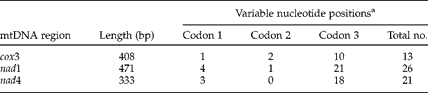
For pcox3, pnad1 and pnad4, intraspecific nucleotide variations were related mainly to changes at third codon positions, while fewer changes were detected at first and second codon positions (table 2), consistent with results from other helminths (Li et al., Reference Li, Lin, Song, Sani, Wu and Zhu2008; Zhao et al., Reference Zhao, Mo, Zou, Weng, Lin, Xia and Zhu2009; Dai et al., Reference Dai, Liu, Song, Lin, Yuan, Li, Huang, Liu and Zhu2012). Intraspecific nucleotide variations represented transitions (A ↔ G or C ↔ T; n= 10 for pcox3, n= 23 for pnad1 and n= 17 for pnad4), and transversions (A ↔ C, A ↔ T, and/or T ↔ G; n= 3 for pcox3, n= 3 for pnad1, n= 4 for pnad4).
Number and position of codon variations in a portion of the mitochondrial cytochrome c oxidase subnit 3 gene (pcox3), and NADH dehydrogenase subunits 1 and 4 genes (pnad1 and pnad4) among Ascaridia galli isolates in China.
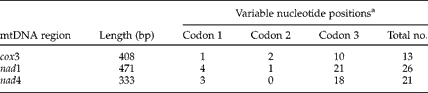
a The first codon position of each sequence was determined in relation to the complete mitochondrial DNA sequence of A. galli.
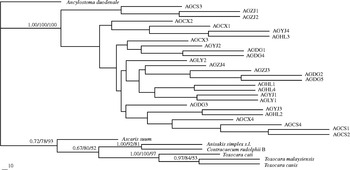
Phylogenetic analyses of the combined sequences of pcox3, pnad1 and pnad4 among 27 individual A. galli isolates from China and seven other nematodes, including A. duodenale as outgroup, using Bayes, ML and MP analyses are shown in fig. 1. Topologies of all trees inferred by different methods (Bayes, ML and MP) were identical or similar, with only the small difference of bootstrap values (fig. 1). In this tree, the Ascarididae + Toxocaridae + Anisakidae and Ascaridiidae form monophyletic groups, respectively, and all the A. galli isolates were more closely related to A. suum than to any other roundworms.
Phylogenetic relationship among A. galli isolates from different geographical locations in China with other roundworms inferred by Bayesian (Bayes), maximum likelihood (ML) and maximum parsimony (MP) analyses using the combined dataset (cox3+nad1+nad4), with Ancylostoma duodenale as outgroup.

In conclusion, sequence variations among A. galli isolates from different geographical localities in China were revealed by sequence analyses of mitochondrial cox3, nad1 and nad4 genes. The results of the present study have implications for studying molecular epidemiology and population genetics of A. galli.
Acknowledgements
This work was supported in part by the Program for Outstanding Scientists in Agricultural Research, the Open Funds of the State Key Laboratory of Veterinary Etiological Biology, Lanzhou Veterinary Research Institute, Chinese Academy of Agricultural Sciences (grant nos SKLVEB2010KFKT010 and SKLVEB2011KFKT004) and the Yunnan Provincial Program for Introducing High-level Scientists (grant no. 2009CI125).