Moving Cage
凯吉一岁 or Dear John opens in complete darkness with only a spotlight falling on choreographer and movement artist Jian Ci-yi, seen standing on an elevated platform.Footnote 1 She raises her left arm, stretches out, then tries to move her torso and subsequently her entire body, but these gestural attempts remain circumscribed by six cords attached to the sleeves and back of the jacket Jian is wearing; the lines extend to the opposite end of the performance space, where a disassembled grand piano, with lid removed and strings exposed, sits. Jian's coat is white and her garment beneath is black – this monochromatic vestment not only serves as a visual representation of the missing white-and-black keys on the misshapen piano, but also symbolically conjoins Jian's body to the sound object. Resembling a marionette, the cords pull on the exposed hammers that then strike the piano wires as Jian moves. Seemingly bemused and yet alarmed by the discordant music that is composed, consequent of the tautening strings, Jian's actions and movements become frantic, wrenching and hauling in ways that suggest she is attempting to break free from the sonic hegemony – of music ‘playing’ the performer or rhythm dictating movement – that is imposed upon her body but that she is, ironically, responsible for. There is disquietude in her expression and figure behaviour: she is uncertain whether she is manipulating or being manipulated by the acoustic output. Aurally, the dissonant frequencies and clashing tonalities, modulated by volume and interval, become metaphoric and metonymic of the axioms and anxieties of sound's dictates on and dictation of the body; listening to, and seeing, this performative event excavates questions not only of musicking (and sounding), of how human intention, perception and action construct music(al) effects and affects, but also of music and sound's actions on the body. Visually, Jian's movements, devised yet spontaneous, choreograph the conditions of sonification;Footnote 2 performatively, the mise en scène invites questions about the intimacies between motion and music, sound and embodiment.
Devised by Taiwanese experimental theatre company 动见体 (M.O.V.E. Theatre), Dear John is an intermodal choreomusical work that explores the interstices of sonification, movement and listening. M.O.V.E. Theatre is known for its original, interdisciplinary, experimental works that explore social and philosophical issues through the incorporation of various performing art forms: music, dance, multimedia and visual arts. More recently, the group has focused on physical and movement-based theatre in interplay with sound and music. In such modes, M.O.V.E. Theatre finds a unique ‘poetic theatrical vocabulary’Footnote 3 that is used to explore the ‘spiritual landscape’Footnote 4 and the human condition in contemporary society. Performed surrealistically, A Dog's House (2014), for example, engages with the darker shades of family life, familial relationships and their disintegration in contemporary Taiwanese society. Performed from an animalized point of view in which the characters seem both as dogs and as human, the performance employed text and movement to comment on the ennui of Taiwan's ‘lost age’, exemplified by the generation of young Taiwanese today who recognize that the good life of the past is lost and the future is characterized by fear, uncertainty and loneliness.Footnote 5
Dear John lacks such explicit social commentary and remains primarily a philosophical and aesthetic experimental performance that explores the intersections of sonicity and corporeality. Staged as a ‘playful sound lab’,Footnote 6 the sound installation performance is composed of various segments or, more aptly, sound events that feature different sounding devices and instruments in the attempt to restage and reinterpret John Cage's philosophies and notable works. As a devised piece, the creators sought to redefine ‘the interpretative vocabulary and the physicality of sound in [the] performing arts’.Footnote 7 Adaptive, improvised movements, at times spontaneous and at others choreographed, unfold to a soundscape of various defamiliarized sound objects: a deconstructed grand piano, sound bottles, wind chimes and sand tubes. The resultant sequence of sound events, understood as individual sounds considered in their associative meanings that occur in a certain place during a particular interval of time,Footnote 8 explore how, according to M.O.V.E, one experiences ‘sound without shape; how we hear a stationary object’.Footnote 9 While one would not quite readily agree that that objective was effectively translated as and in the performance, the acoustemologies of Dear John provoke imperative questions about the intimacies between sound(ing), listening and the moving body. This article will thus consider the interplay of movement and music, body and sonicity as intersubjective embodied experience(s). Written as a critical reflection, from a subject position based on personal reactions and micro-analyses of my own attendance at the performance, which includes observations of the performers’ choreomusical processes, my attention to spectators and my own bodily (re)actions to the soundscape and participatory practices, I will consider the ‘gradations and impacts of vibration (as in sound), [its] transmission (as in intermaterial flow)’ and the transductive effects of sound to movement, and motion to music.Footnote 10 Sonification, the embodied production and reception of sound, is active in both the performing and the listening body as intermaterial vibration, where, as Nina Sun Eidsheim posits, the body both transmits and is transformed by sound as it conceives these vibrations. Dear John's choreomusicality consequently inspires questions about the effective and affective influence of the body on sound and music on movement. With the performance considered from a vibrational perspective, one can posit how, in addition to its thoughtful interplay of sound and movement, Dear John inspires affective connectivities between spectatorial bodies – an unconscious connection effected through vibrating bodies. Additionally, sonification, movement and transmission impact time for sonic vibrations occur (and disappear) in time, as do movements that remain bound by time. As such, this article will also explore the ways sonification invites ideas of time and ‘time-less-ness’ as experienced by the listening subject given how the interplay of sound and space in Dear John engenders perceptions of atemporality and multitemporality. Sound studies and research in musical anthropology attest that music ‘has the capacity to construct unique worlds in which time is experienced in ways that are different from the quotidian order of the everyday succession of events’.Footnote 11 In Dear John, time, confronted as chronological and phenomenological, is confounded by moments of sustained cadences interjected by rapid movement and random rhythms. Interplays of ‘silence’ and sound, action and inaction, engender subjective and embodied experiences of time's multiplicity and heterogeneity, of what Henri Bergson affirms in Time and Free Will (1910) as duration.
Sonification and bodies of/as instruments
The opening event in Dear John underscores how music is not received as a ‘pure sound phenomenon but rather as a “sonic production of action”, that is, of human movements’.Footnote 12 Like Cage's works, Dear John interrogates the concept of ‘music’ and musicality. Music here is then used broadly to refer to performative sound, and this is consonant with Cage's understanding, for he notes how ‘in this new music nothing takes place but sounds’.Footnote 13 Music, this performance, is a consequence of the reciprocal interplay of movement, choreography and the sonic output. The three-minute choreomusical sequence ends with Jian struggling to be free from her white coat. When accomplished, the coat is raised to the ceiling and remains illuminated through the show. It becomes an emblematic (per)sonification of sound's bio-acoustic dimension, and while bio-acoustics is, conventionally understood, an interdiscipline of biological and acoustic studies which examines the production, reception and diffusion of sound in animals and humans, it can be aptly appropriated to describe the kinaesthetic nature of sound and the sonic nature of kinetics. The portmanteau ‘bio-acoustic’ necessarily underscores the relational intimacies between the body and the production and reception of sound, and how bodily position and movement, including proprioception, engender sonicity and receive (and react to) sound.
In the devised compositions of Dear John, the audience are not only asked to pay attention to the sound objects – the physical–material source of soundFootnote 14 – since the dramaturgical design, involving complete darkness with heavy spotlighting shone only on a specific sound event, urges the spectator–listener to locate the non-acousmatic source. They are also asked to receive the music not simply as an attempt at understanding something that is being said, for there is no implicit or explicit message, theme or concern advanced, but to focus on the ‘activity of sounds’Footnote 15 – the act(ion) of (making) sounds, and the sounds of physical action.
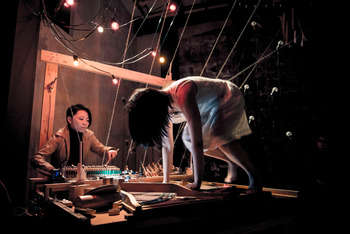
This ‘activity of sounds’ can be defined as sonification. Sonification advances a reconsideration of sound events as sounding – the process of sonicity and the act of (em)bodied listening; it does not refer simply to sound as an object(ive) (or) product but considers the causation of sound from a subject(ive) position. As Vickers, Hogg and Worrall espouse, ‘sonifications inhabit the same spatial environment as the user and so become part of the acoustic ecology and the user's embodied experience of that environment’.Footnote 16 To further exemplify sonification as necessarily embodied, in another sound event, composer and musician Lin Kuei-Ju engages with Jian in a sonic ‘dialogue’ that alludes to, and is reminiscent of, Cage's 1962 performance with Yoko Ono, Piano Walk. In that landmark performance, Ono lay on the strings of an open grand piano while Cage and collaborators Toshiro Mayuzumi and David Tudor hit the exposed piano wires with various objects.Footnote 17 Like this renowned performance that became known as ‘Keji Shokku’ (or ‘Cage Shock’), Lin here places metallic objects such as aluminium cans, tin covers and wooden blocks on the piano strings; she then uses xylophone mallets to hit wires closest to the action frame, thereby producing intense vibrations that in turn cause these objects to ‘bounce’ and ‘scratch’ against the strings’ steel casings. As this occurs, Jian attempts to silence the discordance and stem the vibrations with her palms while Lin randomly hits other strings to avoid the sonic smothering Jian causes. Jian then removes the objects sequentially and the sonification becomes altered: the timbre changes from jarring, ‘cold’, metallic screeches and clanks to more familiar and mellifluous, though atonal, reverberations of a grand piano (see Fig. 1). This exchange between Lin and Jian, body and sound, increases in intensity with this new tonal quality and Jian eventually climbs on top of the strings to silence the music, thus changing once again the sonic quality of the event. The event not only illustrates, quite literally, the reciprocal relationship between the body and sound, or the embodiedness of sonification, but is also a performative metaphor of the inter(re)actions between sound and the body – sound, even in its arrhythmicity and atonality, dictates movements as much as motion engenders sound. Sounds are a consequence of activity and ‘any sonification conveys an implicit assumption of action and movement’.Footnote 18
Tung I-fen performing Dear John in Taiwan. Photograph by M.O.V.E. Theatre.

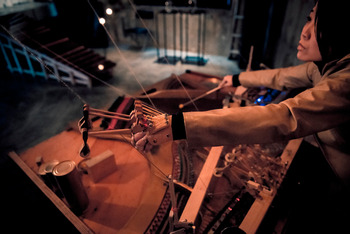
The exchange between Lin and Jian also evidences how listening is transmodal – a movement between different materialities – and involves the entire body. This event was not simply heard as a sonic exchange but was an embodied experience felt in my listening body: vibrational intensities of the piano strings were sensations that could be felt by the body and these were most evident in their interruptions. This experience evidences what Eidsheim posits: listening to, making and manifesting music are aspects of vibrational practices, transferable energy ‘pulsating through and across material and transforming as it adapts to and takes on various material qualities’.Footnote 19 The discordant ‘emotions’ consequent upon listening to the dissonant sounds that vary in volume and pitch, and the visual reception of composing bodies in competition, underscore how embodiment is necessarily a part of sonification. Watching the performers’ actions, one also recognizes how their distinct motions and movements ‘shape’ and are shaped by the sounds of the instruments used, with the most salient being Jian's manipulation of the strings in the opening sequence, and the sonicities caused by her palms (then her body) placed on the piano wires. It is, however, more curious to observe Lin, a trained pianist, adapting to unconventional methods of ‘playing’ (with) the piano, of shaping and being shaped by the sonic output, as she responds spontaneously to the acoustic vibrations. In one particular sound event, Lin strikes the piano wires with improvised mechanical hammers, resembling extended digits, affixed as appendages to Lin's fingers (see Fig. 2). These are instruments created from the sawed-off hammers of the disassembled piano. In an interview, Lin expressed how the means by which she engaged with the piano became defamiliarized; the new sonification required a new mode of performing and new psychophysical reactions. Underlying her description of this novel performativity is the view that these attached mechanical hammers and their sonic output ‘dictated’ her musicality in distinctly corporeal ways – a consequence of how the hammers serve as mechanical extensions of her body and have become part of Lin's body.Footnote 20 Instruments, then, ‘are the “body” that extends and transforms the perceptions of the users of the instrument’ in distinctly embodied ways.Footnote 21
String hammers as Lin's bodily extensions. Photograph by M.O.V.E. Theatre.

While lacking in any narrative development or sense of chronological unfolding, the sonic events interpose what is otherwise a canvas of darkened silence. Yet, as Cage would argue, there is never truly a condition of silence.Footnote 22 Reinterpreting and reworking Cage's renowned work 4′33″ and its accompanying radical philosophy, Dear John seeks to encourage the audience to hear this space of ‘silence’ and so listen to the environmental sounds that include the spectator's own breathing, shuffling feet, and micro-motions when standing still. These soundings interpose, interject and interrupt the sounds of other bodies and become a layered musical composition in themselves. Here, I relate a personal (phenomenological) reaction of being in and part of the acoustic ecology of Dear John to further posit the embodiedness of sonification and the intimate inter(re)action between sound and movement. As the performance did not offer a seated space for the audience, spectators chose to either sit, stand, move between, or approach the various performing sites of the sound event in focus. I stood at a single spot for most of the performance (and only moved closer to the grand piano in the event described above). In the moments between the sound events, I was acutely attuned to the ‘silence’, the absence of composed music, enveloping me: the basal rhythmic cough of a nearby male spectator, the low-frequency pulse of the air conditioning, the squeaks of rubber soles, the taps of heel wear, the accents in whispers. As in Cage's 4′33″ the moments between choreographed sounds led to a heightened awareness of all other sonicities in the performance space. Waiting and standing still are a challenging task and as I moved slightly, placing weight on one foot more than the other to ease the physical discomfort of strained feet, I found myself shifting to the pulse of the slow-dripping water that then choreographed involuntarily a spontaneous yet dictated micro-sway. The lack of visual action happening between the sound events and the accompanying darkness resulted in a heightened sense of listening, an increased proprioception and an acute audial awareness of space and particularly of time, thereby exemplifying Vickers, Hogg and Worrall's view that listening is ‘a very engaged activity in which the listener is [also] aware of the space around them, how they are moving in the space, and in which causality is being sought in the events being perceived through hearing’.Footnote 23 It is ‘an ecological phenomenon in which an organism experiences and interacts with its environment’.Footnote 24 Additionally, this experience evidences the intimacies between what is listened to in the environment and the ‘capacities, sensitivities, and interest of a perceiver’,Footnote 25 and this perceptual experience necessarily bears ‘the trace of an action component’,Footnote 26 a movement of the body regardless of how large this motion is. Like Cage's 4′33″, listening in Dear John becomes an ‘audio-reflexive’ experience, an encounter with the realm of ‘silence’ found within and without the body. These moments of ‘silence’ are of listening to the sounds around but also the sounds embodied, of one's own bodily sonic choreography, voluntarily or otherwise. The sounds one listens to and the sounds produced by one's body become an embodied experience of an unfolding sonic event. Silence, as Cage propounded, invites a process of acute listening and an activity of consciousness of one's body and the bodies of others.
While this experience may have been subjective, even idiosyncratic, the choreomusicality in Dear John affirms the possibility that music, though void of (predictable) harmony, rhythmicity and other characteristics of musicality, gives rise to the sensations of felt motion,Footnote 27 and these movements can be unwilled, with this encounter offering an alternative perspective to Simon Frith's belief that ‘[t]he relationship of “listening” to music and “moving” to music, is, in short, a matter of convention, as is what sort of movement to make … Movement to music seems more willed that movement without it’.Footnote 28
Music as vibrational practice
In Sensing Sound (2015), Eidsheim rejects the view that sound can be understood (or experienced) as a fixed entity, known a priori, or that it can be perceived simply as an ‘aural mode’. Instead, she urges a consideration of singing and listening as vibrational practice in which sound is not only contextually dependent but also tactile, spatial, physical and vibrational sensation: music and sound are transferable energy ‘pulsating across material and transforming as it adapts to and takes on various material qualities’ which become ‘vibrational realizations in material-specific and dynamic contexts’.Footnote 29 Considering sound (in its production and in listening) as vibrational practice is an attention to the impacts of vibration, its transmission as intermaterial flow, and transduction – the conversion of waveforms (from, say, mechanical to electrical). Musical sound thus always involves various material interactions between spaces, audiences, bodies, and performers.
Sound and listening as vibrational (re)actions are evidenced in Dear John. Certain sound events in the performance necessarily involved the randomly scattered audience by having them contribute to the soundscape. This active participatory and co-creative process, in composing the performance's ‘music’ through invoking a sense of communality, was part of the creators’ objectives, and in these sonic activities vibrational energetic transfer was the mode by which this community of participant musicians was engendered. More significantly, the act of co-creation demonstrates how sound flows, conjoins and connects bodies. In the performance I attended, Jian and other crew members encouraged audiences to ring wind chimes of various tonalities and timbres – metal chimes, bamboo chimes – that were hung from the lighting bars at various corners of the performance space. Young children and teenagers in particular responded enthusiastically to this process of musicking. In this sound event, the distinct tintinnabulation of the chimes punctuated the music of Lin's rhythmic tapping on the piano's wooden panel and naked strings; the strikes grew in intensity, with more chimes playing simultaneously, as Lin used a mallet to pull across the strings in a compositional climax that vibrated with colliding harmonics. Jian then proceeded to pull rapidly on a set of wooden chimes located in front of the piano. The density of sonicities is keenly felt in the body, as transduced vibration, as the colliding yet complimentary frequencies converge. The experience of sound and of listening is the energetic transfer from the actant who pulls on the strings then received as vibration when the chimes ring. These vibrations are felt keenly also because of the acoustic conditions of the enclosed, dedicated performance space. The music heard is thus the vibrational practice resultant from specific material environments and dynamic relational events.
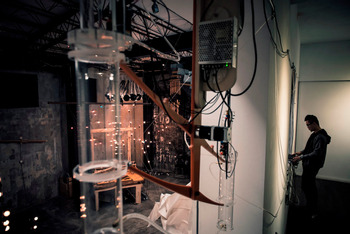
The musical sequence continues but decrescendos as a new sonicity is introduced. A large cross-tube installation (Fig. 3) containing what are presumably grains of sand, fixed upon the frame where the sound bottle installation is located, begin to rotate. As the tube rotates, the sand within is shuffled and produces extended, ‘elongated’ wave-like sounds that sonically ‘cut’ Lin's vertical taps and pounds on the piano. Jian and other crew then hand audiences smaller-sized tubes and they are asked to rotate them slowly before handing them over to the next person. Though all tubes seem visually similar, the texture and tenor of each tube varies in its sounding grain and the sonicity produced differs for each individual rotating it. The sonic articulations from these flowing, shifting particles intersect with the clanks and clangs of the wind chimes, and the musicality of Lin's experimental playing. The cacophonic mix evidences Eidsheim's view that sound is created and shaped in the action and transmission of vibration.Footnote 30 Bodies participate in these point transmissions and ‘there is no knowable music or sound before its singular transmission through us’.Footnote 31 When I was handed the tube to rotate, I recognized that the resulting tonality and texture of the sounds produced, though marginal, was dissimilar from the participants who had played it before me despite the similar speed with which I rotated the tube. The various densities and timbres in this sequence were engendered not only because of the vibrating material bodies of the instruments but also because of the the transductive bodies of those who played them – the physical qualities of the musicians produce differing sensations (and vibrations). The active (and voluntary) participation in this act of musicking evidenced an explicit vibrational transfer between participants, through the sonic medium of the tube and its contents. Acoustemologically, this performance sequence demonstrates how aural experience and an evaluation of sound are intimately bound to the materiality of its production and ‘predicated on our physical contact with sound waves through shared media’.Footnote 32 More significantly, from an ideational perspective, even as one can choose to make music individually, one is connected to another through the transfers of vibration, which is what sounds are fundamentally characterized as. These connections, as vibrations, can be felt and sensed – they are, as Eidsheim posits, physical and tactile.
Sound tube installation by artist Wang Chung-kun. Photograph by M.O.V.E. Theatre.

Such thinking about sound and bodies as vibration and energetic changes, according to Eidsheim, is important because it challenges existing views of sound as a fixed entity of objective aesthetic labels (such as pitch, duration, timbre), received aurally, and commonly regarded as independent of the body of the producer or listener. While such conventions indubitably recognize how bodies produce sound/music, these are regarded as actions acting on and upon instruments that subsequently create acoustic vibrations. However, bodies are organic vibrational media that transduce sound and alter the ways in which it is listened to. Such a view explains why sound is received by, and affects, different listeners dissimilarly. It also affirms the belief that sound remains a relationally subjective experience as it crosses, is affected by, and takes its character from any materiality. Consequently, this view of related, intermaterial vibration underscores a fundamental interconnectedness between bodies. In material terms, it evidences how bodies cannot exist as singular individuals,Footnote 33 and music, as Eidsheim posits, necessarily ‘brings us into the territory of relationality’.Footnote 34 Comprehending vibrational sound leads one to consider how it connects listeners through a sonic kinship; sound, as intermaterial energy, can encourage a reconsideration of sociality and ethicality. In the sound event described, it is evident that bodies were connected both as producing and as receiving mediums of vibration, and while the resonances may have differed for each body, what connected were the vibrational waves and the experience of those waves.
Listening to time
Performance occurs in an alternate temporal space, dislocated from ‘real time’, and imposes other, possibly multiple, temporalities, in the lived experience of the theatrical ‘now’. It allows us to exit chronological time as the internal structure of history such that ‘history [is] felt and lived differently’.Footnote 35 A familiar trope, time is confounded in performance where performance is rehearsed repetition; histories are revived, characters resurrected, narratives revisited, and brought into the performative present. Contained fictions distort time and space further by scene shifts and acts of temporal traversing. And as Marvin Carlson asserts, all of theatre, in its production and reception, is haunted.Footnote 36 In Dear John, the spectre of Cage, his philosophies of music, works and performances, as seen in the reworking of Piano Walk, haunt the performative present. Chronological time is made salient in this performance not only because the work is an adaptation of, and homage to, Cage, but also because it is a performance of and about ‘musicality’, as Cage himself interrogated. In music performances, a different temporality asserts itself since music possesses its own logic of time. Music is inherently a temporal art and sounds are ephemeral sonic events intrinsically defined by timing dimensions.Footnote 37 The feeling of forward-directed motion and movement in conventional and traditional tonal works is music's temporality.Footnote 38 As Roger Savage observes, ‘The work's affective power … is a function of the operation that draws a temporal configuration from the succession of tones, harmonic sonorities, timbral combinations, or acousmatic events … music's communicability rests on the listener's capacity to draw patterned figures from successively sounding events’.Footnote 39 Musical works themselves, in performance, are sounding configurations that create alternate temporalities not simply because of the inherent time quality of music but also because they can project a world ‘replete with sensations, moods, and feelings’.Footnote 40 They have the capacity to engender affective resonances that ‘lift us out of the flow of ordinary events’.Footnote 41 Listening to music, consequently, produces its own logic of time that is ‘out-of-time’.
The enfolding of musical/sonic time occurs as Dear John is ontologically musical but has an equally performative dramaturgy, framed by the distinct signifiers of a performance event and a theatricality of sonification posited earlier. Yet, arguably, Dear John does not seek to engender an alternate temporality, but rather to interrogate the concept of time itself, and to show how time is inherently sonic and sonicity is essentially temporal in nature, as Ernst asserts – ‘in the sonic situation we live in temporal tides’.Footnote 42 Perhaps this contortion of time's constancy is inherent in Cage's experimental work since he regarded chance and indeterminacy as hallmarks of music. The absence of tonal direction, predictable time signatures, and ‘moods’ or ‘feelings’ inspires an uncertainty of time. The creators of Dear John advanced these interrogations of (chronological and musical) time further by exploiting the moments of ‘silence’ between the sound events. In these moments of complete darkness, earlier described, temporal expectations were distorted and only the meditative sound of water dripping from a regulator – a stand-alone installation – provided one with an approximation of time as events passing. Even so, these trickling sounds reverberated with infinity as one wondered whether they would ever stop. Such a dramaturgical intention serves to possibly modulate visuality and encourage attention to aurality and time, and an aurality of time. Time becomes less objective as one's attention is drawn to one's subjectivity in ‘listening’ to it. It is time as immediate experience rather than time ‘mitigated by external measurement’.Footnote 43 In these moments, I became acutely aware of the stretching of time; I felt the persistence of the present, the density of time, and an expansion of an immediate now as I wondered impatiently when the next event would occur. I glanced at my watch frequently to ascertain some measure of objective, chronological time, but these were futile attempts in that darkness. This ‘other’ time – the feeling in which ‘the sense of chronological time passing diminishes, in which the present seems to extend and thicken, in which our consciousness feels itself in a gathering of time that includes, but is also independent from, the sequence of successive instants turning continuously into the next’Footnote 44 – was intimately entwined with listening, for in the absence of seeing one was made to ‘listen’ to (the sonic quality of) time. While this experience seemingly affirms the phenomenological view that seeing is knowledge reliant on external stimuli and listening remains an embodied, ‘internal’ process, it advances a significant question posed by theoretical physicist Carlo Rovelli, ‘What am I listening to when I listen to the passing of time?’Footnote 45
Performatively, this distortion of time (and space) enacts the only spoken lines in the performance in which the protagonist, as disembodied voice, recounts at the start of the show how, at age six, she left Earth with her brother and mother, boarded a spaceship, entered a state of suspended animation, and arrived at her new home. The sense of suspended time was, then, the audiences’ embodied experience of the narrative's ‘timelessness’. Critically, it establishes the importance of time as durationality and lived experience as heterogeneous, for duration ‘nearly always involves the collapse of objective measure. Whether it is short or long in “clocktime”, its passage will be marked by a sense of the warping of time, an opening of regularity to other phenomena or inchoate order’.Footnote 46 Such a conception of time is derived from Henri Bergson's ideas on temporality and multiplicity. Bergson saw that Western philosophy's obsession with space had distorted an understanding of time since time is frequently spatialized and signified, in its semiotic articulation, and in so doing turns time into an arrested object and representation. Time, however, must be conceived of as force, as motion and duration (la durée), for the subject is ‘primarily a subject of action, not of present consciousness or knowledge’.Footnote 47 Duration must not be grasped as a quantitative multiplicity that externalizes consciousness and experience in a homogeneous space; instead, it must be engaged as a qualitative multiplicity that exists in a temporal heterogeneity in which ‘several states are organized into a whole, permeate one another, [and] gradually gain richer content’.Footnote 48 In addition to Bergson's distrust of language, symbols and signs, and an affirmation of ‘intuition’, inner experience and affect, concepts of multiplicity and duration initiate revised conceptions of ethics and community.
Dear John's dramaturgy of duration, subjective temporalities, embodied sonification, and sound (and listening) as vibrational practice could be critically regarded as a performative exemplification of Bergson's notion of multiplicity and heterogeneity. For Bergson, the material universe must be perceived as waves rather than particles, with regard to the wave-mechanical model of matter that underpins the reality of the material universe. Time then becomes the very substance of matter; it now becomes concrete and mobile, ‘embedded in the substance of particular strata or regions of matter, each of which may exhibit its own tempo or duration’.Footnote 49 Likewise, vibration is wave energy in motion and accepting sound as vibrational energy transmitted and transduced, through bodies as vibrational sites, reconceives one's comprehension of sound vis-à-vis material reality. Sound as vibration and motion is part of the body in musicking/sounding and each body has its own subjective duration and rhythm. Such an understanding of vibration further underscores the vitality of motion and its contribution to establishing the subjective, multiple realities of listening and musicking/sounding, and remains consonant with Bergson's view that the experience of community, like reality, is multiple, heterogeneous and durational. Vibration and/as waves, though experienced differently, connect.
In the final scene of the performance, the audience's attention is directed to the white jacket Jian wore in the opening sequence, via an illuminated spot on the vestment which has remained suspended from the ceiling by the strings that are still conjoined to the restructured piano, and a gradual dimming of other surrounding lights. The cacophony of sounds in the sequence before, resulting from the whistling sound bottles, the rotating sand tubes, the many wind chimes being pulled, Lin's drumming on metallic vessels placed on the strings of the grand piano and subsequent hammering of these strings, soften (and slow) to a recognizable melody played on an accordion. While Lin hits the exposed piano strings with a percussion mallet, she hums a mellifluous tune; she tugs at the strings that causes the hovering jacket to move in a way that seems to mimic a person swaying to the legato motions and adagio tempo of the melody. While, dramaturgically, this is a narrative action to possibly indicate the bodily absent protagonist's arrival on a new planet or an indicative gesture of measured movement in the hard vacuum of outer space, the performative moment summarily encapsulates the interpretations posited in this article. The cyclical melody of the tune sung by Lin, repeated several times, and the suspended jacket (as well as the required suspension of disbelief that the jacket is meant to be ‘full-bodied’ because of its human-like movement, and the recollective association with the opening sequence where Jian moved in such a ‘suspended’ fashion when she wore this jacket), is an apt metaphor for the performance's interrogation of timelessness and durationality. The strings that conjoin the piano to the moving vestment are also metonymic of the intermaterial vibration between objects and bodies, as bodies produce and receive sound; it is an evident visual reminder of invisible connections and (vibrational) transfers. This poignant sequence, like the first, underscores the intimate interweaving relationship between sounds, as they are produced and received, motion and bodies.
While not a distinct dramaturgical objective, Dear John's play(ing) of/with sonicity and corporeality opened spaces of connectedness, relationality and sonic affinity. The random organization of spectators in the performance space underscored the socio-ethical considerations the performance evoked; even as they remain apart, distinct and separated by space, vibrational energy connects the audience, performers, ushers and security staff; spectatorial bodies resonate with vibration. And while this performance was not intentionally political, its interrogation of the hegemonic relationship between body and sound produced a sonic–corporeal dramaturgy that accentuated the ‘inter’ of sonic vibration – the interaction, intersection, interdependence and interrelation that sound (and music) has with producing and listening bodies. This possibility of a politics of sound is, as Salomé Vogelin posits, ‘a politics of the incomplete, the unfamiliar, the unrecognizable, and the unheard; that which we have no words for and that which is incommensurable in relation to current norms, but which presses through a naturalized reality, and impresses on us the need and courage to listen-out for alternatives within’.Footnote 50 In writing this article a year after seeing it live in 2019, and in the time of bio-precarity, I have come to realize that the world has become a profoundly different place where relationality has become prohibited and feared; COVID-19 has exacerbated isolation, alienation and racial, cultural hostilities. Dear John's experiments of vibrational practice are a reminder that sound has political potential, for it can enable ‘the re-imagination of a political practice and its material truth’,Footnote 51 of articulating how else ‘the truth of a community, the shared practice of living, might be effected’.Footnote 52