Suicide and suicidal ideation among the young are a major global public health concern (Mann et al., Reference Mann, Apter, Bertolote, Beautrais, Currier, Haas and Hendin2005). Suicide is the third leading cause of death among 10 to 24 years-old adolescents (Hoyert, Kung, & Smith, Reference Hoyert, Kung and Smith2005). In 2007, the suicide rate in the United States approximated 12 per 100,000 (Center for Disease Control and Prevention, 2012). In Europe, it is estimated that between 4 and 40 in 100,000 people commit suicide yearly (Charlton, Kelly, Dunnell, Evans, & Jenkins, Reference Charlton, Kelly, Dunnell, Evans and Jenkins1993). In Latin American countries the rate is estimated at 6.5 per 100,000 (Serfaty, Reference Serfaty1998).
The most prevalent suicide risk factor is the presence of mental disorders, in particular, mood and anxiety disorders (Foley, Goldston, Costello, & Angold, Reference Foley, Goldston, Costello and Angold2006). The onset of Major Depressive Disorder (MDD) is often during early adolescence and is associated with considerable functioning and psychosocial impairments (Rao & Chen, Reference Rao and Chen2009) in addition to high indices of suicide (American Academy of Child and adolescent Psychiatry, 2012). The estimated prevalence of MDD in pre-adolescents (6 to 12 years) is 2% and increases to 8% in adolescents aged 13 to 17 years (Birmaher et al., Reference Birmaher, Ryan, Williamson, Brent, Kaufman, Dahl and Nelson1996). Despite the high incidence of suicide and prevalence of MDD among adolescents and pre-adolescents (Zalsman et al., Reference Zalsman, Oquendo, Greenhill, Goldberg, Kamali, Martin and Mann2006), there remain few studies addressing risk factors that may act as psychosocial stressors leading to suicide attempts and to the onset of MDD among these groups. Furthermore, several studies have demonstrated that in addition to mood disorders there are numerous adversities early in life such as interpersonal difficulties, socioeconomic difficulties, and maltreatment during childhood that can act as risk factors for suicide and suicidal behavior (Johnson, Cohen, Gould, Kasen, Brown, & Brook, Reference Johnson, Cohen, Gould, Kasen, Brown and Brook2002). Family income along with other family variables such as parental separation or divorce have also been shown to be significantly associated with depressive symptoms in children (Tracy, Zimmerman, Galea, McCauley, & Stoep, Reference Tracy, Zimmerman, Galea, McCauley and Stoep2008). Additionally, studies have shown that children are particularly vulnerable to various risk factors that have been associated with mental health problems, such as low levels of education, large families, absence of one parent, frequent negative life events, family history of mental illness, and/or exposure to violence (Carlini-Cotrim, Gazal-Carvalho, & Gouveia, Reference Carlini-Cotrim, Gazal-Carvalho and Gouveia2000; Steinberg & Duggal, Reference Steinberg and Duggal2004).
In a longitudinal study, Johnson, et al. (1999) found that a low family socioeconomic level is associated with a high risk of anxiety, depression, disruptive disorders, and personality disorders in children. Additionally, children living in structurally deprived neighborhoods with few resources tend to have more mental health problems than those who live in more structured neighborhoods (Xue, Leventhal, Brooks-Gunn, & Earls, Reference Xue, Leventhal, Brooks-Gunn and Earls2005). Furthermore, the socio-emotional health of children is worse when the physical condition of their residence and immediate neighborhood is poor (Gifford & Lacombe, Reference Gifford and Lacombe2006). Other factors, including low maternal educational level, unemployment, or the presence of depression in the family may also affect the mental health of children, primarily through internalizing psychopathologies such as depression, anxiety, withdrawal, and somatic complaints (Xue et al. Reference Xue, Leventhal, Brooks-Gunn and Earls2005). Poor socioeconomic conditions as well as adverse circumstances during childhood are important risk factors for suicide (Agerbo, Nordentoft, & Mortensen, Reference Agerbo, Nordentoft and Mortensen2002; Beautrais, Joyce, & Mulder, Reference Beautrais, Joyce and Mulder1998).
In developing countries such as Brazil and India, there are many people living in poor socioeconomic conditions (Chandra, Osorio-Rodarte, & Braga, Reference Chandra, Osorio-Rodarte and Braga2009). “Ragpickers” are workers who collect recyclable trash to earn a small living. These individuals play an important, although frequently unrecognized, role in the garbage management system in metropolitan areas (Figure 1). The practice of collecting recyclable trash to earn a small wage is an established practice in Brazil and India (da Silva, Fassa, Siqueira, & Kriebel, Reference da Silva, Fassa, Siqueira and Kriebel2005; Ray, Mukherjee, Roychowdhury, & Lahiri, Reference Ray, Mukherjee, Roychowdhury and Lahiri2004). It is estimated that there are nearly 800,000 ragpickers in Brazil (Carmo, Reference Carmo2009), and this social category is growing due to the current economic crisis. The increasing number of ragpickers reflects a change in habits over the last few decades. While modern life offers the privileges of comfort, convenience and practicality, it also encourages industries to produce more, leading to an increase in the volume of trash produced, particularly in urban areas.
“Ragpickers”

Most ragpickers in Brazil have recently moved to urban areas from small towns or other poor regions of the country. Many are unable to find well paying jobs and are temporarily unemployed. It is estimated that for every 1000 Brazilian ragpicker, 4000 trees are saved monthly. This savings represents the monthly collection of 200 tons of paper in a single urban area, such as in the Brazilian southern city of Curitiba (Voitch, 2008), a city with an estimated population of 2 million that produces 2.4 thousand tons of trash a day. While the ragpickers play a fundamental role in maintaining a healthy environment, studies addressing the mental health of these workers and their children who often accompany their parents to work are sparse. To the best of our knowledge, there has been only one prior empirical study investigating psychiatric disorders in the ragpicker population (da Silva, Fassa, & Kriebel, Reference da Silva, Fassa and Kriebel2006) and this study did not address how their children may be affected.
The aim of the present study was to assess the presence of depressive symptoms and suicidal ideation in adolescents whose families work as ragpickers in an urban area in the south of Brazil.
Method
Participants
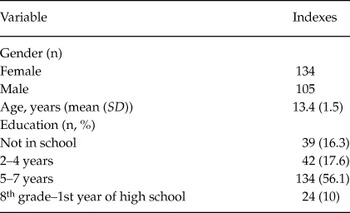
A total of 244 adolescents (56% female, 44% male) whose parents work as ragpickers in a city in Southern Brazil, were invited to participate in the study. The participants were between 12 and 17 years old with a mean age of 13.4 years (Table 1). The inclusion criteria were: a) both the adolescents and at least one parent were able to read or comprehend Brazilian-Portuguese; b) at least one parent worked as a ragpicker in the metropolitan area surrounding Curitiba, a southern city in Brazil; c) the adolescent’s legal guardian agreed to the adolescent’s participation by signing an informed consent; and d) no more than two siblings per family could participate in the study. This research was approved by the Committee on Research Ethics for Human Beings at our Institution.
Participant characteristics

Assessments
Depressive symptoms and suicidal ideation were assessed by the Children’s Depression Inventory (CDI), developed in 1985 by Kovacs (Kovacs, Reference Kovacs1985). The CDI is a questionnaire adapted from the Beck Depression Inventory and consists of 27 self-reported items specifically designed for adolescents between 7 and 17 years of age (Kovacs, Reference Kovacs1985). The CDI was initially translated and validated in Brazil by Gouveia and colleagues (Gouveia, Barborsa, Almeida, & Gião, Reference Gouveia, Barborsa, Almeida and Gião1995). In this Brazilian version of the CDI, the authors reduced the original number of 27 questions to 20 and suggested a cut-off point of 17 (Gouveia, et al., Reference Gouveia, Barborsa, Almeida and Gião1995). In addition, there is a second version translated and often used in Brazil, which kept the 27 questions as originally proposed by Kovacs, and these authors suggested a cut-off point of 13 for indication of depressive symptoms (Baptista, Reference Baptista1997). The current study employed the full version of the CDI including all 27 items (Baptista, Reference Baptista1997). An exploratory factorial analysis of the 27-item CDI has shown strong validity for use in the Brazilian population (Wathier, DellÁglio, & Bandeira, Reference Wathier, DellÁglio and Bandeira2008). The CDI evaluates the presence of negative mood, negative self-esteem, hedonistic capacity, and other interpersonal behaviors, including suicidal ideation (Kovacs, Reference Kovacs2003). While the CDI is a self-reported questionnaire, the researcher is available during administration to answer questions that arise. Each item of the CDI has three choices (scored as 0, 1 or 2; 0 = asymptomatic, 1 = moderately symptomatic and 2 = clinically symptomatic), with the participant choosing which one best describes their state in the last two weeks. The overall CDI score can range from 0 to 54. A longitudinal study (Devine, Kempton, & Forehand, Reference Devine, Kempton and Forehand1994) demonstrated that on average, the results of the CDI are stable over time in individuals not receiving medication. The internal consistency coefficient of the original instrument was (α =.86) in the normative sample (Kovacs, Reference Kovacs1985) and in the translated version used in this study had an alpha reliability of .85 (Wathier, et al., Reference Wathier, DellÁglio and Bandeira2008), and the internal consistency for our sample was (α = .79). Epidemiological studies have established cutoff points, typically between 15 and 17 points indicating depression (Charman, Reference Charman1994). The inventory includes one question regarding thoughts of self-harm. In the current study participants were classified as harboring suicidal ideation if they chose either “I think about killing myself but would not do it” or “I want to kill myself”, scoring 1 or 2 respectively, on item number 9, as suggested by Kovacs (Reference Kovacs2003).
Statistical analysis
The Statistical Package for the Social Sciences (SPSS version 20.0) was used for analysis. Descriptive statistical analyses included averages, standard deviations, maximums and minimums. The Kruskal-Wallis test was used to examine differences between males and females on CDI items that correspond with DSM-IV criterion symptoms for Major Depressive Disorders (MDD) and Dysthymic Disorders (DD). A p-value < .05 was considered statistically significant.
Results
Of the 244 adolescents invited to participate, 239 from 185 families met the criteria for inclusion and agreed to participate. Of the participants, 16 (7%) worked only as ragpickers of recyclable material (with their own or a rented means of transportation, Figure 1), 34 (14%) worked only as recyclers within the recycling shed, and 189 (79%) worked in both collecting and recycling.
Table 1 shows the demographic data of study participants. The study included 134 girls (54%) and 105 boys (44%) with an average age of 13.4 years (standard deviation = 1.5). In terms of education, 39 subjects had never attended formal school (16.3%), 42 had completed 2–4 years of school (17.6%), 134 had completed between 5–7 years of school (56.1%), and 24 were between their eighth grade year and their first year of high school. In the current study, 108 participants were sibling.
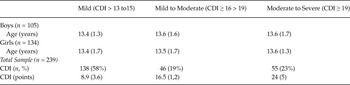
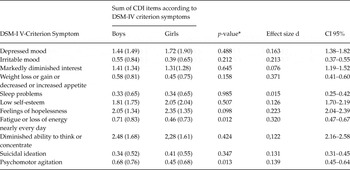
CDI scores of 13 and 19 have previously been recommended as cut-off points for MDD in clinical and community samples, respectively (Roelofs et al., Reference Roelofs, Braet, Rood, Timbremont, van Vlierberghe, Goossens and van Breukelen2010; Timbremont, Braet, & Dreessen, Reference Timbremont, Braet and Dreessen2004), while other studies have recommended a CDI score of between 15 and 17 as the cut-off score for MDD (Charman, Reference Charman1994). Recent studies assessing the presence of depressive symptoms in Brazilian children with sickle cell anemia adopted a cut-off point of 13 as suggestive of depression (Barreto & Cipolotti, Reference Barreto and Cipolotti2011). The current study analyzed three groups: a) those scoring between 13 and 15 points as an indicator of mild depression; b) those with scores equal or greater to 16 but less than 19 as mild to moderate depression, and c) those scoring equal to or above 19 points as moderate to severe depression. The percentage of the study population belonging to each of the three depressive groups categorized by CDI points, age and gender is displayed in Table 2. The CDI score results revealed that 23% of the sample presented depressive symptoms (score of > 19 points) and 35% (n = 84) of the study population presented with suicidal ideation. Although not statistically significant (p = .28), a greater percentage of girls (38%) had a high index of suicidal ideation than boys (31%). Table 3 shows the correspondence of CDI items and DSM-IV criterion symptoms for MDD and DD according to the gender of participants. Regression analysis of DSM-IV criteria found that significantly more girls (29.9%) than boys (17.1%) presented with depressed mood (p = .013), while boys scored significantly higher on DSM-IV criteria for fatigue or loss of energy (p = .012) and psychomotor agitation (p = .013).
Categorization of adolescent participants by depressive symptoms as determined by the Children’s Depression Inventory (CDI)

Data shown are averages (standard deviation)
Correspondence of CDI items and DSM-IV criterion symptoms for MDD and DD. Data shown are averages (standard deviation)

*by Kruskal-wallis, CI: Confidence interval.
Discussion
The incidence of depressive symptoms (23%) and the incidence of suicidal ideation (35%) in adolescent ragpickers were high relative to the general population. The relationship between mental health and poverty has been extensively studied and well established in developed countries (Costello, Compton, Keeler, & Angold, Reference Costello, Compton, Keeler and Angold2003). However, in developing countries, issues regarding mental health, particularly in children and adolescents have not been given as much attention (Belfer, Reference Belfer2008; Belfer & Saxena, Reference Belfer and Saxena2006; Duarte et al., Reference Duarte, Hoven, Berganza, Bordin, Bird and Miranda2003). Basic needs such as nutrition, sanitation, and other health issues such as infectious diseases, have taken priority over mental health. Furthermore, a stigma associated with mental disorders remains, especially in developing countries such as Brazil.
The findings of the current study suggest that adolescent children of ragpickers are at risk for the development of mental health issues, particularly MDD as indicated by the high percentage of adolescents with depressive symptoms (moderate to high on the CDI) as well as suicidal ideation. Compared to the current study findings that 35% of ragpicker children harbor suicidal ideation, a cross-sectional population-based study using a representative sample of adolescents aged 11 to 15 years old living in a city in southern Brazil (using the same question “9” of the CDI as used in the present study) identified only 14.1% of youths with suicidal ideation (Souza, et al., Reference Souza, da Silva, Jansen, Kuhn, Horta and Pinheiro2010). Another Brazilian study using different screening tools in a community sample (aged 14 to > 60 years old, n = 515 participants) detected suicidal ideation in 17.1% of participants (Botega, et al., Reference Botega, Marin-Leon, Oliveira, Barros, da Silva and Dalgalarrondo2009). Furthermore, case-control studies of community samples in Brazil found that suicidal ideation was consistently associated with depressive symptoms such as lack of energy and depressed mood (da Silva, et al., Reference da Silva, Fassa and Kriebel2006). Another study conducted with Brazilian adolescents (7 to 13 years old) using the 27-item CDI and a cut-off point of 17, found that 13.9% presented depressive symptoms with no difference among age and gender (Fonseca, Ferreira, & Fonseca, Reference Fonseca, Ferreira and Fonseca2005). Finally, a study conducted with 553 children and adolescents (aged 7 to 14.9 years) in Hungary detected that 48% of their sample had suicidal ideation and 30% had an actual suicide plan (Liu et al., 2006).
The CDI includes 27 questions that reflect manifestations of depressive symptoms that correspond with DSM-IV criterion for MDD and DD (Kovacs, 2003). Using these criterion symptoms, we observed that boys presented with more symptoms of psychomotor agitation and fatigue than girls while there was no difference in prevalence or severity between genders in other symptoms. These findings are consistent with a previous study which evaluated 383 adolescents in an outpatient clinic (Bennett, Ambrosini, Kudes, Metz, & Rabinovich, Reference Bennett, Ambrosini, Kudes, Metz and Rabionovich2005).
A study examining the link between depression, stress, and risk behavior in North American adolescent students found that 35% of students reported feeling depressed/stressed for at least 10 days within the past month (Brooks, Harris, Thrall, & Woods, Reference Brooks, Harris, Thrall and Woods2002). A study of juveniles in Brazil found that 22% presented with indicators of depressive disorders using 18 on the CDI as a cut-off score (Gouveia et al., Reference Gouveia, Barborsa, Almeida and Gião1995). In addition, an epidemiological study using a CDI cut-off score of 19 found that 20.3% of students (aged 10 to 17 years) presented with depressive symptoms in the state of Paraná (Bahls, Reference Bahls2002). Compared to the aforementioned studies, there was a higher incidence of depressive symptoms in the participants in the current study. Using a CDI score of 15 as a cut-off point, 19% of the participants presented with mild to moderate symptoms of depression while 23% presented with moderate to severe symptoms of depression (Table 2). These numbers are similar to the above reviewed studies. The high rate of depressive symptoms found in the present study may be related to low socio-economic factors. The majority of participating families live in areas without proper sanitation and many families keep the recycled trash in their homes until selling them. These factors have been described as stressors which may cause emotional distress and lead to non-psychotic psychiatric disorders (Costello et al., Reference Costello, Compton, Keeler and Angold2003; Kuruvilla & Jacob, Reference Kuruvilla and Jacob2007; Pataki & Carlson, Reference Pataki and Carlson1995). Prior studies have suggested that low socioeconomic status has a negative impact on mental health, and may play a specific role in the expression of depressive disorders (Regier et al., Reference Regier, Farmer, Rae, Myers, Kramer, Robins and Locke1993; Reijneveld & Schene, Reference Reijneveld and Schene1998). Other studies have not found a relationship between neighborhood socioeconomic characteristics and depressive symptoms in young adults (Henderson et al., Reference Henderson, Diez Roux, Jacobs, Kiefe, West and Williams2005). However, a large community sample study conducted in Brazil using regression models to control for confounders and effect modifiers found that emotional difficulties, lack of neighborhood support, infrequent church attendance, and depressive symptoms were associated with suicidal ideation (da Silva et al., Reference da Silva, Fassa and Kriebel2006).
Prior studies have shown that suicide is correlated with various factors such as sex, age, marital status, socio-environmental circumstances, as well as certain psychological traits (e.g. aggression and melancholia) (Mello et al., Reference Mello, Juruena, Pariante, Tyrka, Price, Carpenter and Del Porto2007). It is likely that the living and economical conditions of the adolescents in the current study may account for the high incidence of suicidal ideation. Factors associated with suicidal ideation include female gender, alcohol consumption, and use of illicit drugs (Carlini-Cotrim et al., Reference Carlini-Cotrim, Gazal-Carvalho and Gouveia2000). However, risk factors associated with successful suicide attempts among adolescents differ between genders. Among males previous suicide attempt, age 16 or older, associated mood disorder, and associated substance abuse are leading risk factors, while among females, risk factors include mood disorders and previous suicide attempts (American Academy of Child and Adolescent Psychiatry, 2001). The majority of the participants in the current study were in the initial stages of adolescence, suggesting a possible rise in these indicators over the course of adolescent development, since emotional problems tend to increase with age (Liu et al., Reference Liu, Sun, Neiderhiser, Uchiyama, Okawa and Rogan2001).
There are a number of limitations that should be considered in the interpretation of the study results. First, the sample used in the present study should not be considered representative of all adolescent children of ragpickers. Participants in the present study were not randomly selected, and included only individuals who worked at organized cooperatives and who were given their personal home addresses by the local Social Foundation Association, government run foundation. In addition, the actual number of families working as recyclers was obtained from the local government environmental office. However, it is suspected that some families may have unlawful records and may not have been registered with this office. Second, we did not investigate a group of higher socioeconomic status participant to compare depressive symptoms and/or suicidal ideation to the ragpicker group. Third, 108 participants were from the same family, and therefore may not be considered independent samples as they may share “family-based” stress, in addition to socioeconomic stress. Fourth, a structured psychiatric interview based on DSM-IV criteria was not performed to determine whether the depressive symptoms detected by the CDI warranted a diagnosis of mood disorders. However, prior studies have shown that the CDI has valid psychometric properties (Figueras-Masip, Amador-Campos, Gomez-Benito, & del Barrio Gandara, 2010) and good sensitivity and specificity for predicting depressive disorders in adolescents (El-Missiry, Soltan, Hadi, & Sabry, Reference El-Missiry, Soltan, Hadi and Sabry2011). In addition, the CDI total score has been shown to not only predict depressive disorder but also differentiate between depression, anxiety, and disruptive behavior disorder (Timbremont et al., Reference Timbremont, Braet and Dreessen2004).
In conclusion, the current results indicate that the adolescent children of ragpickers are at a high risk for developing psychiatric disorders, in particular major depression. In addition, this population is at a high risk for suicide. Furthermore, the results presented suggest that these adolescents should be thoroughly screened through a psychiatric evaluation and interventions should be in place to positively influence their future.
We thank the clinical psychologist Cassia R. Benko, the Social Foundation Association (FAS) of the city of Curitiba for helping to reach the families, and we thank the adolescents and their families for participating in the study. This study was funded by the Brazilian State of Parana Department of Science, Education and Technology (SETI, Conv. 003/07).