1. INTRODUCTION
While working, a ship's Officer Of the Watch (OOW) is exposed to a certain level of mental workload. In general, the mental or cognitive workload can be defined as the level of mental ability required to process information during the performance of a task (Kum et al., Reference Kum, Furusho, Duru and Satir2007). Every officer withstands his or her workload within their own limits and performs the tasks in a regular and normal manner. In demanding situations when personal limits are exceeded, a state of mental overload may occur. During overload the officer's information processing, situation awareness and decision-making ability is affected, thus the officer may be prone to errors.
The OOW workload is affected by numerous factors (Embrey, Reference Embrey2006; Nachreiner et al., Reference Nachreiner, Nickel and Meyer2006; Tzannatos, Reference Tzannatos2004), but five of them, relevant for this research, should be emphasised:
-
• the quality of information (workload increases by low reliability of information, a large number of false or irrelevant alerts and the unclear appearance of alerts),
-
• the low flexibility of primary tasks (workload increases with high-priority tasks and low delay possibilities),
-
• concurrent task processing (workload increases with the number of concurrent tasks),
-
• number and frequency of distractors (workload increases with numerous interruptions with low-priority tasks, in particular irrelevant alerts, radio and telephone calls),
-
• tasks during emergency situations (workload increases when numerous tasks need to be coordinated).
Overload significantly reduces the OOW's performance, in particular during demanding situations requiring the officer's additional attention and cognitive resources (Crowch, Reference Crowch2013). One common approach to reduce overload is to ignore low-priority information and assigned tasks, in order to concentrate on the essential tasks. A second common approach is to temporarily enlarge the bridge team.
On modern bridges it is not easy to ignore alerts. Almost all installed systems notify the OOW about certain events by sound and light signals. It can be stated that information systems do not choose a suitable moment of notification. So even when being ignored they still distract the bridge team.
It is emphasised that adaptive information systems are still not recognised by the International Maritime Organization (IMO) as a tool that may increase the safety of navigation, despite the fact that the technology is available. The idea of an adaptive system appeared in the early 1970s, as an aid in the decision-making process for pilots in the United States Air Force (Rouse, Reference Rouse1994). Examples of adaptive systems applied in the military sector are mission adaptive wings (Beringer, Reference Beringer2002; NASA, 2013), the adaptive control for the production of the Boeing Joint Direct Attack Munition (JDAM) 32 “smart” bombs (NASA, 2013), the Rotorcraft Pilot's Associate (RPA) adaptive display system for the pilots of combat helicopters (Dornheim, Reference Dornheim1999; Steinhauser et al., Reference Steinhauser, Pavlas and Hancock2009), etc. In other transport sectors and industries adaptive systems are under extensive research. Examples are the redirection of in-car phone calls depending on the diver's workload and traffic environment (Piechulla et al., Reference Piechulla, Mayser, Gehrke and König2003), an adaptive car interface recognising driver's affective states (Nasoz et al., Reference Nasoz, Lisetti and Vasilakos2010), adaptive information processing in Air Traffic Control (Kaber et al., Reference Kaber, Perry, Segall, McClernon and Prinzel2006), adaptive interfaces for complex industrial process controls (Letsu-Dake and Ntuen, Reference Letsu-Dake and Ntuen2010), etc.
Subsequently, the goal was to examine an AdIS to be used on board merchant ships capable of automatically recognising demanding navigation situations, and able to delay or redirect certain inputs and assigned tasks that may be postponed in the circumstances at the time.
2. ADAPTIVE INFORMATION SYSTEM MODEL LOGIC
In order to examine an AdIS model a discrete event simulation of bridge task processing has been developed. The model consists of three main modules: the environmental module, generating external and internal task triggers, the task processing module, “executing” assigned tasks, and the AdIS module, assessing navigational circumstances and adapting the information flow. The model developed allows the AdIS module to be switched off.
The environmental module is responsible for generating information and events that are independent of the OOW. It is assumed that ship has an integrated navigational bridge, meeting the provisions of the International Convention for the Safety of Life at Sea (IMO, 1974). Therefore all of a ship's alarms are represented on the bridge (the navigation, communication, propulsion, cargo, bilge, ballast, security and safety systems).
The task processing module actually simulates the behaviour of the OOW. It is responsible for the execution of tasks generated by the environmental module. In addition, this module also generates intrinsic tasks i.e. tasks initiated by rules and regulations and known by the OOW. These tasks are usually part of various working procedures, for example to routinely check radar information or to look out. It is assumed that there is only one OOW who acts professionally, with due regard to all common rules and regulations and as necessary calls for assistance when overloaded (increasing the bridge team).
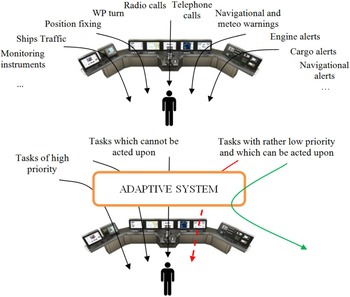
The AdIS module, if switched on, intercepts selected information generated by the environmental module and postpones their execution in accordance with the circumstances (see Figure 1).
It is assumed that with AdIS switched off the OOW constantly monitors the existing equipment and follows the rules and regulations properly. He/she becomes aware of the due tasks as the respective trigger is activated (information, event or a change of status) and begins with one or more actions. A diagram of our AdIS simulation logic is shown in Figure 2.
Influence of tasks on the OOW without (up) and with the adaptive system (down).

AdIS simulation model logic.

2.1. Environmental module
Tasks are characterised by the frequency of occurrence and the actions that the OOW is required to carry out. Tasks defined in the model include: passage planning and passage monitoring, collision avoidance, monitoring and management of the navigational data, alert management, and internal and external communication (IMO SN.1/Circ.288, 2010a).
Tasks' triggers may be external (induced by the environment or nearby traffic), internal (induced by the ship's systems) and duties (induced by professional rules and regulations). Nearly all external and internal triggers, using existing navigational equipment, can be detected, recorded, processed and influenced. Contrary to that, duties cannot be detected or influenced by the AdIS.
Altogether 49 different tasks have been modelled. The response to each task may require one or more actions. Depending on its attributes, a task may be accomplished at once, be interrupted and continued or may be restarted.
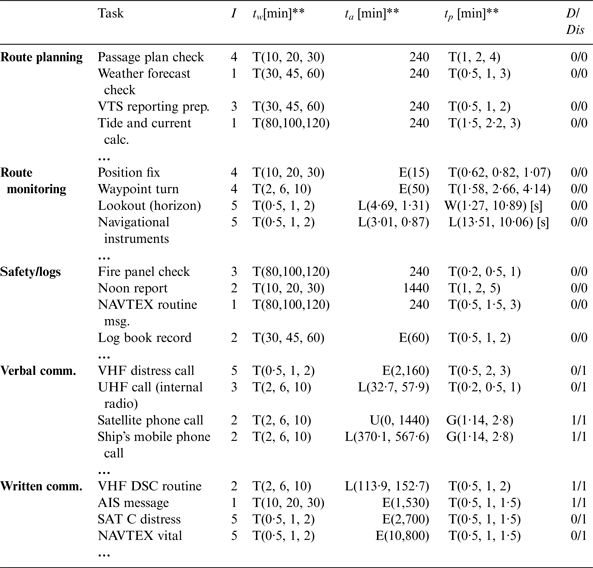
Task attributes describe certain task features. Altogether there are 15 different task attributes ranging from very specific (e.g. type of phone call) to the common attributes assigned to all tasks (see Table 1).
List with most important tasks and their attributes*.

* The sampling methods for tasks are described in heading 3. Source of data
**T = Triangular; E = Exponential; L = Lognormal; G = Gamma; W = Weibull; U = Uniform statistical distribution.
The most important attributes assigned to all tasks are:
-
• Priority (P) – derived criterion for precedence.
-
• Importance (I) – navigational significance, scaling from 1 (lowest) to 7 (highest).
-
• Urgency (t w ) – permitted time to wait for processing, defined by statistical distribution.
-
• Time of arrival (t a ) – time between two consecutive tasks of the same type, defined by statistical distribution or time between two successive events.
-
• Process time (t p ) – time required to fully process a task, defined by statistical distribution.
-
• Distractor (Dis) – attribute allowing the interruption of a process already started.
-
• Delay (D) – attribute allowing low-priority tasks to be delayed for a certain time, to avoid the unnecessary distraction of the OOW.
It should be noted that Priority is a derived attribute. In reality the OOW assigns priority to each task and action based mainly on his/her experience, knowledge and ability. In the model Priority (P) is calculated based upon Importance (I) and Urgency (t w ) as follows:
 $$P = I + \displaystyle{1 \over {10 + t_w}} $$
Priority is assigned to each task and it is used as a selection criterion for precedence when more than one task needs to be processed concurrently. The result is a single real positive number where the whole part indicates the level of Importance while decimal part indicates the Urgency. The selection is taking place in the OOW mental model control unit module.
The Importance is used to distinguish routine from urgent tasks. Tasks levels 1–5 are considered routine, while levels 6 and 7 are considered urgent and undelayable. Initially all tasks are assigned an importance of up to level 5; it is assumed that even the most important tasks require a certain time before execution actually starts. If it is not completed on time (defined by Urgency) the level of importance increases.
The Urgency is defined as waiting time for which the task can be postponed with no significant consequences. Waiting time for all tasks is estimated by triangular statistical distributions (i.e. a distribution described by the minimum, maximum and the most probable value). The distribution parameters are based on interviews and questionnaires completed by seafarers and range from 100 minutes for the least urgent to 1 minute for the most urgent tasks (average values).
Tasks and associated actions are processed in accordance with the following rules:
-
• Each task is processed separately; a task with higher priority takes precedence.
-
• A routine task can be interrupted by an urgent task or a distractor.
-
• An urgent task cannot be interrupted.
-
• By the expiration of a task's waiting time the importance increases by one.
2.1.1. Alerts
Alerts are divided into: Emergency alarm, Alarm, Warning and Caution (IMO A.1021(26), 2009; IMO MSC.302(87), 2010b). The number and priority of responsive actions may differ significantly, but mainly include: alert acknowledgment, (additional) information collection (reading the message, comparison with data from other sources, contacting other persons, etc.) and an appropriate procedure to respond (if required).
The data describing alerts hereafter and used in the model were obtained by a survey questionnaire with serving deck officers. According to this, the frequency of an alert occurrence can be described with a lognormal distribution with the mean value of 14·72 minutes. The number of tasks that an officer performs per alert is described by the rounded Weibull distribution with the mean value of four tasks. The process time for each action is described with a lognormal distribution with the mean value of 0·35 minutes.
Furthermore, emergency alarms represent 0·1% of all alerts (initial importance: 6), alarms 26·9% (initial importance: 5), warnings 38% (initial importance: 4) and cautions 35% (initial importance: 3) of all alerts. Alerts are considered distractors i.e. they interrupt the processing of a previously started routine action.
Except for emergency alarms, it is assumed that 45% of alerts may unnecessarily disturb the officer during demanding situations, hence they are considered delayable. The examples of such alerts highlighted most by the survey's participants are: safety messages via Very High Frequency (VHF) Digital Selective Calling (DSC), Inmarsat C and Navigation Text (NAVTEX) (a large number of false or irrelevant messages), automatic switching between Global Positioning System (GPS) and Differential Global Positioning System (DGPS), radar log error, short term signal loss on the echo sounder or speed log, AIS system overload, high and low levels of cargo tank alarms (due to rolling), cargo heat exchangers, cargo temperature sensor failures, engine log error, bilge alarms during rolling, unattended machinery spaces, generally all engine and auxiliary systems' alerts (except alarms indicating threatening conditions), and many others.
2.1.2. Marine traffic
The basic task of the OOW here is to monitor surrounding traffic and react appropriately and in time to avoid collisions. These tasks are obviously not delayable and cannot be influenced by the adaptive system. In the model presented here the collision avoiding tasks are modelled based on the data collected about the Dover Strait Traffic Separation Scheme (TSS) (Gerdes, Reference Gerdes2009). Consequently, it is assumed that the “own ship” is sailing within TSS boundaries with a traffic density estimated at 200 ships per day in one direction with an average speed of 14 knots. Two principal encountering situations are modelled: overtaking and course intersection.
Assuming that the own ship is sailing at 21 knots (7 knots faster than the average), it is estimated that in one hour four in-lane overtaking situations would occur (exponential distribution with 15 minutes between two overtakings).
Based on the available data and interviews with experienced officers it is estimated that during every watch on average two close crossing encounters occur (exponential distribution with 120 minutes between two close crossings).
Whether overtaking or crossing, the collision risk may assume one of three different statuses. The status Follow describes another ship passing at a distance of 2–5 M (Miles) (no actions required yet), Attention assumes a ship at a distance of 0·5–2 M (action highly likely) and Manoeuvre at a distance less than 0·5 M (collision avoidance required!). Ships passing at a distance more than 5 M are considered as ships not influencing the workload.
Since traffic geometry has not been taken into account (it would significantly increase the complexity of the programming code while not offering significant benefits) the probability for each collision risk status for close quarters is the same, i.e. 33%.
Assuming that the own ship sails mainly along the left side of lane, it is estimated that in the case of overtaking 50% of other ships have the status Follow, while the remaining 50% share Attention and Manoeuvre equally.
The number of actions for each encounter is estimated recording the experienced officers' actions on the bridge simulator. Accordingly the number of actions (visual or electronic observations, course changes, etc.) may be described by a rounded triangular distribution with the mean value of seven.
2.2. Adaptive Information System Module
The AdIS module evaluates the navigational situation and controls the information flow in the case of demanding navigational situations or personal overload. The process can be activated automatically or manually.
2.2.1. Automatic activation
Automatic activation occurs when the system recognises demanding navigational circumstances (by interrogating electronic sources) while manual activation is switched on by the OOW who wishes to postpone low-priority tasks until he completes already started and due high-priority tasks.
It is assumed that the system must remain active for at least 3 minutes, no matter being automatically or manually activated, in order to prevent frequent switching on and off. After being activated AdIS manages selected information by diverting non-vital verbal calls to another crew member(s) and saving delayable information in its internal memory until deactivation.
Navigational circumstances recognised as those requiring increased attention and timely processing of high-priority actions automatically switching on adaptive control of information flow include:
-
– one or more ships with the status Manoeuvre and TCPA < 15 minutes,
-
– two or more ships with the status Caution and TCPA < 15 minutes,
-
– four or more ships with the status Caution and Follow and TCPA < 15 minutes,
-
– imminent course change – approach to way point,
-
– reception of distress call, and
-
– activation of any emergency alarm.
2.2.2. Workload analysis and manual activation
According to the IMO, fatigue is a reduction in physical and/or mental capability as the result of physical, mental or emotional exertion which may impair nearly all physical abilities (IMO MSC/Circ.1014, 2001). The most common factors influencing seafarers' fatigue include workload, sleep time, stress, biological clock, health, drugs, age and other. The workload itself can be defined as the physical and/or mental requirements associated with one or more tasks, while overload can be defined as the level of workload that exceeds personal capabilities in performing one or more tasks.
Workload of the OOW is influenced primarily by the nature and number of navigational tasks in a given time. It can also be influenced by many other factors including on board organisation (staffing policy, resources, breaks, overtime, paperwork, etc.), voyage particulars (number of ports of call, weather and sea condition, routing, etc.), and ship characteristics (bridge design, level of automation, equipment reliability, etc.).
In this research only navigational tasks are modelled. Modelling a complete OOW behaviour including all factors influencing the workload is beyond the scope of this paper.
In the simulation the workload at a time t was anticipated by summing up the priorities of all due actions queued in the officer's short-term memory:
 $$workload\left( t \right) = {\rm \;} \mathop \sum \limits_{i = 1}^{n_r} P_{Ri} \left( t \right) + \; \mathop \sum \limits_{\,j = 1}^{n_u} P_{Uj} \left( t \right) + \mathop \sum \limits_{k = 1}^{n_d} P_{Dk} \left( t \right)$$
Where PR is the priority of the routine action i, PU is the priority of the urgent action j, PD is the priority of the distracting action k, and nr, nu, nd are the respective number of routine, urgent and distractor actions queuing in the short-term memory at a time t.
In reality, the sense of an increased workload is very individual, depending on personal capabilities and experience, and cannot be measured easily. Therefore, the overload level is very difficult to determine and it differs among officers. For this research, the overload level is estimated by interviewing masters and officers who participated in the research (see Section 3). In this model the assumed overload level is used to estimate the efficiency of the model algorithm only i.e. it represents the basis for measuring the time under an overload state with and without the use of AdIS and does not correspond to an actual overload level of any person.
In the model, it is assumed that the OOW perceives an overload and switches the system manually when the workload value is 20 or more according to Equation (2). The value is approximately equivalent to four concurrent high-priority (urgent) actions or 7–12 concurrent mid-priority (routine or distracting) actions waiting to be carried out.
Once the AdIS is deactivated, the system needs to gradually release all the queued information. It is assumed that queued information will be released one by one every 30 seconds. Otherwise, if released at once, it will result with the sudden activation of a large number of alerts, visual and sound signals, again being very distracting.
2.3. Task Processing Module
The task processing module actually models the OOW's mental processes and his/her activities during watch keeping. In the model, it is assumed that the OOW can assume three different statuses: Idle, Busy (processing a routine task, distractor or urgent task) or Calling for assistance.
The module consists of a long term and short term memory. The long term memory retains information on tasks (duties) which ought to be performed at a convenient moment throughout the watch, with a relatively long waiting time. Tasks with a long waiting time (those stored in the long-term memory) are carried out after the status of the OOW becomes Idle or after the waiting time expires and the OOW is not currently performing any other urgent task. The short-term memory retains information about tasks requiring execution immediately or as soon as possible.
The OOW executes tasks one by one according to the assigned priorities. An already started routine task will be interrupted by an incoming distractor or an urgent task; the already started processing of a distractor will be interrupted by an incoming urgent task.
A task interrupted by an incoming distractor continues to be processed once the task caused by a distractor is completed. A task interrupted by an incoming urgent task is processed from the beginning, once the urgent task has been completed.
The processing of an urgent task cannot be interrupted, except when all incoming urgent tasks cannot be processed in a proper time i.e. within their defined waiting times. In such a situation the OOW calls the master for assistance. Upon the expiration of an assigned waiting time, the task priority is increased by one.
Finally, short pauses during the watch are also simulated. These pauses correspond to various brief activities such as informal discussions with other crew members, considerations, drinks and snacks, and similar activities, that usually take place during a watch. These pauses are simulated when there are no other tasks in the short-term memory. Their durations are described using a triangular distribution with an average time of 30 seconds.
3. SOURCE OF DATA
It is well-known that the reliability of any simulation model depends greatly on the quality of the numerical data used to model the various processes. In order to ensure as reliable data as possible different data sources are used, including the direct measurement of different actions carried out by experienced officers (recording their activities on the bridge simulator), a questionnaire-based survey, supported by interviewing selected respondents, the analysis of data already published in various studies, and expert evaluations.
Most of the frequencies and processing times used in the model were estimated by recording and measuring actions carried out by experienced officers while using the navigation simulator. Most of the measurements were accomplished on the full-mission bridge simulator at the Faculty of Maritime Studies, University of Rijeka in June 2014. Sixteen deck officers joined the experiment voluntarily, each holding a valid Certificate of Competence for a Master of Ship of 3,000 GT or more and already familiar with the simulator. Each participant individually undertook the experiment with the same initial program settings (the Dover Strait TSS, SW-bound LNG ship sailing at 21 knots, sea state 5, and good visibility). Each experiment lasted one hour (after a warm-up period of 15 minutes).
The scenario for each experiment included: two overtakings by own ship, Closest Point of Approach (CPA) < 1M, one overtaking of the own ship by another ship, 1M < CPA < 2M, one crossing encounter requiring collision avoidance, CPA < 1M, and four other ships in vicinity in own traffic lane, CPA > 2M.
The scenario included several alerts such as: routine alerts caused by navigational instruments, one steering pump failure, and gyrocompass failure (10° off course).
Particular attention was paid to avoid two high importance tasks happening at the same time in order to distinguish the number and integrity of actions for a particular task. The scenario also included a period of about eight minutes with no alerts allowing participants sufficient time to build a clear situation awareness. The participants were asked to act as they would in reality following all the rules and regulations. They were allowed to modify the bridge's equipment settings.
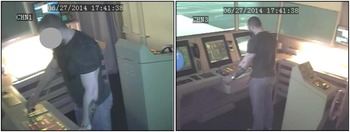
The experiments were recorded with two purposely-placed video cameras, one for monitoring the officer's body position and navigational instruments and the other to determine the officer's direction of view and position of his/her hands (see Figure 3).
Officer on the bridge simulator during the experiment.

Survey questionnaires were used to estimate data not measureable using the simulator or similar experimental procedure. Among the 104 participants 39% were masters, 26% chief officers, 25% second officers and 10% third officers. The questionnaire contained three sections, requesting information about: alerts (frequency, source, significance and their impact on situational awareness), incoming calls (frequency and importance of calls via radio, satellite and telephone), and assessment of importance and urgency of the most common actions during watch keeping. Task attributes which could not be determined by any of the above methods, were estimated using professional reports and studies, where appropriate. Several frequencies were estimated by expert evaluations.
4. SIMULATION RESULTS
The model was developed and run as a discrete event simulation in a commercially available simulation software package. The total simulation time was six months, divided into six replications.
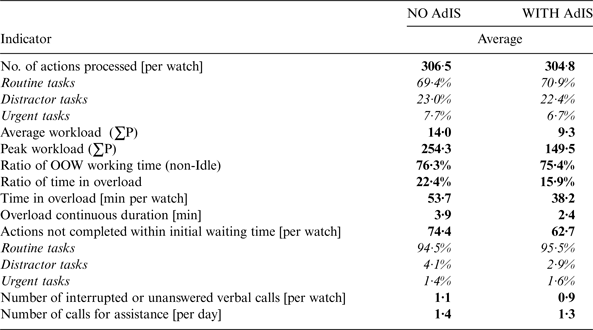
The average number of actions processed during one watch was 306·5 without the adaptive system, and 304·8 with the adaptive system. The total OOW work time differs by less than 1%. Both differences clearly show that AdIS as designed does not reduce the work to be done. It only redistributes the tasks during the watch. Results are summarised in Table 2.
Comparison of simulation results between two model versions.

The use of AdIS reduces the average workload by one-third or 33·6% and the average peak workload by 41·2%. With the adaptation engaged the OOW spends 15·6 minutes less time in an overload condition per watch with the average duration of continuous overload state being 1·5 min or 38·5% less than without it.
In all given navigational circumstances the AdIS was active 44·3% of time, in which one third of the time it was manually activated and the remaining time automatically. The average duration of automatic activation was 12·6 minutes.
Figure 4 clearly shows the peak workload conditions and effects of the AdIS when in the active state. The average number of delayed actions represents the number of tasks temporarily retained in the adaptive unit's memory during active adaptation. On average 30·9 tasks were delayed per watch or 10·1% of all the accomplished tasks. The average delay time was 22·2 minutes. The number of redirected calls during activated AdIS per watch was 1·4.
Selected indicators (representative simulation time sample: 3,600th to 4,320th minute).

5. CONCLUSIONS
The main conclusion following this research is that Adaptive Information Systems can minimise the possibility of the abrupt increase of number of tasks causing stress, negligence, haste and ultimately an error thus increasing the overall safety of navigation. The efficiency of the adaptive information system depends greatly on integrated navigational systems and navigational circumstances. Higher effectiveness should be expected on sophisticated ships and in difficult navigational circumstances.
Adaptive information systems should not impact decision-making processes on the bridge. Thus in this model and in the possible application of the AdIS the information chosen to be delayed or redirected in case of demanding navigational circumstances must be of low importance i.e. not essential regarding a ship's safety or pollution prevention. Furthermore, the delay must be limited for a short time only, allowing the OOW to be notified as soon as possible. Any form of decision-making must remain the sole responsibility of the OOW.
Further research activities are needed, particularly those investigating the possible effects of delayed tasks. Every effort should be made to avoid any information being delayed unnecessarily long. Further research should also concentrate on fine tuning the system, particularly regarding the system's capability to adapt the presentation of information (for example to adapt sound signals, hide certain information and/or highlight important messages) according to navigational circumstances.
Additionally, a particular challenge to this research is to compare the workload estimated using work to be accomplished (by assessment of tasks demand) and actual personal workload assessed measuring physiological effects. Measuring one or more physiological parameters (e.g. heart rate, electrical conduction of skin, body temperature, eye movement etc.) are generally considered as objective methods to estimate actual workload of an operator. In respect of AdIS use, physiological measurements are considered unsuitable because of several identified issues, the most important being: practical issues (the OOW has to carry measuring devices during a navigational watch), personal issues (physiological profile of each OOW should be known), prediction accuracy (real-time measuring would detect high workloads after a demanding situation occurred, probably too late to activate protective mechanisms, such as the AdIS), and incoherencies (it would be difficult to correlate the measured values with the type and seriousness of a situation in order to activate the most appropriate method of adaptation).
However, more developed measuring devices and additional research may bring these two approaches closer, providing effective methods to estimate actual workload, to detect overload of the OOW and to control the AdIS or similar systems.