1. The Shanghai Centre for Research in English Language Education
As one of the two ‘educational special zones’ in China, Shanghai is launching a new round of curriculum reforms centring on lide shuren, viz. ‘fostering integrity and promoting rounded development of people’ (Hu Reference Hu2012). Apart from piloting a new plan for Gaokao, the national college entrance examination in 2014, a ground-breaking endeavour by the Shanghai Municipal Education Commission was to establish 17 key research centres at higher institutions for 16 basic education subjectsFootnote 1 in an effort to push forward city-wide curriculum innovations through in-depth university-school collaborations. Founded in 2016, the Shanghai Centre for Research in English Language Education (SCRELE) is one of these key research platforms.
Based at Shanghai International Studies University, SCRELE involves more than 30 researchers, teacher educators and teachers from major universities, education development institutes, and schools in Shanghai, as well as researchers and practitioners from other parts of China and overseas educational institutions. As with most of the other key research centres,Footnote 2 SCRELE will undertake to achieve the following goals in its first five-year plan: (1) reformulating the current English curriculum standards covering Years 1 to 12; (2) developing a new set of textbooks and instructional resources that are in line with principles in the new curriculum; and (3) educating teachers to work effectively to implement the new curriculum.
2. The Haitong Project
The Haitong Project is named after one of the partner schools of SCRELE, Haitong Primary School, located in Pudong New District, Shanghai. In November 2015, the partnership was established by a group of founding researchers of SCRELE in an initial attempt to ensure and improve the effectiveness of the school's English as a foreign language (EFL) programme. After the foundation of SCRELE, the aims of the project were adjusted to informing and supporting the overarching missions of the Centre. That is, the research team conducting the Haitong Project consists of core researchers who are also responsible for reformulating the English curriculum, developing new instructional materials, and educating primary teachers in Shanghai.
In line with the global trend of educational reform to foster the development of learners’ key competencies (OECD 2006), overall EFL curriculum innovations in China emphasise fostering four essential skills to help learners face the challenges in society when they grow up, specifically, linguistic competence, cultural intelligence, cognitive capacity, and study skills (Cheng & Zhao Reference Cheng and Zhao2016). This goal is congruent with the educational philosophy buttressing task-based language teaching (TBLT), that is, a pedagogical approach that acknowledges what Norris, Bygate & Van den Branden (Reference Norris, Bygate, Van den Branden, Van den Branden, Bygate and Norris2009) state as ‘important roles for holism, experiential learning, and learner-centred pedagogy’ (p. 15). In the English Curriculum for Primary and Secondary Schools in Shanghai (Shanghai Curriculum Innovation Committee 2004), ‘using pedagogic tasks and real-life tasks’ (p. 56) was listed as one of the recommended methods for classroom instruction. However, primary teachers’ beliefs and practices regarding the defining principles and pedagogical effectiveness of a ‘task’ still remain rather thorny issues (Pan Reference Pan2013; Zhu & Shu Reference Zhu and Shu2017a). Therefore, designing, implementing, and evaluating tasks is one of the foci of innovation in the Haitong Project as well as in the upcoming EFL curriculum reformulation conducted by SCRELE.
Realising that a top-down statutory innovation is unlikely to bring about sustainable receptivity to new ideas in the Asian teaching and learning context, (see Carless Reference Carless2004, Reference Carless, Shehadeh and Coombe2012; Zheng & Borg Reference Zheng and Borg2014), the Haitong Project intends to explore a collaborative approach to EFL educational reform. By ‘collaborative’ we intend to reformulate the present curriculum through ongoing dialogues with teachers, students, and their parents. That is, the project is both top-down and bottom-up (Farrell Reference Farrell2000). Specifically, the approach we adopt is ‘the road less travelled’ by conventional educationists. Stakeholders involved in the upcoming educational change begin with teacher education then move to material development and curriculum reformulation. In so doing, we assume that this could be likely to foster teachers’ sense of plausibility about (Prahbu Reference Prahbu1987) and ownership of (Beretta Reference Beretta1990) the educational change.
In sum, our project aims to reconcile the tension between the theoretically justifiable TBLT principles imparted in trainer-fronted teacher education programmes and the context-specific constraints that may hinder teachers from enacting TBLT in their regular classrooms. In our project, the in-residence research team keeps close contact with primary school teachers through regular visits to school and continuous ‘offline’ support via emails, WeChat messages, and phone calls. Also, the trainer–teacher interaction is inspired by and oriented towards classroom realities. Being school-based and practice-oriented, our teacher education programme aims to help Haitong teachers develop the expertise and competence to enact TBLT, and, more importantly, to cultivate their self-esteem and autonomy through their active involvement in the ongoing curriculum innovation.
2.1 The partnership contract
Two SCRELE researchers, three post-graduate students in applied linguistics, and ten out of a total of 18 EFL teachers at Haitong are participating in the project. One in-residence researcher and a head teacher co-coordinate the project based on a three-year partnership contract between the Centre and the school. In accordance with the contract, an ‘in-residence research team’ from SCRELE organises meetings, seminars, or workshops for Haitong teachers on a weekly basis, and it is the project teachers’ responsibility to try out and evaluate pedagogical initiatives designed through collaborative dialogues.
2.2 Setting
Haitong Primary School is a public school founded in 1998, and it spreads across two campuses. There are overall 1,842 students aged from 6 to 11, and the number of classes ranges from 7 to 9 in each of the 5 grades. The class size is quite large, with around 45 students in each class. English courses commence from the first year and are taught by 15 Chinese teachers and 3 foreign teachers. The school implements an integrated English teaching programme encompassing a mandatory comprehensive English course taught by Chinese teachers, a school-based comprehensive English course taught by foreign teachers, and a school-based science course mainly in English with Chinese teachers. Students in Haitong stay at school for 8.5 hours on work days, receiving 7 hours’ classroom instruction on subjects including Chinese, Maths, Science, PE, Music, Art.
2.3 Participants
As previously stated, there are 15 Chinese EFL teachers and 3 foreign EFL teachers at Haitong Primary School. Drawing on an external evaluation conducted at the first stage, we found most teachers tended to be receptive to the principled use of tasks and also knew a few basics about TBLT. Not surprisingly, their understandings are not completely congruent with what is written in research-oriented literature (e.g., Ellis Reference Ellis2003; Willis & Willis Reference Willis and Willis2007). This impacts on how they enact TBLT in their regular teaching (Zhu & Shu Reference Zhu and Shu2017a). Also, we observed variance among teachers with regard to their beliefs, knowledge, and competence. Ten out of fifteen Chinese EFL teachers participated in our project voluntarily, hoping that their professional capacity and the effectiveness of their classroom instructions might be improved.
2.4 Textbook
The mandatory textbook currently in use is English (Oxford Shanghai edition). In each of the textbooks, there are four themed modules consisting of three units targeting specific topics, daily expressions, and language points. The textbook is not task-based, but contains some communicative activities. Nevertheless, the instructions for these activities, such as ‘say and act’ and ‘play a game’, are quite simple, which leaves ample flexibility for teachers to reinterpret and redesign the activities. Given their inadequate knowledge of TBLT, the communicative activities in the textbook were often transformed into traditional grammar or vocabulary exercises. For example, without specific guidelines specifying the rationale and procedure for the activities that might help to make them more task-like, teachers are likely to change the activity to a mechanical pattern practice. What is more, there are no teachers’ manuals and a very limited amount of supporting material associated with the core textbooks.
2.5 Procedure
The Haitong Project is planned to last three years, and consists of three stages: pre-project external evaluation (November 2015 – June 2016), within-project innovation implementation (July 2016 – June 2018), and post-project evaluation (July 2018 – December 2018).
2.5.1 Stage 1: Pre-project evaluation
To investigate how Haitong teachers perceive and practise TBLT in classrooms, we observed a total of 57 regular lessons, yielding 41 hours of video-taped lessons, which were transcribed verbatim. Teachers who participated in this evaluation stage included one inexperienced teacher, one veteran teacher, and one foreign teacher in each grade. Apart from observing the teachers’ regular classroom instructions, we also administered in-depth interviews with four teachers and administered a questionnaire containing open-ended questions to all the teachers regarding theoretical principles and practices of TBLT.
2.5.2 Stage 2: Teacher education programme
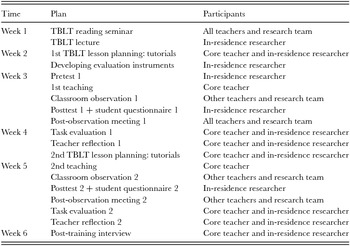
Topics for the task-oriented teacher education sessions are decided by negotiating with teachers. A key aim is to investigate their beliefs and classroom practices during the pre-project evaluation stage (Zhu & Shu Reference Zhu and Shu2017a). Table 1 shows the schedule for one teacher education session in the first phase of the curriculum innovation stage. This is cyclically followed each semester. As presented in the table, in each session there is one core teacher participant, who works intensively with the in-residence researcher to conduct an action research project on designing, implementing, and evaluating tasks. Other teachers, especially those who teach the same grade with the core teacher, are welcome to join in the teacher–researcher meetings when possible.
Teacher education programme in Stage II (July 2016 – June 2017)

In the first phase, teachers are expected to learn the basics for doing TBLT through reading literature, attending lectures, and, most importantly, the ongoing facilitative feedback they receive on their reflective classroom practices. In each teacher education session, the second teaching session draws heavily on evaluating the first TBLT lesson, with students’ learning outcomes, preferences for tasks, task performance, and peer teachers’ post-observation feedback jointly investigated by the in-residence researcher and the core teacher as integrated evidence to gauge the effectiveness of tasks. Moreover, an important ‘by-product’ of the intensive teacher–researcher interaction is the collection of tasks that are co-designed by both parties and will serve as substantial components for a developing task-book to support a teaching unit. In this first phase, other project teachers are encouraged to try out or adapt the tasks used by the core teacher. Towards the end of the first phase, there will be five exemplar task-book units, including materials that will be included in the students’ workbook, the teachers’ manual, and the task resources website, which are to be subsumed into the instructional materials SCRELE is producing for primary school teachers. As Table 1 shows, an in-depth interview is conducted with the core teacher when one teacher education session finishes in an attempt to monitor teachers’ receptivity to our teacher education programme.
Each of the teacher education sessions in the second phase will only be two weeks long. Similar to Phase One, there will still be one core teacher in each session, but other project teachers who teach the same grade are required to try out or adapt the tasks co-designed by the core teacher and the in-residence researcher. There will be five in-residence research teams in this phase, and each team will take charge of the teacher education programme and task-book development for one grade. Towards the end of the second phase, the first draft of 10 task-books containing a total of 80 units will be compiled.
2.5.3 Stage 3: Post-project evaluation
The objective of the post-project evaluation stage is twofold: to estimate the effectiveness of the ongoing in-service teacher education programme by investigating the changes taking place to Haitong teachers’ beliefs and practices, and to assess the quality of the task-books that have emerged from the previous stage by involving ten primary schools in trying out the task-books and providing feedback during a whole academic year. SCRELE researchers will go to these new partnership schools to conduct teacher education programmes along similar lines to those described earlier to ensure the ecological soundness and sustainable implementation of the principles, tasks, materials, and methods conveyed in the task-books in various new educational settings.
3. Challenges of implementing TBLT in the Chinese context
Similar to curriculum innovation projects implementing communicative language teaching or TBLT in Chinese EFL classrooms (e.g., Zheng & Borg Reference Zheng and Borg2014; Zhu & Shu Reference Zhu and Shu2017b), contextual challenges such as large class sizes, limited instructional resources, and non-contextual constraints such as teachers’ entrenched preferences for a non-communicative language teaching approach, are obvious obstacles we need to overcome in our project. Nevertheless, given the ongoing and practice-oriented teacher education programme we provide, the top-down and bottom-up approaches we adopt, and the associated contribution made by SCRELE researchers and Haitong teachers as innovation initiators, implementers and disseminators, the Haitong Project has much potential to add to the list of effective cases of implementing TBLT in primary EFL classrooms.
Acknowledgements
This work was supported by The Teaching and Research Section of Shanghai Municipal Education Commission (grant number JY13JC02201603) and The Shanghai Centre for Research in English Language Education.