1 General assessment and summary
The phonology of Japanese addresses many aspects of Japanese phonology, and its coverage is rather comprehensive. The book assumes basic familiarity with generative phonology, but is written in an accessible way. The book is a welcome contribution to the field, since, as the author mentions (pp. 6–7), there is no recent reference book for Japanese phonology (the classic reference on this topic, Vance Reference Vance1987, is now out of print; a more recent book, Vance Reference Vance2008, focuses more on phonetics, primarily designed for English-speaking L2 learners of Japanese).Footnote 1 The book will be a very useful reference for anybody who is interested in Japanese phonology, especially for non-experts and non-native speakers of Japanese.
One aim of this book is to synthesise the theoretical linguistics approach with traditional grammar, known as kokugogaku. The latter approach is descriptively oriented and has continued to reveal a rich set of data, and as such is of great potential interest to theoretical linguists. However, papers in this tradition are usually written in Japanese and are not widely circulated outside of Japan, and hence are accessible to a small subset of theoretical linguists. The book thus achieves the goal of making this rich source of data available to theoretical linguists. In this connection, I find the index to be a useful component of the book, as it comes with a list of linguistic terms in Japanese with their English translations. The book therefore contributes to bridging the gap between theoretical linguists and the Japanese traditional grammar.
This aspect of the book would have been better, however, if each insight from the traditional literature had been accompanied by a list of explicit references, especially regarding remarks about dialect-specific patterns and historical changes. For example, on page 27 Labrune discusses various dialects with different vowel systems. The discussion would have been more useful if there had been a reference to the original sources of each dialect, for readers interested in knowing more. Similarly, footnote 1 of Chapter 3 (p. 62) states that in Ancient Japanese stops were realised without affrication before any vowel (unlike Modern Japanese), but again no references are given.
Setting aside this problem, the descriptions of Japanese phonology are generally very detailed (partly thanks to the traditional grammar), thereby calling for closer attention from the theoretical literature. The book often approaches the same problem from various perspectives (synchronic, diachronic and cross-dialectal). The discussion of velar nasals on pages 78–87 is a good example, as it covers synchronic, diachronic and sociolinguistic descriptions, as well as OT-based analyses. Not all phenomena are analysed using OT, and hence readers who are not familiar with this approach should still be able to understand a good portion of the book.
In short, this book will appeal to a wide range of potential researchers and students. For theoretical linguists who are already familiar with Japanese phonology, the historical and dialectal perspectives that the book offers should be inspiring. Theoretical linguists without much Japanese background will find the descriptive coverage of this book quite useful as a reference book. In addition to its role as a reference work, it can be used as a textbook on Japanese phonology both at advanced undergraduate and graduate levels.
Chapter 1 is a general introduction, which first lays out two general aims of the book: (i) to synthesise theoretical linguistics and the traditional literature, and (ii) to develop an analysis of Japanese phonology without syllables (see Chapter 6). It also contains a brief review of the history of Japanese, as well as the writing system, and an extensive discussion of the system of lexical stratification. Particularly refreshing is its focus on the historical background of how each type of lexical item has been incorporated into present-day Japanese.
Chapter 2 offers an overview of the vowel system. After brief phonetic descriptions, the chapter discusses the phonological characteristics of Japanese vowels. The phonological phenomena covered in this chapter include epenthesis (in loanword adaptation), epenthesis–accent interactions, vowel deletion in Sino-Japanese, high vowel devoicing and its interaction with accent shift, the phonology of long vowels and diphthongs, and corpus frequency data.
Chapter 3 discusses the phonological characteristics of each consonant. It offers a synchronic characterisation of these consonants (their allophonic variations, distributional restrictions and morphophonological alternations), and their historical developments. Although the chapter is organised by segment types it also includes discussion of many phonological alternations which have been analysed in the theoretical literature. These include affrication of stops before high vowels, palatalisation before [i], the [h]∼[p]∼[b] alternation, velar nasalisation, rendaku, palatalisation (of mimetic forms), gemination and coda nasalisation, and [r]-epenthesis in verbal morphology. The chapter closes with discussion of new phonemes (and phoneme sequences) which have arisen due to recent loanword adaptation, as well as presentation of some corpus frequency data.
Chapter 4 is about voicing in obstruents, which has attracted much attention in the theoretical literature. It starts by presenting general (both phonological and semantic) characteristics of voicing in obstruents, their behaviour in word games, their diachronic development, how they have been represented in orthography at various historical stages and how this may relate to their phonological patterns. It then moves on to rendaku, presenting a summary of factors that trigger and block rendaku, as well as its effect on accentuation, and a review of previous theoretical treatments. The chapter also deals with post-nasal voicing.
Chapter 5 is a brief overview of ‘special moras’ in Japanese: /N/ (the coda nasal), /Q/ (the coda part of an obstruent geminate) and /R/ (the second part of a long vowel). The chapter describes their phonetic and phonological realisations, as well as their historical origins.
Chapter 6 proposes a new theoretical claim about the prosodic organisation of Japanese: it revives the general traditional view that Japanese does not possess syllables. (Since this is an important claim, I will come back it in §2.) The chapter starts with the mora, and defends its psychological reality in terms of poetry, orthography, word games, phonological behaviour, psycholinguistic experiments and speech errors. The chapter then develops an analysis of Japanese phonology without syllables. It closes with a brief discussion of higher prosodic levels (the foot, the prosodic word and higher).
Chapter 7 discusses accent in Japanese. It starts with a phonological characterisation of the accentual system in the standard dialect, followed by its phonetic realisation. The chapter discusses the distributional properties of accents (including unaccented words), and provides an overview of two major theoretical treatments of tonal representations of Japanese accent (Haraguchi Reference Haraguchi1977, Pierrehumbert & Beckman Reference Pierrehumbert and Beckman1988). The chapter then presents the distribution of accents in morphologically simplex words, the interaction between root and suffixal accents, and the accentual patterns of verbs and adjectives, as well as the default accentuation pattern found in loanword adaptation. The chapter proceeds to an OT analysis of the default accents, building on previous studies (Kubozono Reference Kubozono1996, Reference Kubozono1997, Shinohara Reference Shinohara2000), followed by compound accentual patterns, a topic which has attracted the attention of many researchers inside and outside Japan. It also discusses accent patterns of other morphological constructions. The book closes with other general remarks on Japanese accent systems.
As this summary shows, the empirical coverage of the book under review is impressive. Moreover, the book approaches Japanese phonology not only from a synchronic perspective, but also from a diachronic (and sometimes cross-dialectal, sociolinguistic and even orthographic) perspective, which is refreshing and inspiring, especially for those who are engaged in modern theoretical linguistics.
The book touches on phonetic aspects of Japanese, but the discussion is often brief – interested readers should consult Vance (Reference Vance1987, Reference Vance2008) and Akamatsu (Reference Akamatsu1997). A few major domains of Japanese phonology that are not comprehensively covered are psycholinguistic studies of Japanese phonological patterns, morphophonological patterns of verbal inflection, the phonology of mimetics, patterns of loanword adaptation, and intonation (some of which are noted in the introduction of the book.) Except for the first two, however, there are book-length resources in English for these topics: Hamano (Reference Hamano1988) on mimetics, Katayama (Reference Katayama1998) and Irwin (Reference Irwin2011) on loanwords, and Pierrehumbert & Beckman (Reference Pierrehumbert and Beckman1988) on intonation. I hasten to add that including all the topics on Japanese phonology in one book is not realistic or even possible.
2 On the syllable-less theory of Japanese prosody
Labrune claims that Japanese does not possess syllables (§6.2). This claim revives a view from the traditional literature, but goes counter to many views in the generative tradition. Since this is the theoretical claim that is put forward most forcefully in the book, I will discuss it in some detail. It is not possible to fully defend an alternative view in this limited space, but I would like to bring some more issues and data to the table to stimulate further discussion.
I first note that although the non-universalist, syllable-less view is interesting, pursuing the universality of prosodic levels is not without theoretical reasons, the most important one being the restrictiveness of phonological theory. The book uses an Occam's razor argument (p. 167) to eliminate a level that seems redundant, but we need to exercise caution in resorting to Occam's razor, because everything else is usually not equal in linguistic theorisation. In this particular context, from a theoretical point of view it is not desirable to admit language-particular variation at the fundamental level of linguistic organisation, as explicitly claimed by Selkirk (Reference Selkirk, Frota, Vigário and João Freitas2005) and Ito & Mester (Reference Ito and Mester2007, Reference Ito, Mester and Borowsky2012). This theoretical consideration may lead to new empirical findings. In some research on Japanese intonation (e.g. Pierrehumbert & Beckman Reference Pierrehumbert and Beckman1988), no levels corresponding to Intonational Phrases were posited. However, by looking at syntactic constructions in Japanese which were argued to correspond to Intonational Phrases in other languages (e.g. multi-clause constructions), we do seem to find evidence for Intonational Phrases (Kawahara & Shinya Reference Kawahara and Shinya2008, Kawahara Reference Kawahara and Borowsky2012). I do not intend to fully defend a universalist theory of the prosodic hierarchy here, but merely note that it has empirical and theoretical virtues.
Besides these considerations, two phonological patterns come to mind as potential problems for the syllable-less theory of Japanese. One is the observation that in the loanword-truncation process based on a bimoraic template (e.g. [suto] for strike), one heavy syllable is too short, and so an extra mora is attached (e.g. [maiku], *[mai] for microphone) (Itô Reference Itô1990). Another is the observation that in loanword adaptation, word-final gemination does not occur when the preceding vowel is borrowed as long ([bitto] bit vs. [biito] beat), which is due to a ban on superheavy syllables (Kubozono Reference Kubozono and Tsujimura1999, Kubozono et al. Reference Kubozono, Ito and Mester2008). In my opinion, these phenomena still require the notion of the syllable, although Labrune (Reference Labrune2012) contains some discussion on these phenomena from a syllable-less view of prosodic organisation.
Moreover, there is phonetic evidence for syllables in Japanese. Campbell (Reference Campbell1999), in a paper titled ‘A study of Japanese speech timing from the syllable perspective’, claims that there is durational accommodation at the syllabic level. Based on corpus data, he demonstrates that vowels are longer when preceded by a moraic nasal – i.e. in (C)VN sequences – than in (C)V sequences (1999: 34). Vowels are also longer before obstruent geminates (/Q/) than before singletons (1999: 35). These phonetic lengthening patterns show that a vowel and a following coda consonant (be it /N/ or /Q/) interact, suggesting the presence of a syllable. Labrune points out (p. 151) that we should expect shortening instead of lengthening in closed syllables (and hence that the syllabic view is unjustified). However, shortening in closed syllables is not universal; there are languages other than Japanese that show lengthening in pregeminate position (such as Persian, Sinhala and Turkish) and also languages that show no differences (such as Arabic, Estonian and Hungarian) (see Kawahara to appear for references and discussion).Footnote 2
Pre-coda lengthening is not an isolated case of the interaction between segments within a syllable. First, Campbell (Reference Campbell1999: 35) finds a negative correlation in duration between /N/ and the preceding vowel, such that /N/ is longer before shorter vowels. Second, vowels are shorter after geminates than after singletons, instantiating a case in which vowel duration is affected by the moraic status of the onset consonant within the same syllable (see also Idemaru & Guion Reference Idemaru and Guion2008 and Idemaru & Guion-Anderson Reference Idemaru and Guion-Anderson2010 for relevant production and perception experiments). This interaction would be unexpected if a geminate consonant were simply a concatenation of a /Q/ mora and a CV mora (as proposed by Labrune on page 162). Campbell (Reference Campbell1999) does not – and very few people would – deny that there is durational compensation within moras in Japanese (Port et al. Reference Port, Al-Ani and Maeda1980, Port et al. Reference Port, Dalby and O'Dell1987, Han Reference Han1994, though cf. Beckman Reference Beckman1982), but it seems to be the case that there is durational interaction between segments within a syllable as well.
Finally, Inagaki et al. (Reference Inagaki, Hatano and Otake2000) show that before children learn the kana writing system, they show some evidence for syllable-based segmentation patterns (with mixture of mora-based segmentation), and that the dominance of mora-based segmentation develops as they acquire writing skills. The study thus implies that the dominant role of the mora in Japanese speakers' perception is at least partly due to the writing system.
3 Additional matters
3.1 Transcription conventions
I find some transcription conventions in this book to be a little misleading, although they are used for a reason. For example, the book uses boldface to represent accent location (following the Hepburn system), but this style can be sometimes confusing, as boldface tends to distract the reader. When a segment illustrating a point is different from the accented syllable, I was often misled into thinking that the accented syllable is the point under discussion. For example, example (10) in Chapter 3 (p. 70) illustrates the [h]∼[pp] alternation; sometimes syllables that undergo alternations are highlighted because they are (accidentally) accented, but sometimes not. The alternative transcription convention – an accentual mark after the accented syllables, which is arguably more commonly used – has its virtues as well, as it directly reflects the phonetic realisation of Japanese accents (an HL fall in F0).
The book uses ei and ou to represent long [eː] and [oː] respectively. This notation has the potential to be misleading, as it might lead to the impression that these sequences are underlying diphthongs, whereas, especially in the former case, there is no strong evidence that long [eː] is underlyingly a diphthong. (Labrune does not make this assumption, though; see page 40.)
3.2 Clarifying data sources
As discussed above in §1, Labrune sometimes presents discussion of dialectal studies and historical phonology without explicit references. Related to this, the book contains many empirical observations about Japanese, but sometimes it is not clear whether the observation is the author's impression or is based on instrumental work.
For example, on page 32 Labrune states that the word gakusei ‘a student’ ‘is frequently realized with an elision of /u/’. It is not clear whether this statement is based on the author's impression or on instrumental phonetic studies. On page 40 she states that pronouncing long [eː] as [ei] ‘is now spreading among some speakers of the standard language’, but no sources are given. On page 104 the author discusses the devoicing of voiced geminates in an OCP-violating environment, and suggests that ‘one will undoubtedly hear more frequently the forms bakku or betto, with devoicing of the geminate (Kawahara Reference Kawahara2006)’. However, I believe that it is yet to be shown whether devoiced renditions are more common than faithful renditions by way of a production study.Footnote 3 Many other examples of this kind can be found in the book.
Similarly, Table 7.1 (p. 187), based on Shibata (Reference Shibata and Sato1994), reports the frequency of each accentual pattern for words with different mora lengths. It is very useful to have this resource reproduced in English; it would have been informative if the methodological details of the data collection had also been reported, as the source is written in Japanese.
3.3 On phonetic descriptions
I would like to offer a few remarks about some phonetic discussion in this book. On pages 35–36 Labrune gives waveforms and spectrograms to illustrate a devoiced high vowel, presumably captured via screen-shots from Praat – it would have been better to use Praat's picture function and show the y-axis scale and segmental boundaries. On page 182, two pitch tracks illustrate a difference between an accented word and unaccented word, but it would have been more informative to show spectrograms and segmental boundaries too, so that the readers can see how the tonal targets are aligned with respect to the segments.
There are a few remarks in the book about Japanese phonetics that should perhaps be interpreted with caution. For example, on page 25 it is stated that there is no substantial quality difference between short vowels and long vowels. A recent phonetic study shows, however, that long vowels are more dispersed than short vowels in F1 and F2 dimensions (Hirata & Tsukada Reference Hirata and Tsukada2009).
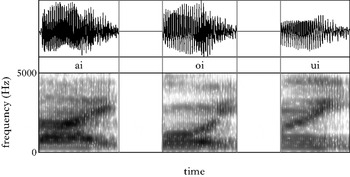
On page 54, Labrune suggests that in a sequence of two vowels, ‘there is no significant gradual change of the quality of the first vowel towards the second one … contrary to what generally occurs with diphthongs in other languages’. However, vowels do seem to involve gradual changes when they appear next to each other in Japanese. Figure 1 illustrates sequences of [ai oi ui] in Japanese, based on my recordings of several adjectival endings. It seems difficult to draw a clear boundary between V1 and V2 on the waveform, and the F2 movement seems gradual until toward the end of [i] on the spectrograms. I do not intend to claim on the basis on this data that such sequences indeed form diphthongs – but more extensive investigation is necessary to test such a claim.
Sequences of [ai oi ui] in Japanese.

3.4 Ranking arguments
Generally, the OT analyses in this book are developed in a ‘top-down’ manner; i.e. a total ranking is given first, with some discussion in prose, and the entire ranking is justified by several tableaux with a large number of constraints (especially in Chapter 7). It would have been preferable to develop a step-by-step analysis by justifying the ranking between each pair of constraints, as constraint interactions in OT are very complex, and it is easier to follow and confirm ranking arguments in mini-tableaux with a few constraints (McCarthy Reference McCarthy2008). For example, Labrune proposes a new constraint, *F[m (‘no foot starts with a deficient mora’), which appears in all the tableaux in Chapter 7.2. Its presence, however, is not justified until (21), the fourth tableau in which it occurs, as far as I can see. A mini-tableau with a few relevant constraints and candidates would help us better understand why the new constraint is necessary, and how it rules out rival candidates.
There are some other minor matters which I thought would benefit from more clarification, but I will not list them here, due to space limitations. I will conclude by reaffirming that despite all these points, the descriptive coverage of this book is still impressive, and they do not undermine the overall value of the book.
In my opinion, this book will prove to be useful for a wide range of readers. For theoretical linguists who are familiar with Japanese phonology, its historical and dialectal perspective is inspiring, and its syllable-less view of Japanese phonology is thought-provoking. Theoretical linguists without much Japanese background will find the book to be a rich resource. Finally for traditional grammarians, the balanced approach adopted within the book demonstrates that theoretical formalisms and descriptive work can be mutually informative.