Difficulties in the acquisition of object clitics in Spanish are common among adult second language (L2) learners (see Liceras, Reference Liceras1985; Sánchez & Al-Kasey, Reference Sánchez and Al-Kasey1999). Bilingual speakers often show inconsistencies in their relative judgments of clitics versus null objects across contexts. Some studies show overacceptance of clitics where null objects are expected, whereas others show mastery at advanced levels (Arche & Domínguez, Reference Arche, Domínguez, Galani, Tsoulas and Hicks2011; Borgonovo, Bruhn de Garavito, Guijarro-Fuentes, Prévost, & Valenzuela, Reference Borgonovo, Bruhn de Garavito, Guijarro-Fuentes, Prévost and Valenzuela2009; Bruhn de Garavito & Guijarro-Fuentes, Reference Bruhn de Garavito, Guijarro-Fuentes, Costa and Freitas2002; Valenzuela, Reference Valenzuela, Brugos, Clark-Cotton and Ha2005). This domain of learners’ difficulty is examined by considering the syntax and semantics of the null objects themselves (see Sánchez & Al-Kasey, Reference Sánchez and Al-Kasey1999). Sensitivity to the restrictions (i.e., definiteness and specificity) that regulate the alternation of object clitics and object omission in Spanish is specifically examined in bilingual and L2 grammars. New data are presented on anaphoric contexts and left-dislocated topics in the Spanish of simultaneous and sequential bilinguals from Lima, Peru, who have Chinese as their first language (L1) and who have lived in a full immersion context for extensive periods.
This is an interesting language pair to study because they differ in anaphora and the set of relevant nominal features. In Spanish, clitic and null object alternation is regulated by definiteness and specificity features, whereas in Chinese, null objects are topic related. Chinese is a radical pro-drop, topic-oriented language with no productive use of pronouns and no marks for definiteness or specificity in the nominal system. Chinese allows null referential objects (1b), which directly refer to a discourse antecedent (1a) (see Yip & Matthews, Reference Yip, Matthews, Eubank, Selinker and Sharwood Smith1995; Yuan, Reference Yuan1997). Huang (Reference Huang1984) treats these null arguments as variables subject to subjacency effects. In Spanish, object drop is constrained by definiteness and specificity features (Campos, Reference Campos1986; Sánchez, Reference Sánchez, Authier, Reed and Bullock1999) so that definite objects—whether specific or not—cannot be omitted, hence the contrast in (2). Thus, there are referential direct object (DO) clitics (2b) and nonreferential null objects (3b). Indefinite objects, however, must be dropped, as in (3b). Given these differences, Chinese learners of Spanish would have to reconstruct the Spanish feature system from the outset.
(1) a. Chinese [+definite +specific]:
Zhangsan kanjian Lisi le ma?
Zhangsan see Lisi aspq
“Did Zhangsan see Lisi?”
b.Ta kanjian e le.
He see (he)asp
“He saw (him).” (Huang, Reference Huang1984)
(2) a. Spanish [+definite +specific]:
¿Compraste la revista?
You-bought the magazine
“Did you buy the magazine?”
b.Sí, la (*Ø) compré.
Yes, it I-bought
“Yes, I bought it.”
(3) a. Spanish [−definite −specific]:
¿Compraste café?
You-bought coffee
“Did you buy coffee?”
b.Sí, compré Ø.
Yes, I-bought
“Yes, I bought (it).”
In general, bilingual difficulties in a given domain result from the interaction of the three dimensions of the acquisition process: structure, experience, and influence of the L1. The structural dimension refers to the complexity, transparency, and saliency of a given domain (O’Grady, Kwak, Lee, & Lee, 2011). Input factors refer to the quantity and quality of the experience as well as the frequency of the relevant triggering context (Yang, Reference Yang2002; Yuan, Reference Yuan1997). The influence of the other language constitutes the third dimension, as it introduces further complexity into the triggering experience by providing alternative, competing representations.
The present study takes into consideration these three dimensions by examining the acquisition of a complex structure in Spanish among learners with different ages of onset of bilingualism living in a Spanish-speaking environment along with the potential transfer from a typologically divergent L1 (i.e., Chinese). Sensitivity to the constraints on clitic and null object alternation is examined by comparing Chinese-Spanish simultaneous bilinguals, Chinese-speaking childhood immigrants, and adult immigrants with a control group of Spanish monolinguals from Peru. Data are presented on elicited production, interpretation, and acceptability judgments of the clitic and null object alternation in anaphoric and topicalization contexts. The first section frames the learning problem by means of a contrastive analysis of the two languages. The second section summarizes previous literature on Spanish L2 clitics. The study is presented in the third and fourth sections, followed by the discussion and conclusion in the last section.
OBJECT EXPRESSION AND OMISSION IN SPANISH AND CHINESE
Spanish Clitics and Object Drop
Unstressed object pronouns in Spanish (e.g., lo, la), known as clitic pronouns, are syntactically and phonologically dependent on a verbal host. The focus of this study is on third-person accusative object clitics. Object clitics agree in gender and number with the antecedent to which they refer, as the example in (4) shows.
(4) Ramón loi compró (el libro).
Ramon cl-3sg masc bought (the book)
“Ramon bought it (the book).”
Under certain circumstances, they coappear with the noun phrase (NP, currently labeled “DP” for determiner phrase) to which they refer, or with a null associate (see Borer, Reference Borer1984; Kayne, Reference Kayne1991; Sportiche, Reference Sportiche, Rooryck and Zaring1996). The clitic may be moved or base generated (Cinque, Reference Cinque1990), and it shares phi-features (i.e., gender, number, person, and case) with the fronted DP. Agreement between [+definite +specific] features of the clitic and the DP satisfies the features of the functional head (Uriagereka, Reference Uriagereka1995). Putting aside controversies between movement (Kayne, Reference Kayne1991; Rizzi, Reference Rizzi1986) and base-generation approaches (Everett, Reference Everett1996; Suñer, Reference Suñer1988), it is assumed that clitics behave like agreement morphemes (Borer, Reference Borer1984). To that end, Suñer (Reference Suñer1988) proposes the matching principle, which stipulates that the values of the entry features of clitics always have to agree with those values of the DP antecedent. Under recent views, a clitic does not stand for the null object pronoun but either identifies it or restricts the recoverability of its potential antecedent (Cummins & Roberge, Reference Cummins and Roberge2005; Sigurðsson, Reference Sigurðsson2011).Footnote 1
Although Spanish is generally not described as an object-drop language, null objects can be used to refer to indefinite antecedents (Campos, Reference Campos1986; Sánchez, Reference Sánchez, Authier, Reed and Bullock1999; Sánchez & Al-Kasey, Reference Sánchez and Al-Kasey1999). This distribution is licensed by the interpretative features of definiteness and specificity— universal semantic categories instantiated in NPs (Farkas, Reference Farkas2002; Fodor & Sag, Reference Fodor and Sag1982; Lyons, Reference Lyons1999). Definiteness refers to whether the NP is known or identifiable by the speaker or hearer (e.g., definite or proper nouns) or not known or identifiable (e.g., indefinite nouns) (Givón, Reference Givón and Greenberg1978). Specificity refers to the referentiality of the NP antecedent (i.e., the existence of the referent in the discourse). Under this view, DPs can be categorically identified as ±specific (Farkas, Reference Farkas, Nash and Tsoulas1995; von Heusinger, Reference von Heusinger2002). Definite DPs are generally specific but can also take a nonspecific interpretation. Indefinite nouns, in contrast, are usually nonspecific but can also have a specific interpretation where differential object marking encodes this distinction (Aissen, Reference Aissen2003).
Definite objects—specific or nonspecific—and indefinite specific objects cannot be dropped in Spanish (Campos, Reference Campos1986; Sánchez, Reference Sánchez, Authier, Reed and Bullock1999). However, indefinite, nonspecific objects must be dropped, as (3b) showed (e.g., Sí, compré Ø; “Yes, I bought [it]”) (Campos, Reference Campos1986). These interpretative and syntactic features also apply to contexts in which the DO appears preposed in sentence-initial position in topicalization or clitic left dislocation (CLLD) constructions (Cinque, Reference Cinque1990; Rivero, Reference Rivero1980; Zubizarreta, Reference Zubizarreta1998). Traditional syntactic analyses in Spanish and Italian have treated preposed topics in these constructions as different types of CLLD (Cinque, Reference Cinque1990; Zagona, Reference Zagona2002). In a topicalization structure, the topic is a base-generated, nonspecific object DP in clause-initial position marked by a specific intonation pattern. This structure does not have a clitic. The nonspecific DP (topic) and its comment (i.e., what is said about the topic) are thought to be linked by a null anaphoric operator as shown in (5a). In the CLLD construction, a base-generated definite topic appears in sentence-initial position. This topic must be doubled by a clitic as in (5b).
(5) a. Bare DP +topicalization:
Café, (*lo) tomo todas la mañanas.
Coffee, (*cl) I-drink every the mornings
“Coffee, I drink every morning.”
b. Definite DP +CLLD:
Estos zapatos, los compré la semana pasada.
These shoes, them I-bought the week last
“These shoes, I bought last week.”
The null object in (5a) or the use of a clitic in (5b) is constrained by the specificity and definiteness features of the topic DP. This bundle of formal features [±definite, ± specific] is not available in Chinese, and this absence may condition a potential role for crosslinguistic influence (Zapata, Sánchez, & Toribio, Reference Zapata, Sánchez and Toribio2005) from Chinese into Spanish.
In current Minimalist analyses, topicalization and CLLD contexts are not distinct constructs. Clitics are a morphological reflex of the silent object; they realize agreement features. Clitics themselves do not license null objects but serve to constrain their recoverability (Cummins & Roberge Reference Cummins and Roberge2005; Sigurðsson, Reference Sigurðsson2011). For instance, a masculine clitic restricts potential linkers to masculine DPs; all overt clitics restrict the selection to definite antecedents. Overt sentential topics—as in (5)—are merged at the left periphery of the clause and trigger an agreement relation with the silent object in argument position. Whereas topics with [+definite, +specific] features match the agreement features of the clitic, indefinites do not. In both cases, the overt topic constrains the identification of the definite or indefinite argument. This is also the case for discourse-introduced topics; thus, note the parallels between (6a) and (6b):
(6) a. Indefinite argument drop:
¿Tomaste café? Si, ya tomé Ø.
You-drunk coffee? Yes, already I-drunk
“Did you drink coffee? Yes, I already did.”
b. Definite specific topic (DO clitic):
¿Qué hace María con los zapatos? Se los pone.
What does Maria with the shoes Self cl-3pl-masc put
“What is Maria doing with the shoes? She is trying them on.”
Object Omission in Chinese
Chinese has a restricted pronoun system and does not encode for definiteness morphologically. Third-person singular object pronouns are all marked by the morphological tonic form tā “him, her, it.” This is the same form used for third-person singular subject pronouns. The plural is formed by adding the suffix -men to the pronoun (i.e., tāmen “they”), and there are no gender or animacy distinctions in second- or third-person pronouns (Li & Thompson, Reference Li and Thompson1981). Additionally, Chinese allows null objects regardless of the definiteness or specificity of the antecedent. According to Huang (Reference Huang1984), in topicalization cases null objects can be a variable bounded by a topic in the discourse. That is, they are bound not by a nominal argument in the matrix clause (i.e., A-bound) but rather by the preceding topic in the discourse, as in (7):
(7) Zhangsan ishuo Lisi bu renshi e *i.
Zhangsan say Lisi not know
“Zhangsani said that Lisi did not know (him *i).” (Huang, Reference Huang1984, p. 53)
The null object in (7) cannot be referentially dependent on the subject in the main clause (i.e., Zhangsan) because of intervention effects. It must therefore be referential with someone else outside the sentence—a topic—and treated as a variable (Huang, Reference Huang1984). This means the null object is c-commanded by a discourse-level topic operator, just as in cases in which the topic is present in addition to a nominal argument in the matrix clause. See (8), from Huang (Reference Huang1984):
(8) Neige reni, Zhangsan shuo Lisi bu renshi ei.
That man, Zhangsan say Lisi not know
“That man, Zhangsan said Lisi didn’t know.”
In (8), the null object is bound by the topicalized NP (i.e., neige ren “that man”) and not by the sentential subject NP. Huang argues that Chinese is a discourse-oriented rather than a sentence-oriented language. This means that topics can be null given that they can be identified with a topic in a topic chain (Huang, Reference Huang1984; Yuan, Reference Yuan1997). However, there is no specification of nominal features of definiteness or specificity and no requirement as to what type of topic can license a null object.
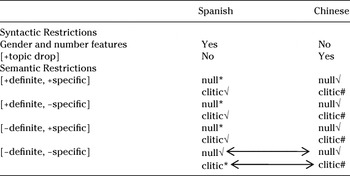
Sigurðsson (Reference Sigurðsson2011) suggests that null arguments are the result of distant agreement with a silent but syntactically present left periphery topic via an invisible C-edge linker (i.e., discourse-linked null topic).Footnote 2 He proposes that in languages like Chinese, which lack lexical complementizers, there are no movement constraints on these relations, unlike in the verb-second Germanic languages. Furthermore, there are no feature constraints on the interpretation of the null argument such as would be imposed in object agreement or clitic languages such as Spanish. Table 1 presents a summary of the differences between Spanish and Chinese.
Summary of syntactic and semantic restrictions on object drop in Spanish and Chinese

The Task of the Bilingual Learner
Given the differences shown in Table 1, Chinese-speaking learners of Spanish are exposed to a structure with different potential representations. Spanish null objects are allowed but restricted to indefinite nonspecific referents. The learners’ task is, in part, to acquire the syntax and morphophonology of the clitics. A second dimension of this task is to restrict learners’ L1 object-drop options; they must acquire sensitivity to the definiteness and specificity features involved in clitic agreement in Spanish. This leaves open the possibility of semantic transfer from the L1 (Faure & Bruhn de Garavito, Reference Faure and Bruhn de Garavito2010; Yuan, Reference Yuan1997).
The goal of the present study is to consider the three dimensions in the acquisition process—that is, structure, experience, and influence of the L1. In considering the structural dimension, the potential learnability issues that arise from the acquisition of clitics in Spanish among Chinese-Spanish bilinguals were identified. Thus, a dissociation of morphosyntactic from morphosemantic learning is proposed. In considering experience as a dimension in the learning process, two separate factors are confounded: (a) quantity of input in the learner’s bilingual environment and (b) age of onset of bilingualism. In immigrant populations, age of arrival determines quantity of input in both L1 and L2 (Jia, Reference Jia1998). Age of onset of bilingualism yields three qualitatively distinct types of bilinguals. Most researchers agree that simultaneous bilingual children (i.e., those exposed to two languages before the age of 3;0) can develop functionally differentiated or autonomous systems with little or no systematic interdependence between the languages (De Houwer, Reference De Houwer1990; Genesee, Reference Genesee1989; Paradis & Genesee, Reference Paradis and Genesee1996). Some authors identify some degree of cross-language influence in simultaneous bilingual acquisition (Müller & Hulk, 2001; Yip & Matthews, Reference Yip and Matthews2007), but the interpretation of the facts is questioned (Meisel, Reference Meisel2007). Early child L2 learners—defined in terms of exposure to the L2 after age 3 but before 7—often show less cross-language influence than adult L2 learners (Gavruseva, Reference Gavruseva, Greenhill, Hughes, Littlefield and Walsh1998; Haznedar, Reference Haznedar, Hughes, Hughes and Greenhill1997; Montrul, Reference Montrul2008; Unsworth, Reference Unsworth, Gavruseva and Haznedar2008).Footnote 3 Adult L2 learning is characterized by pervasive patterns of transfer from their L1 (Hawkins & Chan, Reference Hawkins and Chan1997; Jarvis & Odlin, Reference Jarvis and Odlin2000; Liceras, Reference Liceras, Gass and Schachter1989; Montrul, Reference Montrul2000; White, Reference White1987).
For some authors, transfer fundamentally determines the nature of the L2 grammar. For instance, proponents of the failed functional features hypothesis have argued that L2 learners with typologically different L1s are destined for nonconvergence and representational deficits mostly due to maturational reasons or lack of recovery from L1 options (Hawkins & Chan, Reference Hawkins and Chan1997; Hawkins & Franceschina, Reference Hawkins, Franceschina, Prévost and Paradis2004; Tsimpli & Roussou, Reference Tsimpli and Roussou1991). This view has been contested by other researchers who argue for nativelike attainment among adult learners and access to principles of Universal Grammar (Bruhn de Garavito & White, Reference Bruhn de Garavito, White, Pérez-Leroux and Liceras2002; Schwartz & Sprouse, Reference Schwartz and Sprouse1996; White & Genesee, Reference White and Genesee1996). The present study aims to investigate these three dimensions of the acquisition process by (a) looking at the semantic restrictions imposed on the null object and clitic alternation in Chinese-Spanish bilinguals, (b) studying populations with different ages at the onset of bilingual acquisition, and (c) observing differences between bilinguals from birth and late L2 acquirers in the potential influence of Chinese on Spanish.
THE L2 ACQUISITION OF OBJECT DROP IN SPANISH
Studies on the Acquisition of Spanish Clitics
One area in which L2 learners’ ability to instantiate new functional categories has been studied is clitics in Romance languages (Herschensohn, Reference Herschensohn, Prévost and Paradis2004; Sánchez, Reference Sánchez2003; White, Reference White and Clahsen1996). In the case of Spanish, several studies—with English as the L1—have provided evidence of ungrammatical object drop or DP overgeneration (Sánchez & Al-Kasey, Reference Sánchez and Al-Kasey1999; Valenzuela, Reference Valenzuela, Brugos, Clark-Cotton and Ha2005). Other studies at intermediate and advanced levels rule out L1 transfer effects (Bruhn de Garavito & Guijarro-Fuentes, Reference Bruhn de Garavito, Guijarro-Fuentes, Costa and Freitas2002; Zyzik, 2008).
Arche and Domínguez (2011) examined the morphological development of object clitics in L2 Spanish by L1 English speakers under the assumption that clitic-DP matching implies the acquisition of new morphology rather than a new syntactic feature. A question-and-answer task showed a low overgeneration of null objects by beginner and intermediate learners while favoring the production of overt DPs. The advanced learners used clitics productively, which suggests that the acquisition of clitics is possible. Results from a picture-selection task (i.e., comprehension task) showed increased accuracy rates. The level of target responses increased with level of proficiency, especially with morphologically transparent nouns. The authors concluded that learners have an unimpaired narrow syntax despite apparent inflectional variability.
Bruhn de Garavito & Guijarro-Fuentes (Reference Bruhn de Garavito, Guijarro-Fuentes, Costa and Freitas2002) also documented no difficulties with clitic generation in Spanish. The authors examined the role of input in the acquisition of the subjacency constraints associated with object drop in L2 Spanish by L1 speakers of English and Brazilian Portuguese (BP). They tested whether English and BP intermediate learners have knowledge that object drop is ungrammatical with definite antecedents. Brazilian Portuguese allows object drop in most contexts, which can lead to potential null object overextension in Spanish L2. Thus, they predicted clitic overextension among the L1 English speakers in places where a null object is required in Spanish. The results of a grammaticality judgment task (GJT) showed (a) a high degree of acceptance of object clitics with definite antecedents, (b) target gender agreement between clitic and antecedent, and (c) a high degree of acceptance of indefinite object drop. The authors concluded that both groups have knowledge of object-drop constraints in Spanish and make distinctions that would not be possible if L2 acquisition was fundamentally different from L1 acquisition. However, it should be noted that their results could have been confounded by the fact that specificity was not isolated from definiteness in their materials.
In another study, Zyzik (2008) tested the acquisition of third-person object clitics in anaphoric contexts under coordination and under short question-answer dialogues among English-speaking learners of Spanish. Results showed a high production of clitics. The few null objects that were in the data had nonhuman referents and appeared in pragmatically appropriate contexts. The L2 speakers had minimal acceptance of ungrammatical null objects, and this acceptance decreased with higher levels of proficiency. Learners who produced few clitics were more likely to accept null objects in the GJT. Zyzik thus argued for incorrect parsing strategies rather than grammatical errors.
Other researchers have identified difficulties with object drop. Sánchez and Al-Kasey (Reference Sánchez and Al-Kasey1999) found partial specification of the relevant features. Their English-speaking learners of Spanish showed evidence of clitic use but failed to produce and recognize clitics as licensers of CLLD structures or to distinguish the phi-features relevant to clitic doubling constructions. In the production task, the occurrence of null objects was minimal, but the participants showed a preference for the production of overt DPs when clitics were preferable. The authors thus proposed that the learners’ task is to acquire the relevant feature specifications (i.e., definiteness, specificity, and animacy) for the object agreement head (AgrO). The specification of these feature values accounts for clitic drop in certain contexts (e.g., indefinite, nonspecific settings) but not in others (e.g., definite, specific settings).
Valenzuela (Reference Valenzuela, Brugos, Clark-Cotton and Ha2005) also examined the acquisition of the specificity restrictions involved in Spanish CLLD constructions among L1 English speakers. Results showed target levels of clitic use in L2 Spanish with root and embedded specific objects in the sentence-selection task. The participants, however, incorrectly selected the clitic option with nonspecific topics, especially with embedded clauses. In a sentence-completion task, Valenzuela found target clitic use with definite topics, but nontarget use in nonspecific contexts. The speakers seemed to acquire the structure, but they did not seem to be aware of the specificity constraints. The author concluded that abandoning an L1 property is more difficult than acquiring a new L2 property.
More recently, Borgonovo and colleagues (2009) examined the syntactic correlates of specificity among BP learners of L2 Spanish. Specifically, they investigated whether these learners could acquire the constraints of specific objects and whether determiner definiteness could override specificity constraints. In spoken BP, object drop is constrained by the pragmatic and semantic properties of animacy and specificity (Cyrino & Lopes, Reference Cyrino, Lopes, Kepser and Reis2005). Specific or nonspecific targets with inanimate referents must be dropped, whereas animate specific antecedents are overt, and animate nonspecific objects may be optionally realized. They found that L2 learners showed no significant differences from the controls in specific contexts. In nonspecific contexts, however, the L2 learners showed a preference for clitics and accepted gaps less often than did the control participants. Similar results were found with definite and indefinite antecedents. Borgonovo and colleagues argued that overt clitics are underspecified in the L2 grammar with respect to the feature [+specific], which allows them to appear in [+specific] and [−specific] contexts. In contrast, null operators—related to the gap option—are fully specified for [−specific] because they are restricted to contexts with a nonspecific antecedent DP. Thus, the L2 learners accepted an overt clitic in most contexts and tended to reject gaps in all contexts. Difficulties (i.e., overgeneration of overt clitics) seemed unidirectional, a bias that the authors did not associate with L1 effects. Borgonovo and colleagues argued that these patterns of overextension go beyond L1 distinctions and therefore do not result from transfer. However, there is a learnability issue to be considered, which arises for BP learners when null objects are constrained not only by specificity but also by animacy features—a pragmatic constraint that the authors did not control for in their study. Animacy features are not relevant to pronominal object expression in Spanish. Thus, in the absence of sufficient data on the relevant structure, the learners might have overgeneralized the Spanish clitics to all contexts, even if that option is not available in their L1.
Grüter and Crago (Reference Grüter, Crago, Franich, Iserman and Keil2010) examined the role of transfer in the acquisition of L2 French clitics among L1 Chinese and Spanish children. The authors predicted fewer difficulties for Spanish natives and more overacceptance of ungrammatical null objects among the Chinese learners. An elicited production task supported the predictions; however, the results of a truth value judgment task (TVJT) showed no transfer of referential null object in French. It is possible that the results might be due to the methodology employed, and Chinese speakers might simply have shown a preference for the intransitive reading. Costa and Lobo’s (Reference Costa, Lobo, Baauw, Drijkoningen and Pinto2007) replication with the same methodology in European Portuguese showed speakers treated the objectless sentence not as ambiguous but as exclusively intransitive.
Even though these studies have focused on the acquisition of clitics, they have implications for the status of null objects. Sánchez and Al-Kasey’s (Reference Sánchez and Al-Kasey1999) study considers definiteness and specificity features, such as the licensing conditions necessary for object drop. Borgonovo and colleagues’ (2009) study also makes a direct contribution to the study of null objects by investigating the syntactic correlates related to the semantic notion of specificity and sensitivity to null objects in indefinite, nonspecific contexts. Moreover, Yuan (Reference Yuan1997) examined the role of transfer and reduced L2 input in the acquisition of null subject and object constraints by Chinese-speaking learners of English. He found target results in the acquisition of null subject constraints, but the participants were unable to detect the ungrammaticality of null objects in English, even at high levels of L2 proficiency. Yuan suggested that the unlearning of null subjects is triggered by positive evidence in the input, and difficulties with ungrammatical object drop were argued to stem from L1 transfer effects. The [+topic drop] option is retained by the learners, and the relevant input for resetting this parameter is not sufficient in the experience.
Hypotheses
In the previous subsections, a domain of bilingual acquisition in which the L1 represents the least constrained instance of null objects was identified. Because (a) there are no featural or syntactic restrictions on the recoverability of silent arguments in ChineseFootnote 4 and (b) null arguments are exclusively discourse linked with no definiteness or specificity restrictions, Chinese learners of Spanish must acquire the overt syntax of clitics and their more complex (i.e., marked) semantic distribution (i.e., definiteness and specificity constraints). Because the L1 represents the least marked and lesser restricted language, transfer is predicted to be favored on the basis of structural considerations. Acquisition difficulties are expected to be localized in the identification of the semantic distribution of clitics but not in the realization of the clitic itself. The possibility of clitic realization is predicted to be universally available as a basic component of the faculty of language (Sigurðsson, Reference Sigurðsson2011). Learning difficulties may arise in the identification of the featural content associated with either the dropped object or the clitic (Cummins & Roberge, Reference Cummins and Roberge2005). This identification process is constrained by peripheral components of language, including experience and language-specific data-processing principles—namely, context scanning in Sigurðsson’s (Reference Sigurðsson2011) proposal—understood as the identification of the most (structurally or semantically) prominent referential antecedent in context.
In terms of experience, the target population is lifelong immigrants living in a Spanish-speaking context. It is therefore assumed that they would have sufficient input, which should favor attainment of the target property. However, speakers who had access to Spanish at different points in their development were also considered. If L1 transfer plays a role in the L2, Chinese-Spanish bilinguals are expected to show high levels of acceptability and production of ungrammatical null objects in definite, nonspecific contexts (9a) and in definite, specific contexts (9b). It is also expected that L2 learners will not overgeneralize overt clitics in indefinite, nonspecific contexts (9c) in which a null object is required.
(9) a. *Luisito nunca se come los vegetales pero (la leche) siempre Ø toma.
Luisito never self eats the vegetables but (the milk) always Ø he-drinks
“Luisito never eats his vegetables but he always drinks his milk.”
b. *Cristina llevó la cartera a la discoteca, pero (el pasaporte) Ø dejó en el hotel.
Christina took the purse to the discotheque, but (the passport) she-left in the hotel
“Christina brought her purse to the discotheque but she left her passport at the hotel.”
c. Mi madre quiere que me case pero yo (compromiso) no Ø quiero.
My mother wants that myself marry but I (commitment) not want
“My mother wants me to get married but I don’t want any commitment.”
It is also possible that transfer or attainment operate differently for the three bilingual populations, according to their age of onset of exposure. To this end, an experiment was designed to test the following hypotheses:
1. Child L2 and adult L2 learners will interpret null objects in Spanish as referential (i.e., linked to a discourse antecedent), a property not instantiated in Spanish.
2. Child L2 and adult L2 learners will show significant difficulties in their target realization of overt clitics in anaphoric contexts due to transfer from Chinese options (+DP, +Null).
3. Child L2 and adult L2 learners will show significantly higher levels of production and acceptability of nontarget object omission contexts in which an overt clitic is necessary (i.e., with definite topics). They will not, however, have difficulties with indefinite contexts in which a null object is required in both languages.
4. Simultaneous bilingual speakers will behave as native speakers and show target interpretation of the nonreferential meaning of null objects along with target realization of clitics in anaphoric contexts. They will also reject the production or acceptability of ungrammatical object omission in definite contexts. These participants should behave in a nativelike manner given that they were born and raised in a Spanish-dominant environment with Chinese as a home (heritage) language.
In general, the late learners’ difficulties are predicted to occur despite intense and prolonged exposure to Spanish. To acquire the Spanish semantic specifications, they would be required to block the referential meaning of null objects that continues to be active in their L1 Chinese. Thus, a semantic overextension of null objects in CLLD construction is expected. Such learners may also collapse the distinction between nonspecific, indefinite topics and fronted elements in CLLDs, which would lead to optionality for clitics. Similarly, it is predicted that the child and adult immigrants will show a preference for the use of a null object or an overt DP in discourse anaphoric contexts in which a clitic is preferred in Spanish (e.g., ¿Qué hizo Juan con la manzana? Se la comió “What did John do with the apple? John ate it”). For these contexts, as Chinese allows NPs to serve as definites, the L1 is also capable of reinforcing a possible but not preferred option in discourse anaphora in Spanish (e.g., ¿Qué hizo Juan con la manzana? Se comió la manzana “What did John do with the apple? John ate the apple”).
THE STUDY
Participants
A total of 53 participants took part in the study. There was one control group (n = 15) of monolingual speakers of Peruvian Spanish and three experimental groups of (a) simultaneous bilinguals (n = 12) who were born and raised in Peru, (b) childhood immigrants (n = 13; age of immigration: 4–14 years old), and (c) adult immigrants (n = 13; age of immigration: 15+ years old).Footnote 5 The age of 15 was chosen as the cutoff point for adult bilingualism following previous research that documented significant long-term effects in L2 acquisition outcomes after puberty (see Coppieters, Reference Coppieters1987; Jia & Aaronson, Reference Jia, Aaronson, Greenhill, Littlefield and Tano1999; Johnson & Newport, Reference Johnson and Newport1989). All the participants were recruited and tested in Lima, Peru. They completed a language history questionnaire and a Spanish proficiency test. The proficiency test consisted of an adapted vocabulary section from a Modern Language Association language test and a cloze test, which included three multiple-choice options for each blank. The passage for the cloze test was adapted from the Peruvian newspaper El Comercio. Following previous research, scores between 40 and 50 points were considered the baseline for advanced proficiency level, scores between 30 and 39 points were considered the baseline for intermediate proficiency, and scores between 0 and 29 points were considered as low proficiency (see Montrul & Slabakova, Reference Montrul and Slabakova2003).
The control group consisted of participants who were all undergraduate students from the Pontificia Universidad Católica del Perú. Their average age at time of testing was 21 years old, and their average mean on the proficiency test was 48 out of 50. None of the participants had knowledge of Quechua or any other native language of Peru.
The simultaneous bilingual group consisted of 12 Chinese heritage speakers born and raised in Peru. Their average age at time of testing was 28 years old, with 83% being university educated or currently attending university and 17% having completed high school. Only 7 of the participants reported receiving formal instruction in Chinese in either primary or high school (i.e., the Colegio Peruano Chino 10 de Octubre, a private Chinese school in Lima). The remaining 5 did not report receiving formal instruction in Chinese. Their main language of instruction at the university was Spanish. In terms of language exposure and use at school, 67% reported speaking only Spanish, and 33% reported speaking mostly Spanish. At home, 33% reported speaking mostly Spanish or a bit more Spanish, whereas 17% reported speaking only Chinese, and 50% reported speaking mostly Chinese or a bit more Chinese. At work and in social situations, the majority of the participants indicated speaking Spanish only or mostly Spanish. Finally, 83% of the participants reported feeling more comfortable speaking Spanish. Their average mean in the Spanish proficiency test was 47 out of 50 points. An independent-samples t test showed no significant differences compared to the controls, t(25) = 1.40, p = .171.
The childhood immigrant group consisted of 13 Chinese-speaking immigrants to Peru with an average age at time of testing of 24 years old. Their average age at immigration was 10 years old (range = 4;0–14;0), and their average length of residence in Peru was 14 years (range = 7–22). Most participants (77%) were university educated or were currently enrolled in university, and the rest had completed high school. Nine participants received instruction in Chinese during primary school in China, and 7 received Chinese instruction at the Colegio Chino in Lima. Only 1 participant from this group did not report receiving formal instruction in Chinese in primary or high school. Eighty-five percent of subjects indicated speaking Spanish only or mostly Spanish at school, and 77% reported speaking Chinese only or mostly Chinese at home. In social situations, 54% reported speaking both languages, and 46% reported speaking only Spanish or mostly Spanish. Their average mean on the Spanish proficiency test was 43 out of 50 points (e.g., advanced proficiency). An independent-samples t test showed significant differences when compared to the control participants’ proficiency level, t(26) = 2.57, p < .016.
The adult immigrant group consisted of 13 individuals who immigrated to Peru between the ages of 15 and 30. The mean age of onset of exposure to Spanish was 22 years old, and the mean length of residence in Peru was 10 years. Participants’ average age at time of testing was 31 years old (range = 22–37). All of them received some instruction in Chinese during either primary school or high school. Sixty-nine percent of the participants were university educated, and 23% had completed high school. Sixty-nine percent spoke Chinese only or mostly Chinese at home. At work, 62% reported speaking mostly Spanish or a bit more Spanish, whereas 38% reported speaking both. In social situations, 54% participants reported speaking mostly Spanish or a bit more Spanish, whereas 31% indicated speaking both. About half of them said they felt more comfortable speaking in Chinese. Their average mean in the Spanish proficiency test was 32 out of 50 points (e.g., intermediate level), which was significantly different from the controls, t(26) = 5.792, p < .000.
Structures under Analysis
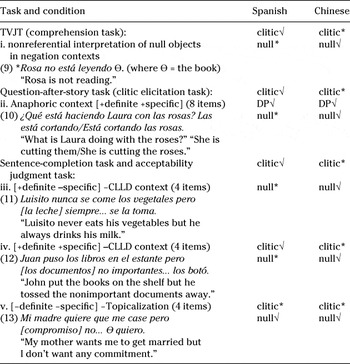
To investigate whether advanced Chinese-Spanish bilinguals have knowledge of the interpretative constraints of object drop in Spanish, five interpretative conditions were examined in which Spanish and Chinese diverge: (a) the non-coreferential interpretation of Spanish null objects in negation contexts (clitic required), (b) definite specific objects in anaphoric contexts (clitic or DP required), (c) definite nonspecific objects in left-dislocated contexts (clitic required), (d) definite specific objects in left-dislocated contexts (clitic required), and (e) left-dislocated indefinite nonspecific contexts (clitic is not required in either language). Table 2 presents a summary of the structures tested and the tasks used to elicit them.
Summary of conditions examined

Tasks
A total of four tasks were implemented: (a) a question-after-story task (i.e., clitic elicitation task), (b) a TVJT using discourse anaphora, (c) a sentence-completion task, and (d) an acceptability judgment task (AJT). The tasks were conducted orally with the aid of PowerPoint. The preambles and test items were digitally recorded by a native speaker of Peruvian Spanish from Lima. The speaker was a male university student of a similar age to the participants. The participants were told that this was a language study, and all the tasks were conducted in one session.
Question-after-Story Task (Clitic Elicitation in Discourse Anaphoric Contexts).
The question-after-story task (Jakubowicz, Muller, Riemer, & Rigaut, Reference Jakubowicz, Muller, Riemer, Rigaut, Hughes, Hughes and Greenhill1997; Pérez-Leroux, Pirvulescu, & Roberge, Reference Pérez-Leroux, Pirvulescu and Roberge2009a) tested the production of definite specific object clitics in discourse anaphoric contexts. If transfer effects from Chinese persist, it was expected that the participants would use a null object or a DP in Spanish—the two available options in the L1. There were a total of 8 test tokens sorted by number and gender. The items were randomized and counterbalanced. The participants were presented with a story introducing a referent followed by a question and an image. They were asked to respond to the question on the basis of the image provided. This is represented in (10) as follows:
(10) [+definite +specific] antecedent:
Laura estaba trabajando en el jardín cuando su vecina le pidió unas rosas.
Laura was working in the garden when her neighbor cl-3sg asked some roses
“Laura was working in her garden when her neighbor asked her for some roses.”
(here an image of Laura cutting some roses)
Investigator:¿Qué está haciendo Laura con las rosas?
What is doing Laura with the roses
“What is Laura doing with the roses?”
Expected answer: . . .las está cortando.
cl-3pl femis cutting
“. . . (she) is cutting them.”
This task aimed to elicit target object clitics (e.g., las “them”), but the production of an overt DP was also a possibility (e.g., Laura está cortando las rosas “Laura is cutting the roses”). Twelve items, which tested the knowledge of typicality restrictions in object drop (not reported in this study), served as distracters.
Truth Value Judgment Task.
The TVJT tested knowledge of the nonreferential meaning of null objects in a negation context using a task developed in Pérez-Leroux, Pirvulescu, and Roberge (Reference Pérez-Leroux, Pirvulescu, Roberge and Jones2008, Reference Pérez-Leroux, Pirvulescu, Roberge, Chandlee, Franchini, Lord and Rheiner2009b). The participants were presented with eight test items: four true (clitics) and four false (null). Four items served as distracters. As with the first task, the test items were randomized and counterbalanced. Each item consisted of two slides. In the first slide, there was a story accompanied by an image. In the second slide, there was a negative sentence with a null or an overt object pronoun as well as an image. The participants were instructed to read and to listen to each story and sentence and then to indicate whether the sentence presented in the story was true or false on the basis of the information provided in the first slide and the image. This is represented in (11) as follows:
(11) a. Picture 1:
El padre de Rosa compró un libro nuevo. El quiere que Rosa lea el libro nuevo.
“Rosa’s dad has bought a new book. He wants Rosa to read the new book.”
(here an image of the father giving the new book to Rosa)
b. Picture 2:
Rosa no Ө está leyendo TRUE X FALSE
“Rosa is not reading.”
(here an image of Rosa reading a newspaper)
Sentence (11b) is false in Spanish because Rosa was reading a newspaper, not the book her father bought for her. If the Chinese speakers have retained their referential meaning of null objects, the interpretation of the null object was expected to be coreferential with the previously mentioned antecedent in Picture 1 (e.g., the book), and therefore the sentence would be interpreted as true. There was a training session at the beginning of the test to make sure the participant understood the task.
Sentence-Completion Task (Left-Dislocated Topics).
The sentence-completion task (adapted from Pérez-Leroux, Pirvulescu, & Roberge, Reference Pérez-Leroux, Pirvulescu and Roberge2011) tested the production of clitics in the following contexts: definite specific (CLLD), definite nonspecific (CLLD), and indefinite nonspecific (topicalization). There were a total of 12 randomized sentences (i.e., 4 per condition) accompanied by an image. The participants were asked to listen to the sentence and complete it on the basis of the image and the verb provided on the computer screen.
(12) [−definite −specific] −topicalization context:
Rosa no gasta mucho dinero en ropa, pero [zapatos] sí . . .
“Rosa does not spend too much money on clothes but [shoes] she does . . .”
______________________________ (comprar) (“to buy”)
Expected answer: Ө compra
In contrast to the question-and-answer task, this task did not allow an overt DP as a possible answer in Spanish or Chinese. If the participants were transferring their L1 options, the overextension of null objects to contexts in which a clitic was required was expected. However, difficulties with indefinite, nonspecific contexts in which a null object was required in both Spanish and Chinese were not expected.
Acceptability Judgment Task.
An AJT tested sensitivity to clitic presence in the same CLLDs and topicalization contexts discussed previously. There were 24 test tokens—8 tokens per condition: 4 grammatical and 4 ungrammatical—and 6 distracters. All the items were randomized and counterbalanced. The participants were presented with a sentence, like the example in (13), and were asked to indicate whether the sentence was odd (1), slightly odd (2), more or less fine (4), fine (5), or whether they didn’t know (3). For unacceptable judgments, the participants were asked to explain why.
(13) [+definite +specific] CLLD context:
Cristina llevó la cartera a la discoteca, pero el pasaporte dejó en el hotel.
“Cristina took her purse to the club but her passport she left it at the hotel.”
1 (extraña) 2 (un poco extraña)3 (no sé) 4 (más o menos bien) 5 (bien)
Reason: omission of the object pronounlo
In (13) the sentence was expected to be judged as odd or slightly odd due to the omission of the clitic.
RESULTS
Elicited Production Task for Discourse Anaphoric Contexts
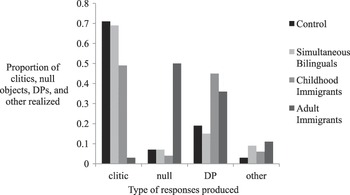
This task tested the elicitation of overt clitics in discourse anaphoric contexts. Another possibility—in addition to the clitic—was the production of a full DP. This option, although not ungrammatical, is much less felicitous in the monolingual norm. The results showed a higher rate of clitic omission among the childhood and adult immigrants in comparison with the controls. These speakers also showed a higher rate of realized DPs. The results are represented in Figure 1.
Question-after-story task (clitic elicitation task): Proportion of overt clitics, null objects, DPs, and other items realized in discourse anaphoric contexts (8 trials).

To examine whether the groups behaved in a significantly different manner in their use of clitics, a univariate ANOVA was conducted with group as the independent factor and proportion of overt clitics as the dependent variable. Results showed significant differences between groups, F(3, 49) = 21.54, p < .000. To examine where the differences lie among groups, a Dunnett’s post hoc test was conducted. Results showed significant differences between the controls and the adult immigrants (p < .000) but did not show significance between the childhood immigrants and the controls (p = .06). The simultaneous bilinguals showed no significant differences from the controls (p = .993). An ANOVA on the proportion of DPs realized showed significant differences between groups, F(3, 49) = 16.52, p < .003. Dunnett’s post hoc results showed significant differences between the controls and the childhood immigrants (p < .009), but no significant differences between the adult immigrants and the controls (p = .112). The simultaneous bilingual group behaved in a nativelike manner (p = .957).
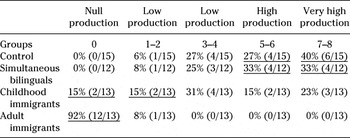
Individual results confirmed the expectations. The childhood and adult immigrants showed a lower rate of clitics realized compared to the control participants, and the simultaneous bilinguals showed no difficulties. These results are represented in Table 3.
Individual results for the question-after-story task: Number of participants across groups classified in terms of the number of clitics produced (8 items)

Four of the childhood immigrants produced between zero and two object clitics and another four produced only half. However, their decreased performance did not stem from clitic omission; rather it stemmed from the overproduction of overt DPs. In fact, only one participant favored object omission in this task with four null objects and four DPs. The rest of the childhood immigrants did not produce any null objects at all. Two of the three childhood immigrants who produced seven to eight clitics (i.e., very high production) also showed rejection of null objects with a referential meaning in the TVJT (i.e., three out of four rejected items). Moreover, six of the eight participants who showed null or low production of clitics also showed decreased performance in the TVJT. The results of the adult immigrants clearly illustrate a clitic deficit. Only one participant produced two overt clitics. The rest of the participants did not produce any clitics, only null objects and overt DPs.
The simultaneous bilinguals and the controls showed no significant differences, as predicted by Hypothesis 4; most of the participants showed a high production of clitics. Four of the control participants showed a low production of clitics due to the use of DPs. The preference for DP realization among the childhood and adult immigrants is understandable given that an overt DP is the preferred option in Chinese with inanimate objects.
Truth Value Judgment Task
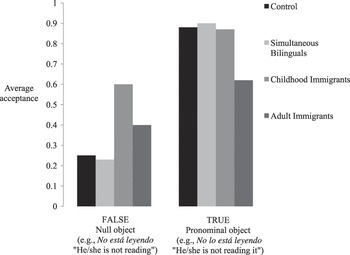
This task aimed to examine whether the bilingual speakers retain the Chinese referential meaning of null objects in Spanish. False answers—target response for null objects but nontarget for overt objects—were scored as 0. True answers—nontarget response for null objects but target for overt objects—were scored as 1. Results in Figure 2 illustrate high levels of difficulties between the childhood and adult immigrants compared to the controls in the false condition (i.e., null objects). Most participants interpreted the null objects in negation contexts as true and showed a low sensitivity to the generic meaning. The simultaneous bilinguals showed no difficulties. There were no differences between groups with respect to overt objects.
Group results TVJT: Average acceptance of null and overt objects under negation per group.

Because this task measured a binary outcome, the scores were transformed to arcsine values before performing the parametrical tests. A repeated-measures ANOVA with group as the independent factor and null and overt conditions as the dependent variables showed significant differences among groups, F(1, 49) = 67.5, p < .000. Independent-sample t tests conducted to examine where the differences lie between groups in the null object condition showed significant differences between controls and the childhood immigrants (p < .006), as expected. There were no significant differences between the controls and the adult immigrants (p = .141) or the controls and the simultaneous bilinguals (p = .924). The adult immigrants, however, treated null and overt objects similarly, F(1, 24) = 2.00, p = .170. This contrasts with the results of the control participants who clearly differentiated between the two options, F(1, 28) = 53.5, p < .000. This highlights a change in the bilingual grammar, confirming Hypothesis 1.
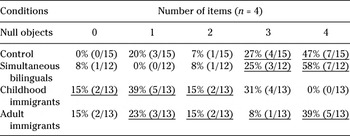
Results from individual analysis confirmed group results. Individual childhood immigrants were less successful in achieving target interpretation of null objects in negation contexts, whereas the adult immigrants showed more target consistency. The simultaneous bilinguals, however, behaved in a nativelike manner. These results are represented in Table 4. Only four childhood immigrants and six adult bilinguals showed target interpretation of false items, rejecting three to four items out of four. The control group performed according to predictions, with 11 participants rejecting these items.Footnote 6
Individual results for the TVJT: Number of participants across groups classified in terms of the number of items considered false in the false condition (4 false items)

Note.
Null objects all represent false items.
Sentence-Completion Task
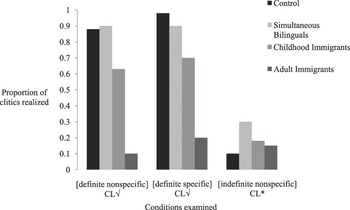
The objective of this task was to test the target production of left-dislocated clitics in definite specific and nonspecific contexts (i.e., CLLD structures) as well as the use of null objects in indefinite nonspecific contexts (i.e., topicalization contexts). In contrast to the question-after-story task, the use of an overt DP was not a possible answer in this task. As predicted, the bilingual speakers showed a much lower level of clitics realized than the controls in definite specific and definite nonspecific contexts. They also showed a higher level of clitic use with indefinite nonspecific contexts than the controls, but not significantly so. These results are represented in Figure 3.
Sentence-completion task: Proportion of clitics realized in left-dislocated contexts (4 items per condition).

A MANOVA with group as the independent factor and proportion of overt clitics per condition as the dependent factor revealed significant differences, F(9, 112) = 10.13, p < .000. Results from a Dunnett’s post hoc test showed significant differences between the control group and the childhood immigrants with definite specific contexts (p < .02) and definite nonspecific contexts (p < .05) in which an overt clitic was required. There was no significant difference between these two groups with indefinite nonspecific contexts (p = .954) in which a null object was required. The adult immigrants showed significant differences from the controls with definite specific (p < .000) and definite nonspecific contexts (p < .000) but did not show any difficulties with indefinite nonspecific contexts (p = .924), thus confirming Hypothesis 3. Some of the participants who failed to recognize the nonreferential meaning of null objects in the TVJT also had difficulties with the target realization of overt clitics. This link between failed interpretation and decreased production was not universal, but it suggests a role for semantic transfer in object clitic omission and expression. The simultaneous bilinguals behaved in a targetlike manner, as predicted in Hypothesis 4, although there was a slight overextension of clitics with indefinite nonspecific contexts. Their results, however, were not significantly different from those of the control group (p = .199).
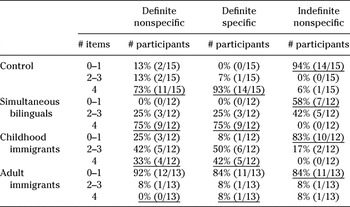
Individual results yield a similar picture, as shown in Table 5. The childhood and adult immigrants demonstrated a decreased production of clitics with definite antecedents, but no difficulties with indefinite nonspecific contexts. Only 33% of childhood immigrants produced only clitics in definite nonspecific contexts, compared to 73% of controls. In a similar manner, in definite specific contexts, 42% of childhood immigrants produced all clitics, compared to 93% of controls. Childhood immigrants performed better with indefinite nonspecific contexts than with the other two contexts. Adult immigrants produced very few clitics in definite contexts. In indefinite nonspecific contexts, all but two participants produced null objects. Although the interpretative feature of definiteness has not been completely specified, transfer from L1 may prevent overgeneration of clitics in indefinite nonspecific contexts. The simultaneous group showed a high rate of clitic realization in definite contexts. However, with indefinite nonspecific contexts, individual behavior was mixed; 42% of participants produced two to three overt objects.
Individual results for the sentence-completion task: Number of clitics realized per condition across groups

Acceptability Judgment Task
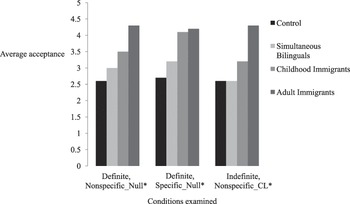
Participants were also asked to complete a contextualized AJT. For ungrammatical items, the child and adult immigrants showed a high acceptance of ungrammatical null objects in definite nonspecific and definite specific contexts (see Figure 4).
Acceptability judgment task: Average acceptance of ungrammatical items per condition by group.

A MANOVA showed significant differences between group as the independent factor and average acceptance of ungrammatical null objects in definite contexts and ungrammatical clitic use in indefinite nonspecific contexts as the dependent factors, F(9, 112) = 4.37, p < .000. A Dunnett’s post hoc test showed significant differences between the control group and the childhood immigrants in definite specific contexts (p < .000), but no significant differences in definite nonspecific contexts (p = .109). In indefinite nonspecific contexts, the childhood immigrants showed no difficulty (p = .380). The adult immigrants also behaved in a significantly different manner from the controls in definite specific (p < .000) and definite nonspecific (p < .000) contexts, as expected. In contrast to the predictions, the adult immigrants showed significant differences from the controls in indefinite nonspecific contexts (p < .001) in which a null object was expected. Thus, Hypothesis 3 was only partially confirmed. The simultaneous bilinguals behaved generally nativelike, confirming Hypothesis 4.
To analyze individual results with ungrammatical sentences, three out of four accepted answers were used as the criteria to indicate that the participant failed to recognize either the ungrammaticality of object drop in definite contexts or the ungrammaticality of a clitic in indefinite nonspecific contexts. These speakers were then classified as acceptance behavior speakers. Speakers who accepted two out of four ungrammatical items were classified as undecided, and those who accepted one or zero out of four were classified as being in a rejection pattern (i.e., rejected speakers). Most of the childhood and adult immigrants failed to recognize the ungrammaticality of object drop in both definite contexts, confirming Hypothesis 3. Most childhood immigrants (i.e., 7 out of 13) and adult immigrants (i.e., 10 out of 13) accepted ungrammatical null objects in definite nonspecific contexts, compared to 3 of the 15 controls. With definite specific contexts, nine childhood immigrants and 10 adult immigrants accepted null objects, compared to four controls. With respect to indefinite nonspecific contexts with ungrammatical clitics, some childhood immigrants had the nontarget acceptance pattern, but to a lesser extent than in the other conditions (6 out of 13 vs. 2 out of 15 controls). Contrary to expectations, adult immigrants accepted the clitic in indefinite nonspecific contexts at much higher rates than any other group. Simultaneous bilinguals behaved better than other bilinguals, but five participants had difficulty with ungrammatical definite specific null objects.
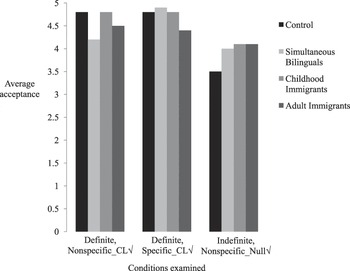
For grammatical items, as shown in Figure 5, group results did not show great differences between groups. The bilingual speakers accepted most of the grammatical items. In indefinite nonspecific contexts, all groups were less targetlike, but this is believed to be due to word order.
Acceptability judgment task: Average acceptance of grammatical items per condition by group.

A MANOVA showed significant differences between group as the independent factor and average acceptance of grammatical overt objects in definite contexts and grammatical null objects in indefinite nonspecific contexts as the dependent factors, F(9, 112) = 3.75, p < .000. A Dunnett’s post hoc test showed no significant differences between the simultaneous bilinguals and the childhood immigrants when compared to the controls in definite specific and indefinite nonspecific contexts. The simultaneous bilinguals, however, behaved in a significantly different manner from the controls in definite nonspecific contexts in which a clitic was required (p < .02). This was due to two participants rejecting most of the grammatical tokens in this condition due to issues unrelated to object drop (e.g., verb type or word order). The adult immigrants showed significant differences from the controls in definite specific contexts only (p < .01); however, an individual analysis following the same criteria described previously showed comparability between groups at the individual level. In indefinite nonspecific contexts, the childhood immigrants were more heterogeneous (i.e., six undecided speakers), but among the control participants, there were also three undecided and three rejected speakers. The rejection of indefinite nonspecific contexts was mostly related to dislike of word order (i.e., object + verb).
DISCUSSION AND CONCLUSION
The goal of this study was to examine whether Chinese learners of Spanish experience difficulties with the acquisition of object clitics, and whether they are able to master the semantic restrictions that regulate the alternation between object clitic and object drop in Spanish. We also asked to what extent these difficulties depended on the different ages of onset of bilingualism in an immersion context as well as whether they could be characterized in terms of transfer.
Differential outcomes between the child and adult immigrant groups were found when compared to native speaker controls, which confirms previous research comparing early and adult L2 learners (see Abrahamsson & Hyltenstam, Reference Abrahamsson and Hyltenstam2009; Jia, Reference Jia1998; Johnson & Newport, Reference Johnson and Newport1989). Simultaneous bilinguals behaved in a consistently nativelike manner across all tasks with a single exception: They duplicated indefinite nonspecific sentence topics with a clitic about a third of the time and thus overextended clitic use to contexts not allowed by native speakers. Two participants who produced clitics in indefinite nonspecific contexts showed similar overextension patterns in the AJT by rejecting all instances of grammatical indefinite object drop. Their results, however, were not statistically different from the controls. In contrast, childhood immigrants who had achieved advanced proficiency according to general measures—albeit not at native levels—had acquired clitics. They were able to discriminate between clitic and null in comprehension and were able to produce clitics in anaphoric contexts. As a group, however, they remained divergent from native speakers and frequently resorted to DPs rather than overgenerating null objects. In CLLD contexts they were generally able to produce clitics but at lower rates than the control speakers. For the AJT, results showed insensitivity to ungrammatical null objects, but no overgeneralization of clitics in indefinite nonspecific contexts. In contrast, adult immigrants retained substantive knowledge gaps overall. They failed to reject the referential interpretation of null objects in the TVJT and did not distinguish between null objects and clitics in interpretation. They produced few or no clitics and instead preferred usage of null objects or DPs in anaphoric contexts. This gap in clitic realization was also evident in the CLLD task, but to a lesser degree.
These results indicate a clitic deficit in the grammar of sequential learners as well as clear age effects. The childhood immigrants show long-lasting challenges in the target acquisition of morphosemantic constraints but full instantiation of the clitic projection. The morphosyntax of clitics seems in place among these early learners, but there appear to be gaps in their knowledge of the morphosemantic conditions on object drop, despite their intense exposure to Spanish in an immersion context. Their data suggest retention of the contextually identified silent argument. Even the highly fluent simultaneous learners do not seem to possess full attainment of the semantic distribution, as evidenced by the fact that they do not comply with the definiteness restrictions. Finally, adult immigrants do not seem to have acquired clitic use and lack awareness of the distributional constraints, relying on overuse of nulls and DPs. These results suggest extensive patterns of transfer in adult learners who remain fully within their L1 parameters.
Age of onset of bilingualism among the three groups led to different acquisition outcomes, with the adult learners being the least successful of all groups. Although the childhood immigrants were more successful than the adult immigrants, they differed from the native controls. In some instances, the childhood learners behaved in a manner closer to that of the simultaneous bilinguals in their production. In other cases, however, they appeared to be closer to the adult learners in their overuse of full DPs in the clitic elicitation task and their acceptance of ungrammatical null objects in definite specific contexts in the AJT. These data support previous L2 acquisition research that shows an effect on the age of onset of acquisition and attainment of L2 linguistic knowledge (Jia & Aaronson, Reference Jia, Aaronson, Greenhill, Littlefield and Tano1999; Johnson & Newport, Reference Johnson and Newport1989). Moreover, these results confirm recent research on the role of age in child L2 acquisition, which documents L2 acquisition difficulties even among learners exposed to an L2 at an early age (see Abrahamsson & Hyltenstam, Reference Abrahamsson and Hyltenstam2009; Granfeldt & Schylter, Reference Granfeldt, Schlyter, Prévost and Paradis2004; Meisel, Reference Meisel, Haznedar and Gavruseva2008).
Regarding the L2 acquisition of the Spanish clitic system, we argue that the difficulties observed stem from insensitivity to the restricted semantic distribution of clitics in Spanish and semantic transfer from the least marked and less restricted configuration in the L1. In other words, Chinese natives are insensitive to the definiteness and specificity features of the clitic features in Spanish. It appears that the existence of an unrestricted alternative for argument identification in Chinese L1 introduces long-lasting variation in the learning of the semantically constrained argument identification strategy in Spanish. Despite intense exposure to the L2 in an immersion setting and at varying degrees according to age of onset of bilingualism, these sequential learners continue to rely on the representation made available by their L1.