The unnamed hero of Tom McCarthy’s novel Remainder (2005) endured a traumatic accident, condemning him to relearn gestures such as raising food to his mouth, which he used to execute without thinking. He quickly finds himself emulating actions he’s seen in movies. As he nears recovery, he begins to deem his behaviors disturbingly inauthentic in contrast to the world of films. Frustration overwhelms him when he notices the way refrigerator doors slightly resist any movement from the handle, whereas in films they pull open instantly in a smooth, seamless motion. From this observation he concludes that, if he were “walking down the street just like De Niro, smoking a cigarette,” he would still be thinking: “Here I am, walking down the street, smoking a cigarette, like someone in a film.” In the story, this sensation is explained through life’s paradoxical habit of becoming “second hand” in relation to films, regarding both content and style (McCarthy [2005] Reference McCarthy2006:24). That a diegesis—the universe constituted by and around a (usually filmic) narrative—could exceed its artistic boundaries and spill out into reality is not such a foreign idea. Yet the formal processes of such transfers—the “styles” through which life borrows from film and the ways in which films then participate in the production of social life—remain relatively unmeasured.Footnote 1
The model of the “infinity loop” developed by Richard Schechner brings out the constant, mutual influence between social and aesthetic dramas: if theatre artists draw from the processes of everyday social experience, social and political actors are equally guided by staging and other theatrical or artistic techniques to support, and indeed even to envisage, their actions (Schechner [1977] Reference Schechner1988:181–83). The study of moving images’ social impacts, by contrast, has been attached to problematically confined contexts. Notably, both popular interest and a wealth of research across disciplines have concentrated on violent behavior -engendered by violent films—a subject often focused on youth and the influence of violence in cinema, television, and video games. Metaresearch concludes that exposure to filmic violence can increase aggressive, even violent, behavior in both the short and long term by priming “aggressive scripts,” heightening our propensity to imitate behaviors through social scripting mechanisms to which no one is wholly immune (Anderson et al. Reference Anderson, Berkowitz and Donnerstein2003). Pornography is another realm that inspires comparable analyses of moving image as agent of reality. In both cases, the concern is often to minimize the expansion of filmic narratives into real life. Yet as former feminist pornographer and scholar Ovidie contends, the nature of the dialectic between mainstream pornography and the sexual behavior of its audience is profoundly chicken or egg–like. Heterosexual intercourse increasingly follows formulaic menus, she notes, its elements as though built into fixed behavioral scripts. While this appears a case of film spreading forcibly over into the realm of sexuality (which would indicate the shrinking of individual agency), she argues that it conversely and simultaneously means that films are reflecting how society is, at a certain level, always-already integrating cinematographic practices as new norms (in Gardette Reference Gardette2016). This ambiguous simultaneity indicates the importance of accounting for cases where the moving image acts at once as cause and document of social practices.
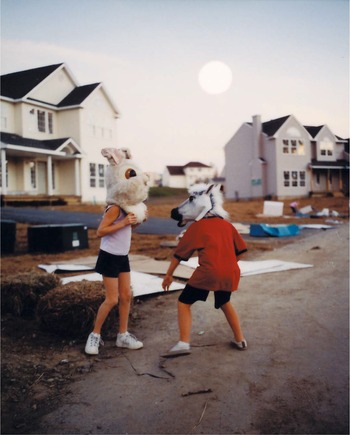
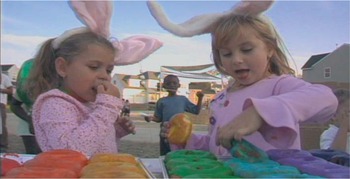
Streamside residents playing in furry animal costumes. Pierre Huyghe, Streamside Day, 2003. Event, celebration. 11 October 2003, Streamside Knolls, NY, USA. Super 16mm film and video, transferred to digital Betacam, color, sound, 26 min. Still. (Courtesy of Pierre Huyghe and Marian Goodman Gallery © Pierre Huyghe)

Indeed, an array of rituals and other social practices is currently developing through -moving-image productions. At times, the two become equivalent, such that any separation between “real life” and its manifestations through videos online can be problematic. For example, videos of high school proms are widely uploaded onto streaming websites, reaching audiences that by far exceed their protagonists’ direct peers. Not only do these filmic afterlives become part of the teenage rite—uploading, watching, and discussing it in the comments section—but prom-goers also increasingly behave in ways that draw from the films they have already seen, likening aspects of prom itself to the acts of both film-making and -watching.
The influence of films is indeed in no way limited to sex and violence, but applies to a vast range of attitudes and traditions—a fortiori to those, such as rituals, that unfold by following a prescribed order and form, in some ways already analogous to a scenario. Moving images are reshaping social realities at a pace that puts pressure on the slow accumulation of patterns often crucial to ritual formation. The artwork at the heart of this article functions as a limit case, its origins being indistinguishably both filmic and ritualistic. Intentionally produced by an artist, the first occurrence of the ritual in question was presented to the world through its eponymous film: Streamside Day (Reference Huyghe2003), directed by French artist Pierre Huyghe. After visiting the newly built suburban-like Streamside Knolls development in Fishkill, located in New York’s Hudson Valley, the artist invented an anniversary ritual to celebrate its foundation and future community life. Huyghe’s actual intervention, within the otherwise grandiose act of producing a rite for a society explicitly beyond any art scene, was reportedly limited to composing flyer--programs detailing the day, before taking several steps back by simply recording the event with the help of a documentary film crew.
In other words, an artist wrote a scenario for a portion of social life; then he filmed it. To examine this case of ritual invention as artmaking means attending to the role of moving image in the conception—understood both in the sense of concrete formation and shared imaginary—of social practices. How can we grasp this current configuration, in which the precedence of behaviors over their filmic representations is no longer a given? Streamside Day departs from the logics of participatory art, which tends to emphasize process over representation. Acting mostly as secondary documents, the images of participatory art are often produced to provide evidence that a social activity took place. By contrast, the mutually reinforcing dynamic between representation and human activity in Huyghe’s project echoes with older traditions of versatile images that depicted, encouraged, and commented upon ritual practice, such as Gentile da Fabriano’s Miracolo dei pellegrini (ca. 1425). Equally central to understanding this work of the early 2000s is the ensuing advent of YouTube in 2005. Since then, the platform has contributed to bringing new rituals to life through video. In return, Huyghe’s work, together with that of artists practicing in the wake of the video-streaming boom, such as Cameron Jamie and Leo Gabin, shed light on new social behaviors that complicate the category of ritual by merging it with moving-image practice.
Huyghe’s body of work embraces a range of everyday human life experiences. To engage with their very stuff and substance, Huyghe often uses methods such as reenactment and remake, the establishment of situations and playgrounds, or the production of entire microcosms to be explored by viewers. His practice is known to question our demarcations of reality and fiction; it includes a large corpus of time-based works relating to everyday celebrations, the quasi--mythical role of the cinema, and self-generating systems, whether biological or social. When Huyghe created Streamside Day, he had recently been the recipient of a Venice Biennale Special Award (2001) and Hugo Boss Prize for achievement in the arts (2002), but he was yet to develop The Host and the Cloud (2010, considered one of his most important works), or have his first major retrospective (2013–14, traveling from the Centre Pompidou). While the theme of celebration had been important to him since the late 1990s, Streamside Day and The Host are his only two works resulting from the endeavor to form a new ritual.
Where The Host explores forms of mysticism and engages with the emotions of performers, Streamside Day epitomizes Huyghe’s experimentations with scenario, film, and social behavior, almost as if in a laboratory where he could orchestrate these components as ingredients. Inspired by past collaborator Liam Gillick, Huyghe expressed interest in the shift from modernist social planning to the production of scenarios more typical of late capitalism, with its exaltation of possibilities that morph according to audiences. A scenario here becomes the narrative guiding one’s behavior. Discussing Streamside Day, Huyghe recounted: “I created a scenario and set it into motion. Then, letting it go, I could approach it on the other side with my camera” (in Baker Reference Baker2004:106). Events become defined as things scripted into existence in order to be represented in film, the now presupposed “other side” of any activity.
Streamside Day
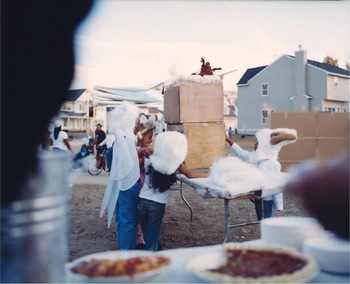
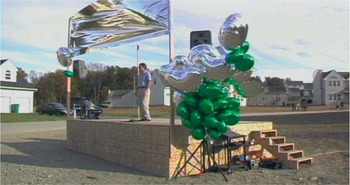
At the core of Huyghe’s multipart project was the Streamside Day Celebration on Saturday 11 October 2003 marking the founding of Fishkill’s new community. Launching this project and finding this housing development in the first place, however, were the result of a curatorial -invitation. A year prior, curator Lynne Cooke and Huyghe had agreed on a solo exhibition at Dia Chelsea. During a drive in the area of Dia Beacon on the Hudson River, Huyghe encountered the brand-new cookie-cutter neighborhood. Deciding Streamside Knolls would be the material for his exhibition, Huyghe began incorporating the area’s mid-19th-century Arcadian renderings by the Hudson River School painters. He later visited Celebration, the planned utopian community developed in Florida in the mid-1990s by the Walt Disney Company to abut its theme park in Orlando. The visual imaginary linked to both sites informed the ritual and artwork Huyghe made for, with, and about Streamside Knolls. Huyghe met with locals, city council, and property developers who accepted his proposal to celebrate the birth of Streamside Knolls (see Barikin Reference Barikin2012:148). He then scripted the celebration, planning to film it as it unfolded. His design was reportedly limited to composing an anthem for the day and scheduling a few activities announced on flyers (Honoré Reference Honoré2011:123). One said, “Celebrate the first birthday of a new community!” and offered the chance to “Make a house out of a cardboard box!” Another provided the location and timing for speeches, parades, singing, cake eating, and fireworks. Holding the event together was its designed aesthetic unity. Throughout the day, distinct colors stood out: overly bright foods among sophisticated dark green and silver balloons; the strangely unified off-whites and dirty beiges of children’s furry animal costumes. Similarly scripted, the parading order of service vehicles seemed to emerge from a children’s book, complete with a school bus, fire engine, and Mister Softee ice-cream truck whose jingle had been discreetly re-composed to sound melancholic.
These highly curated elements of the celebration mark the scale of Huyghe’s intervention, which was not as minimal as announced. The flyers had an additional purpose, functioning also as a film script. It is unclear whether Streamside Day (the holiday) has an existence independent from Streamside Day (2003), the film, the central object of this multilayered artwork. The holiday can be considered as ongoing, given Huyghe hoped for the scripted celebration to morph into an organic, recurrent ritual (Huyghe Reference Huyghe2007). But Streamside Day has not survived as a local anniversary tradition. By designing an event whose legacy was meant not only for the art world but also for a local community, the film puts forward a diegesis whose function from the start was to spill out into a real social sphere where it could directly engender, literally script, a set of behaviors.
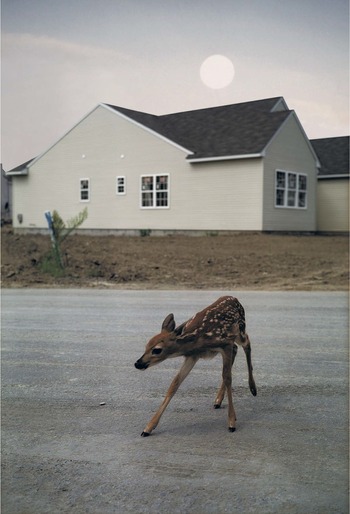
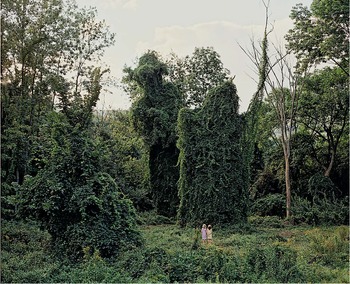
The 26-minute moving-image work is a two-part digital projection made of 16mm film and video transferred to digital color Betacam. The first part, “A Score,” appears as an origins fable—a short, relatively uneventful myth set in the present day. It opens at sunrise, with an Edenic cascade and forest landscape edited in slow fade-outs redolent of travel advertisements. The camera stops for portrait shots of a rabbit, a deer, an owl, and a raccoon, filmed to look like Disney animals, alert yet at peace in their glistening environment. The wider scenic shots evoke the Hudson Valley’s art-historical heyday, depicted as a romanticized land between sublime and pastoral, where wilderness never threatens the potential for settlement. The rest of “A Score” shows a family moving to Streamside Knolls. Parents pack the trunk of their car with moving boxes and start to drive while in the back seat their blond twin daughters hum and play hand-clapping games. When they arrive, the development seems unfinished; the deer reappears, wandering nonchalantly around the properties as it would in a fairy tale. Leaning over a model of the neighborhood, the family locates and admires their new house. The final scene, a slow tracking-out forest shot of the sisters facing gigantic monster-shaped trees, follows a seamless cut that renders Streamside Knolls as a habitat embedded in untouched parcels of nature.
The film’s longer part two, “A Celebration,” makes no use of storytelling or sleek editing devices. Rather, it borrows the visual vocabulary of a low-budget documentary film. We see Streamside Day as it unfolds, filmed with furtive looks to the camera, always-muffled dialogue, a song, and the wan palette of overexposure and sun-flooded lenses. Despite quick cuts, this part of the film feels slow, hinting heavily at the aesthetic of a homemade video, missing only the focus on a single family and its friendly neighbors. Aesthetically, “A Celebration” exemplifies the amateur equivalent of the packaged way of life sold by the Streamside Knolls developers. The marketing of the community resembled that of Florida’s Celebration, which was designed to conjure visions of a lifestyle more than specific real--estate features. Written in 1996 by Disney’s Imagineering team, the Celebration sales brochure reads: “There once was a place where neighbors greeted neighbors in the quiet of summer twilight. Where children chased fireflies. And porch swings provided easy refuge from the cares of the day. […] And there was one teacher who always knew you had that special something. Remember that place?” (in Meade Reference Meade, Brooker and Weinthal2013:401). This text brims with the aspirations highlighted by Streamside Day: a highly cinematographic, often child-centric fantasy of prelapsarian life, one that could exist solely as a series of establishing shots, never upset by the disruptive “actions” of a story. While scenes in “A Celebration” feature some action, they consistently show it, precisely, as establishing shots: rarely for longer than five seconds, without creating any hierarchy or narrative, the camera follows costumed children parading, playing games, building houses with cardboard boxes, while community members of all ages amicably sit and snack outdoors until dusk, participating more or less committedly in a celebration that appears both abundant and boring.
The camera pauses for portrait shots of Disney-like animals. Pierre Huyghe, Streamside Day, 2003. Event, celebration. 11 October 2003, Streamside Knolls, NY, USA. Super 16m film and video, transferred to digital Betacam, color, sound, 26 min. Still. (Courtesy of Pierre Huyghe and Marian Goodman Gallery © Pierre Huyghe)

What these participants ritually share is a form of migration, specifically settlement in suburbia as a group. The Fishkill development consists of 103 new homes (mainly four- to five--bedroom family units) envisioned for people who would cherish “community values” (Barikin Reference Barikin2012:145). A bucolic, lost-Eden ideal was also promoted by AVR Realty through scene--setting slogans: “Step out your front door and take a deep breath. Smell the clean, crisp air. Feel the crackle of leaves and twigs under your feet. This is quintessential country living at its finest” (Real Estate Guide 2001:79). “A Score” similarly evokes happiness as a series of fleeting sequences and presents the theme of bourgeois migration through short, idyllic images featuring a nuclear family. Moreover, as an invented holiday, Streamside Day reenacts imagined elements of the American settlement by white Europeans: the dinner tables resemble a settler’s Thanksgiving feast, with meat, dairy products, pies, and what appears to be cornbread. In his speech, the “proud developer of Streamside Knolls” declares that “a great community spirit is starting” through this day which, hopefully, will continue “on an annual basis” (Huyghe Reference Huyghe2003). Toward the end of the film, the anthem composed by Huyghe is sung slightly out of tune by people standing on a makeshift stage, tirelessly repeating “It’s a Streamside Celebration.” The lack of a precise definition for the event allows it to function as a generic Euro-American celebration imagined by a French artist, filtered through the visual vocabularies of stock--imagery advertising and (the idea of) homemade video.
The sisters face gigantic monster-shaped trees, portraying Streamside Knolls as a habitat embedded in untouched parcels of nature. Pierre Huyghe, Streamside Day, 2003. Event, celebration. 11 October 2003, Streamside Knolls, NY, USA. Super 16mm film and video, transferred to digital Betacam, color, sound, 26 min. Still. (Courtesy of Pierre Huyghe and Marian Goodman Gallery © Pierre Huyghe)

The tension builds, however, between this generic quality and the persistent signs of an artist’s intervention. In addition to the iconography of settlement suggesting a ritual of land incorporation, the holiday hints at Thanksgiving while the Streamside cake evokes birthday and anniversary rituals, the universal celebrations of life cycles. But other emblems are purposefully invented for the artwork. The Streamside cake in the shape and shades of a cardboard box is striking—massive and nondescript gray-brown instead of appetizing gingerbread or chocolate. The event also introduces a strange house costume made from a cardboard box for children, as well as a gigantic second moon in the sky—seemingly the lighting device for night shooting, prominent in the event’s documentation (see also Barikin Reference Barikin2012:156–57).Footnote 2 The community featured in Streamside Day is made up of upper-middle-class families with suburban-cum--pastoral aspirations; their ritual activities are based on familiar neighborly festivities, real--estate marketing campaigns, and the whims of an artist. Intentionally, the core of Streamside Day remains unsettled.
But the choice of the word “score” to describe the film’s first part is pointed. Huyghe uses the terms “scenario,” “screenplay,” and “score” interchangeably to refer to a “set of possibilities and rules” (in Baker Reference Baker2004:101). Yet score, a more polysemic term, renders Streamside Day as both an origins fable and a set of instructions, like a musical score. In addition to the Bambi-like creatures and scenery suggesting a Disney Eden, the other narrative of the film’s first part speaks of a white upper-middle-class family finding happiness, connection to nature, and luxury by moving to suburbia. This vague myth is deeply rooted in the “American dream” as imagined in films. Thus “score” is an appropriate attribute of the project in its entirety, a diegesis spilling out into the real world: a latent myth like a familiar tune playing in the background; and also sheet music or a script, a composed and prescribed set of procedures according to which people must act.
The Invention of Ritual
Declaring that he wished to create “a ritual that the people in the town would actually celebrate because it’s based on what they share,” Huyghe also insisted that, with Streamside Day, he was “not interested in building fiction.” Rather, he was concerned with “setting up a reality, building a situation, constructing a world, and documenting it” (Huyghe Reference Huyghe2007). This claim emphasizes the paradoxical structure underlying the project, in which the artist’s authorship lies at once in the immense gesture of “constructing a world”—not merely a temporary stage but a structure fully integrated into social reality—and the more humble position of bearing witness to the expressly “nonfiction” events that might unfold inside this world. Of course, the events of 11 October 2003 largely followed a script; but then again the same can be said of all ceremonies and nearly all documentary films, too. Thus fiction, which is both part of the project’s process and a term constantly apposed to the work, divides and leans towards two meanings.
The celebratory cake is the dull gray-brown of a cardboard box. Pierre Huyghe, Streamside Day, 2003. Event, celebration. 11 October 2003, Streamside Knolls, NY, USA. Super 16mm film and video, transferred to digital Betacam, color, sound, 26 min. (Courtesy of Pierre Huyghe and Marian Goodman Gallery © Pierre Huyghe)

One of them is fiction as an aesthetic register and genre, the codes of which are clearly applied in “A Score,” part one of the film. Part two, “A Celebration,” gestures towards the traditional cinematographic divide between fiction and documentary, this time through its exaggeration of documentary and home-video tropes: the muffled sounds, washed-out colors, slightly too slow pace, and the reality of the scenes underscored by the focus on participants’ state of distraction. Juxtaposed to the first part’s commercial-looking shots, these features appear as fabricated by Huyghe’s film crew, arousing tensions between recognizable sleekness and the contrived impression of a low-budget documentary production. Hence the work thematizes both fiction as the process always enmeshed in the production of documentary and fiction as an opposing pole—one which these “real” events resist. The other meaning of fiction that pervades Streamside Day pertains to invention, namely the narratives, ideas, and activities that spring from a person’s imagination.
These meanings merge when the social practices in the background of the film are in fact the core of the invented story. By drawing the viewer’s attention to the scripting behind the documentary, Huyghe’s work points to a vast tradition of ethno-fiction cinema, ranging from Jean Rouch’s scripted anthropological movies to the growing popularity of the mockumentary—films in which fictional events are presented through documentary tropes, parading as candid footage within the diegesis, or sometimes extending this deceit beyond it. All these knowing layers form the representation of social reality in Streamside Day, whose purpose is also to design a new social reality by inventing a ritual. In Streamside Day the two meanings of fiction collapse into each other as the scenario becomes a formula for real life.
Today, nearly two decades since Streamside Day, rituals are being invented beyond the institutions of art, religion, nation-states, and political groups.Footnote 3 They tend to circulate in filmic forms via video-sharing platforms such as YouTube, at a pace that perhaps eludes the traditional tools of history and ethnography. The Ice Bucket Challenge springs to mind. The practice involves filming oneself while dumping ice water over one’s (or someone else’s) head in order to promote awareness of motor neuron disease, while “tagging” friends in an online post as an extended invitation to partake in the same ceremonial; less than three years after going viral on social media in the summer of 2014, over 28 million people had taken up the challenge (see van der Linden Reference van der Linden2017). Streamside Day sits somewhere between invented traditions (see Hobsbawm and Ranger [1983] Reference Hobsbawm and Ranger2012) and these rapidly envisioned, self-generating rituals. The democratization of the latter is intrinsically linked to the internet, functioning for them as a site of simultaneous creation and broadcast. At the same time, this mode of diffusion participates in the elusiveness of new rituals. Accounts of their development appear in comparably fleeting ways, through passing mentions in social science studies or rapid online journalism. For example, Richard Sennett, as well as writers for tabloids and online news outlets, described the 2004 baptism of British celebrities Victoria and David Beckham’s sons specifically as a decision to “invent a ritual” (Reference Sennett2012:87). The couple wanted their children to be christened but did not know via what religion, so they designed a ceremony that, not unlike Streamside Day, sampled familiar emblems and practices such as a custom-built chapel, Buddhist shrines, baptismal water (or champagne, depending on the rumors), a meal, and the briefing of the press.
More democratized cases of invented ritual are representative of practices that spread primarily by sharing videos. Over the course of my research, a ritual known as “gender reveal” emerged as a counterpart to Huyghe’s work. I came upon it amid a crowded online world of ceremonies, when the search algorithm made it appear next to the similarly heteronormative and highly formalized ritual subcategory of flash mob surprise wedding proposals—almost invariably choreographed to Bruno Mars’s 2011 hit that culminates with the chorus “I think I wanna marry you.” Uploaded onto YouTube where they often garner from hundreds of thousands to millions of views, these proposals promise to make their viewers cry, bringing the zest and plot structure of a musical romantic comedy to life, only to turn it back into video material to be shared online. Some, such as “Isaac’s Live Lip-Dub Proposal” (Lamb Reference Lamb2012), are even orchestrated to make life look more like film, in this case by seating the woman on the open back of a slowly moving truck, from which she (and the camera) could witness the proposal entirely as a backward tracking shot.
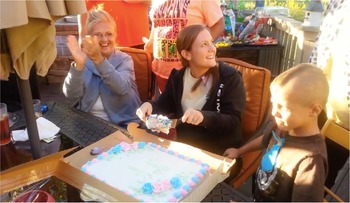
Similarly, gender reveals weave filmic anticipation and editing tropes into social life. The practice admits variants. Usually, an expecting couple has their fetus’s sex test results travel straight from the ultrasound technician to a pastry chef, who is instructed to bake a cake that will announce the baby’s sex. At the celebration, the expectant mother, and sometimes other guests, bite into the provided cake, the filling of which—either pink or blue—signifies the fetus’s sex (conflated here with gender). This celebration conforms partly to Hobsbawm’s definition of invented tradition, namely a set of practices “normally governed by overtly or tacitly accepted rules of a ritual or symbolic nature that seek to inculcate certain values and norms of behaviour by repetition,” thereby implying continuity with the past and inscription in the future (Hobsbawm and Ranger [1983] Reference Hobsbawm and Ranger2012:1). Yet, unlike invented traditions, it is almost impossible to establish where, how, or why these gender-reveal parties emerged. Moreover, just as with Streamside Day, their practice cannot be untangled from their visual and particularly their filmic representations.
“Gender Reveal Party Surprise,” 2013, YouTube video, 5´58˝. (Screenshot by Naomi Vogt)

Despite being contemporary to the spread of the user--generated content that characterizes Web 2.0 (which developed gradually from the early 2000s), Huyghe’s work predates the birth of YouTube by two years, suggesting a form of production anchored in authorship that is more one--directional. The artist’s intervention in the social sphere can be seen as a demiurgic one, in which an individual assumes enormous -creative responsibility on the grounds of exceptionality. On the other hand, what Huyghe created here is not only ostensibly unexceptional—a ritual which, both in its content and presentation, was specifically made to resemble an ordinary activity—but it also relies on the participation of many and their existing familiarity with similar symbols, celebrations, and the video recordings thereof. A shared historical condition thus determines both Streamside Day and new rituals like gender reveals. Both exist in a time of ritual proliferation, where moving images have become central to ritual reinvention; both are based on widespread, generic practices (neighborhood fairs, baby showers), while reinventing themselves primarily through the acts of filming, being filmed, and experiencing events through moving images, such that ritual and filmic forms are condemned to mutually reinforce each other.
Thus, one way of reading Huyghe’s work is as anticipatory: an artwork both as allegory for a social phenomenon and, unwittingly, as a crystal ball for another emerging one. The former phenomenon was one that had already occupied the artist (for instance in The Third Memory [2000]), namely the looping feedback between life and film, blurring the chronology between behaviors and their representations in that medium. In 2003, video-centered social media platforms were in their infancy. Apple had just introduced QuickTime 4 in 1999, the media framework’s first iteration to support streaming. Soon, it would become possible to completely blend one’s engagement in new social practices and one’s homemade video captures of them. Streamside Day thus outlined a phenomenon as it was coming into being. The work also allows one to glimpse a kind of artistic ambition that would no longer be possible in the same way after YouTube. Indeed, people would soon begin to invent and document their own rituals, competing with vast artistic projects such as Huyghe’s, and doing it in some ways with substantially more success.
As such, YouTube rituals and Huyghe’s holiday illuminate each other. The artwork cannot be separated from the phenomenon it barely preceded; simultaneously, looking at it closely provides access to the process—or a potential version of the process—behind something as elusive as the birth of a ritual. The multitude of small decisions required for this to happen—regarding activities, objects, pace, foods, terms, colors, and tone—are brought to light if only as the components of an artwork made by an established artist, namely something that commands careful consideration. What also becomes visible is the desire to generate new social practices, clearly increasingly shared by a growing number in the early 21st century. Huyghe’s approach to his project magnifies a developing human ambition. “Streamside is a little town, north of New York,” he wrote. “It was under construction when I found it, and I created—or invented—a tradition for it” (Huyghe Reference Huyghe2007). His accounts of this act are both simple and hyperbolic. Having neither its own government nor a center, Streamside Knolls is not so much a town as a neighborhood. Moreover, the idea that this unfinished place was “found,” awaiting creative input, evokes the inspiring possibilities attached to a society’s beginnings, emphasized in Huyghe’s enthusiastic press-release statement: “We are in the year 01” (Marian Goodman Gallery Reference Gallery2004). A few years later, fashioning new rites with a community and a camera would become a widespread practice.
The film reveals a multitude of small decisions required, including overly bright foods. Pierre Huyghe, Streamside Day, 2003. Event, celebration. 11 October 2003, Streamside Knolls, NY, USA. Super 16mm film and video, transferred to digital Betacam, color, sound, 26 min. (Courtesy of Pierre Huyghe and Marian Goodman Gallery © Pierre Huyghe)

Indeed the first video of a gender reveal was published on YouTube in 2008, and it is probable that, just like Streamside Day, the ritual and its recording emerged simultaneously. Over a million videos documenting these rituals have been uploaded to the site during the following decade, not counting the number of future parents who use other platforms or favor livestreaming, and thus presumably tend to the camera in an even more sustained manner throughout the celebration. Sociological research emphasizes a double movement in gender reveals: highly individual, customizable practices, they ritualize “the borders and expectations of gendered identity” that had begun to erode, mostly thanks to similarly individualized acts of social reinvention; but the visual commoditization that they encourage also reinforces fixed constructs through “the instant gratification of social media reproductions,” where the correlation of a boy to bowties and blue, for example, augurs instant success (see Gieseler Reference Gieseler2017:666).
Within this shared context, Huyghe’s work marks a turning point, the end of a time—the same as that described in McCarthy’s Remainder—when myth-like diegeses could spill out into lived experience linearly, and the beginning of a more circular relationship between moving images and human behavior. Since their inception, for instance, gender reveals have reinfiltrated filmic media beyond the online platforms that saw them dawn. Television talk shows dedicate episodes to it, such as the Marilyn Denis Show, which paired expectant couples with bakers in advance of its 3 May 2016 episode. In the filmed footage of their encounter, three protagonists discuss the meaning of this ritual and the pastry they envisage. The baker creates an elaborate cake to be sliced open (with an innovation revealing edible confetti) on the show’s set, in front of a tearful audience constituted exclusively of pregnant women. Life-changing announcements are interconnected with talk shows, which, since their beginnings, have sought to position revelations as key life events, from family-secret disclosures to surprise reunions with long-lost friends. Now, certain rituals are merging with the shows’ own ritual structures, including their communities and broadcasting cycles, such that the role of mediation expands beyond dissemination. Indeed it is often this very media framing that sanctions the ritual for participants and audiences alike, given that rituals require stable frames that can ensure witnessing by larger social bodies (see Turner [1969] Reference Turner1991:103–08; Couldry Reference Couldry2003:119–34).Footnote 4 On the Marilyn Denis Show, the gender reveal was not only broadcast via moving-image media; it also fully merged with the talk show’s filmic genre: a short, formulaic, and fast-paced documentary coverage disclosing individuals’ hopes and beliefs followed by the on-set performance of a hyperbolic revelation recorded live. In lieu of a liturgy, these rituals follow a filmic genre.
Ritual Fiction, Filmic Reproduction
If ritual and filmic forms interact to mutually reinforce each other, then fiction, spectacle, and social practice begin to intersect in new ways. Gender reveals were quick to enter filmic fiction. They notably served as the plot setting for multiple episodes of comedy sitcoms, for instance in “The Heart Is a Dumb Dumb” (2015), the season 2 finale of You’re the Worst (created by Stephen Falk), and “And the Show and Don’t Tell” (2016) episode from Michael Patrick King and Whitney Cumming’s 2 Broke Girls. In both stories, the expectant parents throwing a -gender-reveal party are the show’s comically obnoxious, over-the-top secondary characters. And both cases involve a twist whereby the baby’s sex is not revealed in the gender-reveal episode: the first ends on a cliff-hanger with the couple uncertainly cutting into the cake, while the character in charge of making it in the second has never baked and becomes so nervous she forgets to add the pink or blue dye.
These episodes participate in the creation, if not of the ritual itself, certainly of its early determining cultural representations (and more recent gender-reveal episodes of other programs consolidate this pattern). They take their cues both from the existing “real” imagery of gender reveals and from traditions in fiction films linked to other family rituals. Indeed, in these episodes, the celebration leads to potentially destructive conflict and a cascade of revelations barring that of a baby’s sex. Such scenarios unfold similarly in the mainstream drama and comedy films set entirely during a celebration, from disaster-filled, multi-subplot wedding movies (think Mike Newell’s 1994 Four Weddings and a Funeral) to family meal-centered rites such as Thanksgiving or Christmas in which dysfunctional groups come close to disintegrating as life-changing revelations are brought to the table together with flying trays of food (as epitomized in Thomas Bezucha’s 2005 The Family Stone). When developing rituals are so closely connected to their own video versions, their performance is also conflated from the start with their future and preexisting representations.
Furthermore, the repetitions inherent to ritual practice converge with the repetition of diegetic structures or the season-based seriality of sitcoms and talk shows. The cyclical time produced by rituals, which inscribes social life in a historical continuum by marking stages to be celebrated periodically—whether weekly, seasonally, or generationally—overlaps with the cyclical time intimated by repetitive or serial art and entertainment. Both types of cycles overlap in turn with the repetitions involved in the consumption behaviors of moving-image culture: tuning in weekly to follow a TV program, going to the movies as a celebratory activity, etc. The innumerable published videos of gender reveals—which end up having similar lengths, structures, rhythms, and overall aesthetic—are inherently part of the ritual they depict. Similarly, the fabric of Huyghe’s Streamside Day is as much the holiday itself as its film inscribing it within the broader ritual category of attending a neighborhood party and filming it, with the camera’s predictable focus on speeches and children’s activities. Huyghe’s work inscribes itself indistinguishably in a lineage of media entertainment, art, and social behavior.
A critical tradition exists that consists in contrasting the peculiar sensations of time that ritual and contemporary entertainment can respectively generate. In an article addressing the filmic remake, Sven Lütticken revisits some of these pairings, beginning with Mircea Eliade’s religious history, which expressed “reactionary-romantic” nostalgia for ritual repetitions of mythical archetypes in the face of our modern, inferior, and only “quasi-mythic experiences” with repetition, for instance through watching films (Lütticken Reference Lütticken2004:104–07). Similar conceptions of time perception as an organizing tool of society led Guy Debord (whose intellectual career was born alongside his filmmaking) to argue that the spectacle yields “pseudo-cyclical” returns, given that mass media establish a sense of return just as myths once did, yet in a far more calculated manner, engendering a false “consciousness of time” ([1967] Reference Debord1992:174, 182; see Lütticken Reference Lütticken2004).
In all of these readings, “mass media” refers to media designed to reach broad audiences and to their convergence with consumer capitalism since the 1920s, whereas the “spectacle” further encompasses the social relations mediated by these media’s images, a phenomenon presented as permeating all aspects of human experience including time. In this vein, William Burroughs compared mass media to the ceremonial Mayan calendar and portrayed both as instruments for guaranteeing that small social elites maintain power over time perception ([1969] Reference Burroughs and Odier1989:38). In Eliade’s and Debord’s observations at least, it is implied that the time produced by our modern equivalents of ritual repetition has become circular instead of cyclical: an impoverished version of the recurrent cultural material that used to structure social life. Taken one step further, this view suggests that societies are increasingly trapped in alienating circles, whereas they were once offered temporal-cultural opportunities to evolve cyclically.
The camera predictably focuses on children’s activities and speeches, like this one by the mayor. Pierre Huyghe, Streamside Day, 2003. Event, celebration. 11 October 2003, Streamside Knolls, NY, USA. Super 16mm film and video, transferred to digital Betacam, color, sound, 26 min. (Courtesy of Pierre Huyghe and Marian Goodman Gallery © Pierre Huyghe)

Repetition as a profound way for humans to process lived experience peaks with the moving image. Indeed reproduction is ontologically embedded in both film and video, whose technologies rely on capturing time-based traces of profilmic actions. Another form of repetition, similarly based on reproducing existing matter, is equally paramount in moving images. It is one that Erika Balsom calls “circulatory reproducibility,” referring to the ways in which these images are “copied and copied and copied, transforming that singular trace [of reality] into something that is multiple and primed for circulation” (Balsom Reference Balsom2017). This was especially facilitated by the electronic and, later, digital conversion technologies of video, not to mention the exponential growth of video sharing enabled by Web 2.0. But an earlier form of circulation proper to the apparatus of film first shaped the interplay between moving image and ritualized experiences of time. This apparatus, as described by Raymond Bellour, is a “more or less collective” and “unique perception of time and memory” structured by moving images screened in the dark, i.e., the cinema (Reference Bellour2012:14).Footnote 5
There is no clear-cut opposition between an organically developed social practice on the one hand and one calculatingly injected into mass society via moving images on the other. Or rather, those two categories as neatly distinct are fantasies. The gender reveal is at once a seemingly spontaneous practice and the product of the markets that feed from it, beginning with its media derivatives, or indeed sources. And Streamside Day is both a ritual authored externally for a film, and one that nonetheless immediately established a collaborative framework with community members and the narratives that were already culturally significant to them. Crucially, such narratives are often themselves shaped through filmic genres.
“A Score” intermixes idealized imagery of nuclear families buying new homes with popular culture’s darker repertoires linked with arrivals to suburbia, through the film’s eerie atmosphere, slow driving, towering trees, and final mystery shot of the twins. In Hollywood’s abundant versions of a widespread “myth,” arrivals in suburbia lead to existential revelations, the unearthing of dark secrets, or deep family changes, from Sam Mendes’s dramatic variations on the American dream (American Beauty [1999] and Revolutionary Road [2008]) to Marc Cherry’s hit mystery series Desperate Housewives (2004–2012) which, over eight seasons, shaped a generation’s collective conception of suburban life. The need for myth and the meaning humans find in cyclical repetition can be taken on together by the narratives and forms of reproduction allowed by moving images. Where the question seemed to be whether Streamside Day deploys fiction and film to document a ritual or rather to invent it, Huyghe’s work now appears to ask whether there is any fundamental difference between these two processes.
Cameron Jamie and the collective Leo Gabin have tackled this issue from a perspective that complements Huyghe’s more ambiguous project. Since the beginning of the 2010s, Leo Gabin has been producing edited video compilations that, with little to no interference, make up small archives of the ritualized practices formed through YouTube. Thus, Stackin (2012) collects clips of young men “stackin,” namely standing as they perform sets of traditionally gang--affiliated symbols with their hands; while Hair Long (2013) testifies to the rampant practice, usually among young women, of sitting close to their laptop’s inbuilt camera while holding objects up to it, from stationery to makeup, with well-manicured fingers. These attentive odes to video rituals are accessible on video-sharing platforms.
Jamie turns his attention more explicitly to the agency of filming in ritual. The source material of Massage the History (2007–2009) was a series of online musical videos of African American teenagers performing a sex-simulating dance against living room furniture. Jamie gave this unique ritualized dance culture from the suburbs of Montgomery, Alabama, a more formal platform and a different audience, thereby contributing to its ritualization. He tracked down and met the teenagers who repeated the dance, and he recorded it on 35mm film. The strangely emotional work resulting from these encounters, deeply respectful of the practice it witnesses, points to a changing sensorium, where individuals are shaped by the potential becoming-film of all their behaviors.
Twenty-five years before YouTube, Jean Louis Schefer aimed to affiliate with an overlooked form of knowledge by writing about film strictly from the perspective of an “average man” whose social identity is fully intertwined with moving images. “With film comes a new experience of time and memory that, in and of itself, shapes an experiential being,” Schefer insisted. “Out of our participation, film does not produce an alienating structure, but rather one whereby a given reality […] is realized and appropriated; this reality already momentarily exists within the viewer” ([1980] Reference Schefer1997:10). Indistinguishably and simultaneously the producers, actors, and future viewers of their own rituals, the characters in Huyghe’s, Jamie’s, and Leo Gabin’s films represent social subjects as film-inflected beings. The ritual in Huyghe’s work, however, insists on standing out, insofar as it is not only captured by or restaged for an artwork but comes into existence through one.
Reflexive Pilgrims and Installations
Streamside Day Follies is the name of the original installation of Huyghe’s film at Dia Chelsea in 2003. In the gallery, Huyghe staged a looped physical narrative, as five moveable walls with a glowing green metallic coating maneuvered on overhead tracks, exposing mural images including an aerial map of Streamside Knolls and line drawings of children parading. After a few minutes, the partitions regrouped into a screening room as they formed a closed polygonal space in which viewers gathered close to watch Streamside Day. The ultimate component of Huyghe’s work was Streamside Day Community Center, an unrealized project developed with architect François Roche to build a unit for community activities on woodland near Streamside Knolls, based on the Follies model. Every year, on the anniversary of the housing development, the film about the first Streamside Day would be screened at the center (Huyghe and Lavigne Reference Huyghe and Lavigne2013:128). This constellation of parts creates a model whereby art-world and cinematographic models are designed specifically to spill back out into the real world with the hope of integrating it durably, by using a script for a ritual or modeling a social center on a sculptural installation.
The Follies also reflects on the modernist exhibition space through its morphing from ephemeral white cube to small cinema. Tracing a path opposite to Bellour’s (who considers nontraditional film settings as degraded forms of cinema), David Joselit sees art-historical melancholy in Huyghe’s installation, as it “demonstrates the privatization of spectatorship encoded in video projection’s adoption of a theatrical mode.” This theatrical mode contrasts with earlier closed-circuit or otherwise interactive installations. In fact, Huyghe purposefully placed this work on the floor below one of Dan Graham’s seminal, playful glass pavilions on Dia Chelsea’s rooftop (Joselit Reference Joselit2004:154–59). But Huyghe’s installation also intimates to viewers that they have internalized cultural scenarios of “being with art.” As the suspended walls gather, -viewers know to place themselves in a way that renders them a part of the work, while they experience the intimacy of a viewers’ community created by restricted space and shared gestures of attention. Follies turns the screening into an event, and an almost liturgical one: the moving installation engineers a performance of both the museum ritual and the community ritual of Streamside Day.
Yet as far as it is known, Streamside Day has not been repeated or turned into a yearly practice in Fishkill. It has seemingly failed as a ritual, or has only succeeded, retroactively, as an inauguration rite. This may suggest that repetitive practices are not so easily imposed upon groups; individuals will not so willingly remake celebrations if they presumably see no “cyclical” value in the repetition. In an interview in which Huyghe insisted on his wish to create “a ritual that the people […] would actually celebrate,” he also talked about ritual failure, in a way that now seems prescient. Commenting on the importation of Halloween in France in the 1990s, Huyghe suggested that its cutoff after a 10-year run was a simple failure, “like when you transplant an organ, and then the body refuses it because there’s no reason to accept it” (Huyghe Reference Huyghe2007).
For all the participants of Streamside Day, attending meant relinquishing their image rights, but they were allowed to record the event as they wished (Barikin Reference Barikin2012:149). One could thus hypothesize that, had the event occurred a few years later and had the participants been able to appropriate it by uploading their own videos onto social media, the celebration could have gained a little more traction through shares and comments, and might have been more successful, in some of the same ways as gender reveals. However, this ritual has been successful elsewhere, within the narratives that matter most to it: the film, its installation, its existence in Huyghe’s discourse, and the growing awareness of it in the art world—a community that sustains the life of Streamside Day by repeatedly screening the film and assembling the installation. Streamside Day is a ritual in—and to a certain extent for—the art world.
It is noteworthy here that Huyghe’s work was made two years after one of the epitomes of participatory art. Jeremy Deller’s The Battle of Orgreave (2001) reenacted the violent 1984 confrontation between riot police and miners following the Thatcher government’s attempts to close open-pit mines and to break the National Union of Mineworkers, which opposed the closures. A complex work, The Battle of Orgreave also largely relied on local residents, yielded an eponymous film, and evoked not only reconciliation commissions but also a village fête, with a brass band, pies, and children running around. Not only does Streamside Day resonate with it, but Huyghe had also been instrumental (if passively) to a branch of participatory art, namely Relational Aesthetics, examined by Nicolas Bourriaud in 1998. In these participatory practices, the artist is construed as facilitator of occasions for audience engagement, turning sociality into art’s aim and material. Bourriaud specifically argued that, instead of announcing a future world as was art’s function during the historical avantgardes, this art aims at “modeling possible universes” (Bourriaud Reference Bourriaud1998). In the case of participatory art or “social practice”—the North American terminology dispenses with “art”—this has often meant the prevalence of ethical criteria over aesthetic judgment, as Claire Bishop discusses in her 2012 historical study of the phenomenon. Yet film and other historically located aesthetic phenomena were always the determinative factors in Huyghe’s work, including in his earlier participatory projects. Streamside Day does not strive to compensate for the shortcomings of policy or even a lack of social cohesion in the community with which it engages. Rather, cultural histories of the moving image and the mythical dimension of cinema are the work’s explicit motors.
Entangled with a predominantly white, upper-middle-class social setting, Streamside Day further gestures away from the urgency of class politics in participatory art and the latter’s often problematic tropes of democratization. For Bishop, The Battle of Orgreave is both aesthetically and politically potent because, despite a didactic aim (to rewrite a historical wrong through participative performance), it became a “picturing of politics” by thematizing performance; and through the refusal of the “self-suppressing” role of the social-practice artist, Deller sparked singularity rather than a “replicable model” (Bishop Reference Bishop2012:30–37). Similarly, Streamside Day does not seek to use art as a means of social compensation. Despite its (proclaimed) impetus as an artist’s desire to found a new ritual—revealing a form of hubris that contradicts the more humble public discourse around participation—the work’s potency lies in its capacity to picture the production, qua representation, of a ritual.
Streamside Day is simultaneously documentary and prescriptive: it depicts a ritual and, like a recipe, it pushes forth the idea that this ritual could be remade in a world escaping the art scene. In this sense, Streamside Day approximates forms of imagery with which it is not normally associated, such as depictions located in religious sites, premodern Christian imagery crafted to function simultaneously as biblical or liturgical representation and as a prompt for ritual devotion. Such works include frescoes and altarpieces of Gospel episodes that are mirrored in the rituals of the Mass, such as the Eucharist. As rituals set in churches and refectories, shared meals and the Eucharist often echo neighboring Last Supper imagery, particularly the iconography of the Institution of the Eucharist when followers are commanded to consume bread and wine. When Streamside Day was exhibited at Marian Goodman’s Paris gallery in 2004, the Follies moveable walls were replaced by a projection in a room carpeted in green, with a tree and a mural representing the community center plans. Nearby, viewers were served cake. A universally ritualistic dish, cake is central to Streamside Day, assimilating the participatory installation with religious ceremonies featuring the acceptance of food.
Suddenly, from Carol Duncan to Dorothea von Hantelmann, art-history scholarship that has examined exhibition spaces in light of their ritual-producing structures (see Duncan Reference Duncan1995; and von Hantelmann and Meister Reference von Hantelmann and Meister2010) was matched with one of the most literal instances of this type of exhibition to date. In this version of the installation, visitors were invited, like worshippers, to enact part of a ritual that they simultaneously saw represented around them. In fact, they could see at once the myth at the source of the ritual in “A Score” (nearing the function of site-specific biblical iconography), representations of the ritual itself in “A Celebration,” and the surrounding objects and environment necessary to their own ritual participation, through the consumption of communal cake in an installation as consecrated space.
Placing depictions of rituals in the real environments meant to sustain them suggests both the acts of testifying to a social practice and encouraging its continuation via representation. Gentile da Fabriano’s Miracolo dei pellegrini alla tomba di san Nicola (ca. 1425), a tempera on panel painting that once stood in the Quaratesi chapel’s altarpiece in Florence’s San Niccolò Oltrarno, constitutes a similar mise en abyme. The small panel portrays pilgrims approaching Saint Nicholas’s tomb, which was said to exude a miraculous oil. The image existed in a prescriptive ritual environment, namely the high altar, and represented an ongoing -religious practice while imparting behavioral protocols to its viewers; although they did not conform to formal Christian liturgy, healing pilgrimages were nonetheless widespread at the time. Alexander Nagel uses this work in a deconstruction of art-history chronologies, namely the prevalent Western narrative whereby “world-creation” was lost with the Renaissance (when the image became a fragment of the world and, with modern art, simply a thing in the world) before reemerging through installation art (Nagel Reference Nagel2012:44). Claiming that installation is in fact not the counter to painting but rather a way of “returning art to the function served by icons,” namely images’ role as portals, Nagel’s analysis of Miracolo reflects an interactive, reciprocal principle of representation: “paintings model worlds” while “environments take over the function of images” (2012:69). And indeed, as environments, the Streamside Day installations function as portals to other spaces, specifically Streamside Knolls and the social-ritual world modeled by the film.
When these site-specific representations are displaced (for example Miracolo, now in Washington, DC), they continue to “carry” their original context by representing it as the independent figurative works they have become. Streamside Day also carries Streamside Knolls, not only in the sense that it presents images of it, but also because its installation maps out the work’s original location (including the adjacent wooded areas and unrealized community center). Miracolo’s depiction of clerical space together with its former place as part of the altarpiece—its original installation—internalize the altar of the Quaratesi chapel. Huyghe preempted the problem of displacement by anticipating the work’s destiny as an item for collection. The piece exists in an edition of six, as a video projection that can be installed to replicate either the Marian Goodman gallery or the Dia configuration. As such, it is a filmic representation that invites ritual practice by bearing the traces of its original, ritual site-specificity.
What Rituals Do
The same seemingly taboo desire thus appears to drive various visual accounts of ritual: the desire to author not only a rendition, but a living part of social reality. So far, this has never quite amounted to writing a scenario meant to be implemented durably within social life. But the hubris of Huyghe’s gesture can be mitigated in light of the growing phenomenon whereby various forms of film are effectively “authoring” new rituals, from flash mob proposals to gender reveals. A Dutch reality TV program has even crystallized patterns for queer sexual orientation disclosures, turning one’s coming-out into a more formal rite of passage (Boross and Reijnders Reference Boross and Reijnders2015). And research on high school rites has shown that the homemade videos of proms represent a popular or “folk” appropriation of Hollywood media. The afterlives of these films were examined on YouTube, where an “otherwise unarticulated” production emerges: a crossover of mainstream movies and their teenage reenactments. This feedback system, developed through online uploads, spectatorship, and comments, is deeply “changing traditional rites” (Miller Reference Miller2010). McCarthy’s Remainder hero is less and less alone in remarking that life can become a second-hand product of film.
Anthropologists are measuring the productive role of moving images, despite keeping formal and aesthetic considerations of the latter in the margins of this scholarship. Yet filmic aesthetic constructs are pivotal to the social matter that moves from media to lived experience, for instance in the case of prom: the anticipation of the camera shots and editing pace, setting and décor, and the prom-goers’ attitudes in front of cameras. There is something particularly elusive in this notion that films might transmit to people not only gestures and traditions, but also a peculiar sense of self-representation, one’s internalized aesthetic perception of one’s own behavior. In important ways, the tools of film studies and art history are equipped to meet these ethnographies halfway.
I’ve used the term ritual freely here, mirroring the language used to describe these practices as well as the art world’s ongoing appetite for ritual. In anthropology, the definition of ritual is vastly debated and framed by contentious theoretical traditions. Certain strands have dominated the field. One of them stems from the structural functionalism of Alfred Radcliffe-Brown, according to which the underlying purpose of ritual activity is to sustain social cohesion and “structural continuity” (see Radcliffe-Brown Reference Radcliffe-Brown1935); another strand, partly influenced by Clifford Geertz, sees rituals as covert but decipherable symbolic expressions of a society’s worldviews (see Geertz [1966] Reference Geertz1973). Beyond this somewhat schematic divide, Roy Rappaport offers a middle ground, in which ritual is “the performance of more or less invariant sequences of formal acts and utterances not entirely encoded by the performers” (Reference Rappaport1999:24). In this formalist—and, by Rappaport’s own admission, terse—definition, there is no emphasis on meanings hidden beyond what the ritual participants appear to be doing. Rather, ritual is characterized within the formal bounds of the ritual activity itself; simultaneously, ritual here is considered as the act most “basic to humanity” (31). The ongoing search to define this core, formal human activity echoes with the cases and artworks at hand. Particularly noteworthy is the growing focus on ritual’s role as an arena to renegotiate life in society through formal experimentation.
Indeed, the approach to ritual that might best align with Huyghe’s understanding of the term originally stems from Victor Turner. If Rappaport’s ritual is the place where societies are formally preserved, Turner’s ritual is a place of social creation. For him, ritual is primarily process: it is at once instrumental to the overall processes of society and an activity that is formally processual in and of itself. Rituals move society and, through rites of passage for example, individuals are moved from one state to another. In Catherine Bell’s related approach, rituals are a cultural dynamic by which “people make and remake their worlds” (Reference Bell1992:3). This explains not only their purpose and universality, but the reason why they fascinate scholars—and artists—as a window onto a crucial human mechanism, one that usually plays out on a scale otherwise impossible to grasp. Indeed in these ritual arenas, whether they are filled with elaborate liturgy or everyday gestures such as shared meals and handshakes, participants actively redesign, script, and invent aspects of their social worlds.
Jettisoning enduring traditions that construed ritual as the space where beliefs are condensed, recent anthropological research insists instead that ritual temporarily sets aside questions of meaning and belief, giving priority to the formal aspects of our actions. In this way, the performative component of rituals engages with the very “ambiguity of life”: through it, one can play by trying out new formal arrangements, without “undue concern with the authenticity of one’s actions” (Seligman Reference Seligman, Musschenga and van Harskamp2013). Ritual becomes a field of experimentation whose position is interdependent with, yet separate from, other realities—whether moral, religious, or pertaining to everyday community life (Seligman Reference Seligman, Musschenga and van Harskamp2013). At the same time, the power of ritual’s performativity is precisely that it can effect change in the real world; after all, the status of a couple as members in society changes following a wedding (and J.L. Austin’s most enduring example of performative speech remains the vow “I do” [Reference Austin1962]), just as handshakes can seal agreements and street fairs can cement social ties.
This understanding of ritual extends to existing understandings of art, especially those influenced by the historical avantgardes and their ambitions to prepare for new ways of living. Hal Foster has likened Dada to a space in which artists played, exacerbated, and ultimately reinvented aspects of their society (Reference Foster2015:170–80), a description that deeply evokes ritual, or at least the effects of ritual practice. Rituals understood in this way, perhaps appealingly to artists, are thus simultaneously about social life and engaged in a creative relationship with it. Huyghe’s work depicts this process by showing something that is almost impossible to witness: the making of a ritual. It emerges through the artwork’s own process, which tries to make, from scratch, a ritual through a film that both causes and documents it. This impossible and prescient object was made at a turning point in the early 2000s, which opened an era of new rituals fully blurring with the acts of watching, appearing in, and making moving images. Here, intention, belief, or even an assumed shared understanding of what is going on are no longer the most relevant angles for approaching these practices. Faced with Streamside Day, our concerns with the intentions behind an artwork or the veracity of an event can give way to the observation of something else: the specific ways in which certain artworks, like rituals, invent their own social worlds, worlds temporarily shared with others through the forms they produce.