


Galileo Galilei passed away on 8 January 1642, in his Villa ‘Il Gioiello’, in the hills of Arcetri, just a few kilometres to the south of Florence city centre. In his (second and last) will, dated 21 August 1638, he expressed the wish to be buried in the Santa Croce Basilica, where his father Vincenzo and other members of his family were buried.Footnote 1
Accordingly, the day after his death, the body was quietly moved to Santa Croce, and laid to rest – not with his father and ancestors,Footnote 2 in the central nave of the basilica, however, but in the tiny vestry of a chapel on the right-hand side of the transept. Given the circumstances, no grand ceremony was held, nor were official speeches or commemorations delivered: the casket was accompanied by Galileo's son Vincenzo, the parish priest of San Matteo in Arcetri, Galileo's last pupil Vincenzo Viviani, Evangelista Torricelli, and a few relatives. The Grand Duke was in Pisa and did not attend the burial, nor did other prominent members of the court, or any other dignitaries from the city of Florence. Needless to say, no high representatives of the Church hierarchies were there either.
There were good reasons for that, of course. Galileo died while under house arrest, having been found ‘vehemently suspected of heresy’,Footnote 3 and forced to recant his Copernican sins. Discretion was advised in order not to annoy the Church hierarchies, who could prevent the burial of Galileo's body in the basilica. In fact, as soon as Giordano Bolognetti, the Vatican's nuncio in Florence, got to know about the Grand Duke's plan to have a proper funeral monument erected in Santa Croce, he hurried to inform Francesco Barberini – Pope Urban VIII's cardinal-nephew – who in turn gave precise instructions to Giovanni Muzzarelli, the Florence inquisitor. Barberini's letter is worth reading in full:
Most Reverend Father,
Monsignor Assessor read aloud, before His Holiness, Your Reverence's letter, announcing the death of Galileo Galilei and mentioning what he believed should be done both about the tomb and the funeral service. Having listened to the opinions of these Most Eminent people, His Beatitude decided that you, with your usual adroitness, should be sure to let it come to the Grand Duke's ears that it is not good to erect mausoleums to the corpse of someone who was sentenced by the Tribunal of the Holy Inquisition, and died while enduring the sentence: because decent people might be scandalized, to the detriment of His Highness's piety. But in case you could not prevent this plan, you should pay attention that the epitaph, or inscription, which will be placed on the tomb, should not include words that might offend this Tribunal's reputation. And you should treat him who will deliver the funeral eulogy similarly, too, paying attention to read and examine it carefully, before it is delivered or printed. His Holiness entrusts the wise discretion of Your Reverence with sorting out this matter. And may God preserve you.
From Rome, 25 January 1642
As the brother of Your Reverence,
Cardinal BarberiniFootnote 4
The plan for a sumptuous funeral monument for the Grand Duke's primary mathematician and philosopher lasted but a few days, and the humble temporary burial in the narrow vestry to the Chapel of the Novitiate (otherwise known as the Medici Chapel) was to remain Galileo's burial place for nearly a century.Footnote 5
Viviani's Racconto Istorico (1654)
The undisputed champion of resurrecting the plan was Galileo's last direct and most devoted disciple, Vincenzo Viviani (1622–1703). Throughout his life, he tried his best to preserve the memory of his master's life, discoveries and achievements, as well as to publish and circulate his works. The erection of a public funeral monument in Santa Croce was part and parcel of this project, for a proper monument would bear the double meaning both of recalling the importance of Galileo's works, highlighting their superiority with respect to traditional scientific and philosophical ideas, and of claiming the liberty to build on them, extending them to other contexts. The image of Galileo heretic, as it sprang from the 1633 trial, was a clear obstacle to this – hence the key strategic, as well as psychological and political, relevance of a proper funeral monument for Galileo in Italy's most celebrated pantheon.
In Viviani's eyes, however, redeeming his master's reputation did not only mean defending Galileo from his detractors: it also meant, first and foremost, claiming his true and profound pietas. In the Racconto Istorico, Viviani's biography of Galileo (published posthumously in 1717, but actually written in 1654Footnote 6 ), he claimed that Galileo was wrong in not presenting the Copernican picture of the world on a purely hypothetical level; accordingly, the Church rightfully called attention to his mistake, and asked him to recant. The Holy Office sentenced Galileo to house arrest for life, and ordered inquisitors not to license the reprinting of any of his works, nor anything new he wished to publish (de omnibus editis et edendis).Footnote 7 Still, in the Racconto Istorico Viviani almost likens Galileo to the lost sheep in the parable we read in the Gospels of Matthew (18:12–14) and Luke (15:3–7), brought back home by the good shepherd. In Viviani's words,
he was confined in the most beautiful palace in Trinità dei Monti, the residence of the Tuscan ambassador, and having been shown his mistake, he promptly retracted his opinion, like a true Catholic. As a punishment, however, his Dialogue was prohibited, and after five months (during which the city of Florence was infected by the plague) he was dismissed from Rome; and with an act of generous compassion he was destined, for his house arrest, to the residence of Archbishop Monsignor Piccolomini, the dearest and most esteemed friend he had in Siena. Galileo enjoyed with such tranquillity and satisfaction the exchanges he had with him, that he resumed his studies, found and proved most of his mechanical propositions on the resistance of solids, as well as other conjectures. And after approximately five months, the plague having completely stopped in his homeland, at the beginning of December 1633, His Holiness turned the confinement to that house into the liberty of the countryside, which Galileo greatly enjoyed …Footnote 8
Furthermore, having received news that some of his works and manuscripts, which he had written while still wrongly convinced of the truth of ‘Aristarchus's and Copernicus's opinion’, were being circulated, translated and published abroad, ‘he was greatly disheartened’: for, ‘thanks to the authority of the Roman censorship, he had catholically abandoned [that opinion]’, and also benefited from ‘the healthy gift infinite providence kindly decided to award him with, by releasing him from such a terrible mistake’.Footnote 9
Some scholars tend to read Viviani with some benevolence, ascribing to his words a ‘purely instrumental’ meaning.Footnote 10 In their eyes, Viviani – in agreement with the Grand Duke Ferdinand II (1610–1670) and his brother Cardinal Leopoldo (1617–1675) – attempted a conciliatory approach that, while giving in on the crucial issue of the status of the new science, aimed at neutralizing Galileo's alleged heresy, thereby removing what was regarded as the major obstacle to the circulation and understanding of Galileo's thought and works. In other words, in sharp contrast with the image of Galileo as a martyr to libertas philosophandi, which spread throughout Europe, and particularly in France, Viviani's image of Galileo was that of the promoter of a radically new philosophy, which, however, Viviani did his best to present in a non-traumatic way. However new Galileo's science was, its inventor had always deferred to religious authorities, and was fully aware of the limitations and temporary nature of every human endeavour.
Accordingly, Viviani promoted the publication of the first collection of Galileo's works, in order to make them once again available to scholars and laymen alike. Particularly important was the inclusion of the Dialogue on the Two Chief World Systems (published in 1632 and prohibited in 1633), which would be read in a new and reassuring light: not as the authoritative statement of the truth of the Copernican hypothesis, that is, but as an important, although human and thereby intrinsically fallible, attempt at a novel understanding of cosmology. In this way, Viviani hoped to present a new image of Galileo as a Christian hero of science: restored to faith by the acknowledgement of his mistakes, purged by a sincere act of contrition, and intimately and fervently obedient to the Church.
Palazzo dei Cartelloni (1693)
As years went by, however, Viviani realized that his efforts were unlikely to succeed. In 1655–1656, he managed to publish (under the editorship of Carlo Manolessi, in Bologna) the first, two-volume edition of Galileo's collected works, but failed to get approval to include the Dialogue and the other Copernican works. In September 1674, Viviani seemed to be giving up his original plan to move Galileo's remains to a more prominent place in the Santa Croce Basilica, and sought the complicity of friar Gabriele Pierozzi to decorate the humble burial place by adding a celebratory inscription, as well as a bust of Galileo drawn from a sculpture (now lost) by renowned sculptor Giovanni Caccini. The inscription had been ready for some twenty years, for Viviani used the one he had published at the very beginning of the 1655–1656 edition of Galileo's collected works.Footnote 11
On 7 December 1689, aged sixty-seven, Viviani drew up his will, with which he bequeathed his heirs the money and goods he thought would be required to erect a proper funeral monument for Galileo, facing Michelangelo's, adorned with an inscription celebrating his discoveries and achievements.Footnote 12 As to his own body, he added, he wished it to be buried
in the … church of Santa Croce, below the above-mentioned statue and monument to the Great Galileo, or else to the side or below his bones, whenever they are moved there. In the meanwhile, until the above-mentioned plan is accomplished, he [the testator] wants and orders that his body temporarily be laid next to that of Galileo …Footnote 13
He never lost hope, and kept polishing the inscription to be carved in the final monument. He grew increasingly aware, though, that his original plan would not be fulfilled in the few more years he was likely to live. If no public monument was to be erected, however, he eventually resolved to create a private one – one that could be enjoyed, and benefited from, publicly.
Having bought a residence in what is now via S. Antonino (formerly via dell'Amore) 11, in proximity of the church of Santa Maria Novella (at a short walking distance from what is now Florence's central railway station), he entrusted his friend Giovan Battista Nelli, a well-known architect, to restore the palace and turn its facade into a monument to Galileo's discoveries and achievements. Nelli designed the facade to present, at its very centre, above the main entrance door, a bust of Galileo (by eminent artist Giovan Battista Foggini, a friend of Nelli's); next to it, two bas-reliefs celebrating Galileo's telescopic discoveries (on the left-hand side) and his achievements in physics and mechanics (on the right): these were clear references to the Sidereus Nuncius (1610) and Two New Sciences (1638), both of which were included in the 1655–1656 edition of Galileo's collected works.Footnote 14
What were meant to impress and arouse the attention of passers-by, however, were two enormous scagliola scrolls (hence the name by which the palace is referred to: Palazzo dei Cartelloni), on each side of the facade: a ‘historical account, written in form of elogia’, to use Salvino Salvini's expression (Figure 1).Footnote 15 The inscriptions were painted, not carved, and the lower lines are now barely readable, due to time, weather and pollution (not to mention the municipality's indifference). We can reconstruct the text by appealing to the printed text published by Viviani.Footnote 16
Facade of Viviani's palace (known as the Palazzo dei Cartelloni), in via S. Antonino 11, Florence. Photo by Stefano Gattei.

The printed version
Viviani published a printed version of the text of the inscriptions as a section appended to his last scientific publication, De Locis Solidis (1701). In 1702 he published the same text in small booklet form: Grati Animi Monumenta. In fact, these two editions were simultaneous, for the text published as a sort of appendix to De Locis Solidis dates to 1702 (see the ‘Monitum lectori’, translated below). And indeed, the expression grati animi monumenta in the title of the booklet appears in the ‘Monitum lectori’ of the De Locis Solidis too.
As we know from the title page of Grati Animi Monumenta, the inscriptions were actually placed on the facade of Palazzo dei Cartelloni in 1693.Footnote 17 In the ‘Advice for the reader’ (‘Monitum lectori’) introducing the section of De Locis Solidis presenting the inscriptions, we read that the job was done very quickly, and this might well be the reason for a number of errors that we find in the inscriptions themselves. Indeed, the reason why Viviani decided to revise the original text, and leave for posterity, in print, a more elegant and polished one, is likely to be found in the urgency he felt to produce the text of the inscriptions in the first place, and in the dissatisfaction he possibly felt about them later on. The ‘Monitum lectori’ offers a compact history of the text:
Behold, dear Reader, in this year 1702, the engraving of the facade and the inscriptions of the House GIVEN BY GOD,Footnote 18 whence is brought to light this Second Geometrical Divination,Footnote 19 which the author wrote fifty-six years ago, and now appears as it was printed twenty-nine years ago. Here you can find the memorials of a grateful soul: to the most powerful King of France LOUIS THE GREAT, thanks to whose most generous gifts this house was built and restored; to the Royal Highnesses of the Medici Family, most gentle patrons, whose lavish generosity the author has experienced ever since he was sixteen years old;Footnote 20 and to GALILEO, most beloved teacher, to whom the author declares he owes the results he achieved in geometry, however little they are. Hence, wishing to leave a testimony of such great benevolence to posterity, and realizing that, due to advancing age, debilitating health conditions and the approaching threat of death, all other ways are hindered, in 1693 AD, he [the author] ordered that these elogia be inscribed, as quickly as possible, on the facade of this very house. Now, in order that this expression of his grateful soul may forever also reach foreigners, who do not travel, he saw it through the press, as you can see – so that (in case these elogia might be scratched off, either by time all-consuming, or by decision of those who inherit this house, in order to replace them with others) they might remain indelible in the memory of educated people.Footnote 21
As we read on the title page of De Locis Solidis, the book was written in 1646, and printed by Ippolito Navesi in Florence, in 1673.Footnote 22 The printed sheets lay with the publisher for nearly two decades, as Viviani was attending other works,Footnote 23 as well as planning to ‘divine’ all Five Books Concerning Solidi Loci Pappus of Alexandria (fourth century AD) credited to Aristaeus the Elder (fourth century BC) in his Collection.Footnote 24 In 1701, sensing that he was approaching the end of his life, Viviani decided to publish everything he had written (that is, his divination of the first three books by Aristaeus), in order not to leave his work unpublished.Footnote 25 Thus he recovered the (possibly yet uncollated) sheets printed in 1673, and added two more quires, Oo and Pp, each of four folia (eight pages), containing the addenda to the three books he had divined in 1673, as indicated on the title page, and the errata (addenda to books I–III: pp. 105–116 = ff. Oo 1r–Pp 2v; errata: pp. 117–118 = f. Pp 3r–v). On page 119 (= f. Pp 4r) is the imprimatur, requested on 6 August 1673, and granted a few days later, on 11 August: this is the last printed page of the book, as page 120 (= f. Pp 4v) was left blank. Viviani also added two quires at the front of the book, each of six folia (twelve pages), indicated with ✠ and ✠†, including the half title, the title page, and Viviani's Preface to ‘Beginner geometers’ (dated 1 August 1701).
For reasons unknown, the book was not immediately circulated, but remained with the publisher until the beginning of 1702, when Viviani decided to append new material: an additional eight-page quire (Qq), with the text of the inscriptions; the ‘Monitum lectori’, printed on the last page of the previous quire (page 120 = f. Pp 4v), which had been left blank; and three engraved plates, with Galileo's bust (by Foggini), the facade of the Palazzo dei Cartelloni, and the location (indicated by letters A–H) of the various parts of the inscriptions on the facade of the palace. Had Viviani considered inserting these two plates and the text of the inscriptions as soon as he decided to publish De Locis Solidis, he would have certainly mentioned them in the title page of the book. Since he did not, he possibly decided to do that at the very last minute, also using the last (blank) page of the book to add an explanatory note, namely the ‘Monitum lectori’.
Grati Animi Monumenta bears no date on the title page, but it was likely printed more or less simultaneously with De Locis Solidis: the setting of types is identical, but page numbers and quire identifications were changed (from pages 121–128 = ff. Qq 1r–4v to pages 1–8 = ff. A 1r–4v). Almost certainly, once quire Qq was added to De Locis Solidis, the same form was used to print the booklet, too, with due changes of page numbers and quire identification. A full eight-page quire, Grati Animi Monumenta lacks the ‘Monitum lectori’, and offers a distinct title page instead, with a blank verso; also, the lower half of the last page (page 8 = f. A 4v) presents an engraved decoration, instead of the text of the imprimatur, as published in the De Locis Solidis, page 128 (= f. Qq 4v). Moreover, whereas in the ‘Monitum lectori’ of the De Locis Solidis the dedicatees are listed as Louis XIV, the Medici family, and Galileo, in the title page of the Grati Animi Monumenta (as well as in Section B of the manuscript) the order of the dedicatees is different: first comes Galileo, followed by the Medici family, and then Louis XIV. Together with the absence of the imprimatur and date of publication, this detail might support the conjecture that the Grati Animi Monumenta was likely published to be distributed and circulated more ‘privately’.
Furthermore, as the imprimatur is granted to the work ‘whose title is Vincenzo Viviani's etc.’ (cui titulus est Vincentii Viviani etc.), we have to assume that Viviani's manuscript had originally a title. The formulation ‘Vincentii Viviani etc.’ suggests ‘Vincentii Viviani Grati animi monumenta’, rather than ‘Vincentii Viviani Inscriptiones …’; if this is the case, we would have to reverse the printing sequence described above, and suggest that Viviani first considered an autonomous publication of the text (privately circulated), and later decided to append it to the De Locis Solidis too.
The printed version differs greatly (in both length and detail) from the inscriptions we still see on the facade of Palazzo dei Cartelloni. The differences were first noted by Eugenio Albèri, editor of the so-called ‘Florentine edition’ of Galileo's collected works, published in fifteen volumes, with a supplement, between 1842 and 1856. Albèri described them as minor:Footnote 26 possibly he never actually undertook the task of comparing the two texts word by word, as Paolo Galletti (1851–1914), the owner of the collection of Galileiana preserved at the Torre del Gallo in Florence (at Pian de’ Giullari, on the hills of Arcetri – see below), later did. He highlighted ‘striking differences’ between the printed and painted versions of the text, and called Favaro's attention to them.Footnote 27 As a consequence, in 1879, Favaro decided to publish (in parallel columns) the printed text and the text of the inscriptions on the Palazzo dei Cartelloni. The text of the inscriptions published by Favaro was a transcription provided by Galletti.Footnote 28 Galletti also provided Favaro with a transcription of the manuscript of the Grati Animi Monumenta: indeed, the manuscript (also including the imprimatur, on f. 7v) belonged to Galletti's collection, and Galletti thought it to be in Viviani's own handwriting. Favaro used Galletti's transcription to point out, in a few footnotes, some variants of the manuscript from the printed text.Footnote 29
However interesting, a thorough study of these texts and their differences is impossible here.Footnote 30 In what follows, I will be presenting the original manuscript of Viviani's revised text, which was thought to be lost after the dispersion of the collection following Galletti's death.Footnote 31 Recently, I discovered it in London, in the collections of the Wellcome Library, which purchased a significant portion of Galletti's collection. Contrary to what Galletti (and Favaro, relying on him) believed, the manuscript is not Viviani's holograph, but a fair copy prepared by a professional copyist, revised by Viviani, and submitted to the inquisitors for the imprimatur. I am here presenting its very first critical edition and complete translation.
The manuscript
As I said, Viviani's original manuscript for the printed version of the inscriptions on the facade of the Palazzo dei Cartelloni was one of the most cherished items in Galletti's collection, the most important collection of Galileiana of the late nineteenth and early twentieth centuries.Footnote 32 As years went by, however, increasing debts forced Galletti to sell a few documents to the National Central Library of Florence, and Torre del Gallo itself had to be auctioned in 1901. Galletti managed to keep most of his Galileo collection together, though, and in 1910 he again set up a small museum in the rooms of his Florentine residence.
At the time of Galletti's death, on 5 September 1914, the plan for a permanent Galileo Museum he had been hoping to establish in Torre del Gallo was abandoned once and for all.Footnote 33 The collection was eventually sold on the antiquarian market, and scattered in public libraries and private collections. Among the dispersed items was Viviani's original manuscript of the printed text of the inscriptions for the Palazzo dei Cartelloni, which belonged to a significant portion of Galletti's collection.
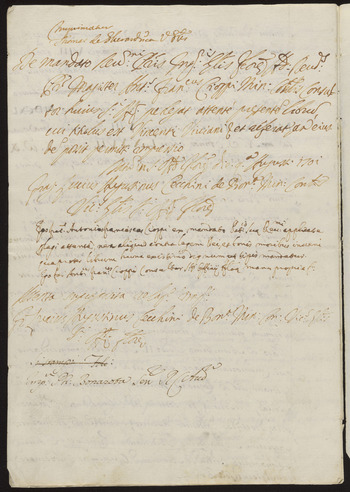
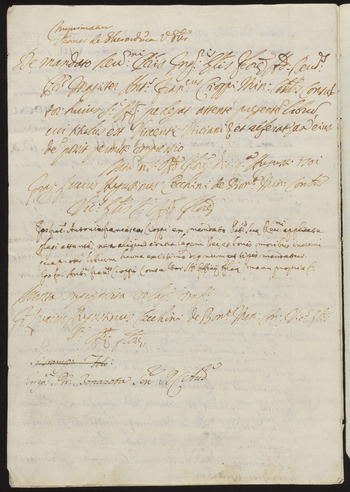
The manuscript consists of eight leaves (folio, 30.5 × 21 cm; last leaf blank), unbound, with no page or folio numbers; the correct sequence of folios is indicated by catchwords; f. 1r–v presents the cover sheet, ff. 2r–7r the text, and f. 7v the imprimatur (Figure 2). As said, it belonged to Paolo Galletti's collection of Galileiana, and was purchased by Sir Henry Wellcome in 1929. It is currently available at the Wellcome Library, Ms. 4949. The manuscript dates to late July or early August 1701, as the request for the imprimatur is dated 9 August 1701 (see below, f. 7v); the final imprimatur was likely granted a few days later, given the short length of the text (although it might have taken a few weeks to obtain).Footnote 34
W, f. 7v: imprimatur granted by the inquisitors to Viviani's text (Wellcome Library, London, Ms. 4949).
When, in his ‘Inedita Galilaeiana’ (1879), Favaro published the texts of Grati Animi Monumenta and of the inscriptions on the Palazzo dei Cartelloni in parallel columns, he was relying on a copy Galletti had provided him with. In fact, Favaro never examined or saw the original manuscript:
The holograph manuscript of the inscriptions, with the Inquisitor's corrections and the imprimatur, has come down to us, and is one of the most precious items of the collection of Galileiana Count Paolo Galletti, the present owner of Torre del Gallo, has so lovingly assembled in it. Thanks to the courtesy of this distinguished gentleman … we had a copy of the precious document, and were granted the permission to make use of it, which we very gladly do.Footnote 35
The manuscript was presented to Favaro as Viviani's holograph manuscript. And when Henry Wellcome purchased it, he relied on Galletti's notes, or on a description accompanying the manuscript – and he believed it was Viviani's holograph manuscript, too. Indeed, as we read in the library's Catalogue of Western Manuscripts,
4949. – Inscription in Latin composed by Viviani, in honour of Galileo, which was placed over his bust, and on both sides of the door of his house in the Via S. Antonino in Florence in 1693. Author's holograph MS., with original ‘Imprimatur’ from the Ecclesiastical Authorities, dated 1701.
8 ll. (last bl.). folio. 30½ × 21 cm. Florence, 1693–1701.
Unbound.
From the Galletti Collection.
Purchased 1929. (52348H)Footnote 36
When I identified Ms. 4949 at the Wellcome Library as the manuscript of Viviani's 1702 appendix to De Locis Solidis and Grati Animi Monumenta, mentioned by Favaro in 1879, I also first assumed that it was Viviani's holograph manuscript. But a palaeographic and philological examination allows me to state with absolute certainty that it is not so. Ms. 4949 (= W) is, in fact, a fair copy of Viviani's holograph manuscript in the handwriting of a professional copyist, and later revised by Viviani himself.
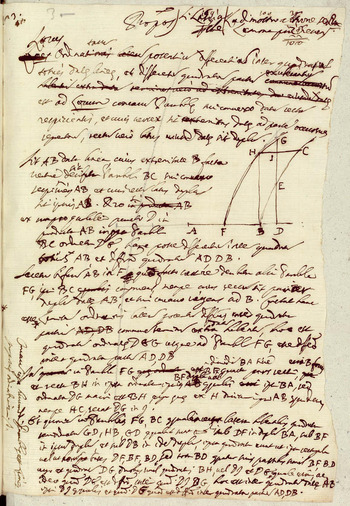
As to the palaeographic examination, I compared W with Viviani's holograph manuscripts (whose authorship cannot be disputed) at the National Central Library in Florence, namely Gal. 203 (containing Viviani's annotations and draft versions for sections of De Locis Solidis) and Gal. 206 (containing Viviani's translations from Apollonius). The result of this comparison is that no typical traits of Viviani's handwriting (see Figure 3 = Gal. 203, f. 15r) are to be found in W; and, conversely, no typical traits of the hand who wrote W (see Figure 4 = f. 2v) are to be found in Viviani's holograph manuscripts – even if we take into account the distinctly cursive handwriting of Gal. 203 and 206 (particularly the former), and the very steady handwriting of W, which might have modified some traits of the handwritings, thereby making the comparison problematic.
Gal. 203, f. 15r: sheet from Viviani's mathematical annotations (Biblioteca Nazionale Centrale, Florence).
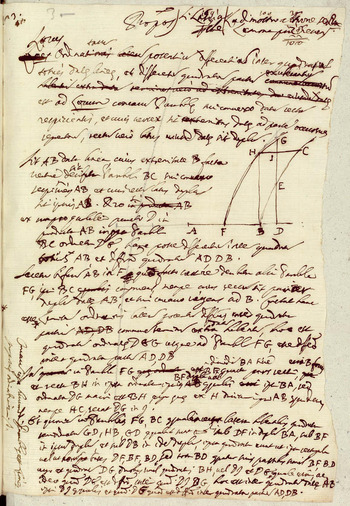
W, f. 2v: sheet from Viviani's text, in the copyist's handwriting, with occasional corrections by Viviani (Wellcome Library, London, Ms. 4949).

The results of the palaeographic examination are fully supported by the philological examination: W presents scribal errors – that is, purely mechanical errors – which by no means might be regarded as authorial errors. They are indicated in the critical apparatus of the Latin text; here is a list of the most relevant passages, accompanied by brief explanatory remarks, so as to make the understanding of the apparatus easier:Footnote 37
52. per lege W ante corr. : perlege W post corr.
The variant ‘per lege’ is grammatically impossible.
55. dem W ante corr. : de W post corr.
It is impossible that Viviani wrote ‘Galilaeo dem Galilaeis’; the error is clearly due to the mistaken interpretation of ‘de’ (with a long final stroke, curling upwards) for ‘dē’ – that is, ‘dem’.
60. causam W ante corr. : causâ W post corr.
This error is very similar to the previous one: the copyist mistook the macron indicating the ablative case for the abbreviation used for a word ending in -m; the outcome is a text that is syntactically wrong.
63. Quid dum W ante corr. : Qui dum W post corr.
The variant ante corr. is a dittography of the initial letter of ‘dum’.
65. opticij W ante corr. : optici W post corr. s.l.
It is impossible that Viviani wrote ‘opticij’, which does not exist.
66. instrumentis structuram W ante corr. : instrumenti structuram W post corr.
This error is analogous to that in note 63.
67. meritò Galilaeo W ante corr. : meritò Galilaei W post corr.
Error due to desinence assimilation.
74. osseruationes W ante corr. : obseruationes W post corr.
Italianism.
76. motus, aspectus W ante corr. : motus aspectu W post corr.
Error due to desinence assimilation, producing an error of punctuation.
81. praemis W ante corr. : praemiis W post corr.
The variant ante corr. does not exist.
83. effemeridas W ante corr. : ephemeridas W post corr.
Italianism.
87. Catolico W ante corr. : Catholico W post corr.
Italianism.
93. duplice lente W ante corr. : duplici lente W post corr.
Desinence assimilation.
116. essoluenda W ante corr. : exsoluenda W post corr.
Italianism.
128. auguste W ante corr. : augustæ W post corr.
Error of ‘dictée intérieure’.Footnote 38
129. prepetua W
This error escaped the rereading of the text, and is due to the mistaken interpretation of the abbreviation for per.
150. additis W ante corr. : abditis W post corr.
Trivialization.
166. Mense W ante corr. : Mensæ W post corr.
Error of ‘dictée intérieure’.
171. cultorem W ante corr. : Cultore W post corr.
Error due to the mistaken interpretation of the macron ē (see note 60).
Clearly, these are scribal errors that support the conclusion of my analysis: W is not Viviani's holograph manuscript.
Once the fair copy was ready, Viviani revised it: his handwriting is clearly recognizable from the correction of Section C of the text. Favaro ascribed this correction to censorship,Footnote 39 but this interpretation is hardly correct. Indeed, the text written on the left margin differs from the one written in the first handwriting (and later crossed out) with respect to only two instances: ‘complessum’ corrected into ‘Complexum’, and ‘Par est’ corrected into ‘Credibile’. And there is no reason why the inquisitor should have rewritten the whole of Section C, instead of simply crossing out ‘Par est’ and replacing it with ‘Credibile’.
Favaro further ascribed the deletion of the words ‘sanctitatem redolentis’ (see apparatus, note 109) to censorship:Footnote 40 again, however, it is more likely an authorial correction; that is, Viviani's own correction of the fair copy provided by the copyist. In fact, in the final annotations related to the imprimatur, the inquisitor explicitly states that he ‘did not find anything against the law of God and good morals’ (‘nec aliquid contra legem Dei, et bonis moribus inueni’Footnote 41 ).
I believe the correction of Section C of the text (Figure 5) might be ascribed to Viviani on the basis of the following palaeographic analysis:
-
• the ending -s in the shape of an oblique stroke: ‘Tellus’; see Gal. 203, f. 10v, line 23: ‘excusationes’ (Figure 6); f. 11r, line 8: ‘quas’ (Figure 7); f. 14r, line 1: ‘Locus’ (Figure 8)
-
• r straight: ‘Astra’, ‘Mare’, ‘profunda’; see Gal. 203, f. 11r, line 3: ‘inter’ (Figure 9); line 6: ‘igitur’ (Figure 10).
-
• d with vertical stroke bent to the left, which enfolds at the bottom: ‘credibile’; see Gal. 203, f. 11r, line 8: ‘decimæ’ (Figure 11); f. 11r, line 9: ‘adinueni’ (Figure 12); f. 22r, line 2: ‘eiusdem’ (Figure 13); f. 22r, line 4: ‘eadem’ (Figure 14).
-
• D with straight inclined stroke and bent stroke that curls to the left: ‘Deo’; see Gal. 203, f. 14r, line 4 ab imo: DG (Figure 15); f. 14r, line 4 ab imo: ID, DF (Figure 16).
-
• L with the upper stroke distinctly bent and the lower stroke corrugated, which goes below the line: ‘Lyncæus’; see Gal. 206, f. 3v, last line: ‘Le’ (Figure 17).
W, f. 2r, detail: Section C of Viviani's text, in the copyist's handwriting, crossed out and rewritten by Viviani (Wellcome Library, London, Ms. 4949).

To Viviani is further to be ascribed the correction ‘optici’, which can be read above ‘opticij’ (W, f. 2v, line 11 = note 65 = Figure 18):
-
• ligature of ti in the shape of a baseless triangle: see Gal. 203, f. 10v, line 15: ‘ultimo’ (Figure 19).
-
• p in the shape of a small r with downward double stroke: see Gal. 203, f. 11r, line 7: ‘appello’ (Figure 20).
On the basis of this comparative examination, I believe we might well ascribe to Viviani also other corrections for which the palaeographic comparison is very difficult, or impossible, as they consist of rewritings of individual letters.
In order to clearly distinguish the copyist of W from its author–corrector (i.e. Viviani), I use W to indicate the text as written by the copyist, and V to indicate Viviani's corrections.
As to deletions, most of them are certainly due to the copyist, who realized he anticipated or misunderstood a word, or the beginning of a word, and corrected it in scribendo. Of course, in these cases, the correction is ascribed to W:
-
61. post quod scr. et del. E W
-
84. post proprios scr. et del. Oty W
-
94. post dono scr. et del. M W
-
97. post tum scr. et del. in W
-
102. post ob scr. et del. aureas (?) W
-
114. post Quod scr. et del. Hin W
-
117. post acquisita scr. et del. prose W
-
119. post alieno scr. et del. sol W
-
121. post Genitoribus scr. et del. et W
-
143. post Annus, scr. et del. ora W
-
159. post suo scr. et del. Anno a Christo W
-
163. post quarta scr. et del. ns W
In two instances, by contrast, the deletion is certainly due to Viviani, as it bears an authorial character:
-
109. uitæ santitatem redolentis W : sanctitatem redolentis del. V
-
112. abditis, ac Deo coaeuis W : ac Deo coaeuis del. V
In both these cases, the correction (also inserted in the printed versions of the text) might be due to caution, in order to avoid the inquisitor's intervention. Interestingly, the words deleted both in the manuscript and in the printed text are to be found in the inscriptions on the facade of Viviani's palace (with the variant redolens instead of redolentis).
Other errors escaped Viviani's revision of the fair copy, and were corrected in print (for abbreviations, see the editorial note below):
-
48. incædis W] incedis LM
-
62. Lotaringiam W] Lotharingiam LM
-
68. Aetera W] Æthera LM
-
72. creatos W] creatas LM
-
80. prenunciandos W] prænunciandos LM
-
86. Orologium W] Horologium LM
-
91. secretioria W] secretiora LM
-
92. Microscopij W] Microscopii ope LM
-
103. textatum W] testatum LM
-
104. Cosmi I. V] Cosmi primi W FERDIN. I. LM
-
111. Nonnullas W] Nonnulla LM
-
120. mærentibus W] merentibus LM
-
124. incoparabili W] incomparabili LM
-
129. prepetua W] perpetua LM
-
130. Prothoplasmate W] Protoplasmate LM
-
137. Antogonistarum W] Antagonistarum LM
-
142. ottaua W] octaua LM
-
147. preclare W] præclare LM
-
148. lætharis W] lætaris LM
-
164. astarunt W] adstarunt LM
-
165. Paroecie W] Parœciæ LM
In four instances, the error was not even corrected in print:
-
79. Idrographia W LM] deb. Hydrographia
-
90. Haeroicâ W LM] deb. heroicâ
-
136. uirtuti W LM] deb. uirtute
-
152. amantissimo W LM] deb. amantissimeFootnote 42
Finally, the manuscript (f. 4v, line 17) presents a correction that seems not to be ascribed either to the copyist or to Viviani:
-
110. eligere curauerit alia manu Wp.corr. LM] eligerit Wa.corr. (Figure 21)
Since, as was shown, the printed versions of the text (LM) present corrections that are not present in W, and W does not show any trace of typographical work, we have to conclude that W is not the printer's copy; rather, it is the model for the printer's copy: the latter is lost, as is often the case. A few elements might be attributed to the preparation of the printer's copy:
-
• underlining, which indicates the use of capital letters, as is evident from the comparison of W and LM;
-
• signs such as [, which indicate the beginning of a new paragraph: see ff. 2v: In Luna … In Sole; 4r: Et sicut … Archimedis … Ante alios; 4v: Quod hinc; 5r: Quod denique.
To conclude: W is not the holograph of Vincenzo Viviani's work, but its ‘idiograph’ (i.e. Viviani's authorized copy), whose relevance is naturally equal to that of an autograph, as it presents the text approved by the author. However, since an ‘idiograph’, as opposed to an autograph, may present – as, in fact, W does present – errors introduced by the copyist that escaped the author's revision, it requires a more complex philological analysis, due to the necessity of distinguishing the author's errors and corrections from the copyist's.
As to the text, the comparison of the manuscript and the printed version shows them to be basically identical: with the exception of the corrections mentioned above and a few minor changes, the printed version reproduces the manuscript faithfully.
The inscriptions are divided into six parts, identified with letters, from A to F. In A, Viviani refers to King Louis XIV of France (to whom De Locis Solidis is dedicated, too, with a dedication running on three in-folio pages), who had granted him a generous pension, with which Viviani possibly purchased his palace. In B, he addresses passers-by, inviting them to stop and read the inscriptions, paying attention and tribute to Galileo. C was meant to be placed just below the bust of Galileo, above the main entrance of the palace (of all the inscriptions, this is the only one that has completely faded away), and briefly introduces Galileo.
In D, the longest section of text, Viviani celebrates Galileo's scientific achievements: his telescopic observations (the rugged surface of the Moon, sunspots, the phases of Venus, tri-corporeal Saturn, the fixed stars constituting the Milky Way, Jupiter's satellites, and comets), his invention of the microscope, his studies of floating bodies and mechanics. Viviani also calls the reader's attention to Galileo's specific method, namely his ‘calling Geometry the wet nurse of Philosophy’.
E has a quite convoluted structure. After a brief reference to Galileo (as if continuing the discourse in D), Viviani speaks of himself, and remains the subject of the whole text that follows. Viviani introduces himself as ‘the very last disciple of so great a man’, and tells Galileo's moral teachings: the pursuit of truth and justice, of good and honesty. He then goes on to mention his patrons and supporters (Grand Dukes Ferdinand II and Cosimo III, from the Medici family, and Louis XIV, king of France), and concludes by referring to the bronze bust of Galileo at the top of the main entrance door, which he set up in 1693.
Lastly, in F, Viviani appeals to the city of Florence, calling the municipality and his fellow citizens to their duty to properly celebrate Galileo. Just as Florence celebrated Michelangelo, erecting a sumptuous funeral monument in a prominent place of the Santa Croce Basilica, so it must do with its other greatest child, Galileo. Viviani also calls the reader's attention to the continuity – under the learned and enlightened rule of the Medici family, at the same time protecting and promoting the arts and the sciences – between the two (alleging Michelangelo's death to have occurred on the very same day, almost at the very same hour, on which Galileo was born), as the loss of the restorer of Painting, Sculpture and Architecture was repaired by the generous gift of the renovator of Astronomy and Geometry.Footnote 43 It is the climax of Viviani's carefully structured rhetorical argument: before turning to telling the story of Galileo's pious and Catholic passing, with which F ends, Viviani suggests that Providence bestowed on Florence the greatest of privileges, and the city should respond by means of appropriate action, fully recognizing the divine gifts of both its extraordinary children.
In so doing, Viviani combined – in a single text – the exhortation to erect a proper funeral monument for Galileo, a celebration of the role played by the Medici rulers in the progress of the arts and the sciences, and the underlining of Florence's continued cultural primacy.
The printed version presents two additional texts, for inscriptions G and H, which are not included in W: indeed, they offer mere quotations from Virgil's Aeneid and Pope Urban VIII's ‘Adulatio perniciosa’ (both of which did not require the imprimatur: I provide the texts of these two inscriptions in footnote 241 below).
The aftermath
Viviani died in 1703, and was laid to rest beside his master, in the vestry of the Chapel of the Novitiate. He never saw the erection of a proper funeral monument to Galileo in Santa Croce, nor the republication of his banned works. His lifelong efforts (he was not even twenty years old when Galileo died, and was over eighty when he himself passed away) were not in vain, however, as they triggered a process that eventually led to the fulfilment of his wish.
The first step was taken in 1715, with the publication of the Lezioni Accademiche of Torricelli (Galileo's pupil), which was followed, in 1727, by the Florentine reprint of the Opera Omnia of Gassendi (a Galilean scholar whose piety was beyond doubt): both works called attention to the actual convergence of faith and the new science of Galileo. Most importantly, between these two editions came the publication of the second edition of Galileo's collected works (1718).Footnote 44 However, despite its support by a growing group of Catholic intellectuals who were engaged in the struggle to modernize the Church, overcoming the traditional hostility towards new philosophical and scientific ideas, the three volumes still lacked the Dialogue and the other Copernican works.
Eventually, after the death of Cosimo III, in 1721, things started to change, however slowly. With the support of a group of eminent intellectuals, his successor, Grand Duke Gian Gastone (1671–1737, the last Grand Duke of the Medici family), undertook the task of limiting the power and influence of the Church, and restoring to the state its full rights and independence. In 1737, Viviani's dream finally came true, and Galileo's body was exhumed and moved to the base of the new funeral monument, which was well under way and was eventually completed on 6 June 1737.Footnote 45
London, Wellcome Library, Ms. 4949 Critical edition and annotated translation of the Latin text Editorial note
I offer here the first critical edition of the original manuscript (W) of the printed text of the inscriptions on the facade of Viviani's palace, in Florence.
The present edition reproduces W – that is, the fair copy that Viviani revised – and indicates in the critical apparatus all changes the text underwent, ascribing them either to the copyist (W) or to the author (V) (with some margin of doubt, in a few cases). The apparatus offers all variants of the printed version of the text (L and M), with the following exceptions: use of capital/small initials (unless Viviani corrected the text); ae/æ, oe/œ, i/j, u/v, vowels with or without accents (ù/u, â/a, è/e), and punctuation. As to the use of whole words in capital letters, W does not present any (as said above, W indicates capital letters by underlining them), whereas LM use capital letters for the incipit of each section of the text, as well as for first names of eminent figures (kings and princes, Galileo, Michelangelo).
What follows is not an edition of the definitive text of the Grati Animi Monumenta, which is constituted by the printed version of the text, but the rigorous and faithful reconstruction of the key testimony of the text, which will hopefully replace the scanty notes of Favaro's apparatus.
Sigla
- W =
-
London, Wellcome Library, Ms. 4949
- Wa.corr. =
-
W ante correctionem librarii
- Wp.corr. =
-
W post correctionem librarii
- Ws.l. =
-
W supra lineam
- V =
-
Vincentii Viviani correctiones in W
- L =
-
De Locis Solidis Secunda Divinatio Geometrica … autore Vincentio Viviani, Florence: Pietro Antonio Brigonci, 1701 (as noted above, quire Qq, containing the revised text of the inscriptions, was added in 1702).
- M =
-
Grati Animi Monumenta Vincentii Viviani, Florence: Pietro Antonio Brigonci [1702].
- add. =
-
addidit
- corr. =
-
correxit
- deb. =
-
debuit
- del. =
-
deleuit
- in mg. =
-
in margine
- om. =
-
omisit
- praem. =
-
praemisit
- s. l. =
-
supra lineam
- scr. =
-
scripsit
[2r]A. Footnote 46
Aedes aFootnote 47 Deo datæ Ludouici Magni Inclyti Regis Christianissimi honorificis munificentijs comparatæ, ac denuo constructæ.
B. D. O. M. Viator
Qui sapientiæ amore percelleris, dum per hanc uiam incædis,Footnote 48 cui, fatidico quodam instinctu amoris nomen maiores fecêre, siste parùm ad hoc (humileFootnote 49 quidem), sed grati, uerique amoris monumentum, erga. Sapientissimum Præceptorem. BenignissimosFootnote 50 Magnos Duces. Et Ludouicum Magnum Christianissimum GalliæFootnote 51 Regem; et quæ has Aedes exornant, dominique mentem demonstrant, perlege.Footnote 52
C.
Galilæus Lyncæus ætatis Annorum IIL. Quem Astra, Mare, ac TellusFootnote 53 complexum mente profunda, Credibile in solo cernere cuncta Deo.Footnote 54
D.
Aeternæ Memoriæ Viro
Galilaeo de Footnote 55 Galilaeis, Patriæ, Etruriæ, Italiæ, imò Europæ totius delicio. Philosophiæ renascentis faci. Qui Veritatis propiùs intuendæ desiderio adeo exarsit, ut longè ultrà, tum Veterum, tum recentiorum Philosophorum placita [2v]progressus, et posthabitis debilioribus humanarum mentium cogitatis, unico Geometriæ (quàm ad Caelum ueritatis ducem uocabat) auxilio fretus, uiam ad ueritatem certius indagandam alios primus docuit,Footnote 56 feliciterque peregit,Footnote 57 comitante semper per tam arduumFootnote 58 iter, Pietate; ita ut,Footnote 59 quæ de Maris aestu, Philolaique systemate exercendi tantùm ingenij causâ,Footnote 60 (quodFootnote 61 præsertim Epistola ad Christinam LotaringiamFootnote 62 demonstrat) excogitauerat; religioni libens animo litauerit.
QuiFootnote 63 dumFootnote 64 Patauij Matheseos Cathedram occuparet, uix auditâ Anno 1609: opticiFootnote 65 tubi famâ, ingenij, et dioptricæ uiribus rem assecutus, instrumentiFootnote 66 structuram inuenit, Senatuique Veneto dicauit, quem docti Viri meritò GalilaeiFootnote 67 nomine donarunt, ut qui primus inuenerit ingenio, non casu.
Nouo hoc fretus auxilio, quasi terra eius ingenio satis non esset, AeteraFootnote 68 reclusit, nouosque ueluti Orbes, Philosophis et Astronomis aperuit.
In Luna montes, Valles, planities, periodicam eius disci librationem.
In Sole nitidissimo lucis fonte, Nubium, ac densarum Caliginum instar nascentes, et renascentes maculas, eius circa proprium centrum,Footnote 69 ferè menstruam ab occasu in ortum Vertiginem primus animaduertit.
Veneris Sydus, ac proindeFootnote 70 Mercurij uarias Lunæ facies [3r]æmulari, ac utrumque ob id proprio motu ab occasu pariter in ortum, ueluti Mars, Iuppiter, ac Saturnus, Solis globum circumire, tutò Astronomos docuit.
Altissimum Planetarum in uarijs cum Sole aspectibus tergeminâ specie, modò rotundum, modò oblongum, modò ansatum; Martemque Perigaeum in quadraturis cum Sole, non nihil mutilum apparere, ante alios admonuit.
Inerrantes stellas, quas numero pauciores nouerant prisci, ac ueluti clauos unico, solidoque Orbi fixas, quasi auxit, dum nouas, et ante se numquam uisas, in Orionis ense; in pleiadibus; in nebulosis; in Lacteo circulo; et undique per Cælum detexit, et ad Dei omnipotentiam magis, magisque declarandam, infinitas ueluti Lampadas, perpetuò ardentes, per immensa fluidorum CoelorumFootnote 71 spatia localiter immobiles, sed ad instar Solis, circa propria centra reuolubiles, ad primarios, et secundarios propriorum systematum Planetas uiuificandos, creatos,Footnote 72 arbitratus est.
Iouis satellites Patauij VII Idus Ianuarij AnniFootnote 73 1609=, ante omnes primùm, et post tres tantummodo obseruationesFootnote 74 a se peractas, detectos, perpetuæ Mediceorum Procerum Footnote 75 gloriæ dicauit, quorum concitatissimi motus aspectu,Footnote 76 iamdiù frustra quæsitum problema de Locorum longitudinibus noctu captandis, proposuit; ita utFootnote 77 nouis gentis Mediceæ auspicijs Geographia,Footnote 78 et IdrographiaFootnote 79 corrigi, restitui ac perfici datum sit; dum Medicearum Stellarum [3v]motus periodicos, et ab Ioue distantias improbo trienni labore assecutus, ad earum citissime abeuntes aspectus prenunciandos,Footnote 80 Canones, et Tabulas confecit; spretisque amplissimis praemiisFootnote 81 ijs, qui tantùm problemaFootnote 82 enodarent promissis, proprias etiam Theoricas, Tabulas, et ephemeridas;Footnote 83 propriosFootnote 84 Opticos tubos, propriumqueFootnote 85 OrologiumFootnote 86 Oscillatorium a se iam a pluribus Annis Pisis excogitatum, ac insuper Viros horum instrumentorum usum probè callentes Anno 1615 = CatholicoFootnote 87 primùm RegiFootnote 88 Philippo Tertio; postmodum Anno 1635 = confoederatis HollandiæFootnote 89 Prouincijs, HaeroicâFootnote 90 sanè magnanimitate obtulit: Sed Dei Omnipotentis decreto tam generosa oblatio, ac nobile tentamentum utrinque euanuit, ut maximum opus Nauticæ, et Geographiæ bono, Ludouici Magni, Terra, Marique potentissimi munificentiâ, et Summi Astronomi Cassini labore, per ipsa Medicea Sydera inciperet, et perficeretur.
Cometarum denique generationem, incrementa, Motûs, Interitum, explicauit.
Qui uerò coelestia et longinqua Dei opera aperuit, idem, ut summùm opificem, in minimis etiam operibus laudandum proponeret, humanæ Philosophiæ secretioriaFootnote 91 penetralia reserauit; dum MicroscopijFootnote 92 ex unicâ, et ex dupliciFootnote 93 lente a se primùm excogitati, et confecti [4r]ac iam Anno 1612: instanti Casimiro Polonorum Regi, donoFootnote 94 missi, humano obtutui minima subiecit, et naturæ ipsius quamdam ueluti anatomen instituit.
Et sicùt Geometriam Philosophiæ nutricem uocabat, ita exemplo, et inuentis demonstrauit; siquidem nouâ Methodo scientiam Centrobarycam, quorumdam solidorum, uix etiam initiatis in Geometria aperuit.
Archimedis Doctrinam de ijs quæ innatant fluidis, et eorum libramenta, ob uim alternarum pressionum primus indigitauit, innumeraque scriptis suis sparsit semina, e quibus plurimorum tractatuum seges præsenti Aetate accreuit, et in dies PosterisFootnote 95 accrescet.
Ante alios, uim percussionis infinitamFootnote 96 suapte naturâ animaduertit.
Nouas scientias omnibus usque ad eius Aetatem seculi intactas animaduertit de solidorum resistentia, de motibus grauium tumFootnote 97 æquabiliter incedentium, tum naturaliter descendentium, tum proiectorum, (e quibus præcipuè bellicorum missiliumFootnote 98 Artem elicuit) primus Philosophiæ sacrario, intulit, promouit, ac Geometricè demonstrauit.
Tantis rerum humanarum bono inuentis fama celeberrimi Viri in Æternitatem permansura, se ipsaFootnote 99 obliuionis, temporumque uictrix triumphabit.Footnote 100
Hoc monumento huius Aedis Dominus gratum animumFootnote 101 [4v]erga eximiam uirtutem, obFootnote 102 auctas, illustratas, perfectas naturales scientias, tantum textatumFootnote 103 in futuras aetates uoluit.
E. Galilaeo inquam de Galilaeis
Patritio Florentino, Serenissimorum Etruriæ Magnorum Ducum, Cosmi I.,Footnote 104 Cosmi II.,Footnote 105 ac Ferdinandi II.,Footnote 106 primario Philosopho, ac Mathematico. Academico, uere lynceo. Geographiæ, Hydrographiæ, Cosmographiæ, Mechanices, Phisices, Astrorum scientiæ, opitulante Geometria, felicissimo instauratori. Inanis Artis genethliacaeFootnote 107 perpetuo insectatori.
Nouissimus tanti Viri discipulus.
Quod ob aurea, Ciuilis,Footnote 108 Moralis, et Christianæ sapientiæ monita; ob exemplum uitæ,Footnote 109 uiam ueritatis eligere curauerit,Footnote 110 ac pro uirili, prosecutus fuerit, Iudicia Dei non sit oblitus. NonnullasFootnote 111 ex infinitis abditis,Footnote 112 vera, ex immensis Geometriæ Thesauris deprompserit,Footnote 113 et per ea homines ad ipsum Deum propius accedere senserit.
QuodFootnote 114 hinc ueritatem, et iustitiam esse fortiter propugnandas; mendacium, assentationem, et Hypocrisin ueluti pestes defugiendas. A segni otio potissimum [5r]abhorrendum. Beneficia in ære, MaleficiaFootnote 115 in Aere incidenda. Benemeritis quantum fieri potest, aut grato saltem animo satisfaciendum. Vnicuique promissa religiosè exsoluenda,Footnote 116 datamque fidem integre seruandam. Honestè acquisitaFootnote 117 pro se suisque honeste impendenda. Auaritiæ sordes, et turpia lucra reicienda.Footnote 118 Nihil in perniciem ingrati animi uitio laborantium cumulandum. Reliqua, omni prius ære alienoFootnote 119 dissoluto, ingenuis potius, et bene mærentibusFootnote 120 læto animo dandum perceperit.
Quod præceptis huiusmodi iuuenili, tum primum suo in animo a natura, a Genitoribus,Footnote 121 a studijs, et a Præceptoris Doctrina impressis, suauissimis propriorum Principum Imperijs, nutibusque, se plane deuouerit; atque hinc ab ingenita Serenissimi Ferd: II. benignitate plura sibi ultro, grauiaque munera, maximis cumFootnote 122 honoribus, ac stipendijs fuerint collata, certatimque a Serenissimo Cosmo III. Footnote 123 incoparabiliFootnote 124 clementia, denuo impartita, in quibus isFootnote 125 deditissimus cliens per quinquaginta fereFootnote 126 Annos, semper totus fuerit ijsque (ueritate, et Iustitia ducibus) eximia sedulitate, et constanti fide ad extremum usque responderit.
Quod denique, ob hæc omnia, Ludouici Magni, Galliarum [5v]et NauarræFootnote 127 inuictissimi Regis christianissimi, tamquam numinis sui, Iudicium, ac uoluntatem promeritus, amplissima eius augustæFootnote 128 liberalitatis dona diutissimè sit consecutus.
Simulacrum hoc Aeneum
Præceptoris sui prepetuaFootnote 129 ueneratione dignissimi ex ProthoplasmateFootnote 130 a celebriFootnote 131 sculptore Ioanne Caccinio, coram serenissimo Cosmo II:Footnote 132 Anno 1610: ad uiuum efformato, exiguum uti Minerual, et grati Animi pignus, ingenuique Amoris monumentum, tot, tantorumque beneficiorum Autoris aeternum memor
Serenissimorum eorumdem MM. DD.
primarius Mathematicus.
Ætatis annorum LXXII.
Anno a Salut. Inc. MDCXCIII.
A GalilaeiFootnote 133 Ortu CXXX.
Ab interitu LII.
Primus publicè posuit.
F.
Florentia præ alijs Vrbibus Deo nimis cara.
Exurge grata, et gratulabunda.
Vt enim non interruptam illustrium, diuinorumque Virorum seriem uideres; eodem Anno, mense, ac die, quo Mundi Conditor substulit nobiliorum artium penè deperditarum [6r]Picturæ, Sculpturæ, atque Architecturæ ad summum usque reparatorem, perfectoremqueFootnote 134 PatriciumFootnote 135 tuum Michaelem Angelum, eodem ipso Anno, Mense, Die, ac propemodum horâ hanc dolendam decoris tui iacturam ipsemet Deus refecit, et ut tu adhuc per noua lustra possis Ciuium tuorum uirtuti,Footnote 136 orbi uniuerso prodesse, fastos tuos, Patritij tui Galilaei, Ortu auxit, Philosophiæ, Geometriæ, atque Astronomiæ felicissimi Instauratoris, Patris, Principis, Ducis.
Hic enim, coelestis planè ingenij uir (longe secus ac Encomiastes quidam, inuidorum AntogonistarumFootnote 137 fidei malè nixus, falsò conscripserat) imperante inclyto Cosmo I. Pisis legittimè nascitur ex patre Vincentio Michaelis Angeli Ioannis de Galilaeis, PatricioFootnote 138 Florentino (qui de uetere, ac recentiore Theorica Musices pereruditos Dialogos conscripsit), et ex honestissima eiusdem Vincentij uxore egregia Iulia, Cosmi, Venturæ, e uetustissima, ac eminentissima Pistoriensi familia de Ammannatis, tunc Pisis, cum eodem Vincentio commorante, Anno a Christi Incarnatione 1564=Footnote 139 stylo Florentino Mense Februari,Footnote 140 dieFootnote 141 decima ottaua,Footnote 142 et hora ab occasu uigesima prima et semis qui quidem Annus,Footnote 143 Mensis, dies, hora tamen XXIII. et semisFootnote 144 itidem ab occasu, Pisis Galilaeo nostro Natalis, eidem Michaeli Angelo Bonarrotio Romæ læthalisFootnote 145 fuit, ut ipsi legimus, in domesticis [6v]Commentarijs Leonardi Bonarrotæ Michaelis Angeli fratris filij propria manu conscriptis;Footnote 146 non uerò die XVII. ut a Vasario in eius uita enarratur.
Exurge ergo, grata, et gratulabunda Florentia, et Summo Conditori illustres toto Orbe Ciues donanti demississima gratiarum actione, obsequia repende. Non defuturos enim semper tibi nobilissimos, insignesque filios Illustria duorum Virorum aeternum mansura, et semper futura foecunda exempla promittunt.
Sed sicuti in Galilaei ortu, eiusque preclareFootnote 147 gestâ uitâ meritò lætharis,Footnote 148 ita in ipso eiusdem religiosissimo obitu, Pietatis Christianæ exemplum ciuibus monstratura pone luctum, imo exulta.
Postquam enimFootnote 149 de rerum abditisFootnote 150 nihil pro mentis humanæ captu non conspexisset, ut meliùs in Creatorem animumFootnote 151 intenderet, Deo permittente, Oculis orbatus, per postremum Vitæ quinquennium Diuinæ Voluntati pius obsecundauit, quod fortiori Animo præstitisse agnoscitur, quo amantissimoFootnote 152 eo sensu in noua semper detegenda fuerat usus. Lenta tandem correptus febre, cumFootnote 153 bonorum Virorum instituto uixisset aesFootnote 154 proprium,Footnote 155 non alienum in pauperes occultè,Footnote 156 effusèque erogando, et multa singularis Pietatis exempla edidisset,Footnote 157 [7r]sensim deficiens, petitis sæpius salutaribus Ecclesiæ Præsidiis,Footnote 158 ac pie susceptis, Pontificia Vrbani VIII. benedictione munitus, Optimus Philosophus, inuocato saepius Iesu, Immortalem spiritum Creatori suoFootnote 159 reddidit pacatissimè, Anno a Christo NatoFootnote 160 MDCXLII.Footnote 161 Die Mercurij VIII. Ianuari,Footnote 162 hora quartaFootnote 163 Novo Stylo Annos agens LXXVII. Menses X. Dies X in suburbano Martellinorum Arcetri rure, ubi plusquam triginta Annos scientijs uacauerat.
Tanti Viri postremæ inualetudini astaruntFootnote 164 assiduè, et postremas uoces accepere Doctor Vincentius filius; Nurus; Proximiores; Sacerdos Paroecie;Footnote 165 duoque alij singulari Doctrina, et Pietate præstantes ad expiandam animam a Galilaeo iam pridem delecti; duoque hospites iam et socij Mensæ,Footnote 166 alter Euangelista Torricellius acutissimus Geometra, per postremum trimenstre. Alter per ultimum triennium nouissimus Discipulus ter felix, Galilaeo a serenissimo Ferd: II. sollicite commendatus, qui memoriam hancFootnote 167 posuit ut a se in Præceptore conspectam,Footnote 168 uel a Cognatis, Amicis,Footnote 169 famulis, sedulò, et tutè auditam,Footnote 170 Nepotibus, et posteris ad Christianos Philosophos edocendos, fideliter aperiret; assentiente, et iubente præsertim Serenissimo Ferdinando Principe Etruriæ primogenito Artium et scientiarum Cultore,Footnote 171 ac Moecenate munificentissimo.Footnote 172
[7v]ImprimaturFootnote 173
Thomas de Gherardesca Vicarius GeneralisFootnote 174
De mandato Reuerendissimi Patris Inquisitoris Generalis Florentinae Administrationis Reuerendus Pater Magister Antonius Franciscus Cioppi Minor Conuentualis Consultor huius Sancti Officii perlegat attente præsentem librum, cui titulus est Vincentii Viuiani etc. et referat an eiusdem possit permitti impressio
Datum in Sancto Officio Florentiæ die 9a Augusti 1701
Frater Lucius Augustinus Cecchini de Bononia Minor Conuentualis Vicarius Generalis Sancti Officii FlorentiæFootnote 175
Ego frater Antonius franciscus Cioppi ex mandato Paternitatis Suæ Reuerendissimæ applicate perlegi attente, nec aliquid contra legem Dei, et bonis moribus inueni quapropter librum hunc existimo dignum ut tipisFootnote 176 mandetur.
Ego frater Antonius Franciscus Cioppi Consultor Sancti Officii Florentiae manu propria feciFootnote 177
Attenta supraposita relatione imprimatur.
Frater Lucius Augustinus Cecchini de Bononia Minor Conuentualis Vicarius Generalis Sancti Officii FlorentiaeFootnote 178
ImprimaturFootnote 179 Ph. BonarotaFootnote 180 Senator Regiae Celsitudinis AuditorFootnote 181
A.
A house given by God purchased and renovated thanks to the honorable generosity of the Glorious and Most Christian King Louis the GreatFootnote 182
B.
To God the Almighty Greetings, wayfarer,
travelling this road, which the ancients prophetically named after Love!Footnote 183 If you are possessed by a love of wisdom, tarry a while before this memorial – humble, indeed, but a testimony of grateful and true love, to the most wise Preceptor,Footnote 184 Most Benevolent Grand Dukes, and the Most Christian King of France, Louis the Great – and read through what adorns this house, and reveals the intention of its owner.
C.
Galileo, Lyncean,Footnote 185 aged 48, who embraced the stars, the sea and the Earth with his profound mind, is plausibly seeing all these in God alone.
D.
To Galileo Galilei,
A man worthy of eternal memory, the delight of his homeland, of Tuscany, of Italy, and indeed of the whole of Europe, the light at the rebirth of philosophy; a man so inflamed by the desire to contemplate the truth, that he went far beyond the received views of both ancient and more recent philosophers, and, disregarding weaker opinions of human minds, relying only on the help of geometry (which he called the truth's guide to heaven), he was the first to teach others a more certain way to truth, and happily pursued it, accompanied throughout his arduous way by piety; so that his discoveries about the ocean tides and Philolaus’ systemFootnote 186 (which he demonstrates especially in the Letter to Christina of Lorraine),Footnote 187 and which he thought out only to engage his mind, he gladly sacrificed to religion.
A man who, in 1609, while he was holding the Chair of Mathematics in Padua, when news of optical tubes had not spread far, pursued the matter with the powers of his mind and of dioptrics, discovered how to construct the instrument, and dedicated it to the Venetian Senate; and so learned men deservedly named it after Galileo, since he was the first to discover it, and by reason, not by accident.
With the help of this new instrument, as if Earth were not enough to occupy his mind, he opened the ether, and disclosed new worlds, so to say, to philosophers and astronomers:
The Moon, [he found] has mountains, valleys, plains, and periodic librations of its disc.Footnote 188
The Sun, the brightest source of light, has spots forming and reforming like clouds and dense fog, as he was the first to see; and also revolves in nearly a month around its own centre, from west to east.Footnote 189
The Star of Venus, and likewise that of Mercury, imitateFootnote 190 the various appearances of the Moon,Footnote 191 as he reliably taught astronomers; consequently, both equally travel around the globe of the Sun, by their own motion, from west to east, just as Mars, Jupiter and Saturn do.
The farthest planet, in its various aspects with respect to the Sun, has a three-fold appearance, as he was the first to notice: at times it is round, at times oblong, at times it has handles;Footnote 192 and perigean Mars, in quadrature with the Sun, appears somewhat maimed.
The fixed stars, which the ancients thought to be few in number, and driven like nails into a single solid orb, he increased in number, disclosing new ones, never seen before, in the sword of Orion, in the Pleiades, in nebulas, in the Milky Way, everywhere throughout the heavens;Footnote 193 and he believed that they declare God's omnipotence more and more,Footnote 194 an infinite number of lights, glowing forever throughout the immense spaces of the fluid heavens; at rest locally, but, just like the Sun, revolving around their own centres, in order to give life to the primary and secondary planets of their own systems.Footnote 195
The satellites of Jupiter, which he discovered first and before all others in Padua, on 7 January 1609,Footnote 196 after completing only three observations, he dedicated to the everlasting glory of the Medicean Princes. And, due to the observation of their very quick motion, he set forth the question, vainly investigated for a long time, of how to obtain the longitude of places at night, so that under the new auspices of the Medicean House geography and hydrography could be corrected, renewed and refined. And while he worked out over three years of persistent work the periods of the motion of the Medicean Stars and their distances from Jupiter, he prepared canons and tables to predict their very rapidly changing aspects. Disdaining the most generous rewards promised to those who solved such difficult problem, with truly heroic magnanimity he offered his set of theories [of Jupiter's satellites], tables and ephemerides,Footnote 197 his optical tubes and his pendulum clock,Footnote 198 which he had devised several years earlier in Pisa, and also men skilled in the use of these instruments: first to Philip III, the Catholic King,Footnote 199 in 1615, and then to the confederate Provinces of Holland, in 1635. However, by the decree of Omnipotent God the generous offer and noble attempt came to nothing in both cases,Footnote 200 so that this essential work for the good of navigation and geography,Footnote 201 was begun by means of the Medicean Stars and carried through owing to the liberality of Louis the Great, the most powerful on land and sea, and to the labours of that most excellent astronomer [Giovanni Domenico] Cassini.Footnote 202
And lastly, comets generate, grow, move and disappear, as he explained.Footnote 203
In fact, the man who disclosed God's distant heavenly works was the same who unlocked to human philosophy the most secret recesses, showing that the supreme artificer deserves praise even in his most minute works; when, as early as 1612, <aided by > the microscope, which he first devised and produced, with a single lens or with two lenses, and sent it as a gift to the Polish King Casimir,Footnote 204 who had asked for it, he brought the tiniest things to human contemplation, and established something like an anatomy of nature itself.
He justified his calling geometry the wet nurse of philosophy, through examples and discoveries, for he was able by his new method to introduce even those barely initiated into geometry to the centrobaric science of certain solid bodies.Footnote 205
He was the first to proclaim Archimedes’ doctrine concerning bodies floating in fluids and their buoyancies, arising from the force of reciprocal pressures,Footnote 206 and scattered innumerable seeds with his writings, from which a harvest of many treatises has grown in the present time, and will grow day by day in the future.
Before others, he called attention to the force of percussion, which is infinite by its very nature.Footnote 207
He called attention to new sciences, which had remained untouched until his own age: he was the first to introduce into the sanctuary of philosophy, and develop and prove geometrically the resistance of solids, the motion of heavy bodies, whether proceeding uniformly or falling naturally, or else of projected bodies (from which he drew mainly the technique of military artillery).Footnote 208
Because of such great discoveries for the good of humanity, the fame of this most distinguished man will remain forever, and will triumph, victorious, over oblivion and time.
With this monument, the owner of this house wished to give to future ages a proper testimony of his grateful soul, for [Galileo's] exceptional ability in extending, casting light upon, and perfecting natural sciences.
E.Footnote 209
To Galileo Galilei, I say,Footnote 210
Florentine Patrician, Chief Philosopher and Mathematician of the Most Serene Grand Dukes of Tuscany Cosimo I,Footnote 211 Cosimo II and Ferdinand II; truly Lyncean Academician, most productive renovator, with the help of geometry, of geography, hydrography, cosmography, mechanics, physics, and the science of stars; tireless critic of the vain art of horoscopes
The very last disciple of so great a manFootnote 212
For, having cared to choose the way of truth, and having pursued it to the utmost of his ability, following the golden commandments of civil, moral and Christian wisdom, and the example of [Galileo's] life, he was never oblivious to God's will. He brought some truths to light out of the infinite secrets, from the immense treasuries of geometry, and discerned that by means of them men draw closer to God Himself.
For, in virtue of this, he himself perceived that truth and justice are to be fought for vigorously, and that falsehood, flattery, and hypocrisy must be avoided like the plague; that the laziness of an idle life is abhorrent; that good deeds are to be carved in bronze, evil ones in air;Footnote 213 that the deserving are to be given satisfaction as much as possible, or at least regarded with a grateful mind; that promises must be conscientiously fulfilled, and plighted faith irreproachably kept; that what a man has honestly acquired may be spent on himself and his kin; that the dirt of greed and filthy gain are repellent; that nothing is to be gained at the expense of those who are tainted with ingratitude; and that what remains, when all previous debts have been settled, should be given away joyfully, preferably to the honest and deserving.Footnote 214
For, thanks to such principles instilled in his young mind first by nature, then by his parents, by studies, and by the teachings of his preceptor, he submitted himself wholly to the most agreeable commands and pleasure of his Princes; the innate benevolence of the Most Serene Ferdinand II Footnote 215 then entrusted several important duties to him, rewarded by the greatest honours and stipends; and these were renewed, with incomparable benignity, by the Most Serene Cosimo III;Footnote 216 and in carrying out these duties, as a most devoted subject for nearly fifty years, he was always faithful, and to which he responded (guided by truth and justice) with extraordinary earnestness and constant loyalty, until his very last moments.
Finally, for he deserved, for all these things, the trust and benevolence of Louis the Great, most invincible and most Christian King of France and Navarre,Footnote 217 whom he regarded almost as a divinity, and from whom he obtained the most generous gifts of august liberality for a very long time;
this bronze bust
of his preceptor, most worthy of everlasting veneration, from the original prototype moulded from life by the famous sculptor Giovanni Caccini, in 1610,Footnote 218 in the presence of the Most Serene Cosimo II,Footnote 219 as inadequate Minerval,Footnote 220 and token of a grateful soul, and a monument of sincere love, eternally preserving the memory of the author of so many and such important services,
the Chief Mathematician
of the Most Serene Grand Dukes,Footnote 221
at the age of 72 years,
in the Year of Salvation 1693,
130 years since the birth of Galileo
52 years since his death,
first publicly set up.
F.
Florence, immeasurably dear to God, more than any other cities, rise, grateful and rejoicing.
In order that you should not see the series of your illustrious and divine men interrupted, in the same year, month, and day in which the Creator of the world took away your Patrician Michelangelo,Footnote 222 supreme restorer and perfecter of the almost lost noble arts of Painting, Sculpture and Architecture – in that very year, month, and day, and almost hour, God Himself remedied this painful loss to your fame, and, in order that you may promote, thanks to the excellence of your citizens, the whole world for many new lustra, enriched your splendour with the birth of your Patrician Galileo, most fortunate renovator, father, prince and guide of Philosophy, Geometry, and Astronomy.Footnote 223
For this man, of quite celestial genius (far from what some biographer wrote, dishonestly relying on the testimony of envious adversaries),Footnote 224 was born legitimately in Pisa, under the rule of the glorious Cosimo I, of Vincenzo, [son] of Michelangelo, [son] of Giovanni Galilei, Florentine Patrician (who composed the most learned Dialogues on the Ancient and Modern Theory of Music),Footnote 225 and of the most honourable wife of Vincenzo, the excellent Giulia [daughter] of Cosimo [son] of Ventura,Footnote 226 belonging to the very ancient and eminent Ammannati family, from Pistoia, who at the time was living in Pisa together with Vincenzo. The year 1564 of Christ's Incarnation, Florentine style,Footnote 227 in the month of February, on the eighteenth day, and at the twenty-first hour and a half, from sunset, that gave birth to Galileo in Pisa – that very same year, month, and day, though at the twenty-third hour and a half from sunset, Michelangelo Buonarroti died in Rome, as we ourselves read in the household notebooks by Leonardo Buonarroti, son of Michelangelo's brother,Footnote 228 written in his own hand – in fact, not on the seventeenth day, as Vasari recounts in his life.Footnote 229
Rise, therefore, Florence, grateful and rejoicing, and reward, with an act of most humble thanksgiving, the Supreme Creator, who presented you with citizens illustrious throughout the world. For the bright examples of these two men, which will remain forever, and will always be fruitful, insure tat you will never be short of the noblest and distinguished sons.
But just as you rightly rejoice in Galileo's birth and gloriously conducted life,Footnote 230 so set aside the sorrow for his passing, in a most religious manner, so as to show an example of Christian piety to your citizens – rather, rejoice!
For, no natural secrets compatible with human capacity to understand remaining for him to disclose, and God having allowed the deprivation of his eyesight so that he could better reach out his mind to the Creator,Footnote 231 he devoutly yielded to the Divine Will during the last five years of his life; for which renunciation he showed a stronger spirit the more passionately he appealed to that sense to discover ever new things. In the end, consumed by a persistent feverFootnote 232 – having lived according to the custom of good men, secretly and generously contributing his own (not others’) money to the poor, and having offered several examples of remarkable piety – gradually passing away, having repeatedly required the salutary aids of the Church, which he devoutly received, strengthened by the Pontifical benediction of Urban VIII,Footnote 233 the greatest of philosophers, having frequently invoked Jesus, most peacefully returned his immortal soul to his Creator, in the year 1642 of Christ's birth, on Wednesday, 8 January, at the fourth hour, in the new style,Footnote 234 aged 77 years, 10 months and 10 days, in the suburban estate of the Martellini in Arcetri,Footnote 235 where for over thirty yearsFootnote 236 he occupied himself with the sciences.
During the last illness, those who constantly assisted the great man and received his last words were his son Doctor Vincenzo,Footnote 237 his daughter-in-law,Footnote 238 closest relatives, the parish priest, and two others of extraordinary doctrine and piety, long before selected by Galileo so that they could atone for his soul; and two guests who were then his table companions: one, the sharpest of mathematicians Evangelista Torricelli,Footnote 239 for the last three months; the other, for the last three years, the last and thrice fortunate disciple, who was warmly recommended to Galileo by the Most Serene Ferdinand II,Footnote 240 and has placed this monument in order to convey faithfully to his descendants and to posterity the memory of what he had seen in his preceptor, and diligently and safely heard about him from his relatives, friends and attendants, for the education of Christian philosophers. With the assent and the command particularly of the Most Serene Ferdinand, Prince of Tuscany by primogeniture, lover of the arts and the sciences, and most munificent patron.Footnote 241
Imprimatur
Tommaso della Gherardesca, Vicar GeneralFootnote 242
On behalf of the Most Reverend Father Inquisitor General of the Florentine Administration, let the Reverend Father Master Antonio Francesco Cioppi, of the Conventual Minors, Consultant of this Holy Office, carefully peruse the present book, titled Vincentii Viviani… and report whether it might be granted publication
Written in the Holy Office of Florence, on 9 August 1701
Friar Lucio Agostino Cecchini, from Bologna, of the Conventual Minors, Vicar General of the Holy Office of Florence
I, Friar Antonio Francesco Cioppi, on behalf of His Most Reverend Father, thoroughly and carefully read, and did not find anything against the law of God and good morals; wherefore I consider this book suitable for publication.
I, Friar Antonio Francesco Cioppi, Consultant of the Holy Office of Florence, wrote this with my own hand
Having carefully considered the report above, let it be printed.
Friar Lucio Agostino Cecchini, from Bologna, of the Conventual Minors, Vicar General of the Holy Office of Florence
Imprimatur, Filippo Buonarroti, Senator Auditor of His Royal HighnessFootnote 243
Appendix
Palaeographic analysis: details from Galileo's manuscripts in the Biblioteca Nazionale Centrale, Florence, and from Ms. 4949, Wellcome Library, London.