Hospital-onset Clostridium difficile infection (HO-CDI) is associated with increased in-hospital morbidity, mortality, length of stay, and cost.Reference Lessa, Mu and Bamberg 1 – Reference Nanwa, Kwong and Krahn 3 A significant proportion of nosocomial exposure to C. difficile spores may be due to concurrent contact with infected or colonized patients. This contact likely occurs primarily within hospital bedrooms, which may contain 1–3 other patients.Reference Shrestha, Sunkesula, Kundrapu, Tomas, Nerandzic and Donskey 4 Numerous strategies have been developed to combat HO-CDI such as improved surveillance, hand hygiene, upgraded cleaning techniques, and antimicrobial stewardship programs.Reference Dubberke, Carling and Carrico 5
An additional commonly utilized and evidence-based measure to reduce rates of HO-CDI are patient placement in a single-bed room and the use of contact barrier precautions when CDI is confirmed or suspected.Reference Siegel, Rhinehart, Jackson and Chiarello 6 Isolation of patients with confirmed CDI likely helps prevent further spread of the organism, but this is a reactive strategy. Alternatively, isolating all patients outright may prevent such exposures before they occur and, thus, reduce the likelihood of patients developing HO-CDI. This strategy is highly resource intensive and difficult to implement in many settings. Current guidelines by the Society for Healthcare Epidemiology of America (SHEA) for the prevention of C. difficile do not explicitly identify the need for hospitals to pre-emptively place patients in single-bed rather than multiple-bed rooms to reduce the spread of C. difficile. Reference Dubberke, Carling and Carrico 5
Several studies have investigated the utility of assignment of patients to single-bed rooms to reduce HO-CDI rates.Reference Longtin, Paquet-Bolduc and Gilca 7 – Reference Ellison, Southern and Holton 9 Such a strategy may be an effective mechanism to prevent HO-CDI, especially among high-risk groups such as the elderly, the immunocompromised, or those with significant comorbidities.Reference Brouqui 10 Potential support for this strategy would be establishing that inpatient exposure to multiple-bed rooms is associated with HO-CDI. Therefore, in this case-control study, we examined whether exposure to a multiple-bed room increased the risk of HO-CDI in adult hospitalized patients on general medical or surgical wards. Furthermore, we hypothesized that this risk may differ when examining exposure immediately following admission versus the exposure period just prior to diagnosis of HO-CDI.
Methods
Setting and patient selection strategy
The study was conducted at San Francisco General Hospital and Trauma Center (now Zuckerberg San Francisco General), an urban, public academic hospital with more than 16,000 annual inpatient medical and surgical admissions. Cases were defined as adult patients admitted to the hospital between January 1, 2010, and December 31, 2015, with a new positive C. difficile stool test >72 hours after admission. Testing prior to June 2011 was performed using the Wampole C. Diff Tox A/B ELISA (Technologies Lab, Blacksburg, VA) and thereafter was performed using Cepheid Expert PCR (Cepheid, Sunnyvale, CA). Patients who first tested positive for C. difficile in the intensive care unit (ICU) were excluded.
Controls were selected at random from the general adult medical/surgical inpatient ward population using incidence density sampling (the selection of a control at the calendar date of case diagnosis) and were matched to cases based on hospital ward. To test our hypothesis that multiple-bed room exposure might be differentially associated with HO-CDI at either the beginning of admission (within 14 days immediately following admission) or near the time of C. difficile diagnosis (14 days immediately preceding diagnosis), we matched cases with 2 sets of controls and performed analyses on each separately. The first set of controls was matched with cases (at a maximum ratio of 1:3) on the basis of date of admission, ward, and a minimum admission length corresponding to their matched case. Similarly, a second of set of controls was chosen on the basis of presence on the same ward as cases on the day prior to the positive C. difficile stool specimen and a minimum preceding length of admission corresponding their matched case. Therefore, for cases with a length of admission of 14 days or fewer, the corresponding controls for both analyses were identical. For cases with admission lengths longer than 14 days, the controls differed between analyses.
To exclude those with recurrence of C. difficile, controls were excluded if they had suspected or confirmed CDI at the time of admission to the hospital or a history of CDI within the last 12 months. Case patients and controls were also excluded if their admission was intensive care unit (ICU) predominant (>50% of the admission was spent in the ICU) because almost all rooms in our institution’s ICU are single occupancy; therefore, we could not study the effects of multiple-bed versus single-bed rooms among these patients.
The study was approved by the Institutional Review Board of the San Francisco General Hospital and Trauma Center, University of California, San Francisco.
Patient and exposure data
Patient data were collected using hospital-wide inpatient databases. These data included demographic data, comorbidities (summarized in the Charlson comorbidity Index, CCI), and room assignment. Because patient admissions are dynamic in that patients may enter or leave single- and multiple-bed rooms multiple times during admission, we documented room assignment once daily (representing the patient’s assignment at midnight) in terms of whether the room was a single- or multiple-bed room (defined as any room with one or more roommates). Of a total of 166 general medical and surgical rooms at our institution, 58 are single occupancy. Patients would have been assigned to a single-bed room for reasons including bed availability, behavioral concerns, or need for isolation precautions. The reason for assignment to a private room was not available for individual patients. Room assignment exposure data for cases was tracked from the day of admission until 1 day prior to the positive test for C. difficile. A 1-day gap was chosen because some patients may have been transferred to single-bed rooms prior to a positive test due to early suspicion for CDI. At our institution, the isolation policy for patients with confirmed CDI is that patients remain in isolation until they have received a minimum of 5 days of therapy and have had resolution of diarrhea for at least 48 hours, which is defined as having no more than 3 bowel movements in a 24-hour period. Rooms of patients with CDI are terminally cleaned using bleach. Rooms of patients not known to have CDI are terminally cleaned using a hospital-approved disinfectant that is not specifically active against spores.
For controls, exposure data were tracked from admission through the same number of days as the matched case. Separate analyses were performed to compare exposure between cases and controls at the beginning of case admission (first 7 and 14 days) and just prior to C. difficile diagnosis (7 and 14 days prior to diagnosis).
Statistical analysis
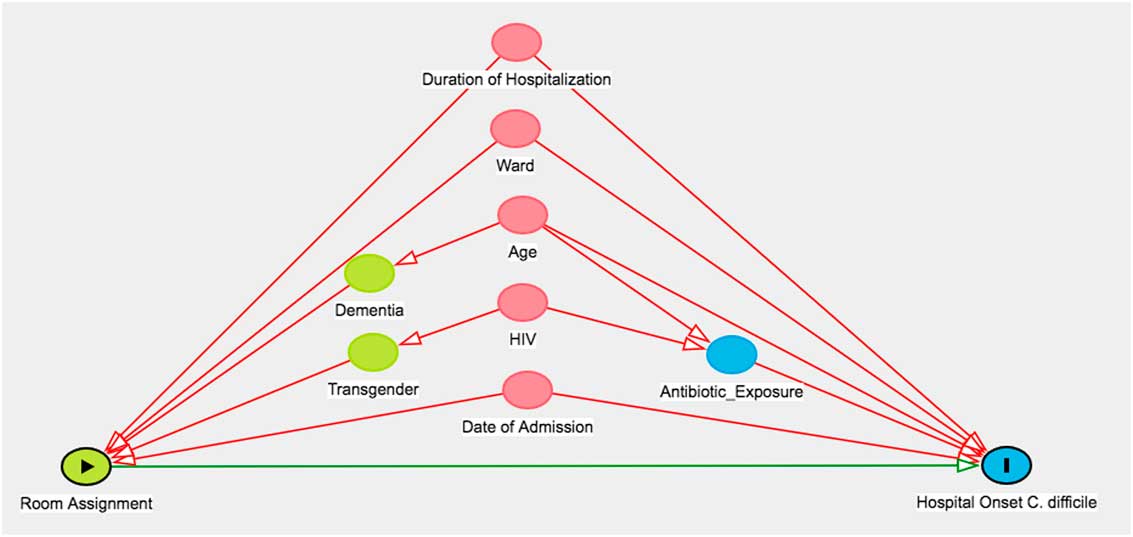
A conditional logistic regression model was used to estimate the association between multiple-bed room exposure and HO-CDI among matched pairs of cases and controls. Because incidence density sampling was used, the calculated odds ratios were unbiased estimates of the rate ratios, which we reported in our results. Covariates were selected on the basis blocking residual causal pathways on a presumptive directed acyclic graph that depicted the relationship between the primary predictor of hospital room assignment and the outcome of HO-CDI (Fig. 1). Because the pathways through ward assignment, date of admission, and duration of admission were blocked using matching, we adjusted for the variables of human immunodeficiency virus (HIV) infection and age in the regression analysis to block these remaining backdoor pathways. The temporal and geographic variations in other exposures such as proton pump inhibitor (PPI) use, nasogastric (NG) tubes, and ward occupancy with patients with CDI and other multidrug-resistant organisms (MDROs) would be accounted for by incidence density sampling and matching on ward for controls. Although some specific antibiotic exposure may be associated with HIV positivity, this was accounted for by controlling for HIV status in the regression model. Additionally, we did not include a general antibiotic variable in the analysis because it is not commonly linked back to the main exposure variable, ie, room assignment. Temporal and geographic variability in antibiotic exposure would also be accounted for by incidence density sampling and matching on the ward.
To investigate patients with significant comorbidities who are at particularly high risk of HO-CDI, subset analyses were also performed for patients with Charlson scores ≥4, a score that was associated with increased risk of HO-CDI in a large cohort study.Reference Kyne, Hamel, Polavaram and Kelly 11
Directed Acyclic Graph depicting the relationship between room assignment and hospital-onset C. difficile infection. Open pathways between the main predictor (room assignment) and outcome (HO-CDI) represent confounding threats to internal validity. Date of admission, duration of hospitalization, and admission to specific wards determine the risk of acquiring C. difficile and also directly influence the proportion of time spent by a patient in a single versus multiple-bed room.Reference Khanna, Gupta, Baddour and Pardi 29 Both age and human immunodeficiency virus (HIV) status may indirectly influence room assignment via possible diagnoses of advanced dementia and transgender status and also are associated with HO-CDI directly and through increased antibiotic exposure.Reference Lippman, Moran and Sevelius 30 Therefore, we blocked these pathways by matching on ward, duration of hospitalization, and date of admission and statistically controlled for HIV status and age.

STATA version 14.1 software (StataCorp, College Station, TX) was used to conduct these statistical analyses.
Results
During the study period, 187 cases were identified and matched with 512 and 515 controls for the admission and at-diagnosis analyses, respectively. Among these control patients, 460 patients were selected in common to both control pools. The clinical characteristics of these patients are shown in Table 1. The mean age of case patients (58.9 years) was slightly higher than that of the 2 control groups (54.6 years and 54.1 years, respectively). The mean Charlson comorbidity scores, gender, and proportion of patients admitted to a surgical ward were similar for case patients and controls. Furthermore, a similar proportion of hospitalization time was spent in single-bed rooms among case patients (18.8%) and controls (18.1% and 16.5% for the admission and at-diagnosis analyses, respectively). The median time to diagnosis of HO-CDI was 7 days following admission (interquartile range, 4–12 days).
Clinical Features of Cases and Controls

Note. SD, standard deviation; HIV, human immunodeficiency virus; IQR, interquartile range; HO-CDI, hospital-onset Clostridium difficile.
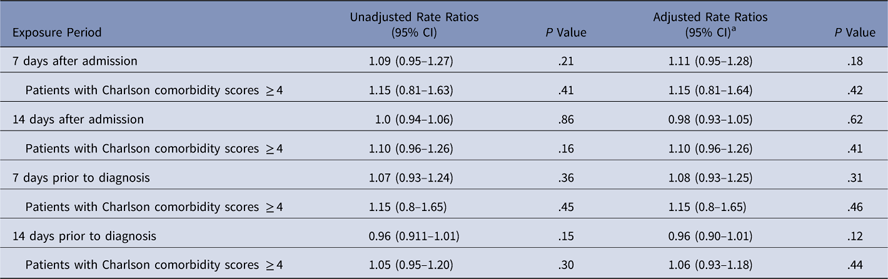
The adjusted and unadjusted rate ratios for the development of HO-CDI associated with multiple-bed room exposure are displayed in Table 2. In the analyses of exposure within the first 7 and 14 days of case admission to hospital, the adjusted rate ratios for the development HO-CDI associated with multiple-bed room exposure were 1.11 (95% CI, 0.95–1.28; P=.31) and 0.98 (95% CI, 0.93–1.05; P=.62), respectively. In patients with Charlson comorbidity scores ≥4, these values were 1.15 (95% CI, 0.81–1.64; P=.42) and 1.10 (95% CI, 0.96–1.26; P=.41), respectively.
Association Between Multiple-Bed Room Exposure and Hospital-Onset Clostridium difficile

Note. CI, confidence interval.
a Adjusted for age and HIV status
In the analyses of exposure 7 and 14 days immediately prior to HO-CDI diagnosis, the adjusted rate ratios for the development HO-CDI associated with multiple-bed room exposure were 1.08 (95% CI, 0.93–1.25; P=.31) and 0.96 (95% CI, 0.93–1.18; P=.12), respectively. In patients with Charlson comorbidity scores ≥4, these values were 1.15 (95% CI, 0.80–1.65; P=0.46) and 1.05 (95% CI, 0.93– 1.18; P=.44), respectively.
Sensitivity analyses were performed to evaluate the risk of HO-CDI in the 3 and 5 days after admission and diagnosis. These analyses also did not show a statistically significant association between multiple-bed room exposure and HO-CDI (data not shown).
Discussion
We found no statistically significant association between the development of HO-CDI and exposure to multiple-bed rooms. Although prior studies have examined the relationship between room assignment and HO-CDI in terms of prior occupancy by a patient with CDI, no study to date has directly investigated the association between dynamically observed room assignment and the risk of HO-CDI among patients admitted to medical and surgical floors.Reference Shaughnessy, Micielli and DePestel 12 , Reference Freedberg, Salmasian, Cohen, Abrams and Larson 13
Our findings contrast with those of certain observational and interventional studies that have suggested benefits of single-bed rooms on hospital-acquired infections such as influenza,Reference Munier-Marion, Bénet, Régis, Lina, Morfin and Vanhems 14 tuberculosis,Reference Jensen, Lambert, Iademarco and Ridzon 15 and with some studies of methicillin-resistant Staphylococcus aureus (MRSA) in which single-bed rooms were associated with protection from infection.Reference Gastmeier, Schwab, Geffers and Rüden 16 – Reference Stiller, Salm, Bischoff and Gastmeier 18 However, these results should be compared with caution because the transmission dynamics of C. difficile are different from those of MRSA and respiratory pathogens. To date, data from studies specifically focusing on hospital acquisition of C. difficile have been conflicting. An interventional study in the ICU setting demonstrated that the rearrangement from multiple-bed to single-bed room occupancy led to a decrease in C. difficile infections by 54%.Reference Teltsch, Hanley, Loo, Goldberg, Gursahaney and Buckeridge 8 Additionally, a quasi-experimental study conducted across hospitals in Quebec showed that outright isolation of C. difficile carriers at the time of admission reduced rates of HO-CDI.Reference Longtin, Paquet-Bolduc and Gilca 7 However, 2 natural experimental studies performed in ward settings showed no difference in the incidence of hospital-acquired infections, including C. difficile, among patients admitted to single-bed rooms compared to wards with multiple-bed rooms. Disagreement in the findings may be due to differences in setting, adjusted covariates, patient population, and confounding by other concurrent interventions at the time of room privatization.Reference Wilson, Dunnett and Loveday 19
It is unclear why we found no difference in the risk of HO-CDI with respect to bed assignment in this study. One possible explanation is the opposing effects of hand hygiene and likelihood of prior bed by a patient with CDI. Specifically, because patients assigned to single-bed rooms are more likely to be exposed to beds that were previously occupied by patients with CDI, we might have expected to see a positive association between single-bed room assignment and HO-CDI.Reference Mitchell, Dancer, Anderson and Dehn 20 However, because healthcare workers entering single-bed rooms may have improved hand hygiene compliance compared with those entering multiple-bed rooms, there may have been a trend indicating a protective effect of single-bed rooms. These conflicting effects may have negated each other, and, along with other unmeasured factors, resulted in the measure of association we arrived at.
The implications of studies that support or contest the association between high-occupancy rooms and hospital-acquired infections are still debated.Reference Brouqui 10 , Reference Wilson, Dunnett and Loveday 19 Specifically, it remains unclear whether possible infection control benefits justify higher costs associated with hospital designs that include only or mostly single-occupancy rooms. Regardless of the evidence for or against the benefits of single-bed rooms in terms of infection risks, there has been a tendency to redesign hospital wards with more single-bed rooms due to additional benefits including improved patient privacy, improved sleep, and overall satisfaction.Reference Berry 21 Thus, further experimental study is needed to definitively determine whether infection prevention can be included as a benefit of single-bed rooms and, therefore, help to justify the increased costs associated with hospitals with mostly single-occupancy inpatient rooms. Specifically, given restrictions in resources, such a strategy may only be feasibly targeted toward patients at particularly high risk of developing HO-CDI such as the elderly or those with high antibiotic exposure.
A major strength of our study was that we treated the exposure of single-bed versus multiple-bed room as a time-dependent variable, an approach that has yet to be performed when analyzing its effect on HO-CDI. This analysis allowed us to detect a potential causal relationship between bed assignment and HO-CDI. An additional strength in our study design was that we selected two groups of controls for comparison to identify whether potential exposure to infected or colonized patients in multiple-bed rooms was more crucial at the beginning of admission or near symptom onset. With regard to the period just prior to symptom onset, numerous studies have demonstrated that longer lengths of stay are associated with higher risk of C. difficile acquisition in the acuteReference Beurden, van, Dekkers and Bomers 22 – Reference Clabots, Johnson, Olson, Peterson and Gerding 25 and long-term healthcare settingsReference Ponnada, Guerrero and Jury 26 , Reference Al-Tureihi, Hassoun, Wolf-Klein and Isenberg 27 due to accumulated exposures. However, with regard to the period immediately following admission, it is unclear whether this exposure time holds any particular risk for C. difficile acquisition, and future research that addresses this question may have important implications in optimizing interventions to reduce HO-CDI.
Our study has several limitations. First, it was conducted in a single academic hospital site, which may have had a significant bearing on our results given variations in hospital infection prevention and control practices among institutions. Regarding the statistical analysis, a possible threat to our results was confounding bias. For example, we did not include antibiotic exposure, a well-known cause for the development of HO-CDI, into our statistical model because we did not identify a significant confounding pathway between our primary predictor and outcome that remained open without controlling for antibiotic exposure (outside of the link through age and HIV status, which was controlled for). However, a possible (yet uncommon) link between antibiotic exposure and room assignment may have occurred through certain infections (for example, diarrheal illness) that, on one hand, require antibiotic therapy and therefore increase the risk of CDI and, on the other, require contact precautions and, therefore, isolation to a single-bed room. Not blocking this pathway by adjusting for antibiotic exposure may have biased our measure of association towards the null; however, given that admissions to hospital for non-CDI diarrheal illnesses that require ongoing antibiotic therapy are relatively uncommon, this was unlikely to introduce a significant amount of bias into our study. In an additional consideration, the variable of ‘contact precautions’ is directly linked to the need for assignment to a single-bed room for infection control purposes and is also directly linked to HO-CDI because contact precautions may be protective against the development of HO-CDI.Reference Caroff, Yokoe and Klompas 28 Not controlling for precaution status likely biased the measure of association away from the null given its protective effects; therefore, this would not have a major impact on our results, given that the calculated rate ratios were around the null value.
In conclusion, our study, the first to directly examine the relationship between room type and HO-CDI, did not indicate an increased risk of developing HO-CDI associated with multiple-bed room exposure on general medical and surgical wards. Future investigation should be performed with larger cohorts in multiple sites to more definitively address the question of whether multiple-bed room exposure increases the risk of HO-CDI because this issue could have implications for patient room assignment and hospital design.
Acknowledgments
The authors acknowledge Elaine Dekker for her assistance in gathering the data and insight on the institution’s infection prevention and control policies.
Financial support
A.V. has received funding from the Elliot Philipson Scholarship Program by the Department of Medicine at the University of Toronto.
Conflicts of interest
All authors report no conflicts of interest relevant to this article.