Revolutions, wrote the architect Moisei Ginsburg in 1924, ‘in their sweep and the burst of psychic energy unleashed along the way, draw a sharp boundary line between the old and the new. . . cleansing the horizons and facilitating the crystallisation of a new and more viable culture.’Footnote 1 This overwhelming sense of cultural apocalypse, propagated by the new Bolshevik regime, envisaged not only the destruction of a political order, but the ‘liquidation’ of all forms of cultural life which perpetuated this order and stifled the development of the proletariat. As a transitional step, therefore, destruction was positive, a means to hasten the coming of a more perfect society, and this ethos fed the violence with which the Civil War was conducted. The parameters of the ‘new and more viable culture’, and the society that it represented, were largely conceived negatively: in opposition to, and qualitatively different from, what had gone before. Yet, as hostilities ceased in 1921 and the Soviet regime moved from a state of defence to one of peacetime reconstruction, the necessity of defining a positive vision of a new society, and pinpointing the means by which that society was to be constructed, became all-important. How was the new Soviet body politic to be constituted?
This article analyses one of the first extensive ‘acculturation’ projects undertaken by the Soviet leadership. As the historian David Hoffmann discusses, the term ‘acculturation’ refers to ‘Soviet authorities’ attempts to inculcate behavioural norms in the population’, which formed a key element of the broader Soviet project to transform the body politic in accordance with socialist values.Footnote 2 Soviet acculturation policies drew on European enlightenment ideas of progress, with the introduction of rational practices of hygiene and order, but also sought to engender uniquely Soviet values in the population, such as ‘anticapitalism, collectivist values, and atheism’.Footnote 3 In its genesis and realization, the Central (Gorky) Park of Culture and Leisure (Tsentralnyi Park Kul'tury i Otdykha imeni Gor'kogo), allowed for the articulation not only of these new Soviet values of behaviour, but also of the envisaged interaction of the built environment and the individual that was deemed essential to the transformation of the body politic.Footnote 4 From its inception in 1921, through its realization in 1928 and its constant remodelling (both physically and conceptually) during the 1930s, the Park demonstrated the development of Soviet policy towards environmental (and particularly urban) acculturation. Yet, as a project which preceded, and was organizationally distinct from, the much celebrated ‘Stalin Plan’ for the reconstruction of Moscow, it allowed for the isolation of the concept of parkland as ‘leisure’ space, distinct from the chaos of the city, the order of the factory, or the feared individualism of private life. Leisure's privileged role as a locus of acculturation can thus be analysed in its spatial and behavioural specificity.Footnote 5
The aim of this article, therefore, is to conduct a close reading of the developing conceptualization of Gorky Park as, to borrow Timothy Colton's phrase, a ‘fairground for “building the new man”’.Footnote 6 My ‘text’ is a composite of government decrees, representations of both activities and behaviour in the Park grounds in the official newspapers Pravda and Izvestiia and the changing architectural style of the Park itself. The dearth of published sources on this subject naturally limits my sphere of enquiry; however, in approaching the Park from an official perspective (all these sources were, to a greater or lesser extent, controlled by the party) I intend to analyse not only how Gorky Park was conceived as a site of acculturation, but also how, over time, the limits of this conception became evident.
Genesis and theory
On 3 September 1921, the Moscow Committee of the Communist Party announced that ‘The Park of Culture and Leisure is established to provide improvement and health for millions of workers.’Footnote 7 The decision to instigate a prestigious park project in Moscow stood as testament to the rapid change in the city's status since the revolution. Following the transferral of the capital from Petrograd (St Petersburg) to Moscow in 1918, steps had been taken to provide the city with both the infrastructure to support its new role, and the architectural symbolism to reflect its status as a ‘socialist’ capital.Footnote 8 Even at this early stage, the Park project could be read as both symbolic of the new Soviet society, and as an agent for its construction. At the most basic level, the decree stood as testament to the new government's affiliation with the working class, its striving to provide the proletariat with institutions specifically tailored to its needs. In a strictly spatial sense, however, the proletariat was already strongly identified with Moscow's cityscape. In 1918, workers’ families were relocated en masse from their suburban barracks to flats and houses within the garden ring, expropriated from their bourgeois owners by the Bolshevik nationalization of all land and property.Footnote 9 This appropriation of Moscow's city centre would suggest that all existing institutions could be redefined in terms of the workers they now served, becoming ‘proletarian’ in their new modes of use. The decision to create an explicitly proletarian park, therefore, in a city already rich with green open spaces – the Sokol'niki and Petrovskii Parks and the Alexander Garden outside the Kremlin walls – demonstrates the belief of city planners that the particular design of a proletarian park space would play an active role in shaping its users.
The notion of a city park as a means to shape society has its roots in the western experience of ‘modernity’ and the city. As James Bater puts it, ‘the city has long been both an agent and example of modernisation’.Footnote 10 As industrialization led to increased urban migration, the cityscape became the means by which self-identification and ‘urbanization’ (the casting off of peasant habits, a new awareness of time and space) took place. The ghettoization of class conflicts and the sharp division between public and private space led to a strong awareness of behaviour within the confines of the city. It was this growing awareness of the public and private, and of the notion of population as a force to be shaped (usually by the elites within a city) that inspired the creation of many major city parks in western Europe. The pleasant green spaces of Central Park, as discussed by Roy Rosenzwieg and Elizabeth Blackmar, were seen as having political as well as aesthetic benefits: by training the public to use the Park in an appropriate manner (requiring ‘parlour manners’), it would be possible to confer elite values on the working-class population, and provide an alternative to such morally degrading locales as the saloon.Footnote 11 Similarly, in the creation of Városliget Park in Budapest, the bourgeois use of public space, defined through self-discipline and self-control, was envisaged as a dominant force in shaping social interaction.Footnote 12
In the west, therefore, city space acquired its transformative powers by shaping modes of use. In the Soviet context, this behavioural construct took on ideological overtones, moving from a limited discussion of morals and values, articulated in a specifically public setting, to an all-encompassing interaction of physical space with the abstract consciousness. This notion acquired its status as truth from the writings of Marx and Engels, who posited the theory that the social environment played a determining role in shaping the character of the individual and the collective. This belief translated into practice through architecture and city planning. On the pages of the journal Contemporary Architecture, the theoretical ability of buildings to act as ‘social condensers’, or instruments for creating the New Soviet Person, was a constant theme throughout the 1920s.Footnote 13 Seen in this light, the desire to develop a proletarian city space, architecturally designed to maximize ‘condensation’, can be understood as an expression of the new government's desire to remould the body politic.
The Park plan, therefore, functioned as part of an expansive vision, both of a new society, and of the lived environment that shaped and reflected it. Furthermore, as a green space within a city, the Park reflected several dominant concerns of 1920s city planning: the notion of the green city, and the role of leisure in everyday life. Despite the emphasis on the urban experience in Marxist literature, one of the most significant developments in 1920s town planning was a desire to limit the differences between town and countryside. This too had its roots in a western phenomenon: that of Ebenezer Howard's garden city. A translation of his work Tomorrow: A Peaceful Path to Real Reform appeared in Russia as early as 1905, and it was seen to represent a very real alternative to the imperial cityscape so distrusted by Soviet theoreticians. Work on the first Russian garden city, the so-called ‘Green City’ on the outskirts of Moscow, began under the guidance of the avant-garde architect Konstantin Mel'nikov in 1929. Although it did not become a norm for city reconstruction, the ethos of the garden city influenced many prominent city planners, such as Le Corbusier, whose avant-garde commissions featured prominently in Moscow's architectural landscape. In 1929, he wrote: ‘The gigantic phenomenon of the great city of tomorrow will be developed amid pleasant verdure . . . a proportional “mean” between the fact “man” and the fact “nature”. This is what we need.’Footnote 14 For Le Corbusier, the benefits of green space were not incompatible with the giganticism of a city centre, a notion that could not but inform those seeking to reconcile the desire for limited socialist settlements with the reality of urban migration into Moscow in the 1920s. The desirability of green space was enshrined in town planning legislation in the early twenties, with a decree that no newly built housing unit was to be further than 2,000 feet from a park space.Footnote 15
The desire to provide green space to city residents again demonstrates the dichotomy between ‘social condensation’ and what Rosenberg refers to as the ‘pleasures, virtues and rewards of labour’, in other words, between social institutions as rewards provided by a beneficent state, or as agents for the development of the population.Footnote 16 Despite writing from a western perspective, Le Corbusier made clear the practical uses of providing green space to city inhabitants: ‘this is the only way to ensure the necessary degree of health and peace to enable men to meet the anxieties of work occasioned by the new speed at which business is carried on’.Footnote 17 Thus the environmental benefits of green space could be seen as instrumental in developing workers’ health and capability, preparing them better for labour. However, the development of the Park project also coincided with the reconceptualization of the role of leisure in Soviet society. In the early years of the revolution discussion of ‘leisure’ had focused narrowly on the restructuring of both byt (notoriously difficult to translate, the word implies the mundane tasks of everyday life, comprising eating, sleeping, household chores and the like) and work.Footnote 18 Even the title conferred on the new park project, ‘Park of Culture and Leisure’ did not initially demonstrate specific aspirations for acculturation. Although in later years, the word ‘otdykh’ came to be linked specifically to theories of recreational activity as a tool for the ‘all-round development of the personality’, in the early twenties the word otdykh was tied to the Marxist theory of class struggle, in the commonly used phrase dni otdykha, or ‘days of leisure’. By citing so specifically in the Park's title that the Soviet government would provide its citizens, not merely with access to culture, but also to precious free time, it again underlined its commitment to serving the needs of the proletariat.Footnote 19 The late 1920s, however, saw the development of a strong cultural awareness of leisure as a site of collective transformation. Symbolist theatre sought to engender moments of collective emotion as means to break down class barriers and promote an abstract collective spirit.Footnote 20 Cinema began to focus on leisure space as a means by which newcomers to the city could be initiated into proletarian culture. As Lewis Siegelbaum has suggested, the workers’ club, in its combination of architectural specificity and delineated cultural activities, formed a ‘cultural base of total vospitanie’ functioning on four levels: the cognitive, symbolical, axiological and cultural.Footnote 21 Therefore, with its green space, modes of leisure time use, and specific activities to act as ‘cultural intermediaries’ (Siegelbaum), the plan for the Park of Culture and Leisure captured the Zeitgeist of contemporary Soviet acculturation theory.
1928
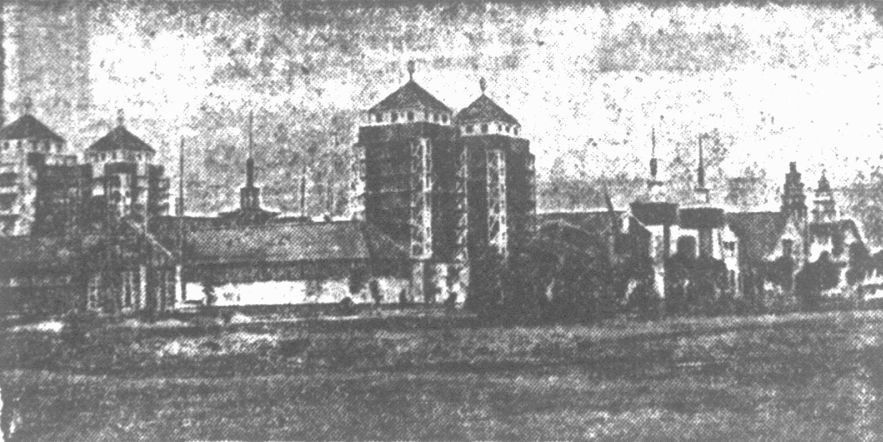
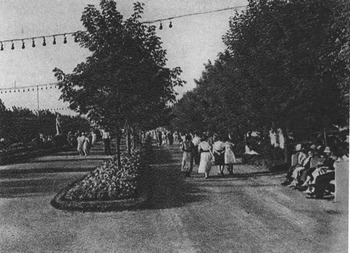
Despite the seeming cultural relevance of the Moscow Park, it took seven years from the project's inception to its opening on 12 August 1928. Most western historians tend to view the Park's creation in terms of Oksana Bulgakowa's comment that ‘space that is unconnected with the old history confirmed its primacy over time and memory’.Footnote 22 Timothy Colton, in particular, dwelled on the fact that the Park was located ‘where the city's main dump had been before’ – a potent symbol of a new culture rising from the detritus of the old.Footnote 23 In actual fact, this new cultural institution was formed from the refurbished pavilions of the 1923 All-Russian Agricultural Exhibition and the existing parkland of the Neskuchnyi estate to the east (Figure 1). This prudent reworking of the existing site was augmented by new landscaping of paths, alleyways and lakes, the building of an open-air theatre, and the introduction of entertainments, many of them imported (Figure 2). Thanks to ‘adverse weather conditions’ this construction dragged on a full six weeks after the anticipated opening date, and led to debates on the pages of Pravda and Izvestia whether to push for an opening in late summer, or to delay until the following year.Footnote 24 These debates give an insight into how the Park was conceived at this stage. A Pravda article from 24 June 1928, some ten days before the official opening date, shows the Park from the point of view of a construction worker, whose candid opinion is that the Park cannot and should not be opened on the official date.Footnote 25 Yet the tone of the piece is far from negative. The article demonstrates all of the potential entertainments included in the Park, paints an impressive picture of the expansive landscape and calls for another year to create, not merely the façade of a park space, but a ‘genuine Park of Culture and Leisure’.Footnote 26 The role of the Park as a landmark in the proletarian struggle is underlined by the article's author, Kholodnyi: ‘Well, we've waited “three hundred years”, and we'll keep on waiting, even till next spring!’Footnote 27 However, the article does give hints of some tropes that were to become dominant over the course of the 1930s: a worker is cited as saying ‘But we will put all the forces of MKKh [the Moscow Committee on the Economy] to the task! . . . Ten days, and the Park will be ready! We will keep to the plan!’Footnote 28
Pavilion, Park of Culture and Leisure, Moscow (Pravda, 24 Jun. 1928, 7)

Grand alley, Central (Gorky) Park of Culture and Leisure, Moscow (Bol'shaia Sovetskaia Entsiklopedia, 1st edn, vol. XIV (Moscow, 1939), 202)

The construction delays led to the awkward coincidence of the Park's opening with three other explicitly leisure-orientated activities; Sunday 12 August also saw a parade on Red Square, the continuing All-Union Sports Competition and a racing Derby. This did not seem to deter the 150,000 citizens who, according to official statistics, visited the Park on the first day. Yet both Pravda and Izvestiia confined their coverage of the opening to the back pages. This could be due to their seeming difficulty in defining the role the Park should play in Soviet life. Both describe in much detail the ‘institutions’ located within the confines of the Park, but both shy away from spelling out the Park's benefit in acculturation terms. Much of this can be attributed to the context of the Park's opening. The year 1928 marked the transition from the New Economic Policy (NEP), the relative market freedom tolerated as a response to economic crisis in the wake of the Civil War, to the first Five Year Plan of Stalin's planned economy. The NEP had seen the return of cafes, taverns, commercial theatre and cinema, dance halls and other commercial entertainments. To have any hope of attracting clientele to the Park of Culture and Leisure, the planners needed to engage with this popular commercial culture, which represented a very real competition for the precious leisure time of workers. To that end, a zoo was established, amusement-park entertainments, such as a helter-skelter, were imported from abroad and a theatre and cinema were included in the plans (although it is doubtful that they were ready for the Park's opening date) (Figure 3).Footnote 29
Helter skelter, Central (Gorky) Park of Culture and Leisure (Bol'shaia Sovetskaia Entsiklopedia, 1st edn, vol. XIV (Moscow, 1939), 202)

The seeming engagement with commercial culture contrasted, however, with a growing emphasis on state intervention in the acculturation project. The imposition of the planned economy, with its attendant ‘shock projects’ and over-fulfilment of targets, pointed to a prevalent notion within the Soviet government: the state could not wait for the perfect socialist society to evolve naturally, but should, instead, take an active role in shaping that society. This contradiction came to the fore in what Eric Naiman terms as the anxiety engendered by the NEP.Footnote 30 The mixed economy of this period was seen as allowing socially undesirable elements, or ‘class enemies’, to flourish. Their role began to be conceived pathologically, that is, as ‘internal émigrés’, or ‘former people’, who could infect or, at the very least, stifle the development of the proletariat. The result of these notions was a strong emphasis on active intervention, or prophylaxis, in the sphere of acculturation. This would have been all the more necessary in the Park setting, as parks were traditionally perceived in Russian culture as sites of moral degeneration, prostitution, drunkenness and hooliganism (a perception that could have only been enhanced by the inclusion of western, ‘decadent’ entertainments).Footnote 31 Thus, the Park of Culture and Leisure negotiated an uneasy balance between contemporary consumer culture and the desire to use the Park as the agent and example of Soviet pedagogy.
The first such intervention was the fight against alcoholism, literally described by Pravda as a ‘shock subject’ (udarnaia tema).Footnote 32 This struggle was conducted through lectures in the main pavilion, guided discussions in the Park grounds and the ministrations of the ‘Society of Sobriety’ (Obshchestvo Trezvosti). In addition, though food and drink were plentiful, alcoholic drinks were not permitted within park grounds. Alongside these direct interventions, many of the pedagogical ideas of the moment were in evidence; for example, a belief in the potentially harmful influence of parents on their children was countered by the creation of a ‘children's city’ within the Park complex. Described as an ‘independent children's republic’, it was equipped with a theatre, run by the Moscow Children's Theatre, and a plethora of games and sporting opportunities, in accordance with the notion, put forward in Bukharin and Preobrazhenskii's ‘ABC of Communism’, that child's play is the best preparation for labour in adult life.Footnote 33 Signs reading ‘Don't Disturb the Children’ (Ne meshaite detiam) warded off any unwanted adult intrusion. Similarly, a crèche allowed mothers of younger children to enjoy the Park unhindered.
These direct interventions were perhaps motivated by the needs of the Soviet economy: with the beginning of the Five Year Plan and the urgent need for skilled workers, it was imperative in 1928 for newcomers to city life to rid themselves of their old habits, such as drinking, and become effective members of the proletariat.Footnote 34 However, the more general behavioural concerns put forward in Pravda and Izvestiia suggest that acculturation still remained an aspirational concern. In both newspapers, tsarist-era entertainments were contrasted with the high quality of contemporary leisure. This binary was expressed in the opposition between narodnoe gulian'e and kul'tura. The first, which loosely translates as ‘popular celebration’, implied, in the broadest sense, delinquency and anti-social behaviour (including drinking). The second, ‘culture’, as Vadim Volkhov suggests, had come to imply a ‘value that could be accumulated, purposefully transferred to and acquired by wider groups of the population’: in other words, an agent of acculturation.Footnote 35Pravda made clear that culture was a vital aspiration of those who visited the Park: ‘those blue- and white-collar workers, who have come here to relax culturally’.Footnote 36Izvestiia took this further, by drawing a distinction between cultural and cultural-educational (kul'turno-prosvetitel'nyi) activities. The first was defined in terms of the physical (dance, performances, sport), and the other in terms of the mental (museums, exhibitions, lectures and the like). Yet both can be seen as contributing to the common goal of acculturation into the socialist body politic. The sports outlined in Pravda are singled out for their amateur, all-inclusive nature, welcoming all who come along to join in a game of push-ball.Footnote 37 Exhibitions by the Moscow Soviet engendered a communal sense of pride in what the Soviet government, with the help of its people, had achieved (exhibits included agricultural technology, city planning, money, education and health).Footnote 38 Finally, the pursuit of reading was a vital concern.Footnote 39 Conceptually, it represented the fulfilment of human potential: a prerequisite to the achievement of consciousness, it facilitated individuals’ full engagement in the collective. Therefore, positively conceived leisure activities were seen as having an influence in developing the proletarian nature of man. It is worth noting, however, that the opposition of cultured leisure to its negative other, narodnoe gulian'e, defined as drunkenness, gambling and rowdiness in public places, did not naturally correspond to the NEP binary of proletarian culture versus bourgeois decadence. In the American context, such negative behaviours were naturally associated with working-class unrestrainedness, which Central Park's superintendents sought to counter with examples of middle-class, value-driven leisure pursuits, such as exhibitions and self-improvement activities.Footnote 40 Soviet acculturation sought to frame ‘culture’ as the preserve of the worker.
A comparison with the western context also highlights the changing awareness of ‘public’ space in the use of the Park of Culture and Leisure. Rosenzweig and Blackmar discuss modes of use in Central Park as negotiating the boundary between public space as municipally owned and therefore under the influence of certain political bodies (albeit claiming to represent the needs of all citizens), but also as freely accessible to the ‘great public’ who resisted attempts to curtail their activities. Such a distinction was naturally reconceptualized in the Soviet setting: all land nominally belonged to the proletariat, rendering such a distinction invalid. However, the use of the term ‘public’ does point to a growing awareness of proletarian space as a unified phenomenon defined by its users. Natalia Lebina discusses the development of a working-class identity in the pre-revolutionary period, defined by work, but also reinforced by common use of certain areas of public space within the city.Footnote 41 The dominance of public space use in the late 1920s combined this sense of group definition with a real need for public spaces in which to spend time outside of work. Walter Benjamin attested to this fact in 1927, when in his Moscow Diary he announced that ‘the Bolsheviks have abolished private life’.Footnote 42 With the rise of the kommunalka, or communal flat, as the dominant mode of living space, homes became temporary and cramped: the norm was 13 square metres of space per family unit, divided by temporary partitions or curtains. People in the 1920s city therefore ‘lived’ in public spaces: the street, working clubs and parks. Thus public space became an all-important substitute for private living. However, the notion of a ‘greater public’ insisting on their free access to public institutions, a vital part of the conceptualization of public space in the case of Central Park, was noticeably absent. In a small addendum to its article on the Park of Culture and Leisure, Izvestiia announced that the entrance fee of 10 kopeks, reached in agreement with the Moscow Soviet, would be waived in honour of the opening day. The idea of paying to use nominally public facilities in this case caused nothing like the outrage experienced in New York, when rioting forced the Park commissioner George Clausen to reinstate free access to chairs within the Park.
1936
In the period between its opening in 1928, and the carnival in celebration of the new Soviet Constitution held within its grounds on 12 July 1936, the Park of Culture and Leisure underwent sweeping changes to its organizational and physical structure. In the early thirties, the Park became the hub of a vast network of park spaces, operating on a citywide and ultimately a nationwide level. In 1931, a decree announced the creation of Parks of Culture and Leisure in cities throughout the Soviet Union, taking the Moscow (now Central) Park of Culture and Leisure as their model.Footnote 43 Four years later, as part of the General ‘Stalin’ Plan for the reconstruction of Moscow, which saw the destruction of monasteries, churches and medieval city walls to make way for the grandiose ‘socialist reconstruction’ of the city, the desire for green spaces in close proximity to residential and working areas led to the articulation of a plan for ‘wedges of green’ to penetrate the city. These comprised parks on a variety of scales: the neighbourhood park, district or community parks, children's parks (along the lines of the ‘Children's Republic’ discussed above), sports parks and the Parks of Culture and Leisure.Footnote 44 The conceptual primacy of the Parks of Culture and Leisure within this complex was reinforced in 1935 with the construction of the first line of the Moscow Metropolitan, which ran from Sokol'niki Park of Culture and Leisure in the north-east to the Central Park of Culture and Leisure in the south-west, passing through Okhotnyi Riad, the seat of the Soviet government. Administratively, the Park began to develop its own institutions, with the journal Park of Culture and Leisure published from 1929.Footnote 45 Art historian Boris Brodskii attests to the developing influence of the Park within the Moscow administration:
The director of the Central (Gorky) Park, Betty Glan, had only to phone any one of the factory giants, or the military sector, for a detachment of several dozen youngsters or a whole subdivision of the Red Army to turn up at the Park, to weave garlands, hang posters and banners, hook up electrical wiring, or adjust communication lines, to dig, tidy up, plane, or glue.Footnote 46
Much of this ‘voluntary’ sector, he suggests, was influenced by the developing conceptualization of the Park as a site of collectivity: the volunteers were ‘convinced that man studies “for himself” – i.e. for today – whereas work in the Park is for society – i.e. leads to the future’.Footnote 47
The tendency to look to the Central Park of Culture and Leisure as a model, both physically and administratively, did not curtail the Park's development. With its design considered still unfinished, the Park commission instigated its redevelopment as early as 1929, when the ‘Green City’ architect Konstantin Mel'nikov offered a plan for the reconstruction of the grounds, with a dramatic fountain to be placed at the entrance. In 1931, the General Plan for the Reconstruction of the Park of Culture and Leisure (Moscow) was announced, to be determined by an architectural competition (which soon became the norm in Soviet construction and city planning projects). This was funded by a dramatic increase in the state budget for the Central Park, from 500.000 roubles in 1928, to 6 million roubles in 1933, and peaking at 32 million roubles in 1938.Footnote 48 For the first time in the Park's development, the goal was explicitly to encourage acculturation through spatial design. In the 1932 edition of Sovietskaia arkhitektura, L.B. Lunts called for the Park to be designed in such a way as to ‘raise the general culture of the masses and most of all to help them understand the particular issues and tasks of the present stage in the struggle for socialism . . ., to propagandise the international meaning of the USSR . . ., to openly demonstrate the growth of our military preparedness and to prepare labourers for national defence’.Footnote 49 Acculturation, it seemed, had evolved from a vague notion of engendering consciousness; it now concerned the creation of both an awareness of the developing nature of the body politic and a sense of patriotism in response to international threats. Yet the dominance of spatial structure in this process was still evident. The project by Mel'nikov, mentioned above, was ultimately rejected because, despite being suitably awe-inspiring, it lacked a ‘clear social programme’.Footnote 50
From the myriad of celebrated architects who took part in this competition, including El. Lissitskii and Moisei Ginsburg, the project by the architect A.V. Vlasov, later president of the Academy of Builders and Architects under Khrushchev, was singled out. Under his leadership in 1934–36, the Park underwent significant remodelling, with the widening of its territory to the south-west, into the Lenin (previously Sparrow) Hills, the creation of an outdoor theatre and sports fields and new landscaping of the existing territories. Most notable in this remodelling, however, and attesting to the increased budget allocated to the Park, was the introduction of permanent stone structures, including embankments alongside the river, staircases, pathways and statues (Figure 4). Despite the classical nature of this architecture (which does, at first glance, seem strikingly similar to an imperial style), the statues took as their subject, not the gods and cherubims of antiquity, but the physical beauty of the worker: Marx and Engels’ ‘sovereign proletariat’. In a similar fashion to the National Parks movement, or the commitment to patriotic symbolism in the plans for Budapest's Városliget, Vlasov placed the central focus of the Soviet Union's patriotic sentiment – the proletariat – at the heart of his design. This is representative of a more general phenomenon: the metro also placed proletarian man and woman (the New Soviet People) at the heart of its décor, second only to the figurehead of Vladimir Il'ich Lenin. The focus on perfect examples from the proletarian collective also points to a shift in the nature of acculturation in the1930s – the singling out of heroes for the masses to emulate. This can be seen in the trends of Stakhanovism in the workplace and the doctrine of Socialist Realism in literature and art, which called for authors to represent ‘reality in its revolutionary development’.Footnote 51 In 1932, this desire for heroes found expression through the re-christening of the Park after the proletarian writer Maksim Gorky, whose novel The Mother was regarded as a model of Socialist Realism. Tying this cultural exemplar so explicitly to the Park of Culture and Leisure had the result of both raising the cultural significance of the Park itself and giving concrete, spatial form to the abstract nature of his ‘heroism’.
Main entrance, Central (Gorky) Park of Culture and Leisure (Pravda, 19 May 1936, 2)

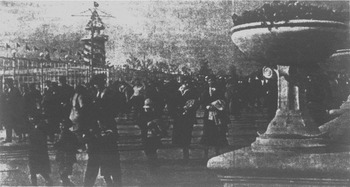
The most striking change between 1928 and 1936, however, was in the behaviour encouraged within the confines of the Park. In 1935, Stalin made his famous comment that ‘Life has become more joyous, Comrades!’, and that observation shaped the yearly carnival held in Gorky Park. Although carnival was not a new phenomenon – the first such event, celebrating the achievements of Soviet society in a riot of song, dance, food and drink, took place in 1929 – it was in 1936 that ‘carnival’ as a specifically Soviet behavioural form reached its zenith.Footnote 52 On 12 July, at 9 pm, Gorky Park opened its gates to a multitude of masked revellers, who had come (on public transport, naturally), from all corners of Moscow to celebrate the formation of the new Soviet Constitution, guarantor of the newly proclaimed ‘good life’ (Figure 5). In contrast to the coverage of the 1928 opening celebrations, both Pravda and Izvestiia were confident in their discussion of what this event represented for Soviet society. Seen through the lens of carnival, the perfect society so desired by the revolutionaries of 1917 was no longer in transition but actually achieved. As befits a society formed in relation to theories of environmental determinism, these achievements encompassed both social interaction and spatial concerns. The territory of the Park was transformed by the products of Soviet labour: decorated by ‘the capital's best artists’, ‘saturated with electric light, flowers and colourful paints’.Footnote 53 Yet both papers concentrate their analysis on behaviour: the ‘happy, unforced smiles’,Footnote 54 the ‘lack of constraint, simplicity of interaction, and genuine democracy [that] could be felt in this happy and celebratory crowd’.Footnote 55 An opinion piece in Pravda by A. Likulin linked behaviour on the night of the Constitution Carnival to the progress made by Soviet society since the revolution:
Let us look to the past – only then will we understand and appreciate the Soviet carnival . . . Remember the dust, the crush, the bad language of the cops forcing back the tired and embittered crowd. The jaded youngsters . . . The dishevelled drunk, fooling about in the bushes. The obscene songs and women's squeals. That was ‘popular celebration’ in the old times.Footnote 56
In contrast, the new celebration entailed song, harmony, laughter and ‘dance, of which, it seemed, there would be no end’.Footnote 57 This celebration of society's progress was also set in contrast to the west: despite having a more developed tradition of carnival, cities such as Nice and Paris could not compete with the Soviet version, because ‘the future [of their citizens] was shrouded in gloom, whereas [a Soviet citizen] felt himself master of his life and country’.Footnote 58
‘Carnival in the Central Park of Culture and Leisure’ (Pravda, 12 Jul. 1936, 6)

It is not my intention to try and explore the Bakhtinian potential inherent in the idea of carnival, or to assess Karen Petrone's assertion that ‘Soviet official carnivals created a space for limited social critique and for activities that did not comfortably fit into the official Soviet worldview’: such analysis is not possible within the scope of my sources.Footnote 59 However, given the nature of Soviet carnival as a centrally dictated behavioural norm, some historians have attempted to shed light on the role of carnival within the confines of both the acculturation principle and the political interaction between state and people. In his analysis of Soviet consumer culture, Jukka Gronow suggests that carnival, in its excessive consumption of food and drink, and of the pleasures of celebration, formed a means of inculcating loyalty among Soviet citizens.Footnote 60 Several historians, including Lewis Siegelbaum, have compared Soviet carnival to the Italian fascist dopolavoro, seeing both as examples of the promotion of state beneficence in order to counteract dissidence among subjects.Footnote 61 The significance of this does not need to be spelled out, with the political regime taking on an air of permanence, and 1936 marking the beginning of the most violent period of Ezhev's purges. Yet this cynical notion of carnival representing a ‘deal’ with the populace entirely counteracts the aspirational subtext evident in Soviet attitudes to leisure since the revolution. From the evidence presented on the pages of Pravda and Izvestiia, behaviour as an agent of acculturation remained a prominent concern for the party leadership. Although some hints at the forced nature of this celebration exist – there is a definite police presence, although Pravda is keen to stress that they had nothing to do – it is made clear that the celebratory behaviour has a transformative effect on the revellers.Footnote 62Izvestiia describes how shy carnival-goers were soon drawn in to the spirit of the celebration: ‘Above the crowd from time to time appeared the tall heads of guides – a giraffe, an oaf, a beard, but soon the crowd cast them off – it no longer needed practical jokers, humourists, provocateurs of liveliness or organizers of fun. Merriment developed according to its own rules’ (Figure 6).Footnote 63 The inclusive nature of the celebration is stressed: Pravda describes ‘a serious, middle-aged engineer in glasses’ transformed by masquerade and dance: ‘Everyone had fun in the way they wished, in the way they knew how, finding all that they could want – fun games, Estrada, dance, music, song, and even silence, if they wished!’Footnote 64 Through an inclusive celebratory ritual, the diverse social body was seen to unify, to become ‘collective’ in their enjoyment. In this analysis, therefore, carnival as a behavioural rite forms part of the general notion of transformative leisure articulated in the 1920s.
‘Yesterday a great Carnival was held in the Central (Gorky) Park of Culture and Leisure, Moscow’ (Izvestiia, 13 Jul. 1936, 6)

Although carnival was becoming a dominant trope of leisure and acculturation, influencing such diverse works of art as Tsirk (an immensely popular film by Grigorii Alexandrov, released in 1936) and Andrei Platonov's novel The Foundation Pit, it did not signal the end to other cultural and acculturing activities on the site of Gorky Park. The work of cultural intermediaries in the field of literacy, anti-alcohol drives, hobbies and the like continued well into the thirties. As in the case of behaviour within the Park, however, these cultural activities were generally presented as a battle already won; a solid foundation on which to build an appreciation of higher culture (which had once been the preserve of pre-revolutionary elites). Activities demonstrating this move towards high culture attracted consistent media attention. A literary evening in honour of the Congress for the Defence of Culture in Paris, for example, was held in the Green Theatre in Gorky Park, where 20,000 workers flocked to hear the words of André Gide on the ‘cultural battle’.Footnote 65 Exhibitions and theatrical productions continued to be popular, but tastes (or the party's taste) leaned more to the classics of theatre, rather than to explicitly new or proletarian works. In addition to this focus on high art, the definition of culture shifted in this period, leading to further changes in the notion of acculturation. With ‘culture’ becoming synonymous with questions of technical capability, it was therefore deemed necessary that the Soviet individual be conversant with the most advanced technologies in the fields of agriculture, industry and education. This need for technological knowledge combined with another preoccupation of the late 1930s: the need to develop the people's awareness of external threats. This subject became the ‘shock project’ of the Park, combining exhibitions of the latest defence technologies with lectures, discussions, dedicated evenings and frequent visits by military personnel, often bringing their tanks and aeroplanes to display to the public (Figure 7).Footnote 66 In the eight years since the Park's opening, the notion of acculturation had thus widened to encompass a range of activities and specific goals: patriotism, an awareness of high culture and knowledge of technology. However, the pragmatism which informed some of these goals, and the nature in which behavioural norms were enforced, should not be seen as detracting from the overall nature of acculturation as a means to a more utopian end; that of a cultured, socialist society.
The Proletarian Division perform military exercises on the banks of the Lenin Hills (Pravda, 19 May 1936, 1)

The decline of Gorky Park
After World War II, Gorky Park began to lose its privileged role as a locus of personal and collective development. Those factors that cemented its role in the cultural lives of Muscovites – its architecture, its role as exhibition centre, and its work on the dissemination of culture – were gradually eroded or, in some cases, taken over by other facilities. From 1945 to 1948, the Park was home to an exhibition of the weaponry and technologies seized as spoils of war from the retreating German army; with the opening of a permanent exhibition centre (VDNKh) in the north of Moscow in 1954, however, all such further exhibitions took place on this new site. The architectural structures of Gorky Park also seemed to lose their cultural significance; the triumphal arched entrance gate, designed by the architect I. Shchuko, received no media attention whatsoever when it was unveiled in 1955. This could be due to the transitional nature of the period; in many respects the gates were an architectural anachronism, as Khrushchev had recently announced plans for the reform of the building industry, cutting out unnecessary embellishments and calling for ‘simplicity, austerity of form . . . cheapness and attention to living conditions’.Footnote 67 Even the notion of celebrating Soviet reality, the foundation of carnival, had translated into tightly controlled demonstrations and parades on Red Square. An emphasis on green space did remain, and the ‘green wedge’, proposed in the 1935 Moscow Plan to join Gorky Park to green spaces in the south-west, was completed in 1953.Footnote 68 In sum, the notion of the Park as an aspirational concern appeared to drop off the Party's radar.
This outcome was likely more a result of changing modes of use than of changing ideology. Khrushchev's renewed emphasis on the ideological parameters of socialism had led to a mass of publications tracing the primacy of the ‘leisure principle’ in its conceptual development from before the revolution.Footnote 69 Yet, as recent scholarship has shown, the post-war period led to a diversification in leisure trends, and an emphasis on individualism, both of which counteracted the ideological principles inherent in ‘Soviet leisure’. According to Paul Hollander, the ‘privatization’ of leisure developed in tandem with the development of Stalinist administrative elites: their privileged access to goods and services functioned as the catalyst for the end of cultured, communal leisure.Footnote 70 Elite modes of consumption favoured small parties at home, as opposed to the public experience of visiting a park. Denis Shaw also points to the growth of car ownership, and the tendency to use precious days off to leave the city and travel to a dacha rather than use the park spaces within the city. At the same time, the conception of parks as supposed sites of transgression gained currency, with a Komsomol initiative in 1954 for the patrolling of public places singling out park space as the illicit location of gambling and hooliganism.Footnote 71 As Hollander points out, the perception of leisure time use in this ‘privatized’ context followed similar patterns to the class-specific perception in capitalist societies: those of a higher economic status experienced active and fulfilled use of leisure time (focused on the dacha), whereas workers were more often accused of wasting leisure hours.Footnote 72
By the 1950s, the conceptual basis of the Park of Culture and Leisure had lost its urgency, or at least its specific spatial and behavioural focus. That is not to say that the Park ceased to be considered an influential institution: the number of Parks of Culture and Leisure continued to grow, reaching 1,100 in 1973, and the Great Soviet Encyclopaedia continued to describe in some detail their instrumental nature. Given the changing nature of state attitudes to leisure and acculturation, however, it is not surprising that the experimental nature of the Park's design and functioning was set aside in favour of competitive sports and the more esoteric attractions of fairground rides. Today, in the era of post-Communism, the Park is considered a kitsch monument to the Soviet era, with its odd mix of rickety American-style amusements, blaring pop music and Soviet monumental architecture.
Conclusion
From its inception, Gorky Park represented a site on which the theory and practice of Soviet acculturation policy were played out. Initially viewed in terms of Marxist theories of environmental determinism, the Park was intended to shape the consciousness of its visitors through the positive influence of its spatial organization and its provision of health-giving green space and leisure. Yet it was behaviour within the Park that formed the focus of acculturation policy. In the 1920s, in the context of post-war reconstruction and the need for skilled and cultured workers, this policy manifested itself in ‘shock projects’ promoting sobriety, literacy and physical fitness. By 1936, the year in which the party celebrated the achievement of socialism, ‘shock projects’ had given way to carnival and celebration as a behavioural ritual, which not only celebrated Soviet reality but was seen to engender a qualitative change in its participants. In the design of Gorky Park and the representation of behaviour within its borders, however, the tensions within the acculturation project had become evident. The uneasy juxtaposition of consumer entertainments and state-directed ‘shock projects’ demonstrated the inherent paradox of using leisure to promote acculturation: the tastes of visitors and the promoted values of ‘proletarian culture’ were not always consistent with each other, and fears of the degrading influence of traditional ‘popular entertainments’, such as drinking and gambling, were a constant source of anxiety. Attempts to inculcate behavioural norms also pointed to the thin line between state promotion of culture and state enforcement, whether through the provision of state beneficence in return for correct behaviour, or through the intervention of police and the Komsomol. As these tensions became more pronounced after the war, the perception of the Park as a site of misbehaviour gained prominence, furthering the subsequent decline in its role as a site of acculturation. This is not to say that acculturation had ceased to be a concern: in fact, the project to fashion a socialist body politic was to be given new impetus with Khrushchev's succession. Rather, the Park could no longer be seen as an ideal arena for such a project, and attention shifted elsewhere. Despite its initial role at the vanguard of Soviet acculturation efforts, therefore, Gorky Park's place within the Soviet project to remake man proved paradoxical, and ultimately unsustainable.