INTRODUCTION
Due to wide application of fast ion beams in physics, technology, and medicine, problem of effective generation of high-energy ion bunches attracts the attention of scientists for many years. One of the most interesting methods of production of the ion beams seems to be laser-driven acceleration. Especially, ion beams produced at ultra-high laser intensities (I L > 1020 W/cm2) have potentially many applications and can be implemented in proton radiography (Borghesi et al., Reference Borghesi, Fuchs, Bulanov, Mackinnon, Patel and Roth2006; hadrontherapy Bulanov et al., Reference Bulanov, Esirkepov, Khoroshkov, Kuznetsov and Pegoraro2002), nuclear physics (Ledingham et al., Reference Ledingham and Galster2010), or inertial confinement fusion (ICF) targets (Badziak et al., Reference Badziak, Jabłoński and Wołowski2007b; Fernandez et al., Reference Fernandez, Honrubia, Albright, Flippo, Cort Gautier, Hegelich, Schmitt, Temporal and Yin2009).
One of the laser-based methods having the potential to achieve parameters of ion beams required for the above mentioned applications is the so-called radiation pressure acceleration (RPA) (Macchi et al., Reference Macchi, Cattani, Liseykina and Cornalti2005; Esirkepov et al., Reference Esirkepov, Borghesi, Bulanov, Mourou and Tajima2004; Robinson et al., Reference Robinson, Zepf, Kar, Evans and Bellei2008; Liseykina et al., Reference Liseykina, Borghesi, Macchi and Tuveri2008; Macchi et al., Reference Macchi, Veghini and Pegoraro2009), also known as skin-layer ponderomotive acceleration (SLPA) (Badziak, Reference Badziak2007a; Badziak et al., Reference Badziak, Jabłoński, Parys, Rosiński, Wołowski, Szydłowski, Antici, Fuchs and Mancic2008). This concept is based on the momentum exchange between photons and ions, near the critical plasma density n c. During this process, a dense ion bunch is produced, with the ion density n i much greater than the critical plasma density n i > 1021–1022 cm−3. The ion bunch generated in this way is moving in the direction of the laser beam, and even at relatively low mean ion velocities <v i> and energies <E i> the bunch intensity I i = n i <v i> <E i> and fluence Fi = n il < E i> (l is a target thickness), can be very high. RPA enables also to attain very high ion velocities provided that the normalized laser energy ε = 2E L/m bc 2 is sufficiently high (E L is laser energy, m b is the ion bunch mass, and c is the speed of light). When ε > 1, the accelerated ions can reach even relativistic velocities and the laser-to-ions energy conversion efficiency η can attain tens of percent. However, for existing and emerging laser facilities, realistic values of the parameter ε are expected to be well below unity and, as a result, expected energies of the produced ions should be in the sub-relativistic range and the conversion efficiencies should be lower.
It was shown in our previous papers (Badziak et al., Reference Badziak, Jabłoński and Rączka2012a; 2012b) that using a novel, recently proposed scheme of acceleration called laser-induced cavity pressure acceleration (LICPA) (Badziak et al., Reference Badziak, Borodziuk, Pisarczyk, Chodukowski, Krousky, Masek, Skala, Ullschmied and Rhee2010a; Reference Badziak, Jabłoński, Pisarczyk, Rączka, Krousky, Liska, Kucharik, Chodukowski, Kalinowska, Parys, Rosiński, Borodziuk and Ullschmied2012b) and a picosecond, high-energy (~100 kJ) laser driver, an ion beam of parameters relevant to fast ignition of ICF targets can be produced with the energy conversion efficiency by a factor 2 or more higher than for RPA. In this paper, we investigate and compare ion generation in the LICPA and RPA schemes for a laser driver of much shorter pulse duration (130 fs) and higher intensity (~1022 W/cm2), which correspond to the parameters of the extreme light infrastructure (ELI) built in Europe. The comparison is made for circular and linear light polarization and carbon targets of various thicknesses using a one-dimensional (1D) particle-in-cell code.
RESULTS
The basic idea of LICPA is to place the target inside the special cavity into which the laser beam is introduced through a small hole (Fig. 1). In such a setup, the laser light is reflected many times inside the cavity, which leads to an increase in the laser-to-ions energy conversion efficiency. In order to investigate ion generation in this scheme and to compare the ion beam parameters with those for the conventional RPA scheme (Fig. 1), we used a custom-made special 1D particle-in-cell code (PIC1D) (Badziak & Jablonski, Reference Badziak and Jabłoński2010b) based on similar physical and numerical concepts as in the popular LPIC ++ code (Lichters et al., Reference Lichters, Pfund and Meyer-ter-Vehn1997). The PIC1D code is fully relativistic both for electrons and ions.
(Color online) Basic idea of the LICPA and the RPA.

It is assumed that carbon targets are completely ionized at the start of simulations. Simulations were performed for the target foils of 0.2 µm, 0.5 µm, 1.0 µm, or 2.0 µm thickness. All targets are preceded by a thin, exponential layer of pre-plasma with the density gradient scale length L n equal to 0.25 µm. The maximum ion density at the initial moment is n i = 1.020 × 1023 cm−3. In the case of the LICPA scheme, the target is assumed to be placed 40 µm behind the entrance to the cavity (L c = 40 μm).
Calculations were performed for both the circular and linear polarization, assuming that the total energy of the laser beam E L is the same in both cases. This implies that laser intensity for circular polarization is equal to I L = 1022 W/cm2, and for linear one I L = 2 × 10²² W/cm2. Those intensities are at the beam waist (the beam waist is placed in the input hole) nonetheless, they do not differ from the intensities on target in the case of 1D simulation. The laser pulse length τL = 130 fs and the pulse shape is described by super-Gaussian profile I(t) = I L × exp(−t 6/τ6). The radiation intensity reflection coefficient R c for the inner cavity wall is assumed to be 0.64. Such a value for reflection coefficient R c was assumed on the basis of the two-dimensional (2D) simulations, where the basic sources of the laser light losses inside the cavity were investigated. We assumed that during 2D simulations the cavity length L c equals 40 µm and the cavity width X c equals 6 µm. Additionally, in order to simulate losses inside real cavities, we assumed that the target and the cavity walls were made of Au.
Initially, the Au target was ionized and its charge was balanced (plasma consists of Au10+ ions and electrons). Diameters of the input cavity hole d were equal to 1.5 μm or 3.0 μm. For d = 3.0 μm average losses per one cycle (one cycle should be understood as a single interaction of the EM pulse with the Au target and with the input wall where the hole is placed) were equal to 0.49, which leads to R c = 0.51. As for the diameter d = 1.5 μm, the obtained value was about 0.36, which means that the reflection coefficient R c = 0.64. This value was taken into account during our 1D investigation.
In general, in the case of increasing in parameter R c, one can expect that the larger part of the input pulse energy will be transferred to the plasma and such plasma parameters as the maximum ions energy and the average ions energy will increase. This is true both for the 1D and 2D simulations. However, in the first case, due to the absence of the transverse non-uniformity of laser intensity, the time interval over which enhanced acceleration occurs is longer than in the case of a 2D simulation. It means that 1D simulations give over-predicts peak ion energies. The laser wavelength λ we assumed to be equal 0.8 µm. Such parameters correspond to sub-optimally focused 1.3 kJ pulse of the 10 PW ELI laser.
In Figure 2, we show an example of charge densities along Z axis for 1 µm carbon target driven by 130 fs laser pulse for circular and linear polarization, for the LICPA and pure RPA scheme of acceleration. It is important to write a few words about the hydrodynamic instability in the case of LICPA scheme and pure RPA scheme (no cavity scheme). In the case of the LICPA scheme, as well as in the case of the RPA scheme, Rayleigh-Taylor instability is present and can be observed. The authors claim that in the first case (the LICPA scheme) such instabilities can be even greater than in the case of RPA scheme because of much more complex structure of the EM fields inside the cavity. Due to the cavity walls (the LICPA scheme) ions and electrons are forced to stay inside the cavity and they can be accelerated much longer than in the case of pure RPA scheme. It is particularly evident in the case of 2D simulations. In Figure 3, one can find the results of the 2D simulations made for a completely ionized carbon target, where the target thickness L T equals 0.2 µm, its width X T = 6 µm, the cavity length L C = 40 µm, the laser wavelength λ = 800 nm, the laser intensity in waist I L = 2 × 10²² W/cm2, and the input hole diameter d = 3.0 μm. Figure 3 presents the complex structure of the E y field, as well as the complex trajectory of the C6+ ions and electrons. Two-dimensional computations were made with the use of the code PIC2D written by the authors of this paper. The above-mentioned reasons lead to the conclusion that the advantage of the LICPA scheme over the RPA scheme lies rather in the retention of the pulse energy and the plasma inside cavity and not in the suppression of Rayleigh-Taylor instabilities. It should be emphasized that 1D simulation cannot provide answers to such questions as instabilities, transvers non-uniformity of laser intensity and so on. However, the speed and the simplicity of 1D simulation, make this method very useful for preliminary calculations.
(Color online) Charge densities for 1 µm carbon target driven by 130 fs laser pulse for circular and linear polarization in the case of LICPA and RPA.
(Color online) The PIC2D results for laser acceleration of the carbon target for the LICPA scheme (cavity length L c = 40 µm) for the time t = 150 fs. Top part — absolute value of the electric field E y, middle part — concentration of the carbon ions, bottom part — concentration of the electrons, inset part — energy spectrum of the carbon ions. λ = 800 nm, I L = 2 × 10²² W/cm2, τL = 130 fs, linear polarization, L T = 200 nm, L n = 250 nm.
Presented in Figure 2 snapshots for electron and ion densities were made for four time windows t. Time t = 0 we understand as the beginning of the laser-target interaction. The process of the acceleration can be divided into two main parts. First, carbon plasma is compressed in the region near to the critical density, by strong E z electric field created by ponderomotive force, which leads to increasing of the plasma density well above the solid density. When the compression phase is finished (for time t > τL) target composed of nearly neutral carbon plasma is accelerated to high velocities. Differences between two schemes (RPA, LICPA) are very distinct for longer time period (t = 790 fs, 1530 fs, 2990 fs). In the case of RPA, where plasma bunch is not actively accelerated after t > τL we can observed spreading out of the bunch and at the same time decreasing of its density. This phenomenon is the result of energy dispersion of ions as well as Coulomb interaction between ions since the plasma is not fully neutral. Such a mechanism is observed for both the circular and linear polarization. However, in the case of circular polarization for both schemes (RPA, LICPA) the parameters achieved for accelerated bunches seem to be better. This could be explained in the following way: when we use of the circular polarization, resultant electric and magnetic field vector has the same value in time, which results in a smooth ponderomotive force, responsible for acceleration. For linear polarization, such vectors oscillate with the period of T/2 (T-period of the light-wave), which leads to a periodic ponderomotive force, that gives noticeably worse conditions for acceleration.
In Figure 4, we show energy spectra of the carbon ions corresponding to the time t = 2990 fs and the 1 µm carbon target. This figure can be a very good supplement for Figure 2. In the case of circular polarization, we see a well-defined energy profile with a small dispersion which is a highly desirable feature for potential applications. Linear polarization gives near exponential characteristic. Interesting in this case are very similar profiles of energy spectra for RPA and LICPA scheme. It can be explained by the fact that during LICPA acceleration, the target became transparent to the laser light and further acceleration inside cavity by the light reflected at the inner cavity wall became impossible.
(Color online) Energy spectra for 1 µm carbon target for linear and circular polarization corresponding to the last phase (t 4 = 2950 fs) of the acceleration shown in Figure 2.
The effect of the carbon target thickness L T on the energy conversion efficiency, the average ion energy and on the maximum ion energy is shown in Figures 5, 6, and 7. All curves show similar behavior. We can see that all parameters of the accelerated ion bunch decrease with an increase in the target thickness. An explanation is obvious in the context of the parameter ε = 2E L/m bc 2, described in the introduction, where it was mentioned that higher value of ε leads to the higher ion velocities and energies. When we have a fixed total laser-beam energy E L, using the thicker target means that we are dealing with a higher mass of the bunch m b, and parameter ε will be lower than in the case when we use thinner target.
(Color online) Energy conversion efficiency as a function of the target thickness for LICPA and RPA. τL = 130 fs, I L = 2 × 10²² W/cm2 (LP), 1022 W/cm2 (CP). Figure made for C6+ ions.
(Color online) Average ion energy as a function of the target thickness for LICPA and RPA. τL = 130 fs, I L = 2 × 10²² W/cm2 (LP), 1022 W/cm2 (CP). Figure made for C6+ ions.
In general, values observed for LICPA are clearly greater than for the RPA scheme due to the more efficient use of the laser energy (repeated use of the light beam introduced into the cavity system). Energy conversion efficiency η for circular polarization in the case of LICPA scheme are in the range from 28% to 58% whereas for the RPA scheme they vary in the range from 8% to 24%. Similar values on η are achieved for linear polarization. The main differences for the two polarizations are visible in the maximum ion energies (Fig. 7). They results from differences in acceleration mechanism. In the case of the linear polarization, a significant part of the laser energy is deposited in fast ions produced by target normal sheath acceleration (TNSA) mechanism. The energy conversion efficiency for TNSA is quite high as compared to RPA, though the number of accelerated ions is relatively small. The TNSA mechanism is strongly suppressed in the case of circular polarization where predominant effect is the RPA mechanism, responsible for generation of a huge number of ions with rather moderate velocities. In other words, the expected maximum ion energies should be greater for linear polarization than for circular polarization but average energies of ions should be similar. This is confirmed by Figure 6 (average ion energy) and Figure 7 (maximum ion energy). As we can see, the maximum carbon ions energy (see Fig. 7) for the linear polarization case is of order of 8 GeV. It is a very high level for pure TNSA mechanism of acceleration. For instance, Yin et al. (Reference Yin, Albright, Jung, Shah, Palaniyappan, Bowers, Henig, Fernandez and Hegelich2011) have shown that during TNSA phase, C6+ ions are accelerated up to 400 MeV in 400 fs and for laser pulse intensity I L = 5.1 × 10²⁰ W/cm2. In order to find reasons of this mismatch, we must remember that our numerical experiment was made for the case in which the laser pulse intensity I L = 2.0 × 10²² W/cm2. For such a high intensity, we are dealing with a combined acceleration instead of a pure TNSA mechanism. In the beginning, strong photon pressure (RPA mechanism) directly accelerates the ions (front part of the target) and then, such “preliminary prepared” ions are accelerated by the classical TNSA mechanism. In the case of Yin's experiment, ions have a rather low starting velocity and the pure TNSA mechanism is not capable of producing carbon ions of such high energy. Additionally, results obtained from the 2D simulation were very similar to the above-mentioned results. The maximum ions energy was of the order of 6 GeV.
(Color online) Maximum ion energy as a function of the target thickness for LICPA and RPA. τL = 130 fs, I L = 2 × 10²² W/cm2 (LP), 1022 W/cm2 (CP). Figure made for C6+ ions.
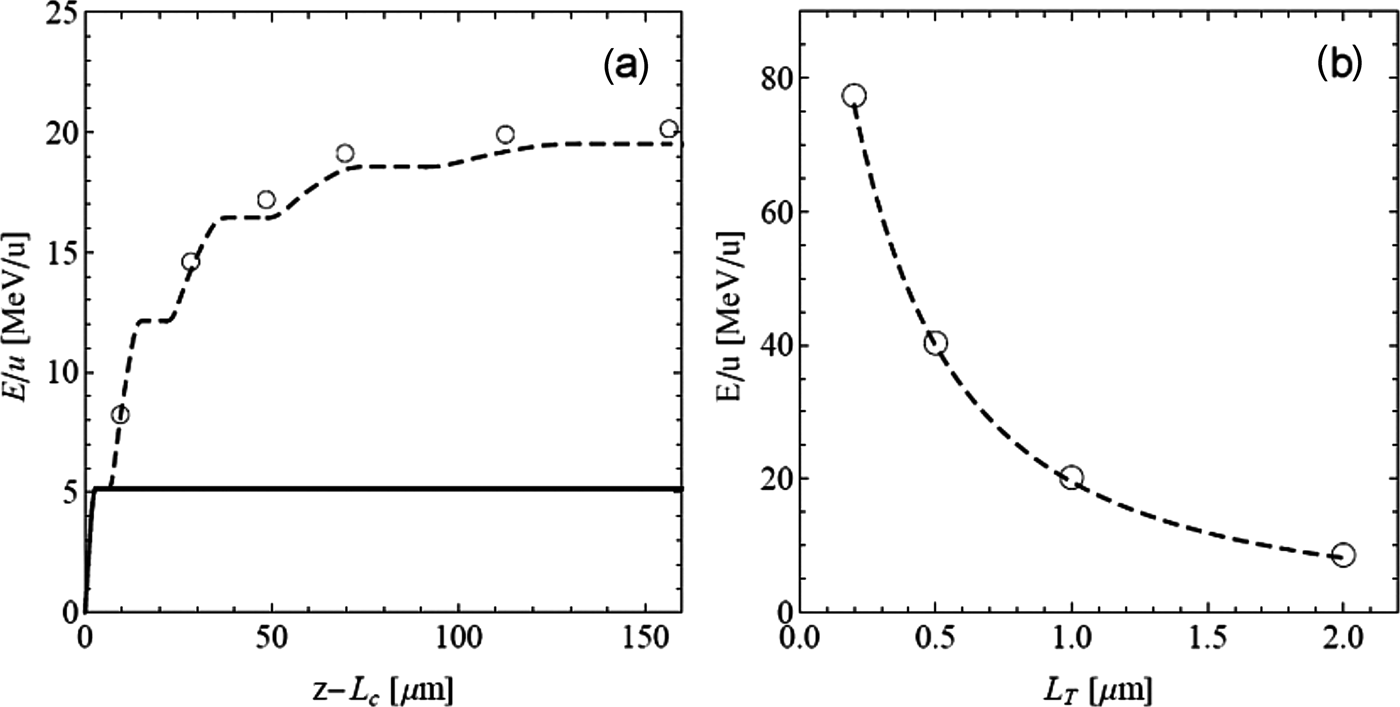
Finally, let us note that PIC simulations for LICPA and RPA are found to be in fairly good agreement with the predictions of the generalized light-sail model (Fig. 8). This observation allows us to quickly predict, how the cavity enhancement effect would scale with target parameters and the laser intensity.
Average energy per nucleon vs. positions of center of mass of the accelerated bunch (a) and average energy per nucleon at acceleration distance of 156 µm as a function of the target thickness (b) for a 1 µm carbon target: open circles — 1D PIC model; dashed line — the light-sail model; solid line for (a) — no cavity.
CONCLUSIONS
In conclusion, it has been shown that the LICPA accelerator using femtosecond ultra-intense (~1022 W/cm2) laser driver is capable of producing carbon ion beams of sub — GeV to multi — GeV ion energies with the laser-ions energy conversion efficiency approaching ~ 40–60%. The conversion efficiency as well as the maximum and average ion energy for LICPA is a few times higher than the ones for the conventional RPA scheme and the enhancement factor increases with an increase in the target thickness. The increase in the above-mentioned parameters for LICPA scheme is probably not a result of the instability suppression but rather of the retention of plasma and EM fields inside cavity, which prolongs the effective time of acceleration. The effect of laser light polarization (linear, circular) on the conversion efficiency and energies of ions produced by LICPA is not very strong, however the polarization is crucial for the shape of ion energy spectrum — only circular polarization ensures quasi — mono-energetic energy spectrum of the generated ions.