


Introduction
It is important for therapists to recognize the dimensional nature of depression and to treat both clinical depression and subclinical depressive symptoms. Theory-driven research investigating the interplay of factors associated with depressive symptoms can improve the lives of affected individuals and reduce the overall societal burden.
Beck proposed in his cognitive theory (Beck, Reference Beck1976) a stress-vulnerability model, that stressors can activate schemata, the first of four proposed cognitive vulnerabilities, which leads to the activation of the other three cognitive vulnerabilities, including the cognitive triad. Finally, these cognitive vulnerabilities, not the stressor, are associated with depressive symptoms. In other words, the cognitive vulnerabilities are mediators in the association between stress and depressive symptoms. Beck stated that the first component of the cognitive triad, a negative view of the self, can be defined by low self-esteem or regard, beliefs of deficiency, and self-criticisms (Beck, Reference Beck1976). The second component, a negative view of the world, is characterized by idiosyncratic feelings of loss or views of one’s problems as insurmountable. When an individual perceives themselves as incapable of overcoming problems their outlook on future events may become more negative. The third and final component of the cognitive triad is a negative view of the future, leading to feelings of hopelessness and a lost sense of control (Beck, Reference Beck1976).
Some previous research demonstrated that the components of the cognitive triad are associated with depressive symptoms (e.g. Beckham et al., Reference Beckham, Leber, Watkins, Boyer and Cook1986). However, much of the research on the association between depression and the cognitive triad focuses on the cognitive triad as a whole rather than the individual components. Focusing on the individual components in relation to depressive symptoms may provide vital information on the domains through which depressive symptoms develop in different populations.
A person’s subjective social status (SSS; Adler et al., Reference Adler, Epel, Castellazzo and Ickovics2000) encompasses both economic aspects (e.g. access to basic resources) and non-economic aspects (e.g. relative prestige compared with peers), and is a stressor associated with depressive symptoms (e.g. Callan et al., Reference Callan, Kim and Matthews2015). SSS is also associated with pessimism and low perceived control over life (Adler et al., Reference Adler, Epel, Castellazzo and Ickovics2000), which both reflect negative views of the world and future (Beck, Reference Beck1976). These findings demonstrate the relevance of integrating SSS into Beck’s cognitive theory (1976) as stressor activating the cognitive triad.
The current study
Our study examined if SSS can be integrated as stressor into Beck’s stress-vulnerability theory (1976) and if it impacts depressive symptoms through the individual components of the cognitive triad. We hypothesized that SSS and each individual component of the cognitive triad are associated with depressive symptoms; that SSS is related to each individual component of the cognitive triad, observable in the form of SSS being associated with the elements of the cognitive triad; and that each component of the cognitive triad partially mediates the relation between SSS and depressive symptoms.
Method
Participants
Our sample consisted of 243 students from an American community college aged 18 to 62 years old (mean 23.95, SD 8.62); 58.6% were female and 41.4% male. The sample was predominantly White or European American (50.5%) and self-reported income ranged from under $10,000 to over $100,000 per year. The specific ethnic/racial and income breakdown is found in the Supplementary material.
Measures
Center for Epidemiologic Studies – Depression Scale (CES–D)
The CES-D is a 20-item self-report questionnaire measuring the frequency of depressive symptoms for the previous week in the general population (Radloff, Reference Radloff1977). Each item is rated ranging from 0 (rarely or none of the time) to 3 (most or all of the time). Internal consistency reliability of the CES-D in our sample is .90.
Cognitive Triad Inventory (CTI)
The CTI (Beckham et al., Reference Beckham, Leber, Watkins, Boyer and Cook1986) consists of 36 items that respondents answer ranging from 1 (totally agree) to 7 (totally disagree). Each component of the cognitive triad is measured with 10 items, and six items are not scored. In our study internal reliability for view of the self is .81, for view of the world is .71, and for view of the future is .87.
The MacArthur Scale of Subjective Social Status
The MacArthur Scale of Subjective Social Status was developed as an indicator of where one places themselves across socioeconomic status aspects (Adler and Stewart, Reference Adler and Stewart2007). Participants are asked to mark the rung of a social ladder where they feel they stand in comparison with others in their community.
Procedure
Data were collected from 12 of 24 (50%) Psychology 110 classes being taught in the Fall of 2015. The surveys were administered during class sessions. Surveys within the packets were randomized to reduce order effects.
Data analytic plan
After cleaning the data, we determined that 515 of 59,290, or 0.87%, data points were missing (number of items across all participants) and no apparent pattern among the missing data was found implying data to be missing at random. Available Item Analysis was selected to address the missing data (see detailed description in Supplementary material).
We tested the assumptions of and calculated ordinary least squares (OLS) regressions and direct, indirect and total effects of SSS and each view of the cognitive triad on depressive symptoms. To test the assumptions predictor variable scatterplots and a histogram were examined, skew, kurtosis Kolmogorov–Smirnov and Shapiro–Wilk tests, and variance inflation factors were calculated (see detailed description in Supplementary material).
The direct effect estimates the effect SSS has on depressive symptoms without going through the views of the cognitive triad, while the indirect effect estimates the effect of SSS on depressive symptoms through each individual view of the cognitive triad. Total effect estimates the effect of SSS on depressive symptoms, with and without including each view of the cognitive triad as mediators. An effect is statistically significant when the bias-corrected bootstrap interval does not include zero.
Results
Table S1 in the Supplementary material presents means, standard deviations and internal consistencies for the variables and correlations between the variables used in this study. The mean CES-D score in our sample is between the cut-point of mild and moderate depression. All the scales are significantly correlated with each other in the expected direction.
Our regression analyses demonstrate that SSS is significantly and negatively associated with each of the three views that make up the cognitive triad (view of the self: β = –1.05, SE = 0.32, p ≤ .01; view of the world: β = –0.95, SE = 0.27, p ≤ .001; view of the future: β = –0.67, SE = 0.33, p ≤ .05). Thus, lower SSS is associated with a more negative view of the self, world and future. Additionally, SSS is significantly negatively associated with depressive symptoms (β = –0.86, SE = 0.30, p ≤ .01). Negative views of the self (β = 0.53, SE = 0.09, p ≤ .001) and the world (β = 0.23, SE = 0.10, p ≤ .05) are significantly positively associated with depressive symptoms, while a negative view of the future is not significantly associated with depressive symptoms (β = 0.12, SE = 0.09, p > .05).
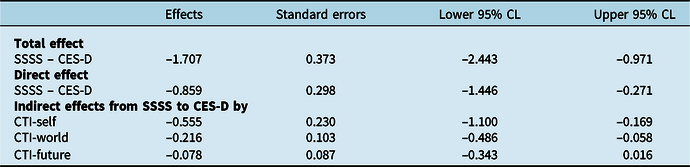
Mediation analyses showed a significant total effect between SSS and depressive symptoms (see Table 1). This association is based on a significant direct effect, but also on two indirect effects. A negative view of the self and world, but not a negative view of the future, significantly mediates the association between SSS and depressive symptoms.
Total, direct and indirect effects and their confidence intervals testing for multiple mediations (n = 190)

Data for the indirect effects are bootstrapped (5000 samples). CL, confidence limit; SSSS, MacArthur Subjective Social Status Scale; CTI, Cognitive Triad Inventory (self: view of the self scale; world: view of the world scale; future: view of the future scale); CES-D, Center for Epidemiological Studies – Depression Scale.
Discussion
Our results confirmed that SSS predicts each individual component of the cognitive triad and depressive symptoms. Also consistent with our hypotheses, a negative view of the self and the world predicted depressive symptoms. Contrary to our expectation a negative view of the future did not predict depressive symptoms. Similarly, a negative view of the self and the world, but not the future, mediated the relationship between SSS and depressive symptoms. The lack of association between the view of future and depressive symptoms in our study may be because each negative view is a component of the cognitive triad, the same vulnerability within Beck’s cognitive theory (1976). Therefore, one might expect they explain overlapping variance in depressive symptoms and not each component remaining significantly associated with depressive symptoms when used in the same analysis. Bivariate correlations between the components of the cognitive triad and depressive symptoms (self r = .65; world r = .53; future r = .51) support this hypothesis. Not only do these correlations show that each component of the cognitive triad substantially correlates with depressive symptoms when examined separately, but we also see the view of future had the lowest numerical correlation with depressive symptoms. Accordingly, if variance explained by the three components overlaps, it would seem logical that the component with the weakest association with depressive symptoms is not significant when each component is simultaneously entered in the same analysis.
The direct effect of SSS on depressive symptoms remains significant along with the two mediating effects of the view of the self and world, which may indicate the existence of additional mediators. Thus, other cognitive vulnerabilities within Beck’s cognitive theory (i.e. schemata; cognitive errors, and automatic thoughts) may serve as mediators for the effect of SSS on depressive symptoms.
Strengths of our study include that the sample from a community college is diverse in age, ethnicities/racial identities, income level, and life experiences. Additionally, we integrated the previously unrelated research on SSS and depressive symptoms with research examining the cognitive triad and depressive symptoms. Finally, our study examined the individual components of the cognitive triad as proposed in Beck’s cognitive theory (1976) and SSS and depressive symptoms.
Our study was limited by recruitment from just one community college in the United States, limiting the generalizability. Second, the sole use of self-report instruments could lead to bias by the respondent due to either over- or under-reporting from respondents. Third, the cross-sectional design means we are unable to draw conclusions regarding the true directionality and causality of the relations between SSS, the cognitive triad, and depressive symptoms.
Based on our findings, future studies should further examine the best way the cognitive triad is conceptualized (as one construct, three individual components, weakest link). Furthermore, other cognitive vulnerabilities proposed by Beck (Reference Beck1976) should be examined as potential mediators. A larger sample incorporating multiple regions of the United States and countries would provide a more representative and diverse sample. Finally, utilizing a longitudinal design would give the opportunity to examine the directionality of the relations between the studied variables.
While further research is needed, our findings have clinical implications and indicate that SSS can be integrated into Beck’s cognitive theory of depression (1976). Therapists may consider SSS when examining possible stressors and can focus on the negative view of the self or the world of a client when questioning and restructuring their negative cognitions, depending on relevance to the individual client.
Supplementary material
To view supplementary material for this article, please visit: https://doi.org/10.1017/S1352465821000394
Data availability statement
The data that support the findings of this study are available from the corresponding author, P.P., upon reasonable request.
Acknowledgements
We would like to thank all instructors of and students in the Psychology 110 classes of our local community and technical college.
Author contributions
P.P. oversaw the project, analysed the data, reviewed the first draft of the manuscript and revised all later revisions, T.W. wrote the first draft of the manuscript and reviewed all later revisions; S.J.R. coordinated the data collection, data entry, and reviewed all drafts of the manuscript.
Financial support
None.
Conflicts of interest
All authors (P.P., T.W. and S.J.R.) have no conflicts of interest with respect to this publication.
Ethical statements
The authors assert that all procedures contributing to this work comply with the ethical standards abided by the Ethical Principles of Psychologists and Code of Conduct as set out by the BABCP and BPS. The procedures and measures used in this study were approved by Institutional Review Boards of the University of Louisville and Jefferson Community & Technical College (IRB no. 15.0351).




Comments
No Comments have been published for this article.