




No CrossRef data available.
Article contents
Meta-analysis of age-prevalence patterns in lymphatic filariasis: no decline in microfilaraemia prevalence in older age groups as predicted by models with acquired immunity
Published online by Cambridge University Press: 05 October 2004
Abstract
The role of acquired immunity in lymphatic filariasis is uncertain. Assuming that immunity against new infections develops gradually with accumulated experience of infection, models predict a decline in prevalence after teenage or early adulthood. A strong indication for acquired immunity was found in longitudinal data from Pondicherry, India, where Mf prevalence was highest around the age of 20 and declined thereafter. We reviewed published studies from India and Subsaharan Africa to investigate whether their age-prevalence patterns support the models with acquired immunity. By comparing prevalence levels in 2 adult age groups we tested whether prevalence declined at older age. For India, comparison of age groups 20–39 and 40+ revealed a significant decline in only 6 out of 53 sites, whereas a significant increase occurred more often (10 sites). Comparison of older age groups provided no indication that a decline would start at a later age. Results from Africa were even more striking, with many more significant increases than declines, irrespective of the age groups compared. The occurrence of a decline was not related to the overall Mf prevalence and seems to be a chance finding. We conclude that there is no evidence of a general age-prevalence pattern that would correspond to the acquired immunity models. The Pondicherry study is an exceptional situation that may have guided us in the wrong direction.
Information
- Type
- Research Article
- Information
- Copyright
- © 2004 Cambridge University Press
INTRODUCTION
It remains unclarified whether humans, who are life-long exposed to lymphatic filariasis infection, develop a protective immune response (Maizels, Allen & Yazdanbakhsh, 2000). The possible operation of acquired immunity in regulating filarial infection has received special interest, because of its potential consequences for the long-term effects of control measures (Anderson & May, 1985), but also because understanding immunity may help in the development of vaccines against lymphatic filariasis (Kazura, 2000).
There is a large body of research on the role of acquired immunity in helminthic diseases in men, especially for schistosomiasis (Hagan, 1992). In experimental animal models, protective immunity against new infections has been generated by repeated infection with infective larvae or by immunization with irradiated larvae from different filarial species (Selkirk, Maizels & Yazdanbakhsh, 1992). It is more difficult to determine whether acquired immunity also plays a role in human individuals who are naturally exposed to lymphatic filariasis, because neither an individual's exposure to infective mosquitoes nor the number of adult worms present in the human body can be quantified easily. Therefore, immunological studies in humans focussed on the correlation of various types of immune responses with infection status. Although these studies revealed many differences between infected and presumably uninfected hosts, it is unclear to which extent this is indicative of an acquired protective immune response (Kazura, 2000; Ravindran et al. 2003).
Epidemiological studies can be helpful in investigating the role of acquired immunity in helminths. Based on pioneering epidemiological and immunological studies in Papua New Guinea, it was suggested that the acquisition of new infections may be reduced in adults due to acquired immunity against infection (Day, Gregory & Maizels, 1991a; Day et al. 1991b). Assuming that exposure is constant with age and that prolonged exposure leads to (partial) resistance against new infections, mathematical models predict an increase in infection intensity to a peak at a certain age followed by a decline in older individuals who have acquired immunity against new infections; the peak would occur at higher level and at younger age in areas with higher transmission intensity (the so-called peak-shift theorem) (Anderson & May, 1985; Woolhouse, 1992). If transmission intensity is stable over time, these age-patterns should be reflected in cross-sectional data on prevalence and intensity of infection.
A strong indication for the operation of acquired immunity in lymphatic filariasis was found in a study from urban Pondicherry (India) that examined the long-term effects of vector control (Rajagopalan et al. 1989; Subramanian et al. 1989). With the availability of longitudinal data on microfilaria (Mf) intensity for a large number of individuals and on transmission by mosquitoes, this study is ideal for examining the dynamics of filarial infection. Mf prevalence in Pondicherry was found to decline after about 20 years of age (Fig. 1) (Rajagopalan et al. 1989). Mathematical simulation models had to include strong acquired immunity to explain these data and alternative models without immunity failed (Chan et al. 1998; Subramanian et al. 2004). Additional epidemiological evidence for acquired immunity in lymphatic filariasis comes from a literature review that showed a peak in prevalence in various studies. The peak appeared most pronounced in areas with high transmission intensity, and the age at which the peak occurred decreased with increasing endemicity (Michael & Bundy, 1998).

Fig. 1. Age-pattern in Mf prevalence in urban Pondicherry, 1981. Figure reproduced using data from Rajagopalan et al. (1989). The symbols indicate the observed Mf prevalence per age group with 95% confidence intervals, plotted against the mid-point of the age range.
However, there are also locations where Mf prevalence does not decrease in the oldest age groups. Acquired immunity is not required to explain these patterns (Simonsen et al. 2002; Michael et al. 2001). This raises the question whether it is justified to attribute a decline in prevalence among older age groups, such as in the Pondicherry study, to this form of immunity. To answer this question, insight into observed patterns of lymphatic filariasis infection prevalence by age is required. We carried out a meta-analysis of all published age-specific data on prevalence of bancroftian filariasis in India and subSaharan Africa, to investigate whether a decline in Mf prevalence in older age groups is common in these regions and whether its occurrence is related to transmission intensity.
MATERIALS AND METHODS
Data sources
We searched Medline (entry dates through September 2003) combining search terms Africa or India and Wuchereria bancrofti or filariasis to identify papers that possibly contain age-specific data on Mf prevalence. Other papers were identified by checking references from selected papers and recently published reviews. Full text copies were retrieved for all papers. Additional data were available from published books and reports from the WHO library. All publications that presented data on Mf prevalence of bancroftian filariasis from India or subSaharan Africa for at least 2 adult age groups were selected for inclusion in the review. Reasons for exclusion were: age-specific data on the number of individuals examined and positive were not given; the overall infection prevalence was very low (<1%); vector control or mass treatment was carried out in the 10-year period preceding the survey; the study population concerned a non-representative sample of the total population (e.g. selected on clinical or parasitological status, hospitalized patients); a large part of the population concerned migrants. Two studies reporting data from the same location were both included if the surveys took place with an interval of at least 10 years; otherwise only the study with the largest sample size was included. If a study separately presented data from different locations, these data were included as different observations in the final database and analysed separately, with the exception of 1 study that provided separate data for 17 villages with small sample size (Zielke & Chlebowsky, 1979). For each observation we recorded: bibliographic information, country, and the numbers of persons examined and positive for Mf in each reported age group. Differences in diagnostic tests between studies were ignored, because these were not expected to influence the patterns of Mf prevalence by age. In some studies, more than one diagnostic test was used. The occasional use of different tests in children versus adults does not influence our analyses, since we compare adult age groups only. Few studies reported the use of multiple diagnostic tests in adults. If data from different diagnostic tests were provided separately, then only the data from the most sensitive diagnostic test (resulting in the highest prevalence levels) were used.
Statistical analysis
To investigate whether Mf prevalence declined after the age of 20, we compared the Mf prevalence in 2 adult age groups. The aim was to compare age groups 20–39 vs 40+, but the many studies with age groups 21–40 vs 41+ or 25–44 vs 45+ and the few studies that only allowed comparison of age groups 15–39 vs 40+, 16–40 vs 41+, 15–44 vs 45+, or 15–34 vs 35+ were also included in this comparison. Per observation, we calculated the ratio of the prevalence rate in the older over the prevalence rate in the younger group. In order not to miss studies with a possible decline in prevalence, we assessed significance at the α=10% level. That is, we calculated 90% confidence intervals around the prevalence ratio rather than the more common, but wider, 95% confidence intervals, so that we will sooner conclude that a difference in prevalence between age groups is significant. In the few cases with zero Mf prevalence in one of the age groups of interest, we calculated the relative risk and confidence limits assuming that 0·5 individual was Mf positive. The number of observations that showed a significantly lower prevalence in the oldest age group was compared to the number of observations with no change in Mf prevalence or with a significantly higher prevalence in the oldest age group. Using the overall Mf prevalence in the study population (children and adults) as indicator for transmission intensity, we assessed whether a possible decline in prevalence in older age groups occurred more frequently in areas with higher transmission intensity. To allow for the possibility that a decline starts in older age groups, we carried out similar analyses with 30–49 vs 50+ and 40–59 vs 60+.
All statistical analyses were carried out in SAS (version 6.12).
RESULTS
We identified 79 publications that contained age-specific data on Mf prevalence for either India or subSaharan Africa. Together, the studies contained n=122 observations, including 66 observations for Africa from 15 countries and 56 for India from 14 states. There was a large variation in the sample size, ranging from 84 to about 4000 in African studies and from 153 to 1·6 million in Indian studies. The overall community Mf prevalence ranged from 2·7% to 48·1% in the African data and from 1·2% to 18·8% in the Indian data. A complete list of the articles that provide data for the current analysis is given in the Appendix. For each study it is indicated whether comparisons of age groups 20–39 vs 40+, 30–49 vs 50+ and 40–59 vs 60+ were included.
Fig. 2A plots the relative risks of infection in the 40+ groups compared with 20–39 year olds with 90% confidence limits for India. Values <1 indicate a lower Mf prevalence in the older group. A significant decline with age was found in only 6 out of 53 Indian observations. A significant increase occurred more frequently (10 observations), but most often the difference between the two age groups was not significant. The data in Fig. 2 were sorted by overall Mf prevalence in the community. An association with endemicity level is not apparent. When age groups 30–49 and 50+ were compared only 6 out of 52 observations showed a significant difference: 4 with lower and 2 with higher prevalence in the oldest age groups. Out of 17 observations that allowed comparison between age groups 40–59 and 60+, there was none with a significant decline and 1 with a significant increase.

Fig. 2. Relative risk of infection with Mf in 2 adult age groups. (A) India: ratio of Mf prevalence in age group 40+ vs 20–39; (B) Africa: ratio of Mf prevalence in age group 50+ vs 30–49. On the Y-axis, overall Mf prevalence in the entire study population and the study number are given for each observation; study numbers refer to the list that is given in the Appendix. Symbols indicate the point-estimate for the relative risk; horizontal bars give the 90% confidence intervals around the point-estimate. Plus and minus signs on the right side of the figure indicate observations with a significantly higher (+) or lower (−) prevalence in the older group.
In Africa, the comparison between age groups 20–39 and 40+ revealed only 1 out of 65 observations with a significantly lower prevalence in the oldest group and 18 with a significantly higher prevalence. Taking non-significant increases into account, 80% of observations had higher Mf prevalence in the oldest group. This indicates that any decline in prevalence would occur at a later age than in India. However, in the comparison of age groups 30–49 and 50+ respectively 1 and 9 out of 48 observations showed significantly lower and higher prevalence among 50+ (Fig. 2B). In the comparison between 40–59 vs 60+ these numbers were 0 and 4 (n=41). As in India, a decline was not more common in areas with higher prevalence.
DISCUSSION
This meta-analysis shows that patterns with declining prevalence in the oldest age groups, which would be expected if acquired immunity plays an important role in preventing infection, are not common in areas endemic for bancroftian filariasis. In India, comparison of age groups 20–39 vs 40+ showed that the number of sites with a significant decrease in prevalence with age was low and comparable to the number of sites with a significant increase. In Africa, comparison of age groups 30–49 vs 50+ even showed that an increase in prevalence with age occurred much more frequently than a decrease. Assessing significance at the α=5% level resulted in a somewhat lower number of studies with significant differences between the age groups of interest, but did not lead to different proportions of significant decreases and increases.
Based on a recent study of age-infection patterns of lymphatic filariasis in East Africa, it was suggested that the impact of acquired immunity in moderating infection levels, may only be apparent in areas with high transmission intensity and especially in the oldest age groups (Michael et al. 2001). This hypothesis is not supported by our results: using overall Mf prevalence in the study population as an indicator for transmission intensity, we found no indication that a decline in prevalence occurred more frequently in areas with higher transmission intensity. This pattern did not change when we compared older age groups. A peak in Mf prevalence and subsequent decline seems to be a chance finding, which has no relation to endemicity level.
Our results do not confirm the results of the earlier study by Michael & Bundy (1998), who also analysed age-prevalence patterns to investigate the role of acquired immunity in lymphatic filariasis transmission. Their analysis was restricted to locations for which combined data were available on annual infective biting rate (as the indicator for transmission intensity) and age-specific Mf prevalence. The authors showed that a peak in Mf prevalence occurred at younger ages and higher levels in areas with higher transmission intensity; this ‘peak shift’ has been interpreted as a strong indication for the operation of acquired immunity. However, the authors a priori assumed a peak in Mf prevalence in all studies and estimated the peak level and age at which the peak occurred by fitting a quadratic curve to the data from each study. This curve, though, does not accurately describe patterns with stabilizing prevalence above a certain age. In fact, the estimated peak level was sometimes considerably higher than the prevalence level observed in any age group. Based on the results of our meta-analysis, the earlier conclusion that prevalence patterns are shaped by acquired immunity may have to be reconsidered.
The quality of data in our study may to some extent be compromised by the variation in sample sizes. Several Indian studies provided highly aggregated data, e.g. for an entire district, with very low overall Mf prevalence levels. Age-patterns from these studies could be biased if endemicity levels vary within the region and if there was imbalance in sampling of different age groups from different locations. Also, details on past control activities in Indian sites were often not provided. For example, in many urban areas, vector control and selective treatment may have taken place as part of the National Filariasis Control Program (NFCP). Nevertheless, there is no reason to assume that these factors introduce such strong bias that patterns with declining prevalence were masked completely. African studies were usually confined to well-defined, small geographical areas and, in most areas, there were no previous control activities.
Overall, our results do not suggest that prevalence is systematically reduced in older age groups, which would be expected as a consequence of acquired immunity. This has implications for the modelling of lymphatic filariasis transmission. Two currently available simulation models, which were both quantified based on data from Pondicherry, included strong acquired immunity to explain the data from this area (Chan et al. 1998; Subramanian et al. 2004). Our study revealed that Pondicherry is one of only few locations with declining prevalence at higher ages (study number 28 in Fig. 2A). Nevertheless, this exceptional pattern was found in data from both the integrated vector management arm and the control arm (Rajagopalan et al. 1989). Also, it was visible in subsequent cross-sectional surveys from the area (Das et al. 1992; Manoharan et al. 1997) and in individual-level longitudinal data (Vanamail et al. 1989). Other factors than immunity may have to be considered to explain these data, such as trends in transmission intensity over time, immigration from areas with low endemicity levels or emigration of infected cases from urban Pondicherry, differences in treatment history between age groups, or a site-specific decline in exposure to mosquito bites with age. Changing assumptions on acquired immunity may influence model predictions of the long-term effects of mass treatment and of the probability of elimination (Stolk et al. 2003).
The absence of a decline in Mf prevalence in older ages does not necessarily preclude the operation of acquired immunity. Theoretically, it is possible that exposure increases until the oldest age groups but that prevalence stabilizes at a certain level due to acquired immunity. However, there is no reason to assume that exposure would increase with age among adults. It is also possible that the immune response regulates the density of microfilariae rather than presence or absence. However, the number of studies reporting age-specific data on Mf intensity is much smaller than the number of studies that report prevalence data and information on variance to be used for statistical comparison is usually lacking. Scanning through the available articles for patterns on Mf density, though, we also found no indication of a regularly occurring decline in Mf intensity in older age groups (unpublished data). It may also be useful to analyse data on prevalence and intensity of antigenaemia by age in a similar way (Simonsen et al. 1996; Onapa et al. 2001; Steel et al. 2001; Tisch et al. 2001; Simonsen et al. 2002). Nevertheless, the age-patterns of Mf prevalence in published studies were not consistent with existing models of acquired immunity. Possibly, models for acquired immunity can be adapted so that the predicted patterns are more consistent with the aggregated data from literature (e.g. with different assumptions on parasite mortality, the parasite stages that trigger immunity, the rates of acquisition or decay of immunity, the effects of immune responses, or the strength of immunity). In this respect, it is interesting to note that Day et al. (1991b), who also did not find a decline in infection intensity in older age groups, suggested that acquired immunity may only affect the rate of parasite establishment and the plateau worm burden. Further, even if acquired immunity does not protect against new infections, it may for example protect against development of disease.
This meta-analysis has shown that a decline in prevalence in older age groups is not found more frequently than an increase in W. bancrofti-endemic areas, and that the occurrence of such patterns is not related to transmission intensity. The aggregated data thus provide no indication that Mf prevalence among adults is moderated by a form of acquired immunity. More detailed analysis of age-patterns in lymphatic filariasis infection may enhance our understanding of the factors that shape age-prevalence curves. For vaccine development, for predicting the long-term effects of mass treatment and for assessing the prospects of achieving elimination, better understanding of the dynamics of infection in the human host and the role of acquired immunity is crucial.
This investigation received financial support from the UNDP/WORLD BANK/WHO Special Programme for Research and Training in Tropical Diseases (TDR).
APPENDIX
Bibliographic information of articles with source data for manuscript by Stolk et al. entitled ‘Meta-analysis of age-prevalence patterns in lymphatic filariasis: no decline in microfilaraemia prevalence in older age groups as predicted by models with acquired immunity.’ Letters between brackets indicate that the study was included in the comparison of the following age groups: [a] 20–39 vs 40+, [b] 30–49 vs 50+, [c] 40–59 vs 60+.

References
REFERENCES
ANDERSON, R. M. &
MAY, R. M. (
1985).
Herd immunity to helminth infection and implications for parasite control.
Nature, London
315,
493–496.CrossRefGoogle Scholar
CHAN, M. S.,
SRIVIDYA, A.,
NORMAN, R. A.,
PANI, S. P.,
RAMAIAH, K. D.,
VANAMAIL, P.,
MICHAEL, E.,
DAS, P. K. &
BUNDY, D. A. (
1998).
Epifil: a dynamic model of infection and disease in lymphatic filariasis.
American Journal of Tropical Medicine and Hygiene
59,
606–614.CrossRefGoogle Scholar
DAS, P. K.,
MANOHARAN, A.,
SUBRAMANIAN, S.,
RAMAIAH, K. D.,
PANI, S. P.,
RAJAVEL, A. R. &
RAJAGOPALAN, P. K. (
1992).
Bancroftian filariasis in Pondicherry, south India – epidemiological impact of recovery of the vector population.
Epidemiology and Infection
108,
483–493.CrossRefGoogle Scholar
DAY, K. P.,
GREGORY, W. F. &
MAIZELS, R. M. (
1991 a).
Age-specific acquisition of immunity to infective larvae in a bancroftian filariasis endemic area of Papua New Guinea.
Parasite Immunology
13,
277–290.Google Scholar
DAY, K. P.,
GRENFELL, B.,
SPARK, R.,
KAZURA, J. W. &
ALPERS, M. P. (
1991 b).
Age specific patterns of change in the dynamics of Wuchereria bancrofti infection in Papua New Guinea.
American Journal of Tropical Medicine and Hygiene
44,
518–527.Google Scholar
HAGAN, P. (
1992).
Reinfection, exposure and immunity in human schistosomiasis.
Parasitology Today
8,
12–16.CrossRefGoogle Scholar
KAZURA, J. W. (
2000).
Resistance to infection with lymphatic-dwelling filarial parasites. In
Lymphatic Filariasis
(ed. Nutman, T. B.), pp.
83–102.
Imperial College Press,
London.CrossRef
MAIZELS, R. M.,
ALLEN, J. E. &
YAZDANBAKHSH, M. (
2000).
Immunology of lymphatic filariasis: current controversies. In
Lymphatic Filariasis
(ed. Nutman, T. B.), pp.
217–264.
Imperial College Press,
London.CrossRef
MANOHARAN, A.,
DAS, P. K.,
KEERTHISEELAN, V. B. &
RAMAIAH, K. D. (
1997).
Trend of Wuchereria bancrofti infection in Pondicherry urban agglomeration after the withdrawal of a five year vector control programme.
The Journal of Communicable Diseases
29,
255–261.Google Scholar
MICHAEL, E. &
BUNDY, D. A. (
1998).
Herd immunity to filarial infection is a function of vector biting rate.
Proceedings of the Royal Society of London, Series B
265,
855–860.CrossRefGoogle Scholar
MICHAEL, E.,
SIMONSEN, P. E.,
MALECELA, M.,
JAOKO, W. G.,
PEDERSEN, E. M.,
MUKOKO, D.,
RWEGOSHORA, R. T. &
MEYROWITSCH, D. W. (
2001).
Transmission intensity and the immunoepidemiology of bancroftian filariasis in East Africa.
Parasite Immunology
23,
373–388.CrossRefGoogle Scholar
ONAPA, A. W.,
SIMONSEN, P. E.,
PEDERSEN, E. M. &
OKELLO, D. O. (
2001).
Lymphatic filariasis in Uganda: baseline investigations in Lira, Soroti and Katakwi districts.
Transactions of the Royal Society of Tropical Medicine and Hygiene
95,
161–167.CrossRefGoogle Scholar
RAJAGOPALAN, P. K.,
DAS, P. K.,
SUBRAMANIAN, S.,
VANAMAIL, P. &
RAMAIAH, K. D. (
1989).
Bancroftian filariasis in Pondicherry, south India: 1. Pre-control epidemiological observations.
Epidemiology and Infection
103,
685–692.Google Scholar
RAVINDRAN, B.,
SATAPATHY, A. K.,
SAHOO, P. K. &
MOHANTY, M. C. (
2003).
Protective immunity in human lymphatic filariasis: problems and prospects.
Medical Microbiology and Immunology
192,
41–46.Google Scholar
SELKIRK, M. E.,
MAIZELS, R. M. &
YAZDANBAKHSH, M. (
1992).
Immunity and the prospects for vaccination against filariasis.
Immunobiology
184,
263–281.CrossRefGoogle Scholar
SIMONSEN, P. E.,
LEMNGE, M. M.,
MSANGENI, H. A.,
JAKOBSEN, P. H. &
BYGBJERG, I. C. (
1996).
Bancroftian filariasis: the patterns of filarial-specific immunoglobulin G1 (IgG1), IgG4, and circulating antigens in an endemic community of northeastern Tanzania.
American Journal of Tropical Medicine and Hygiene
55,
69–75.CrossRefGoogle Scholar
SIMONSEN, P. E.,
MEYROWITSCH, D. W.,
JAOKO, W. G.,
MALECELA, M. N.,
MUKOKO, D.,
PEDERSEN, E. M.,
OUMA, J. H.,
RWEGOSHORA, R. T.,
MASESE, N.,
MAGNUSSEN, P.,
ESTAMBALE, B. B. &
MICHAEL, E. (
2002).
Bancroftian filariasis infection, disease, and specific antibody response patterns in a high and a low endemicity community in East Africa.
American Journal of Tropical Medicine and Hygiene
66,
550–559.CrossRefGoogle Scholar
STEEL, C.,
OTTESEN, E. A.,
WELLER, P. F. &
NUTMAN, T. B. (
2001).
Worm burden and host responsiveness in Wuchereria bancrofti infection: use of antigen detection to refine earlier assessments from the South Pacific.
American Journal of Tropical Medicine and Hygiene
65,
498–503.CrossRefGoogle Scholar
STOLK, W. A.,
SUBRAMANIAN, S.,
OORTMARSSEN, G. J.,
DAS, P. K. &
HABBEMA, J. D. (
2003).
Prospects for elimination of bancroftian filariasis by mass drug treatment in Pondicherry, India: a simulation study.
Journal of Infectious Diseases
188,
1371–1381.CrossRefGoogle Scholar
SUBRAMANIAN, S.,
PANI, S. P.,
DAS, P. K. &
RAJAGOPALAN, P. K. (
1989).
Bancroftian filariasis in Pondicherry, south India: 2. Epidemiological evaluation of the effect of vector control.
Epidemiology and Infection
103,
693–702.Google Scholar
SUBRAMANIAN, S.,
STOLK, W. A.,
RAMAIAH, K. D.,
PLAISIER, A. P.,
KRISHNAMOORTHY, K.,
OORTMARSSEN, G. J. V.,
AMALRAJ, D.,
HABBEMA, J. D. F. &
DAS, P. K. (
2004).
The dynamics of Wuchereria bancrofti infection: a model-based analysis of longitudinal data from Pondicherry, India.
Parasitology
128,
467–482.CrossRefGoogle Scholar
TISCH, D. J.,
HAZLETT, F. E.,
KASTENS, W.,
ALPERS, M. P.,
BOCKARIE, M. J. &
KAZURA, J. W. (
2001).
Ecologic and biologic determinants of filarial antigenemia in bancroftian filariasis in Papua New Guinea.
Journal of Infectious Diseases
184,
898–904.CrossRefGoogle Scholar
VANAMAIL, P.,
SUBRAMANIAN, S.,
DAS, P. K.,
PANI, S. P.,
RAJAGOPALAN, P. K.,
BUNDY, D. A. &
GRENFELL, B. T. (
1989).
Estimation of age-specific rates of acquisition and loss of Wuchereria bancrofti infection.
Transactions of the Royal Society of Tropical Medicine and Hygiene
83,
689–693.CrossRefGoogle Scholar
WOOLHOUSE, M. E. (
1992).
A theoretical framework for the immunoepidemiology of helminth infection.
Parasite Immunology
14,
563–578.CrossRefGoogle Scholar
ZIELKE, E. &
CHLEBOWSKY, H. O. (
1979).
Studies on Bancroftian filariasis in Liberia, West Africa. I. Distribution and prevalence in the north-western savanna area.
Tropenmedizin und Parasitologie
30,
91–96.Google Scholar
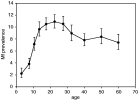
Fig. 1. Age-pattern in Mf prevalence in urban Pondicherry, 1981. Figure reproduced using data from Rajagopalan et al. (1989). The symbols indicate the observed Mf prevalence per age group with 95% confidence intervals, plotted against the mid-point of the age range.
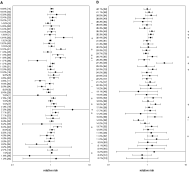
Fig. 2. Relative risk of infection with Mf in 2 adult age groups. (A) India: ratio of Mf prevalence in age group 40+ vs 20–39; (B) Africa: ratio of Mf prevalence in age group 50+ vs 30–49. On the Y-axis, overall Mf prevalence in the entire study population and the study number are given for each observation; study numbers refer to the list that is given in the Appendix. Symbols indicate the point-estimate for the relative risk; horizontal bars give the 90% confidence intervals around the point-estimate. Plus and minus signs on the right side of the figure indicate observations with a significantly higher (+) or lower (−) prevalence in the older group.
 You have
Access
- 20
- Cited by