INTRODUCTION
In recent decades, cancer has become a more significant issue and a clear public health problem worldwide. The World Health Organization (WHO) estimates that in 2030 there will be 27 million cases of cancer, 17 million deaths from cancer, and 75 million people living with cancer annually. The greatest effect of this ~70% increase will be on low- and middle-income countries (International Agency for Research on Cancer, 2013; National Cancer Institute Brazil, 2014). Thus, cancer control seeks to decrease the morbidity and mortality due to the disease and to improve the quality of life of patients through interventions for prevention, early detection, diagnosis, treatment, and palliative care. Another concern is the aging population, which will cause an increase in cancer incidence, mainly due to accumulation of risk factors for specific tumors combined with the reduced effectiveness of cellular repair mechanisms (World Health Organization, 2013).
Palliative care aims to control symptoms at any stage of the disease and follow patients and their family members until the end of the patients' lives, reducing suffering and improving quality of life (Johnston et al., Reference Johnston, Kidd and Wengstrom2012). The early introduction of palliative care can improve quality of life and increase lifespan (Temel et al., Reference Temel, Greer and Muzikansky2010). Patients with progressive and incurable disease should experience effective and wide relief of symptoms, whether physical or psychosocial, which only add to the challenge. In this population, symptoms are complex and multiple, and their frequency and intensity increase as the disease progresses, while the capacity for daily life and self-care activities decreases (Mercadante et al., Reference Mercadante, Casuccio and Fulfaro2000). The Edmonton Symptom Assessment System (ESAS) is routinely applied (Alberta Health Services, 2010) to evaluate symptoms in patients with advanced cancer. It is a simple instrument, with rapid application and low complexity, which facilitates care planning, intervention indications, and knowledge of the effectiveness of treatments. It is also a combination study, research, and audit tool.
Modern information and communication technologies (ICTs) are revolutionizing the way that individuals communicate, search, and exchange information and enrich their lives (Paré et al., Reference Paré, Sicotte and Chekli2009; Ryu, Reference Ryu2012; Bradford et al., Reference Bradford, Young and Armfield2012; Reference Bradford, Armfield and Young2013). Remote communication between doctor and patient through ICTs is one of the competencies of telemedicine. The real-time transmission of sound and image through data communication networks is a tool that facilitates care, shortens distances, and reduces costs and minimizes wasted time (Johnston et al., Reference Johnston, Kidd and Wengstrom2012; Bradford et al., Reference Bradford, Armfield and Young2013). Moreover, it allows for personalized and intense contact between doctor and patient, which further contributes to reduced suffering (Rich, Reference Rich2001). Thus, telemedicine has proved to be a useful tool for overcoming distance and enabling access to high-quality medical care for currently unassisted communities, even in large urban centers (Bradford et al., Reference Bradford, Young and Armfield2012; Reference Bradford, Armfield and Young2013).
Keeping patients with advanced disease at home is difficult and unsettling due to the severity and rapid deterioration of their conditions (Paré et al., Reference Paré, Sicotte and Chekli2009). Patients and their family members often wish to stay at home during the final moments of a patient's life, but the fragility of the situation and feelings of helplessness can lead them to seek hospital support. At this point, telemedicine may play an important role (Krupinski et al., Reference Krupinski, Nypaver and Poropatich2002; Balas et al., Reference Balas, Jaffrey and Kuperman1997). Orientation by phone can sometimes mitigate this situation, but the use of real-time audio and video has greater potential as a more effective tool for assisting patients and caregivers by providing continuous monitoring. In-person assistance cannot be replaced by virtual assistance, but web conferencing as a complement to monitoring in the intervals between outpatient consultations enhances care and improves access to healthcare services (Lima et al., Reference Lima, Monteiro and Ribeiro2007).
Despite the explosive development of ICTs, the paths for using them, especially in patient assistance, are underexplored. We believe that telemedicine may be important as a adjuvant tool for monitoring patients with advanced cancer under palliative care. Thus, our study aimed at assessing the potential contribution of telemedicine in detecting physical and psychosocial symptoms and in observing the clinical evolution of a disease until the final outcome as a complement to outpatient assistance for the palliative care of patients with advanced cancer.
METHODS
Patients
This work was a prospective, longitudinal, qualitative, descriptive, and case series study conducted between January of 2011 and August of 2013 that monitored patients with advanced cancer referred for outpatient care by the Centre for Palliative Care of the Pedro Ernesto University Hospital, Universidade do Estado do Rio de Janeiro (State University of Rio de Janeiro) (UERJ). Patients were included if they were at least 18 years of age and diagnosed with advanced cancer, with no chance of a cure, and with the following computing resources available: computer with Adobe Flash Player support, a web browser, access to the internet, and multimedia support including webcam, microphone, and an audio playback device. Only patients with cognitive impairment were excluded. All individuals signed an informed consent form, and the protocol was approved by the research ethics committee of the Pedro Ernesto University Hospital (no. 2869/2011).
Study Design and Measurements
The study was developed at the UERJ TeleHealth Laboratory, where online interviews were conducted with patients via a web conference using Adobe Connect Pro software (Adobe Systems, San Jose, California). To connect with the UERJ TeleHealth Laboratory, the minimum speed required was 256 Kbps. In-person consultations with the multidisciplinary team (physician, nurse, social worker, psychologist, and music therapist) occurred monthly, whereas web conferences with the team occurred weekly. The following means of communication were employed for monitoring patients: in-person care at the hospital, web conferencing, electronic messaging (email), telephone calls, ICTs, and home visits. In remote contacts, symptoms were assessed and complaints heard, and the relationship between what was reported and what was seen in the video was also evaluated. Monitoring continued until the patient's death.
Video and audio quality during web conferences were evaluated as good or poor. Good audio quality meant that words spoken at the two connection points could be understood without difficulty, whereas poor audio quality was identified when understanding was difficult, when the audio track was noisy, or when the telephone had to be used to establish communication. Video was considered good quality when the images could be defined without difficulty and poor when the images had low definition or sharpness or when they were dark, pixelated, or fragmented. The satisfaction of caregivers with the telemedicine care and the influence of ICTs on choice of patient's place of death were also analyzed.
The ESAS was utilized to assess symptoms during in-person consultations and web conferences (Bruera et al., Reference Bruera, Kuehn and Miller1991). The ESAS is a scale that assesses a combination of physical and psychological symptoms, and it consists of a list of nine symptoms often found in cancer patients: pain, fatigue, nausea, depression, anxiety, drowsiness, appetite, well-being, and shortness of breath. The ESAS is scaled from 0 to 10, where 0 represents absence of a symptom and 10 represents the greatest possible intensity of a symptom. The sum of points from all symptoms is defined as the symptom distress score. The instrument can be completed by the patient, by the family, or by the healthcare team, having been previously validated for Portuguese (Neto, Reference Neto2006). During in-person consultations, the numeric scale of the ESAS was printed and presented to the patient, who answered orally and assigned a score to each symptom. In web conferences, this numerical scale was presented on the screen so that the number corresponding to symptom intensity could be viewed and clicked.
Statistical Analysis
Descriptive statistics were employed to analyze the data. The results were expressed as the mean ± standard deviation (SD). Data analysis was performed using SAS software (v. 6.11, SAS Institute, Cary, North Carolina).
RESULTS
In total, 12 patients were monitored (7 men and 5 women), with a mean age of 68 ± 9.43 years. All patients were diagnosed with advanced cancer: 7 had lung cancer, 2 head and neck cancer, 2 cancer with an undetermined primary site, and 1 bile duct cancer. All patients were cared for by family members who operated the ICTs for participation in web conferences. The mean monitoring time was 195 ± 175.1 days; 5 of the 12 patients lived in other cities within a radius up to 60 kilometers.
During monitoring, family members and/or patients were contacted on 305 occasions, with 89 hospital consultations, 19 in-person assistances to the family (without the patient), 77 web conferences, 38 telephone contacts, 80 emails, and 2 home visits. Each patient had different frequencies of contact, with mean in-person consultations, web conferences, and total contacts of 7.42 ± 6.29, 6.42 ± 7.64, and 25.4 ± 16.3, respectively.
Audio quality was good in eight cases. In four cases, the audio was considered of poor quality, and telephone contact was required. Video quality was good in all 12 cases. Video favored communication beyond words through body language, emotion, and facial expressions of suffering or happiness.
In the absence of technical problems, the interviews lasted approximately 15–20 minutes. However, when there were connection problems, technicians intervened to solve them, and this waiting time reached up to 50 minutes until the web conference started. In most cases, communication problems were related to network latency and low speed. No patients were able to handle ICTs and connect with UERJ TeleHealth Laboratory by themselves, which was due to unfamiliarity with the use of ICTs, and not due to their frailty because of the advanced disease. All family members were unanimous in stating that they had no difficulty in using the computer and internet and also agreed that the use of telemedicine enhanced the care for their family member and provided greater confidence in the care provided.
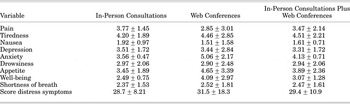
Table 1 shows the results obtained using the ESAS. Evaluation of symptoms utilizing ESAS encouraged detecting the specified symptoms and reporting other complaints. Furthermore, the instrument made the interview more objective and reduced the connection time of web conferences. However, when the condition of the patient was very severe, symptoms could not be evaluated using this instrument. Two patients did not complete the ESAS, and two others completed the instrument only once in person. All other patients could not complete the instrument when their clinical condition worsened. Of the eight patients who completed the ESAS in both contacts (in-person and remote), six had lower symptom scores in the web conference interviews than in person.
Means ± SD of results obtained by Edmonton Symptom Assessment System

In addition to detecting clinical conditions during web conferences—such as dyspnea, bedsores, and edema—aspects related to the comfort of the patient at home were also observed (bedsores, movement in the house, ability to walk to the computer). The remote interviews included questions and doubts about treatment, prognosis, social rights, requests for medical certificates for power of attorney, and reports of activities performed in addition to requests for support, authorization, and emotional support.
In addition to in-person consultation and web conference contacts, two home visits were made to two patients. This decision considered the availability of the team and the detection of a need for intervention regarding orientation about dressings, assessment of dyspnea, and the cognitive impairment of the patient. These visits were intended to enable the family to stay at home with good control of symptoms until the patient's death, in addition to ensuring the team that this was the will of the patient.
Regarding place of death, two patients were hospitalized for over a month before they passed away. Five patients preferred to stay at home until death. Five others remained at home as much as possible until the symptoms became intense and death was imminent, seeking emergency services only after contacting the doctor by telephone. All family members contacted the team near the time of the patient's death for orientation, farewell, or to notify the team of the death. All family members were unanimous in stating that the use of ICTs influenced the choice of place for a patient's death.
DISCUSSION
The incidence of cancer increases with age and leads to disability and the need for greater care, especially during the final phase of life. All healthcare service levels should participate in the assistance provided to cancer patients at some point during evolution of the disease. Thus, both training and qualification of healthcare providers are important to provide accessibility and to promulgate public health policies for cancer prevention and assistance to cancer patients. In this context, palliative care aims at controlling the symptoms caused by cancer and should ideally begin with a diagnosis of the disease when the patient is still in good general condition and retains good functionality (Paré et al., Reference Paré, Sicotte and Chekli2009; Donnem et al., Reference Donnem, Ervik and Magnussen2012).
ICTs have a great potential to assist in solving problems of access, equity, quality, and cost-effectiveness of healthcare services (Johnston et al., Reference Johnston, Kidd and Wengstrom2012; Bradford et al., Reference Bradford, Armfield and Young2013). Watanabe and colleagues (Reference Watanabe, Fairchild and Pituskin2013) showed that telemedicine resulted in a marked reduction in total spending on consultations, a reduction in time spent in transport, and high satisfaction of patients and family members . However, in our study, knowledge of the use and access to computing resources of patients with advanced cancer was one of the greatest limitations. Only patients and/or family members who had computer resources could access the system adequately for video conferencing, whereas patients and family members who did not have this knowledge could not employ the resources, even if the project provided the needed materials and orientation.
For healthcare professionals, symptoms are clues to the diagnosis in addition to a therapeutic challenge. For patients, the disease experience is associated with the physical and psychological afflictions it causes individually under the influence of several psychosocial and cultural factors (Johnston et al., Reference Johnston, Kidd and Wengstrom2012). Evaluating symptoms, especially the most distressing ones, is a vital aspect of clinical treatment, particularly for advanced and incurable diseases. The management of symptoms should be guided by a thorough evaluation that incorporates an understanding of its multidimensional nature and of the quality of life, and its measurement should reflect the complexity of patient perceptions (Derek et al., Reference Derek, Hanks and Nathan2004; Paré et al., Reference Paré, Sicotte and Chekli2009). According to Grossman et al. (Reference Grossman, Sheidler and Swedeen1991), there is no relationship between the intensity of pain perceived by the patient and the pain supposed by doctors, nurses, and caregivers. Clinical reassessments should be performed regularly, more frequently during the most advanced stage of the disease, near the end of life, because symptoms tend to change both in terms of quality and intensity. In research and particularly in clinical trials, the challenge of measuring symptoms lies in capturing the relevant concerns using measures that are simple and quick enough not to tire the patient excessively and to encourage adherence to treatment (Ingham et al., Reference Ingham, Seidman and Yao1996).
Assessing symptoms is particularly difficult in many subpopulations (Paré et al., Reference Paré, Sicotte and Chekli2009; Bradford et al., Reference Bradford, Armfield and Young2013). The use of ESAS by patients who are at risk of imminent death may produce controversial results (Hebert et al., Reference Hebert, Paquin and Whitten2007). Stern and colleagues (Reference Stern, Valaitis and Weir2012), when evaluating 13 patients under palliative cancer care through video calls accessible 24 hours a day, observed that the most common reason for contact was pain control followed by the need for emotional support. In our study, the ESAS was not applied to patients who already had cognitive impairment or an altered consciousness level. However, we always tried to find the cause for this possible change, and symptoms were assessed according to reports of family members or caregivers. Because the ESAS assessments presented in this study were performed at different times with different frequencies, the different results may be related to the clinical condition and not to the location (hospital or home) or means (in-home or remote) by which the instrument was completed.
In our study, the attention provided by telemedicine to patients with advanced cancer under palliative care was essential to maintain quality home care. The population studied had difficulties regarding transport and access to specialized healthcare services, even though living in large urban centers. These difficulties were related not only to the distance from the hospital or the means of transport but also to the fragile physical condition of the patients. Telemedicine reduced the impact of distance and favored the continuous provision of healthcare, especially at the end of a patient's life (Paré et al., Reference Paré, Sicotte and Chekli2009). In all cases, we found that, as the disease progresses, the clinical condition changes rapidly, and adjustments and orientations are necessary for good care to be provided, as already reported by Donnem and colleagues (Reference Donnem, Ervik and Magnussen2012). We believe that in-person communication combined with web conferencing may make the relationship among the doctor, patient, and family even more personal and intense, in addition to favoring affection, trust, and confidence bonds.
In our study, telemedicine intervention was important for the patients to have quality care and comfort until death, preventing iatrogenesis, therapeutic futility, and dysthanasia. It is known that patients in emergency services are admitted before healthcare professionals know anything about their history, imposing considerable suffering and disproportionate interventions on them at the end of their lives, with concomitant poor cost-effectiveness (Koczwara et al., Reference Koczwara, Francis and Marine2010). Conversely, in the current culture and framework, spending the terminal phase within a hospital environment may decrease the burden on caregivers, in addition to preventing problems regarding death verification and the issuance of death certificates (Paré et al., Reference Paré, Sicotte and Chekli2009).
All of the family members contacted our institution near the time of the patient's death, even when they died at home. This action can be explained, at least in part, by the bonds formed, the shared commitment, the attention paid, and a recognition of the care received. Of course, social and legal issues are also important. All care during patient monitoring can fail if the family has difficulty in obtaining death verification and a death certificate. Thus, the multidisciplinary team must be alert to prevent any problem that may hinder this process.
In conclusion, the attention offered by telemedicine to patients with advanced cancer under palliative care positively contributed to maintaining the quality of home care. The efficiency of telemedicine depends on technological factors and on the training or prior knowledge of patients and/or their family members. The ESAS can be administered using telemedicine; however, there are limitations regarding the patient's condition. The use of telemedicine allows detection of symptoms or aggravation in clinical evolution as a supplement to in-person observation. Telemedicine contributes to individualizing the best environment for the occurrence of death. In addition, telemedicine was unanimously considered by caregivers and family members to be valuable in the treatment of patients under palliative care.
Thus, the use of telemedicine in routine palliative care resulting from integrated action between healthcare professionals and telecommunication providers is feasible both from the technical and sociocultural perspectives. The rapid development of medicine combined with computer technology requires further studies to evaluate the impact and performance of telemedicine in care and accessibility, addressing the clinical, psychological, social, cultural, and economic concerns of both patient and provider.
DISCLOSURES
The authors state that they have no conflicts of interest to declare.