1. Introduction
Institutional economics is beginning to pay more attention to the challenges posed by behavioural insights in matters dealing with political economy (Schubert, Reference Schubert2017). Three germane challenges can be broadly identified: nonstandard preferences (such as those that account for the preferences of others), limited cognition (the inability to possess all relevant knowledge for first best optimisation), and time-inconsistency (e.g. internalities from lack of intertemporal self-control over bads) (Alm and Shreffin, Reference Alm and Shreffin2017). The purpose of this article is to pick up the challenge of limited cognition in the context of policymaking. The premise is that hitherto little attention has been paid to the potential of an institutional analysis of the complex process of policymaking that also explicitly endogenises behavioural insights.
We zoom in on the challenge by analysing fiscal federalism, for one economics interpretation of a federation is as a laboratory; that is, a public sector organisation where local governments try to obviate (or at least decrease) their limited cognition by working as a ‘collective intelligence’ (Langlois and Garzarelli, Reference Langlois and Garzarelli2008) that runs multiple policy experiments in parallel. Local experiments that prove unsuccessful will have a low cost to the federation as a whole, as the experiments are only performed on a local level, whereas those experiments that prove successful will have a high return as they can be adopted by other governments in the federation (Oates, Reference Oates1999: 1131–4).
A federation therefore is a useful organisation for knowledge growth from trial and error. There is a missing link, however. The literature does not present a theoretical nexus that explicitly ties policy experimentation in fiscal federations to intergovernmental grants.Footnote 1 This missing link is puzzling, because grants are frequently used to stimulate policy experimentation. For instance, grants were used for the State Children's Health Insurance Program in the United States, which allocated lump-sum grants to states, enabling state-level design and application of policy coverage in different ways (Weissert and Scheller, Reference Weissert and Scheller2008). Another US illustration is the Patient Protection and Affordable Care Act, which uses federal support in the form of intergovernmental grants to create incentives for states to innovate on policy. The results of the policy experiments are evaluated, and data are collected and made publicly available (Madison, Reference Madison2014). Other countries use grant funding for policy experimentation too. For example, public universities in Scotland used lump-sum grant funding to experiment with different fee payment policies (Keating, Reference Keating2005), and China's local policy experiments to stimulate economic growth also benefit from grants (Xu, Reference Xu2011). Furthermore, on the other side of the equation, official government publications underscore how one of the fundamental rationales for grants is to induce policy experimentation (CBO, 2013: 7–12).
The missing link defines the central question that this article addresses: what role do grants play in the economic theory of laboratory federalism?Footnote 2 The article's answer is intuitive, namely that different types of grants stimulate ‘muddling through’ (Lindblom, Reference Lindblom1959) different policy experimentation sets at the recipient government level. Specifically, through elementary, formal reasoning that blends together a simple behavioural learning heuristic from experimental psychology (Herrnstein, Reference Herrnstein, Rachlin and Laibson1997; Sims et al., Reference Sims, Neth, Jacobs and Gray2013) with received economics wisdom, the article shows that a local government grant recipient is likely to have more opportunities to experiment (and possibly also learn more) from a less conditional rather than from a more conditional grant. More conditional grants ‘can be equivalent to a centralisation of constitutional powers’ (Breton, Reference Breton1996: 258).
In public finance one finds the notion that an intergovernmental grant is a useful policy tool. A grant is most often a funding formula for any of the following: horizontal equalisation, interjurisdictional externality internalisation, minimum local service delivery and vertical fiscal imbalance. And, depending on the problem at hand, the grant can take on different characteristics (general revenue, specific purpose non-matching, matching, and so on) creating different effects (income, substitution) on the grantee budget. However, the crux of the matter is that it is the main corrective policy tool in a federation. So a grant usually serves the purpose of offsetting various types of welfare losses. Its role in creating novel welfare value is underexplored.
Public choice finds that, notwithstanding its formulaic nature, an intergovernmental grant is subject to the same special interest capture that characterises all other public institutions. Grants are viewed as a means by which central government can collude with local governments through taxation: while local governments may have to compete along a number of Tiebout dimensions, including lowering taxes, central government can raise taxes and then redistribute these back to local governments through grants. Because local political representatives compose the national government (state legislators) it is common sense that the national government would collude with local government. The literature therefore concludes that intergovernmental grants (1) expand the size of the public sector, and (2) allow taxes overall to be higher than they would be otherwise (Grossman, Reference Grossman1989; Grossman and West, Reference Grossman and West1994). Related studies find that the greater rent-seeking value of lump-sum grants increases political competition for state legislative offices (Duquette et al., Reference Duquette, Mixon and Cebula2017; Mixon and Ladner, Reference Mixon and Ladner1998), and that these incentive inefficiencies persist once set in motion (Sobel and Crowley, Reference Sobel and Crowley2014).
Consider now the context of US highway grants.
Although highway grants are distributed primarily according to formula, individual legislators, especially those with political power, have available several means for altering the distribution of grants for the benefit of their home state. In reference to highway grants, Senator Patrick Moynihan (D, NY) stated ‘You don't have a formula here, you have 50 negotiated numbers’. (Knight, Reference Knight2002: 78)Footnote 3
Others document similar scenarios in other countries and other public expenditure sectors (Litschig, Reference Litschig2012).
The upshot is that public choice perceives a grant more as a compromise for rent seeking, and less as a compromise for novel welfare value generation. This article does not deny intergovernmental rent seeking and the need to offset it (Lee, Reference Lee1985). However, it centres on the neglected obverse: the positive analysis of an ongoing normative phenomenon, to wit, the iterative process of experimental policymaking through grants. Before trying institutional reform, we ought to have as clear a picture as possible about both the negative and positive properties of existing institutions. To do otherwise would signify letting the political idealism abandoned by public choice enter analysis in another guise (Buchanan, Reference Buchanan1995). For this reason, the interest rests in offering a first approach that describes how diverse, plausible intergovernmental fiscal institutions affect policy experimentation differently.
This article correspondingly shifts the main emphasis on the policy role of intergovernmental grants in a federation by adopting an institutional approach that draws on both public finance and public choice. From public finance we maintain that grants are policy tools that can take on different characteristics creating different budget effects. Public choice is more pivotal for two related reasons. First, we pick up the notion that grants can be interpreted as fiscal institutions for political compromise – shared rules of conduct between grantor and grantee about the spending of transferred funds (Buchanan, Reference Buchanan1990). Second, the aspect of politics as exchange in intergovernmental fiscal relations is what renders our argument non-tautological (Buchanan, Reference Buchanan1968): the familiar logic of budget shifting from grants as formulas, though necessary, is insufficient to create scope for experimentation. What also matters are grant-embedded incentives from the pursuit of individual (often parochial) interest.Footnote 4 At the same time, our approach differs in emphasis from both public finance and public choice by underscoring that a grant can also be useful to create value from learning tied to various attempts at policy design.Footnote 5
We can extrapolate from the literature two main categories of incentives to innovate from a grant, which are both political: vertical bottom-up and horizontal. The vertical bottom-up refers to the anticipation of not being re-elected if the consumer-voter ascribes grant reductions in public good spending to the local grant recipient (Nicholson-Crotty, Reference Nicholson-Crotty2015). For example, after unconditional lump-sum grants replaced conditional ones in Norway in 1986, local government representatives had an incentive to ‘use spending decisions as strategic instruments to achieve additional grants’ (Carlsen, Reference Carlsen1995: 56) or else run the risk of losing their political seat. The horizontal incentive regards the desire of local governments to retain the political right to compete for grants from central government (Salmon, Reference Salmon1987), an incentive that strengthens when it is believed that a local policy innovation will be adopted by central government (Callander and Harstad, Reference Callander and Harstad2015).
The aspect emphasised here directs attention to a third political incentive to innovate: the vertical top-down from grantor to grantee. This incentive refers to the notion that a grant is an institutional compromise between levels of government that reveals how funds ought to be spent. The grantee is motivated to satisfy the grantor's spending preferences – to follow the rules innate in the grant, such as to employ funds to perform policy experiments – to maintain good political and bureaucratic relationships over time. The grantee's expectation is to receive further grants, make career progress, keep a committee seat, be reappointed, be sponsored for re-election, and the like. For instance, the 2015 South African Division of Revenue Act stipulates that the National Treasury has the authority to use past grant performance to determine future grants. Hence, like other institutional compromises (Wildasin, Reference Wildasin2004) where politics is a repeated game, incentives to respond to the devolution of property rights over policymaking are not wholly absent (Oates, Reference Oates2008). The substantive implication is that conditionality is the economic policy instrument that genuinely governs and disciplines the grantee's policymaking set – what we term the policy experimentation space – that is generated by the grant. Thus to neglect conditionality would be tantamount to an interpretation of intergovernmental grants where the ‘decision makers’ are not ‘real governments’ (Breton, Reference Breton1987: 315).
The more encompassing point to underscore is that not all incentives from a grant need necessarily have unfavourable consequences (Besfamille and Lockwood, Reference Besfamille and Lockwood2008). Unsuccessful experimentation through grants still generates learning: forgiving the grantee whose experiment is unsuccessful, through ‘permission to fail’ (Osborne and Gaebler, Reference Osborne and Gaebler1992: 135–6), is critical to policy (and other) innovation in the public sector.
If grants were given to local governments without supervision there would be some instances of gross neglect or venality and more variety in the quality of the performance of public functions. We should also expect to find that much of this variety was eminently sensible, and that many types of experimentation would constantly be embarked upon by the more venturesome and the more foolish communities – with large social benefits from both the successes and the failures. (Stigler, Reference Stigler1957: 219)
While our suggested approach is, as far as we can ascertain, entirely new, two recent strands of literature touch on related issues: policy experimentation and the Second Generation Theory of fiscal federalism (SGT). As in intriguing recent contributions about policy experimentation (Callander, Reference Callander2011), we envision a policymaker facing uncertain scenarios over multiple ill-defined policy choices at the same time rather than one-off, well-defined choices. Yet we differ from these contributions by (1) considering the more specific context of fiscal federalism, (2) focusing on policy innovation as separate from diffusion, and, more substantively, (3) interpreting intergovernmental grants as fiscal institutions that are valuable for experimentation.
In our approach a grant can be thought of as an institution for nudging. That is to say that a grant can influence policymaking without simultaneously ‘offending the susceptibilities of local autonomy, and without losing the very real advantage of local initiative and local freedom to experiment’. It is ‘a . . . relation between local and central government’ that creates ‘a new species of administrative hierarchy, which has attributes of its own’, and which can produce ‘results . . . in a remarkable combination of liberty and efficiency’ in harmony with ‘the conditions and stipulations that are attached’ to it.Footnote 6 In other words, as a shared fiscal rule that structures grantor-grantee interaction, a grant generates constraints and options for policy experiments.
Notice how nudging here refers not, as is typical (Thaler and Sunstein, Reference Thaler and Sunstein2009), to the relations between policymaker and consumer-voter (public to private sphere nudging), but to nudging between levels of government (nudging within the public sphere). Other things equal, nudging between levels of government is less likely to be subject to the shortcomings of policymaker to consumer-voter nudging – such as ineffectiveness resulting from a lack of understanding of expected behaviour, confusion or short-term effects; the possibility of compensating behaviour; or nudge resistance (Sunstein, Reference Sunstein2017: 20–1). Local policymakers are more likely to possess the relevant knowledge to inform their experimentation than their central counterparts, weakening ineffectiveness; and short-term effects are mitigated by repeated interactions and feedback. Similarly, as our nudge is reinforced with career concerns and potential loss of future grants, one would expect less opportunity for compensating behaviour, or nudge resistance.Footnote 7
The SGT studies intergovernmental fiscal relations through the lens of the theory of the firm, an important subset of institutional analysis concerned with solving various organisational problems (e.g. principal–agent). It borrows insights about how to limit perverse incentives, applying them to comparable problems in federations (e.g. optimal political delegation) (Weingast, Reference Weingast2009). Like the SGT, this article is interested in incentives. However, it differs by emphasising fiscal incentives to innovate (Bednar, Reference Bednar2011; Madison, Reference Madison2014; Rose-Ackerman, Reference Rose-Ackerman1980; Strumpf, Reference Strumpf2002).
A grant therefore can stimulate experimentation as well as cushion unsuccessful experimentation. This view of grants, where both learning from success and learning from failure are equally important, is at the core of our approach.
2. Policy devolution and grant conditionality
Central government's motivation to devolve property rights to experimentation
Why would central government devolve the right to experiment? We can identify three motivations for experimental devolution. The first derives from uneven knowledge distribution. The notion that each individual holds idiosyncratic bits of knowledge suggests that individuals can generate different bits of new knowledge if interaction is left to them (Hayek, Reference Hayek1948; Turgot [1775] Reference Turgot and Baker1987). The second is that complex problems usually push diverse individuals to pool resources together. Sharing the pain of policy experimentation entails sharing the gain: new knowledge (Kollman et al., Reference Kollman, Miller and Page2000). The third motivation concerns the containment of the costs of a possible policy failure.
The three motivations, as parts of our story shall also intimate, often operate together. However, we presuppose that the primary motivation for central government to grant rights to experiment to local governments is the third one. The reason is simple: policy failure is politically unpopular. A significant policy failure (like a perfect policy success) is rare, but it does occur, and usually correlates with bad policy design. Recall for instance the UK public expenditure programmes on the Concorde aircraft and on the Advanced Gas-Cooled Reactor (Henderson, Reference Henderson1977). More recently, we can think about the higher costs that the US would have incurred had the California electricity deregulation experiment of the early 2000s been done nationally; or, in a similar vein, about the costs that would have turned up if Texas's 1993 multiyear experiment with school finance equalisation (the so-called Robin Hood plan) had been national. In essence, our stance is that central government has an interest in devolving property rights to experiment primarily for political concerns.
Limited cognition and implicit conditionality
Suppose that the grantor writes down several grant conditions. This conditionality might be interpreted by the grantee (e.g. a Brazilian mayor, an Italian regional president, a US state governor) as a signal that the grantor views other aspects of the grant as relatively less important, leaving many degrees of freedom along the unwritten aspects, also in terms of not necessarily spending for experimentation. Under a totally unconditional grant this would be the case a fortiori. As a result, there could be cases of policy drift (McCubbins et al., Reference McCubbins, Noll and Weingast1997). A recent illustration is when in March 2015 the South African Treasury withheld one of its grants to 60 municipalities when the latter did not employ the unconditional transferred funds as expected.Footnote 8
In these cases, the first instinct is to try to tie the grantee's hands through more conditionality. A scenario that comes to mind is for the grantor to use grants as a way to direct subnational policy experiments toward the (perceived) highest expected value experiments. The idea is that local policymakers do not exercise their experimental potential in ways that are welfare maximising, as they may experiment only on policy options that make the grant programme a safer bet for them. Reasons for grant conditionality then may include differences in legal enforceability for third parties (e.g. local beneficiaries of the grant project), legislators wishing to constrain the discretion of bureaucracies that will administer the grants, the desire to bind subsequent national legislatures that might take a different view of the terms of the grant, attempts to decrease local corruption, and the like. Thus, the rationale would be that highly conditional grants, in which the central government closely directs the policy chosen by each sub-unit, may leave less discretion for each local policymaker, but produce more valuable experiments overall (Galle and Leahy Reference Galle and Leahy2009).
In this scenario, conditionality avoids the costs of directly monitoring the binding of the target experiment. We do not disagree with the view that more conditionality ex ante has the potential to offset ex post commitment and enforceability costs tied to limiting perverse incentives. But this scenario, where experimentation is planned from the grantor, would at least imply that the grantor to some extent suffers from fewer cognitive limitations than the grantee (Minkler, Reference Minkler1993).
A second scenario would be for the grantee to guess about the importance of all the terms ex post. In this case we would need to think of the grantee not just as a risk lover, but also as possessing particularly strong political intelligence. A scenario that is less aleatory and that would require a more mundane political intelligence is the one that lets the grantee negotiate (at some cost) the importance of all the terms ex post. But this third possibility does not necessarily guarantee reduction of perverse incentives after negotiations close (Williamson, Reference Williamson2005).
There is another ex ante scenario that can assist in assuring binding, however. We refer to implicit conditionality, the notion that there may be conditions from relational understandings that are outcomes of negotiation as well, albeit not explicitly spelled out in the grant per se. Since, as underlined at the outset, political relations are intertemporal rather than discrete, these implicit conditions reduce the probability of deviation from the stipulated terms even when a grant is explicitly unconditional (Brennan and Pincus, Reference Brennan and Pincus1990; Garzarelli, Reference Garzarelli2006).
Implicit conditionality therefore can be seen as bringing in a ‘gap-filling’ (Ayres and Gertner, Reference Ayres and Gertner1989) dimension to mistake-ridden policy innovation. That is, this last scenario can be a means to decrease uncertainty by saving on ex post costs of political compromise through ex ante relational agreements about terms for experimentation. The ensuing pages accordingly consider that, on balance, implicit conditionality crowds in the incentives to experiment should explicit conditionality fail to do so; and that those cases where grants are not used as destined can be thought of as mostly exceptions resulting from weak exogenous political incentives, such as local and/or central leadership turnover and end of term in office with no prospect of re-election.
Let us be clear here. We are not suggesting that a policy success is a necessary precondition to receive future grants, promotions, etc. Rather, the precondition that sufficiently qualifies for success in our context is that grants are employed as destined, namely for policy experimentation. In a behavioural setting, in fact, optimal rationality is about a reasonable rule-following procedure in light of the situation faced, which does not necessarily coincide with an optimal result in the standard optimisation sense (Simon, Reference Simon1990).
3. Intergovernmental grants and laboratory federalism
Economising rules
Since policymaking is a very uncertain production activity, it usually proceeds in incremental or so-called piecemeal fashion, where one tries out different solutions to actively seek mistakes in order to extend knowledge and improve practice. For example, in the recent case of legalising cannabis in some US states, reflecting on
the range of potential gains and losses, and of policy options, the probability of finding the perfect combination right from the start must surely be near zero. Thus, the best initial policy will not be the one that comes closest to some calculated optimum, but instead the one easiest to adjust in light of experience, which among other things means building in evaluation and policy feedback mechanisms. (Kleiman and Ziskind, Reference Kleiman and Ziskind2014: 78)
So the rational (but fallible) policymaker proceeds gradually by exploring the solution space by taking many small decisions over time on each policy under consideration and treasuring the lessons learned at each step. The lessons learned during this muddling through are what endogenously drive policymaking forward, because each moment of choice builds on the outcome from each previous step. The point being that the positive and negative lessons learned serve as rules of decision-making when each policy – each production activity – is considered separately in terms of its value-generating attributes (degree of externality internalisation, institutional compatibility, revenue stream generation, etc.), which is the basic intuition behind the dynamics of our simple heuristic. Namely, that over repeated trials through time, the frequency of the selection of a policy is proportional to the net welfare value of selecting that policy.Footnote 9
If we suppose, for simplicity, that there are a number of experiments on two competing policies, x 1 and x 2, and that for each experiment there is a corresponding welfare value function, v 1(x 1) and v 2(x 2), then we can more precisely render how the frequency of policy selection changes over time through a familiar replicator equation, such as:
 $$\begin{equation}
\left. {\frac{{d{x_i}}}{{dt}}} \right|_{i = 1}^2 = {x_i}\left[ {{v_i}\left( {{x_i}} \right) - \bar{v}\left( {\bm{x}} \right)} \right].
\end{equation}$$
 $[ {{v_i}( {{x_i}} ) - \bar{v}( {\bm{x}} )} ]\ $is the difference between the average value of the trials of the chosen policy, vi(xi), and the average of the values of all policy trials,
 $\bar{v}( {\bm{x}} ) = \mathop \sum_{i\ = \ 1}^{n\ = \ 2} {x_i}{v_i}( {{x_i}} )$. If
 ${v_i}( {{x_i}} ) > \bar{v}( {\bm{x}} )$, then xi will continue to be selected; if instead
 ${v_i}( {{x_i}} ) < \bar{v}( {\bm{x}} )$, then xi will not continue to be selected. There is indifference between policies when they have the same value.
The simple evolutionary dynamic from equation (1), explicitly or otherwise, describes behaviour under uncertainty in a variety of contexts and fields where repeated trials are involved (Fudenberg and Levine, Reference Fudenberg and Levine1998; Hofbauer and Sigmund, Reference Hofbauer and Sigmund1998; Sugden, Reference Sugden2005). For the purposes at hand, it informs us that a policymaker experiments – learns by trial and error – according to average rather than marginal welfare value per unit of investment (a money sum, knowledge, opportunity cost, time, etc.) at each step taken. More precisely, the muddling through occurs at the margin, but the reinforcement (negative or positive) to the muddling through is considered in terms of its average return. The heuristic therefore is that the higher the average welfare value from a policy in relation to alternatives, the more a policy will be pursued.Footnote 10 It resonates with the view that when uncertainty does not permit straightforward decision making, rules of behaviour are coarser rather than finer (Bookstaber and Langsam, Reference Bookstaber and Langsam1985) – less is more (Gigerenzer and Brighton, Reference Gigerenzer and Brighton2009).
Besides its intuitive appeal, the heuristic is factually not unrealistic. Take a tangible policy case, which while not in the specific context of grants can be easily related. The Johannesburg Roads Agency introduced the freely downloadable JRA Find&Fix application for smartphones in 2014, which allows drivers to report in real time a pothole with GPS coordinates as well as a photograph.Footnote 11 The app competes with more traditional policies for reporting a pothole, such as contacting the relevant authorities by telephone to report its approximate location and description.
If we think about these two competing policies as our x 1 and x 2, then it is patent that, over time and with other conditions remaining the same, v 1(x 1) trumps v 2(x 2). For, among other things, x 2 first requires a search – usually after some time from the initial reporting, which would also include a description of the size of the pothole – for the precise pothole location so that, usually after some additional time, a repair team can fix it. x 1 instead bypasses the description and search steps, implying that it exhibits transaction cost and time saving economies that on average allow for quicker pothole repair compared to x 2. Hence, x 1 will be preferred to x 2.
As a matter of fact, thanks to JRA Find&Fix, ‘the average time to resolve’ a road infrastructure ‘service request’, such as ‘potholes, faulty traffic lights and other road-related defects’, reduced ‘from 32.4 days to less than a day’. The app ‘complements’ the Roads Agency's ‘ability to plan repairs . . . based on reports and data received, thereby enhancing efficiency and increasing productivity’.Footnote 12
Grants and policy experimentation
We are prepared now to illustrate how an intergovernmental grant aids policy experimentation in a federation. The illustration hinges on likening the dynamics of trial and error policy production, as introduced above, to experimenting within a grant-generated policy experimentation space, with the bottom line being that the conditionality from different grants creates different policy experimentation spaces.
In line with the discussion so far, we continue to reason in two dimensions, and take as our comparative institutional cases two grants of the same amount, but of different types: an unconditional lump-sum and a conditional closed matching. The reason for selecting these two grants is that the characterisation of most other grants can be seen as falling within these two. That is, we can think about unconditional lump-sum grants and conditional closed matching grants as the ideal-typical inclusive polar extremes of a possible grants spectrum.Footnote 13 More generally, the simplifications do not entail loss of generality (Oates, Reference Oates1972: 101–2). The first section of the Appendix contains a formal treatment.
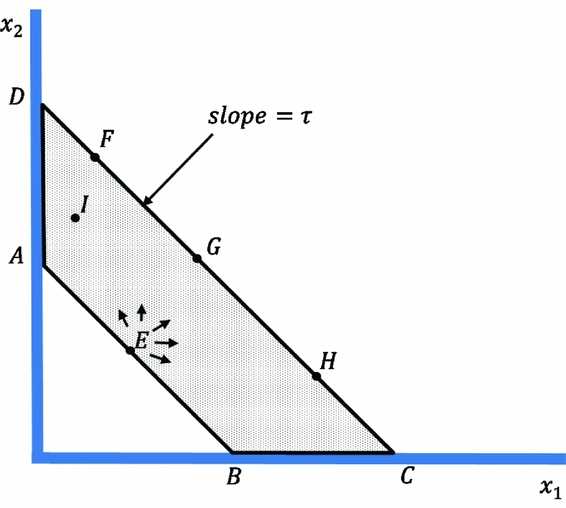
Assume two levels of government, central and local, the absence of fiscal illusion and of local government borrowing, that the pre-grant local budget is, as usual, credibly fixed from the previous year, and that central and local taxes remain constant. In keeping with our previous example, we can keep thinking about experiments on two competing policies, x 1 and x 2, that try to solve the same problem. Following standard practice, the number of experiments on both policies is chosen so that the cost of one unit in terms of the other is unity. The pre-grant local budget constraint, raised from only local taxes, is AB, with slope τ. See Figure 1.
Experimentation with an unconditional lump-sum grant.

Suppose that local government, in the form of our policymaker, is the recipient of an unconditional lump-sum grant. Further suppose that the Bradford–Oates ‘veil hypothesis’ holds, viz. that there is equivalence between the grant and a budget increase of the same size (Oates, Reference Oates1999: 1129–30). (We will characterise this supposition more precisely presently when discussing the flypaper effect.) In terms of Figure 1, the grant shifts the local public budget from AB outward to CD.
Our primary interest here is on the experimental effects from the grant. We know that the grant serves both as a constraint and as an option for policy experimentation. The constraint is the budget for conducting experiments on x 1 and x 2. It is equal to the money amount transferred from central to local government through the grant, entailing that experimentation is not unbound. Relatedly, recall that it is in the interest of the grantee-as-policymaker to employ the grant amount as destined.
Being revenue extraction from local taxes, AB does not incorporate the institutional nudge from grantor to grantee; and the space above the grant is not feasible. The option consequently manifests as a proportion between the simple policymaking heuristic from equation (1) and the area that, by difference, is created by the grant:
 $$\begin{equation}
\left. {\frac{{d{x_i}}}{{dt}}} \right|_{i = 1}^2 \propto {\it ABCD}.
\end{equation}$$
In different terms, relation (2) informs us that experimentation is commensurable to possible experiments. The constraint and the option jointly define the space for muddling through, which is essentially the budget set for experimentation. That is, the bundles of experiments lying inside and on the boundaries of region ABCD in Figure 1.
Policymaking from the grant proceeds along the following lines. As a starting point, the policymaker can pick any combination of policy experiments within region ABCD. Suppose experimentation starts at a locus where there is an equal number of experiments on x 1 and x 2, such as E. Then, depending on the experimental feedback, the policymaker will take the next step. Thus, the arrows emanating from E are not vectors, but indicative of direction.
If x 2 has a relatively higher average welfare return, then the policymaker would move in a north-westerly direction, for example toward point F. A movement toward H reflects learning about a relatively higher average welfare return for x 1. A diagonal movement between 0 and 90 degrees represents indifference:  ${x_1}\sim\ {x_2} \Leftrightarrow [{v_1}( {{x_1}} ) = {v_2}( {{x_2}} )] \ge \bar{v}( {\bm{x}} )$.Footnote 14
The halt of experimentation is less evident. On the one hand, there is the case of funds from the grant being exhausted, which occurs anywhere on CD. However, lying on CD can imply either experimental failure or experimental success. That is to say that learning through the heuristic does not automatically guarantee policy success even when the entire grant amount is employed as expected. Indeed, recall that behavioural analysis is less about rational optimisation of outcomes than it is about adaptive rule-following procedure.
On the other hand, the experiment can halt before the grant funds are exhausted. Here too there can be experimental failure or success. Regardless of experimental outcome, the policymaker would be somewhere within region ABCD exclusive of the upper boundary CD – for example, at point I.
I represents failure when experimentation stops without stumbling upon a successful policy. In this case, we can think of I as, e.g. a case of policy drift, such as the episode of the South African municipalities reported earlier, which we hinted could originate from a variety of weak exogenous political incentives.
I is a success when experimentation stops in light of a successful policy. In this case, the residual funds can be invested in something related to the successful experiment until grant funds are exhausted. The Public Safety Department (which consists of both fire and police) of Fairfield, California, for instance, was allowed to keep savings from a lump-sum grant. This led to a change in strategy from only fighting fires to fire prevention, which lowered the running costs and improved the insurance rating of the department (Osborne and Gaebler, Reference Osborne and Gaebler1992: 222–6).
Notice the asymmetry. Experimentation stops when there is exhaustion of the grant funds, irrespective of success or failure; while the exhaustion of the funds is not necessary for experimental success or failure. The important detail to keep in mind, though, is that learning occurs on both sides of the asymmetry.
At this juncture the flypaper-effect theorist will point out that empirically there is non-equivalence in a change in spending between an unconditional lump-sum grant and a corresponding parallel shift in grantee budget (Hines and Thaler, Reference Hines and Thaler1995). For present purposes, a simple recasting of our reasoning offers one rationale about why the budget shift of Figure 1 might not be an anomaly.
The flypaper effect considers that local government spending may not always be in line with welfare maximisation. Rather, the grant stimulates local government spending beyond the welfare maximisation point (but still on the grant-aided budget constraint). Spending on policy experiments, however, is not per se welfare enhancing. In our approach, mistake-ridden learning also enters community welfare. Two considerations follow when also accounting for learning. First, a successful policy experiment may be either welfare enhancing (JRA Find&Fix improves pothole repair turnaround times) or welfare-neutral (JRA Find&Fix leaves pothole repair turnaround times unchanged). Neither of these cases contradicts flypaper-effect models (Bailey and Connelly, Reference Bailey and Connolly1998: 336–8). Second, policy failure can be seen as decreasing welfare from a financial viewpoint until learning offsets it. In this case, spending is not reflected as it is in flypaper models.Footnote 15 Thus, the approach proposed here accounts analytically for both variation in local government spending from the flypaper effect and spending on failed policy experiments – the policy experimentation space incorporates both.
Pointing out that the approach analytically can account for the flypaper effect as a special case is not the same as simultaneously accounting for the economics of why we can consider the grantee-as-policymaker as having an incentive to span the full experimental space. Economists of diverse persuasions (Brennan and Pincus, Reference Brennan and Pincus1990; Inman, Reference Inman, Durlauf and Blume2009; Roemer and Silvestre, Reference Roemer and Silvestre2002) share common ground when emphasising the importance of political considerations for grantee behaviour, especially in the face of unconditional lump-sum grants. The common ground is that grant relationships are characterised by equilibria among many political actors, implying that the translation of budget effects from single-consumer to collective decision-making contexts is off the mark.
Our political scenario concerns repeated exchange. In repeated exchange, an initial large number of local governments involved in negotiation with the central government changes into a bilateral, non-anonymous grantor–grantee exchange relation when the grant is implemented (and when renegotiation occurs). The grantee–grantor relation is then a type of sunk investment in reciprocal political capital that can be changed only at significant sacrifice. As repeated exchange increases the value of the investment in reciprocal political capital, small number exchange increasingly dominates.Footnote 16 This means that the constraint on the feasible set tightens for the grantee's situation as such as well as for the repercussions of grantee–grantor interaction. The repercussions from repeated exchange create a strong ‘coercive force’ that renders the grant binding endogenous (Langlois and Csontos, Reference Langlois, Csontos, Mäki, Gustafsson and Knudsen1993: 117–20). It follows that we can heuristically consider the grantee-as-policymaker as having a vertical top-down incentive to employ an unconditional lump-sum grant for policy experimentation in its widest sense, rather than let it crowd out own-source funds on a dollar-for-dollar basis, not just because there is an exchange of commitments embedded in a grant's institutional interstices, but also because the exchange recurs bilaterally.
Let us now turn to the conditional closed matching grant of the same amount. Since the policymaking procedure is behaviourally fully analogous to case of the unconditional lump-sum grant, we can focus directly on the comparative institutional analysis of the two grants in terms of the respective experimental spaces.
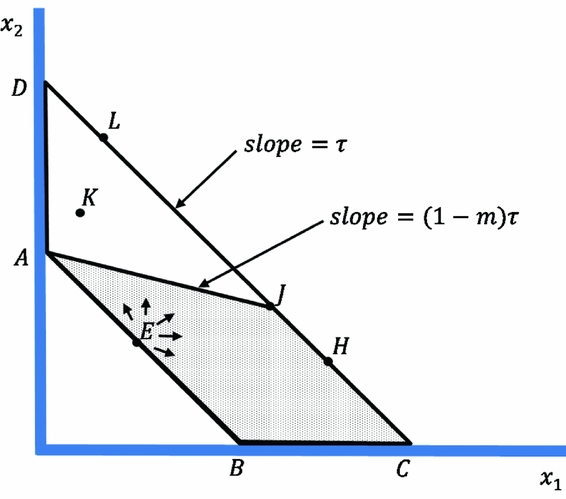
Let the grant direct more funding to x 1, as in Figure 2. The local public budget shifts from AB to AJC. m pivots the budget about point A to AJ. The slope of segment AJ is (1 − m)τ. The grant reaches its maximum amount (which, recall, is the same of the previous grant) at J. The remaining budget constraint JC has the same slope as the unconditional lump-sum grant, which is also the slope of the original budget (τ).
Experimentation with a conditional closed matching grant.

The conditions involved are two: the matching ratio, m ∈ (0,1), and the maximum amount at which the grant closes. m represents the fraction of the cost of the experiment subsidised by the grant (e.g. if the donor funds 50 cents on every dollar spent on experimenting on xi, then m = 0.5).
Conditionality here assures that, as a targeted grant, the closed-ended matching grant focuses on a specific experimentation area, and therefore would not allow policy trials outside the constrained area. Otherwise, if the closed grant is fully used – namely, in the range of constrained funding – then the grant's (equally valued) funds become fungible and resources can be allocated more generally within the budget – like the lump-sum grant. (The reverse is less problematic. If the closed end matching grant is not fully used, then we are in the range where the price incentive of the grant is still binding, even if in that range the local government will receive less dollar support from the targeted grant than from the lump-sum grant.)
By inspecting Figures 1 and 2 we notice that the constraints and the options for experimentation differ. The constraint of the conditional closed matching grant is twofold: the amount of the grant as well as the matching ratio. The grantee receives the full grant amount only by experimenting on x 1 to the grantor's satisfaction, which is at least the horizontal distance BC. The option is:
 $$\begin{equation}
\left. {\frac{{d{x_i}}}{{dt}}} \right|_{i = 1}^2 \propto {\it ABCJ}.
\end{equation}$$
Accordingly, the space for muddling through in Figure 2 is represented by all the bundles of experiments lying inside and on the boundaries of the region ABCJ.
Further inspection of the two figures shows that ABCJ < ABCD. That is to say that the experimentation space is smaller for a conditional closed matching grant than for an unconditional lump-sum grant. The intuition is that the matching ratio reduces the experimental space by favouring a specific experiment (in this case, x 1). There is therefore less experimentation potential under the conditional closed matching grant than under the unconditional lump-sum grant. The second section of the Appendix presents a proof of this result.
Some factual considerations
Consider US federalism. In 2015, welfare transfers to state and local governments amounted to 3.4% of GDP. Approximately 76% of these transfers (US$16 billion) are for the Temporary Assistance for Needy Families (TANF) programme, of which lump-sum grants for cash assistance comprise approximately 25% of total spending (about US$4 billion) (NASBO, 2016; OMB, 2017). The right to these non-trivial figures from less conditional grants was gained over the years by significant intergovernmental fiscal interaction, and was itself the fruit of mistake-ridden learning.
The Aid to Families with Dependent Children (AFDC) was a New Deal welfare programme in support of families without fathers that ran from 1935 to 1996. It provided states with federal funds in the form of open-ended matching grants for cash assistance, and allowed states to determine the level of monthly benefits. Under the AFCD, states could experiment with welfare policy from 1962 by applying for a statutory waiver from the federal government, hence creating leeway for ‘experimental, pilot, or demonstration’ projects aligned with the socioeconomic areas of the programme.Footnote 17 The federal government had discretion to approve the waiver in full or in part, and could change the scope of the experiment. By the end of the AFDC programme, almost all 50 states had received waivers and experimented with eligibility rules, work participation requirements, time limits of benefits and payment policies. However, among other issues, waiver applications were seen as a form of red tape that delayed local policy initiatives. Perhaps more significantly, states resented the interference of the federal government in their freedom to experiment, blaming the failure of many local experiments on central intervention. These central–local tensions around limiting discretion generated a phase of imbalance between levels of government that unintentionally led to institutional change (Bulman-Pozen and Gerken, Reference Bulman-Pozen and Gerken2009: 1274–6).
It is during the imbalance phase that, in the attempt to more precisely tailor welfare policies to their idiosyncratic needs, states induced significant reform in federal law toward more experimental autonomy. Eventually, the amount of vertical negotiation among levels of government during the phase led to a new welfare programme for cash assistance to families with children: the TANF, which, in 1997, replaced the more conditional AFDC (Van Wiggeren, Reference Van Wiggeren1997).
The TANF does not require the condition of an absent father for disbursement, and delegates to states the authority to design their own welfare programmes, subject to a few federally mandated conditions regarding work participation targets and time limits for cash assistance. States also have the flexibility to allow counties to decide the rules and cover preferred. Upon implementation of the TANF, states made numerous changes to their cash assistance programmes in terms of eligibility rules, work participation requirements, time limits for assistance, and payment policies (Zedlewski et al., Reference Zedlewski, Holcomb and Duke1998). Moreover, the experimental flexibility under the TANF allows states to make small or incremental changes to cash assistance programmes. Additionally, under the AFDC, matching grant states would bear the full cost of any failed experiments, but only retain a percentage of savings from the successes. The TANF, however, allows states to keep all savings from successful cost reduction experiments. Thus there is an indirect positive incentive to reduce welfare dependency that was not present under the open-ended matching grant of the AFDC.
From the AFDC to the TANF the US as a federal laboratory moved from a single cash assistance programme to more than 50 different programmes that have the potential to evolve more freely through local experimentation by means of less conditional grants. More generally, the policy shift testifies the iterative learning process that took place on two levels, which we can term macro and micro (using language somewhat informally). The macro level concerns iterations between central and local governments that eventually led to the TANF; the micro level concerns local iterations through grants. The iterations on the two levels were synergetic because there was bipartisan political will at the federal level both to concede rights to experiment and to learn from the state experiments, which is something that the US Congress currently seems to be missing when it comes to reforming healthcare.Footnote 18
4. Conclusion
This article concerns behavioural-cum-institutional theorising in the context of policymaking. One common proposal to aid the challenging task of policymaking is to employ a federation as a laboratory. An important issue that laboratory federalism addresses is how to stimulate local government to experiment with, and to learn from, different policy conjectures. However, the issue is dealt with largely independently of the theory of intergovernmental grants, which is surprising since the record shows that grants are employed to assist with policy experimentation. The article consequently attempts to fill the literature's theoretical gap about the role of grants in laboratory federalism.
The policy experimentation approach proposed here suggests that grants are best understood as negotiated intergovernmental fiscal institutions. The institutional economist versed in the study of intergovernmental fiscal relations will find partial novelty in this suggestion if merely taken literally. The substantive novelty of the approach lies in the characterisation of how, in keeping with self-interest, a grant can stimulate experimental policymaking behaviour: a grant can engender novel welfare value through trial and error policy experimentation by helping to structure the context of choice.
The literature contains the notion that more grant conditionality can offset rent-seeking behaviour. Little is said about the notion from a positive viewpoint – about how less conditionality can stimulate innovative behaviour. By considering the dynamic benefits tied to less conditionality the article offers a more complete interpretation of grants as fiscal institutions. For any given grant, the conditionality sliding scale is double, not single: conditionality concerns positive (welfare value creation) as much as negative (rent-seeking) trade-offs. The main thrust of the present characterisation relates to the positive trade-offs. It postulates that different degrees of conditionality can mean different degrees of experimentation. The difference in conditionality manifests as different policy experimentation spaces that the local policymaker – the grantee – can span for policy solutions: ceteris paribus, the more the conditionality, the smaller the experimentation space, and vice versa. In short, while there are sensible static efficiency reasons to bind local behaviour through conditionality, there is the neglected dynamic concomitant to consider as well: the gain in experimentation involved as an undervalued benefit of less conditionality.
The normative ramification is self-evident. The provisos of a grant are an economic policy variable to leverage for less or more encouragement of policy trials. We would expect the least (most) conditional grants to deal with the most (least) challenging policy problems: the scale of collective intelligence from the devolution of property rights to policy in a federation should be a function of the magnitude of policy challenge. Or, put in more fashionable language, an unconditional grant may be a better intergovernmental nudge than a conditional one when needing more experimentation.
We witness policies with widely acknowledged low value persist over long periods of time. An illustration is the Italian Workers' Statute of 1970 – that ended up protecting the incumbent worker irrespective of his productivity, rather than job opportunities – which took almost half a century to be reformed. One could easily recall other more striking cases too, such as South African apartheid. In these and similar cases one can sensibly speculate that policies with below average welfare value persist because policymakers do not survive only according to selection of the comparatively more feasible policy. In public contexts survival also depends on capture, populism, preference falsification and the like. An empirical analysis congruent with our approach then could be the estimation of policy survival functions in relation to different grantee-as-policymaker ideal-types (Fedeli et al., Reference Fedeli, Forte and Leonida2014).
The article considers the quid pro quo intergovernmental fiscal relations that design grants in a parsimonious way. It concentrates almost entirely on how grants as fiscal institutions can vary the extent of decentralisation in the internal organisation of the public sector. It directs little attention to how the given internal organisation can vary. A priori, one could have internal organisation based on principles of function and specialisation (the U-form of Eastern Europe and the former USSR) or multi-level geographic decentralisation more typical of the Chinese M-form. Or there could be, as in the case of Mexico's Progresa-Oportunidades poverty reduction programme, a dedicated administrative unit between central and local government managing payments (Levy, Reference Levy2006). As a result, one can reasonably conjecture that different public sector organisations can have different experimental consequences in the light of the same grants (Volden, Reference Volden1999). A line of inquiry that relates our approach to different initial internal organisations is a promising area for further research.
Acknowledgements
Emma Galli, Pavel Kuchař, Dick Langlois, Rim Limam, Matheus Magalhães, Aldo Sitoe, Nic Spearman, Dick Wagner, Ron Wintrobe, and graduate students offered very useful feedback when we were muddling through various (differently titled) preliminary drafts. The intriguing comments of JOIE's three anonymous referees triggered additional significant improvements. We are also grateful for the stimulating interactions with audiences of ERSA, IPEG, Sapienza – Università di Roma, University of the Witwatersrand, and 2015 WINIR in Rio. GG acknowledges the support of 2016 Progetti di Ricerca, Sapienza – Università di Roma (RP11615501F36030).
Appendix
The Appendix is in two sections. The first section presents the two budget sets for experimentation from the two different grants in familiar algebraic notation. The second shows that the two budget sets are not isomorphic: the set from the conditional closed matching grant is a proper subset of the one from the unconditional lump-sum grant – a result indicating that, ceteris paribus, a policymaker disposes of more experimental bundles in the unconditional case.
Budget sets for experimentation
Let the set of possible policies be X = {xi}, i = 1, . . ., n with respective costs C = {ci}, i = 1, . . ., n.Footnote 19 Following an example from the main body of the article, imagine only the case for experiments with two competing policies for road maintenance: {xi}2i = 1 ∈ X, with {ci}2i = 1 ∈ C. The pre-grant local public budget (AB in Figures 1 and 2) then is:
 $$\begin{equation}
{c_1}{x_1} + {c_2}{x_2} = {B_A} > 0.
\end{equation}$$
We know that (A.1) can be spent on a variety of experimental policies concerning road maintenance, such as pothole repair methods.
The central government locally devolves the rights of experimentation by means of an unconditional lump-sum grant, G. The grant-aided budget for total experiments on the two policies (CD in Figure 1) is:
 $$\begin{equation}
{c_1}{x_1} + {c_2}{x_2} = {B_G},
\end{equation}$$
where BG > BA. The budget constraint is the total budget for {xi}2i = 1, which is equal to the amount of G,
 $$\begin{equation}
G = {B_G} - {B_A}{\rm{.}}
\end{equation}$$
The option is a proportion between the policymaking heuristic from equation (1) and the area generated by grant G:
 $$\begin{equation}
\left. {\frac{{d{x_i}}}{{dt}}} \right|_{i = 1}^2 \propto \left[ {\mathop \smallint \limits_0^{\frac{{{B_{\hbox{\fontsize{4.5}{4.5}\selectfont{\it G}}}}}}{{{c_{\hbox{\fontsize{4.5}{4.5}\selectfont{1}}}}}}} {x_2}\left( {{x_1},{B_G}} \right)d{x_1} - \mathop \smallint \limits_0^{\frac{{{B_{\hbox{\fontsize{4.5}{4.5}\selectfont{\it A}}}}}}{{{c_{\hbox{\fontsize{4.5}{4.5}\selectfont{1}}}}}}} {x_2}\left( {{x_1},{B_A}} \right)d{x_1}} \right].
\end{equation}$$
Relations (A.3) and (A.4) jointly define the budget set – the space – for experimentation:
 $$\begin{equation}
\left\{ {\left. {{x_i}} \right|{x_i} \in X{\rm{,\ }}{B_A} \le \mathop \sum \limits_{i = 1}^2 {c_i}{x_i} \le {B_G}} \right\}.
\end{equation}$$
Consider now the case of the devolution of rights of experimentation through the allocation of a conditional closed matching grant, Z, of equal size to G. The reasoning is analogous to that of the previous case.
The budget from Z (AJC in Figure 2) is
 $$\begin{equation}
{B_Z} = \left\{ {\begin{array}{@{}*{1}{c}@{}} {\left( {1 - m} \right){c_1}{x_1} + {c_2}{x_2}{\rm{,\ }}{\it if}\ {B_M} \le {B_G}}\\ {{c_1}{x_1} + {c_2}{x_2}{\rm{,}}\ {\it if}\ {B_M} > {B_G}}. \end{array}} \right.
\end{equation}$$
m ∈ (0, 1) is the matching ratio, which in this case is tied to experiment x 1. The constraint is from the total budget for experimentation,
 $$\begin{equation}
Z = {B_Z} - {B_A}{\rm{.}}
\end{equation}$$
The option instead is the proportion:
 $$\begin{eqnarray}
\left. {\frac{{d{x_i}}}{{dt}}} \right|_{i = 1}^2 & \propto & \ \Bigg\{ \Bigg[ {\mathop \smallint \limits_0^{\frac{{{B_{\hbox{\fontsize{4.5}{4.5}\selectfont{\it G}}}} - {c_{\hbox{\fontsize{4.5}{4.5}\selectfont{2}}}}{x_{\hbox{\fontsize{4.5}{4.5}\selectfont{2}}}}}}{{\left( {1 - m} \right){c_{\hbox{\fontsize{4.5}{4.5}\selectfont{1}}}}}}} {x_2}\left( {{x_1}{\rm{,\ }}{B_M}{\rm{;\ }}m} \right)d{x_1} + \mathop \smallint \limits_{\frac{{{B_{\hbox{\fontsize{4.5}{4.5}\selectfont{\it G}}}} - {c_{\hbox{\fontsize{4.5}{4.5}\selectfont{2}}}}{x_{\hbox{\fontsize{4.5}{4.5}\selectfont{2}}}}}}{{\left( {1 - m} \right){c_{\hbox{\fontsize{4.5}{4.5}\selectfont{1}}}}}}}^{\frac{{{B_{\hbox{\fontsize{4.5}{4.5}\selectfont{\it G}}}}}}{{{c_{\hbox{\fontsize{4.5}{4.5}\selectfont{1}}}}}}} {x_2}\left( {{x_1}{\rm{,}}\ {B_G}} \right)d{x_1}} \Bigg] \nonumber\\
&& - \mathop \smallint \limits_0^{\frac{{{B_A}}}{{{c_1}}}} {x_2}\left( {{x_1}{\rm{,}}\ {B_A}} \right)d{x_1} \Bigg\}.
\end{eqnarray}$$
Relations (A.7) and (A.8) jointly define the budget set for experimentation:
 $$\begin{equation}
\left\{ {\begin{array}{@{}*{1}{c}@{}} {\left. {{x_i}} \right|{x_i} \in X{\rm{,\ }}{B_A} \le \left( {1 - m} \right){c_1}{x_1} + {c_2}{x_2} \le {B_Z}{\rm{,\ }}{\it if}\ {B_M} \le {B_G}}\\ {{\rm{and}}\ {B_A} \le \mathop \sum \limits_{i = 1}^2 {c_i}{x_i} \le {B_Z}{\rm{,\ }}{\it if}\ {B_M} > {B_G}\ } \end{array}} \right\}\!.
\end{equation}$$
Relation between budget sets for experimentation
The main body of the article basically puts forth a constructive proof that the area from the right-hand side of proportion (A.4) is always strictly greater than the one from the right-hand side of proportion (A.8). The intuition is that m, the matching ratio, reduces the area by favouring a specific experiment (such as x 1). This leads to the implication that, ceteris paribus, a more (less) conditional grant effectively reduces (increases) the experimental budget set. This section presents a direct proof of the relation between the areas through simple set-theoretic reasoning.
Let, for compactness, M ≡ (A.5) and N ≡ (A.9). We need to prove that N⊊M. Namely: ∀ x(x ∈ N → x ∈ M) ∧ ∃ x(x∉N ∧ x ∈ M).
Proof. Let K (such as the same point from Figure 2) be the ordered pair (x 1k, x 2k) ∈ M: BA ⩽ c 1x 1k + c 2x 2k ⩽ BG. However, (1 − m)c 1x 1k + c 2x 2k > BZ for m ∈ (0,1). Moreover, we know that  ${B_Z} \le {B_G}\therefore ( {{x_{1k}},{x_{2k}}} ) \notin N\therefore N \subsetneq M.$QED.